Transparent heart icon with white outline and + sign.

Life's busy, read it when you're ready!

Create a free account to save articles for later, keep track of past articles you’ve read, and receive exclusive access to all RP resources.

White magnifying glass.

Search thousands of RP articles

Helping you think, speak, and act in Christ.

Open envelope icon with @ symbol

Get Articles Delivered!

Helping you think, speak, and act in Christ. delivered direct to your Inbox!


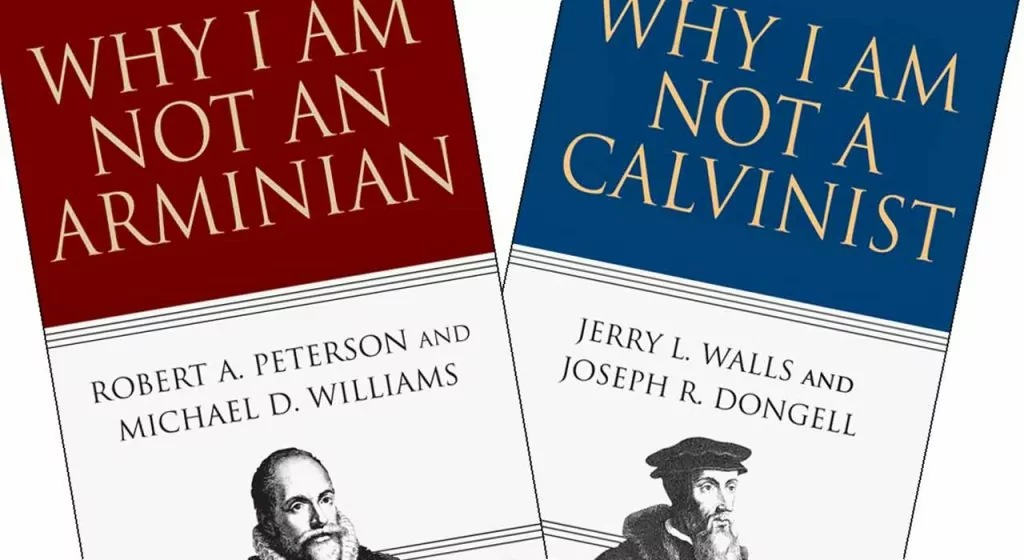
two book covers
Red heart icon with + sign.
Adult non-fiction, Theology

Calvinist vs. Arminian: a tale of two books

Why revisit the debate between Arminianism and Calvinism? Isn't it a waste of precious time to discuss these differences even as the world is aflame with political unrest? No, this is a debate that should always generate interest and discussion. Dr. J. I. Packer once observed that the very terms Calvinism and Arminianism represent opposition: “The words are defined in terms of the antithesis, and the point is pressed that no Christian can avoid being on one side or the other." Arminianism had considerable influence in Anglo-American theological developments and, on the surface, Calvinism might seem to have lost the battle in the theatre of American evangelicalism. Many evangelicals even believe that Calvinism is “irrelevant.” They say, “Christianity cannot possibly teach that.” With a commitment to egalitarianism and the rejection of the traditional doctrine of original sin, American culture is receptive to Arminianism. The Arminian emphasis on individualism and self-determination dominated much of 20th century American evangelicalism. Billy Graham, for instance, uses the language of Arminianism in his crusades when he asks attendees to "make a decision for Christ" – language that Calvinists find utterly foreign to their understanding of salvation. Revival of Calvinism So it seems clear that Calvinism does not fit the American ideal. Why would anyone be a Calvinist then? The reason is quite simple. The gospel of Jesus Christ is countercultural. Perhaps this is why Calvinism seems to appeal to young people, especially college students. There is also a renewed interest in Calvinism among the Southern Baptists, the largest Protestant denomination in the United States. What is at stake? But why should we know the differences between Calvinism and Arminianism? Because they represent stark opposing theological visions, at the heart of which are profoundly different views of God. Two books, published as a set of sorts, highlight just how profound the differences are: What I am not a Calvinist, by Jerry Walls and Joseph Dongell, and Why I am not an Arminian by Robert Peterson and Michael Williams. The authors of Why I am not a Calvinist believe: “...the heart of the matter is how we understand the character of God. The issue is not how powerful God is but what it means to say he is perfectly loving and good.....The breathtaking vision of God's Trinitarian love is obscured by the Calvinist claim that God passes over persons he could just as easily save and thereby consigns them to eternal misery." The following questions then, are at issue: How are we saved from our sins and granted eternal life? Are human beings so fallen that they must be saved exclusively through the unilateral and unconditional actions of God? Is it possible for human beings to successfully resist the saving approaches of God's grace? Can any who were once truly redeemed through faith in Christ fail to receive final salvation? The tone of the debate Considering the seriousness of the differences, it shouldn't come as a surprise that the history of the debate between Calvinism and Arminianism has been one of intense and often "mean-spirited" confrontation. However, Why I am not an Arminian's authors aims to treat their Arminian brothers and sisters in Christ as they would want to be treated. They also note that the Synod of Dordt was right to condemn the Arminian misrepresentation of the saving ways of God. "Yet we do not think of Arminianism as a heresy or Arminian Christians as unregenerate." They observe that Calvinists and Arminians are brothers in Christ. In other words: “The issue of the debate is not between belief and unbelief but rather which of two Christian perspectives better represents the biblical portrayal of the divine-human relationship in salvation and the contribution of both God and man in human history." And Why I am not a Calvinist authors rightly say, "We should all speak with a measure of care and reserve when delivering our interpretative conclusions." Why I am not a Calvinist So what type of argument do the authors Why I am not a Calvinist make? They first provide some background. Arminianism has its roots in the work of Jacob Arminius (1560-1609). It teaches that salvation is available to anybody who exercises faith; it contrasts with the Calvinist understanding that God alone determines who is and who is not among the elect. Arminian popular belief tends toward the overestimation of human ability and the human redemptive contribution. Traditional Arminianism believes that the death of Christ provides grace for all persons and that, as result of his atonement, God extends sufficient grace to all persons through the Holy Spirit to counteract the influence of sin and to enable a response to God. But, they argue, it is possible for sinners to resist God's initiative and to persist in sin and rebellion. Arminianism believes that God's grace enables and encourages a positive and saving response for everyone, but it does not determine a saving response for anyone. Furthermore, an initial positive response of faith doesn't guarantee one's final salvation: “It is possible to begin a genuine relationship with God but then later turn from him and persist in evil so that one is finally lost.” In 1610, the disciples of Jacobus Arminius produced a manifesto called the Remonstrance, which they regarded as a corrective to the Calvinist doctrine of election. The authors view the divine election of Israel and Christ as “that tree of redemption into which all persons can be incorporated by faith.” They state: “God doesn't unconditionally predestine particular persons to salvation. Rather, election is in Christ, and all are saved who do not knowingly and persistently refuse God's gracious offer of life.” Interestingly, Why I am not Calvinist's authors go beyond traditional Arminianism, and seem favorably inclined to Openness Theology, also called Open Theism. Advocates of Open Theism have argued that while God knows everything that can be known, He cannot have exhaustively definite knowledge of the future. Since the future will involve decisions made by genuinely free creatures, knowledge of the future is said to be impossible, by definition. Since God doesn't know future free choices, the future is not completely settled. Clark Pinnock, a noted Open Theism advocate says, “Some prophecies are conditional, leaving the future open, and presumably, God's knowledge of it.” And Richard Rice argues, "Where human decision is presupposed, God cannot achieve his purpose unilaterally. He requires our cooperation.” Open Theist theologians acknowledge “the triune God of love has, in almighty power, created all that is and is sovereign over all,” but in His freedom and desire to enter into a relationship of love with humanity has “decided to make some of his actions contingent upon our requests and actions.” They also believe that God is “dependent on the world in certain respects.” Consequently, they propose that the traditional view of God's infallible foreknowledge is a conviction that should be dispensed with. Open Theist theologians seem to highly esteem people while limiting God. For example, according to Pinnock human freedom can be won only by surrendering divine foreknowledge. I agree with those theologians who call Open Theism radicalized Arminianism. And if our future free actions cannot be known with certainty, even by God, how can we believe in the fulfillment of prophecy? Why would God "promise" anything if He cannot know the future or guarantee it by His almighty power? For the authors, the doctrine of election does not seem to hold any mystery. In fact, an appeal to mystery scandalizes them. They claim that some Calvinists “make a hasty retreat to mystery” when faced with charges of inconsistency. And they argue, “It isn't a sign of true piety for one to be willing to dispense with logical coherence in the name of mystery.” They critique John Piper's declaration that the potter has absolute rights over the clay, and if God chooses not to save some persons, it is not for us to understand but simply to adore. Interestingly, on the one hand the authors state that Calvinists have been zealous evangelists and missionaries and have contributed powerfully to the cause of winning the lost for Christ. On the other hand, they argue that Calvinists can't make coherent sense of their claim that God makes a bona fide offer of salvation to persons he has not elected for salvation, nor can they explain how God can truly have compassion for such persons. They claim, “the consequences for evangelistic preaching are profound indeed.” Why I am not an Arminian What are the counter arguments from the authors of Why I am not an Arminian? In their carefully reasoned, understandable exposition of Calvinism, they address the historical context, theological concerns, and biblical texts in a readable manner. In fact, they are Bible-centered in their presentation. They point out that the question of ecclesiastical authority and the integrity of the church as a confessional body was an intense bone of contention for both sides in the struggle between the Calvinists and the Arminians within the Dutch church. The Calvinists argued that a Reformed church is a confessional church. Hence they pleaded for the maintenance of particular confessional standards. Following in the tradition of Erasmus of Rotterdam, however, the Arminians championed the liberty of the individual conscience relative to doctrinal standards. The authors show that Calvin was not the first one to talk about reprobation or the absolute sovereignty of God. They point to the church father Augustine who emphasized the utter dependence of man upon God alone for salvation and the supremacy of grace to the exclusion of all human contribution. His teaching has proven a problem for many Christians throughout the centuries, and it still lies at the heart of the Arminian rejection of Calvinism, which was in many ways a 16th century revival of Augustine's teaching on sin and grace. The authors show that Calvinism stands for the doctrine that all humankind is sinful. Human beings will not and cannot make their way to God, retrieve their own lives or earn their own salvation. If humankind is to be saved, God must act. God must be gracious. Human beings are utterly dependent upon the saving grace of God. And apparently, God has not acted on behalf of all. He has not chosen to be gracious to all human beings. Sovereign in His grace, God showered His redemptive love upon a Jacob but not on an Esau. It is a mistake, therefore, to pit individual and corporate election against each other. In other words, egalitarian fairness – treating all persons the same – may be a cultural ideal for the modern West, but there is no biblical reason to suppose that God shares it. The authors write: "For his own reasons, God assumes the right to save one and not another – a Jacob, for example, and not his older, more talented brother; for Esau, left to himself and his sinfulness, is deserving divine wrath.” Why does God elect some and others are passed by? God does not elect Abraham and Jacob based on foreseen merit or even foreseen faith. The basis of their election is God's love and will. The authors also show that both individual and corporate election are taught in the Old Testament. God chose Abraham and Jacob, also the nation of Israel. As fallen human beings, Calvinists struggle with a sovereignty that stretches and often transcends our abilities to discern the redemptive ways of God. Scripture leads us to the contention that divine sovereignty – God always prevails – is compatible with human freedom. God is not rendered idle by a world ruled by human freedom. Furthermore, in the new heaven and earth: “the ultimate life of the redeemed will not include libertarian freedom, the ability to choose sin rather than obedience, apostasy rather than faithfulness.” The authors also show that Calvinism is much broader in scope than the TULIP doctrine. The five points of Calvinism do not sufficiently define Calvinism, and certainly do not say all there is to be said about the Reformed faith. They affirm the five points of Calvinism but also a Reformed understanding of the church and sacraments. They explain the particular Reformed contribution to Christian reflection on the covenant and the kingdom of God. They also stress the church as the people of God with a call to seek a cultural life in the world that is typified by justice, mercy, and a transformational vision for individual vocational life. Both Arminians and Calvinists agree that not all believe. One person hears the gospel as the word of life; another sees it as foolishness. But the authors of Why I am not a Calvinist critique Piper's rejection of "the wider hope," which holds that saving grace is available to all persons, not just those who have heard the gospel in this life. The Cannons of Dordt follow Augustine in their explanation. God has sovereignly chosen to save some but not all. And unlike Arminianism, Calvinism believes in the perseverance of the saints. The Canons of Dordt judged the Arminian agnosticism regarding perseverance as a hopeless position. If our salvation depends on us, whether it be our merits, our will or even our striving to keep in step with God's grace, we are most surely lost. The authors of Why I am not a Calvinist claim that an emphasis on God's sovereignty in salvation hinders evangelism, yet that emphasis encouraged the apostle Paul to continue preaching. In the line of Paul, Calvinists believe that the message of the cross is to be presented to all in order that they may believe and be pardoned. The good news of a provided forgiveness is to be as universally proclaimed as is the command to repent. God commands us to take the gospel to the ends of the earth and to every person in it. The Synod of Dordt did not see the doctrine of particular atonement as compromising preaching in the slightest. "God wants all to hear the gospel, but He intends to save only some. Why that is the case, we don't know." As evidence of the compatibility of belief in limited atonement, and a fire for spreading the gospel, Calvinists can refer to Jonathan Edwards, George Whitefield, Charles H. Spurgeon and Francis Schaeffer. They proclaimed a redemption that is definite and yet good news and offered an invitation addressed to all. Much more can be said about the differences between Calvinism and Arminians. I hope that this summary review will enhance our readers' love for our Calvinist heritage and the rich doctrines of sovereign grace. Rev. Johan Tangelder (1936-2009) wrote for Reformed Perspective for 13 years. Many more of his articles can be found on his blog Reformed Reflections....

Red heart icon with + sign.
Book Reviews, Children’s non-fiction

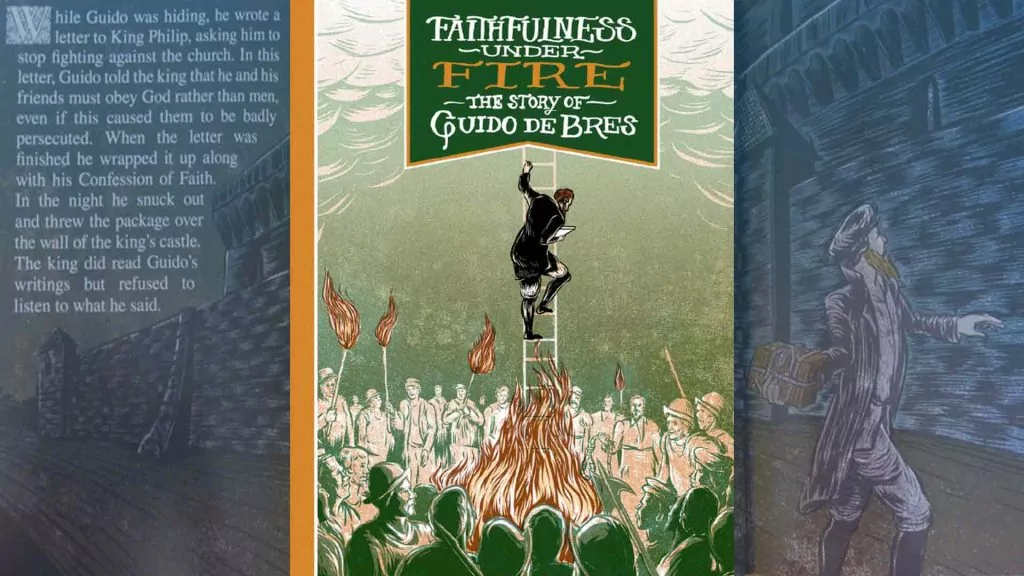
Faithfulness Under Fire: the story of Guido de Brès

by William Boekestein 2010 / 32 pages Rating: GOOD/Great/Give “Church history” and “picture book” are almost mutually exclusive terms, but William Boekestein, author (and URC pastor), and Evan Hugues, illustrator, show that they don’t need to be. Faithfulness under Fire is the story of Guido de Brès and how God used this man to craft the Belgic Confession. De Brès was born in 1522, and once he learned to walk, always seemed to be on the run. Persecution drove him to leave his hometown of Mons, Belgium, and head across the Channel to England. We learn that, for the brief period of Edward VI’s reign, Protestants could find refuge here, but the king’s death prompted Guido to return to Belgium, where he became a traveling preacher. Preaching was against the law, so he was always on the move, and didn’t even dare use his real name. About midway through the book, we see a great picture of de Brès throwing the Belgic Confession over a tall castle wall. This is where the Catholic King of Spain lived – de Brès hoped he would read the Confession and stop persecuting Protestants. That didn’t happen. But God decided to use de Brès’s efforts another way – the Confession has since spread around the world and been a gift to strengthen and instruct millions of Christians. As you may recall, Guido de Brès was eventually captured, imprisoned and hanged. A hanging might not seem a good way to end a children’s book, but as Boekestein makes clear this was not the end of the man, but only the means by which he entered “the comfort of his Lord” (and the hanging is never pictured). I’m not sure if this is a book children will read on their own, but the readable text and fantastic illustrations will certainly keep their attention if mom or dad reads it to them. ...

Red heart icon with + sign.
Adult non-fiction, Assorted

"The Devil’s Delusion" and the baseless confidence of the certain atheist

Some atheists, such as the late Christopher Hitchens, were very certain about their doubt. This sort of sure skeptic will argue that society should make a clean break from religion of every sort and instead embrace science and all its implications. But their assertions about science – that it proves God is not – don’t approach anything close to the truth. It was to counter such ridiculous claims that mathematician David Berlinski wrote The Devil's Delusion: Atheism and its Scientific Pretensions. Berlinski is as interesting as his book. He is not a creationist or even a Christian. This self-described “secular Jew” doesn’t oppose atheism and mindless evolution on any religious grounds. He just wants to pop the bubble of pretentious atheists, and as such the purpose of his book is not to determine whether God exists “but whether science has shown that He does not.” It has not, as Berlinski humorously, shows. BIG BANG THEORY Secular science has a very different origin story than the one we find in Genesis. According to the Big Bang theory view, billions of years ago something of incredible density suddenly started to expand, leading to the universe as we know it today. The Big Bang theory is relatively new – from the 1920s – and, from its start, it made atheists very uncomfortable. As Berlinski writes, If the Big Bang expresses a new idea in physics, it suggests an old idea in thought: In the beginning God created the heaven and the earth. Christians don’t have to agree with the Big Bang theory to be amused by the implications – even this secular theory suggests the universe had a starting point. And that prompts the unavoidable question: Who or what caused it to start? While atheists insist “Not God!” they have no scientific reasons to be so insistent. The Big Bang theory hardly requires an atheistic conclusion. APPEARANCE OF DESIGN Many aspects of the universe are precisely ordered to sustain life on earth, and Berlinski shares several, beginning with the “cosmological constant.” The cosmological constant is a number controlling the expansion of the universe….And here is the odd point: If the cosmological constant were larger than it is, the universe would have expanded too quickly, and if smaller, it would have collapsed too early, to permit the appearance of living systems. Very similar observations have been made with respect to the fine structure constant, the ratio of neutrons to protons, the ratio of the electromagnetic force to the gravitational force, even the speed of light. Why stop? The second law of thermodynamics affirms that, in a general way things are running down. The entropy of the universe is everywhere increasing. But if things are running down, what are they running down from? This is the question that physicist and mathematician Roger Penrose asked. And considering the rundown, he could only conclude that the runup was an initial state of the universe whose entropy was very, very low and so very finely tuned. Who ordered that? “Scientists,” the physicist Paul Davies has observed, “Are slowly waking up to an inconvenient truth – the universe looks suspiciously like a fix. The issues are the very laws of nature themselves. For 40 years, physicists and cosmologists have been quietly collecting examples of all too convenient “coincidences’ and special features in the underlying laws of the universe that seem to be necessary in order for life, hence conscious beings, to exist. Change any one of them and the consequences would be lethal.” Those arguments are very much of a piece with those that Fred Hoyle advanced after studying the resonances of carbon during nucleosynthesis. “The universe,” he grumbled afterwards, “looks like a put-up job.” Creationists often point to additional features, not specifically mentioned by Berlinski. Some examples include: The earth’s orbit is precisely in a zone where it is not too close to the sun (which would cause water to boil) and not too far from the sun (which would cause water to freeze). The earth’s rotation helps to regulate the planet’s temperature, preventing one side from becoming too hot, and the other side from becoming too cold. The tilt of the earth’s axis is perfectly aligned to result in regular seasons that are necessary for many forms of life to thrive (think of trees in the fall and spring, for example). The earth’s atmosphere is a thin layer of nitrogen and oxygen held in place by gravity and indispensable to maintaining life. The list goes on and on. Atheistic scientists have proposed speculative theories to explain this unlikely string of coincidences. Berlinski demonstrates that these theories are not at all convincing, which poses a big problem for the atheists, because if their theories …do not suffice to answer the question why we live in a universe that seems perfectly designed for human life, a great many men and women will conclude that it is perfectly designed for human life, and they will draw the appropriate consequences from this conjecture. In other words, the reason the universe appears designed to support life is because it has been designed. But by Who? One answer is obvious. It is the one theologians have always offered: The universe looks like a put-up job because it is a put-up job. That this answer is obvious is no reason to think it false. Nonetheless the answer that common sense might suggest is deficient in one respect: It is emotionally unacceptable because a universe that looks like a put-up job puts off a great many physicists. They have thus made every effort to find an alternative. Did you imagine that science was a disinterested pursuit of the truth? Well, you were wrong. DARWINIAN EVOLUTION Everyone is familiar with Charles Darwin’s theory of evolution. Over long periods of time, mutations occur in various organisms. Some mutations help the organisms to survive and even to thrive. As this process continues over millions of years, different species emerge. This is called “speciation.” One species evolves into another through a series of small and gradual developments. Unfortunately, for its proponents, the fossil record does not show this gradual advance. Body types appears in the fossil record fully developed. Evidence of transitions from one species to another has not been found. Yet such evidence is precisely what Darwin’s theory requires. Besides the absence of fossil evidence, Berlinski points out that there are no laboratory demonstrations of speciation either, millions of fruit flies coming and going while never once suggesting that they were destined to appear as anything other than fruit flies. This is the conclusion suggested as well by more than six thousand years of artificial selection, the practice of barnyard and backyard alike. In short, there is no genuine scientific evidence that any species has gradually developed into another species. ATHEIST WORLDVIEW So if science doesn’t back unguided evolution, why do atheists insist it does? This is where we really get to the crux of the matter. Berlinski writes, If Darwin’s theory of evolution has little to contribute to the content of the sciences, it has much to offer their ideology. It serves as the creation myth of our time, assigning properties to nature previously assigned to God. It thus demands an especially ardent form of advocacy. Like everyone else in the world, atheists have certain presuppositions about the nature of the world, life, and reality. They have a worldview. When they try to explain the existence of life and the universe, they interpret everything through the lens of their worldview. Because they begin with the presupposition that God does not exist, their worldview rules out certain conclusions right from the very start. Berlinski understands this and points out that behind the current wave of aggressive atheism “is a doctrinal system, a way of looking at the world, and so an ideology.” Atheists formulate arguments using science to make it appear that science supports their beliefs. But as Berlinski writes, Arguments follow from assumptions, and assumptions follow from beliefs, and very rarely – perhaps never – do beliefs reflect an agenda determined entirely by the facts. ATHEISM AND MORALITY Interestingly, Berlinski discusses the implications of atheism for morality. Many atheists like to assert that their beliefs pose no problem for ethics. Atheists can still make moral judgments. The problem is that if they do make moral judgments, those judgments cannot be based on their atheistic beliefs. Atheism provides no basis for ethics aside from subjective personal preferences. Berlinski writes, If moral imperatives are not commanded by God’s will, and if they are not in some sense absolute, then what ought to be is a matter simply of what men and women decide should be. There is no other source of judgment. Morality is either determined by God or by man. If God does not exist, there are no external ethical restraints on man’s behavior. CONCLUSION So does science prove “God is not”? No, and atheists who claim otherwise are only showing their willingness to look past the evidence. They’ve started with atheistic assumptions and arrived at atheistic conclusions that are dictated by their worldview. Berlinksi is not a Christian and he accepts many aspects of the secular worldview, including a long age for the universe, and, seemingly, aspects of evolution. But even in accepting these secular tenets he can’t look past the overwhelming evidence for design, and thus some sort of Designer, apparent in the world around us. Michael Wagner’s book, "Leaving God Behind" about Canada’s Christian roots can be purchased here....

Red heart icon with + sign.
Adult biographies, Adult non-fiction

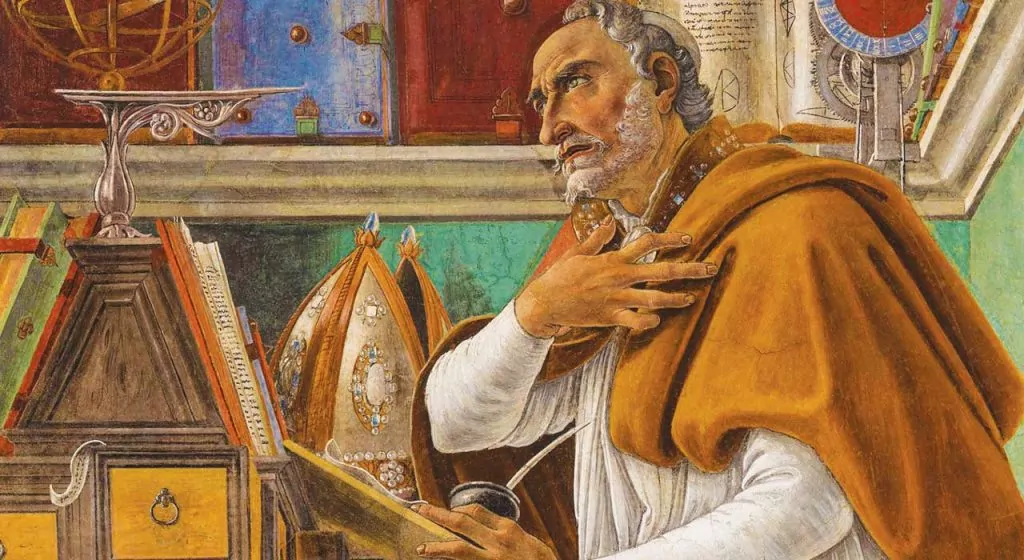
Shocked by Augustine's Confessions

There are many classics I mean to read in my life, but I just haven’t yet. Fortunately this summer, while laid up with an injury, I found myself facing Augustine’s Confessions without an excuse. So I dove into it. And I was quite shocked – not by any of his confessions, but how readable it is. You always imagine classics to be quite unreadable, which doesn’t really make any sense, because how could anything become a classic unless people read it? But whatever the case, this classic is engaging. FREE TO QUESTION The best thing about the first few chapters is all of Augustine’s questions. Instead of doing what most books do, which is pose a question (such as ‘Why does a good God allow evil?’) and then immediately answer it, Augustine just begins with posing questions. Many chapters start with a block of questions directed towards God, and Augustine doesn’t even pretend he has answers to most of them. If he has part of an answer, or a thought about the answer, he’ll say it, but it’s not from a position of authority. His bits of answers are not presented as definitive. He just lets his mind go wild with wonder over God. I’d give a few examples, but to baldly state the questions in my own words destroys his beautiful wording of them. I’ll just say one or two – for example, haven’t you ever wondered whether you have to know God first before you cry out to him, or if you can cry out to him in order to know him? And haven’t you ever wondered how a God who’s outside time, and created time, experiences time? AN ATTRACTIVE HUMILITY The unexpected thing about this is Augustine is such a revered figure in the church. He’s more or less the ancestor of many of the churches that exist. So much of Christian theology has roots that go back to his writings. So I expected him to present himself as an expert. It was refreshing because I haven’t read a book that admitted it didn’t have the answers for a long time. Most often people write books because they do think they have the answers. Or they write because they think people need the answers, so they cobble together some kind of explanation. They know their book won’t attract our precious divided attention if they don’t make bold claims. But Augustine shocked me because he’s not presenting himself as the pattern the Church after him should follow…even though the Church does. (At least, he doesn’t present that way in the first part of Confessions.) If anyone has a right to make bold claims, it would be Augustine, of all writers. Some translations of Augustine’s "Confessions" can be easily found online and downloaded for free. But the free versions often have older language, with "Thees" and "Thous." A more current, very readable (but not free) version is Benigus O’Rourke’s translation pictured here. – JD This is not to say Augustine is completely uninterested in answers. No, in fact much of his search for God is driven by his dissatisfaction with the answers given by his pagan worldview. And finding a few answers was central in his conversion – he explores answers more and more the further you delve into his book. However, the questions never stop. In the end, he is willing to have faith without answering every question that could be asked about God. QUESTIONS ASKED IN FAITH The second really cool thing about Confessions is that, unlike if I was the one asking the questions, Augustine is able to ask them without a trace of cynicism. He doesn’t resent God for not providing answers to all of them. Somehow Augustine is able to put down all his wonderment with the deepest humility, and in a fever of steadfast love. He’s asking because he loves God. He wonders because a person is obviously interested in the ones they love. I can only hope I present a similar attitude one day. If someone had wanted me to read Confessions before now, they should not have described it as Augustine’s autobiography, or however else people describe the book. They should have said, “Here’s a guy who lived a couple thousand years ago, who has a mind that works just like yours.” It’s crazy to reach across the centuries and find a thought pattern that feels familiar. And as for the unanswered questions? This is what Augustine says about them: “Let ask what it means, and be glad to ask: but they may content themselves with the question alone. For it is better for them to find you, God, and leave the question unanswered than to find the answer without finding you.”...

Red heart icon with + sign.
Adult non-fiction

How does a Christian live in the midst of suffering?

A book summary of Kelly Kapic's Embodied Hope **** Pain and suffering require good theology because often, during intense pain of any kind, the whole question of how God’s sovereignty and goodness relate becomes intensely personal. Often Psalm 92:15 – The Lord is upright; he is my Rock, and there is no wickedness in him – becomes a very difficult confession. Is God really good? Sometimes it’s an arrogant question, but when there’s suffering it is often something entirely different. In Embodied Hope: A Theological Meditation on Pain and Suffering, Reformed theologian Kelly Kapic considers physical pain and discusses “how a Christian might live in the midst of suffering.” That is, ultimately, what those in pain need, far more than abstract theories of the problem of suffering. THE NEED TO KNOW GOD AND KNOW THE SUFFERER Kapic, a professor with a wife who suffers severe chronic pain, insists that to help others with pain we need both pastoral sensitivity and theological insight. Without careful study of who God is – without theology – we often head into psychology and moralism. Conversely, without loving and knowing the sufferer, we may end up with harsh principles. Kapic’s deep understanding of the gospel, and of pain, and of the writings of godly men like Augustine, Athanasius, Luther, Calvin, and Bonhoeffer, enable him to explores how hope and lament are intertwined. He discusses how we can deal with the fact that God’s good creation has been compromised, how we experience that as we suffer, how to lament that biblically, and how God’s faithfulness ultimately shapes biblical lament. Vigorously rejecting the ancient and still common idea that the body and its pain are not important, Kapic points out that God created our bodies as well as our souls. Our bodies are essential to our identity as individuals, they are essential to our relationships, and essential to our worship. And all of that is tied to Jesus Christ, who is hope embodied, hope made physical. Jesus is the answer to the sufferer’s questions and he is God’s solution to the brokenness of the universe. Because of him our sufferings are not the final word, nor are pain, aging, forgotten memories, or death. 2017 / 192 pages GOD GIVES US EACH OTHER However, it is not only our individual relationship to Jesus Christ that counts; our relationships in the body of Christ are also vital. In fact, suffering shows how essential the body of Christ is to each member. Kapic states that we are in essence “members of a larger body, and thus also inherently unstable when isolated.” If this is true in general, it is even more important when someone is suffering. Being is pain is not a safe place to be alone. Lonely pain opens up temptations to despair, to dwelling on already-forgiven sins, and to questioning God’s care. A Christian who suffers chronic pain alone is vulnerable to Satan’s attacks, but a Christian who suffers in the body of Christ is, ideally, carried and encouraged by the faith, hope, and love of other believers. For example, when Luther was ill, he begged prayers from his friends that he would be saved “from blasphemy, doubt and distrust of his loving God.” Even so, sufferers must not ultimately look to other believers but to God’s revelation in Christ, since all faith, hope, and love “must ultimately point to and come from the triune God, and not merely from the communion of saints.” BEING THERE Of course, believers need to learn how to come along side those in pain. We often just want to help and, while this can be very important, our goal should not be to “fix” the other person. Rather we must learn to accept that pain is real and that the suffering person often just needs someone to be there. It can be very hard to watch someone suffer, and many people feel helpless and want to run away. Instead, we need to learn to share God’s love, perhaps with a glass of cold water, or a card, or a smile, or perhaps with endless hours of simply being there, suffering faithfully together, listening, honestly accepting the pain, and pointing to Christ, together. Just as the suffering person needs other believers, so other believers need sufferers. In loving and being loved by sufferers, those who are well are reminded that they, too, are poor and in need of God's grace. Otherwise it can become easy to imagine that they are self-sufficient and deserve their wellness because of how faithful they have been. Furthermore, those who suffer are uniquely able to witness that, though troubles are real, “God is unflinchingly faithful.” And, as Kapic points out, sufferers, too, have a responsibility. They can encourage and serve those who are well by loving them and being grateful and compassionate. They “need to beware of abusing others.” “Those dealing with a great deal of pain often have to work hard to avoid self-absorption and cultivate neighbor love. It takes intentionality. It takes a missional focus. But it can be life-giving.” CONCLUSION In Embodied Hope Kapic, as the husband of a wife with chronic pain, shares many practical insights. Yet he always comes around to this: “Beloved, amid the trials and tribulations of life, let us have confidence not in ourselves, not in our own efforts, but in God. This God has come in Christ, and he has overcome sin, death, and the devil. While we may currently be walking through the shadow of death, may our God’s love, grace, and compassion become ever more real to us. And may we, as the church, participate in the ongoing divine motions and movements of grace as God meets people in their need." This book has helped me come to terms with the fact that chronic suffering exists and has given me insight for supporting my daughter. I think it will be a blessing to every Christian who suffers physical pain or who loves someone who does, and I strongly recommend it. Embodied Hope would be a great addition to a church library, as well. Annie Kate Aarnoutse reviews books at Tea Time With Annie Kate where this first appeared....

Red heart icon with + sign.
Adult non-fiction, Pro-life - Euthanasia

"A Guide to Discussing Assisted Suicide": a summary review

Do you find it harder to make the case against euthanasia than against abortion? That might be, in part, because we have less experience – abortion has been legal in Canada since 1969, and euthanasia only since 2016. Also, in abortion, we have victims who need advocates because they can’t speak for themselves, whereas in euthanasia the victims are also the perpetrators. How do you help someone who doesn’t want to be helped – who wants to die? And consider how, in euthanasia, many of the cases involve terminal illnesses, and so have the same emotional tension as the hardest cases – those involving rape and incest – have in the abortion debate. That’s why it’s more difficult. JUST TWO OPTIONS But, just as in the abortion debate, the key is to first find the central issue. With abortion, the main question is, "Who is the unborn?" There are only two options. If the unborn is not human, there is no justification needed for “its” surgical removal. But if the unborn is human, then no justification is sufficient for killing him or her. As in Blaise Alleyne and Jonathan Van Maren’s explain in their new book, A Guide to Discussing Assisted Suicide Similarly, the crux of opposition to euthanasia can also be boiled down to just one question: How do we help those who are feeling desperate enough to want to kill themselves? And again, there are only two options: either we prevent suicide, or we assist it. Alleyne and Van Maren have given us a wonderful tool in this book. Their extensive experience in the pro-life movement is evident as they start by framing the debate. If we’re going to be effective, pro-lifers need to understand the three possible positions that people hold on this issue. They are: the split position – we should prevent some suicides while helping others the total choice position – anyone who wants to commit suicide should be helped to do so and the pro-life position – all life is precious, and all suicides are tragic THE SPLIT POSITION So how do we respond to the split position? Van Maren and Alleyne say that it is the job of pro-life apologetics is to show the split position’s inherent inconsistency. Suicide is tragic sometimes, but to be celebrated other times? The authors then give ways to counter the reasons often used to justify some suicides, given by the acronym QUIT for: Quality of life Unbearable suffering Incurable condition Terminal prognosis They spend 20 pages showing why these are fallacious reasons, so I can’t properly sum up their argument in just a line or two, but one underlying flaw to these justifications for suicide is that they are based on ageism and ableism. So in much the same way we can expose the inadequacy of many justification for abortion by bringing out an imaginary "two-year-old Timmy" (“What if the mother was too poor to have a baby?” “Would that be a good reason to kill Timmy?”) in the assisted suicide debate we can bring out an imaginary able-bodied 19-year-old. If someone opposes this 19-year-old committing suicide, why is it that they are fine with that 90-year-old doing so? Or that wheelchair bound lass? We can expose them for being ageist and ableist – treating people as less worthy of life based on their age or ability – and show them it is wrong to assist the suicide of anyone, of any age or level of health because as the authors put it, "suicide is a symptom , not a solution." TOTAL CHOICE Next, the authors take on those are (sadly) willing to be consistent and advocate total choice for all who desire to be assisted in ending their lives. Our only response is to insist that the suicidal need love even more than they need argument. THE SOCIAL CONSEQUENCES The fourth chapter shows how dangerous it is to accept either the split or the total choice position, because they have always involved a slippery slope toward more and more assisted killings they reduce the willingness to prevent suicide they undermine the morale of everyone who works in any facility that provides suicide assistance THE PRO-LIFE POSITION Finally, the authors show the pro-life position. We know, on the one hand, that life is a gift from God, so it is not to be thrown away, but on the other, that all life ends, and because of Jesus we need not fear death. So the pro-life position is not about continuing life at all costs. It allows for: the refusal of burdensome treatment the use of pain medication, even when that risks hastening death, as long as the intent of such medication is to alleviate pain rather than to kill The pro-life position also offers positive responses to the suicidal: psychological health resources, pain management, palliative care, and dignity therapy. The authors end with two pleas: "Let death be what takes us, not lack of imagination." In other words, may no-one ever have their death hastened because we refuse to imagine how we may show more compassion. "As people who believe in the dignity and value of every human life, it is our responsibility to.... persuade people that assisted suicide is wrong." In their Guide to Discussing Assisted Suicide Alleyne and Van Maren have done an admirable job of giving us the tools to carry out that responsibility. Given the urgency of the push toward euthanasia in both Canada and U.S., we need to read this book. “A Guide for Discussing Assisted Suicide” can be ordered at lifecyclebooks.com (where you can also find the option to buy in bulk for your pro-life group or circle of friends at greatly reduced prices). This article was originally published under the title "Speaking against suicide: a summary review of 'A Guide to Discussing Assisted Suicide'."...

Red heart icon with + sign.
Adult non-fiction

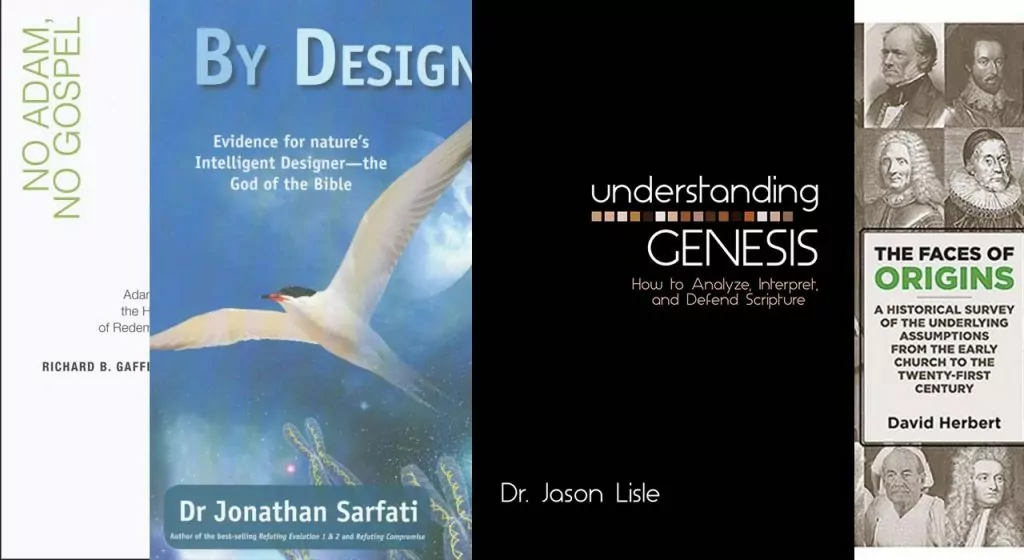
4 books on the irreconcilable divide between Creation and Evolution

Four encouraging books to equip the Church in the current Evolution vs. Creation debates, listed by size, smallest to biggest. No Adam, No Gospel: Adam and the History of Redemption by Richard B. Gaffin Jr. 29 pages / 2015 More and more professing Christians are accepting scientific theory that suggests that man-like mammals (hominids) preceded the coming of Adam by millions of years. Biologos, a well-funded organization, is also pushing evolution using scholars who have a conservative reputation to convince people to accept evolution. But what does affirming evolutionary origins of the human race do to the gospel? Can you affirm that Adam was not historically the first human on earth without jeopardizing the Good News? Professor Gaffin clearly shows that “the truth of the gospel stands or falls with the historicity of Adam as the first human being from whom all other human beings descend.” After clearly explaining Romans 5:12-19 and 1 Corinthians 15:21-22, 45-49, Gaffin responds to The Evolution of Adam, a book written by a popular Old Testament scholar, Peter Enns. Gaffin shows how the views of Enns lead to a complete abandonment of the Reformed faith in its biblical understanding of sin, salvation, and death. Indeed, no Adam, no gospel! The results of accepting evolution theory are disastrous for the Christian faith. Although a small publication, this booklet is timely and packed with excellent biblical insights. I highly recommend it. The Faces of Origins by David Herbert 180 pages / 2012 It’s often said that new scientific knowledge has made it impossible to continue to accept the truth of the Genesis creation account, that this new knowledge meant scientists had no choice but to accept evolution. Herbert challenges this narrative. He says it wasn’t the new knowledge, but a new worldview that led to the rejection of the Genesis creation account. Western civilization left a worldview based on biblical revelation, where God was actively involved in history, and instead embraced a naturalistic worldview based only on reason. Naturalism believes that natural processes alone are sufficient to account for life and creation. Herbert shows that for eighteen centuries a biblical understanding of origins had the upper hand. Real change came during the seventeenth century. Indeed, BenoÎt de Maillet (1656-1738) was the first modern uniformitarian and evolutionist. Once scientific findings were interpreted without God, through the lens of naturalism, evolution became the most popular explanation of our origins. This in spite of the fact that the empirical evidence points to design and not evolution. The price of excluding God and denying Genesis is high. It has led to a resurgence of atheism. This book is a great and easy read. By Design: Evidence for nature's Intelligent Designer – the God of the Bible by Jonathan Sarfati 260 pages / 2008 The Bible tells us that God’s “invisible attributes, namely, his eternal power and divine nature, have been clearly perceived, ever since the creation of the world, in the things that have been made, so they are without excuse” (Rom 1:20). One implication of these words is that scientists who study creation must be able to see something of God’s awesome power and wisdom. Yet, most mainstream scientists steadfastly refuse to give glory to God and instead seek to honour the god of their making, the theory of evolution, to account for the wonders of creation. This delightful book illustrates magnificently how God’s glory can indeed be seen in his handiwork. God’s design is evident everywhere and it all argues against evolution. For example, God has put an incredible amount of information in creation to enable everything to work properly. “There is enough information capacity in a single human cell to store the Encyclopaedia Britannica, all 30 volumes of it, three or four times over.” This book is chock-full of all sorts of examples of God’s wonderful design, including the incredible designs allowing sight, smell, flight, orientation, and stickiness. Critics are answered and God’s wisdom is celebrated. Understanding Genesis: How to Analyze, Interpret, and Defend Scripture by Jason Lisle 496 pages / 2015 Building on his The Ultimate Proof of Creation (2009), Jason Lisle, who has a doctorate in astrophysics, goes into considerable detail in outlining the rules and principles for correctly interpreting God’s Word. He wants to logically refute faulty interpretations of Genesis and equip Christians to defend God’s Word against compromised positions, especially with respect to Genesis. These concerns take up the first half of the book. The second part of the book goes into considerable detail in applying sound principles of interpretation to the matter of geocentricity, the age of the earth, theistic evolution, and the extent of the Genesis flood. Two appendices on a defense of the Trinity and formal fallacies round off the book. Lisle’s approach is sound and he does an excellent job in fleshing out how to interpret Scripture. He resists the temptation which earlier creationists like Henry Morris fell into by claiming that the Bible is a scientific textbook and so this book appears to be a significant improvement in the manner in which the Bible Is used. Lisle rightly prioritizes Scripture over scientific theories and through careful exegesis wants to let the Word of God speak. This is a very helpful book. Dr. Van Dam is the Emeritus Professor of Old Testament at the Canadian Reformed Theological Seminary and the author of several books including "The Deacon: The biblical roots and the ministry of mercy today," and "The Elder: Today's ministry rooted in all of Scripture."...

Red heart icon with + sign.
Adult non-fiction, Book Reviews

God and government

Biblical Principles for Today: An introduction and Resource by Cornelis Van Dam 330 pages / 2014 Rating: GOOD/Great/Gift Any Christian who wants to be involved in politics, or any politician who wants to understand Christians who are involved in politics, needs to read this book. Dr. Van Dam explores the two great foundations of Canadian politics – Christianity and humanism – and the nature of the conflict between them. Then, after outlining the conflict, Dr. Van Dam makes clear how Christian principles can function in a world dominated by humanistic ideals. Christians and humanists have very different views of the origin and task of government, the relationship of church and state, and the concepts of human rights and toleration – but, as Van Dam shows from both Biblical and historical evidence, the Christian understandings of these concepts leads to both greater stability and freedom for society. That same general form of looking at the fruit of the two worldviews leads to enlightening discussions of the differences an approach guided by the Bible could make in areas like the abortion and euthanasia debates, the issue of capital punishment, the need for traditional marriage, the balance of productive work and necessary weekly rest, the stewardship of creation, and immigration policy. By this point in my reading, my renewed commitment to see Biblical values reaffirmed in our politics had me primed for the last section – "Working for Change" – which first describes the Biblical reasons for getting involved in the government of the country, and ends with a look at the many excellent organizations that are doing just that. The study questions and bibliography at the end make this an excellent resource for starting some political activism of your own, with both insightful Biblical application and plenty of written and online works, as well as the groups mentioned above, to help you (and me) and like-minded Christians to get going (or to keep going, only with a little better grounding in basic principles). Of course, this conflict isn’t limited to Canada – humanism and Christianity are also battling it out in the US, in Australia and most other Western nations – so this would be a great book for Reformed Christians in all those counties. To get a print copy of God and Government, Australians, Canadians, and Americans can email [email protected] for information – they have a suggested donation of $10. Americans also have the option of a Kindle version for just $10 at Amazon.com. This review was first published on ReallyGoodReads.com. You can read two excerpts from the book: the first is on what principled pluralism is, and the second is on the Bible and pluralism....

Red heart icon with + sign.
Adult non-fiction

BOOK REVIEW: Paul Tripp's "Parenting: The 14 Gospel Principles That Can Radically Change Your Family"

What’s the best passage in the Bible about parenting? Maybe some will say Ephesians 6:1-4. Others will point to Deuteronomy 6:4-9. Paul Tripp has his own suggestion about a helpful parenting passage. But he also wants us to realize that the Bible isn’t meant as a topical resource to consult when we have specific questions or difficulties. We probably sometimes wish that that’s how the Bible was organized: if you’re angry, turn to this text; if you’re lonely, read this one. And if you want good advice about raising your strong-willed kids, read this. The Bible isn’t written as a topical study, addressing the daily issues which concern us. From beginning to end it’s a story, where God is telling us about His great work of salvation through his Son. And so nearly every text in the Bible reveals something about God, or about ourselves, or about sin, or grace through Christ, or life in this world, or our calling. This broad scope means that almost every passage in the Bible has something to say that relates to the many diverse areas of your life, including your job as a parent. This is the kind of “big picture” perspective that Tripp teaches in his book Parenting. He doesn’t provide ten practical steps for raising nicer kids. He doesn’t share how-to strategies for the challenges of boundaries and discipline. Instead, he wants to reorient the very way that we look at parenting. What are we really trying to do in our homes? What are our chief goals? And what’s the one foundational thing that parents and children need, so much more than good manners, civilized dinner times, and open communication? THE WAY OF GRACE The subtitle of Tripp’s book says a lot about his approach: “The 14 Gospel Principles That Can Radically Change Your Family.” He argues that the better way of parenting – the only way – is the “way of grace,” or the way of the gospel of Christ. That sounds vague, but then follow fourteen chapters exploring principles of how God’s grace is worked out in the parenting task. For example, Principle 1 is, “Nothing is more important in your life than being one of God’s tools to form a human soul.” Or Principle 5, “If you are not resting as a parent in your identity in Christ, you will look for identity in your children.” And Principle 11, “You are parenting a worshiper, so it’s important to remember that what rules your child’s heart will control his behavior.” These powerful principles give a flavor of the kind of book that Tripp has written. For each of these norms he shows that the core of parenting resides in the human heart: not just the hearts of our children, but our own hearts as dads and mums. Both their and our hearts need to be changed by the salvation that is granted through the work of Jesus Christ. TWO DANGEROUS AND DESTRUCTIVE LIES Our children need transformation because they all believe two dangerous and destructive lies. First, a child reckons that he’s autonomous, a completely independent human being with the right to live his life however he chooses, and to worship whomever he wants. Second, a child believes that he is self-sufficient, that within himself he has everything that he needs. If you pay a bit of attention, you can see these lies getting worked out in the conduct of our children, right from those aggravating moments of trying to spoon mushy peas into their mouth, to the frustrations of getting the silent treatment from your teenage daughter. Born in sin, our children desperately need help. God has placed them in our life so that we can help them, with wisdom, compassion and hope. MAKING PARENTS SQUIRM As a parent, reading parts of this book made me uncomfortable. This is because Tripp seems to know parents and our weaknesses so well. He knows that we often focus on changing our children’s outward behaviors (use of technology, clean language, respect for curfew, etc.), without targeting the heart behind the actions. He knows that we tend to “lay down the law” when there’s been a household infraction, instead of showing grace. He knows that in the heat of the moment we can get sinfully angry and say cruel things to our children, and then spend the rest of the evening telling ourselves that what we did was totally fair and completely justified. Uncomfortable, because it’s true. Still, Tripp wants to encourage. He says that parents who finally admit that they’re inadequate and run to God for help actually make the best parents. When your weakness is again so painfully evident, “Know that God hasn’t left you to the limits of your righteousness, wisdom, and strength," but that He is with you, and He is almighty and gracious. Tripp insists that successful parenting isn’t about us achieving our own goals or upholding our own values (e.g., producing punctual, responsible, hard-working children), but it’s about us being usable and faithful tools in the hands of God. After all, God is the only one who can produce good things in our children, and He’s the only one who can bring them to faith in Christ. As parents, we are unfinished people ourselves, being used by God as agents of change in the lives of unfinished people. CONCLUSION Tripp doesn’t pretend that it’s going to be easy. I love his line on page 208, “Parenting is about the willingness to live a life of long-term, intentional repetition.” Our task as parents means that we’ll need to do the same thing, over and over. We’ll need to say the same things, over and over. That’s fine, for God is pleased to use our humble prayers and efforts and energies for the good—and even for the salvation—of the children He’s entrusted to us. This is an excellent book. It’s a book to savor: read a chapter, and then let it simmer. Talk about it with your partner in parenting, or talk about it with other parents (whether more or less experienced). You’ll be challenged and encouraged. This article first appeared in the Oct 7, 2017 issue of Una Sancta, a magazine of the Free Reformed Churches of Australia, and is reprinted here with permission. Rev. Reuben Bredenhof is pastor of the Mt. Nasura Free Reformed Church in Western Australia. Below you can find a talk on parenting Paul Tripp gave earlier this year. "Parenting is Gospel Ministry" from The Gospel Coalition on Vimeo....

Red heart icon with + sign.
Adult non-fiction, Book Reviews

Spanking resources to read, listen, or watch

God gave us children and gave us his Word to show us how best to raise them up to know and love Him. In addition, He gave us godly teachers to help us grow in knowledge and wisdom so we can better be able to take up this privileged and awesome responsibility. You can find three different teachers below, all espousing variations on the same theme. All are excellent, so whether you learn best via listening, watching, or reading, there is something here for you. Biblical Childrearing by Douglas Wilson Approx. 3 hours Format: Audio In this series of four sermons Pastor Douglas Wilson goes over the biblical principles, and explains the practical outworking of them. Of the three selections here I’d say this is the most clearly biblically grounded – Wilson spends more time than the others connecting what he is saying to what God has said. This is available as a $6 US audio download at CanonPress.com. Getting to the Heart of Parenting by Paul Tripp Approx. 4.5 hours Format: Video Paul Tripp is a favorite in our church circles and for good reason. In this video series, Tripp emphasizes how very important it is to keep our focus on nurturing our children’s hearts rather than on the externals of their behavior. It is available on DVD or as a $35 US video download at PaulTripp.com. Don’t Make Me Count to Three by Ginger Hubbard 150 pages Format: Paperback This might be the most practically-focused of the three, with Ginger Hubbard offering plenty of illustrative conversations to show how we might best talk to and teach our children discipline. The one caution I will add is that Hubbard doesn’t have a covenantal understanding of childrearing – she views our children as being pagans in need of conversion rather than as prince and princesses who have received promises. However, this is only a minor matter in the book, popping up in only a few places. And since Hubbard grounds what she says about discipline in what the Bible says, her advice is good and godly. Her book is available as a $9 ebook at Shepherdpress.com and also at most any online bookstore....

Red heart icon with + sign.
Adult non-fiction

Four reasons to pray: a summary review of William Philip’s "Why We Pray"

Does prayer intimidate you rather than refresh you? Do you wonder whether your heart is really in it? If so, then you’ll be interested in William Philip’s Why We Pray, a brief, easy-to-read and often humorous response to these and other questions that many of us have about prayer. Philip is a Scottish minister who used to be a cardiologist, and in this book he continues to deal with "matters of the heart." Rather than lecturing us on how important it is to pray more, he explains how prayer is a response to who God is. Philip uses examples from politics, sports, and his own life to clarify the four Biblical reasons why we may and must pray. 1. God speaks and we get to respond We may pray, first, because God is a speaking God. He spoke creation into being and shaped it by his word, so creation "speaks" back visibly by displaying His power (see Psalm 19:1-6). God wanted more from human beings, though, because He made us capable of responding audibly. When we cut off the conversation through the sin of Adam and Eve (including hiding from God), He restored the relationship through Jesus Christ. Real prayer is responding in faith to God's call in Jesus Christ. 2. God is happy to hear his children The second reason we pray is because we are "sons of God" (even the "daughters"!). Philip says that the reason we are called sons of God is because we, like sons in the ancient world, have an inheritance. We can pray to our (adoptive) Father in heaven because of the work of God's (natural!) Son, Jesus Christ. Because Jesus Christ was (and is) such a faithful Son, God gladly accepts us as His children - so we have the right to appear before Him. Like any loving father (only much more so!), God wants to hear His children speak to (and with) Him. 3. God is able to do what we ask It is because, in the third place, God is sovereign that our prayer is so meaningful - though some do not necessarily see it. If God is so great, and is working out His infinite plan, some ask, then why pray at all? Philip compares our part in God's plan to being on an unbeatable sports team. Would any of us quit simply because we are so sure that the team is going to win? In His infinite power, God is not only a willing father, but also able to grant whatever we ask that is within His will. 4. The Holy Spirit teaches us to pray rightly Finally, God is the Spirit who dwells within us, and this makes sense of the requirement that we ask only what is within His will. The presence of the indwelling Spirit makes prayer into the conversation that God intended to have with us before the fall into sin. This gives us both hope and a significant responsibility. God wants us to pray for whatever we think we need, but He also speaks to us by His Word and Spirit, so that as we pray, our Biblically informed consciences enable us in time to see what His will is, and in the meantime to ask that He grant us only what is according to His will. In other words, as Philip tells us, prayer is to "think God's thoughts after Him." Conclusion Each chapter ends with questions that invite us to ponder just how our own relationship with God is reflected in prayer. If you want a helpful clear explanation of we may, and why we should want to, pray to our speaking, Fatherly, sovereign, indwelling God, then I encourage you to pick up a copy of William Philip’s Why We Pray. A version of this review first appeared on Really Good Reads...

Red heart icon with + sign.
Adult non-fiction

What Grieving People Wish You Knew about what really helps (and what really hurts)

We have all struggled with what to say to someone who has lost a loved one. Whether it be at the funeral, waiting to give our condolences, or an encounter with the bereaved at the store or at church, it can be challenging to offer words of comfort that don’t sound cliché or inadequate to our ears. What can we say that will help this person in their grief and sorrow? Sometimes we are at a loss of how we can best help a friend in their season of grief. Too often, we don’t think much past the first few months after a death. But grief is a long and difficult journey, and our brothers and sisters in Christ need us to be there for them in this painful time. With What Grieving People Wish You Knew, Nancy Guthrie has written a practical guide for those who want to help their friends and family members who are grieving. From someone who knows Nancy Guthrie / 188 pages / 2016 Guthrie writes on the perspective of someone who has suffered profound loss, as two of her three children died in infancy. She has experienced firsthand the comfort that thoughtful words and caring deeds can bring, but also the well-meant comments that can unintentionally hurt. To write this book she questioned many grieving people via an online survey, asking them to provide concrete examples of what others had said or done that helped them in the midst of grief, and throughout the book she shares many of these testimonies. Guthrie gives straightforward advice on what to say, what not to say, what to do, and what not to do. As you read the chapter “Typical Things People Say” (that miss the mark), you will probably cringe in the realization that you yourself have said some of these things, unaware how insensitive these words may sound to a person raw with grief. “I know just how you feel” is one example. This statement, though well-meaning by trying to establish camaraderie through a similar experience, in essence minimizes the other’s loss by suggesting that their grief isn’t unusual, or unique. “You’ll be fine” is another comment that sounds encouraging enough at face value, but, Guthrie notes, “what the grieving person hears you saying is that the person who died didn’t really matter enough for his or her absence to matter.” Ouch. Or have you ever said “Just call me if you need something”? A grieving person is not going to call. They likely don’t even have the headspace to know what they need. A more helpful thing to do is figure out what can be done for them and then do it. Tell them that you’re going to mow their lawn, pick up their groceries, or help them with their taxes. This is putting into action your love and concern for them in their grief. Even the simple question of “How are you?” can be a tough question for the bereaved to answer. It makes them feel put on the spot to give what is hopefully an acceptable report of how they are really doing. “The grieving person knows what the questioner most likely wants to hear – that everything is getting better, the world is getting brighter, the darkness is lifting, and the tears are subsiding. But oftentimes that just isn’t the way it is, and it can be awkward to be honest about the confusion, listlessness, and loneliness of grief.” Ways to comfort What can we say instead? Guthrie’s survey revealed that there are two particular things that grieving people really want to hear from others, and they are closely connected. First, they love to hear stories, anecdotes, or things that their loved one said or did that were meaningful, and the more specific the better. Second, they want to hear the name of the person who died. “Oh, to hear that person’s name. It is like salve to an aching soul, music to a heart that has lost its song.” So, talk with them about their loved one who has passed on! Tell them about the special thing he did for you, the way she was always so encouraging, or the joke he told that you still laugh about. Don’t be uncomfortable about speaking the deceased’s name, for hearing it spoken will bring comfort to those who mourn. Just show up! Perhaps the most insightful chapter is the one entitled “Assumptions we make that keep us away.” Often people unconsciously distance themselves from the grieving for one reason or another – possibly we’re unsure of what to do or say, or feel we don’t know them well enough, or maybe we assume that the grieving just want to be left alone. But, as Guthrie writes, “If I had to boil down the message of this entire book to just two words, these two would probably cover it: show up.” She encourages us to put aside any awkwardness we might feel and simply show up, and here again she offers many tangible ways of doing so. Also really helpful is a section about heaven, briefly summarizing what the Bible teaches about it as well as tackling some common misconceptions. Guthrie brings forward the comfort and hope that believers possess, knowing they will be with Christ when they die. She also cautions not to assume the deceased is in heaven; in such cases where it seems unlikely she encourages readers to simply offer what they know to be true about God, rather than give false hope by going beyond what the Bible says. While Guthrie’s regard for and knowledge of Scripture is evident throughout the book, the notion of covenant seems to be missing in this section on heaven, specifically in regard to the eternal destiny of children who die. But this is a minor imperfection in a beautiful chapter that focuses on the richest comfort we can offer those who are grieving – the resurrection that is yet to come! Conclusion This is not an easy read. There is so much raw emotion written on its pages, in the countless examples of real people’s experiences of hurt, hope and healing. I found sometimes I had to put this book down for a while because reading about so many individuals’ sadness and pain became truly overwhelming. If you are anything like me you will probably shed more than a few tears, but you will also learn a lot, for this book will equip you with skills, words, and ideas “for being a balm of comfort to the grieving people in your world.” I encourage you to read this book if you know someone who is grieving and you want to truly help them, to walk alongside them in their grief. And even if you don’t know someone who is grieving right now, some day you will. Reading this book will help you to help them in their time of need. I highly recommend it. A version of this article first appeared in the July 15, 2017 issue of Una Sancta, a magazine of the Free Reformed Churches of Australia, and it is reprinted here with permission. Below is a 20 minute video in which author Nancy Guthrie shares some of what she believes are the key points in her book "What Grieving People Wish You Knew." ...

Red heart icon with + sign.
Adult non-fiction

Understanding Gender Dysphoria

A book worth chewing on…but not swallowing whole UNDERSTANDING GENDER DYSPHORIA: Navigating Transgender Issues in a Changing Culture - by Mark A. Yarhouse - 191 pages / 2015 Christian leaders have a new, helpful and thorough resource available to help them respond to the recent phenomenon known as “gender identity disorder” or “gender dysphoria.” Understanding Gender Dysphoria is authored by Dr. Mark Yarhouse, a clinical psychologist and Hughes Chair of Christian Thought in Mental Health Practice at Regent University. He has a long career of counseling those struggling with gender dysphoria, a condition in which the person feels there is some sort of disconnect between their biological sex and the gender they feel they really should be – they are men who feel like they should be women, and women who feel like they should be men. Yarhouse’s book brings a Christian perspective to the issue that avoids simplistic answers and embraces and grapples with the psychological and theological complexity. Yarhouse engages with an incredible amount of social-scientific and medical research, but avoids the pitfall of producing a merely clinical document. Rather, he emphasizes pastoral sensitivity and challenges the Christian reader to walk side by side with people struggling with their identity. OVERVIEW OF THE BOOK There’s a lot in the book, so let’s begin with a quick overview. Understanding Gender Dysphoria is written for a Christian audience, a fact made obvious by the dedication on the first page: “To the Church, the Body of Christ.” Yarhouse is motivated by a desire to see the Church proactively grapple with this issue and help those who desperately need help. He has a lot of criticism for the “culture wars” mentality, which tends to be too simplistic in its engagement of issues like transgenderism. He lays the groundwork by explaining what exactly gender dysphoria is and how complex of an issue it really is. He then delves into Scripture, and wrestles with a number of different texts, analyzing them in light of their historical or literary context and applying them to the issue. He spends a chapter on the causes of gender dysphoria (the short answer is, we just don’t know!), a chapter on its prevalence and how it manifests, and a chapter on prevention and treatment. Throughout these chapters, Yarhouse cites the latest studies, and is careful to note strengths and weaknesses in the reliability of those studies. He makes it clear that much more careful study is needed. Yarhouse ends his book with two chapters on a Christian response, one at the level of the individual and one at the level of the institution. Here he enters the pastoral realm and gives suggestions for better ways in which Christians and churches can compassionately assist and walk alongside transgendered neighbors. GENDER IDENTITY CONFLICTS: THREE LENSES A theme that runs throughout the book is an analysis of three frameworks or “lenses” through which different groups see the issue of transgenderism and gender dysphoria. It’s helpful to explore these in order to understand the starting point for how the various groups in society view and understand the issue. All three perspectives have something to offer, and also have limitations. After discussing them, Dr. Yarhouse proposes his own fourth “lens” or framework, which includes aspects of the other three. So what are these frameworks? 1. Integrity framework The integrity framework is probably the lens through which most Christians, as well as most orthodox Jews, and Muslims, view the transgender issue. This framework understands gender in terms of the sacred integrity of maleness and femaleness. We are our biological sex, and there’s no changing that. God created mankind as male and female, equal in dignity and worth, yet with distinct and complementary roles. But you don’t have to be religious to believe that our gender is stamped on us and unchangeable. A naturalist (one who denies the supernatural) might simply note that in nature we see humankind and the animals as being a binary species: male or female markers are imprinted on each and every one of the trillions of cells of each human and animal body. According to the integrity framework, men and women are to conform to, and live in accordance with their biological sex. Scriptural backing for the integrity framework can be found in the creation account, particularly in Genesis 2, and also some Mosaic prohibitions in Deuteronomy against cross-dressing, as well as Jesus’ teachings in the gospels and Paul’s teaching in his letters to the Ephesians and to Timothy. Meanwhile, the naturalist can look to the consistent testimony of biology, DNA and chromosomal data, as well as abundant social-scientific evidence to confirm the binary biological differences between the sexes. Are there any limitations or potential pitfalls to this approach? Well, holding exclusively to this view might leave a person liable to seeing all male/female differences as unchangeable, including those that are actually just gender stereotypes (i.e. women are bad at math, men are bad at cooking). It might also lead some to overlook and dismiss the struggles of individuals with gender dysphoria (as in “He’s a guy not a girl – what doesn’t he just smarten up!”). And it also has the potential to paint all transgender people with the same brush. 2. Disability framework Another way of understanding transgenderism is through the disability framework. As the name suggests, it focuses on the mental health dimensions of the phenomenon of gender dysphoria, and views transgenderism as a disorder of the mind. Most Christians would see some value in this framework too. As our society begins to understand the realities of mental health issues such as schizophrenia, multiple personality disorders, anorexia or post-partum depression, then we get a new sense of what gender dysphoria is like. The potential pitfall to the disability framework is that in presenting the problem as a health one or a medical matter, it might well prevent discussion of any theological dimension. Treatment becomes very clinical; theological or spiritual responses are sidelined. As one transgender Christian said, “By reducing gender dysphoria to a mere medical diagnosis, I felt trapped and robbed of a spiritual solution.” 3. Diversity framework The diversity framework is the way most social progressives view transgenderism – they see gender dysphoria as a good thing, to be celebrated. There are two subgroups within the diversity framework. A vocal minority – Yarhouse calls them the “strong” form diversity framework – sees the sex-gender binary as a socially constructed authority structure to be destroyed and eliminated. But there’s another group within the diversity framework (the “weak” form) that simply seeks to give expression to the lived experience of a transgendered person and to answer two questions of identity and community: “Who am I?” and, “Where do I belong?” For those who subscribe to the integrity framework and, to a lesser extent, those who subscribe to the disability framework, there are many problems with the diversity framework. We know that our gender is fixed, and, in fact, a gift from God. So any efforts at undermining the reality of gender are to be opposed. But Yarhouse argues there is still some value in the weak form of the diversity lens, particularly for the Christian community. What can we learn from this framework? Well, Christians recognize that all humanity is disordered. Any honest Canadian would agree that every human being struggles with the brokenness of life, biologically, psychologically, and spiritually. So “Who am I” and “Where do I belong” are important questions that need to be answered. There are answers, and they apply to all, including the transgendered. Indeed, there is a lesson here for broader Canadian civil society: we can give space for expression of struggles and assist with answering deep questions of identity and community without having to go so far as to deconstruct gender or to embrace and affirm new and dangerous social theories. 4. An integrated approach Dr. Yarhouse argues that we need to take the best of all three of these approaches and create a new framework altogether: what he calls “an integrated approach.” The integrated view recognizes the integrity of the two complimentary sexes as God has created them. It also recognizes the psychological element or disability associated with this issue, which needs to be addressed with compassion. And the integrated approach takes from the diversity framework the understanding that every individual in their particular circumstances and struggles want their experience or struggle to be understood and heard and want to know who they are and where they belong. The Christian worldview offers a compelling alternative to the approach of the proponents of the “strong” form of the diversity framework, which seeks to deny and destroy all gender differences. Sadly, the strong form of diversity framework has been adopted – without critical reflection and to the exclusion of other perspectives – by too many provincial governments and is now being imposed onto our communities and schools with the force of law. CAUTIONS ABOUT THE BOOK A legitimate question can be asked at this point: Is Yarhouse’s integrated model backed up by Scripture on all three points? I think they are, with this caveat: an integrated approach does not necessarily mean taking an equal measure of each of the three views (integrity, disability and diversity). Yarhouse himself seems to favor the disability model first (he is a clinician, after all), informed by the integrity model, with the diversity model adding a smaller piece to the overall puzzle. Dr. Robert Gagnon, a leading theologian on the bible and sexuality, has offered some push back on Yarhouse’s thought (I commend to the reader his article published Oct. 16, 2015 titled “How Should Christians Respond to the Transgender Phenomenon?”). Gagnon takes issue with points of conflict between the disability lens and the integrity lens. While he acknowledges the disability lens, Gagnon is concerned that Yarhouse’s use of the disability label might have the unintended effect of accommodating sinful choices, since Yarhouse argues that “the disability lens also makes room for supportive care and interventions that allow for cross-gender identification in a way the integrity lens does not.” To put it in other words, Gagnon is worried that understanding this as merely a disability might lead to treatments that, in themselves, could become sinful behaviors. It is important to note here that Gagnon agrees with Yarhouse that the mere existence of gender dysphoria is not sin itself. He writes: I do not view the mere experience of gender dysphoria as necessarily resulting from active efforts to rebel against God… Where I would qualify Yarhouse is in noting a more complex interplay of nature, nurture, environment, and choices. Incremental choices made in response to impulses may strengthen the same impulses. Gagnon suggests that it is here that Yarhouse departs from the Biblical language by referencing the clear dictates of Scripture in Deut. 22:5, and Paul’s reference to “soft men” in 1 Cor. 6:9-10. Gagnon suggests that while having the internal turmoil over gender identity is not sin, “acting on a desire to become the opposite sex can in fact affect one’s redemption.” How far should Christians following Yarhouse’s suggestions of compassionate accommodation go? On the one hand, were a man wearing a dress to attend one of our services, his attire should not be our first concern. We can greet him, and get to know him, ask what brought him, etc. The Church is, after all, a place for sinners, so we should be able to accommodate all sorts of seekers. But Yarhouse pushes accommodation further. He talks of intermittent (and often private) cross-dressing as a way for some Christians to manage their struggle with gender dysphoria. But this is no longer accommodating a seeker who doesn’t yet know what God has said about gender. It is accommodating someone who knows God made us male and female, who wants to indulge in sinful behavior on occasion. So Yarhouse doesn’t properly limit the extent of the accommodation the Church should show. One final caveat: Yarhouse makes repeated reference to the Church rising above the culture wars or abandoning the culture wars on this issue. I do think there is value in the Church elevating our language and avoiding the typical style of the so-called culture wars, by avoiding debates that lack all nuance and are blunt or belligerent (the style of Ezra Levant is an easy target, but there are many on both sides of the debate who engage in this style). That being said, Christians cannot avoid the culture wars altogether – it’s one manifestation of the antithesis. The question is not whether we do it, but how. We must engage with the culture as salt and light. We must engage winsomely and relationally. Perhaps this is what Yarhouse is getting at. But simply because some do the culture wars poorly isn’t any reason at all for Christians to disengage. RECOMMENDATION This book was a challenging yet rewarding read. It really opened my eyes to a much fuller understanding of the issue of transgenderism and, in particular, gender dysphoria. It's pastorally sensitive while also being scientifically grounded and very well researched. Yarhouse is definitely an expert in the field and has given me a deep appreciation for the complexity of the issue. This book does require work to get through, but the payoff is a much better, fuller and more nuanced understanding of the issue than what is readily available through any short-form articles in the mainstream or social media. With the cautions noted above, I recommend this book for Christian counselors, pastors, elders and teachers....

Red heart icon with + sign.
Children’s non-fiction, Parenting, Sexuality

A book for children, to help prevent sex abuse

God Made All of Me: A book to help children protect their bodies by Justin S. and Lindsey A. Holcomb 32 pages / 2015 Rating: GOOD/Great/Give God Made All of Me is a picture book written for young children to teach them about their bodies, and Who made them, and how to protect their bodies from sexual abuse. It’s a parent/caregiver book as well – right at the front, before the children’s section begins, there is a page that is directed to parents/caregivers where the authors state their goals and reasons for writing this book. The book also ends with a couple pages for parents/caregivers with 9 ways to protect their children from sexual abuse. The bulk of the book happens between these notes for parents. It is a story of a family with young children, and it starts off with quoting Genesis 1:31 “God saw everything He had made. And it was very good.” This quote is the springboard for the conversation that happens between the children and the parents in the book in regards to the children’s bodies. The book also quotes from Ps. 139 and Ps. 28. Using this dialogue between the children and parents, the book goes through different scenarios the children may find themselves in and gives ways for the children to respond in such circumstances, all with the premise that God made their bodies special and so no one is allowed to touch them. I highly recommend this book for young children aged 8 and under. It deals with a topic that, as parents, we don’t always know how to talk to our children about, yet it is so, so important that we do. In fact, I find this book so valuable that I now include it as a recommendation every time I train people in how to prevent child sexual abuse. What a blessing then that God has used these authors to write this book to help us out. I love that the whole book is based on God, His creation of us, and His Word. I also think it very wise of the authors to have it written the way they do: a dialogue between parents and their children, including different situations children may find themselves in. Although I found some of it a bit repetitive, my children did not. But then again, what child doesn’t like a book repeated?! If you have young children, I encourage you to get this book. You will not regret it. Michelle Helder has done presentations in Southern Ontario (and one in Lynden, WA) on what parents can do to best prevent sexual abuse. In a 3-hour workshop, she facilitates and leads discussions, using the Stewards of Children video and an interactive workbook. If you are interested in contacting her to do this very valuable workshop with your group, contact the editor for her email information....

Red heart icon with + sign.
Adult non-fiction, Church history

What God has done in Korea

The Korean Pentecost  tells the remarkable story of Christianity in 20th century Korea ***** Christianity is originally an Asian religion. It can seem strange to think of Christianity that way now because currently, Christianity has less presence in Asia than perhaps any other continent. That’s largely because Islam violently expunged most Christians from Asia hundreds of years ago. However, in one part of Asia, Christianity has been growing since the beginning of the twentieth century. South Korea probably has the strongest presence of Protestant Christianity of any Asian country. Yet life for Christians in Korea has not always been easy as is clear from its numerous martyrs during the twentieth century. Their sure confidence in God, even in the face of death, is an example to us. 1832 – Protestantism arrives in Korea While there may have been a Roman Catholic presence in Korea from as early as the 1500s, it wasn’t until 1832 that the first Protestant missionary, a German, came to visit Korea. However, he was in the country only briefly. It wasn’t for thirty-three years before another Protestant missionary arrived. In 1865, Rev. Robert Thomas, a Welshman, boarded an American ship, The General Sherman, to take gospel tracts and Bibles from China to Korea. However, many Koreans were suspicious and fearful of the intentions of those on that ship, and therefore set it on fire. As crewmembers swam ashore, the Koreans killed them. Rev. Thomas made it to shore with some of his Christian literature, but he was killed as well. Years later, in 1893, American missionaries of the Methodist and Presbyterian churches established permanent residences in Pyongyang, Korea. The following year, as a result of the First Sino-Japanese War (1894-1895, in which China and Japan fought over the Korean Peninsula) Christians in that city fled into the countryside. They shared the gospel with others, and by the war’s end, many Koreans had become Christians. As missionary William Blair put it, “God’s Spirit had been using those days of war and peril to make men welcome the message of his love and the comfort of the gospel.” 1901 – William Blair arrives The missionaries visited each new group of Christians. However, there were too few missionaries to keep up with all the work because of the large number of new converts. Additional help was requested from America. William Blair was a young missionary who responded to this call and went to Korea. He arrived in 1901 under the auspices of the Board of Foreign Missions of the Presbyterian Church in the U.S.A. Blair later put pen to paper to record his experiences in Korea, and is one of the two authors of the recently republished The Korean Pentecost and the Sufferings Which Followed. His first-hand account of what God did in those early years make up the first part of the book. (The second half, by his son-in-law Bruce Hunt, covers the period of Japanese persecution and then the post-World War II Communist persecution of the Christians in North Korea.) Upon his arrival, Blair’s first task was to learn the Korean language. Then he began his missionary work in earnest. Interestingly, he found that the fact that Jesus was not an American made Christianity more appealing to Koreans. In his words, “It makes a world of difference to an Oriental to know that Jesus was born in Asia.” Blair and the other Presbyterian missionaries carried on their regular tasks of evangelism, Bible study, catechizing, baptizing, etc. year after year. The success of their efforts led them to set up an autonomous Korean Presbyterian Church in 1907. However, Korea was under Japanese occupation, and a strong anti-Japanese and anti-foreigner nationalism was taking hold in Korea. Even Korean Christians were caught up in this nationalism. Some of the anti-foreigner sentiment was directed towards the American missionaries by Korean Christians. 1907 - The Korean Revival It was during this time of crisis that a large, days-long Bible study class for men was held in a Presbyterian church in Pyongyang, early in January 1907. American missionaries and Korean pastors took part in leading the meetings. About 1,500 men attended in the evenings. On the second night of these meetings, Blair writes, “a sense of God’s nearness, impossible of description” was felt. A Korean pastor called upon the men to pray. According to Blair: “As the prayer continued, a spirit of heaviness and sorrow for sin came down upon the audience. Over on one side, someone began to weep, and in a moment the whole audience was weeping.” The following night was even more unusual. Early on, one of the Korean elders publicly confessed to the sin of personally hating William Blair. He then asked Blair to forgive him and to pray for him. As Blair began to pray, “It seemed as if the roof was lifted from the building and the Spirit of God came down from heaven in a mighty avalanche of power upon us.” Men throughout the meeting began to pray aloud, some lying prostrate on the floor, others standing with their arms outstretched towards Heaven. The missionaries had been praying for an outpouring of God’s Spirit upon the people and they realized their prayers were being answered. Many of those praying felt a need to publicly confess their sins and the missionaries gave them an opportunity to do so. Public confession of sin As Blair relates: “Every sin a human being can commit was publicly confessed that night. Pale and trembling with emotion, in agony of mind and body, guilty souls, standing in the white light of that judgment, saw themselves as God saw them. Their sins rose up in all their vileness, till shame and grief and self-loathing took complete possession; pride was driven out, the face of men forgotten.” This was an unusual way to conduct a meeting and Blair knew that. But he notes, “We may have our theories of the desirability or undesirability of public confession of sin. I have had mine; but I know now that when the Spirit of God falls upon guilty souls, there will be confession, and no power on earth can stop it.” After this series of meetings, the men returned home with a new enthusiasm and a special closeness to God. “Everywhere the story was told the same Spirit flamed forth and spread till practically every church, not only in North Korea, but throughout the entire peninsula had received its share of the blessing.” Those were exciting times for Christians in Korea. Unfortunately, as Bruce Hunt relates in his portion of The Korean Pentecost, severe hardship and persecution were just around the corner. Japanese oppression As mentioned, Korea was under Japanese occupation. The Japanese hated Christianity because they saw it as a threat to their authority. Some Christians were arrested and tortured. The situation became worse shortly after the end of World War One. With President Woodrow Wilson advocating for the self-determination of small nations, many Koreans felt a need to speak out on behalf of their own country’s independence. Hunt writes: “A Declaration of Independence was secretly drawn up and signed by thirty-three prominent leaders in Korea. Fifteen of the signers, including the Rev Kil Sunjoo, a nationally beloved evangelist and Bible teacher, were Christians.” The Japanese reacted violently to that declaration, wounding and killing many Korean nationalists. Because Christians were prominent among the nationalist leaders, Christians in general were singled out by the Japanese for punishment. Many of them were killed. A major conflict erupted over education. The Japanese authorities demanded that all schools be registered with the government and use government-approved curriculum. Religious – in other words, Christian – instruction was forbidden. Later, the Japanese partially relented and allowed some Christian instruction, but frequently the Christian teachers were not acceptable to Japanese authorities and therefore not allowed to teach. Compulsory idolatry Things got even worse when the authorities began requiring all teachers and students to regularly bow before Shinto shrines to demonstrate that they were loyal subjects. Shinto is a religion in which the Japanese Emperor is considered to be a deity. Bowing to a shrine shows loyalty and submission. This is analogous to Roman times when Christians were expected to offer incense to the Roman Emperor, who was also considered divine. At first, Christians knew they could not participate in idolatry by bowing to the shrines. Gradually, however, compromise set in and some were able to rationalize the activity. Eventually the Japanese decided they wanted all subjects to bow to Shinto shrines regularly. All public meetings, including Presbytery and General Assembly meetings of the Presbyterian Church, had to be opened with Shinto bowing. Many Christians broke under the strain and went along with this idolatry. The church became divided between a majority who compromised with Japanese demands and a minority who determined to remain faithful to God. The Presbyterian General Assembly itself compromised and declared (under heavy government pressure) that shrine worship was not idolatry. As a result, faithful Christians withdrew from the Korean Presbyterian Church to worship separately. Hunt writes: “Following the example of the Scottish Covenanters, a statement was drawn up, pointing out the biblical teaching on shrine worship and the necessity of breaking completely from those who condoned idolatry. From then on, no one was baptized who did not give consent to this document, and no one was allowed to lead services who had not subscribed to it.” Those that remained faithful were persecuted, often imprisoned and even killed. According to Hunt, no one knows how many Christians were killed for refusing to participate in Shinto worship. 1939 – A courageous testimony in Japan In 1939, Elder Pak Kwanjoon made an especially courageous testimony against Japan’s persecution of Korean Christians. He traveled to Japan with two other Christians to protest directly to the government. On March 21, all three went into the Japanese Parliament, which is known as the National Diet, with leaflets hidden in their clothing. They took places in the gallery above the four hundred Diet members. When Pak gave the signal, all three threw their leaflets onto the members of the Diet. Hunt writes: “Elder Pak’s leaflet urged the Japanese government to cease from its rebellion against God in forcing shrine worship on its people, lest the wrath of God fall upon the country. Pak’s leaflet 1) urged that Christianity be made the national religion of Japan, and 2) warned that if Japan continued to persecute Christianity, she would be destroyed” It may be worth noting that six years later Japan surrendered to the Allies after being devastated by two atomic bombs. Could that be a fulfillment of Elder Pak’s words? He was arrested and sent back to Korea where he died in prison shortly before the end of WWII. 1945 – From the frying pan into the fire Of course, with the end of World War Two in 1945, Korea was freed from Japanese oppression. Unfortunately, the Soviet Union occupied the northern part of the country and imposed Communism. Hunt notes that from the Communist perspective: “Christianity was interpreted as a political crime, an act of vilest rebellion against the state, ‘the people,’ and therefore deserving of the severest punishment, even death.” Korea’s northern Christians went from the frying pan into the fire. Before the end of 1945, Christians in North Korea were being imprisoned. This was just the beginning, for as Hunt writes: “After the Communists came into power in the northern half of Korea, thousands of Christians in that area, especially Christian ministers, church officers and leaders, were killed by them.” The few remaining North Korean Christians continue to suffer persecution to this very day. Conclusion Christianity is commonly seen as a European or Western religion but that is not true. Most of the events in the Bible occurred in Asia or Africa, and Jesus Himself was an Asian. The “Holy Land” is in Asia, not Europe. Currently, Christianity has little presence in most Asian countries. But since the late nineteenth century it has been growing successfully in Korea. The Korean Revival of 1907 is widely recognized as having had a great influence on the spread of Christianity in that nation. And the faithful testimony of Korean martyrs in the twentieth century should be better known in the West. The Korean Christians have suffered much for the faith but stood strong, assured that God remained with them. We can learn much from their example. Dr. Michael Wagner is the author many, many books, and is a regular contributor to Reformed Perspective....

Red heart icon with + sign.
Children’s non-fiction, Teen non-fiction

The Sweet Taste of Providence: 74 devotional episodes from history

by Christine Farenhorst 2016 / 296 pages Rating: GOOD/Great/Give Seventy-four! When Christine Farenhorst comes out with a new collection of short stories, the big question I have is, how many can I look forward to? And in The Sweet Taste of Providence she has given us an impressive 74. These short stories are packaged as 4-5 page devotionals. They take no more than 5 minutes to read out loud, and end with a couple of questions for discussion. That makes this a great book to read with your kids, maybe 8 and up, before bed…or a little earlier, because this might get them discussing and dissecting right when you want them calming down. The short story length could also make this a good, ahem, “bathroom reader.” What we see in this book is Christine's love of history, and the lessons that can be learned by looking backward. The slices of history she shares are most often bits most of us will never have run across before, so there is always something fun to learn. But she is after more than just fun. Since it can be easier to see God's hand in things when we’re looking at what's happened than when we’re looking around in the present (yes, God will turn even today’s evil to our good – Romans 8:28) these stories are maybe first and foremost a wonderful dose of encouragement – our God continues to uphold His people! But The Sweet Taste of Providence is also just a fun read. It's meant to be read to children, but mom and dad will enjoy reading it too. Christine's other short story collections Afterwards I knew: a seven-story collection about war The Great Escape: includes a story about Harry Houdini Hidden: Stories of War and Peace: “I was a Stranger” is simply wonderful ...

Red heart icon with + sign.
Children’s non-fiction, Children’s picture books

Martin Luther: A Man Who Changed the World

by Paul Maier 32 pages /  2004 Rating: GOOD/Great/Give Take a look at your children’s bookshelves. How many of the stories there are about the history of God’s church? Here, finally, in a wonderfully illustrated edition we have a story for young children that gives a beautiful account of the life of Martin Luther. It was 1483 when Martin Luther was born in Eiselbern, Germany, but this story starts long before that. This story begins with God’s promise to preserve His church throughout history, and already on the first pages of this book we read of God’s mercy in sending people to call His church to repentance. Times were dark for the church in the 15th century. The church was leading the people away from the true word of God into a world of lies and false doctrines. The people were walking in darkness and it was into this world that Martin Luther was born. Luther’s story is very familiar to most of us. His name is a common one in our households. Yet this book brings out for the young reader what life was like for Martin Luther. As a child growing up, his life would have been much different than ours. Did you know, for example, that in his school children who did poorly had to wear a donkey mask! Or, can you imagine the students in your school having to go from door to door in the neighborhood to sing for their food? As Luther’s life unfolds, the young learner can see how the Lord leads Luther step by step. The author shows how Luther, through constant searching and studying of God’s word, learns that his salvation does not come from himself, or from the church, but that his salvation rests in God alone. It is with this sure knowledge and the confidence in his Savior that Luther confronts the Roman Catholic Church. His boldness to proclaim God’s Word leads him into many life-threatening situations but the Lord uses his efforts to spread His true word to many people around the world. Paul Maier is the professor of ancient history at Western Michigan University. His overview of the life of Martin Luther in this non-fiction children’s book remains true to the historical details of the time. He does not shy away from telling what was wrong with the Roman Catholic Church of the time and proclaims the message of salvation through grace alone as Luther himself did many years ago. Greg Copeland adds to the book’s appeal with beautiful illustrations that bring this story to life. There are very few books written about our church’s history that are geared to the young readers in our homes and schools. This book is ideal for a read-aloud at home or in the primary grades at school. Add it to your bookshelves as a research tool for your young students in both the primary and intermediate grades. It would be wonderful to be able to fill our children’s bookshelves with stories and resources like this little gem on Martin Luther!...

Red heart icon with + sign.
Adult biographies, Book Reviews

The life of John Calvin

by Theodore Beza Rating: GOOD/Great/Give This biography has two strengths. First, it is short. Because it was originally written as an introduction to Calvin’s last published work, his Commentary on Joshua, it weighs in at only 144 pages. That could also be considered a weakness – the small size means it doesn’t have the detail or scope of most other Calvin biographies – but the slim size makes it more inviting than its 400 or 500 page rivals. This is a biography that can be read in a few days, rather than a few weeks. Second, this is an eyewitness account. Theodore Beza was a friend and disciple of Calvin and wrote his account as a tribute. That too could be considered a weakness; Beza’s admiration of Calvin made him incapable of seeing, or at least incapable of recording, any of his mentor’s faults. But this same admiration made Beza the best chronicler of Calvin’s gifts, the God-given talents that made the man a giant of the Reformation. The Life of John Calvin is available in a number of different editions but, because the original is over 400 years old, some translations are dated and simply dreadful. Fortunately Evangelical Press's The life of John Calvin: a modern translation of the classic (1997 / 148 pages) is really good, and can be found used in various spots around the Internet. While I'd really recommend hunting down this modern version, one benefit of a "not quite so modern" translations is that with a little effort pdf copies can be found available for free online....
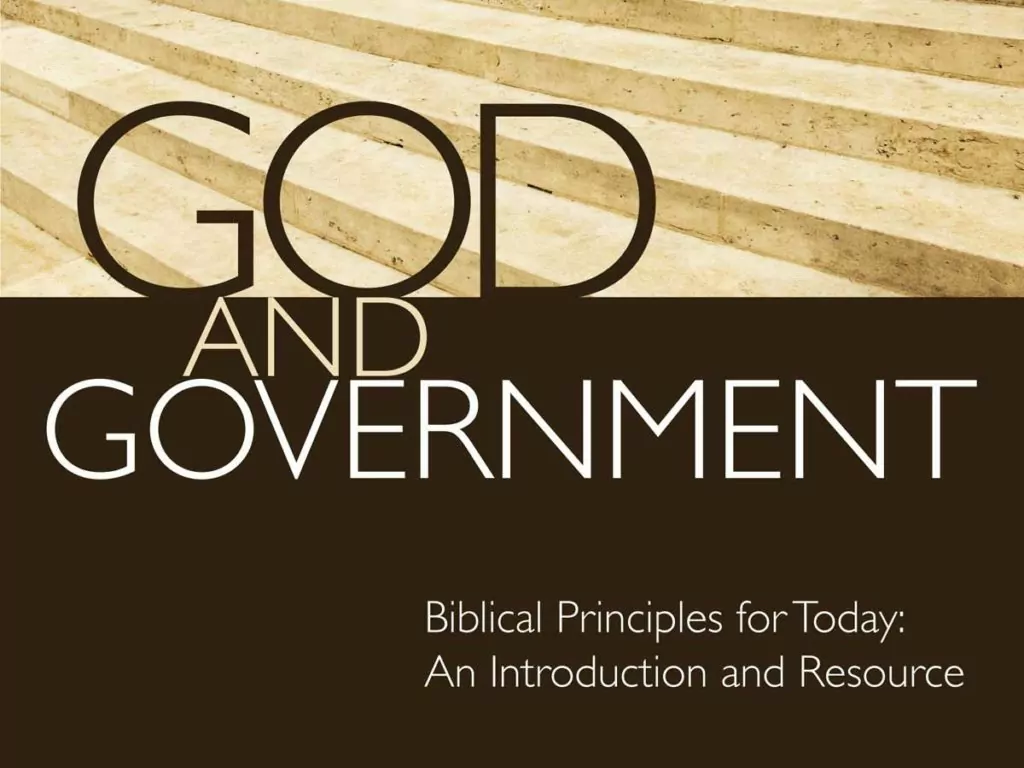
Red heart icon with + sign.
Adult biographies

The Legacy of Sovereign Joy

by John Piper 160 pages / 2000 Rating: GOOD/Great/Give Meet the giants! In this slim volume, John Piper tells the tales of Augustine, Martin Luther and John Calvin with a very specific purpose. He aims to encourage modern-day believers by showing how God’s grace overcame each man’s flaws to provide the church with the gift of their work and example. Augustine was arguably the most influential church father after Paul. He was also a favorite of John Calvin, who quoted him 342 times in the Institutes. He spent the early years of his life enslaved to lust, living with a concubine, and drinking in the philosophical ideas of his day. His eyes were finally completely opened and God became his “sovereign joy.” Augustine spent much of his life and energy defending the centrality of God’s grace against the Pelagians, who taught that, “though grace may facilitate the achieving of righteousness, it is not necessary to that end.” His complete dependence on God is perhaps best summed up with his prayer: “Command what you wish, but give what you command.” Martin Luther’s story is generally well-known among Reformed folk, and is another striking example of the grace of God at work in history. Luther had an extremely high view of the Bible as the very words of God, and thus spent countless hours reading and wrestling with the Word. It was this relentless study that God used to open Luther’s eyes to the wonder of grace, which freed him from bondage to the works righteousness of the Roman Catholic church. This view of God’s Word also led Luther to warn against spending all one’s time reading commentaries and books and never going beyond this to the Word itself. Doing so makes us “like men who study the signposts and never travel the road.” John Calvin, another well-known Reformer, shared Luther’s view of God’s Word, and was awestruck at the majesty of God present in the pages of Scripture. B.B. Warfield once wrote that, “No man ever had a profounder sense of God than he.” Calvin had visions of spending his days quietly as a biblical scholar. However, God called him to pastoral ministry through the imprecations of William Farel and later Martin Bucer (contemporary Reformers). Calvin continued to dig through the gold mine of God’s Word, producing an astounding number of sermons, commentaries, and his well-known Institutes of the Christian Religion. This book is certainly not an exhaustive historical treatment of each of these men since it serves a more pastoral purpose of encouragement. Throughout the book Piper makes generous use of original quotations from these men, and, although some quotes are unnecessarily reused a number of times, they overflow with a love and zeal for God. In fact, they may stir the reader to reading the originals. Overall, an easy and encouraging read for anyone. To make it even more appealing, John Piper is giving the e-book version of it away free. You can download the pdf by going here....

Red heart icon with + sign.
Adult biographies, Teen non-fiction

This was John Calvin

by Thea B. Van Halsema 224 pages / 1959 Rating: GOOD/Great/Give I’ve read four John Calvin biographies and this is by far my favorite. It is tightly written at only 224 pages, and interspersed with dozens of illustration, but what sets it apart are the many minor details the author includes. One example: other biographies will mention that Martin Luther read and greatly respected what John Calvin wrote about the Lord’s Supper, but in This Was John Calvin we discover how Luther first learned Calvin’s thoughts. He picked up a Latin copy of Calvin’s Little Treatise On The Holy Supper Of Our Lord in a German bookstore. It’s only a small bit of additional detail but it is this sort of extra tidbit that makes history come alive – now I can picture the large Luther ducking through the small front door of a local bookstore, scanning the shelves of the Religion Section and plucking from the titles a slim volume by this young Calvin fellow he had heard so much about. That’s fun to imagine. Another example: every Calvin biography will note that half of Geneva’s citizenship opposed the Reformer, many of whom were constantly scheming to get him expelled from the city. Van Halsema goes further, spending 3 chapters (out of the book’s 36) to tell the story of Geneva before Calvin’s arrival, and explain the historic reasons for the division in the city. She also provides a helpful background to Calvin’s encounter with Michael Servetus – a heretic that Calvin is sometimes accused of murdering. Servetus was burnt at the stake by the Genevan authorities for denying the Trinity, and while Calvin agreed with his execution, Van Halsema notes that most everyone at that time did too. In fact the Roman Catholic town of Lyons had previously burnt Servetus in effigy, only substituting a dummy because the man himself had escaped their grasp. To sum up, this is a great, readable biography that will be enjoyed by anyone in their late teens or older who has even the tiniest bit of interest in church history....

Red heart icon with + sign.
Adult biographies, Adult non-fiction, Book Reviews

True Right: Genuine Conservative Leaders of Western Canada

by Michael Wagner 128 pages / 2016 Rating: GOOD/Great/Give Feeling like you're the last true conservative left in Justin Trudeau's Canada? Then you need to read Michael Wagner's True Right and find out that all through Canada's history great, solid, courageous conservative men have stood up to the socialist hordes. What is a genuine conservative? How’s this for a definition? Someone who knows who God really is, and knows the government ain't Him. That comes out in the book, which is divided into 17 short biographies of political leaders who shaped Western Canada, some of whom were conservative another who were not. There's controversy to be had in the "weren't" camp, where the author places some big and well-loved names...but his reasoning is hard to argue with. Among the 13 who were, their faith in God is often evident. In this latter group most readers will find a pleasant surprise or two, meeting stalwart gentlemen who they'd not previously known. You might differ with Wagner on some of his assessments – I think in noting these men's strengths, he's sometimes overlooked a notable shortcoming or two – but you'll most certainly come away encouraged. Yes, even in Canada there have always been true conservatives, good and godly men, who were willing to stand up and fight, win or lose. True Right can be purchased here and a clip of the author outlining the book can be found below. ...

1 2 3 4 5 6 7 8