Transparent heart icon with white outline and + sign.

Life's busy, read it when you're ready!

Create a free account to save articles for later, keep track of past articles you’ve read, and receive exclusive access to all RP resources.

White magnifying glass.

Search thousands of RP articles

Helping you think, speak, and act in Christ.

Open envelope icon with @ symbol

Get Articles Delivered!

Helping you think, speak, and act in Christ. delivered direct to your Inbox!


Red heart icon with + sign.
Book Reviews, Children’s fiction

In Aunt Lucy's Kitchen

by Cynthia Rylant 1998 / 56 pages Rating: GOOD/Great/Give Three nine-year-old cousins are staying with their Aunt Lucy, and wondering what sort of fun they can cook up. When Lily comes up with the idea of a cookie company, Rosie and Tess are quickly on board. And all it takes to convince their Aunt is the promise of some free Cinnamon Crinkles, her favorite. It's this enthusiasm, right from the start, that most appeals in this "The Cobble Street Cousins" series. All 6 books are low on the drama – no fights or conflict – but high on the creativity, with the three girls always eager to build on each other's ideas. Lily is the writer, so she composes a poem to help them advertise their cookies: Cookies to your door, Who could ask for more, Aunt Lucy's girls will bake for you Cinnamon Crinkles, sweet and true Call us for a Baker's dozen We'll bring them over with no fussin! This is just the first of Lily's works, and while not her best (one of the others prompted my youngest to blurt out, "That was a really good poem!") it gets the word out. And then the orders start a'coming! Their first delivery is to a young man stuck on his couch with his leg in a cast. The outgoing Tess just has to know how it happened, and before long the girls have learned the man's name (Michael) and his occupation (he studies plants), and they find out that he has visited their aunt's flower shop but been too shy to really talk with her. That, of course, gets the girls thinking, and before long they've figured out a way to have the two of them meet: the girls will have a performance and invite the neighborhood! There are 5 others in this Cobble Street Cousins series, all just as sweet. They are, in order: In Aunt Lucy's Kitchen A Little Shopping Special Gifts Some Good News Summer Party Wedding Flowers In #4, the girls start their own newspaper, which got my middlest doing so as well. She described the whole series as "inspiring." Cautions The one caution concerns the cousins' parents, or more specifically, their absence. Whether it is Peter Pan, Frozen, or The Green Ember, a common theme in kids' stories is for the parents to be conveniently out of the way. That's because it will be harder for children to have big adventures if their big folk are still around to keep them safe. Sometimes the absence is because the parents are dead (Pollyanna) or desperate times have required desperate measures (WWII bombings in The Lion, the Witch, and the Wardrobe). But in the Cobble Street Cousins series, the three girls are with their aunt because their parents are professional dancers doing a year-long tour. My kids didn't notice that this was a lame reason to leave your kids behind for a year... but I wanted them to notice because this is the "career over kids" misplaced priority that the world is so often pitching. To disarm it, we need to be able to recognize it. In addition, Tess only has a mom, and her dad's complete absence – no explanation is offered as to whether her dad is dead, or her parents are divorced – is odd. Conclusion While these will only appeal to girls (girls read boy books, but a boy wouldn't dare be caught reading a book about three girl cousins!), they most certainly will appeal. And at between 56 and 72 pages long, these are a nice digestible size for Grades 2 through 4. I'll also note that our family really enjoyed them as a bedtime read – the Cobble Street cousins are gentle, happy girls, who will inspire pleasant dreams! Cyntia Rylant has also authored the absolutely wonderful "Mr. Putter and Tabby" series, which, if you haven't checked it out already, you really should. Find my review here....

Red heart icon with + sign.
Book Reviews, Graphic novels

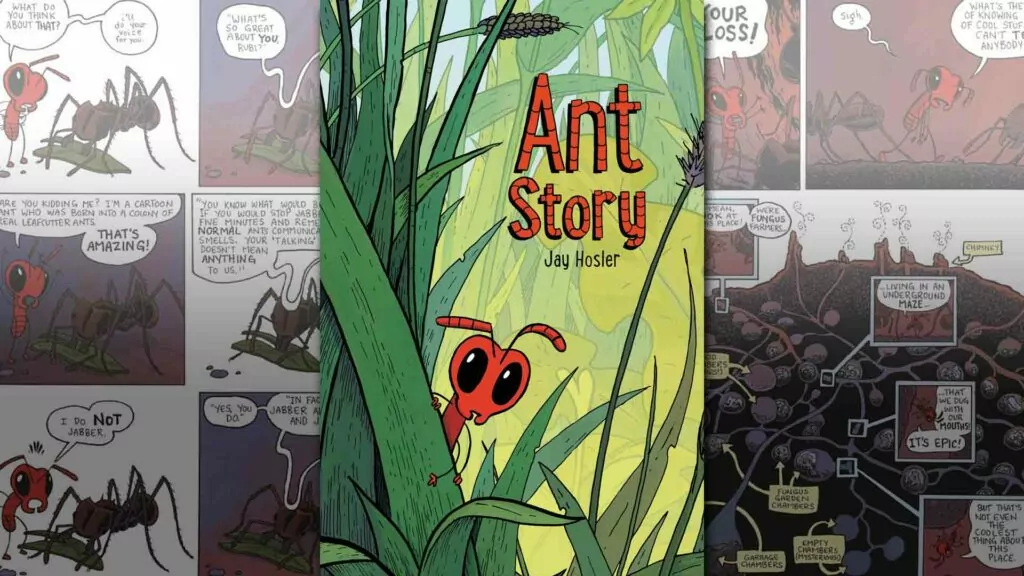
Ant Story

by Jay Hosler 2024 / 158 pages Rating: GOOD/Great/Gift This is as fascinating and creepy a comic about ants as you're likely to read. Ant Story is narrated by Rubi, an ant different from all the others in the colony in that she can talk. She also differs in that she is drawn rather "cartoony" while they are all quite realistic. It makes for a lonely existence, but being a talking ant means that Rubi can give us quite the inside look at her ant colony. As Rubi gives us the tour, we learn that there are about a "gajillion" ways for an ant to die, and we're shown one right off – an ant that Rubi was having a one-sided conversation with is suddenly slurped up by a "death tongue." Or, as we might describe it, a chameleon ate it. There is a bit of grim humor throughout, which will likely appeal to boys, with the main example involving Rubi and a friend. When Rubi meets what seems to be another talking ant – the first she's ever encountered! – she eventually discovers it isn't actually a talking ant, but is instead a talking parasitic phorid flea (named Miranda) that is growing and developing in the brain of this, now mostly "zombified," ant! That's grim, but realistically grim – these critters do exist, and do lay their eggs in ants, for them to grow and eventually burst out of. But I skipped ahead. Before we discover that Miranda is a phorid, and not just another talking ant, Rubi explains all sorts of ant basics, and we get to learn right along with Miranda. That makes this quite the educational journey. Cautions While the science, entertainingly told, is the reason to get this comic, it is that grim reality that makes for some cautions too. The parasitic phorid, and the predators Rubi and Miranda both evade, will raise questions which many younger readers may not know how to deal with, like: "If God created everything good at the start, why are so many predators so seemingly well designed to kill?" This secular book doesn't offer any answer, but we know it's due to Man's Fall into Sin. But to some, particularly this book's younger target audience, that general answer might not seem to adequately account for the impressive design behind these killing machines. Death via something uncontrolled like a volcanic explosion seems easier to understand. That fits with the brokenness that came with sin – the volcano has broken loose! But precision engineering in murderous parasites is the very opposite of brokenness, so... what's with that? Thus this might not be a book for a tween or early teen reader, though it is one that a student in Grade 11 and 12 should certainly be able to contend with before leaving the protective environment of our school. Some answers on this front can be found here: Why did God make viruses? Did God create parasites? If your school library doesn't have any resources addressing the problem of parasites, then it should get something like Answers in Genesis's The New Answer Book (Vol. 1, 2, and 3). Another caution concerns Jay Hosler's previous book about bees, which pushes evolution, and is not worth getting. Conclusion This is an absolutely fascinating read that will appeal to many a science-minded student. But the sometimes grim topic matter, and the complex theological issues that are tangentially touched on, mean this is one for high school and up....

Red heart icon with + sign.
Adult non-fiction, Book Reviews

Ordinary Men: Reserve Police Battalion 101 and the Final Solution in Poland

by Christopher R. Browning 1992 / 384 pages Rating: GOOD/Great/Gift This is a really horrifying book. Ordinary Men tells the World War II story of German Reserve Police Battalion 101. Police battalions were units sent into occupied territory to quell civil unrest and to take care of any remaining partisan forces. They generally consisted of men too old for the regular military draft, or sometimes volunteers attempting to avoid conscription into an active military unit. They were formed of men with families and careers, the sort of men you might meet at the grocery store, or perhaps go bowling with. The men in police units were not normally those you'd consider likely to become mass murderers. On July 13, 1942, that all changed. The nearly 500 men of the battalion were sent to Jósefów in Poland. Upon arrival, Major Wilhem Trapp, the battalion commander gave the men their instructions. In tears he told them that they were to round up the 1500 or more Jews in the town and execute them. In an unusual move, Trapp invited anyone to step forward who did not want to carry out the task at hand and be assigned to other duties. Only 12 of the nearly 500 took Trapp up on his offer. Those who didn’t stepped forward were set to work, and an initially small group of them was brought to the nearby woods where they were instructed on how to execute the Jews in as swift and tidy a way as possible. With their victim lying face down on the ground, the policemen were instructed to place the bayonets of their rifles at the base of their victims' necks, and then fire. This method ensured a swift death for the victim, and was as clean and tidy as a mass execution could be. Later groups that carried out the executions that day were not given the same precise instructions, and often shot wildly. This meant that the victims' skulls were frequently blown apart, splattering the formerly tidy uniforms of the police with blood and brains of the victims. As might be expected, many of the shooters were unable to continue and were allowed to assume other less distasteful duties. Unit discipline was surprisingly loose that day, and many of those doing the shooting simply abandoned their posts without permission and slipped off into the woods. They were able to do this without any punishment from their superiors. Despite it being so easy to avoid being one of the executioners, 80 per cent or more of the battalion continued rounding up and executing the Jews until the job was completed. Upon returning to their barracks, most of the men of the unit quickly got drunk. As with most difficult tasks, executing the Jews became easier, and even a source of merriment at times. Battalion 101 did few actual executions on their own, generally providing police cordons to prevent doomed Jews from escaping their fate. While Lithuanian "Hiwi" units did much of the actual shooting, the men of Battalion 101 were involved in the execution either directly or by providing a security cordon to at least 38,000 Jews from July 1942 until November 1943. Additionally, they forced at least 45,200 other Jews onto trains bound for death camps like Treblinka. Story of Those That Killed This is a horrifying book, but not so much because of the number of men, women and children who were innocently executed. This book is not the story of those who died, but of those who killed them. After the initial incident at Jósefów, battalion discipline was tightened. Despite this, men who didn't want to be involved in the executions had little trouble avoiding the duty. When officers set up details, they generally picked volunteers. On those occasions when they simply chose people at random, it was still easy to avoid the duty by moving to the back of the crowd. It quickly became apparent that men in close proximity to the officer got picked, so avoiding this unpleasant job was a relatively simple affair. The horrifying part is that despite it being easy to avoid execution duties, it was never a problem finding volunteers, eager to go out and join the latest squad. There were always other more seemingly honorable tasks available for those who chose not to join the execution squads, such as joining a patrol to eliminate partisan resistance fighters. None the less, there was a conspicuous number of men in the unit who appeared to prefer the task of killing unarmed civilians. In reading a book like this, one has to ask how an average man could become a mass murderer. The author is quick to emphasize that these were not men trained to kill. As police officers, their military training was no better than the average. They had received no special indoctrination that prepared them for their task. Being, for the most part, middle aged men set in their ways, they were, if anything, less susceptible to the worst of the Nazi propaganda than most of the younger soldiers conscripted into military units. Only about 25 per cent of the policemen were members of the Nazi party and most of those were late joiners, coming into the party after National Socialism had become well established in Germany. In other words, most of these men weren't even committed Nazis. The author emphasizes that in almost every conceivable way, the men of Battalion 101 were average. They were, quite literally, ordinary men. They could well have been your neighbor next door, or the guy from down the street. So how do you explain something like this, when ordinary men become willingly involved in extraordinary evil? The author notes that psychological experiments suggest humans will readily inflict severe pain on other human beings when ordered to do so by an authority figure. It seems that the average man's conscience can be put at ease if someone else has told him to cause pain, for perhaps then he might be able to convince himself he is not morally responsible. In the case of Battalion 101, however, the normal stern authority figure who ordered the killings was a kindly older man, so distraught about the orders he brought that he was literally in tears. His instructions to clear out the ghetto in Jósefów came less as an order from an authority figure than as a request from a man deeply uncomfortable with his task. The standard explanation of many accused of heinous crimes - "I was merely following orders" - simply doesn't apply here for it was almost always possible to avoid the order with no adverse consequences. The authority figures of the battalion never took a stern line and never forced the men to kill. Rationalizing Evil Some of the men of the battalion rationalized their actions in strange ways. One explained that he always paired himself with another policeman who would shoot the parent of a child. Since the child was now an orphan, it seemed only merciful to this individual to also shoot the child, for this would "deliver" him from the lonely, miserable life that orphans have often experienced. It may not have been intentional, but the policeman justifying his actions used a perverse pun. The same German word he used to suggest he delivered the child, also means "to redeem." It seemed shooting these Jews almost took on a religious significance for him. The author also contrasts the policemen with the bureaucrats in Berlin who issued the orders that Battalion 101 followed when they executed civilians, or forced them onto death trains. These bureaucrats, he notes, were able to issue their directives with relative ease because they never actually had to face the people whose deaths they were responsible for. The men of this police battalion never had that excuse. They couldn't claim that they were emotionally distant from their victims as they escorted them, one by one, to the areas in the forest where the killing was taking place. The policemen saw their victims close up, and were able to look them in the eye. The men of the battalion indicated they even struck up conversations with the men, women, and children they were about to kill though one is left to wonder what kind of a conversation could possibly have occurred. The policemen could not claim a moral distance from their victims like the bureaucrats in Berlin could. They looked many of their victims in the eye and treated them like human beings until the very last possible moment. True Cowardice So what could be the cause? There is, perhaps, only one explanation that makes sense and even partially accounts for what occurred. Twenty years after the fact, when facing criminal prosecution for their actions, men of the battalion were asked why they didn't step forward and avoid becoming a mass murderer when offered the opportunity by Trapp. Most explained they didn't want to appear cowardly. It was one thing to start with the executions and then be unable to finish. It was quite another to not do the executions at all. That was cowardly. Only one individual seemed to understand his own motivations clearly. When asked why he didn't step forward when given the chance, he didn't say that he was trying to avoid being a coward, but that he didn't step forward precisely because he was a coward. He was less afraid of killing innocent children than he was of the peer pressure exerted by his comrades. The true story of Battalion 101 is a horrifying tale. There was, no doubt, enormous pressure from the rest of the battalion to conform and to join the executions. Yet peer pressure is not an excuse. We don't excuse kids at school caught smoking who gave in under pressure from their peers, and, though the crime is larger, people caught in the situation of the battalion cannot be excused either. Peer pressure helps to explain their actions, but it doesn't take away the guilt. Perhaps the most obvious element lacking from all the excuses provided by the policemen is any sense of morality. Twenty years after the fact when criminal investigators interviewed these former policemen, there was no longer an immediate sense of peer pressure. The rest of their unit no longer had the same sway over them, and even that long after the events the policemen overwhelmingly indicated they had done what they did because they didn't want to appear weak in front of their comrades. They hadn't been motivated by a belief in Nazi values. Twenty years after the fact they expressed little remorse for what were clearly morally repugnant actions. Even those who had not been involved in the killing did not claim to be "too good" to kill, but they were "too weak." It is almost unbelievable that crimes of this magnitude could be discussed without any reference to morality. In All of Us Though this is a work of history and not theology, and though the author reveals no obvious religious bias, his conclusion sounds like something straight out of the Bible. He warns against the smugness many feel when discussing the evil actions of others. As he notes in his final sentence, if under these circumstances the very ordinary men of Battalion 101 could become mass killers, "what group of men cannot?" It is in this last comment that it might be possible to finally understand the actions of these men. The Heidelberg Catechism explains that we are "incapable of any good and prone to all evil" and the Larger Catechism of the Westminster Confessions states that mankind is "wholly inclined to all evil." This is why the tale of Battalion 101 is so utterly horrifying. Their actions are not horrifying because they're so unusual, and so implausible, but because they're something we're all capable of. The level of evil to which they descended - the same evil we've seen repeated in places like Rwanda, or by individuals like Ted Bundy, Jeffrey Dahlmer, or Clifford Olson - is something that lies in the hearts of all of us. Reading a book like this is not for the faint of heart, or those prone to nightmares. As one of my grad school colleagues commented, it is almost senseless to talk about preventing these kinds of actions, for without the regenerating work of God the cause of the evil remains unsolved. Despite its disturbing story, the book is one well worth reading for it illustrates in a brutally clear fashion why reaching out to our neighbors is so urgent. If you ever needed a slight push to talk to co-workers, or the people just across the back hedge, to explain to them "the reason for the hope that you have," this book will do that for you. This review originally appeared in the March 2000 issue under the title: "Ordinary Men, Ordinary Monsters." Listen to Jordan Peterson talking about Police Battalion 101 below. ...

Red heart icon with + sign.
Adult non-fiction, Book Reviews

How Should We Then Die?

A Christian Response to Physician-Assisted Death by Ewan C. Goligher 2024 / 145 pages Rating: GOOD/Great/Gift In April 2024, a desperate father in Calgary, Alberta begged a judge to prevent the doctor-assisted suicide of his 27-year-old autistic daughter. The father argued that his daughter’s “condition, to the extent that she has a condition, is mental not physical in nature” and raised serious concerns about the approval process for her death, including whether legal safeguards had been met and whether “doctor shopping” had taken place (where patients assessed as “ineligible” continue to seek out opinions from other doctors until they find ones willing to approve of their assisted suicide). Confusion reigns But the judge felt he could not intervene: “MAiD assessments are conducted in accordance with the structure imposed by the Criminal Code … but they remain medical assessments conducted by doctors … are private in nature and involve the application of specialized professional judgment. … The Court has no expertise and no place in reviewing MAiD assessments in some sort of ad hoc system of pre-authorization...” But by this logic, any medical assessment, including a mistaken or careless one, approving of an assisted death could be impervious to judicial review. Furthermore, the judge reasoned that preventing the daughter from accessing “medical assistance in dying” would do more harm to her than allowing it, a deeply religious argument Dr. Goligher tackles head-on in his book, as we will see. Thankfully, the Alberta Court of Appeal granted an injunction halting the assisted death from proceeding at least until the appeal is heard later this year. This story emphasizes just how far we’ve come in Canada with euthanasia and assisted suicide (collectively referred to in Canada with the euphemism “medical assistance in dying” or “MAiD”). What’s more, many Christians seem genuinely confused about how to deal with the issue. I’ve taught multiple university courses on law, human rights, and public policy in two different Christian post-secondary institutions, and in most of them the issue of euthanasia has been discussed and studied. In each class, I have found Christian students who either (1) believe that euthanasia is wrong but are unable to articulate why, or (2) believe it is wrong (morally wrong, I suppose) to “impose” on others one’s belief that euthanasia is wrong. Much-needed book And so, not even a decade into this legal and moral quagmire, Christians in Canada are in desperate need of resources to help respond to this issue in a way that is compassionate, thoughtful, and theologically grounded. Thank the Lord for providing such a resource through the pen of Dr. Ewan Goligher! Dr. Goligher is a medical doctor and an elder in a PCA church in Toronto. I first met him when he and I co-taught at the Christian Legal Institute (the only Christian legal training academy in Canada) and he urged students to pay careful attention to this issue and to champion the human rights of the vulnerable whose lives are placed at risk in the name of “autonomy” and “self-determination.” He also encouraged students to be prepared to defend Christian and other doctors who are clinically, ethically, and conscientiously opposed to participating in the intentional termination of patients’ lives. Since that first meeting, I’ve enjoyed a friendship with Ewan and we have picked up our conversations at other events: Christian legal and medical conferences and at the Apologetics Canada conference where Dr. Goligher has also lectured. Ewan’s book is a beautifully written apologetic for the Christian answer to the ultimate question that every human will face: how should we then die? Secular god doesn’t value life Our culture is increasingly promoting one answer: “Autonomy is lord. And so I have the right to die, with public assistance, at the time and place and in the manner of my own choosing.” Ewan dispels that approach as a falsehood that completely undermines the value of some. “So when we say that people matter, we are also saying that it is good that they exist. If people have intrinsic value, then it is always good that they exist. And if we insist that they really matter – that they have deep intrinsic, inherent value – then the cessation of their existence (their death) must always be regarded as a terrible tragedy.” Ewan also shows persuasively how embracing “assisted death is an act of secular faith” and just how presuppositional and religious the arguments for assisted suicide are. “Because those who claim that death is nothing don't really know that for sure, physician-assisted death is best considered an act of blind faith on their part. It is an act at least as superstitious and religious as any carried out in any religious services of any kind. Those who administer physician assisted death are functioning not as doctors but as priests, helping their patients by ushering them out of life and into the afterlife, the great unknown.” The real God offers real hope But what of despair? Ewan offers a fuller, hopeful approach to those struggling to find meaning in their suffering, rooting his answer in the confession of faith as expressed in the Heidelberg Catechism: we belong not to ourselves but to a faithful, loving Savior. Expanding on and moving beyond the work of Jewish psychoanalyst and Holocaust survivor Viktor Frankl, Ewan shows that, to live with suffering we need transcendent meaning rather than self-invented meaning, and that, “we only clearly behold the true meaning and significance of our lives in the life, death, resurrection, and ascension of Christ.” A third way The opening paragraph of the Supreme Court of Canada’s 2015 Carter v. Canada decision – which led to the legalization of doctor-hastened death – presented an “either/or” dichotomy: either a person dies a horrific death with extensive suffering, or they take their own life early. However, Dr. Goligher shows his readers a third way: physical and existential suffering can be substantially mitigated without eliminating the sufferer. He also helpfully distinguishes between refusing treatment, the cessation of which leads to death, which is ethical; and euthanasia, which is not. This area of medical ethics has been the source of some confusion due to the conflation of certain concepts and terms. In short, to refuse treatment is permissible for a Christian because where there is a “decision to withdraw life support (which is not really an action but rather the cessation of action)… the actual cause of death is the underlying illness. Life-sustaining treatments are not discontinued in order to bring about the patient’s death; rather, they are discontinued because it is recognized that they are no longer effective or appropriate.” But any act the intention of which is to end the life of the patient is something different in kind, and is immoral because it intentionally seeks to end the life of the patient. Such action is properly called homicide. In fact, assisted suicide (or MAiD as it is called in the Criminal Code) is still classified as homicide in the Criminal Code. As Dr. Goligher notes, “The intention, or goal, of the action is the key distinguishing feature.” Highly recommended Ewan’s book is thoughtful and engaging. Multiple references and allusions to Shakespeare and Schaeffer, Augustine and Tolstoy, Camus and Nietzsche show a breadth of knowledge and engagement with key thinkers, without ever coming across as stuffy or academic. I highly recommend this book for young Christians’ study groups, for elders and pastors, for moms and dads, for nurses and doctors. At a relatively short 145 pages, the book is a very accessible read, easily understandable for a grade 11 or 12 student. And it is written to be understandable and compelling to both Christians and the broader Canadian public. It presents the gospel beautifully in its final chapters. Throughout the book, Ewan’s approach is that of a compassionate doctor, one who has clearly seen more than his fair share of suffering. Each chapter opens with a true heart-wrenching story of extreme anguish. There is no downplaying how brutal human suffering can be, but Ewan’s extensive clinical experience in managing and mitigating pain and suffering also shines through in this book. Ewan is more than a physician; he is also a pastor-elder and his compassion comes through the pages of this book too. The moving stories he shares put a lump in my throat as I read them. As the story I opened with illustrates, and as many experiences will confirm, physician-hastened death will impose itself on the Church on many fronts. Christian physicians, nurses, and palliative institutions are being pressured to provide and approve of euthanasia (these professionals are no longer seen as virtuous but as villainous for not “supporting” their patients). Some doctors are now proactively suggesting euthanasia to elderly or disabled patients as a “medical option” that should be considered. And our culture is planting the seed early in the minds of our children (and our seniors!) to see medically hastened death as a dignified way to die. The Church cannot be silent or ignorant on this issue. No better resource is available to assist her to understand and speak than this book. André Schutten is Senior Legal Counsel and Director of Training & Development at Christian Legal Fellowship (CLF), Canada’s Christian legal ministry. Christian Legal Fellowship sits at the intersection of the church, the state, the legal academy, and the legal profession. To learn more, please contact André at [email protected]....

Red heart icon with + sign.
Adult biographies, Book Reviews

The Watchmaker's Daughter

The true story of World War II heroine Corrie Ten Boom by Larry Loftis 2023 / 384 pages Rating: GOOD/Great/Give Larry Loftis is an international bestselling author who has written three other nonfiction thrillers of World War II heroes. Now, with The Watchmaker's Daughter, he has written an excellent, well-paced and very well-researched biography on Corrie Ten Boom. I really enjoyed this book; I read it in one sitting while enjoying the sunshine on my patio! At a young age, Corrie started to learn the watchmaking trade from her father, Casper, widely renowned for his amazing skills and known as the Grand Old Man of Haarlem. Shortly after they celebrated the 100th anniversary of the business, Hitler's Nazi forces took over the Netherlands. The Ten Boom family was deeply religious and believed that they needed to protect the Jews who were “the apple of God's eye” so they opened their home to Jews and to onderduikers (dutch for "divers"), young men hiding from the Nazis. But in March 1944, the family was betrayed by a Dutchman, one of their own. During the rest of the war, as Corrie was moved from one concentration camp to another, she finally ended up in Ravensbruck, a hellish place. But during the years of giving refuge, and throughout her and sister Betsie's imprisonment, she relied completely on her Savior, finding blessings even during the darkest of days. After the war, Corrie spent 25 years visiting more than sixty countries telling her story of love, forgiveness and grace. In his afterword the author writes that “writing about Corrie's message of faith, hope, love and forgiveness was an empowering and spiritually moving experience for me.” What I also enjoyed about the book was the occasional mention of Anne Frank's family in Amsterdam, and of Audrey Hepburn in her early to mid-teens who lived in Amersfoort. Hepburn worked in the military hospital there and put on private ballet performances in nearby homes, donating the proceeds to the underground. Dietrich Bonhoeffer also gets mentioned, as he was also in concentration camps, and towards the end of the war was shot. And all three of these connections are dovetailed right into the Ten Boom story. I also liked the several appendices, the “rest of the story” which completes the story of the refugees in the Ten Boom home. Appreciated as well were the 45 pages of notes where we read quotes from Bonhoeffer and Victor Frankl, and the extensive bibliography and an exhaustive index. This would be an excellent book for school and church libraries. There are at least two other books with the title "The Watchmaker's Daughter," one of them even about Corrie Ten Boom (but a children's book), so be sure to track down the one by Larry Loftis....

Red heart icon with + sign.
Adult non-fiction, Book Reviews

In Holy Service

by Cornelis Van Dam 2023 / 255 pages Rating: GOOD/Great/Gift The question of personal identity has become a hot-button issue in recent years. The ideology of gender has encouraged the notion that our identity is self-selected; we can choose to be whatever we want to be, regardless of biological realities. Even the existence of a single human nature that unites all of humanity has been called into question. The era in which we live has been profoundly impacted by this radically new understanding of anthropology, of what it means to be a human being. As this ideology continues to advance, the Christian Church is called to continue to declare an ancient and unchanging message, and Christians are called and called again to find their identity in Christ, and in their office and calling as people who are united to Christ. This is the theme that unites the writings of Dr. Cornelis Van Dam that have been published under the title In Holy Service. Three main points The majority of the material included in this collection had been previously published in Clarion, Diakonia, and elsewhere, between 2008 and 2021, and it has been revised and collated under the headings of: The General Office of a Believer The Ecclesiastical Offices Women in Special Service The book concludes with an epilogue, “Retrospect and Prospect,” which looks back to the early history of the Christian Church, while looking forward to the future. Recommended There is much to recommend in this book. Dr. Van Dam’s writing style is simple, clear, and straightforward. He presents his thoughts in a way that is understandable, and his arguments are cogent and easy to follow. He ably defends Biblical principles about the unique callings and responsibilities of men and women, and provides solid Biblical evidence for his conclusions. His insight into the history of the ecclesiastical offices are helpful and perceptive, and his discussions of specific issues, such as the continuing importance of catechetical preaching, the necessity of training to prepare men to take on the office of elder, and the question of women’s participation in the election of office-bearers are well-argued and firmly rooted in Scripture. These individual chapters could serve well as a starting-point for group studies at church, and the material included serves as a healthy antidote to the spirit of the age in which we live, and the constant pressure being exerted upon the Church to adapt and change with the times. Critiques The character of In Holy Service as a collection of previously-published works does mean that it lacks the unity of a book written “from scratch.” Some of the chapters are very brief, while others are lengthy, and one wishes, for example, that a subject like Chapter 11’s “The Office of the Church in Relation to the Civil Government” would have received a fuller treatment than it does. Dr. Van Dam’s epilogue, which compares the situation of the early Church with that of our day, is excellent. He emphasizes that Christianity must be counter-cultural, and that we must count the cost to follow Jesus Christ. This is an important reminder, and a necessary one. However, I believe that Dr. Van Dam’s conclusions about the Christian’s relationship with the civil authorities as taught in Romans 13 and his related discussion of the Church’s response to COVID-19 in Chapter 11 do not accord with the strong and forceful message with which he concludes the book. This is an issue that demands a fuller treatment. Conclusion In conclusion, I believe that In Holy Service is a helpful resource that can serve God’s people as a useful guide to Biblical principles of individual and ecclesiastical life that must be reappropriated, taught, and defended from generation to generation. It is available at ProvidenceBooksPress.com. Rev. Jim Witteveen is the author of “How In the World Did We Get Here?” and host of the DanElevenThirtyTwo.com podcast. ...

Red heart icon with + sign.
Adult non-fiction, Book Reviews

You are not enough (and that's okay)

Escaping the toxic culture of self-love by Allie Beth Stuckey 2020 / 208 pages Rating: GOOD/Great/Gift In today’s culture, women often encounter myths promoting the belief that genuine happiness is attainable through self-love and autonomy. Social media platforms like Pinterest and Instagram frequently showcase quotes urging women to embrace their supposed perfection and view self-love as the ultimate path to fulfillment. Allie Beth Stuckey’s book, You’re Not Enough (And That’s Okay), fearlessly confronts these myths from a Christian standpoint, emphasizing the significance of discovering true contentment through Jesus rather than the pursuit of selfish ambitions. Dismantling 5 myths Stuckey dismantles five prevalent myths perpetuated by the culture of self-love: You are enough You determine your truth You’re perfect the way you are You’re entitled to your dreams You can’t love others until you love yourself Drawing from her Christian testimony, she exposes the emptiness that arises from relying on oneself for happiness, recounting her struggle with a failed college relationship leading to a season of partying and disordered eating. Christ, not you Living in a culture that constantly affirms self-worth, conveying the message that one is a sinner in need of redemption through Christ provides a counter-narrative. Stuckey adeptly navigates this cultural landscape, highlighting the inherent discontent and feelings of inadequacy resulting from the pursuit of self-love. In the chapter “You’re perfect the way you are,” Stuckey asserts that one is “not perfect the way you are, and you will never be.” She explains that Scripture reveals two kinds of selves: the old self, utterly depraved and seeking love and satisfaction in the wrong places, and the new self, redeemed by Christ and free from the bonds of sin. Accepting the secular narrative of “you’re perfect the way you are” means that instead of relying on Christ's perfection, we'd be relying on our own, embracing ourselves instead of Him. Stuckey also addresses the Church’s susceptibility to the allure of the self-love culture. She reminds readers that Jesus’ commandment to love others as oneself is not an endorsement of self-love. Rather, Jesus understands that “self-love” is inherent, born out of looking out for our own interests. Stuckey cites Philippians 2:3-4, teaching that we should consider others’ interests more important than our own. The book concludes with a poignant reminder that while self-love depletes, God’s love is enduring. Stuckey highlights the profound and eternal nature of God’s love, contrasting it with the superficial and temporary nature of self-love. In summary, You’re Not Enough (And That’s Okay) provides a much-needed Christian perspective in a culture saturated with self-love....

Red heart icon with + sign.
Book Reviews, Children’s fiction

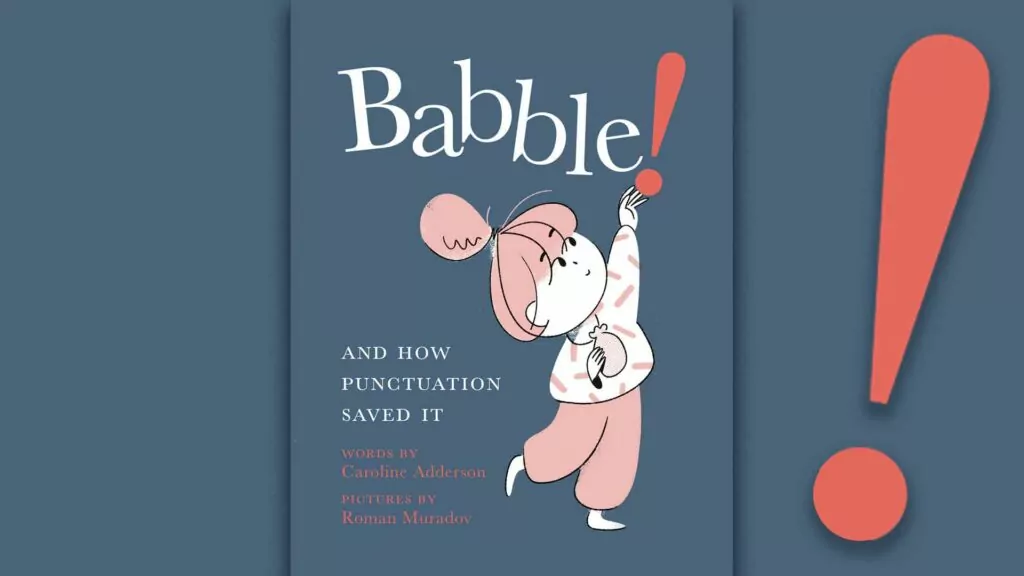
Babble! And how punctuation saved it

by Caroline Adderson illustrated by Roman Muradov 2022 / 72 pages Rating: GOOD/Great/Give In the village of Babble no one knows what punctuation is which means they do not know when a sentence ends and the next begins they can't even figure out when they are saying things out loud or just thinking them because they don't have quotation marks But then along comes a little girl who introduces them to the period. Whewww. That helps a lot but the villagers have all sorts of questions they want to ask. But they can not. Because they still do not have question marks. Can you imagine the relief they felt when the little girl shared that special little squiggle with them? Onward it goes with quotation marks, commas, exclamation marks, and apostrophes introduced in the following chapters. The village of Babble, where there was once nothing but noise, now has people talking, thinking, questioning and, don't you know, contracting too! This would make for a great introduction to the importance of punctuation. Kids will especially love the chapter where the comma is introduced. In what's an old gag, but will be new to kids, accusations are made about Babble villagers indulging in cannibalism! But how could that ever be? Well, it's all about how the following sentence sounds if you don't include a key comma: "Soon we will eat Grandpa." Commas can save lives! This cute tale is really a must for every elementary school library!...

Red heart icon with + sign.
Book Reviews, Children’s fiction

The Boxcar Children: Great Adventure

1. Journey on a Runaway Train 2. The Clue in the Papyrus Scroll 3. The Detour of Elephants 4. The Shackleton Sabotage 5. The Khipu and the Final Key created by Gertrude Chandler Warner  2017 / 687 pages total Rating: GOOD/Great/Give The Aldens are four children – Benny, Violet, Jessie, and Henry – aged 6 to 14, who, after being orphaned, ran away and found an abandoned railway boxcar in the woods which they turned into their new home. The very first book in the series, The Boxcar Children, published way back in 1924 is all about how their grandfather searches for them, and how they hide from him, thinking him to be a mean man since he'd never come to visit the family when their parents were still alive. But, as so often happens in children's stories, this bad guy turns out to be not so bad after all: Grandfather Alden is actually a wonderful man (and rich too) who loves them very much. Eventually, all the misunderstandings are cleared away and the children go to live with him in his big house. To top things off Grandfather Alden has their boxcar brought to his house's backyard, so they can use it as their clubhouse. That first Boxcar book spawned 200 more, with this Great Adventure series published almost 100 years after the original story. Great Adventure is really just one story, 687 pages long, that's been divided into five books (each 129-145 pages) for the sake of making it a lot less intimidating for the intended 8- to 10-year-old audience. The setting is modern day, and the mystery that starts it all takes the children around the world to retrieve lost treasures. It turns out there are two groups after the treasures: a good "Reddimus Society" that wants to restore the items to the museums where they belong, and a bad Argent group that just wants to keep the treasures for themselves. The children are allied with the Reddimus Society and use the group's plane to fly from one place to the next. But somehow the Argents always seem to know where the Aldens are heading. Could one of their pilots be a traitor? And if so, which one? Cautions The main caution is God's complete absence. This struck me as a lot like a typical Christian kids' fiction series in how safe it is: a loving grandfather, his sweet grandchildren, and all sorts of other very kind people contend with villains who are most often misunderstood rather than evil. And unlike pretty much all the children's fiction published after 2020, there's no one here sharing their pronouns or any of that sort of wackiness. Safe. But that's not exactly a recommendation – to badly paraphrase Chesterton, it's good for children to read about evil, not to learn about its existence, which they already know, but for them to realize that evil can indeed be fought. At the same time, there is a time and place, so some nice safe books, in a moderate dosage, can be good too. It is that safety that makes these a favorite among Christian families (and even sold in some Christian bookstores).  But it struck me that in the stories themselves, there's not a Christian to be found anywhere. Nor is there any hint of Christianity – Sunday is celebrated as a day off of school when they can work on their projects. When the kids get into trouble, God's absence becomes all the more noticeable since the kids never think to ask Him for help. So, even though the first story was written a century ago in what was still a largely Christian culture, this is an entirely secular series. So, this 5-book series could be great fun, but you might not want your kids immersing themselves in dozens and dozens of books from this godless 200-book series. One other caution has nothing to do with these 5 books. If your kids want to check out more Boxcar, there are a couple of hundred others. However, while the original 19 books written by Gertrude Chandler Warner all seem similarly "safe," the 150+ books written after her death aren't always so. There's still no one offering pronouns (so far) but in one, Native spirituality is given a soft endorsement, and it might have been that same book where Man was presented as more an enemy of Nature than as the caretaker that God has charged us with being. So parents shouldn't presume that the whole series is reliably safe. Conclusion This 5-book set is just a fun, simple adventure that has enough suspense to keep its young target audience on edge. It's also a bit of an educational travelogue, with readers learning at least a bit about each country they visit, which includes Egypt, England, Italy, India, China, Thailand, and even Antarctica. For kids just learning to read, they'll feel a sense of accomplishment in tackling all five, and if a little one finds working through it a bit tough, the audiobook version is quite well done. Overall, this is a story that most boys and girls under 9 will really enjoy, whether it is being read to them, or they are tackling it themselves....

Red heart icon with + sign.
Book Reviews, Economics, Teen fiction

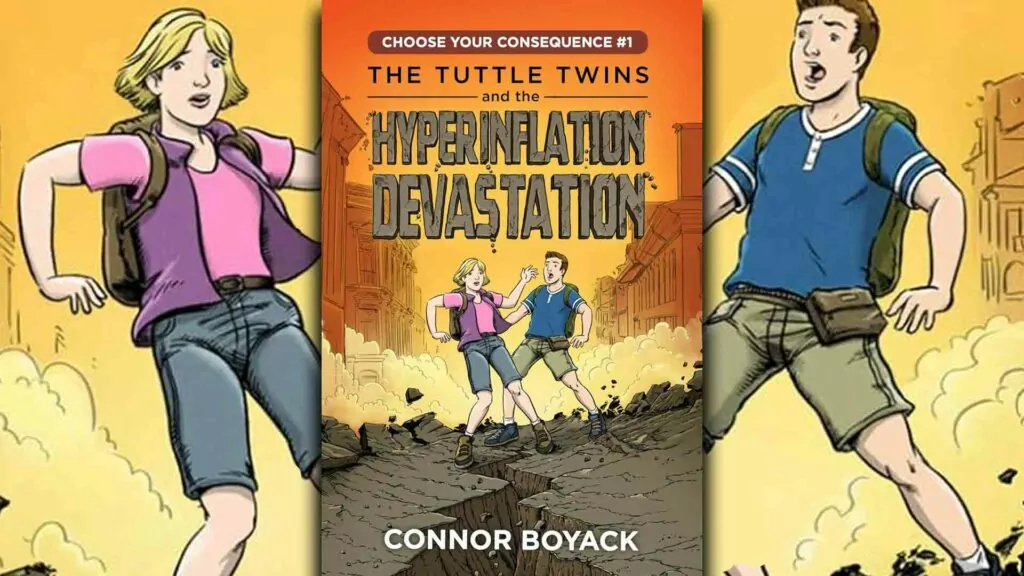
The Hyperinflation Devastation

by Connor Boyack 400 pages / 2019 Rating: GOOD/Great/Give Remember those “Choose Your Own Adventure” books kids loved back in the 1980s? Readers would be brought to a fork in the road, given two options to choose from and if they chose Option A, they would be told to go to one page, and if they chose Option B then they would be directed to another. Afterward, they would continue on their chosen track with the adventure continuing to branch repeatedly thereafter. In The Hyperinflation Devastation, author Connor Boyack has taken that concept and expanded on it, creating a 400+ page “Choose Your Consequence” adventure to teach teens various lessons about economics. In this, the first book in the series, Emily and Ethan Tuttle, a pair of 15-year-old twins, head out on their own to the small South American country of “Allqukilla.” If 15 strikes you as young to be out without parents, I’m with you. However, these two are a particularly independent pair who have spent the last year planning and saving for this trip. They want to go to Allqukilla to check out the country’s ancient ruins. But is it to be? Right after their plane arrives, they see local news reports warning about an impending earthquake and it’s here that readers face their first choice. Are the Tuttle twins going to have an incredibly short adventure and head back on the very next plane, or are they going to go on to their hotel? Of course, no reader is going to take the cautious route, so onward and forward the adventure continues. While exactly what happens depends on the choices a reader makes, the twins will encounter that earthquake, and then, with power disrupted, they’ll have to deal with roads in bad repair, hyperinflation, a lack of available food and water, and no cell phone service, as the two figure out their way home. The author’s economic outlook is a small government, libertarian one, which comes out in the lessons the twins learn. So, for example, in one story branch, they end up in a small village in the hills that still has power because these villagers have never relied on the government to provide it. In another branch, they encounter some not-so-warm-hearted help – entrepreneurial sorts who will do them good…for a price. The twins sometimes get entirely altruistic help, but the point is, they also get help from people who wouldn’t otherwise be helpful, except that it is in their own self-interest to do so. The lesson here is that the free market is important because it gives people a motive to provide things other people want. While this is intended as an educational story, Boyack doesn’t beat readers over the head with the lessons he’s trying to teach. Only once, in the eight or so different story arcs does a character offer up a prolonged economics lecture. But even then, it isn’t too long. CAUTIONS The one caution I would offer deals not with this book, but with the author. He writes from a generally Judeo-Christian, libertarian perspective. Often times, those two perspectives can match up quite nicely since both Christians and libertarians recognize that the government shouldn’t try to be God. Thus we both believe in some form of smaller, limited government, which sets us apart from the many who call on the government to solve whatever problems they face. But in some of Boyack’s other books, his libertarian perspective comes in conflict with his Judeo-Christian perspective. In The Tuttle Twins Learn About the Law (one of the Tuttle Twins picture books he’s written for younger readers) he teaches readers that governments gain their authority from people, and not God. Based on that assumption the author argues that governments should only be able to do what people are able to do, therefore just as it would be wrong for a person to forcibly take money, so too the same must be true of government. But this simply isn’t true. God has empowered governments to do some things which individuals must not do, and taxation is one of them (Luke 20:25, 1 Peter 2:13-14). The libertarian perspective in Hyperinflation Devastation is more restrained, and thus in keeping with a Christian worldview that understands God as distributing powers and responsibilities not simply to the state, but to parents, and the church, and individuals too. CONCLUSION I would recommend this for any kid from 10 to 15. The adventure is a solid one, and the Choose-Your-Own-Adventure component will grab their attention. Yes, this is an economics lesson, but it is a generally subtle presentation that never gets in the way of the story. That allows most kids, whether they are politically-inclined or not, to enjoy this. But because the economics angle is so very different from what they are reading in other books, it may well spark an interest in learning more about money, inflation, politics, and more. It may interest parents to know there are other titles in this “Choose Your Consequence” series so far, but as I haven’t read them, I can’t recommend them as of yet. There is one mistake in the book, on page 388, where we are directed to Page 335 but should be directed to Page 111. I recommend some of the Tuttle Twin pictures books on my personal blog here....

Red heart icon with + sign.
Book Reviews, Children’s non-fiction

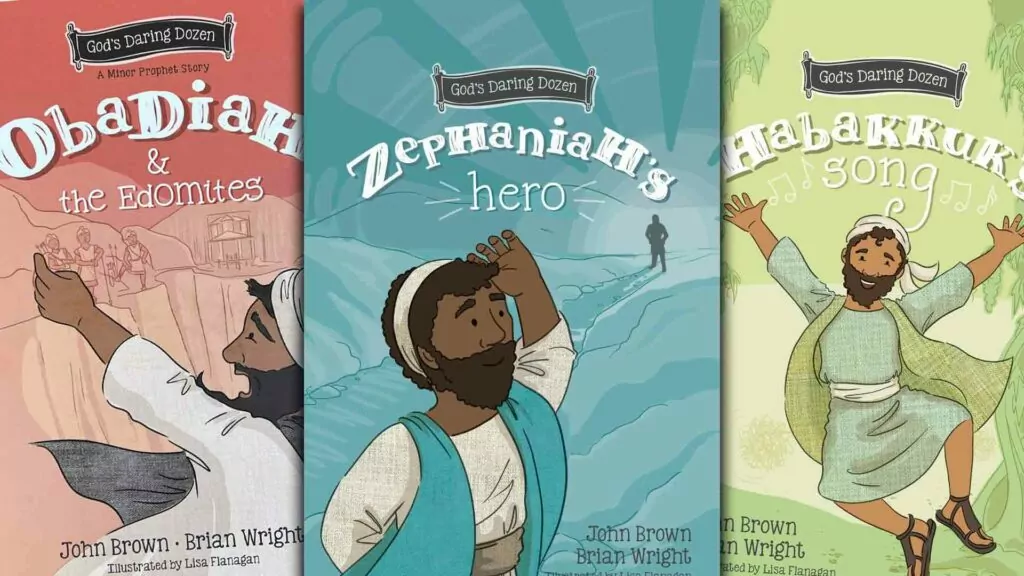
God’s Daring Dozen: A Minor Prophet Series

by John Brown and Brian Wright Illustrated by Lisa Flanagan 2021 / 40 pages each Christian Focus Publications Rating: GOOD/Great/Give I’ve never been a fan of children’s Bibles. When our kids were young, we never used them during our daily family worship. We always just read straight from the Bible. I figured they would get enough Bible stories at school – and they did. My negative attitude about story Bibles is due to a couple of factors.  One is their tendency to moralize everything and the other is to miss the One to whom the whole Bible is pointing: Jesus. So I was a tad skeptical about this series of storybooks based on the Minor Prophets. I looked at the first four volumes in this series: Obadiah & the Edomites, Habakkuk’s Song, Haggai’s Feast, and Zephaniah’s Hero.  They’re meant for reading to kids ages 4-6, but kids ages 7-10 should be able to read them for themselves. I read through them for myself and mostly appreciated the approach. They’re well-written, capturing the message of these books, and helping kids see how they point to Christ. The illustrations are colorful, bold, and appropriate. I don’t have any young children at home anymore and no grandchildren yet either. However, I have a daughter who works as a nanny.  I asked her to test drive these books with the children she cares for. These were kids on the younger side of the target audience and she found they had a hard time focussing. However, she did say that they would probably work well in the Christian primary school environment or perhaps Little Lambs (Sunday School) at church. ...

Red heart icon with + sign.
Book Reviews, Graphic novels

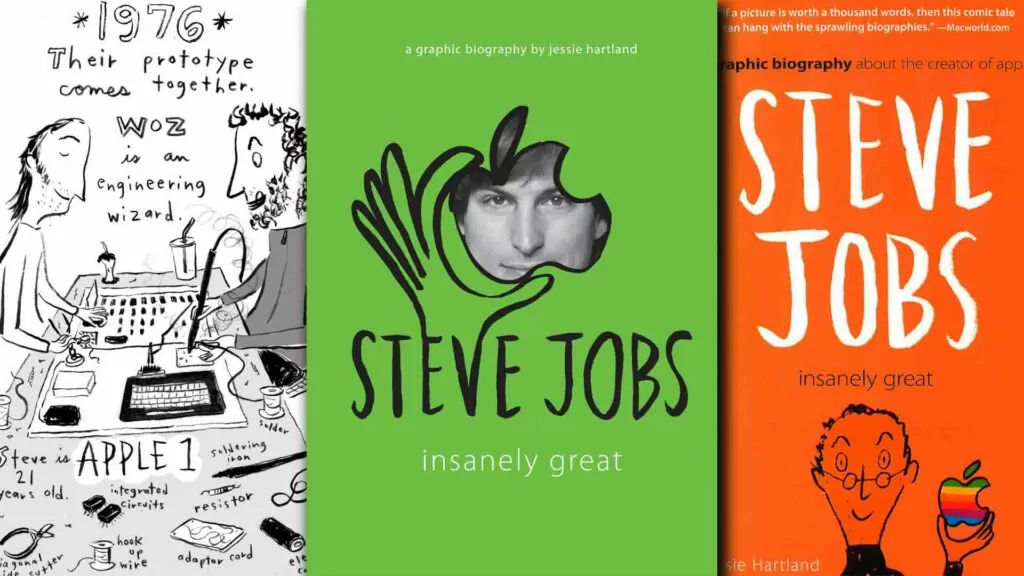
Steve Jobs: Insanely Great

by Jessie Hartland 2015 / 216 pages Rating: GOOD/Great/Gift What makes something a really good read? It can be the writing – some writers can turn anything into a page-turner. It might be the subject – newspaper accounts often lack artistry, but the facts themselves grab and keep our interest. And other times it comes down to the purpose of the piece. I've reviewed novels that didn't cut it as entertainment, but that was okay, because their main purpose was education. And this packaging of education as fiction made learning much more enjoyable than this same material would have been, had it been in textbook form. So, for learners, these novels would be really good reads. So if Steve Jobs: Insanely Great were read as simply a graphic novel biography, it is only middling. But if read to a different end? Well, this is an absolutely fascinating account of the tech industry's development from the 1960s through the 2000s. As a biography I picked this up because I am a bit of an Apple fan, based solely on the fact that my two Mac desktops both lasted twice as long as any of the five PCs that preceded them. I appreciate the quality. And that had me curious about the man who started it all – surely there must be lots to learn from an entrepreneur who turned his home-based business into one of the biggest companies on the planet! But as it turns out, in Jobs' life there are more examples of what not to do than examples worth imitating. He was a genius, undeniably, but genius is something you either have or don't. He was also driven, and while I think most of us could benefit from being a little more driven, we don't want to be like Jobs. He abandoned his young daughter for a time because she got in the way of his pursuits. So yes, he was self-absorbed, and also impatient; he smoked pot, and invented and sold a device which stole from the phone company. I'm not trying to say Jobs was an especially horrible person. It's only that I most often read biographies for examples who will challenge and encourage me. And this is not one of those sort of biographies. As a tech industry history For a generation who grew up with the Internet and smartphones and Netflix, it might be hard to imagine a world without computers. But when Jobs was born, personal computers hadn't yet been invented, and business computers were the size of buildings even though their computing power wouldn't match today's most basic calculator. In this account of Jobs' life, we also get an insider's look at the development of the personal computer and all the technology it spawned. As we go from decade to decade, author Jessie Hartland occasionally interrupts the story to provide a two-page spread on the technology of that time. For the 1960s, it was the record player, transistor radios, rotary phones and black and white TVs with no remote controls! And what a leap we see, in just a decade – in the 1970s there are color TVs, now with remote controls, and the first video game consoles have been invented. Invention after invention, we see it all progressing forward to our modern day. You might have to be a bit of a geek to like this, but that's all it would take – just a smidge of nerdy DNA – for anyone to enjoy this as a history of the tech industry. Cautions There is passing mention made of Jobs' interest in Zen mysticism, and as noted earlier, it shares that Jobs also smoked pot. So this is not one for young readers. But the style of the pictures, and the large amount of text means they wouldn’t pick this up anyway. Graphic novels are often a great means to grab reluctant readers, but I will note this is not that sort of graphic novel. It is much more book than comic, with lots of text, and the illustrations, while helpful, are not the eye-catching, action-packed sort of visuals that will draw the casual reader in. Conclusion So who would love Steve Jobs: Insanely Great? I’d recommend this to older teens and adults who have an interest in computers and technology. For them, this will be really fun, informative, and readable. I know I enjoyed it immensely. ...

Red heart icon with + sign.
Book Reviews, Graphic novels

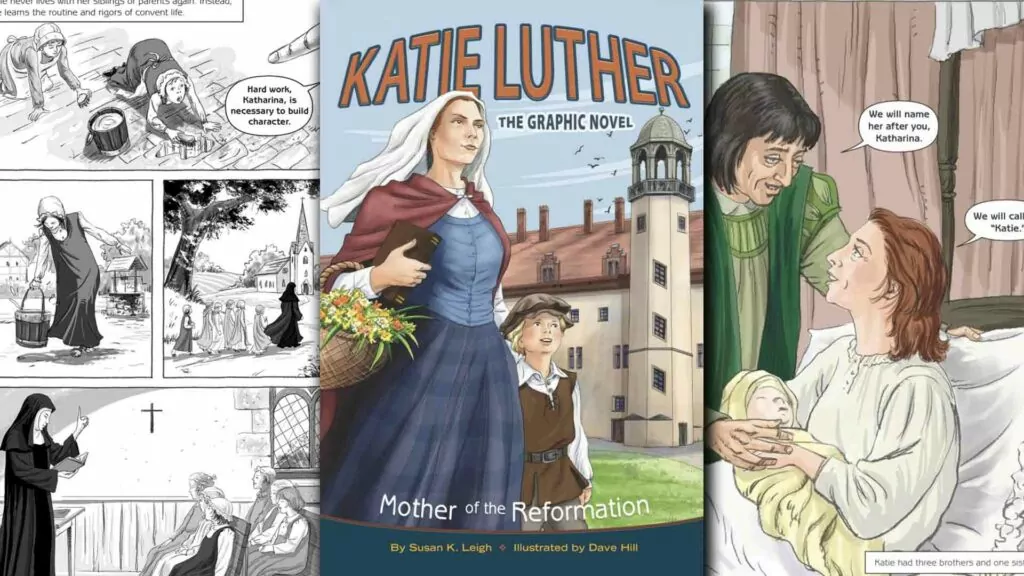
Katie Luther: the Graphic Novel

Mother of the Reformation by Susan K. Leigh illustrated by Dave Hill 95 pages / 2016 Rating: GOOD/Great/Gift My daughter recently asked, "Why aren't there more girl heroes? Why are the heroes always boys?" I explained that some of the heroes we read about are soldiers - generals and others – and that these are all boys because boys are bigger and stronger, so they make better soldiers. But that conversation also set me off in search of good examples of heroic women. And one very good example is Katharina Luther. An "ordinary" hero? This graphic novel biography is a sequel of sorts. In 2011 comic the same author and illustrator came out with Luther: Echoes of the Hammer. This sequel is slightly smaller, but every bit as good. Of course, not everyone will be impressed. I showed it to a friend and flipped through the page to share highlights from Katie Luther's life and he suggested that running a household was just something that women back then did. So, hardly amazing or exceptional. There's something to that. On the one hand, Katharina was extraordinary: as a nun she read Martin Luther's writings, even though that would have been a risky thing to do. Then, at the risk of grave punishment, she planned an escape from her convent. The first attempt was found out, and she was punished. But she tried again, and got out under cover of night, hidden away with 11 other nuns in empty barrels – she had conviction and courage! As the comic makes clear, she was also a remarkably capable woman – Luther's household was often very large, with 30 or more students, and as many as 11 children under their care (some of whom were nieces and nephews), plus many others, eating at the table. It was quite a feat to run this all, which was more restaurant and hotel than house. On the other hand, in many ways what Katharina did is what women have done through the ages: she was an able helpmeet, supporting her husband in his role, even as she took care of the children and managed the house. This supportive role is ordinary in the sense that many wives do this every day, but that hardly makes it unimportant. Supportive roles don't get the same recognition that leadership positions do, but they are every bit as vital. So this is a book I'm going to share with my daughter in the hopes that Katie Luther will inspire and encourage her in whatever role - whether ordinary or extraordinary - God sets before her. Conclusion At 95 pages, this is a comic that takes some time to get through, so it is not a casual, quick read. The artwork is just as the cover depicts - solid, colorful, and full of detail. There's also a lot of information packed in here, so anyone, whether teen or older, who wants to learn about Katharina Luther will enjoy it. That's why this would also be a good resource for schools. However, this is not a comic most students will pick up on their own. But if it were given as an assigned reading, the graphic novel format does make this pain-free reading for almost any student. It's a far easier read than any book, and more educational than many....

Red heart icon with + sign.
Book Reviews, Graphic novels

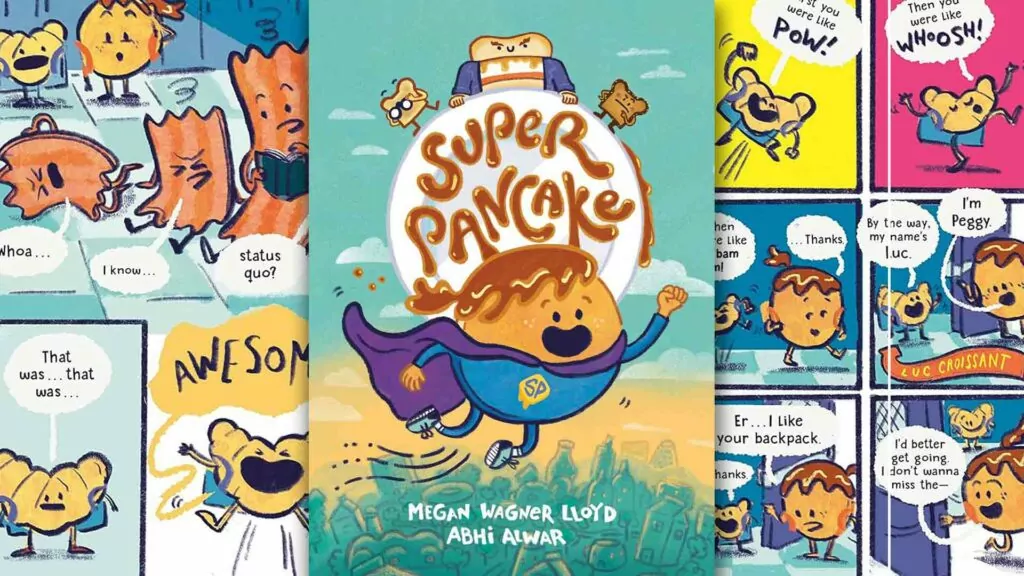
Super Pancake (2 books)

by Megan Wagner Lloyd illustrated by Abhi Alwar 2023 / 170 pages Rating: GOOD/Great/Gift Have you ever thought your breakfast could be heroic? If you have, this book is for you, with every character coming from the most important meal of the day. Our humble hero is Peggy Pancake, who comes from a suburban family of pancakes. Our story starts with Peggy late for breakfast (which seems to be cereal and milk) and missing the school bus. Not the best start to a day. When she gets to Winfred Waffle Elementary, a new kid, a croissant, is getting picked on by the “bacon bullies” and when Peggy stands up for him they become friends. Things take a dramatic turn when Dr. Egg, the town’s leading scientist, gives a lecture to the kids, and the bacon bullies snag a vial from his backpack and put it in Peggy’s lunch. What they meant for ill, ends up giving Peggy superpowers. But because she didn’t know what the bullies had done, she doesn’t know why she can suddenly fly. There’s the usual, learning about her powers section, and then she has to face off against the villain of the piece, Dr. Breakfast Sandwich and his henchtoast. Fortunately, she has a sidekick to help her, Luc, the croissant. Cautions would be a little breakfast food violence as Peggy beats back the bullies, and Peggy not being as forthcoming as she should be with her parents about her superhero identity. She does this to protect them but I don’t like the idea of kids keeping any secrets from their parents. Still, it is a minor element, as she did tell them right away when she first got her powers; they just didn’t believe her. A 2024 sequel, Super Pancake and the Mini Muffin Mayhem, has Peggy taking on a babysitting gig. But even with the help of two friends, she's still outnumbered by her five mini-muffin charges. And when a mad – or at least madly curious – scientist invents a mega laser that turns one of the mini muffins really, really big, it'll take a Super Pancake to set things right. It's another goofy, innocent adventure....

Red heart icon with + sign.
Book Reviews, Graphic novels

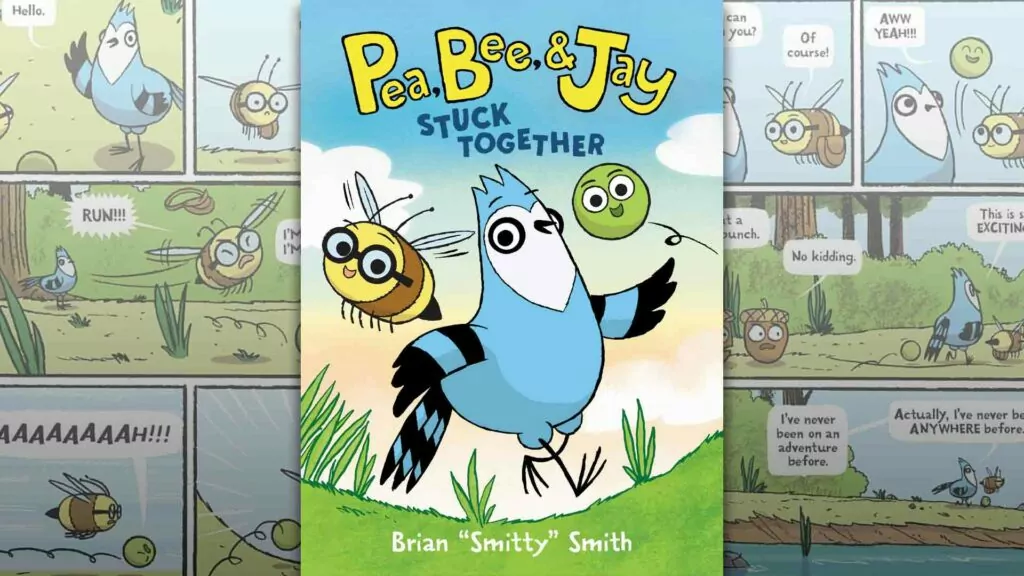
Pea, Bee, & Jay #1: stuck together (3 books)

by Brian "Smitty" Smith 2020 / 64 pages Rating: GOOD/Great/Gift A bite-sized vegetable, a bug, and a bird wouldn't seem the most likely of friends, but hey, sometimes the oddest combinations just work, right? Pea is fresh out of the pod, and likes to roll. When he rolls right past the farm fence into the neighboring forest, the young-un gets a bit flummoxed, especially after a storm hits. Fortunately, he rolls right into Bee, a very smarter pollinator, who seems to be hiding from her fellow bees. That's odd, sure, but Bee is willing to help Pea learn the ways of the forest, and the two head off together. What's Bee's first lesson for Pea? To stay clear of birds because birds like to eat bugs and peas. Who do they meet immediately after? A blue jay, of course. But while Jay is indeed a bird, he's an unusual sort. First off, he doesn't fly. His nest fell out of the tree when he was but a lad, and he never knew his parents, so there was no one to teach him. Second, he doesn't seem to eat bugs or peas. This might be the beginning of a wonderful friendship! The three comrades go on to tangle with a hungry fox, three overzealous acorns, a host of loyal bees – it turns out that Bee is actually the queen of her hive, and as the adventure rounds up, it's time for her to head back to her royal duties. Cautions If there's a downside to the story, it'd be how Pea sets out on his adventure: he heads past the farm fence on a foolish dare from his "friends" to go check out a tree where he knows his momma wouldn't want him to go. But, at story's end, he does get grounded for it and mostly accepts that as a punishment he had coming his way. Added bonus: Pea learns to stop caring what these "friends" think. He was supposed to bring back a leaf to prove he made it to the big oak on the other side of the fence, but when he loses the leaf on the way back, Pea doesn't care, because even if he can't prove it, he knows he made it. Conclusion There are all sorts of farm-related puns in this one, whether it's raspberries giving raspberries, or Bee telling some of her subject bees to "buzz off." It didn't even hit me, but my kids all thought the PB&J combination of characters was super clever. There are six books in this series so far, and our family really liked the first three. In the second, Pea, Bee, & Jay #2: Wannabees, Bee's constant absence from the hive leaves an opening for a usurper named Lenny. Lenny goes over the top with all the trappings of royalty, arranging for a red carpet, trumpets-blowing sort of entrance wherever he goes. That's kind of annoying, but the other bees figure, well, at least he sticks around! Bee learns her lesson – her people need her to be dependable – and when she is able to prove that Lenny is embezzling honey, she's in again as Queen Bee. The third, Pea, Bee, & Jay #3: Lift Off, is still funny, but not quite as good, with Jay learning how to fly with a little help from his friends. It also has a passing mention of diarrhea that it could have done without. The last three didn't grab anyone. They weren't horrible, but certainly aren't worth recommending. In Pea, Bee, & Jay #4: Farm Feud, things take a turn as two of the friends are feuding for almost the whole book. Yes, they get back together in the end, but their constant fighting meant it just wasn't fun to come along for this ride. Pea, Bee, & Jay #5: Gotta Find Gramps starts with the three watching a professional wrestling match, and then discovering Grampa Pea used to be a professional wrestler too. Professional wrestling is often bloody and sexual, and while there's none of the sex here, it's just not a "sport" I want my kids to spend a lot of time learning about. Finally, Pea, Bee, & Jay #6: The Big Bully, is well-intentioned, tackling the topic of bullying. But I think it's also naive, encouraging kids to befriend their tormenter, because, after all, he's probably just been bullied himself. That might even be true sometimes, but other times the bullies are just bullies. Many kids won't have the smarts yet to tell one sort from the other, making this "befriending encouragement" unhelpful and possibly even harmful. So, three is company, and there's no need to get the rest. These would be great for Grades 1-3, though our older girls and their dad appreciated them too, as a quick light read....

Red heart icon with + sign.
Book Reviews, Graphic novels

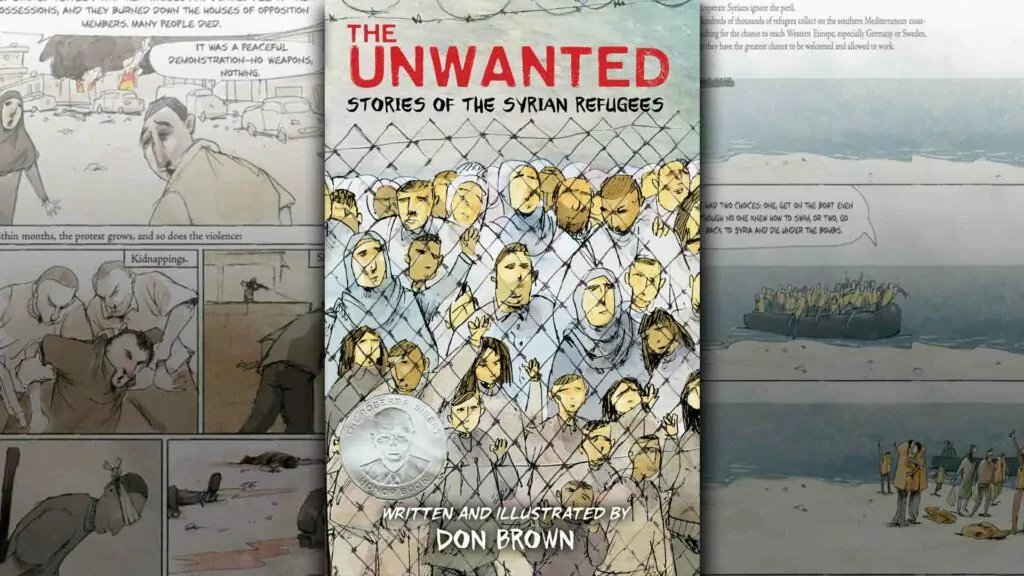
The Unwanted: Stories of Syrian refugees

by Don Brown 2018 / 104 pages Rating: GOOD/Great/Gift This is not a pleasant read because it lays out a tragedy for which there seems no ready solution. In 2011, Syria descended into civil war after the dictatorial ruler, President Bashar al-Assad, used his military force to attempt to squelch protests. But the deaths that resulted only sparked more protests. Soon Assad's own soldiers were joining with the protesters. And for the dozen years since then, the country has been in a constant state of conflict. And with constant warfare comes refugees. Of Syria's pre-war population of 22 million, at least 5 million have fled after their homes were destroyed or their friends, neighbors, or family members were shot and killed. That's what this book is about: the millions of Syrian refugees' search for safety and security. As Don Brown explains, many Syrians were forced to leave with little or nothing to their name. While there was compassion for them early, as the thousands fleeing turned into millions fleeing, the refugees became an increasing expense for any nation that allowed them in. So borders started being blocked, barbwire went up, and anyone who wanted to leave had to turn to smugglers, some of whom would deliver on their promises, sneaking the refugees across the border. But others would prey on the fleeing Syrians, taking their money but doing little or nothing for them. It is a sad, sad story, and it continues to this day. What Don Brown doesn't get into much is the legitimate security concerns countries have about letting thousands and hundreds of thousands of refugees in. Most are Muslim, and many are undocumented, making it easy for radical elements to hide amongst them. So, countries would want to check credentials before letting a refugee in. But how can you check credentials they don't have? At the same time, the Bible tells us that whoever is generous to the needy honors his Maker (Prov. 14:31). So, how can help be offered on this enormous scale? Cautions While Don Brown is very restrained in showing the impacts of the war, there are a few panels where, even as most of the violence occurred just out of frame, some blood is shown. That, and the overall topic matter, means this is one for high school. Conclusion I think the strength of the book is that Don Brown spends his time explaining the problem without pretending to have a solution. There is no simple solution. But there is a pressing need. And there are some individual actions that can be done, like praying for God's intervention. The peace that no one seems able to bring, only He can accomplish. Another possibility is donating to Syrian relief efforts like the Canadian Reformed World Relief Fund....

1 2 3 4 5 6 7 8