Transparent heart icon with white outline and + sign.

Life's busy, read it when you're ready!

Create a free account to save articles for later, keep track of past articles you’ve read, and receive exclusive access to all RP resources.

White magnifying glass.

Search thousands of RP articles

Helping you think, speak, and act in Christ.

Open envelope icon with @ symbol

Get Articles Delivered!

Helping you think, speak, and act in Christ. delivered direct to your Inbox!


Red heart icon with + sign.
Book Reviews, Children’s fiction

The Great Cake Mystery

by Alexander McCall Smith 73 pages / 2012 Rating: Good/GREAT/Give Precious Ramotswe must rank up there with some of the best-loved fictional detectives of all time, rubbing elbows with Hercules Poirot, Cadfael, and Father Brown. But as beloved as she is among adults, did you know that the star of Alexander McCall Smith's The No. 1 Ladies Detective Agency is also popular among children? McCall Smith has written a series of mysteries for children, featuring Precious when she was just eight years old. For those who don't already know, Precious lives in Botswana. In The Great Cake Mystery, Precious doesn't think of herself as a detective yet, but her dad thinks she has it in her. So when a classmate is accused - without any proof – of eating someone else's sandwich, she is upset. Precious, you see, is a kind girl who wants to help others. In this case helping means setting a trap to catch the real snack stealer. SPOILER ALERT: Precious bakes a cake full of glue, covers the whole thing with icing, and places the cake outside the classroom "on the shelf where the children left their bags." And not too long afterward the whole class hears the howling cries of the little thieves - monkeys! Precious has saved her friend from the mean accusations of their classmates. And, this being an old-fashioned sort of book, those classmates are truly sorry for what they thought and said. This is a charming book, made all the more so by the folksy illustrations throughout, at least one on every two-page spread. McCall has written four other children's mysteries starring the young Precious, with The Great Cake Mystery billed as "Precious Ramotswe's very first case." (In a confusing twist, that same billing is shared with at least one edition of another book in the series, Precious and the Monkeys. Whether The Great Cake Mystery is the first or not, it serves as a wonderful introduction to the young detective-to-be.) CAUTION We've read two other "young Precious" mysteries so far, and our daughters have loved both The Mystery of Meerkat Hill and The Mystery of the Missing Lion. I had a slightly different take. While I loved the former, I thought the latter was marred by an insertion at the end where they treat a lion as if he were a person. Precious ends up giving a brief lecture about how all lions should live free, including the missing tame lion they'd just recovered, and all the adults side with the child. It is, on the one hand, no big deal - it is only a few pages in an otherwise enjoyable story. But it rankled me because this childish "feel-good-ism" is rampant in our culture, and I don't think we need to be feeding any of it to our undiscerning children. The fact is, a tame lion would most likely die in the wild and a well-treated tame lion is not an oppressed lion. So what Precious proposes is both completely unnecessary and quite likely very harmful to the very lion she wants to help. We're taught that good intentions are what really matters, but God says otherwise (Prov. 27:14) – if our well-meaning efforts cause damage, then we need to stop doing this well-meant damage! CONCLUSION My wife and I didn't know about this brief lecture until we came across it in the audiobook with the kids listening along. It wasn't objectionable enough to stop listening to the book we were already three-quarters of the way through, but if I was buying this series for a Christian school library I would get The Great Cake Mystery and The Mystery of Meerkat Hill, but give The Mystery of the Missing Lion a pass. There are two others in the series but we have yet to read (or listen to) them. I should note that the audiobook versions are truly remarkable, with the reader delivering all sorts of wonderful accented voices. Oh, and if your kids like this series, they might also enjoy a five-book series McCall Smith wrote about Akimbo, a boy who lives on a game reserve in Africa. I've reviewed those here. All, in all, these are books that children even as young as 5 may really enjoy listening to, and 9 year-olds and up could really enjoy reading. Our whole family was thoroughly charmed. This review first appeared on ReallyGoodReads.com....

Red heart icon with + sign.
Book Reviews, Children’s fiction, Teen fiction

Brave Ollie Possum

by Ethan Nicolle 373 pages / 2019 Rating: Good/GREAT/Give If you were ever a scaredy-cat, or if you might have one in your family, this could be a fun story to read together... though you might have to do so during the daytime, with all the lights on. It's about nine-year-old Ollie Mackerelli, who is so afraid of things that go bump in the night that he's taken up permanent residence in his parents' bed. This is about how he learned to be brave. But his transformation doesn't happen quickly. Things start off with cowardly Ollie running to his parents' bedroom yet again to crawl under the sheets with them. That's a safe place to be, but it does come with a cost: three people in a double bed leave his dad with bags under his eyes and a scowl on his face. He wants to know when Ollie is going to grow up and stop being afraid of imaginary monsters. Then, mysteriously, Mizz Fuzzlebuzzle, a very strange, very large lady shows up at the Mackerellis' door. She offers to take their son to a "special go-away fun place where children like Ollie can be taken and all his fears will be gobbled up." Who is this lady? Her card says she specializes in "professional anti-scary therapy and comfortology." Desperate, the sleep-deprived parents hand off their son to the expert, hoping she'll be able to help. But here's the twist: Mizz Fuzzlebuzzle isn't actually an expert in anti-scary therapy. She's actually an ogre. And all those bumps in the night? It's her pet monster making them. Ollie was right all along! But being right won't get him out of the clutches of this ogre. And to make matters worse, she wants to eat him. It turns out scared children are an ogre delicacy. But despite being scared, Ollie gathers enough courage to spray the ogre with one of her own magic potions. Sadly, ogres aren't susceptible to magic potions. People are, though, so when the ogre spits the potion right back at him, Ollie is transformed into a creature that passes out in the face of danger: Ollie becomes a possum. The rest of this rollicking tale is about Ollie, with the help of some animal friends, learning what true courage is: that it's not about being unafraid, but about facing our fears and going on anyway. The author of Brave Ollie Possum is one of the folks behind the Christian satire site Babylonbee.com so the book is every bit as funny as you might expect. Another highlight is the artwork. This is a full-size novel, but it could almost be called a picture book, with fantastic, fun illustrations every three pages or so. CAUTION The only caution I'll note is that this book about being brave is, at times, scary. I think it might be the book I am most looking forward to reading to my children, but there is no way I could read this as their bed-time story, or even in the middle of the day. I'm going to have to wait a bit, probably until they are all at least nine. CONCLUSION But for kids ten and over, particularly boys, this will be so much fun. And for certain 9-year-old kids who are scared of what goes bump in the night, this could be a good day-time read with mom and dad to help a little one learn what being brave is all about. ...

Red heart icon with + sign.
Adult fiction, Book Reviews, Teen fiction

The Winter King

by Christine Cohen 351 pages / 2019 Rating: Good/GREAT/Give 15-year-old Cora lives in a time of horses, and swords, and meat pies. It's also a time of poverty, and bitter winters, and threadbare clothing, and not enough food to make it through to Spring. To make things even worse, ever since Cora’s father was killed, the village has treated her and her family as if they are cursed, and as if that curse is contagious. But no matter, Cora is resourceful, and she’ll do just about anything to ensure her family lives through the winter. But how does a young girl stand up, by her lonesome, to the village god, the tyrannical Winter King, who is taking their food? I didn’t know quite what to think of this book in the early stages. While the other villagers were religious, Cora was not. And she was the hero. So how was this a Christian book, then, if the god in the story seemed to be the bad guy? Well, as one reviewer noted, this is a very Protestant book in that Cora rejects a false religion in favor of the true one. She rejects the false representation of the Winter King that the village’s religious authorities maintain. But then she uncovers a book that tells a very different story about this King, presenting instead, a God who loves. CAUTIONS Cora is bitter and sometimes manipulative, and so driven to keep her family fed that she does stuff that she should not. There's good reason for her desperation – death is reaching for her whole family – but that it is understandable makes it tricky ground for the younger reader to tread. This is not a heroine in a white hat, and for the pre-teen, or even younger teen reader, used to simpler morality tales, they might not have the discernment skills yet to be able to cheer on a hero whose actions are not always praiseworthy. I feel like I'm making Cora sound darker than she is. There is surely darkness in her – but there is also a darkness around her that she is fighting, futilely at first. And then hope comes. CONCLUSION From the cover to even the way the pages are laid out, this is a gorgeous book, with a deep and satisfying story. I'd recommend it for 15 and up, but I know adults will find this has real depth to it that they'll enjoy exploring. ...

Red heart icon with + sign.
Adult fiction, Book Reviews, Teen fiction

The Seraph’s Path

by Neil Dykstra 2019 / 475 pages Rating: Good/GREAT/Give Maybe I should have gotten someone else to review this, what with me sharing the same last name as the author. But this is a fantasy title, so I had to take a peek. And once I got started I wasn’t going to hand it off. Besides, the two of us aren’t actually related. I know Neil, but only well enough to recall he is the superior volleyball player, and nowhere near well enough to have had an inkling he could serve up something like this. It’s remarkable! The Seraph’s Path has quite the cast of characters, but it is mostly the story of Dyrk, a young horse trainer who wants to make something of himself, in part, because his parents don’t seem to think about him much at all. Our story begins with Dyrk determined to enter a competition his father won’t even let him watch. Somehow he finagles his way in, and reaches the final round, a free-for-all among 16 mounted soldiers-in-training, with the last man standing guaranteed entry into the King’s own College. I won’t tell you what happens, but I will say that for every good thing that happens to Dyrk something bad soon follows…and vice versa. The wonder of fantasy fiction is that anything can happen. Young children can open a wardrobe and get transported to a world of talking beasts. Or little fellows with hairy feet can be trusted with a mission that the most powerful could never accomplish. Or a horse trainer can suddenly find himself delivering the mail mounted on a flying tarn. The problem with fantasy fiction is just the same: anything can happen. That means if the author doesn’t have a tight hold on the reins the story can run amuck, and quickly lose all connection with the real world. If you haven’t read much fantasy, you might think a world of dragons, gryphons, and flaming swords couldn’t possibly ring true. But the author has pulled it off. In The Seraph’s Path, Dyrk doesn’t understand the opposite sex, and he’s prone to dig himself deeper via ongoing procrastination, and then he can’t figure out how best to ask for forgiveness. There’s something very real about this made-up world. I was also impressed with how patient the author is and I’ll give one example. In this world, the god Arren is served by seven Seraphs. Dyrk sends his prayers via those angelic servants because he thinks Arren is too holy to approach directly. If that strikes you as Roman Catholic-esque, I’d agree. But isn’t Dyrk our hero? So how can he, via his repeated prayers, be teaching us something so very wrong? Well, a few hundred pages in Dyrk has his first encounter with people who talk to Arren directly. And he doesn’t know what to think about that.  By the end of this book, the issue is still unresolved, but our hero has been given something to think about. Caution I can only think of one caution worth noting. At one point a key character faces sexual temptation, and while the passage is not lurid – there’s nothing here that would make grandma blush – it is sad and realistic enough that pre-teen readers might find it distressing. Conclusion Dykstra has engaged in some downright Tolkien-esque world-building, with not only exotic creatures and nations to discover, but layer upon layer of legend and history shaping the events. If you never made it through The Hobbit, or you haven’t read a fantasy book with a glossary in the back to help you keep track of the characters, then this might be too intense a read for you. But if you want a whole new world to explore, and a story that’ll not only entertain but really get you thinking, you’re going to love The Seraph’s Path. I finished this nearly 500-page tome in 3 days, and the only downside to it was the cliff-hanger ending. So I was very happy to discover that the 700-page sequel, The Seraph’s Calling has just been released. I look forward to finding out what happens next! You can buy both books at Amazon.com and Amazon.ca....

Red heart icon with + sign.
Adult non-fiction, Book Reviews

The Gospel Comes With a House Key: an instructive, inspiring, downright intimidating look at Christian hospitality 

by Rosaria Butterfield 2018 / 240 pages Rating: Good/GREAT/Gift ***** This is a scary book. I have heard of several people putting it down after only reading a chapter or two of it, feeling overwhelmed by Rosaria Butterfield’s seemingly heroic examples of daily hospitality to her numerous neighbors and friends. As Carl Trueman states in his recommendation, “She sets the bar very high - and there is plenty of room here for disagreement on some of the proposals and details.” But fear not! As Trueman goes on to say, “The basic case, that church is to be a community marked by hospitality, is powerfully presented and persuasively argued.” Think of it this way. One of your friends just memorized the entire book of Ephesians. You think that’s admirable, but it sounds like more than you can handle. Yet, there are some verses in Psalm 4 that you want to memorize because they comfort you, so this reminds you to do it already. Or maybe your cousin enthusiastically tells you he is part of a “Read the Bible in 90 Days” group that really helped him see the connections between Scripture portions and helped him improve his Bible-reading habit. But when you hear he was reading one hour each day, that sounds like more than you can do. Yet, his example encourages you to increase the amount you are currently reading. Rosaria Butterfield’s The Gospel Comes With a House Key is about using hospitality to spread the gospel. It is about loving your neighbor as yourself and thus spreading God’s love, peace, and salvation to the dying world that is next to you. It is about viewing where you live as the location where God placed you and figuring out how you can, as the saying goes, “bloom where you are planted.” Whose house is it? Hospitality is similar to the Greek word philoxenia, which means “love of the stranger.” The hospitality Rosaria is encouraging is not about inviting your relatives and fellow church members over for coffee or soup and buns on a Sunday, or taking them a casserole at a difficult time. What Butterfield is talking about is what she calls “radically ordinary hospitality.” Those who live out radically ordinary hospitality (ROH) see their homes not as theirs at all but as God’s gift to use for the furtherance of his kingdom. They open doors; they seek out the underprivileged. They know that the gospel comes with a house key. They take biblical theology seriously, as well as Christian creeds and confessions and traditions…. Engaging in ROH means we provide the time necessary to build strong relationships with people who think differently than we do as well as build strong relationships from within the family of God. Cost in time and money But how can we manage this, when we are already so very busy, and finances may be tight? Rosaria gives the answer: Practicing ROH necessitates building margin time into the day, time where regular routines can be disrupted but not destroyed. This margin stays open for the Lord to fill – to take an older neighbor to the doctor, to babysit on the fly, to make room for a family displaced by a flood or a worldwide refugee crisis. Living out radically ordinary hospitality leaves us with plenty to share because we intentionally live below our means. In other words, we may need to learn to leave some space and not to schedule every moment of every day, filling it up with things that we desire to do. Those who become parents find that life cannot follow a strict schedule, because children have a way of barfing, bruising themselves, or battling with siblings that is always unscheduled. In the same way that we scaled back our desired goals then, we ought to do it to allow for hospitality. If we truly believe that we should “be there” for others, then we may need to be open to the unusual and unexpected. On the other hand, it is possible as well to set aside a period of time each week in which you reach out to your neighbors. Rosaria and her husband started this by putting a picnic table on their front lawn on Thursday evenings and providing food for whoever wandered by and wanted to join them. This eventually grew into a well-attended and beloved activity for a lot of their neighbors, but it started with one dinner time. If you don’t have a house or a picnic table, why not try to visit a neighbor or invite a coworker to have lunch or dinner with you? As for cost, all of our money comes from the Lord – might He not want you to allocate some of it for the hospitality that He asks you to do? Rosaria writes: Daily hospitality can be expensive and even inconvenient. It compels us to care more for our church family and neighbors than our personal status in this world. Our monthly grocery bill alone reminds us that what humbles us cannot hurt us, but what puffs up our pride unwaveringly will. But what if we run into people who have different viewpoints than ours? What kind of example will that be for our children? Here is where we really need to believe that hospitality is something that God calls us to do. The truly hospitable aren’t embarrassed to keep friendships with people who are different. They don’t buy the world’s bunk about this. They know that there is a difference between acceptance and approval, and they courageously accept and respect people who think differently from them. They don’t worry that others will misinterpret their friendship. Jesus dined with sinners, but he didn’t sin with sinners. Jesus lived in the world, but he didn’t live like the world. This is the Jesus paradox. And it defines those who are willing to suffer with others for the sake of gospel sharing and gospel living, those who care more for integrity than appearances…. the sin that will undo me is my own, not my neighbor’s, no matter how big my neighbor’s sin may appear. What will I say to them? If you feel like you don't know what to say to a stranger, just remember that people always like to talk about themselves. Get to know them. Ask about their interests and try to find a common ground in gardening, cars, sports, cooking, knitting, reading, or whatever. If they have a difficulty they are enduring, offer to pray for them before you end your visit – just a simple prayer. Be friendly. This isn’t the type of evangelism where you have to lead them down the Romans Road and get them to sign on the dotted line at the end of your time together. Jesus is the one who saves. The Holy Spirit will draw some people to God, and we are just planting or watering the seeds. We may or may not get to do the harvesting. But the reason we want to be hospitable is because people need to be rescued from their sin, just as Jesus rescued us from our sin. We are living examples of what God has done, and what He can do for others. Hospitality, then, is a chance to put God’s work in us on display. Radical hospitality shines through those who are no longer enslaved by the sin that once beckoned and bound them, wrapping its allegiance around their throat, even though old sins still know their name and address. Used by God Rosaria gives a list of how she hopes and prays that her book may inspire us to: Use our home, apartment, dorm room, front yard, gym, or garden to make strangers into neighbors and neighbors into friends and friends into the family of God Build the church by living like the family of God Stop being afraid of strangers, even when some strangers are dangerous Grow to be more like Christ in practicing daily, ordinary, radical hospitality Be richly blessed by the Lord as He adds to His kingdom Be an example of what it truly means to be a Christian to the watching world Have purpose, instead of casting about for our own identity, or wondering what to do with our time Conclusion Let’s not be sidelined by fear that people will hurt us or that we won’t know what to do or say. Using our home regularly to show hospitality brings glory to God, serves others, and is a way of living out the Gospel. It may seem sacrificial, but then aren’t we called to die to ourselves and live for God? So don’t be afraid to read the book. Be inspired, and pray over what God would use you to do. ...

Red heart icon with + sign.
Adult fiction, Book Reviews

Greg Dawson and the psychology class

by Jay Adams 2008 / 149 pages Rating: Good/GREAT/Give This is a novel, but it'd be more accurate to call it a textbook masquerading as a novel – the goal here is education, not entertainment. Jay Adams' fictional protagonist Greg Dawson is a preacher who lives near a Christian college. Some of the students want to know the difference between the psychological counseling theories they are being taught and the biblical counseling Greg Dawson uses. Via a series of informal conversations with Pastor Dawson, the students learn that the psychology they’re being taught at their Christian college is built on secular counseling theories. They are asked to consider just how many different secular counseling theories there are. These theories claim to be built on insights into what Man is really like, and yet the different theories disagree with one another, and sometimes wildly. So how are we to evaluate them? Dawson points students to the Bible, asking them to examine how many of the theories line up with a biblical understanding of our inner nature. So long as these secular theories understand Man outside of our relationship with God how can they understand what Mankind is really like? Dawson asks them to also consider that most of these theories don't acknowledge our sinful nature, or understand our purpose here on earth. As the back of the book details, some of the other issues explored include: the difference between apologizing and forgiveness the place of evangelism and faith in Biblical counseling Is all truth God's truth? some specific issues such as depression, mental illness, and marriage Adams is only one of many experts to consult when it comes to biblical counseling. Others include Ed Welch, Heath Lambert, Wayne Mack, Paul David Tripp and David Powilson. But this book is an ideal introduction to the subject – the novel format makes for an easy, yet highly educational, read. And if you like this one, you'll be interested to know Jay Adams has written two other "Greg Dawson" novels: The Case of the Hopeless Marriage and Together for Good: Counseling and the Providence of God....

Red heart icon with + sign.
Adult biographies, Book Reviews

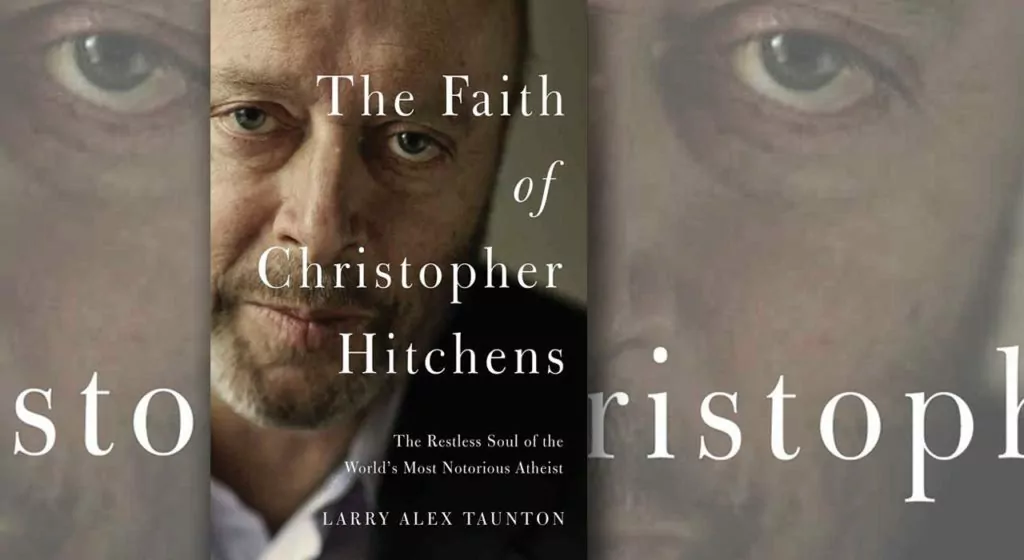
The Faith of Christopher Hitchens

by Larry Taunton Biography 181 pages / 2016 Rating: Good/GREAT/Give The late Christopher Hitchens is best known for his book god is not Great: How Religion Poisons Everything. He was an aggressive atheist who made his living blaspheming God. So why would we want to know more about him? And why would Christian author Larry Taunton want to write a book about him? Because this book is much more about God’s graciousness than it is Hitchens’ rebellion. And because Hitchens wasn’t quite what he seemed. Taunton writes of Hitchens having “two sets of books” just as fraudulent accountants do, with the one set for the viewing public, and the second private set that gives the true tally. Hitchens’ public face was that of the confident anti-theist who thought it made good theater to claim God was both unforgivably evil and non-existent. Meanwhile, the private Hitchens was spending more and more time with God’s followers, calling some of them friends, and even studying the Bible with one or two. If he wasn’t deliberately seeking God, this other Hitchens’ interest in the truth was bringing him closer and closer to his Creator. The author, Taunton, got to know Hitchens after arranging public debates between Hitchens and prominent Christians. Often times after these debates the two public combatants, Taunton, and others, would head out to a late dinner where the debate would continue. This is how Taunton and Hitchens became friends. When Hitchens was diagnosed with terminal cancer the late-night debating seemed more important to them both. God not only brought Christians into Hitchens' life, He also gave this materialist a sure knowledge about the reality of evil. The atheistic/materialistic worldview has no room for right and wrong – things just are. We don’t speak of chemical reactions as having any sort of “moral quality,” and in the atheist worldview all we are is chemical reactions. So when atheists speak of evil they are speaking of something they have no explanation for. Hitchens seemed to understand this, but, particularly after the 9/11 terrorist attack, was also certain there was evil. Hitchens bravely denounced radical Islam, which lost him friends among the Left but more importantly exposed – seemingly to Hitchens himself – the big hole in his godless worldview. It was another nudge in a Godward direction. While Taunton doesn’t make any claims about a deathbed conversion for one of the world’s most notorious atheists, he shows us that God was ever so gracious to Hitchens, teaching and confronting him repeatedly. We don’t know if Christopher Hitchens ever repented, but we do know God gave him every opportunity. Caution The only caution I’d note is that some of the Christians noted in the book – some who debated Hitchens and gave him something to think about – have some notable flaws in their theology, the most common being some sort of bow to theistic evolution. This isn’t much of a concern in this book but I share this only as an alert to any readers who might be spurred to look up the works of some of these mentioned men. Conclusion This is a close-up look at a wavering atheist that concludes without a clear happy ending – that makes it strange, particularly for a Christian-authored book. But the glimpse at what God was doing in Hitchens’ life makes this a compelling book. God gave Hitchens time, allotting him 16 months after his initial terminal cancer diagnosis; He brought him into close company with men who were able to answer his objections, and He also made Hitchens aware of evil. Why read The Faith of Christopher Hitchens? Because one can’t help but be struck by God’s graciousness in the life of Hitchens....

Red heart icon with + sign.
Children’s fiction

BOOK REVIEW: Love That Dog: a novel

by Sharon Creech 2001/ 86 pages Rating: Good/GREAT/Give A review of a read-aloud book, to be read aloud. ***** As I started reading the very first page of this book, I thought it was dumb. I’ve never been a fan of poetry, particularly if it was the type of poetry that didn’t even rhyme. And that’s what was in this book. But I kept reading and found out, on that very first page, that the author agreed with me! The book is by Jack, a boy in elementary school, who doesn’t like poems either. Each day he writes a journal entry, for his teacher Miss Stretchberry, and there on the very first page, in his first entry, he tells her his thoughts on the poem they have just read in school. He writes: If that is a poem about the red wheelbarrow and the white chickens then any words can be a poem. You’ve just got to make short lines. It was a book of poetry, by a boy poet, who didn’t like poetry! So I kept reading, and I started learning. Jack’s teacher showed his class poems. Some did rhyme, some were by famous writers, and some weren’t very good at all. But I started learning, along with Jack, that poetry doesn’t always have to rhyme, or even have a set rhythm. Sometimes it can just be a different sort of way to express your thoughts, to lay them out, so people understand them better.  Poetry can be easier then teachers sometimes make it. And it can be powerful. And it can make you cry. I started reading this book, about a boy learning about poetry, and making poems, and expressing beautiful thoughts about his beautiful dog, and by the time I got to the end of it I realized it wasn’t dumb at all. Love that book....

Red heart icon with + sign.
Book Reviews, Children’s non-fiction

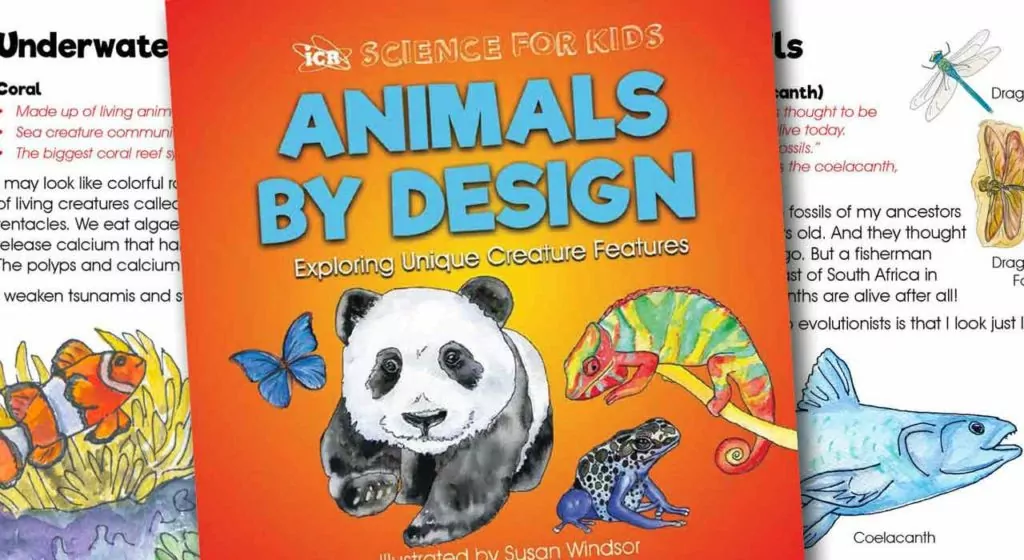
Animals by design: exploring unique creature features

by ICR illustrated by Susan Windsor 125 pages / 2018 Rating: Good/GREAT/Give Mexican walking fish, lantern fish, immortal jellyfish, and zorses – those are just some of the crazy creatures featured in this fun little book. Every two-page spread showcases another animal, and even when it’s one you’ve heard of before, there’s sure to be cool details that’ll surprise you. Animals by Design is published by the Institute for Creation Research. That means that, in addition to all the fascinating facts, a clear Christian perspective is also included. The point of this book is to introduce our children to how awesome our God is: hey kids, just look at the amazing, bizarre, surprising, unique, and simply astonishing creatures He’s made! This has been sitting on our coffee table, off and on, for a few months now, and it turns out I was the only one in the family who hadn’t been regularly reading it. My wife and girls had all been taking turns flipping through it. It’s an easy book to dip in and out of – it doesn’t require a big time commitment – because each animal can be read on its own. So, maybe this time I’ll learn a little about zorses, and the next time I sit down at the couch, I can always find out then what makes an immortal jellyfish immortal. The colorful drawings will appeal to kids but it’s a kids book that mom and dad and anyone interested in animals or science will love too. In the US you can find it at ICR.org and in Canada you can order it through the Creation Science Association of Alberta.                  ...

Red heart icon with + sign.
Book Reviews, Teen fiction

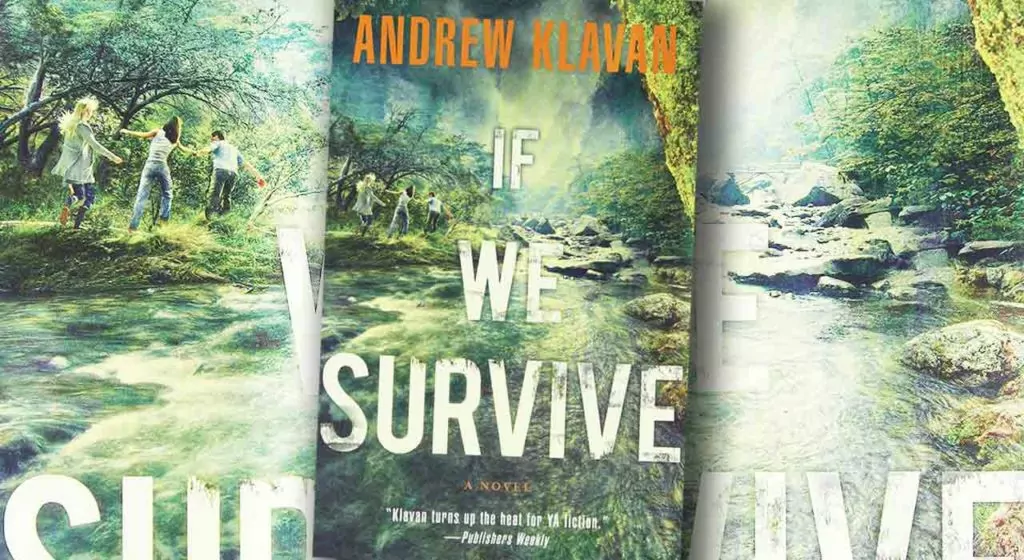
If we survive

by Andrew Klavan 352 pages / 2013 Rating: Good/GREAT/Give "We came to Costa Verdes to build a wall. I just wish I could tell you that all of us made it out alive." Will Peterson is a 16-year-old visiting a small Central American village with his church's mission team, there to help rebuild the local cinder-block school. They've finished the work and are waiting in the cantina for the bus to take them back home when the room is suddenly filled with rebel soldiers and the pot-bellied, smiling waiter, who had been joking with them only moments before, is now on the floor, shot dead by the rebel leader. What happens next is a not-so unusual chase-type adventure. The rebels have taken over the government and are executing anyone for any reason, and they don't want to let any American witnesses get out of the country alive. So now these church kids, along with an unexpected helper, are on the run, barely staying ahead of these murderous bandits. What makes this something special is the characters in it. The most intriguing might be Jim Nolan, a 16-year-old intellectual who has read the biography and op-ed articles of the country's rebel leader...and who believes everything he's read. Even when the rebels start killing people, Jim is sure they're fighting for justice. Even when the guns are turned their direction, he's just as sure that it's all a horrible mistake, and if he can only talk to someone, things can be straightened out. Jim steadfastly holds onto his rebel sympathies despite all the bloodshed around him. Author Andrew Klavan makes clear why Jim remains so loyal: because a lot of what he's being reading, about how the government was oppressing the country's poorest, is entirely true. Klavan isn't taking a cheap shot at the naivety of liberals here – this is a more nuanced look that admits the problems the Left points out might well be problems, even as the solutions they suggest are no solutions at all. Or, in the context of this story, just because the government is bad doesn't make the rebels good. That’s an important lesson for Klaven’s target age group to learn, as teens (and many an adult too) will often stake their ground, not on God’s Truth, but simply as a knee-jerk reaction against lies they’ve been able to see through. Christians need to understand that the opposite of a lie is not necessarily the truth – as was once said, there are two ways to fall off a horse, and to react against one lie might well be to overcompensate and fall for the equally wrong but opposite error. Will is also a well-developed character. He came on the trip as a way of escaping his home life: mom and dad are always arguing and, he thinks, on the path to divorce. But now, unbelievably, things have gotten a whole lot worse, and as Will and the others bounce from one crisis to another, he has to battle a very understandable sense of panic. He does so by remembering two things: a Hemingway quote that cowardice is "a lack of ability to suspend the functioning of the imagination." advice from his youth pastor, who once told the group, "Don't worry about anything – pray about everything." CAUTIONS While praying is always good advice, the way Will's prayers are depicted in the story makes it seems like it is more the act of praying, and not the God he is speaking to, that really helps Will. Another caution worth noting is that while the church mission group is Protestant (and seemingly some sort of conservative Evangelical) there are positive, if brief, portrayals of other religions. This includes Roman Catholicism, in which a priest has a key role in saving them, and the villagers' ancient spirituality, when the missions group is invited to sit in on a pagan festival of lights. However, Will keeps to the facts, describing what they see, but not digging into what it all means. A discerning reader would have reason to presume Klavan believes Roman Catholicism isn't importantly different from Protestantism, but that isn't a message the author is trying to hammer home here. CONCLUSION This is a gripping read that any teenage boy would really enjoy, and dad won't mind either. And if dad does join in, this could be a leap off point for some really good conversations about: the American role as policeman of the world one-sided news coverage, both from the Left and Right, and how that compares to what God tells us about the importance of hearing both sides in Prov. 18:17 courage and what it really involves what prayer to God is actually why we find nice people following other gods, or worshipping God in wrong ways So, overall, I'd recommend this for teen guys with a little discernment, and a willingness to talk things through with their parents....

Red heart icon with + sign.
Adult non-fiction, Graphic novels, Teen non-fiction

The Faithful Spy: Dietrich Bonhoeffer and the plot to kill Hitler

by John Hendrix 176 pages / 2018 Rating: Good/GREAT/Give  The world “pastor” is not often paired with words like “plot” or “kill.” But when the Nazis took over Germany, and used nationalism and intimidation to silence its churches, and then set out to conquer the world, Pastor Dietrich Bonhoeffer had to do something. And he felt himself pulled to do what would once have been unthinkable to him: Bonhoeffer joined a conspiracy to kill his country’s leader, Adolf Hitler. At 176 pages, and text-dense, author John Hendrix has a lot of space to explore Bonhoeffer and his time.  He starts with his birth and family life, before showing how World War I impacted the Bonhoeffers – one of Dietrich’s older brothers was killed – and how the runaway inflation that came shortly afterwards destroyed everyone’s savings. In 1921 a German could exchange 75 marks for 1 US dollar, but by the end of 1923 to get that same US dollar he would have to bring a wheelbarrow, or maybe a dumptruck, to carry the 4 billion marks that’d now be needed. Money, jobs, and hope were scarce, and this set the scene for the rise of Hitler. Germans wanted a way out, and Hitler presented himself as a savior. Meanwhile, Bonhoeffer was learning, via travels in Europe and America, that a love for one’s country doesn’t mean you have to support everything your government does. So when the Nazis, only a few months after they came into power, fired Jews from any government positions, Bonhoeffer was one of the few church leaders to speak out. He published a public paper called “The Church and the Jewish Question” in which he laid out an explicitly Christian justification for resisting the government. He described three ways the Church can and should respond to an evil government. Question the State and its methods: a True church must reject government encroachment on its beliefs Aid the victims of State actions: the Church has an unconditional obligation to the victims... Strike back: it is not enough to just bandage the victims under the wheels, but to put a spoke in the wheel itself! As you can tell, this “comic book” gets into some big and heady topics. What’s more, “how to deal with a hostile State?” is a topic of growing relevance these days. That makes this an important book, but also one that should be discussed between parent and child. There is some serious theology here, and while the general thrust is right on – we owe our allegiance first and foremost to God, even if that means resisting the State – what exactly it looks to live that out, back then and today, is a topic too weighty for a teen to work out on their own. This is a graphic novel worthy of both a teen and adult audience. The thought and research that’s has gone into it is evident throughout. Even the coloration of the book is fascinating, with Bonhoeffer consistently shown either in teal or with a teal background, the Nazis always highlighted with the use of red, and when death makes an appearance there is a predominance of black. I’d recommend The Faithful Spy for any teen who has begun to think on big issues, and anyone anyone interested working through what it means to live to God’s glory in tumultuous times. ...

Red heart icon with + sign.
Adult non-fiction

You Who? Why you matter and how to deal with it

by Rachel Jankovic 235 pages / 2019 Rating: Good/GREAT/Gift I began reading my wife’s copy of You Who? only after she shared comments from the online critics who were savaging it. A good encouraging review won’t necessarily sell me a book – I have too many others stacked up already competing for my attention – but when a certain sort of critic just hates a book then my curiosity is piqued and I want to know, “What could have gotten them that riled up?” So I owe Rachel Jankovic’s detractors thanks for getting me started on one of the best books I’ve read this year. The author’s premise is simple: “Who am I?” is a question everyone asks and most of us answer badly. The most common answers involve our jobs: people will say “I’m a farmer” or “I am a small business owner.” But there’s a problem with identifying with our career: we can lose our job, or retire from it. And who are we then? Others will identify themselves with their abilities or interests (“I am an artist,” or “I am a surfer”), or in their marital status (“I am single”), what groups they belong to (“I am Canadian”), or in not belonging to any groups (”I am a free spirit”). And many women look for their identity in the roles of wife and mother. But here, too, problems exist because here, too, things can change: over time our abilities fade and our interests can shift. Over time the country we were once proud of may betray the values we thought it held. And over time even the most loving spouse will repeatedly let us down. Sure, our children can be a frequent source of pride and joy, one week sitting side by side in the church pew, hair combed, shoes polished, lovingly sharing the songbooks, but the next week it’s just as likely you’ll be taking two out at a time, their legs kicking and little lungs giving full vent to their protests in front of the whole congregation. If we find our identity in being the perfect parent, it doesn’t take any time at all for that bubble to burst. So if those are all wrong answers to the "Who am I?" question, then what’s the right one? Jankovic wants to: “encourage and equip believing women to see their identity in Christ as the most essential part of them, and to see all the ways that will work its way out in their lives, manifesting itself as strength, dignity, and clarity of purpose.” Encouraging believers to make Christ our first and foremost shouldn’t be controversial. So why were critics upset? Because they were confused, mistaking Jankovic’s call to God-honoring obedience for some sort of legalistic works righteousness. There’s a sense in which that’s understandable. Legalism (or works righteousness) and antinomianism (or lawlessness) are a set of paired theological errors. The legalist can’t believe God’s grace is really free, so he wants to earn it by obeying God’s law and, like the Pharisees of old, will even add to and expand on God’s laws. Meanwhile, antinomians recognize that the law can’t justify us and conclude that since we can’t measure up to God’s standard then Jesus must have come to abolish all those pesky Commandments. These are huge, dangerous errors, but if you speak out against one, it’s inevitable someone will mistake your point and think you are a proponent of the opposite error. And that’s what’s happened here. In the Reformed circles that this magazine serves we all know we can’t earn our way to heaven, but if we have a tendency to err in one direction or the other then we’re probably more likely to tip in the legalistic direction (just think of all the additional rules we once had for Sunday and how often we heard "dat niet op Zondag"). But in the evangelical world – Jankovic’s target audience – the error is on the other side. In those circles many believe sin is no big deal because, after all, the more we mess up, the more it just shows how gracious God is. Or as the current star of the Bachelorette reality TV show (a self-professing Christian) put it this month, after she had sex with one contestant and went naked bungee jumping with another: “I refuse to feel shame….I am standing firm in believing that maybe God wants to use a mess like me to point to his goodness and grace.” What this neglects is the Apostle Paul’s answer to the question, “Shall we then continue in sin that grace may abound?” to which he gave a definitive, “By no means!” (Romans 6:1-2). Of course, we shouldn’t expect solid theology from reality TV. But this antinomianism – lawlessness – is working itself out in the audience of evangelical wives and moms that Jankovic is speaking to. There we find that the false identities some Christian women are adopting, are giving them reasons to disobey God’s call to faithful, mundane, day-after-day obedience. A mom who finds her identity in her abilities will ignore her children in favor of her career aspirations. Or if she’s made herself the center of her world, then she’ll have every reason to skip the laundry folding and partake in a little “me time” instead. And if her kids become her identity, then neglecting her husband to give the little ones more attention can be spun as downright virtuous. That’s what it can look like, but as much as these identities promise us meaning and fulfillment, they never deliver. Jankovic wants us to understand we were made to glorify God and enjoy Him forever. Our identity is in Christ. We were made to worship. That’s our identity: God worshippers. And His people give Him glory by doing the good works that He has prepared for us to do (Eph. 2:10). Does that mean folding laundry is the key to pleasing God? Well, God might be calling you to get at that pile of clothes and, if so, then you should obey. Then that is how you can glorify Him. But the kids' homework might be a more important priority, or maybe, to take on the rest of the day, a nap is needed. If so, then that unfolded pile can also glorify God as you, in loving obedience, get some rest, or help with homework instead. I am not a mom or a wife, but this book was a help to me too. There wasn't all that much in here that I didn't already know but it served as a much-needed reminder that I am not what I do. I’m at that stage of life where joints are giving out, and it’s more obvious now than it has ever been that I am no athlete. Before I read You Who? that was getting me down. But there is joy to be found when, instead of finding my identity in my athletic ability (or lack thereof) I bow my knee and ask my God and King, “How can I honor You?” When I make Him my focus, then it turns out I’m still able to throw a ball far enough to play with the three kids God has given me to raise and nurture. I can't glorify myself anymore in my athletic endeavors, but in playing with the kids He's given me, it turns out I can glorify Him. I can still, in this way, do what I was made to do. And instead of being depressed at being able to do less, I can be content knowing God isn’t concerned with the declining volume of my output. But, as Jankovic notes, He does demand everything I have to give. If that sounds like a lot, of course, it is. Jankovic emphasizes obeying God in the day-to-day grind, making every moment about Him. We're not going to succeed at that, but when we understand what Christ has done for us, and how we are His, then we will want to try. And in trying, we will glorify Him. In failing we will also glorify Him. And we can glorify him, too, in repenting and then, secure in what Christ has done for us on the cross, going to bed assured of forgiveness and getting ready to do it all over again tomorrow. If I’m not making this sounds exciting, then that’s a good reason for you to pick up You Who? where Rachel Jankovic says it a lot better. And if you are excited, well, what are you waiting for? You're going to love You Who? I’d recommend it for any study group, women or men, and if your group is interested, then you may be interested to know there is a study guide that you can download as an e-book for free here (the paperback is $6.99 US). ...

Red heart icon with + sign.
Adult non-fiction, Book Reviews

BOOK REVIEW: Know why you believe

by K. Scott Oliphint 2017 / 221 pages Rating: Good/GREAT/Gift There’s a need for different types of books on apologetics. We need the books on theory – and there are plenty of them. Several efforts have been made over the years to write books specifically addressed to unbelieving skeptics. However, so far as I’m aware, there haven’t been too many books written for believers at a popular level. I’m talking about the kind of book you could give to your teenage son or daughter when they start asking hard questions about the Christian faith. This is that book. As a professor of apologetics at Westminster Theological Seminary, Dr. Scott Oliphint is well-qualified to write this kind of work. He has a great grasp of the background philosophical and theological issues – and this is evident in his more scholarly apologetics books. Yet he also has a track record of accessible writing for popular audiences – for example, some years ago I reviewed his great series of biblical studies entitled The Battle Belongs to the Lord: The Power of Scripture for Defending Our Faith. He’s done it again. Except for a couple of more technical sections, most of Know Why You Believe should be comprehensible to the average reader from young adults upwards. And the book launches with this profound quote from C.S. Lewis at his best: “I believe in Christianity as I believe that the sun has risen: not only because I see it, but because by it I see everything else.” That really sets the tone for everything following. One of the reasons I love this book and can highly recommend it is because it takes God’s Word seriously. It takes Psalm 36:9 seriously: “For with you is the fountain of life; in your light do we see light.” God’s light especially shines forth in his Word. If you want to see clearly, you need to see things God’s way. This is also true when it comes to the reasons for believing the Christian faith. The best and most trustworthy reasons come from God himself – the faithful God who never lies. That’s the basic approach undergirding Know Why You Believe – a biblical, Reformed approach to apologetics. Oliphint covers 10 questions we might struggle with: 1. Why believe in the Bible? 2. Why believe in God? 3. Why believe in Jesus? 4. Why believe in miracles? 5. Why believe Jesus rose from the dead? 6. Why believe in salvation? 7. Why believe in life after death? 8. Why believe in God in the face of modern science? 9. Why believe in God despite the evil in the world? 10. Why believe in Christianity alone? Each chapter deals with one of these questions. It explains the reasons and then also addresses responses or objections that might arise. There are also “Questions for Reflection” and recommended readings with every chapter. Just touching on one chapter, the second last deals with the problem of evil. It describes the problem and then explores two ways in which Christians have tried to address it, albeit unsatisfactorily. Instead, Oliphint attempts to offer biblical reasons as to how evil can co-exist with a good God. He points out that God has recognized the problem of evil from before creation. Furthermore, God created human beings in his image as responsible agents. When Adam and Eve fell, God rightly judged their sin. The real blame for evil is on them, not God. He then points out how God himself has dealt with, is dealing with, and will deal with the problem of evil through his Son Jesus Christ. This is a good explanation, but Oliphint might have said more. For instance, he could have added that because God is good, he must have a morally good reason for allowing whatever evil there is to exist. Not every Christian ponders the deeper questions of why we believe what we do. But if you or someone you know does, this will be a great read. It would also make a great gift for consistories to give to young people who make public profession of faith. A 12-part video series based on the book is also available. Here below you can see the episode based on "Chapter 5. Why Believe Jesus Rose from the Dead?" Dr. Bredenhof reviews many other books on his blog Yinkahdinay.wordpress.com. ...

Red heart icon with + sign.
Adult non-fiction, Book Reviews

2 to help us understand the Muslim holy book

WHAT EVERY CHRISTIAN NEEDS TO KNOW ABOUT THE QUR'AN by James R. White 311 pages / 2013 Rating: Good/GREAT/Gift More than ever, Christians need to be equipped to deal with the challenges posed by Islam.  We often live beside Muslims, work alongside them, and study with them.  It’s good to have helpful resources to inform our conversations with our Muslim neighbors.  Though it is now a couple of years old already, James White’s book on the Muslim sacred text is one of those valuable helps. White is the author of numerous non-fiction books.  He’s well-known as an author, speaker, and debater.  He is an elder in a Reformed Baptist church in Phoenix, Arizona, and the director of Alpha and Omega Ministries, an organization with a focus on apologetics (done in a Reformed, presuppositional manner). Rather than summarize everything in this book, let me just highlight two points which stood out for me. Qur-an’s caricature of the Trinity shows it isn’t perfect One has to do with what the Qur’an says about the Christian doctrine of the Trinity.  In chapter 4, White points out that the Qur’an says Christians believe the Trinity to consist of Allah, Jesus, and Mary. Christians are alleged to believe that Allah and Mary had relations to produce Jesus.  This is important because: Everyone affected would affirm that by the early decades of the seventh century, God Himself would have a perfect knowledge of what the doctrine of the Trinity actually says. And if that doctrine does not accurately represent His own self-revelation, He would be in the perfect position to refute its falsehoods with devastating precision.  But is this what we find in the Qur’an? The Qur’an doesn’t get the Trinity right, and so the Qur’an can’t be taken seriously as a revelation from God. Qur’an’s claim about itself is patently false In chapter 11, White has a penetrating discussion about the text of the Qur’an.  Muslims claim that it is a perfect, immutable text. Of course, that’s contrasted with the text of the Bible which, they allege, has been mutilated by Jews and Christians.  White gives a couple of examples from Muslim writers. This is one of them: Muslims and non-Muslims both agree that no change has ever occurred in the text of the Qur’an. The above prophecy for the eternal preservation and purity of the Qur’an came true not only for the text of the Qur’an, but also for the most minute details of its punctuation marks as well…It is a miracle of the Qur’an that no change has occurred in a single word, a single the alphabet, a single punctuation mark, or a single diacritical mark in the text of the Qur’an during the last fourteen centuries. White demonstrates that this claim is patently false. He notes that “even widely published editions of the Qur’an contain information indicating variations in the very text.”  He cites Yusuf Ali’s edition with its note on Surah 33:6.  In The Hidden Origins of Islam (ed. by Karl-Heinz Ohlig and Gerd-R. Puin), there is an essay by Alba Fedeli on variant readings in early Qur’anic manuscripts.  It is simply not true that there is a single immaculate Qur’an text preserved from the time of Muhammad. Conclusion One question I wish White would have addressed is whether these claims are made in ignorance or deliberately to deceive.  There is a doctrine in Islam known as al-Taqqiya.  This teaching says it is permissible to lie in order to advance the cause of Islam.  This is one of the things making Islam such a threat to western civilization in general, and Christianity in particular.  How can you tell when a Muslim is lying about Islam? I would recommend this book to anyone who has regular contact with Muslims.  Be aware though: most, if not all, of the points raised by White in the book have rebuttals by Muslim apologists somewhere online.  The rebuttals are weak, but if you are going to use White’s material in conversations it would be advisable to prepare yourself beforehand for what your Muslim neighbor may bring back in response. Dr. Wes Bredenhof blogs at Yinkahdinay.wordpress.com. ***** UNDERSTANDING THE KORAN by Mateen Elass 193 pages / 2009 Rating: Good/GREAT/Gift If I were to offer a one-sentence review I'd describe this as the most readable and most loving Christian book on Islam I've yet read, and while it isn't a very big book, there is a lot packed in it. The advantage of this “Quick Christian guide to the Muslim Holy Book” is how much it packs into its small size. The author, Mateen Elass, wanted to craft an introduction to the Koran that anyone could pick up and read, and somehow he's managed to make it both easily digestible and 100% solid meat - there's no fluff here. Elass is a Presbyterian pastor who was raised in Saudi Arabia so he knows what he’s talking about it, and can offer a solid, biblically-grounded insight. He outlines how the Koran is a compilation of muddled Bible stories, Gnostic accounts, and Jewish folk tales, and compares and contrasts Christian views on our Bible with Muslim views about the Koran. The only caution I had regards Chapter 6 “Is Allah a False God?” where the author argues that, like the Samaritans in New Testament times (see John 4:22), Muslims worship the real God, but in ignorance. This is a controversial stance – Muslims insist that Allah has no Son – but it becomes less so when the author makes it clear he isn’t arguing for any sort of equivalence between Islam and Christianity or that Muslims can be saved apart from Jesus. Introductions to Islam can generally be divided into those that have nothing but good to say about Islam, and those that have nothing but bad. One strength of this title is that it takes a third approach – the author is Christian, but one knows and loves Muslims, so while he is direct, thorough, and quite devastating in his critique of the Koran, he always remains calm, and never resorts to rhetoric. Understanding the Koran is small and engaging enough to be read in a few evenings, but the depth of material, and the review questions for each chapter, make this one worth reading a second time at a slower more studious pace. Jon Dykstra and his siblings blog on books at ReallyGoodReads.com....

Red heart icon with + sign.
Adult fiction, Book Reviews, Teen fiction

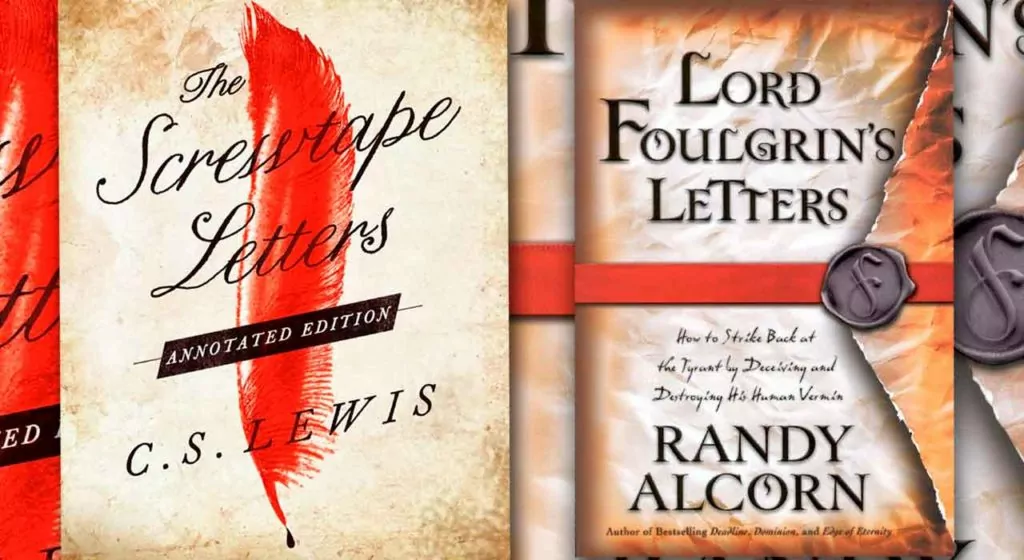
Lord Foulgrin’s and Screwtape’s letters: why you should read this devilish correspondence

The Screwtape Letters by C. S. Lewis 1942 / 200 pages Rating: Good/GREAT/Give Lord Foulgrin's Letters by Randy Alcorn 2001 / 208 pages Rating: GOOD/Great/Give Normally, we don’t appreciate people going through our personal correspondence. However, from the 1600s on, people have been fascinated by other people’s letters, whether real or fictional. In Screwtape Letters, C. S. Lewis used the device of the correspondence between two devils to make his own points about the kind of temptations faced by human beings, temptations that may well have been orchestrated by hell itself. (See the description of the tongue in James 3!) More recently, Randy Alcorn, who admits his debt to Lewis, has created his own more involved version of the same story, titled Lord Foulgrin’s Letters. Should we delve into this darkness? If you are considering reading either of these books, you may have two questions ringing alarm bells in your head. One is essentially negative: Does anyone have any business looking that deeply into the nature of evil, especially demonic evil? The other is skeptical, but basically positive: What can a look at the topsy-turvy perspective of the evil one tell us about the way life should be? So, first, is it dangerous to look at evil too closely? The apostle Paul certainly implies that we should not focus on evil, but on good, when he commands us to think about things that are “noble, ...right, ...pure, ...lovely, ...admirable, ...anything... excellent or praiseworthy” (Phili. 4:8, NIV). Paul also tells the Ephesians that “it is shameful even to mention what the disobedient do in secret” (Eph/ 5:12). So one might ask why C. S. Lewis and Randy Alcorn didn't choose to write about angels instead of focusing on demons. Lewis answered that question, explaining that he felt that it was impossible for him to write authentically about angels, since he, as a sinful man, could not well portray the absolute submission of angels to God’s will. However (sadly), we all know far too well what devilish thoughts and desires must be like, since by nature we are also in rebellion against God. Alcorn, on the other hand, does include a letter from one of God’s angels in his book, but you’ll have to read the book to find out whether or not this "works." Do not be naive...  Lewis’s words do give us an idea of why looking at devils might be useful for a Christian. To realize that temptation often has a demonic source may help us take our own sin and misery more seriously, something the Heidelberg Catechism points out is all-important knowledge (Lord’s Day 2). And while it may be shameful to self-righteously focus on others’ sins (see Matt. 7:1-5), we must be aware of our own sinful weaknesses, lest we fall prey to them. Lewis and Alcorn’s books echo the great truth of Eph. 6:12, that we are in the midst of a “struggle... against the spiritual forces of evil in the heavenly realms.” The Screwtape Letters and Lord Foulgrin’s Letters may even be seen as obeying the command of Philippians 4:8 when we realize that Lewis’s and Alcorn’s devils cannot help speaking about whatever is noble, right, pure, lovely, admirable, excellent and praiseworthy. Of course, they speak in enmity rather than awe, but as long as we accept whatever they reject, we can learn much from their malicious advice. Alcorn takes it one step further Alcorn’s book is particularly interesting, because it carries Lewis’s premise just a little further. Whereas Lewis sticks to letters written by a senior devil to his protege during World War II, Alcorn alternates letters with chapters of narrative about the family targeted by Foulgrin, and sets the story in our own time, with references to e-mail and teenage despair. Even more importantly, while Lewis’s account takes us up to the moment of conversion of a non-Christian, Alcorn deals with the demons’ reaction to the conversion of the central human character, especially their attempt to make him an ineffective Christian. What this means is that Alcorn deals with two issues that Reformed Christians also struggle with now: how to react to the world, and how to respond to God in our spiritual life. For instance, at the same time as Foulgrin extols the danger of pornography on the web, of broken families, of consumerism and materialism, he also rages against the “sludgebags” whom God gives physical bodies. Through Foulgrin’s words and the narrative chapters, we see both the temptations of worldly pleasures and the true beauty of the pleasures God gives us in this physical life: the taste of a fine meal, the touch of a loving husband in a foot massage for his pregnant wife, the sight of a sunset, and the smell of freshly baked chocolate chip cookies. Alcorn thus attacks both the attitude of Christians who mistrust enjoyment in life and the foolishness of those who think that we can experience the world on the world’s terms, and not be influenced by that world. Foulgrin gleefully mocks the stupidity of Christians who know that viewing someone else’s nudity and sexual intimacy is wrong, but do not flinch from seeing the same in a movie. He is, of course, immensely pleased also by parents who keep poisonous household products on the top shelf to protect their children, but who pay no attention to the toxic ideas their children ingest through the Internet and the music they listen to. Alcorn also uses Foulgrin’s warnings to his student Squaltaint to show what the demons shudder at in the Christian life. Foulgrin advises Squaltaint to keep his human charge Jordan Fletcher away from “the forbidden Book” (the Bible) and “the forbidden squadron” (the communion of saints in the local congregation). He warns Squaltaint not to let Fletcher draw close to God in prayer, not to let Fletcher read good Christian fiction, not to let Fletcher think of his life (his time, his thoughts and emotions, his money) as belonging to God rather than himself. Cautions and conclusion Are there still problems with reading about life from a demonic perspective? Any concerns with this way of writing about the spiritual and moral life of a Christian may be allayed by the fact that both Lewis and Alcorn show their demonic title characters losing in the ultimate sense. The only other problem that Reformed Christians might have with both these books is that they seem to imply that conversion is a matter of man’s free will – the error of Arminianism. Whether this Arminian tendency is simply the devils’ mistaken understanding is not clear, but Lewis at least seemed to be Arminian in his other writing (even while demonstrating that his own conversion was a result of God’s persistence rather than his search!). Despite this quibble, I would recommend both these books to any Christian who is open to considering just how effective and consistent his or her own Christian walk is, and in what areas he or she needs to plead for God’s Spirit to work “against the spiritual forces of evil in the heavenly realms.” Below is a 8 minute adaptation/preview of Lewis's "The Screwtape letters." ...
Red heart icon with + sign.
Adult non-fiction, Book Reviews

The Genesis Account: A theological, historical, and scientific commentary on Genesis 1-11

by Jonathan Sarfati 786 pages / 2015 Rating: Good/GREAT/Gift Outside of sermon preparation, it is not often that I read a commentary from front to back. If my reckoning is correct, this is only the third time and certainly the longest of the three – but it was well worth it! Dr. Jonathan Sarfati of Creation Ministries International has provided the Church a monumental resource on issues relating to the first 11 chapters of Holy Scripture. Sarfati has produced a thorough commentary on Genesis 1-11 which takes Scripture seriously as the inerrant Word of God. The greatest strength of this volume is its commitment to the inspiration of the entire Bible and everything that necessarily must follow from that. For example, one of the foundational issues that confronts Genesis commentators immediately is authorship. Commendably, Sarfati appeals to all of Scripture to prove the traditional view that Moses wrote Genesis, though quite possibly collating materials from earlier. Throughout the commentary, he also refutes the arguments of the “documentary hypothesis” – the old liberal idea that several authors were responsible for the Pentateuch, authors who lived much later than Moses. Generally, Sarfati lands on the right side of the issues in the interpretation of these chapters. He defends creation in six ordinary days – a creation which happened thousands of years ago, not millions. He maintains that Adam was created on the sixth day out of literal dust from the ground, while Eve was created from Adam’s rib. There was a literal snake which led to a historical fall of the first man and first woman. Later, Sarfati makes the case for a global flood in the days of Noah. He gets full marks on the big-ticket items. Some disagreements When we get down to some of the interpretive details, I disagree with Sarfati on some points. For example in Genesis 6:2, we read that “the sons of God saw that the daughters of man were attractive. And they took as their wives any they chose.” Sarfati vigorously argues the old view that “the sons of God” were angels. In other words, angels were married to human beings and had sexual relations with them. He argues that Jude 6-7 proves that angels engaged in sexual immorality. He argues that since angels can eat, surely they could also reproduce. I am not convinced. In their essence, angels are spiritual beings, not physical beings and therefore cannot engage in sexual relations, much less reproduce by inter-breeding with humans. I find the “Sethite interpretation” to be correct – people descended from Seth (the line of the Messiah) married rebellious unbelievers. However, I would also grant that Sarfati’s view falls under the umbrella of what we call “the freedom of exegesis.” As a Reformed reader, regrettably, there are other areas where I cannot be as forgiving. While I have a lot of appreciation for the work Sarfati has done here, I would be remiss if I did not highlight several serious theological issues. One issue that arises here and there is Sarfati’s dispensationalism. He often quotes from (and refers to) fellow Messianic Jew Arnold Fruchtenbaum, another dispensationalist and figure on the “biblical prophecy” scene. This view emerges when, for example, Sarfati argues that Genesis does not speak directly about the church. For a Reformed believer, Genesis is all about the church! Sarfati makes a distinction between the Old Testament people of God (Israel) and the church, but the Belgic Confession says in article 27, “This church has existed from the beginning of the world and will be to the end, for Christ is an eternal King who cannot be without subjects.” Not unrelated to this is the muted development of covenant theology in this commentary. For example, there is hardly a word about God’s covenant with Adam and Eve either before or after the fall into sin. Another issue which caught my attention was Sarfati’s occasional references to followers of philosopher Gordon Clark, particularly Gary Crampton and John Robbins. Clark was part of the Orthodox Presbyterian Church when it first began in 1936. However, theological complaints lodged against him eventually led to his departure in the late 1940s. In Clark’s thinking, logic and God are to be identified with one another. God is pure logic, according to Clark and his followers. Clark famously translated John 1:1, “In the beginning was Logic, and Logic was with God, and Logic was God…” Critics of Clark (like John Murray and Cornelius VanTil) argued that Clark had confused creation with the Creator. God stands sovereign over logic; he is not subject to it nor equal to it. Unfortunately, Sarfati seems to follow Clark’s reasoning in several places. It leads him to assert that maintaining the presence of any paradoxes, antinomies or tensions in Scripture (even apparent contradictions or humanly irreconcilable statements) is very dangerous. However, I would argue that this makes God, the author of Scripture, subject to our notions of what must be logical – far more dangerous! There are things taught in Scripture that are simply not capable of rational explanation – for example, the one God eternally existing in three persons. This is why the Belgic Confession says in article 9 that “this doctrine far surpasses all human understanding.” Helpful insight Enough about the theological and interpretive issues – this commentary also promises to shed scientific light about the first chapters of Genesis. This is where this commentary is most helpful. A few examples will illustrate. Genesis 2:21 says that God created Eve from Adam’s rib. Sarfati notes the fact that human ribs can actually regenerate. Hence, Adam would eventually have had a complete set of ribs again. When discussing the Flood, the commentary point outs that catastrophic plate tectonics can explain the mechanism of this deluge. How do we explain the formation of canyons that appear to be millions of years old? Sarfati describes how canyons have rapidly formed following catastrophic events like the eruption of Mt. St. Helens in 1980. Off the coast of Iceland, an island (Surtsey) appeared due to volcanic activity in 1963. Scientists have since been dumbfounded at how quickly Surtsey developed a “mature landscape," including cliffs that would otherwise have been dated as far older. In many instances, I was skeptical of Sarfati’s claims. However, I did my own research on many of them and in every instance, so far as I could tell, his claims proved accurate. This commentary aims to be scholarly in many respects. The author has used the original biblical languages – Greek and Hebrew are found throughout, but always transcribed. A lot of research is in the background, both biblical and scientific. However, an incongruent feature is the informal style of writing often used – this can be distracting in a commentary that strives to have an academic calibre. Conclusion The Genesis Account would especially serve well in the context of Christian education. Christian science and Bible teachers should have this volume on hand and refer to it often – they will find that their teaching on creation-related issues will be greatly enhanced! Preachers would also appreciate it, especially when confronted with questions from parishioners. I regularly give my catechism students the opportunity to ask me questions. I am always surprised how many of the questions have to do with either the beginning (protology) or the end (eschatology). This book has already helped me to be better prepared to deal with the former. Last of all, all Christian households could benefit from having a book of this nature on hand as a reference tool. When you hear or read the claims of the world, Sarfati will typically lead you back to the solid ground of biblical teaching on origins. Yes, as noted above, there are some caveats, but overall this commentary can be recommended. Dr. Bredenhof blogs on books and many other things at Yinkahdinay.Wordpress.com ...

Red heart icon with + sign.
Children’s non-fiction, Children’s picture books

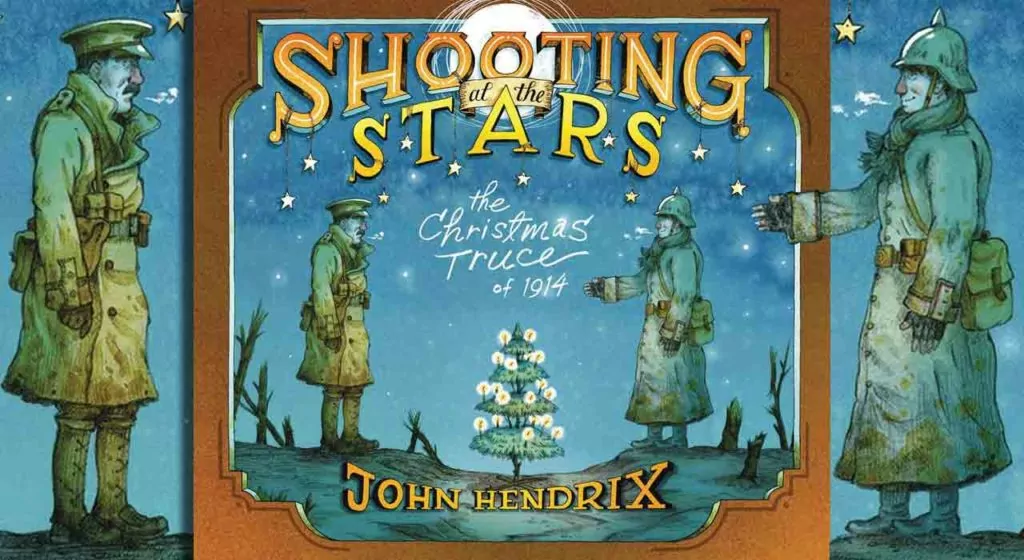
Shooting at the Stars: The Christmas Truce of 1914

by John Hendrix 40 pages / 2014 Rating: Good/GREAT/Give I was raised with stories of the Dutch Resistance and the Canadian liberators fighting against the brutal Nazis – war, it seemed, had clear villains and obvious heroes. Later, though, I learned that right and wrong in war can be far more confusing: for example, in recent years we’ve seen US-backed groups fighting other US-backed groups in Syria. John Hendrix’s Shooting at the Stars: The Christmas Truce of 1914 presents parents with a tool to give our children a more nuanced understanding of war. In a style that is halfway between realistic and cartoon, the author tells us the events of Dec. 24 and 25, 1914. On the day of Christmas Eve, 1914, all along the frontlines, the shooting slowed, and that night the Germans could be heard singing Stille Nacht, Heilige Nacht – “Silent Night, Holy Night.” Then the next morning, on Christmas Day, in spots up and down the frontlines, German, British, and French troops spontaneously came out of their trenches and celebrated Christmas together. The next day they returned to killing one another. Does that make this book sound anti-war? I’d say it is more an underscoring of just how horrible war is. Fighting is sometimes necessary, which is why we are grateful for the courage of the Dutch Resistance and the Allied forces in World War II, who understood that stopping the Nazis was worth risking, and even giving, their lives. We need to remember their sacrifice because it was noble, and selfless, and good. But if war gives us examples to admire and imitate, there is also much that is foolish, and which we must learn to avoid. To give our children a more complete understanding of war, we need to show them that there are those who, under the guise of patriotism, rush to war even though war should always be a last resort. There are leaders who do not treat their young men’s lives as precious, and World War One is an example of that right up to the last day when 11,000 soldiers died in fighting that occurred after the peace treaty was signed. Commanders who sent their men out on offensives on that last day – some from our side – should be remembered as murderers. Shooting at the Stars is a gentle way of teaching the ethical complexities of war. It is gentle in that no blood or gore is seen (making this suitable for maybe Grade Three and up). The most war-like illustration occurs on a two-page spread where we see three corpses, as soldiers on both sides work together to bury their dead. What is striking is simply that there were men on both sides who could praise God together one day and fight to the death the next. That is a shocking bit of history. And it needs to be remembered. Jon Dykstra and his siblings blog on books at ReallyGoodReads.com....
Red heart icon with + sign.
Children’s picture books, Parenting

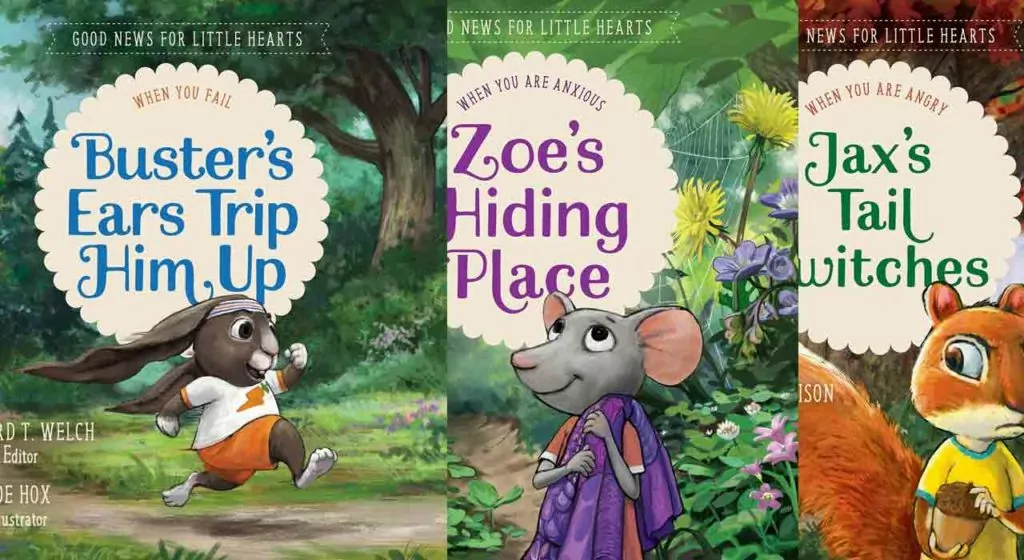
3 picture books that tackle anxiety, anger, and failure

Children get anxious. And angry. And they can get frustrated when they fail. As adults, we often struggle with these same emotions, and sometimes we don't do all that well with handling them. Which makes it that much the harder for us to teach our children what to do. That's why this series of pictures books, from the Christian Counseling and Educational Fund (CCEF) are a welcome resource. Not only are they a tool for parents to help children, they can help us adults too. There is good advice in these pages, pointing us straight to the One who can really help. Zoe's Hiding Place: When you are anxious edited by David Powlison illustrated by Joe Hox 32 pages / 2018 Rating: Good/GREAT/Give The story is about a little mouse named Zoe who's worried about a school trip to the art museum. The last time the class went, she became so fascinated by one painting that she lost track of where the rest of the group went. Then, when she looked up, no one was around, and "It felt like I was alone forever!" She's scared it will happen again. So now she's retreated to her hiding place – under the covers in her bed. How can Zoe deal with her fear and worry? Her mom begins by listening. That's a good start. Then she explains to Zoe that what she is feeling is understandable. But when worry makes us feel like we're all alone, that's not true – God is always with us, and will never forsake us. Mom tells Zoe she can "turn each fear into a prayer" because God will help her. Her mom also helps Zoe think through ways she can stay with the group and not get separated. In the back of the book, the moral of the story is developed further with a two-page message to parents on "helping your child with anxiety." There the editor of this book, David Powlison – a very well-respected biblical counselor – has included a list of 10 "things to remember that will bring comfort to you and your child." Thoughts include: Recognizing that in this world "We have good reason to be anxious and worried." The most frequent command in the Bible is 'Don't be afraid.' Reminding your child that the Lord has listening ears. This is a wonderful book, meant for kids, but helpful for adults too. And the absolutely stunning pictures make this a pretty special morality tale. Yes, this is more an educational tool than an entertaining read. But it is a pretty entertaining read too. And the pictures are so fun to look at, a couple of my daughters have been paging through it regularly. I'd recommend Zoe's Hiding Place to any parents trying to help a child through worry or fear. With its firm grounding in Scripture, this will be a real help to both the child and the parent. For a 10-page preview of the book, you can check out this link here. Two others There are two other books in the CCEF's "Good News for Little Hearts" series, on failure and anger. Buster's Ears Trip Him Up is about dealing with failure. Buster is a speedy rabbit who thinks that winning is everything, so when his long ears trip him up and he loses the big race, he doesn't know how to deal with it. Fortunately, he has a big sister, and a wise father, who both know how to help him deal with failure. They remind him that God loved us before we had ever done anything so it really isn't about our accomplishments, but rather what Jesus accomplished on the cross. You can read a 6-page sample here. Jax's Tail Twitches is about when we are angry. Jax is a squirrel whose big brother is pestering him and that makes him mad. What's worse, the neighbors next door are taking their nuts without asking, and that makes his dad mad. But even when there is good reason to be angry, our anger is, most often, the wrong response to this wrong situation. This is a lesson that mom and dad can certainly benefit from, even as we share it with our children. You can read an 8-page excerpt here. I'd recommend all three of these book as wonderful tools for parents to read with and discuss with their children. The stories are solid, the artwork incredible, and what it teaches is biblical, helpful, and accessible. Jon Dykstra and his siblings blog on books at ReallyGoodReads.com....

Red heart icon with + sign.
Adult non-fiction, Book Reviews

Calvin’s Magnum Opus: a review of "Institutes of the Christian Religion"

A “magnum opus” is an author’s greatest work. When it comes to John Calvin his Institutes of the Christian Religion is one of the classics of Protestant theology. However, as often as it is referenced, it is seldom read as a complete work from front to back. I first purchased my copy of the McNeill/Battles edition before starting pre-seminary studies in university, more than twenty years ago. Over the years I have read bits and pieces and there, often as a need or interest required but it wasn’t until this past year that I finally read the Institutes from beginning to end. In this essay, I will share some of the highlights of my complete tour through this theological masterpiece, and those highlights will include both points of appreciation and critique. I read the two-volume McNeill/Battles edition published in the Library of Christian Classics. This edition is based on the final version Calvin published in 1559. I also occasionally referred to the older editions of Beveridge and Allen, and even sometimes checked the original French and Latin. Different translations and editions Calvin originally wrote the Institutes in 1536 as a sort of catechetical handbook. It was never designed to be a systematic theology – such a creature did not yet exist. It was also not designed to be a book of extensive commentary on Scripture. No, its original purpose was catechetical – to summarize the teaching of Scripture on essential matters of faith and life. However, as the work progressed to its final form in 1559 – twenty-three years later – it did take on a more systematic form. In some places there is limited commentary on Scripture – for example, when dealing with the Ten Commandments (2.9) or the Lord’s Prayer (3.20.34-49) – and there are extensive references to Scripture, but generally Calvin leaves biblical exposition to his commentaries. A Scriptural foundation…most of the time His approach is typically theological, with the Scriptures explicitly as a foundation. However, by way of exception, there are parts that are more philosophical. For example, in 1.15.6-8, Calvin discusses the soul. There is almost nothing directly from Scripture in this discussion. Instead, Calvin works more with philosophical ideas from the likes of Plato. For a modern reader unfamiliar with Greek philosophy, this discussion is difficult to follow. Related to that, there are places where Calvin follows Platonic notions instead of biblical ones. One of the most well-known examples is how Calvin speaks of the body as the prison house of the soul. He does this in at least four places (1.15.2, 2.7.13, 3.7.5, 3.9.4). This devaluing of the body does not accord with the biblical worldview. In Scripture, the body is redeemed by Christ just as well as the soul (1 Cor. 6:19-20), and will be raised at the last day (1 Cor. 15). Well-read and it shows The attentive reader will pick up on Calvin’s copiousness – he read widely! Throughout the Institutes, Calvin refers to numerous authors going all the way back to the early church. Two stand out in particular. The most quoted and referred to author is Augustine. This is not surprising since Augustine is the most influential of the church fathers on the Protestant Reformers in general. Most of the time Calvin quotes Augustine approvingly, but there are also occasions where he dissents. The other author is Bernard of Clairvaux, a Cistercian monk who lived from 1090 to 1153. While Bernard lived before the worst developments in Catholic theology, he was still not exactly a medieval quasi-Protestant. Nevertheless, Calvin made use of Bernard’s best insights. In 2.16.1, Calvin gives this beautiful quote from Bernard’s Sermons on the Song of Songs: The name of Jesus is not only light, but also food; it is also oil, without which all food of the soul is dry; it is salt, without whose seasoning whatever is set before us is insipid; finally, it is honey in the mouth, melody in the ear, rejoicing in the heart, and at the same time medicine. Every discourse in which his name is not spoken is without savor. Calvin appreciated Bernard’s fervor for Christ and his felicitous turn of phrase. Brilliant, but also inexplicable, word choices Calvin likewise employed language with a skilled eye to felicity. Calvin valued beautiful rhetoric – throughout the Institutes there are words so well crafted you may feel some salty moisture rolling down your cheek. Calvin’s Institutes feature numerous sections like this in 3.2.42: Accordingly, in brief, hope is nothing else than the expectation of those things which faith has believed to have been truly promised by God. Thus, faith believes God to be true, hope awaits the time when his truth shall be manifested; faith believes that he is our Father, hope anticipates that he will ever show himself to be a Father toward us; faith believes that eternal life has been given to us, hope anticipates that it will some time be revealed; faith is the foundation upon which hope rests, hope nourishes and sustains faith. Calvin was indubitably a master of using language to powerful effect. Regrettably, I have to say I also encountered instances where Calvin uses strong, questionable, or even offensive language. He uses strong language when it comes to unbiblical and dangerous ideas. But he also uses strong words for the person of his theological opponents: “blockheads” (3.20.25), “stupid men” (3.21.7), “swine” (3.23.12), and many other such insults. I have read enough Reformation literature to know Calvin was not unusual in using this kind of language – and our day tends to be far more sensitive about throwing invectives around in our theological polemics. I am far less inclined to give Calvin a pass on some other language he uses. In three places, Calvin uses the exclamation “Good God!” (3.4.29, 3.4.39, 4.16.27). In each context, it is clearly an exclamation and not a sincerely-meant prayer to God. The expression was used in Calvin’s original Latin of the 1559 edition (“Bone Deus!”), but for some reason he dropped it in the French. In each instance, the older translations of Beveridge and Allen omit these exclamations. I have encountered the same expression in the writings of Guido de Brès. I find it troubling and I cannot find a way to excuse it. I would suppose that, being former Roman Catholics, they became accustomed to using this exclamation to express great horror – a blind spot. Challenges and benefits For readers today there are some challenges in reading and benefiting from Calvin’s Institutes. Some of the discussion has less relevance to us. For example, I found the discussion about the sacramental theology of the Roman Catholic Church to be one of the most tedious parts of the work. It may be interesting from a historical standpoint, and it might still be valuable to someone actively engaged in apologetics with Roman Catholics, but for the rest of us, the temptation to skip through this section is difficult to resist. Persevering readers will encounter some of Calvin’s best and most well-known theological insights. Among them: The Scriptures serve as spectacles to help us see God clearly (1.6.1, 1.14.1) “…man’s nature, so to speak, is a perpetual factory of idols (1.11.8) Calvin believes the world to be less than 6000 years old (1.14.1, 3.21.4) Justification “is the main hinge on which religion turns.” (3.11.1) Fasting “is an excellent aid for believers today (as it always was)…” (4.12.18) If baptism is to be denied to the infant children of believers because Scripture is silent on the explicit practice, then women should also be denied access to the Lord’s Supper (4.16.8) The Lord’s Supper should be celebrated frequently, preferably every week (4.17.43) Aristocracy, or perhaps a system compounded of aristocracy and democracy “far excels” all other systems of government (4.20.8) Revolts are possible when led by lower magistrates (4.20.30) Reading Calvin’s Institutes will remind Reformed believers today that Calvin is not the gold standard for what it means to be Reformed. After all, there are several points at which much contemporary Reformed faith and practice departs from Calvin. For example, in 4.3.16, he discusses the laying on of hands in connection with office bearers. He argued that this laying on of hands ought to be practiced not only with the ordination of “pastors and teachers,” but also deacons. Interestingly, the original Belgic Confession also said that all office bearers should be ordained with the laying on of hands. While there are Reformed churches which follow Calvin on this, there are also those (like the Canadian Reformed Churches and the Free Reformed Churches of Australia) which do not involve the laying on of hands in the ordination of elders or deacons. Conclusion Let me conclude with noting that the McNeill/Battles edition is generally well-done. There are comprehensive indices. There are immense numbers of helpful explanatory footnotes. It must be said, however, that some of these footnotes reflect the editor’s liberal theological bias. For example, in a footnote in 1.8.8, the editor informs us that Calvin did not hold to the modern view of a late date for Isaiah 45 and its mention of Cyrus. Well, I guess not, seeing as how Calvin believed the Bible to be the Word of God! As another example, in a footnote in 4.8.9, the editor claims Calvin does not explicitly support biblical inerrancy anywhere. While it would obviously be anachronistic to expect Calvin to affirm every jot and tittle of the Chicago Statement on Biblical Inerrancy (written in 1978) there is plenty of evidence to affirm Calvin has far more in common with biblical inerrantists today than their opponents. For most Reformed people today, Calvin’s Institutes will remain a reference. No one should expect regular church members to pick it up and read it straight through with profit. Those who try will almost certainly get frustrated and give up. We must be realistic. It is a work from an era in which theologians could expect far more from their readers. I wonder whether even many of today’s pastors would be able to digest everything Calvin serves up. Some of his discussions and references certainly went beyond my ken. We live in a strange time where we have more access to information than anyone else in the history of world, and yet, compared to Calvin from 500 years ago, we are dullards. Reading through the Institutes certainly drove that point home to me. Dr. Bredenhof blogs at Yinkahdinay.Wordpress.com where this article first appeared....

Red heart icon with + sign.
Adult non-fiction, Book Reviews

Calvin's Institutes: Which edition should you read?

John Calvin published five different Latin editions of his Institutes, expanding on it with each new edition. The 1536 edition was just 6 chapters long, and the addition of 17 shorter chapters in 1539 doubled the book’s size. Four more chapters were added in 1543, and then only minor changes made in 1550. But the final, 1559 version was fully 80% larger than its predecessor. In addition to these Latin editions, Calvin also created French versions that, while very similar, were not strict translations – they taught the same doctrine, in the same order, but sometimes said things in different ways. It is the final Latin 1559 version that most translations are based on, including the two best-known English-language translations: the 1845 Henry Beveridge, and the 1960 Ford Lewis Battles (edited by John T. McNeill), translations. 1845 Beveridge One advantage of the Beveridge edition is that the copyright has expired on this translation, so it is readily available online for free (there is also a harder to find 1813 translation by John Allen also available online for free – Vol. 1, Vol. 2, Vol. 3 – as well as in print). Cheap print and e-book copies are also available, but this is where you have to be wary, as some have crisp new type and a beautiful layout, and others look like they are copies of copies of the original 1800s publication, with dark text cramming every nook and cranny of the page. If you plan to be reading the Institutes front to back – all 1,700 some pages of it – then a nice airy, legible layout is important. So buyer beware – be sure that you can take a look at the inside of whatever edition you are buying. 1960 Battles This edition came a hundred years later, so as you might imagine, the language is somewhat more current. The editor, John T. McNeill also provides lots of helpful explanatory notes at the bottom of many pages. However, as Dr. Bredenhof notes in his Institutes review, McNeill's liberal theological bias comes out in some of these notes. 2014 White In addition to being the most modern translation (by Robert White and published by the Banner of Truth) this edition's main feature is one that will be regarded as a strength by some and a weakness by others – it is based on the much smaller 1541 French edition. It clocks in at just 920 pages, instead of the more than 1,700 pages of the final 1559 version. So, this would be the best one for those interested in checking out the Institutes but who would appreciate an abridgment...in this case, done by the author himself! Conclusion While it might seem a trivial thing, I really can't emphasize enough the importance of buying an edition with an inviting layout. You're going to be investing a lot of time with this book, whatever edition you buy, and if you get one with dense text, and a hard to read font, it will wear on you. And on that point, the White edition is beautiful, the Battles/McNeill seems good though not great, and the various editions of the Beveridge run the gamut from beautiful to atrocious. Jon Dykstra and his siblings blog on books at ReallyGoodReads.com....

Red heart icon with + sign.
Adult non-fiction, Book Reviews, Dating, Teen non-fiction

Thoughts on Deepak Reju's "She’s got the wrong guy"

Sometimes a pointed comment sticks with you for years. A decade back, a dad of two unmarried mid-twenties daughters exclaimed in exasperation, “I really don’t know what guys are looking for in a girl.” I knew those young women. They were beautiful, talented, educated, faithful Christians. The one in particular even had a delightful sense of humour. So what are guys looking for? And when they don’t make a move, what is the girls’ response? Sometimes it means that a woman – a smart woman – will “settle.” That is the premise of Deepak Reju’s book, She’s Got the Wrong Guy-Why Smart Women Settle. Deepak Reju, a pastor of biblical counseling and families in a Baptist Church in Washington, DC, writes from a wealth of experience with the sad consequences that arise when women make poor choices in marriage. He writes with genuine empathy for the realities 21stcentury Christian women face. Some problems are ageless. When confronted with the spectre of the single life, women have always questioned themselves. What is wrong with me?  Am I never going to have children? Doesn’t God care that I feel lonely? Today there are added challenges. Sex is everywhere, more than ever. Both men and women are single longer and marry later, requiring a sustained commitment to purity. Technology has changed the way we do relationships. Face-to-face conversations, always more risky, become the exception.  There is comfort in hiding behind a screen. “It’s a lazy man’s dream – no intentionality, no commitment, and no risk” (p. 5). Online dating allows optimal, but not necessarily honest, presentation of oneself. Another reality is that today more women are educated, accomplished and talented as they enter the workforce. With university degree in hand they move into successful careers. This may be intimidating for some men. The secular world generally does a better job valuing women for their intelligence and capabilities. Christian women are affirmed and rewarded in the workplace, but often treated like second-class citizens in their church. Dating as a conservative Christian woman is hard; dating as an intelligent, gifted and self-confident Christian woman seems almost impossible (p. 6). Added to this mix of challenges is the current confusion over sexuality, gender, the value of marriage, and the rising number of divorced singles and single parents. Reju suggests that faced with such a confusing, complex world of dating, women too often make the choice to simply settle for an OK man. It could be that a woman thinks of marriage as the most important goal of life, a sort of idolatry. “As Christian women, we teach the gospel, pray the gospel, sing the gospel – and we secretly hope for marriage” (p. 7).  One can hardly blame her, since that is typically an unspoken expectation in church communities. Or “settling” could be the result of personal baggage that makes a woman undervalue herself. I don’t really deserve better. It’s the best I can do.  She might have blinders on, refusing to see the problematic aspects of a dating relationship. He’s not very spiritually minded now, but I’m sure that’ll change after we’re married. She may live with anxiety, fearful that she is not really lovable, or seen as too picky, or that she’ll always have to fend for herself. Fear of loneliness is real. It’s good to reflect what it would be like attend several weddings each year as a single (Will I ever walk down the aisle?) and baby showers after that. And how about never having a reason to go to the church nursery except to babysit other women’s children?  I remember the exasperation of one single woman in her early thirties who still visited with her married girlfriends: “If I hear another breast feeding or diaper rash story, I’m going to scream….or puke!” Men to watch out for Reju is not dismissive of the discouragement and loneliness single women feel, but he urges them not to forget Jesus. Instead, desire him above all else. As Christians, our goal, male or female, is to form our lives around growing closer to Jesus. Marriage and family life are valuable, but they are earthly treasures. Christ remains the greatest treasure. That said, the bulk of the book deals with the ten, yes ten, categories of men to avoid in dating. It’s a formidable list. Avoid the following: the control freak the promiscuous guy the unchurched guy the new convert the unbeliever the angry man the lone ranger the commitment-phobic man the passive man and the unteachable guy Each of these types will present significant issues in a marriage. It will be more difficult for the wife to mature as a Christian. It is unlikely the relationship will be truly loving or of mutual benefit. Likely the woman will suffer. Each chapter of about ten pages includes an engaging story of a couple that highlights the serious challenges that develop. A brief look at one of the stories – that of Janelle and Dominique – will give a taste of Reju’s approach to the complex topics he’s addressing. Janelle, from a Christian home, met Dominique, a relatively new believer, at church and began dating. It wasn’t long before she noticed his controlling patterns. When she was with girlfriends he would call to ask where she was. He would check with her multiple times a day. She rationalized his behavior, “He’s protective of me.” But his behavior was sometimes accompanied by anger, jealousy, and insistence on his own way. Despite realizing that her relationship had problems and that her guy didn’t meet the biblical criteria of a loving husband, she carried on. She thought, “He knows me; we are making it work; he’s fun; and I like him.” It seemed like too much work to untangle the relationship and start over. Besides, that would be admitting failure. And things would change once they were married. But warning flags should be flying! Such a man displays a warped perspective on what the Bible says about male leadership. He uses Scripture to make his girlfriend or wife do what he wants. He lords it over her through spiritual language that is twisted to support his demands.  Maybe such a man could change with growing maturity, but it’s better and much safer not to date this sort until he does. Don’t assume that you can change him. Better to break off and not marry him, than face a lifetime of emotional abuse, and worse. Interestingly, Reju devotes a whole chapter to the topic of ending relationships: “Breaking up for the Glory of God.” Who’s left? As I made my way through chapter after chapter on men to avoid, I began to wonder, “Well, who’s left. Now what? Should women just stay single?”  Thankfully, the author offers a way forward. There are godly men who desire to serve the Lord within the context of marriage. Women must realize that there is no perfect man, even if he is a committed Christian. It happens that good men are overlooked because they don’t meet expectations in superficial or non-essential things, like physical appearance, age, or charisma. Furthermore, a woman cannot expect complete maturity and thoughtfulness from a man in his twenties or even thirties. Christian maturity takes time. So it is possible to choose wisely while choosing an imperfect man. Choose to be attracted to one who is growing in Christ and demonstrates interest in continued growth in Christ together with you. Don’t settle for the problematic man who is far from God and shows little sign of change. Reju devotes a final segment explaining that waiting is OK. Yes, waiting is hard, but there is a way to wait well. I think it’s fair to say that in many churches singleness is not seen as a beautiful thing. Scripture presents a high view of marriage, with only a couple passages highlighting the benefit of being single. Reju suggests that singles may be made to feel incomplete. I would argue that at times we are even guilty of taking advantage of our singles, counting on them for some heavy lifting for our church programs and duties. One mature single confided to me, “They say, ‘Well, you’re alone anyway so you have more time.’” She continued, “They should realize that I have to do everything myself, including groceries, home repairs, painting and car maintenance. I have no one to share the workload. I work full time. I probably have less not more time.” So, church involvement, yes, but certainly to be accompanied with a lot of appreciation and support. The author argues that what makes waiting hard is that it exposes the heart. You begin to believe that what you “want” is what you “need.” Waiting is hard because it shows what you really worship.  Patience is difficult. What do you pray while you are waiting? And then there is the challenge of maintaining sexual integrity. Desire for sex is a healthy thing. Desire for children, no less so. These are challenging realities to face, while not knowing if the desire for marriage will ever be fulfilled. But it is possible to wait well. Scripture does portray singleness as a positive thing that allows a single-minded devotion to the Lord. Remember, marriage is temporal, singleness lasts to eternity, for everyone. The goal is to wait on the Lord, not to wait for marriage. Be willing to share your heartache and pain with others. In the church we live in community; singles and marrieds need each other as we wait together. Remember that no man will ever fulfill your ultimate desires; only one bridegroom does that and he’s planning the ultimate wedding banquet. Conclusion 192 pages / 2017 Would I recommend this book? Yes, certainly for single women who are dating. The book offers pertinent questions and issues to consider before making any commitment to marriage.  Breaking up for the glory of God may be necessary. The book also offers helpful advice for single women not in a relationship. It will expose the heart’s desires, and help her not to settle for being married to an unsuitable man, but to wait, relying that God’s grace will be sufficient. Single men should read the book as well. They will gain insight into the typical longings of a woman’s heart. If they find a chapter or two that serves as mirror for them, there is the choice to put away ungodly attitudes and become the mature man in Christ. It will also be a helpful read for friends of singles and those who counsel them. And while I agree the title is catchy, I wonder if it might put off exactly those who could benefit most from reading it. I was also left with the thought there could be a second volume, warning men which women to avoid: the manipulator, the gossip, the passive-aggressive, the I’ll-change-you-for-the-better-agent and of course, the unbeliever, the unchurched and the angry woman. All in all, I appreciated the honesty of Reju’s book. He writes with empathy and understanding. His advice rings true. Some final reflections: I read this book with keen awareness of the many beautiful, talented, educated, godly young women (and some men) in our church communities.  I wonder what it’s like to be a single in our churches. That would be worthwhile to explore. Are they lonely even while being part of a congregation? Are they appreciated for who they are as singles, or perhaps somewhat pitied? How well do our churches serve and support our singles in their twenties and thirties, and beyond? Do our conversations revolve around our families, our spouses, and children with scant thought what that feels like to someone who longs for marriage and children? Do we encourage post-secondary education for our young women according to interest and ability, or do we fear that will make them less marriageable? Do we expect singles to shoulder tasks in the church because, “Well, they have the time, anyway?” Are we as inclusive as we purport to be? It’s a good thing when a book makes the reader reflect on the broader issues at play in our churches. She’s Got the Wrong Guy: Why Smart Women Settle is one of those books, and well worth the read!...

1 2 3 4 5 6