Transparent heart icon with white outline and + sign.

Life's busy, read it when you're ready!

Create a free account to save articles for later, keep track of past articles you’ve read, and receive exclusive access to all RP resources.

White magnifying glass.

Search thousands of RP articles

Helping you think, speak, and act in Christ.

Open envelope icon with @ symbol

Get Articles Delivered!

Helping you think, speak, and act in Christ. delivered direct to your Inbox!


Red heart icon with + sign.
Book Reviews, Graphic novels

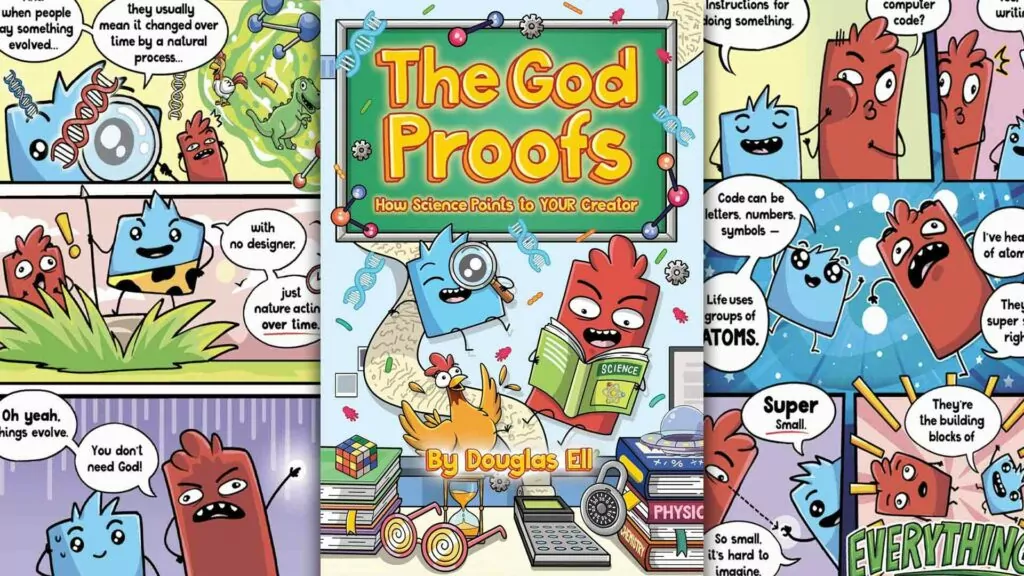
The God Proofs: How Science Points to YOUR Creator

by Douglas Ell 2024 / 207 pages Rating: Good/GREAT/Gift A blue square with legs, arms eyeballs and mouth, wants to prove to his red rectangle friend that God exists, and he offers up three separate "proofs." This is a fun educational comic, but problematic in that this initial set-up implies that the evidence for God is not patently obvious to all, which is contrary to what Romans 1:19-20 tells us is so. "...since what may be known about God is plain to them, because God has made it plain to them. For since the creation of the world God’s invisible qualities – his eternal power and divine nature – have been clearly seen, being understood from what has been made, so that people are without excuse." So trying to "prove" God's existence to an agnostic or atheist, is less about them having intellectual or logical objections, and more a matter of stubborn rebellion. God says someone who doesn't acknowledge His existence can only do so by suppressing the implications o everything he sees around him in God's brilliant creation. Apologetics – defending the faith – is less about debate, and more about declaring what's what. It's akin to the approach you'd take with a child who can't hardly speak because his mouth is too full, even as he protests he doesn't know anything about any missing piece of cake. We can't and shouldn't take his protest seriously. We need to understand that atheists and agnostics are liars more than doubters. But can we lie to ourselves, and so convincingly that we believe it? Yes indeed. We live in a time when folks are literally saying, with straight faces, that a 6'5" guy with a beard can be a girl, and this sort of self-deception isn't limited to folks with multiple degrees (though it does seem to find a particular harbor there). So there can be some benefit to, as Paul writes in 2 Cor. 10:5, demolishing "arguments and every pretension that sets itself up against the knowledge of God." We can help the sincerely confused by helping them work through their self-deceptions. The book also pitches "Science" as the final arbiter of truth. But this makes an idol of Science, placing it above God. The scientific method is a great tool, but like everything else in our fallen world, it can be twisted by bias and fallibility. Have we mentioned that we humans are really good at lying to ourselves? With that in mind, this comic could be a great tool for helping the confused, and for our own encouragement, since this highlights some astonishing fingerprints God has left on His creation. The blue square offers up three proofs, but I'll touch on just one: "the numbers proof." The numbers proof highlights that all of life is built on incredibly complex "code" that could never have come about by chance.  What's this code? DNA, and not only do we come with code, all of our cells come with miniaturized code - or DNA – printers. This numbers proof is built on the fact that you have "3.2 billion letters of DNA code in almost all of your thirty trillion cells." That's a lot of letters, and like the letters of the alphabet, they don't mean anything unless they are assembled in a precise order.   Blue square goes on to illustrate that the odds of getting a particular order of even something as small as the paragraph just above - the one in bold - just by chance is beyond infinitesimal. "Suppose that every atom in the universe is also a blind chicken pecking at a keyboard. ...And suppose each of these atoms/chickens is typing at lightning speed: one hundred million trillion, trillion, trillion letters per second. .... If you all type for a trillion, trillion years, and don't take any bathroom breaks, you still have an almost unimaginably small chance...any of your atom/chicken friends would ever type this short phrase." There's much more to this odds argument, spelling out how it is more impossible than even this makes it out to be. So how is this a "proof" of God? Well, if chance and time can't make us, then the alternative is that we are the intentional product of a Supernatural Mind. Cautions There is, on page 120, a brief appearance of God as a grey-bearded white robed painter, painting canvases of DNA and animals He's designed. It is just the one panel, but why? Conclusion The comic format makes some otherwise complicated scientific information pretty accessible. I think any high schooler would be able to work through this, and the engaging format means at least some of them will want to too. These are engaging evidences, but we need to remember how to use them. Don't attempt to prove God's existence: proclaim it, and then use this material to show how God's creation shouts His Name too. It might seem a subtle difference, but it is a significant one. It's the difference between elevating Man's intellect, or glorifying God instead. So... a good tool for Christians, but not a book you should just hand out to unbelievers....

Red heart icon with + sign.
Adult non-fiction, Book Reviews, Teen non-fiction

Give Morning and Evening to your teen

A teen offers up a different sort of book review for Spurgeon’s classic devotional ***** Sometimes, dead white guys make the perfect walking companions. Want to know who my personal dead white guy is? Charles Spurgeon. If I’m in a rut, I’ll go and take a walk with him. It’s very therapeutic. And practically not weird at all. I’m writing here as a teenage girl who has struggled with a lot of depression, and I’m hoping I can offer parents reading this some food for thought for their own teenage daughters. I’m sure you’re watching your daughters as they curl up and cry, or just sit in their rooms doing nothing, or even scroll on their phones to numb the pain, and you feel helpless. What can you do? What should you do? Have them read Spurgeon. Don’t be afraid to corner them and offer them a stack of books by Charles Spurgeon to read, no matter how much they protest, because whether they acknowledge it or not, it’s what they need. I was introduced to Spurgeon through my mother. During specific seasons in my early teens, I would wake up each morning very depressed, and there was not a day that passed that didn’t have me in tears, or giving up in despair. My mother started reading me quotes from Spurgeon’s daily devotional, Morning and Evening. She kept egging me on to read them myself (ornery, brilliant creatures, mothers…), but I stubbornly refused. Stop telling me what to do! I wanted her to fix me with a snap of her fingers, so I could be my normal happy, contented self, but sadly, it doesn’t work that way – a hard lesson God had in store for me. I eventually came to the conclusion that my face was going to end up severely disfigured from all the crying I was doing, and at the point that I had to wring out my pillow a couple times before going to bed, I decided I should maybe take Mom’s advice and start reading Spurgeon’s works. I knew that he struggled with depression his entire preaching career, and I had heard good reports on his works, but the last thing I wanted was to be severely preached at. Boy, was I wrong. He was exactly what I needed. Unlike what I was expecting (a mean pastor shaking his finger at my weakness), Spurgeon, through his writings, seemed to sit with me on my bed and wrap a loving arm about my shoulder, acknowledging the weakness and depravity I felt. What I needed was someone to walk the lonely road with me, listening to what I had to say, but also gently reminding me of the truth and mercies of God Almighty. By his care and compassion for my predicament, and his gentle correction, Spurgeon pointed the way to the Cross, where I should’ve been the whole time. The Word was even more precious the more I gleaned from Spurgeon, and I ran to God with open arms. I continue to fill my bookshelf with Charles Spurgeon’s writings, because sometimes, you need a companion to walk the lonely road of depression with you. Meeting him has meant introductions to his companions, the Puritan writers he turned to. The road grows ever more crowded with encouraging voices from the past. Anxiety, depression – shucks, being a teenager requires a companion. Even if that companion turns out to be a dead white guy. Editor's note: "Morning and Evening" is a 365-day devotional with, as the title suggests, a verse and short reading for the morning, and then both again for the evening. First published in 1866, the copyright has long since expired, so it is available for free all over the internet in both daily doses and in ebook editions. But if you're handing this to your teen you may want to go with an updated physical copy, like Crossway's recent edition that's been lightly revised by Alistair Begg....

Red heart icon with + sign.
Book Reviews, Children’s picture books

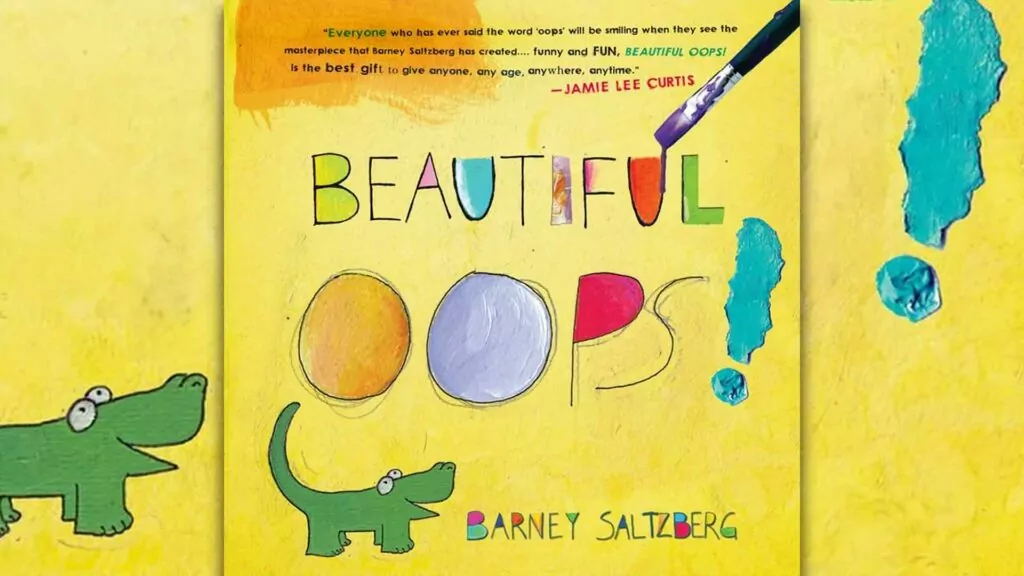
Beautiful oops!

by Barney Saltzberg 2010 / 28 pages Rating: Good/GREAT/Give I play a “scribble game” with my girls. One person makes a quick jot on a page, and the other person has to turn these random lines into some kind of person, animal, or face. It’s a cooperative game – the scribbler can’t be too messy or it’s impossible to play – so we added one more rule. If you can’t turn the scribble into something, then you can challenge the scribbler to show you how it could be done. In other words, you don’t want to make a scribble you wouldn’t want to deal with yourself (a little Matthew 7:12 here). In addition to being quite the portable travel game, it’s a fun way for kids to work through any perfectionist impulses. Can’t make a scribble perfect, can you? Beautiful Oops! is another great tool to help whatever young perfectionists you know. Saltzberg highlights the joy that can come from running with your artistic mistakes. Clever foldouts show first a mistake – a couple of splotches of ink – and then how those “oops” can be turned into a pair of wheels for a jeep. A tear in the page can become the open craggy mouth of an alligator. Smudges and smears and coffee cup stains can all be turned into something fun. The only caution with this book is practical. It’s built out of sturdy cardboard, but has elements of a pop-up book, so it might need some adult supervision if it's to last more than a little while. That said, it would be a great one for parents to read with their preschoolers. If you’re looking to make this same point – don’t let minor mistakes slow you down – to an older 7 to 11-year-old audience be sure to check out Corinna Luyken’s The Book of Mistakes. See the Beautiful Oops! book trailer below. ...

Red heart icon with + sign.
Book Reviews, Graphic novels

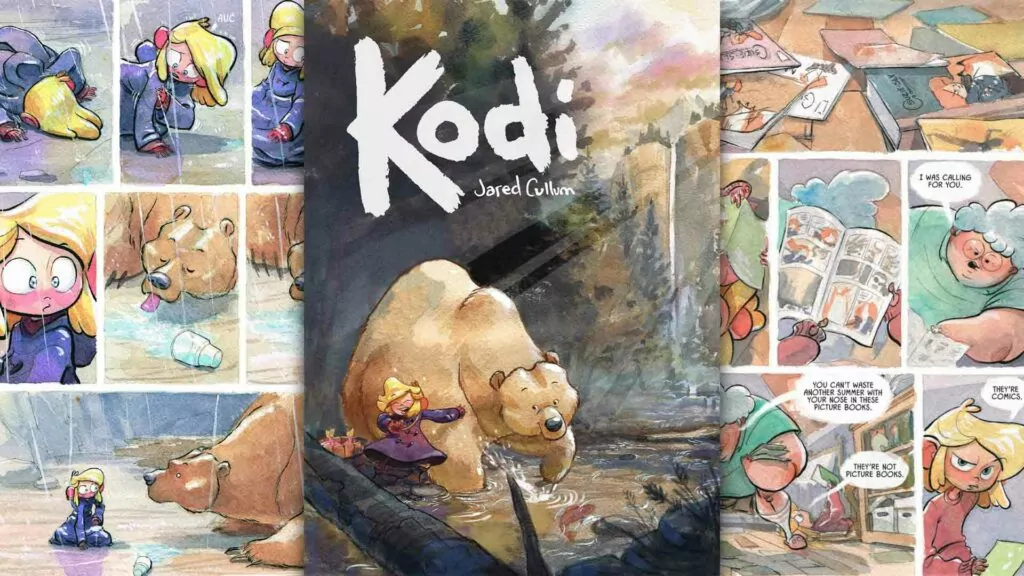
Kodi

by Jared Cullum 2020 / 176 pages Rating: Good/GREAT/Gift Katya is spending the summer in a cottage in the woods of Alaska with her "Meema" (or grandmother). And while she'd be content to spend her time just reading comics, Meema sends her to town to go buy a Slurpee, and maybe find a new friend too. On the way home through the forest, Katya takes a tumble into a ravine. The fall knocks the wind out of her, but there's someone else there in the ravine with her who is in a bit more trouble – an enormous bear has been pinned down by a tree. Katya does what every sensible kid should do when confronted with an injured bear – she sings to it, then rushes off to an adult to get help bringing it home. Up to this point the book had been fairly "realistic" – I'm not talking the drawing style, which, while gorgeous is definitely still cartoony. What I'm referring to is that nature was nature, and civilization was civilization, and so when Katya met the bear, we weren't expecting it to talk. It was an animal, and this didn't seem the sort of book where the critters were going to be anthropomorphized. But, the author goes halfsies here, with the bear, named Kodi by Katya, not exactly a 100% realistic wild animal, and not exactly a person either. Kodi turns out to be kind of half person/half pet. When Katya and her Meema have to fly back to Seattle to care for a sick relative, they have to leave Kodi behind. But Kodi isn't having that. He stows away on a cruise ship, gets off in Seattle, and starts searching the city streets for his friend Katya. There he meets a sailor who is willing to help, leading, eventually, to a reunion and a very happy ending. Cautions The one caution here concerns the sailor who has just one leg. In a flashback we see how he lost his leg – his boat landed on it, crushing it. That struck me as a bit out of keeping with this otherwise pretty lightweight fare. But it isn't shown in any detail, so, not much of a concern at all. I was wondering where Katya's mom and dad were – mom is mentioned only briefly and dad never is – but we can presume they are back in Seattle. It's never explained. Conclusion This is a beautifully painted comic. While it's intended for maybe 12 and under, older readers could enjoy it just for the artwork. Overall, this is just a wonderfully sweet and gentle story, a throwback to a simpler sort of comic that has no weird agendas to push. Highly recommended!  ...

Red heart icon with + sign.
Adult non-fiction, Assorted, Book Reviews

Necessary Endings

Finding the courage to let go in business, church, and family ***** Why did my dad’s tomatoes and cucumbers always flourish? I used to think it may have something to do with the tobacco smoke from his pipe, which he puffed while tending to them. But the success carried on even when the days of the pipe ended. I got my answer some years ago when my dad checked out our greenhouse and noticed lanky cucumber bushes with little fruit. He showed me how to identify “suckers” and shoots that needed to be pinched off. For a new gardener, it seems strange, even shocking, to cut off healthy branches and flowers. But whether it is cucumbers, apple trees, or flowers, God designed many plants to produce more buds than they can sustain. Plants have limited energy, so without pruning, that energy goes towards growth that literally isn’t fruitful. I was looking for cucumbers, not huge cucumber plants without fruit. In other cases, sick branches or dead branches need to be removed, as they will hold back the plant or tree from flourishing. Contrary to popular thought, nature doesn’t do best when left alone. Through these plants, God is teaching us something about our own lives and the causes we invest in, including in business and the Church. We need deliberate pruning – we need to make endings happen. That is true for all stages of life, but especially as we feel the effects of age. Endings are necessary As much as we value beginnings and growth, God has made endings a natural and important aspect of life, even before the Fall into sin. There is day and night, and a season for planting, watering, harvesting, and cleaning up so that it can start over (Eccl. 3:1-2). Accepting endings, and making them happen at times, is the design that God wove in the very fabric of our lives. “In your business and perhaps your life, the tomorrow that you desire and envision may never come to pass if you do not end some things you are doing today.” That is how Christian psychologist and business coach Dr. Henry Cloud opened his book Necessary Endings. This book gave direction and encouragement when I had to make some hard endings a few years back. But the value of it keeps resurfacing as I notice how much we can struggle because we resist endings: • We hold onto possessions that have no more use to us; • Teens refuse to end their childhood, and continue doing little to help the family; • Young adults grow older but fail to launch, continuing to be cared for by their parents; • Seniors don’t deal with past hurts or ongoing sinful patterns because they have resigned themselves to who they are; • Spouses endure abuse because they think they have no choice. In some cases, endings seem to be even a bigger challenge for Christians: • Committees and societies continue longer than they should because the people involved are simply fulfilling their term, and don’t think it is their place to end something that others started; • Poor performance by people in positions of authority (pastors, elders, deacons, volunteers, school board members) can carry on perpetually because others feel that if they speak up, they will be seen as the problem, inviting unwanted conflict and stress into their lives; • A church member can take advantage of the kindness and care of their congregation year after year, without consequence; • Church leadership can struggle for years with following through on church discipline because of the desire that things will turn around. Dr. Cloud pulls no punches in response to scenarios like these. Endings are crucial and “your life and business must face them, stagnate, or die.” He explains that we prune our lives for the same reasons we prune plants. 1. “If an initiative is siphoning off resources that could go to something with more promise, it is pruned. 2. “If an endeavor is sick and is not going to get well, it is pruned. 3. “If it is clear that something is already dead, it is pruned.” Why aren’t we pruning? This is a proven formula for flourishing. So why do we sometimes have such a hard time doing it? An obvious reason is that endings often require confrontation and some pain. Cutting away an apple tree, or pulling flowers off a plant, doesn’t feel good. There are no immediate rewards. We convince ourselves that the status-quo is a better option than change. But the problem with this approach is that we are being led by our feelings rather than reality. It is wishful thinking. Dr. Cloud compares our reluctance to make necessary endings to getting an infected tooth pulled. It isn’t a pleasant experience. But it is so important to get done. “We all hurt sometimes in facing hard truths, but it makes us grow…. That is not harmful. Harm is when you damage someone. Facing reality is usually not a damaging experience, even though it can hurt.” Another reason why we may not be making necessary endings in our lives is because we don’t know what we are aiming for, or pruning towards. We are drifting with the current, reacting to whatever comes our way. This makes sense for our unbelieving world, which struggles to understand what it means to be a human being, man, woman, parent, or senior. The world isn’t interested in following God’s blueprint. It isn’t sure it even wants the cucumber plant to produce cucumbers. Unfortunately, it is also an issue for Christians, even though God gives very clear direction for our lives. We struggle with disciplining our children in response to behaviors that need to stop, even though the Bible makes it clear that God has entrusted parents with this task. We let teens have the responsibilities and expectations of children even though an entire Bible book was given to them to chart a path of responsible living (see Proverbs). And even church leadership can have a difficult time seeing through commands like 1 Corinthians 5:13 to “expel the wicked person from among you.” When we refuse to prune, not only are we making growth more difficult, we are also getting in the way of the beautiful plan that God has for our lives, the church, and society. Perhaps another reason why Christians may feel uncomfortable with this talk of pruning is that it seems to clash with our calling to love even our enemies, or to care for the vulnerable. As we read in Isaiah 42:3, the Lord sustains the weak: “A bruised reed He will not break and a smoldering wick He will not snuff out.” This is where we need to realize that the pruning metaphor has its limitations. The point of this article, and Dr. Cloud’s book, is not at all to cut away people who have weaknesses. Caring for the vulnerable is one of the goals we are pruning towards and aiming for. We are pruning away what hurts the vulnerable. For example, a church committee that has long passed its expiration date will continue draining the time of its members, and cut into their capacity to help those who really need help. And a person or family who is taking advantage of the care of others in the congregation because they keep asking for help (when they could be taking care of themselves) is preventing the congregation from caring for those who really need it. If all of this sounds like it is based on worldly motivations for productivity, it may help to remember that our Lord Jesus Christ spoke strongly about this: “I am the true vine, and my Father is the gardener. He cuts off every branch in me that bears no fruit, while every branch that does bear fruit he prunes so that it will be even more fruitful” (John 15:1-2). He was also willing to leave an area and move on. For example, in Mark 1 we read how Jesus went to a solitary place to pray. When his disciples came they said “Everyone is looking for you!” To this, Jesus replied “Let us go somewhere else – to the nearby villages – so I can preach there also. That is why I have come.” Proactive pruning I have written elsewhere how I learned the hard way (through burnout) that life produces too much to sustain. Unfortunately, I had to feel significant pain to pull the pruners out. The problem with waiting until something crosses a line is that it unnecessarily leads to lasting hurt for ourselves and others. My lack of pruning may have seemed to benefit my family (as I was fixing up our home and property) and employer in the short-term, as there was a lot of growth, but it ending up hurting them both. As we age, it is critical that we make pruning a normal and healthy practice of our day-to-day living. As with a cucumber plant or apple tree, this pruning should be done before there is obviously a problem. Proactive pruning also means that we have to let go of meaningful relationships that we once had, even though there is nothing wrong with them. Dr. Cloud points to brain research that shows we seem to have capacity to manage 140 to 150 relationships. As we grow older, our circle will grow quickly. Trying to juggle 300 relationships in a meaningful way is a recipe for doing a horrible job with all 300. So we will only be able to take on new ones if we are pruning old ones. Settling in a new community will mean having to let go of wonderful people from your old home that meant so much to you. Serving on the school board may mean having to give up that weekly visit you treasure so much. And yes, this also means that some people that we used to send a Christmas card to may no longer get it. It doesn’t mean that we no longer care for these people. Rather, it means we are investing in the relationships that God is calling us to in this time and place. Like a cucumber plant, we are directing the limited energy or “juice” we have to the fruit God wants to see. It also means pruning off parts of our lives that haven’t been fruitful, even if we really hoped they would be. A successful business like Starbucks will still regularly shut down hundreds of stores. Dr. Cloud notes that often “when that occurs, the stock prices go up.” That is because the business community understands that pruning isn’t a sign of weakness but of health and strength. The fact that a church plant isn’t growing to the point where it can sustain itself is a reason to consider working towards an ending, not to stop planting churches, but to try again somewhere better. More fertile ground may be waiting, but your next effort can’t start until the other has ended and sufficient resources are freed up. This is also why it was so important that Christian aid organizations have come to realize that simply giving more money, food, and supplies to people in need isn’t necessarily a blessing. In fact, it may be the very thing holding back people from making the changes necessary to succeed long-term. Sometimes the best way to help a person, family, or non-profit is to stop giving them what they are asking for. They won’t make necessary changes until you stop enabling them to carry on as they are. The wise, the foolish, and the evil Throughout his book, Dr. Cloud coaches the readers to figure out if endings are necessary and how to make them. He teaches the reader to get realistic, and even get hopeless if they expect change while carrying on the same way, so they’ll get motivated. But I found the most value in a chapter he devoted to figuring out how to discern whether the process of change is even worth it. For example, “how do you know when to invest the effort with someone to work on making things better and when should you tell them that you are done talking about it?” He does this by explaining that there are essentially only three categories when it comes to people’s character: the wise, the foolish, and the evil. Although his audience isn’t all Christian, he explains that these Scriptural categories are proven true in all fields of life, including business, psychology, and law. It is critical that we understand whether the person we are dealing with is wise, foolish, or evil, because it will determine the track we take and whether an ending is necessary. A wise person recognizes truth for what it is, takes it in, and adjusts themselves accordingly. When corrected, they listen and change their life. As a result, they improve every day again. They are motivated to change, and are willing to show genuine remorse when they need to. When dealing with a wise person, communication goes a long way. They are eager to be trained or coached. Talking helps. A fool doesn’t adjust to the truth. Rather, they adjust the truth so that they don’t have to change themselves. He or she isn’t the problem. Others are. They are defensive, they blame, and talking to them doesn’t help at all. Instead, it creates conflict and division. “At this point it is time to change the conversation from trying to get them to change to talking about the fact that no change is happening and that is the problem…. Roger, this team and the environment we want to have around here are important to me, so I can’t allow your abusive behavior to ruin it anymore.” Adding consequences is often required. “Dave, I want to live in a sober house, and since you have chosen to not do anything about your addiction, I won’t be living with you anymore until you get treatment and get sober.” The key with dealing with foolish people is to end the pattern. “You cannot control them or get them to change. What you can do is create an ending to the effects their refusal to take responsibility is having on you or others.” Although we would love to think otherwise, there are no shortage of fools in our lives. Apart from God’s grace and the working of His Holy Spirit, we are all fools. But we have been born again, and it is important that we act accordingly. Finally, there are evil people, who intentionally want to hurt you. An evil person is the “kind of person who likes to bring others down, is intentionally divisive, enjoys it when someone fails, and tries to create the downfall of others or of the company is to be protected against at all costs.” As Christians, we can be guilty of a living in a pretend world. We see numerous examples of evil people in the Bible, including among God’s covenant people (e.g., Old Testament Israel or the New Testament Church). But we act as if there are no evil people in our families, schools, or churches today, even when the evidence is clearly stacked against us. Untold pain has been caused by tolerating wicked abusers in our circles, simply because we foolishly assumed that if they came from another Reformed church, they must be trustworthy. Parents, elders, and school boards must have the courage to do whatever is necessary to protect God’s children from these wolves in sheep’s clothing (see Matt. 7, 1 Cor. 5). It's time for change Is God looking to you to make a necessary ending? Will you prayerfully consider this? It may be the beginning of a whole new life. A transition begins with an ending, not a new beginning. We don’t just become an adult. We first stop acting like a child. At this point I should add a caution. Some people are so motivated to see things change that they are too eager to prune. Pruning isn’t something to be done carelessly. It takes discernment. If you attack an apple tree with a chainsaw without knowing the right season or method (something I’m guilty of), your tree may die. The goal of this article, and Dr. Cloud’s book, is not to pursue endings for their own sake. Rather, it is to nurture flourishing lives. As such, if you are eager to see an ending, it would be good to first search your heart to discern what is motivating you. Dr. Cloud is a Christian, but the book is written for a broader audience. If we go to Scripture, we can find even more wisdom and perspective as it relates to the importance of endings. God makes it clear in His Word that our lives, and all history, are progressing towards an ending: our impending death and the judgement we will face before His throne. Whether it is through the pain of burnout, disease, or old age, God is reminding us that our lives on earth won’t carry on forever and we shouldn’t pretend they will. He has given us a blueprint to show us how He wants us to use the time He has given. And He also warns us to “keep watch, because you do not know on what day your Lord will come” (Matthew 24:42). But Scriptures also show that God is not a harsh boss who is only interested in the bottom line. Our works aren’t going to satisfy Him. Thankfully, because of the good news of Jesus Christ’s victory over death in our place, death isn’t an ultimate ending. Rather, it is a door to a whole new life of joy. Once again, we see how endings are necessary and open the door to a new life. May our willingness to make endings here reflect the confidence we have in the new life that is waiting. ***** Necessary Endings: The employees, businesses, and relationships that all of us have to give up in order to move forward by Henry Cloud 2011 / 238 pages It is one thing to see the need for pruning, and another to know how to do it. The idea of ending an activity that has gone on for years, or cutting someone out of our lives, can be scary and needs to be managed carefully. Space doesn’t allow me to summarize all of Dr. Cloud’s advice so I’m going to instead encourage readers to get a copy of the book to discover the wealth of wisdom he shares. This includes topics like “having the conversation: strategies for ending things well.” And if you find it difficult to read a whole book on the topic, it is also available as an audio book. Perhaps you can listen to the book with someone else who would be blessed by it....
Red heart icon with + sign.
Book Reviews, Children’s fiction

Pollyanna

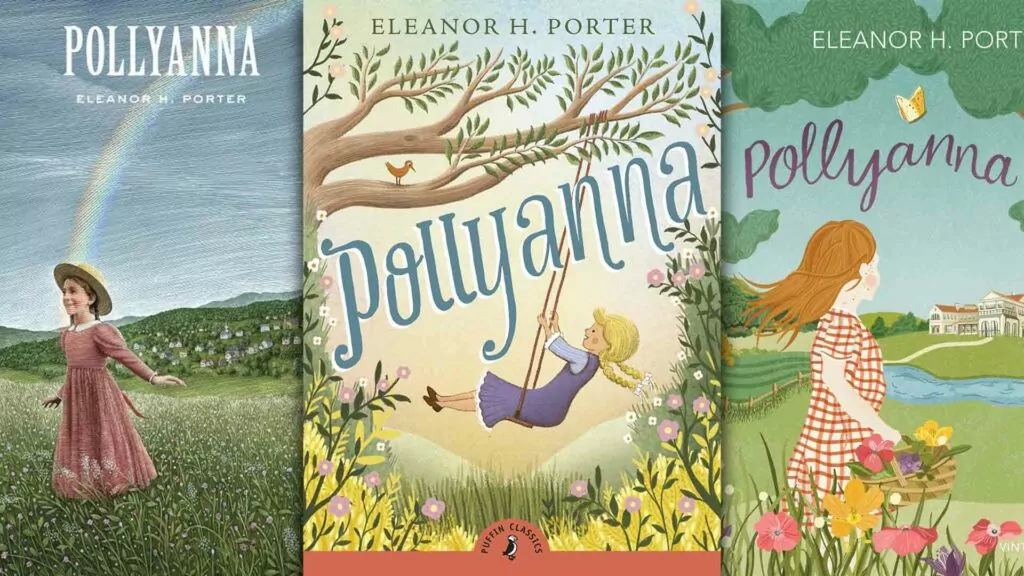
by Eleanor H. Porter 1913 / 198 pages Rating: Good/GREAT/Give Pollyanna’s father and mother were poor missionaries, and when they died she was sent to her Aunt Polly who is not poor, and not very nice – she’s the sort who thinks children shouldn’t be seen or heard. So how is Pollyanna going to win over her crusty aunty? With her sunny disposition of course! Before he died, Pollyanna’s father taught her the “glad game” where the pair would search out the silver lining for their troubles. So when Pollyanna was hoping a doll might come with the latest mission barrel, and all it had was a pair of crutches, she was glad that at least she didn’t need them. When Pollyanna brings the glad game to her new town she manages to charm even the grumpiest of residents... including her aunt. While this is a 100-year-old story, it is still a readable treat. Do buy a copy with a modern cover, to help your daughter want to pick it up. Or read it to your children yourself – you’ll benefit as much as them, learning how to see things like Pollyanna does. There is one shocking/sad moment that could cause young listeners some distress – Pollyanna gets hurt quite badly. I peeked ahead and made sure that the chapter with the accident was the first one I read that night, and then I kept on reading the next couple chapters so we could finish on a happier note. That helped my audience work through this tense section. Recommended for readers in Grade Two and up....
Red heart icon with + sign.
Book Reviews, Graphic novels

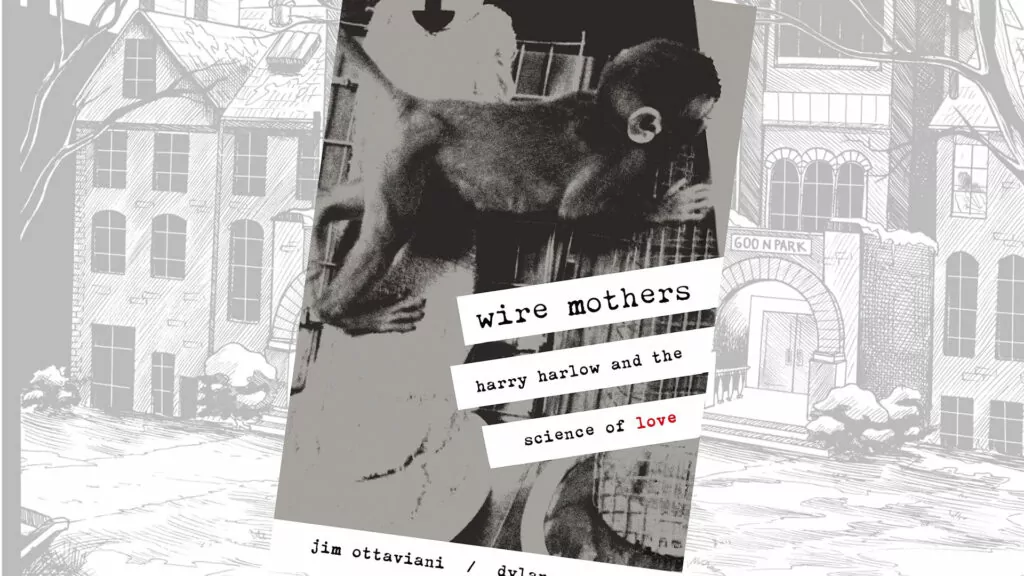
Wire Mothers: Harry Harlow and the Science of Love

by Jim Ottaviani and Dylan Meconis 2007 / 84 pages Rating: Good/GREAT/Gift Many horrors have been done in the name of science. Wire Mothers is the story of how Harry Harlow combatted one of them. In the first half of the 20th century, psychologists were warning parents not to show too much affection to their children. That might not seem so crazy; after all, we all know parents who spoil their kids. But what exactly is this "too much affection" they are talking about? Here is how one prominent psychologist put it: "Never hug and kiss them." What? Really? Yup. American Psychological Association President John B. Watson encouraged parents to shake hands with their children rather than hug. That really was being promoted! This is misinformation that Christians at that time should have been able to see through. since there is a lot of kissing and embracing going on in the Bible – just think of Jesus's story of the prodigal son being embraced by his father (Luke 15:11-31). Many in the world swallowed this pseudo-science whole, but scientist and psychologist Henry Harlow wasn't one of them. He doesn't seem to have been Christian (at least, not from what this book shares), but he did understand that parents hugging their children wasn't the problem it was being made out to be. In fact, he knew it was a good thing and set out to prove it, using monkeys. Harlow rigged up an experiment in which monkey babies were "raised" by two surrogate "mothers" – each surrogate was a simple wireframe monkey body, with no arms or legs, topped with a simple-looking head. On the first "mother," the researchers included a milk bottle inside the wireframe, with the bottle nipple situated so the baby monkey could cling to the wire and suckle at this "breast." The second mother had the same wireframe body and simple head, but didn't have a bottle. Instead, it had soft terry cloth wrapped around the wire body. So which "mother" did the baby have an emotional response to? The one that fed it, or the one with the terry cloth body? While the baby monkey would feed on the "bottle mother," it would spend less than an hour a day on it, quickly returning to the cloth mother afterwards, where it would spend as many as 17 hours per day cuddling. As pale an imitation as this was to a mother's cuddling – this cloth surrogate had no arms to hold the monkey baby – it was a great deal better than the bare wire body of the first surrogate mom. Harlow also discovered that when a frightening stimulus was brought into the setting – a noisy wooden creature – the monkey would go to the cloth mother. And, after seeking comfort, it would then feel secure enough to go investigate this clanking noisy creature. Harlow showed that if a monkey was to learn, it needed affection and comfort and cuddling, even if only from this surrogate mother. That Harlow presumed what was true for monkeys would be true for mankind shows an implicit evolutionary bias, but it is never made explicitly. And while Harry Harlow probably had evolutionary beliefs, his findings are just as useful to Christians. An evolutionist might assume that monkeys and men have this common need for touch because we are related, but as Christians, we know that this is a matter of us both having a common Designer. God is love, so is it any wonder that love is also apparent in some forms and fashions in the animal kingdom? No, not at all. Rather than bolstering evolution, this story highlights what happens when we have science untethered from God. Why did these scientists convince so many not to hug their children? Because the world listened more to these supposed experts than to what God says in His Word. And that's never a good idea. Cautions I'll note a couple of language cautions: "crap" and "stupid ass." In the interest of thoroughness, I'll also note that while this isn't remotely titillating, there is a depiction of what might be the side of a naked woman, though with all the key bits covered up. There is also an episode in which Harlow gets rescued by a group of drunk navy sailors who sing (in the background) "I love to go swimming with bow-legged women, and swim between their legs." Any kid old enough to want to read this will not be impacted by either of these two concerns. Conclusion This is a great one for adults and older teens. It's important that both we and our children remember the many times and many ways that all-knowing "Science" has messed up in the past. As Wire Mothers shows, there are many scientists who are making pronouncements that go far beyond their findings. So, this small comic is actually quite an important book....
Red heart icon with + sign.
Book Reviews, Children’s picture books

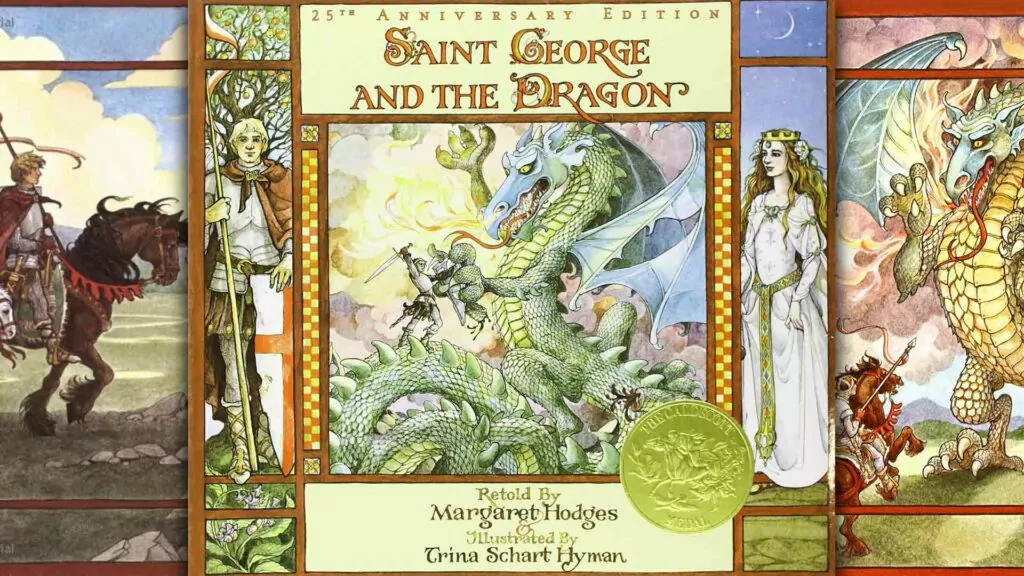
Saint George and the Dragon

retold by Margaret Hodges illustrated by Trina Schart Hyman 1990 / 32 pages Rating: Good/GREAT/Give There are a lot of "powder-puff" stories for the pre-K set – stories where everyone is nice, they do nice things, and a nice time is had by all.I'm all for niceness, but there is a certain lack of drama to these stories. And after reading one after another of them to my three-year-old I noticed she was having a hard time dealing with stories that included disagreements, disappointment, or suspense. Anything that wasn't the nicest of nice was becoming scary to her. Steps needed to be taken to rectify this situation, and what better approach than to tell her stories of valor, self-sacrifice, and dragons! Admittedly, the first go-around wasn't a success. With no dragon books at hand I made up a story about daddy fighting a dragon in defense of my daughters, and then getting eaten by the fierce beast! Now, I knew this dramatic turn would push my little one's limits, but I was going to quickly follow it with my climactic reemergence, sword in hand, out of the belly of the now-dead dragon. A fantastic ending, if I do say so myself. But, alas, my daughter wasn't around to hear it...she had already fled the room. For my second go, I decided to turn to the experts and get an actual book, one of the very best dragon-fighting stories ever crafted: Saint George and the Dragon. In this account, taken from Edmund Spenser's classic Faerie Queene, the brave Red Knight is asked by Princess Una to come save her land from a dreadful dragon. And come he does, along with his dwarf companion. The battle that then commences is beyond epic. The fearsome dragon has "scales of brass fitted so closely that no sword or spear could pierce them," leaving the Red Knight no opportunity to slice into him. It is only "the strength of the blow" that gives the dragon pause. The first day's battle ends when the Red Knight's thrust glances off the dragon's neck, but pierces its left wing. In fury, the beast throws the knight and his horse to the ground and then bellows "...the like was never heard before - and from his body, like a wide devouring oven, sent a flame of fire that scorched the knight's face and heated his armor red-hot." The knight falls, and the dragon thinks he has won. But that was just Round 1! The spot where the knight fell, it so happens, was an ancient spring which cools his armor and restores his strength. So much so that the next morning he was ready to do battle again. Two more rounds follow, with the dragon losing a paw, and a length of tail before ultimately succumbing to the Red Knight in Round 3. My daughter loved it! She needed some reassurance midway through the battle that the knight was going to win, and I should also note I didn't give it as dramatic a reading as I could have - vocally I tamped down on the tension. But there was still plenty of suspense, loads of actions, and a full-on disagreement between knight and dragon. And my daughter handled it all. So why should little kids be exposed to drama? Because stories, in addition to being a source of entertainment, can also serve as a means of education. We don't live in a powderpuff world – there are dragons that need slaying. What's more, Christians need to teach their children that the fiercest dragons out there can be and must be slain. God calls us to battle, so while stories about tea parties and talking puppies have their place, at some point training must commence. We have to be properly prepared for disagreements, disappointments, drama and dragons. I learned something from my little girl when I saw how she could make it through the scary parts so long as she was assured it would all end well. Lots of scary stuff in life too, but what do we have to fear, knowing as we do that God has already won? So, to sum up, this is an epic tale, retold in the very best way imaginable – my English teaching brother assures me no one has done a better job than author Margaret Hodges. The illustrations are detailed, and while not gore-free (we do see blood spurting from the dragon's tail when it gets cut off) certainly not gory. Both children and adults will enjoy time just pondering the pictures - when people talk of visual feasts, this is what they mean. The only caution I can add is a bit comical - there is some small elfish immodesty in these pages, with the clearest example in the last picture here on the right. The elves are not part of the story (they are a part of the larger Edmund Spenser tale Faerie Queen, of which this is an extracted part)  but appear on the title page, and in small pictures that frame each page's big center image. The elves, in one or two instances, are entirely naked, but the pictures are so small as to be easy to miss, and the elves themselves so childlike as to be quite innocent-looking. Nothing lascivious here and I mention it only so that those who might find such pictures objectionable aren't surprised by them. Children from 3 or 4 to as old as 8 or 9 will love this story. And their dads will enjoy reading it to them. ...
Red heart icon with + sign.
Book Reviews, Teen non-fiction

Skip College: Launch your career without debt, distractions, or a degree

edited by Connor Boyack 2019 / 250 pages Rating: Good/GREAT/Give This is the case against college, but not because any of the 9 contributors here think education is unimportant. They just want to share what they believe is a shorter, cheaper, more enjoyable, and more productive way to get the education you actually want.  Editor Connor Boyack shares in his introduction that a survey of 600 human resource leaders found “90 percent were open to hiring a candidate without a four-year degree.” If you’re going to be a nurse, doctor, or lawyer, you’ll need a degree, but in other fields, increasingly, it isn’t the requirement it once was. And with far more people getting degrees today than in our parents’ and grandparents’ time, a degree also isn’t the guarantee of high-paying employment it once was. Add to that the ever-increasing tuition costs, and what kind of return on investment are you going to get? Contributors Ian Morehouse and Brittany Hunter pile on by highlighting just how anti-intellectual many college campuses have become. Morehouse hits it from the student side: “Everybody cheers when class is canceled because they aren’t there for learning but for a piece of paper.” So, he asks, why not create your own piece of paper by building up a résumé of accomplishments? Since it is hard to get a job without experience and hard to get experience without a job, Morehouse pitches the idea of offering to do a project or two for free – maybe create a website for a company. Your low cost means they can take a chance on you and you can learn as you work. Getting paid nothing to work might sound like a sucker’s deal until you remember that in university your work actually costs you tens of thousands. Hunter’s chapter, “Indoctrination Factories,” focuses more on the professors and administration. She uses mostly US examples, but Canadian Jordan Peterson gets a mention for how his University of Toronto administration pressured him to use students’ “preferred” pronouns. He isn’t Christian, but wouldn’t submit to compelled speech. The fact that they came after him as a professor highlights just how hard it’d be for students to take the same stand. Next up is Kerry McDonald, on learning through living. She shares this quote: “…very little of what is taught in school is learned, very little of what is learned is remembered, and very little of what is remembered is used.” Sometimes that’s intentional: I took an education course that covered the evolutionary origins of play, and I crammed what I needed into my short-term memory so I could pass that test and the course, but I sure didn’t want to remember any of this nonsense afterward.  The material we actually retain is what we value and what we use. Remember all those young men who weren’t great students, but became great learners after they left school? That's because now they're studying something that has a clear application to what they're doing. In this chapter McDonald offers tips on how you can best plot out your own self-directed educational path. Mentors and digestible, do-able, micro-goals are important, but the key might simply be that there’s no better way to learn than doing. And if you start doing right out of high school, imagine how good you might become in four years time! Now compare that to where you’d be if you got a degree and only started doing after graduating. The editor of Skip College is Mormon, and I suspect the rest of the contributors run the gamut from godless to Christian. But what makes this book valuable to Christians is the one principle we’d agree with and which every contributor supports: young people need to consider how to best steward the skills, money, and time they’ve been given.  This would be a great one for any high school student to contend with, whether they are thinking of university, or planning for something else. And it’d be particularly needed if a student has no plans at all, as this gives them no excuse but to start building up their résumé, whether it’s academically or otherwise. This is certainly a book all my kids are going to read. While Skip College is a little difficult to find in Canada in paperback, the American publisher, LibertasPress.com, will ship north of the border. And it can be readily found as a Kindle e-book on Amazon.ca....

Red heart icon with + sign.
Book Reviews, Graphic novels

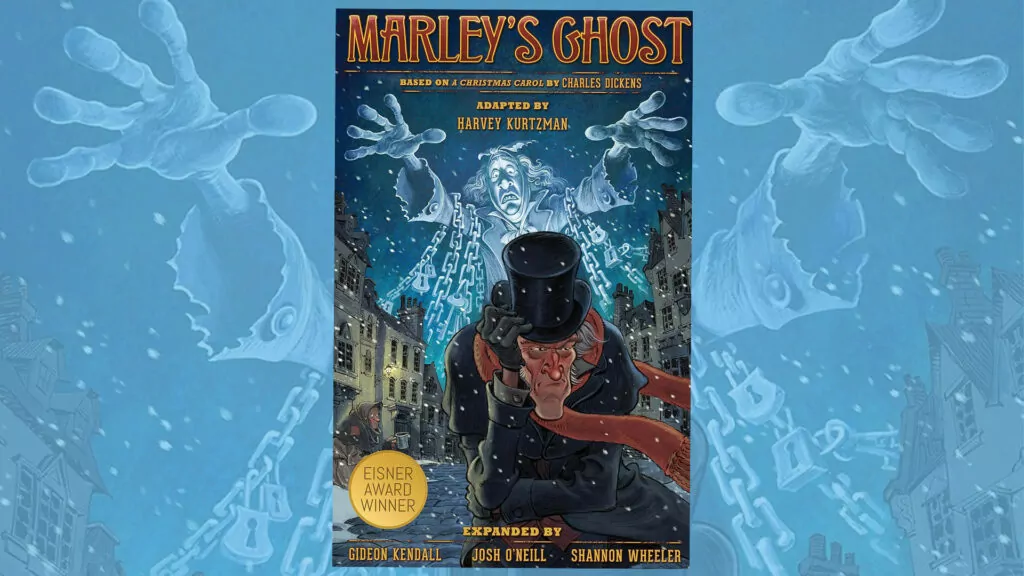
Marley's Ghost

by Charles Dickens adapted by Harvey Kurtzman, Josh O'Neill, and Shannon Wheeler illustrated by Gideon Kendall 2017 / 129 pages Rating: Good/GREAT/Gift This is a fantastic and faithful graphic novel adaptation of Charles Dickens' A Christmas Carol using much of the story's original dialogue, with only the lightest (and very helpful) bit of modernization. The revisions are limited, with the biggest probably being a change of the Ghost of Christmas Past from an old, child-like, man, to now being a waif-like girl. Not sure why the change was made, but it doesn't impact the story. Then there is also the general abridgment, with the comic coming in at probably half the text of the original story. The original has some problematic spiritual content – ghosts of various sorts, including those of Christmas Past, Present, and Future – and this adaptation shares the same. So if you disliked the original for that reason, you won't like this one either. But I'd argue that is a mistake, as this story isn't meant to teach anything about ghosts or the afterlife. Dickens lesson is entirely about the here and now – he wants us to understand that money brings cold comfort – Scrooge treats gold as his god, and this deity only brings him misery. What's actually problematic is the alternative "god" Dickens proposes. While the God of the Bible is made mention of (less in the comic than in the original) He is not the source of happiness in this story. The god here – in both original and adaptation – is generosity. If you are generous, then you will be happy and your life will have meaning. Oh, Dickens, so near and yet so far! Still, with that shortcoming understood, this classic can be appreciated – Christmas is made much of, and if we remember what this day commemorates, then we can see Scrooge's transformation as a small reflection of the generosity and humility Christ showed in coming down to earth. Cautions This book has a loose connection to Harvey Kurtzman, a cartoonist most famous for his work with Playboy and Mad magazines. However, the comic is not written or drawn by him but is only based in part on a treatment he produced, so this connection is really rather irrelevant. I only mention it to note that as good as this book is, his other work isn't. Other cautions would be limited to the unnecessary additions of two words – "bugger" and "bloody" – to Dickens' original text. Would that this bit of "modernization" had been forgone! Conclusion This is a loyal and inventive rendition that will be more enjoyable to read than the original for most of today’s readership. And they may get more out of it than they would, struggling through the original....

Red heart icon with + sign.
Adult non-fiction, Book Reviews

seasons of sorrow: the pain of loss and the comfort of God

by Tim Challies 2022 / 199 pages Rating: Good/GREAT/Gift Nick Challies was just 20 years old when he died. He was involved in a dorm activity, playing a game along with his sister, fiancee, and other college students when he suddenly fell to the ground, never to get up. Nick's dad is Tim Challies, a blogger known to many in Reformed circles. This book covers the year – the four seasons – that followed Nick's death, as his father turned to writing to figure out what he was thinking and feeling about God's decision to take his son now, and not the much later that Tim, his wife, family, fiancee, and friends, had anticipated and hoped for. The gift Challies gives here is that in his struggles to articulate his loss, he gives his readers the words to express their own. Like Job, he knows God's ways are best, so he can echo, "The Lord gave and the Lord has taken away. Blessed be the Name of the Lord" (Job 1:21). He trusts that even as he can't understand why God did this, it was somehow for his good, and that of his whole family. But Challies also expresses his fear of the Lord – not the holy sort of fear that is the beginning of wisdom (Prov. 1:7) but just the downright afraid sort, because if God has taken one child from him, what might God have planned for him next? It's this back and forth that I found the most helpful. Challies is trusting the Lord, but that doesn't keep him from expressing his doubts too. He's comforted by God's promises, but that doesn't leave him any less devastated. He has all sorts of questions, and finds many answers in the Psalms and in the writings of Christians who have wrestled with loss in ages past, but he doesn't find all the answers he'd like. Over the last two decade, Challies has made a name for himself as a discerning Christian leader. In laying open his broken heart for us all to see, I think his example will help dispel any "peer pressure" that might have some grieving men thinking that enough is enough, and it's time for me to get over it now. Challies speaks of the need for getting on with things, but is sure there'll be no getting over the loss of his son. At one point Challies worries that he may be making an idol of Nick. When he thinks of heaven, he's anticipating his reunion with his son more than meeting Jesus face to face. Again, this openness gives voice to a feeling I think many wrestle with, but maybe haven't even thought or dared to put into words. I found it helpful too when Challies shared a prayer he continues to offer up to the Lord, that he himself doesn't understand. He's asking the Lord to give him sons. His only son has died, and he and his wife are too old to have more children. He does hope and anticipate that his two daughters will bring a couple of good Christian young men into their family one day, but that is not what this prayer is about. He loved being the father of a son. And so he brings that desire to God still, not even sure what he is asking of God. And yet he comes to his Heavenly Father with his confusion and deepest longings. Seasons of Sorrow will be an impactful book for anyone who has experienced loss themselves, but the best time to read this might be before you ever need it....

Red heart icon with + sign.
Book Reviews, Children’s fiction

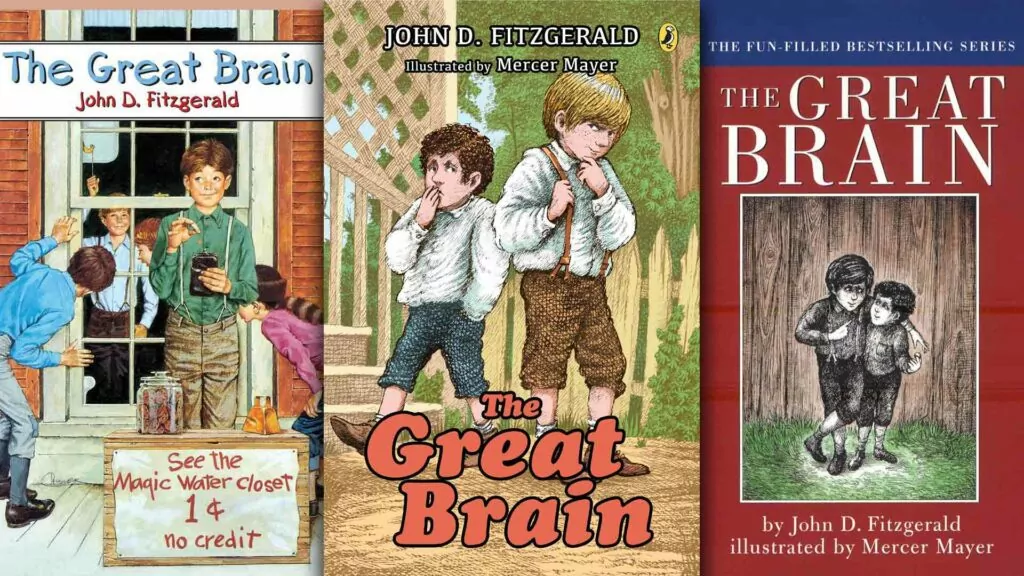
The Great Brain

by John D. Fitzgerald 1972 / 175 pages Rating: Good/GREAT/Give The Great Brain is the story of Tom Fitzgerald, a ten-year-old boy living in frontier Utah in a time so long ago that indoor toilets were considered a novelty. His hometown of Adenville is, like most Utah towns, populated mainly by Mormons who live beside a handful of Catholics and Protestants. For Tom that doesn’t matter since he can out think them all. The all consuming love of Tom’s life is money. If there’s a way to get it, Tom puts his great brain to work so that the money can be his. Not surprisingly, Tom’s great brain finds other things to work on, including finding kids lost in a cave, and getting even with his teacher. This book is fun to read as the schemes dreamed up by the “Great Brain” are often hilarious and crazy and almost always successful. Yet, though Tom’s fascinating schemes are not always something to admire, there’s a wonderful sense of morality that runs through the book. The whole tale is told by Tom’s younger brother, John. He is often taken in by Tom’s smooth justifications of his actions, but John always lets you know that he’s still left with nagging doubts. Part of John knows, however silky the Great Brain’s explanations might be, that his schemes still aren’t quite right. Tom also has great parents who are almost always on the ball. They catch onto his antics, punish him, and force him to make restitution to those he’s swindled. In the end, though, the Great Brain sees that there’s more than money. While there isn’t an overt religious message in the book, Tom actually saves a friend’s life and passes up a great money making opportunity that went with it. It makes him feel “extra good inside. Sort of clean and warm and Christmasy.” This is a fun book, good for anyone 9 and over. I absolutely loved it when I first read it as a kid. While it tells the story of an entertaining and sometimes shady child, it doesn’t glorify his antics. Ultimately Tom’s activities are clever, entertaining, confounding and successful, but you still are left with a clear sense that they’re wrong. It’s a fascinating tale with an “old fashioned” sense of morality; good must ultimately win out. The best part is that not only is this a great book, but if you love it as much as I did, there’s are sequels!...

Red heart icon with + sign.
Book Reviews, Children’s picture books

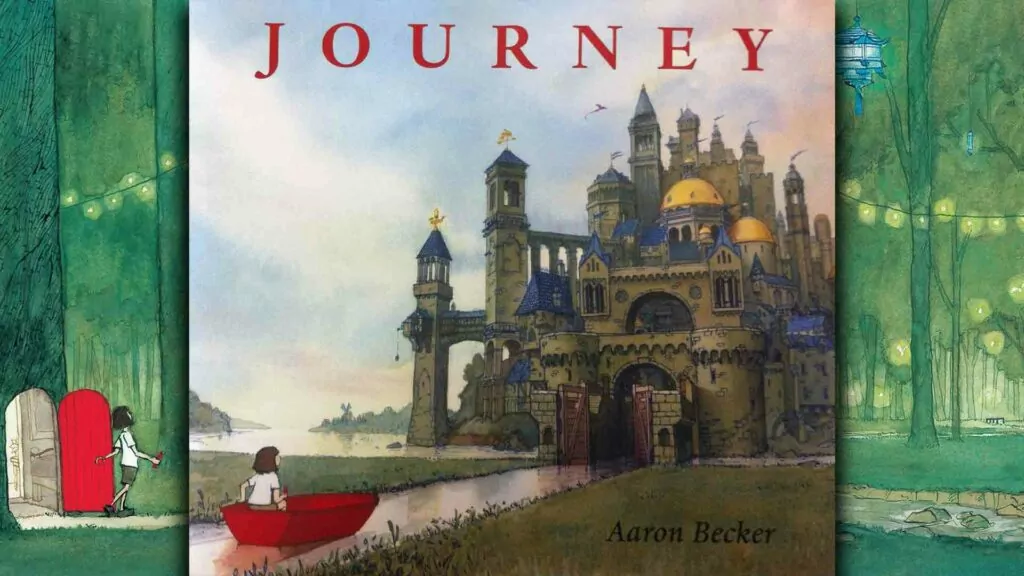
Journey

by Aaron Becker 2013 / 40 pages Rating: Good/GREAT/Give If your children loved Crockett Johnson’s Harold and the Purple Crayon you’ll want to check this one out. While Johnson wrote her own sequels, Aaron Becker’s Journey might be the most worthy successor. There are some notable differences: Harold’s world is a blank page, ready to be drawn on, while Journey has lavish full-color spreads; Harold is narrated, while Journey is a completely wordless book. But in both books, a child equipped with a large crayon and an even larger imagination sets out on an adventure of their own crafting. In Journey, a girl’s dad, mom, and sister are all too busy to play with her, but when she finds a large red crayon on her bedroom floor she discovers she can make her own fun. She uses the crayon to draw a door on her wall, which she can then open and walk through into a whole other world of wonder. A quickly drawn red boat allows her to float down a forest stream to a castle that has moats running all throughout it, and friendly guards who wave her through. Like Harold, she too, in a moment of quick thinking, conjures up a balloon to save herself from a big fall. The adventure continues into the clouds, where she comes upon a strange king, his stranger airship, and an imprisoned beautiful purple bird that looks almost as if someone – someone with a purple crayon – had drawn it! Of course, she has to free the bird, and of course it isn’t easy, leaving her requiring some rescuing herself. In the sequel, Quest (2014), red crayon girl, and the purple crayon boy she meets at the end of the previous book meet an orange crayon king right before he is dragged away by soldiers. They set out to rescue him, using their own crayons and the orange crayon the king left behind. But to do that, they need to find three more crayons and, as the title indicates, have to go on a quest, and they’ll have draw the tools and the animal friends they’ll need along the way. The conclusion to this wordless trilogy is Return (2016), in which the girl’s dad discovers the red door in his daughter’s bedroom and enters this other world in search of her. While the girl rescues them both with a quickly drawn submarine (these crayons work even underwater!), it’s dad who devises and draws (Wait, he has a crayon too? Has he been here before?) the trap that catches the evil king. These are all great fun, and deserve a slow “read” and then “reread” as children will be sure to notice all sorts of details on a second run-through. ...

Red heart icon with + sign.
Book Reviews, Teen fiction

Team Burger Shed

by Tavin Dillard 2024 / 188 pages Rating: Good/GREAT/Give Tavin Dillard is of an indeterminate age (he looks mid-30s, but gets around on a bike, which he also uses to pull the mower for his landscaping business so is he in his teens?), and lives in a small, indeterminate town, probably in Arkansas. What we do know for sure is that he likes softball. So when his buddy Myron Curtis invites him onto a team, Tavin is quick to say yup and hand over his twenty bucks for a team shirt. But then Myron got hisself all distracted after asking out Mary Beth, and never got around to ordering the uniforms. That means that for their first two games, everyone has to play "skins' versus their fully-decked out opponents who get to play "shirts." And that also means that when Tavin tries to steal a base, he slides in "chest naked." While I don't have a problem with it myself, that's a bit of descriptive folksy terminology that I could imagine some parents not liking, particularly with younger boys who you might not want going around describing themselves, every time their shirt is off, as "chest naked." I read it to my girls, so that is not a situation that will happen here. From then on, each chapter centers around a game and other softball-related developments, including how they got a sponsor (the Burger Shed), and how the softball field concession stand got burned down when Mary Beth got the idea to try selling s'mores. One whole chapter is about Tavin eating a "black nanner" (a blacker than black banana) because it would have been rude to decline. This is folksy, ridiculous, and charming – it's what'd you'd expect if you turned the Duck Dynasty TV show into a book about a rec league softball team. Cautions In addition to a few "chest naked" references, there's some mild pottyish humor, one instance related to a player who ate jalapeño nachos mid-game. And, with his "tender guts," this meal had the already slow Myron Curtis now moving at quarter speed. When its his turn at bat, his team is rooting for him to make it to first... "without ruining his breeches." Conclusion It's a season that starts slow, but has Team Burger Shed coming from way back to make it into the playoffs. Do they win it all? You'll have to read it to find out, but I think you and your teens will want to. This is not some great literary work, but it is a fun read aloud, written such that I was drawling with a southern accent the whole way through....

Red heart icon with + sign.
Book Reviews, Graphic novels

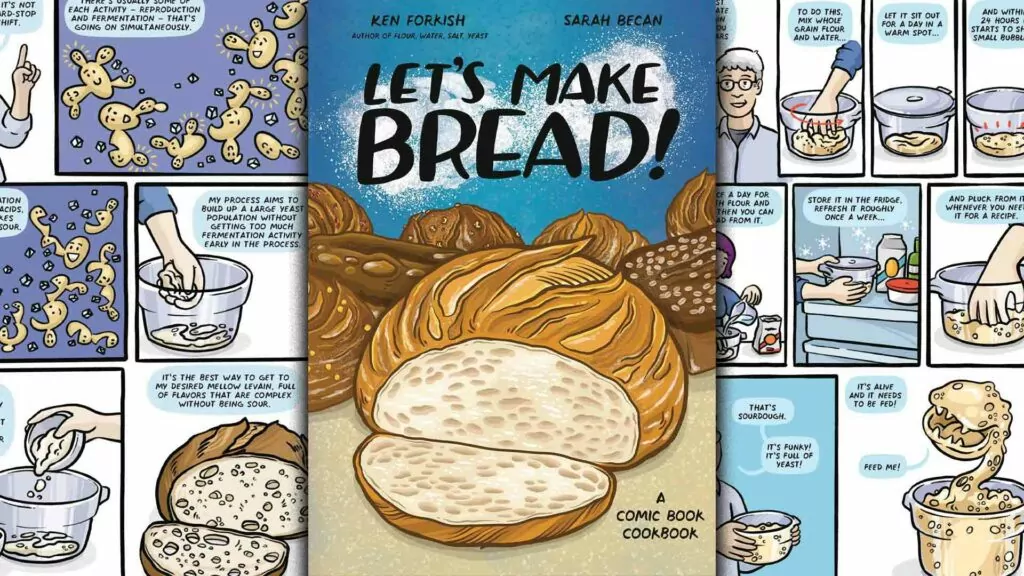
Let's Make Bread! (3 books)

by Ken Forkish and Sarah Becan 2024 / 158 pages Rating: Good/GREAT/Gift This is the comic I never knew I wanted: a how-to for baking all sorts of delicious breads. And while I'll admit to not trying out any of the recipes myself, this did get my oldest daughter experimenting. I liked the results of her labors, so this might have to move from just being a library lend to being something we really need to buy. The format is a friendly one: we get introduced to the two authors, and because this is a comic, there they are, speaking right to us with their word bubbles. The first thirty pages also introduces us to the basic tools and ingredients we'll need to get baking. Then we learn about everything from the first rise, to how best to spread our salt onto the dough. The pictures allow this how-to manual to show tips that would be really hard to just describe, like how the dough, at one stage, should have a gentle "webbing." What is bread webbing? I wouldn't have a clue if the picture hadn't shown me! Among the bread recipes, there is even a detailed procedure outlined for how you can get your own sourdough starter going. The various uses you can put it to include a really great pizza dough! There are no cautions to offer, other than that if you buy this for one of your children, you might have to also spring for some baking tools, if you don't already have them. This is a book that will inspire, so you best be ready for some flour on your counters then! Cookbooks aren't really supposed to be fun, but this one kind of pulls it off, so two thumbs up. Not a book for everyone, but certainly a great one for any young bakers in the house. The illustrator Sarah Becan teamed up with Hugh Amano for two prequels: Let's Make Ramen! (2019) and Let's Make Dumplings! (2021).  I could imagine making the dumplings, as long as I had a little help from someone more culinarily-inclined, but the ramen recipes weren't just beyond me, but astronomically so. That's why, while I'd recommend both Bread! and Dumplings for any kids who likes to bake or cook, I'd only suggest Ramen! to the expert cooks among us....

Red heart icon with + sign.
Book Reviews, Graphic novels

Secret Coders (6 books)

by Gene Luen Yang & Mike Holmes 2015-2018 / 92-110 pages each x 6 volumes Rating: Good/GREAT/Gift Hopper is at a new school and gets off to a rocky start: her classes are boring, the other students are ignoring her, and when she does get their attention, it almost results in a fight. During lunch period she ends up sitting alone... until a bird comes flutter down to sit in front of her. A feathered friend is better than no friend at all, right? That's what Hopper figures, at least until it blinks one of its four eyes! Turns out the bird is robot, and it's blinking in binary. Another student, Eni, spots the odd bird and gives Hopper, and us, a lesson in how binary works. Then the two of them discover a turtle robot designed to aid the janitor, that seems programmable, if only you know how. The janitor turns out to be a super genius, and there is a whole secret subterranean system underneath the school, but accessible only to those who know how to program the turtle. That gets us to the goal of this book. This is a series that my kids read, just for fun, but it's actually educational fiction – the authors' goal is to teach kids some of the basic logic that's involved in computer programming. And as Hopper and Eni  get better at coding simple computer programs to make the turtle robot move and work, readers are learning too. Cautions In the first book we learn that the teacher that Hopper has the biggest difficulty with – and speaks disrespectfully to – is actually her mom. We also find out that Hopper's mom and dad had a big fight six months ago, her dad left, and they haven't seen him since. It seems like he walked out on his family, though we later learn that he was kidnapped and has been stuck in a two-dimensional system since then. Thankfully Hopper does realize she needs to apologize to her mom. But her initial rudeness, and a few conversations between Hopper and her mom about whose fault it is that dad is gone, mean this isn't one for under 12s. Language concerns would be limited to a few jerk-faces, a gosh and a geez. Conclusion There are points at which the story is sacrificed for the sake of the education – each time Eni and Hopper program a turtle we all have to think through it slowly and carefully. But a nefarious principal, his rugby team henchmen, a green-skinned villain and his army of toothy robot ducks, and a budding romance between Hopper and Eni, keep things interesting. The math and logic involved in programming mean this will be a bit much for kids under 12. They might still read it just for the story, but to read these for the fun and skip over the education is to miss the point of the series. Any teen with a bent towards math and logic will find these an entertaining introduction to some basic computer code thinking. ...

Red heart icon with + sign.
Book Reviews, Science - Creation/Evolution, Teen fiction

The Farm at the Center of the Universe

by Guillermo Gonzalez and Jonathan Witt 2024 / 167 pages Rating: Good/GREAT/Give An astrobiologist has written a young adult novel with an Intelligent Design agenda, so the obvious questions are: Can he tell a good story? Does he honor God? The answer to question #1 is yes, definitely, and to #2, no, or at least not nearly enough. While the story doesn't quite stand on its own, it'll grab anyone who has even the least bit of interest in learning about atheistic evolution's shortcomings. That's why every Christian teen should read this before they finish high school – undirected evolution is one of our culture's big lies (with fruit like euthanasia, abortion, homosexuality, etc.) so our students need to be ready to contend with it before they head to university or the workforce. And this novel format transforms what could have been a dry, dusty, academic debate into a much easier read. As the opening chapter begins, Isaac and his older cousin Charlie are driving to visit their grandparents' farm for a week. Isaac is a teen who wants to know why God let his dad die from cancer. Charlie is in his twenties, and is also Isaac's science teacher (that's what can happen in a small town) and he's a tough love type, heavy on the tough. As a Darwin devotee, he tells Isaac that his dad's death is proof there is no God, just an uncaring universe. But it turns out Grandpa is not only a more sympathetic listener, he's also a retired chemistry professor who has his own thoughts about how the universe came to be. He introduces Isaac to the "book of nature," which gives all sorts of hints as to what happened in the distant past. And he also highlights how brilliant design gives evidence of a Designer. This is both the book's strongest point and its weakest: it absolutely blows up evolution, but doesn't offer the true, biblical, six-day alternative. Still, it is a very helpful read, and fun too, especially when Grandpa debates Charlie. But Isaac isn't sure exactly who he is rooting for. "Part of him wanted Grandpa to be right about a Creator and Charlie to be wrong. Isaac didn't want his dad's death to just be random. If it were random, then there wouldn't even be a God for Isaac to be angry at for letting it happen. But another part of him saw the attraction of his cousin Charlie's view. The idea of a God so powerful He could create things like these microscopic machines that filled his body, but Who hadn't even intervened to help his dad, was oddly frightening. It was almost easier to just ignore a God like that – insist He isn't out there. The silent treatment. Punish Him for letting good people die. And, after all, maybe just maybe, there really wasn't a God and he could just forget about all the hard questions." That highlights some of the book's depth in raising the "problem of evil." Though it is a theological, rather than scientific objection, it is one evolutionists will frequently raise: if a good God exists, why does He let bad things happen? But this also highlights why this isn't a book teens should read alone, because the objection goes largely unanswered. Isaac rightly notes that his feelings have no impact on whether or not God exists. That'd be a scientific answer to this objection, and a good one to have in hand. But teens should know the biblical answer too, as God gave it to Job, or as Paul teaches in Romans 9:20-21: "Who are you, a human being, to talk back to God?" And this answer needs to be understood in the context of this same God sending His Son to humble Himself and die for us. He has shown He is loving, so while we don't understand all He does, we do know we can trust Him. That's an important point, but one parents will need to provide. (Greg Koukl approaches the problem of evil from another direction with his helpful "problem of good.") As Grandpa and Charlie continue with their back-and-forths, it gives them both a chance to pitch the arguments for and against Intelligent Design. I've followed this debate for decades, and I think this fiction format allows for one of the most concise, clear, and devastating evolutionary takedowns I've read. One of my favorite bits is when Isaac is worried his Grandpa might be exaggerating a bit, when he says the cell is like a miniature factory, because, after all, factories "were massive, complex buildings filled with machinery and workers who built things like cars and trucks and Grandpa's tractor." Grandpa's response? "...you're half right. Calling a cell a factory isn't quite accurate.... It's not quite a good comparison because I'm giving too much credit to man-made factories. A cell is more like, how can I put this? A factory that builds factories that builds factories. Or a robot that builds robots thats build robots. Do you know any man-made factories that do that?" Despite Charlie's best efforts, the legs are kicked out from under his Darwin idol. Caution But what's left standing in its place? Grandpa briefly gives a nod to the Bible, reading from the opening four verses of Psalm 19 about how "the heavens declare the glory of God." But he never addresses the opening chapters of Genesis. Grandpa doesn't believe in unguided evolution, but it becomes clear he also doesn't believe that God created in just six days. The problem here is akin to the situation we have with a Jordan Peterson or even a Pierre Poilievre. In our blind land, these one-eyed men see so much better than most. But they are still seeing only half as well as they could. The book of nature that Grandpa appeals to offers him only hints and clues as to the reality and nature of God, but God has revealed Himself much more clearly in another book, His Word. If only Grandpa was willing to rely on the clearest of the two books, instead of leaning on his own understanding (Prov. 3:5-6). Conclusion While every Christian teen should read this, none of them should read it alone. They should read The Farm at the Center of the Universe because of how it makes quick work of atheistic evolution. It'll prepare them for many of the attacks a university prof might muster. But while evolution-toppling accounts for about 99 percent of the novel's contents, there is also 1 percent that misdirects by leaving open the possibility that God could have created over billions of years. Are the authors proposing some sort of theistic evolution? That's never clearly stated, but it needs to have been ruled out. And since Farm is targeted to teens that 1 percent of misdirection shouldn't be overlooked. Teens should read it, but with a teacher or parent alongside....

1 2 3 4 5 6