Transparent heart icon with white outline and + sign.

Life's busy, read it when you're ready!

Create a free account to save articles for later, keep track of past articles you’ve read, and receive exclusive access to all RP resources.

White magnifying glass.

Search thousands of RP articles

Helping you think, speak, and act in Christ.

Open envelope icon with @ symbol

Get Articles Delivered!

Helping you think, speak, and act in Christ. delivered direct to your Inbox!


Red heart icon with + sign.
Book Reviews, Graphic novels

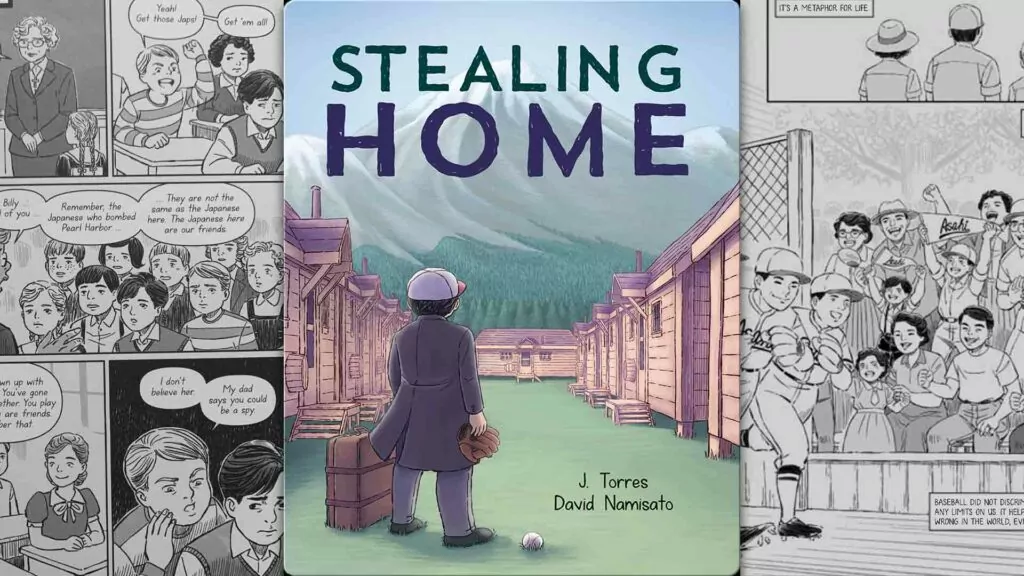
Stealing Home

by J. Torres and David Namisato 2021 / 112 pages Rating: Good/GREAT/Gift During World War II, after Japan attacked Pearl Harbor, Canada rounded up Japanese Canadians living on the coast and shipped them away to abandoned mining towns further in the interior. To add to the horror, this "temporary measure" came with devastating permanent consequences: their homes and most of their goods were sold, and the money was used to build and maintain their internment camps. So when the war ended and they were released, these families couldn't go home. They had to start from nothing. So how could such a sad chapter of Canadian history get a gentle enough treatment to be suitable for this Grade-4-and-up graphic novel? By focusing on how at least some of these Japanese Canadians managed to overcome their mistreatment. For Sandy Saito, baseball was a big help. Even before the war, anyone of Asian descent didn't exactly fit in with the predominantly white population of Canada. But on the baseball diamond, it didn't matter what others thought; all that mattered was how you played. As we're introduced to Sandy we find out this young boy is a huge fan of the Vancouver Asahi, a local baseball team made up of Japanese Canadians. Because Asahi players were smaller than their opponents, they couldn't play bash ball; their game wasn't about hitting more home runs than the opposition. They, instead, played "brain ball" with steals and bunts. And it worked so well they won the league championship 11 of the previous 24 years. When Sandy and his family were sent away, he took his baseball glove, as did others. They had no insulation in their cabins, and families had to share space. There were outhouses instead of bathrooms. And they couldn't leave. But they could play baseball. I don't have any cautions to offer. The only critique I can think of is that in making this gentle enough for elementary students, the authors might have made a little too little of the horrible abuse that happened. My own fourth grader read this, and thought it was quite good, but it didn't disturb her like it did me. That's probably because I was reading between the lines, and she was just taking it as it was told on the page. As to audience, she didn't know if it would grab a fourth-grade boy's attention. I think she might be on to something. Even though baseball is central to the story, this isn't a sports book. We don't see any great plays, or tight games, so it doesn't have that sort of boyish pull. But for elementary-and-up kids with any interest in history, this will be a very intriguing read. And for adults like me, who never knew about these events, this is a must-read. If we want our government to act with restraint in the future, we need to remember the times when it didn't do so in the past. We need to know, and we need to share that history, lest in forgetting it, we have to live through it again. For a more brutal account of how the US treated Japanese Americans during the war, you'll want to read We Hereby Refuse: Japanese American Resistance to Wartime Incarceration....

Red heart icon with + sign.
Adult non-fiction, Book lists, Book Reviews

Help for the anxious and those who struggle with measuring up

Last summer, in an issue of this magazine devoted to the topic of anxiety, I shared my own struggle with burnout and anxiety. I don’t think I ever received as much interaction with any other article I have written in my lifetime. From bachelors to mothers, loggers, seniors, and pastors, people continue to pull me aside to talk about their own struggles with anxiety. It has been a great encouragement to see how the LORD works through our weakness to refine us, burn away the chaff, and direct our eyes upward to trust in Him. Since then, a couple more solid resources have been published that I’m confident will be a blessing to many who desire to live in the freedom that Christ has obtained for us. Building a non-anxious life by John Delony 2023 / 300 pages With anxiety symptoms being so widely recognized and diagnosed, it is becoming more common to hear comments like “I have been feeling lousy, visited my doctor, and discovered that I have anxiety!” Or, “my 5-year-old isn’t able to do that because she has anxiety.” Underneath these comments is a perception that anxiety is a kind of illness or condition we are stuck with, a part of our identity, with little hope of change. We then reshape our lives and the world to adapt accordingly. Sadly, this often results in us building a world around ourselves, doing little for others and for God’s kingdom. In his new book Building a Non-Anxious Life, Dr. John Delony challenges this way of thinking about anxiety head-on, offering a far more hopeful and practical approach. Dr. Delony’s thesis is that anxiety isn’t the problem. Rather, our focus needs to be on “addressing the things causing anxiety in the first place – the situations, thoughts, schedules, and choices throwing your wellness and world totally out of whack.” Dr. Delony compares anxiety to a smoke alarm in our homes. If the alarm goes off, the problem isn’t the alarm itself. We can find all sorts of tricks to try to make the smoke alarm less irritating, like covering our ears, distracting ourselves, or even stuffing a pillow on top of it. That may help muffle the noise and make things more bearable in the short term, but it doesn’t address the root of the issue: there is something causing the smoke! That is what needs our attention. The book proceeds to introduce six daily choices that he argues will help build a non-anxious life, putting out the fire. It begins with choosing reality – becoming aware of what isn’t working in your life. Although he writes for a broad and even secular audience, the sixth choice is “belief.” Specifically, “If you want to go all the way to truly live, build, and enjoy the fruits of a non-anxious life, you have to surrender. You must choose belief in something greater than yourself.” Delony is open that he experiences this in his faith in Jesus Christ. The book has become popular quickly for good reason. Dr. Delony has a knack for being able to explain complicated things in simple terms. This book is easily accessible for all ages and walks of life. I know of one family with teens that is working through it together, chapter by chapter. But what I appreciate most about it is that it helps to set captives free, challenging the disposition among many to allow anxiety symptoms to hold them in bondage. Although some people may have predispositions to anxiety, and it may be a life-long struggle, it is so important that we take to heart Galatians 5:1: “It is for freedom that Christ has set us free. Stand firm, then, and do not let yourselves be burdened again by the yoke of slavery.” As a result of some quality resources, counseling, and God’s tender care, when I experience anxiety symptoms today, I can see them as something to be grateful for. I’m reminded that God has designed my body to sound an alarm when things aren’t right. That means I can make changes. Delony’s book has given me even more tools to help with building a non-anxious life.  Impossible Christianity by Kevin DeYoung 2023 / 160 pages The causes for anxiety symptoms and burnout will be different for each person. It can be connected to being raised by an anxious parent, early life trauma, stress, illness, or drug use, among other things. But there is another factor that many of our readers may share with me, namely spiritual guilt and a struggle with knowing whether God is pleased with us. Yes, we know that our eternal destiny is secure in Christ. But it is another thing to know that He is already pleased with us right now. And if we aren’t sure about this, we can foolishly try to earn God’s favor by our performance, and feel guilt or even despair when we fall short. Kevin DeYoung’s latest book, Impossible Christianity, isn’t directly about anxiety, but it gets to the heart of a problematic way of thinking that seems to be more common among Reformed Christians. His subtitle gives a clue: “Why Following Jesus Does Not Mean You Have to Change the World, Be an Expert in Everything, Accept Spiritual Failure, and Feel Miserable Pretty Much All the Time.” I keep buying and giving away copies of DeYoung’s Just Do Something book, as it is such a big help to those struggling with discerning God’s will for their lives. It truly is a liberating read (and not just because it is short). Impossible Christianity is proving to be no less impactful, and I think it will be particularly so for folks from the Dutch-Reformed tradition. DeYoung begins by sharing stories about his long-standing efforts and love of competitive running and then notes that “many Christians have come to expect (and accept) that being a disciple of Jesus is a lot like my thirty-five-year journey with running. You read the books. You watch the videos. You get the right equipment. You try to be disciplined. You try to improve. But with only the mildest of success.” He then proceeds to make the case that he now sees how this has been the implicit message in all his other writings as well: “following Christ is never easy, but it does not have to be impenetrably mysterious, exceeding complex, and relentlessly guilt-producing…. Ordinary Christians and ordinary churches can be faithful, fruitful, and pleasing to God. In short, Christianity doesn’t have to be impossible.” There is a lot of theologically sound content packed in another very short book. For example, he takes readers to the book of 1 John to find three road signs that can provide assurance of salvation. Based on 1 John, he notes that we should have confidence if we believe that Jesus Christ is the Son of God (1 John 5:11-13), if we live a righteous life (1 John 3:6-9), and if we love other Christians (1 John 3:14). “These are not three things we do to earn salvation, but three indicators that God has indeed saved us by his grace.” To be clear, this is just one small part of a larger argument he makes, and I’m not going to try capture his full case in this article. Most compelling for me is his discussion about how God looks at us as a Father does, not just as a judge. As a father myself, DeYoung’s words resonated in my heart in a way that intellectual arguments have not been able to. If one of my children draws me a picture, mows the lawn, or cleans up part of the house, I’m truly pleased with them. Sure, the picture may show that I have four hairs on my head (I’m sure I have at least six), the lawn may not be cut in perfect lines, and they failed to dust the shelves. But I’m not looking for perfect obedience. Rather, I’m looking for true obedience – from the heart. It meant the world to me to realize that God looks at me as a Father, who has already found perfect obedience in our elder-brother Jesus Christ. God is actually pleased with me. The reason why I think this book is particularly relevant to those with a Dutch-Reformed tradition (i.e the majority of RP’s readers) connects to his point that “Too many Christians make the mistake of thinking that if they are to be seriously godly, they must utterly denigrate everything they do as Christians.” Hardly a week passes where we aren’t reminded about how our best works are “like filthy rags.” Yet God’s Word, and the Reformed confessions, make it clear that our good works are accepted by God in view of Christ’s work. He is willing to say to us “well done, good and faithful servant” (Matthew 25:23). From the conversations I have had with some others in Reformed churches, guilt over not doing enough is one of the contributing factors leading to stress and even burnout. If that includes you, I heartily encourage you to buy this book and take the encouraging words to heart....

Red heart icon with + sign.
Book Reviews, Graphic novels

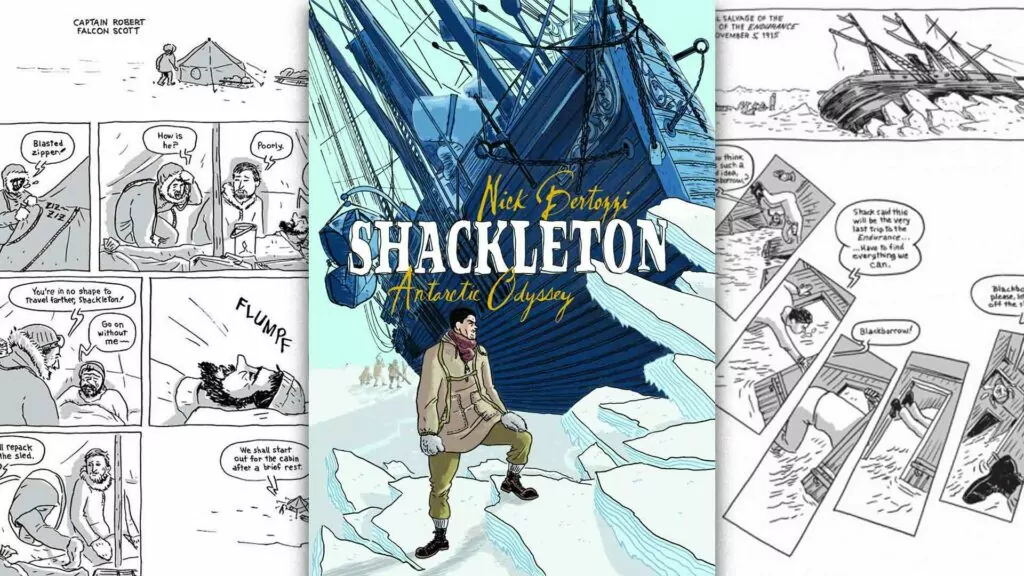
Shackleton: Antarctic Odyssey

by Nick Bertozzi 2014 / 125 pages Rating: Good/GREAT/Gift Sir Ernest Henry Shackleton was obsessed with reaching the South Pole. He tried to be the first to get there, setting out on two expeditions that fell short when harsh conditions drove them back. Ultimately he was beaten to the Pole by a Norwegian, Roald Amundsen, who made it there in December of 1911. But if Shackleton couldn't be the first to the Pole, then he was determined to be the first to traverse the Antarctic from one side to the other. With this ambitious goal in mind, he set out with his crew on August 1, 1914. Shackleton would fail this time too, but in such a spectacular and heroic manner that the tale of his failure has been retold again and again in countless books and several documentaries. His ship sunk, his sled dogs were killed to be eaten for food, and his crew was stranded on an icepack that was constantly breaking up, the only solid ground being an island 100 miles away across the open water. Yet, somehow, Shackleton and his crew all made it home alive, more than 2 years after they left. Nick Bertozzi's graphic novel is one of the latest and certainly one of the greatest additions to the Shackleton canon. At times humorous – it includes a toga party and a stowaway who readily accepts that should food be in short supply he will be the first eaten – and gripping throughout. Bertozzi presents Shackleton as a man who would risk much, but who wouldn't throw away his men's lives to complete this goal. As obsessed as he was with the Pole, Shackleton was more obsessed about his men's well-being and he was determined to do whatever it took to get them back home. Cautions This does have some language concerns, but doesn't take God's Name in vain. "Damn" or "damned" occurs about a half dozen times, and also notable is the use of the word "bloody" which I understand is quite offensive among the British (but doesn't seem so bad to me) – it is used more than a dozen times. Conclusion I'd recommend this for any teens who might have a history project to do. They might not find it as gripping as the latest Marvel movie, but this is a pretty rollicking tale, and especially if they keep in mind that this is true, it really could grip them. Shackleton: Antarctic Odyssey will also appeal to any adults who aren't embarrassed at the thought of being seen reading a comic....

Red heart icon with + sign.
Book Reviews, Graphic novels

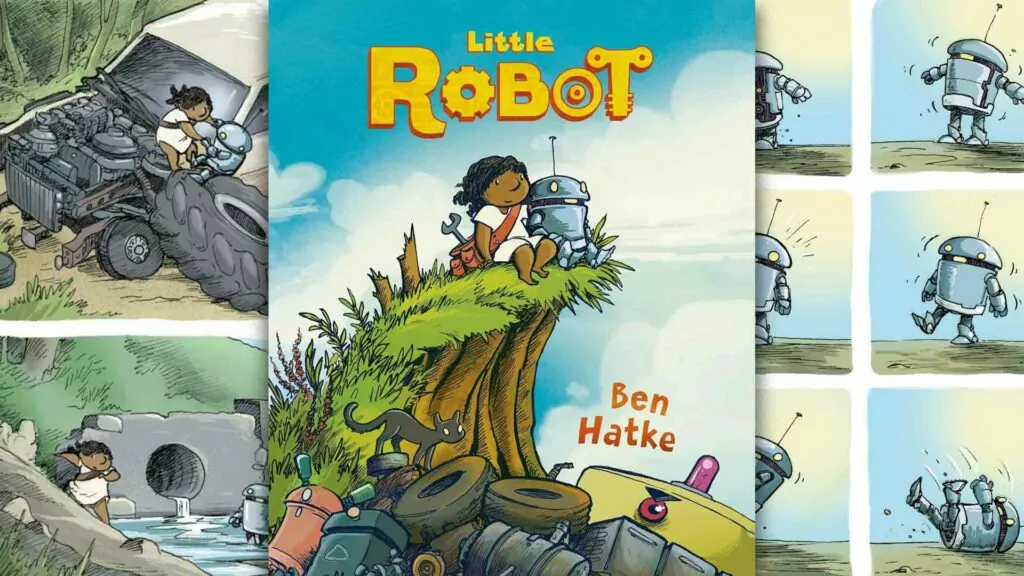
Little Robot

by Ben Hatke 136 pages / 2015 Rating: Good/GREAT/Gift This is one of those little-girl-meets-little-robot, little-girl-loses-little-robot, little-girl-kicks-some-big-robot-tushy-to-save-little-robot stories. What sets it apart from all the others is that the first 26 pages are entirely wordless, and there isn't much talking the rest of the way either. The little girl, it turns out, is quite the amateur mechanic, so when she comes across an abandoned box and discovers a robot inside, she sets out to get it running. And she gets a little frightened when it does come to "life." This little girl is also quite lonely, so once she overcomes her fear, she becomes convinced this is going to be her new friend. However (insert ominious music here) she isn't the only one interested in the little robot! His manufacturer has noticed he's missing, and has sent a big bad robot on a search and recover mission. And this thing is massive – a semi-truck-sized beast that looks like it could eat trees! When it swallows the little robot, it's up to the girl, and some other new-found robot friends, to outwit the big robot bully and free her little buddy. Cautions At one point the big bad robot also swallows a poor defenceless kitty, but never fear, the fuzzball isn't chewed up – it's just inside, waiting to be rescued. The only other caution would be the notion of robots as people. Kids' stories have all sorts of anthropomorphism – cats can have hats, rabbits have swords, and trees might even walk – so is it a big deal if robots get this treatment too? No, unless kids get too much of it. No one believes cats, rabbits, or trees could actually become people, but they are saying that about robots today. The world misunderstands mankind as simply "meat robots," and from there, it isn't much of a leap to think robots could one day become "metal people." But we are more than our meat - we are body and soul, and no amount of hardware or software will ever engraft a soul into a robot. And that's a point that might be worth sharing with our kids. Conclusion The protagonist of the story usually gives you a good gauge of the target audience, and as this one is a little girl, girls would certainly be among those interested. But it's also got robots, and robots hunting robots, which will appeal to the boys. And as a mostly wordless comic, it will also have some appeal for early readers. It has a bit of tension, which could be a bit much for some in Grade 1, but for most in Grades 1 through 5, this will be a real treat....

Red heart icon with + sign.
Book Reviews, Children’s picture books

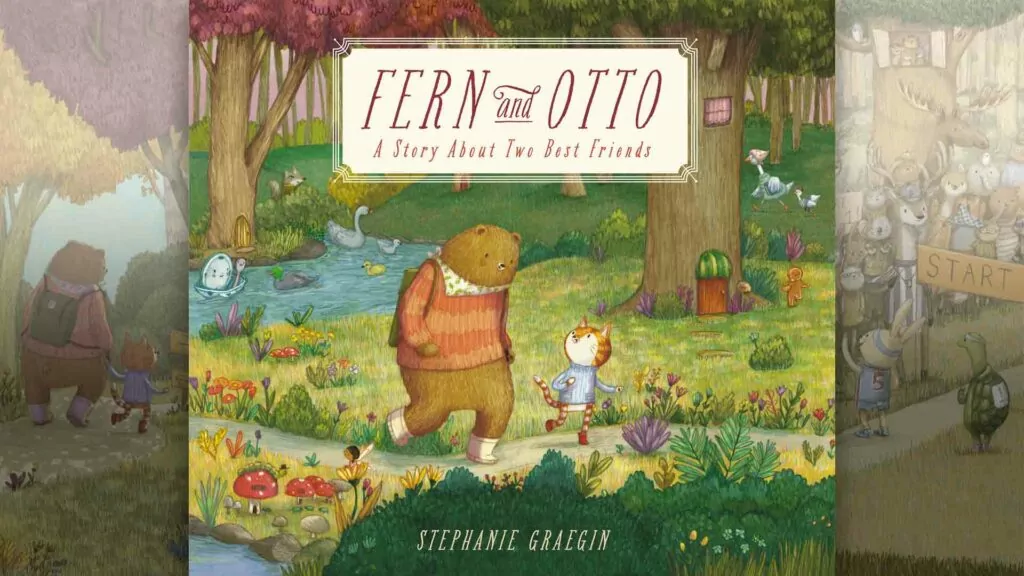
Fern and Otto

by Stephanie Graegin 40 pages / 2020 Rating: Good/GREAT/Give Fern is a bear, an author, an illustrator, and a best friend to Otto, the adventurous cat who shares her treehouse abode. Fern has authored a book, and naturally, it is about her best friend and the activities they get up to together, like eating lunch and napping in the sun. Otto likes napping, but he isn't wild about being immortalized in a book as a napper. He wants the story to be about something more adventurous. And that means Fern and Otto need to head outside and find excitement. So off they head into the woods, two friends looking for some sort of heart-pumping happenings. This already delightful book amps up the delight when Fern and Otto come across all sorts of fairytale events – they bump into the Tortoise and the Hare right as their race is about to start – only to have Otto insist they keep walking so they can find something more interesting. Kids will enjoy spotting familiar fairytale critters (like the Three Little Pigs shuttling their supplies) who show up in the background a few pages before Fern and Otto eventually bump into them. Fern and Otto are both clueless as they just miss one adventure after another, meeting Goldilocks, but leaving before the Three Bears show up, and walking with Little Red Riding Hood, but heading their own way just before she reaches Grandma's house. The Gingerbread Man, Hansel and Gretel, Chicken Little, and many more make quick appearances. It's only when the two best friends stumble across a witch that they realize that excitement isn't all it's cracked up to be, and home sounds pretty good right about then. The fractured fairytales are great fun, and I also appreciated this for the kid-level look it provides of the creative process – we get to see Fern write her book, work with feedback, and then rewrite it. Two thumbs way up!...

Red heart icon with + sign.
Book Reviews, Graphic novels

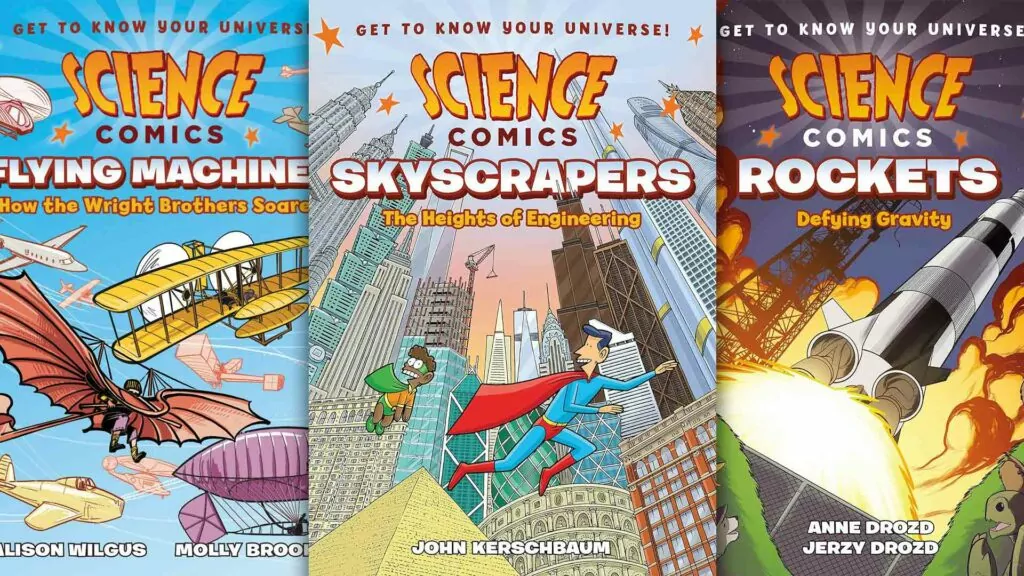
Science Comics: a quality quartet

Comics that are hilarious and instructive? That's impressive! What's less impressive about this “Science Comics” series, is that quite a few of the titles give a nod, or a full-on bow, to evolution, and others push climate catastrophism. For materials intended for kids, that's a good reason to give them a skip. But the quartet reviewed below are the exception, and just give us the facts and history and hilarity. So, two thumbs up for these four, but be aware that others in the series are not always as praiseworthy. Flying Machines: How the Wright Brothers Soared by A. Wilgus & Molly Brooks 122 pages / 2017 This is the history of powered aviation as told by the Wright brothers' only sister, Katherine. She’s a lively and curious narrator, interacting with not only her brothers but other early aviation innovators as well. While this is history, as part of the "Science Comics" series, it digs deep into the science of how flight works, which makes this a comic even an adult could appreciate... though it is probably aimed at Grade 4 and up.  Skyscrapers: The Heights of Engineering by John Kerschbaum 128 pages / 2019 This is as funny as it is educational. The narrator is a flying superhero, and while he is never named, his red cape and boots and his blue full-body long johns sure look familiar. He’s also able to leap over tall buildings in a single bound… except that he just tripped over the tip of a new, really, really tall one. Boy, are they building them big these days! When his sort-of sidekick Quiz Kid show up, the two travel to and fro through time to find out how we learned to build up up and away! They get into why arches work, and how they distribute forces, the tensile and comprehension forces on stone, how concrete is made, and what technological leaps were made that’ll allow us to build a mile high. What makes this such a fun read is the comic duo: “superman” playing the straight man, and the Quiz Kid his foil. The only cautions would be a “Holy holes” utterance by Quiz Kid about how deep a foundation was. Rockets: Defying Gravity by Anne Drozd and Jerzy Drozd 120 pages / 2018 The comedians this time are all sorts of animals – pigeons, chickens, sheep, monkeys and even bears – who were the test subjects that served as the very first astronauts. There is a lot of science in this one, to the point that I'm not sure I understood it all. But I enjoyed it all! We're taken back in time, to meet Isaac Newton and get introduced to his three laws of motion. Then we're shown how those laws were in play with man's firsts attempts at flight, via balloons. We also get to meet some of the animals that were the first passengers. The animals, including a very enthusiastic bear, take us traveling around the world, to China and Europe, to see how rockets were used for both warfare and entertainment. We repeatedly pop back to the near present, watching the space race between the USSR and USA. Then the whole thing finishes off with some of the developments being made in private rocketeering today, by Elon Musk and others. There is so much packed into this one that I could see teens reading it again and again. There is a "dang" or two, but no other cautions. The sheer intensity of education on offer here means this is probably best for teens and up. Bridges: Engineering Masterpieces by Dan Zettwoch 122 pages / 2022 A quartet narrates this look at bridges all over the world. Each has their favorite type: Bea likes beams, Archie favors arch bridges, Trudy prefers triangles, and the youngest of them all and still a student, Spence likes suspension bridges. We are also introduced to the different loads that engineers have to consider, and the different forces they have to contend with, including compression, tension, torsion, and shear. This quartet also challenges readers to have a bridge-building contest at their school to experiment with what bridge types might be best. The only cautions? A passing mention of millions of years, and a bridge early on that, legend says, was built by the Devil to give himself a place to sunbathe. That's it....

Red heart icon with + sign.
Book Reviews, Graphic novels

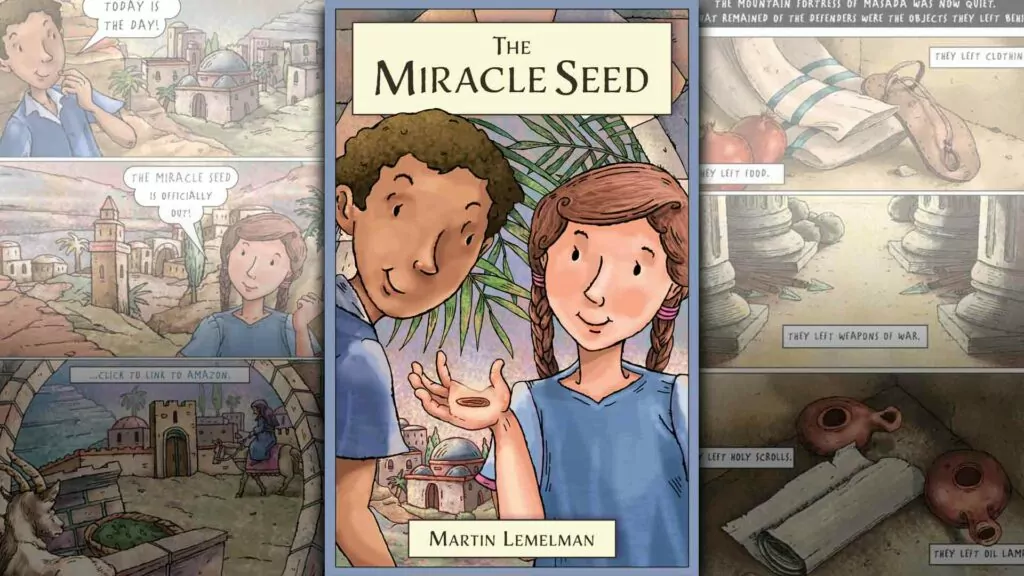
The Miracle Seed

by Martin Lemelman 2023 / 80 pages Rating: Good/GREAT/Gift In 70 AD, after besieging Roman forces destroyed Jerusalem and the Jewish Temple, they went on a destructive rampage through the rest of Israel, killing thousands of Jews and enslaving thousands more. And, as this graphic novel shares, they also cut down and burned groves of Judean Date Palm Trees. Eventually, a small group of Jewish forces retreated to the hilltop fortress of Masada. Numbering under one thousand, they tried to outlast a Roman force ten times their size, but it was only a matter of time. And when the Jews lost, they left behind broken weapons, scraps of clothing, and pots to be buried by the drifting sands... only to be uncovered by archeologists millennia later. Amongst those pots was one that contained Judean Date Palm seeds. The Judean Date Palms that remained after Rome's rampage didn't fare well without people around to tend them. Even the wild varieties started dying off, though we're told it is unclear whether that was due to changes in climate or perhaps the activities of the Crusaders one thousand years later. All we are sure of is that in our modern day the Judean Date Palms were only known by their accounts in the history books – they had been extinct for hundreds of years. The comic continues the story in 1963, when that the jar of seeds was discovered. The six seeds inside were put in a drawer and forgotten about for 40 more years. Then a medical researcher got involved. Dr. Sarah Sallon wondered if what she'd read about the Judean Date Palm's healing powers might have been true. And that got her wondering if those six seeds could be used to revive the species! As the title gives away, the trees did have an amazing comeback. It was quite a process, involving inventiveness and imagination – who would have thought it could be possible to sprout seeds thousands of years old? Caution The author is Jewish, and that comes out in a couple of quotes from Jewish commentaries. The first, opening the book, is nonsense, and a young audience might need to be told that nowhere in the Bible does it say, "There is no plant without an angel in heaven tending it and telling it, 'Grow!'" The only other caution is that the title miracle is never ascribed to God – He is not mentioned. Conclusion This will be fascinating read for students curious about science or history – there's more than a bit of both here. I'd recommend it for Grade 6 and up, including adults who will appreciate this as a quick, light read about an intriguing topic. ...

Red heart icon with + sign.
Adult fiction, Book Reviews

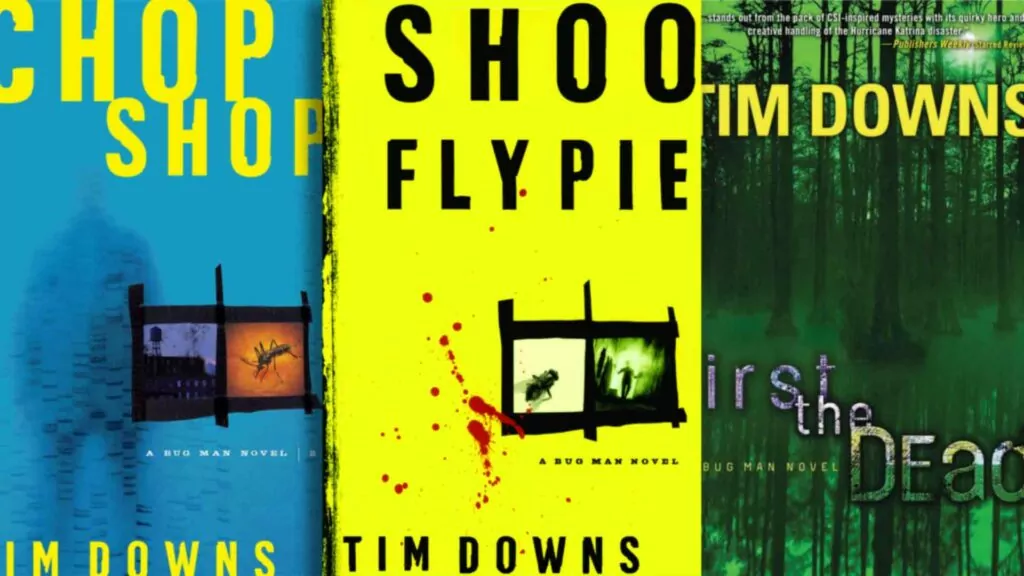
Shoofly Pie

by Tim Downs 2003 / 371 pages Rating: Good/GREAT/Give Did you know that insects have been known to help solve murder investigations? One of the first recorded cases of an insect aiding in a murder investigation occurred in 13th-century China. The murder weapon was assumed to be a sickle, a common tool used to harvest rice. An investigator had all the local workers lay out their sickles and although the sickles looked clean, flies began to swarm one. Why? Because the unseen blood was a magnet for flies who were searching for a place to lay their eggs.  Forensic entomology, the study of insects to solve crimes, has now progressed to a point that investigators are able to estimate the time and place of a death just by looking at the age and species of the maggots on the person of interest. In Shoofly Pie, we follow a fictional entomologist, Nick Polchak, as he investigates the suicide of one of his clients’ close friends. Polchak is extremely bright and has decided to move beyond associating with the human race, referring to them only as “your species.” This disassociation leads Polchak to some funny and interesting interactions with the human species around him.  I had a really hard time putting this book down. Author Tim Downs does a great job developing characters that you want to care about while at the same time driving a very strong plot. Cautions If thinking about maggots makes you squeamish, this may not be the book for you as descriptions of death and decay are encountered often. There is also reference to hard drug use by one of the characters, so if the mention of a suicide didn't already make it clear, this isn't a book for preteens. The only language concern would be one use of “Gosh." Conclusion I highly recommend this book to anyone high school-aged or above. I loved it! If you enjoy this book as much as I did, Shoofly Pie is the first in a series of eight "Bug Man" novels. ...

Red heart icon with + sign.
Book Reviews, Children’s picture books

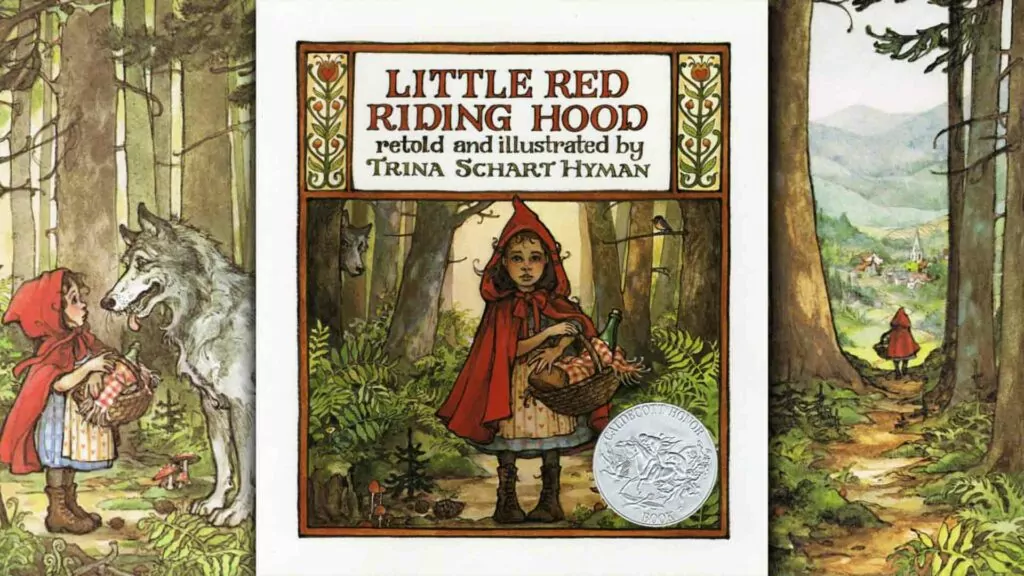
Little Red Riding Hood

by Trina Schart Hyman 28 pages / 1983 Rating: Good/GREAT/Give This is about a little girl and the big wolf that gobbles her up. If that is a bit of a shock to you, then the version you were told as a child was likely some modernized, bubble-wrapped rendition in which grandma is shut up in a closet rather than eaten, and the woodsman arrives before Red Riding Hood takes a trip down the wolf's gullet. But in Trina Schart Hyman's retelling we hear the traditional tale: first the wolf eats his fill; then he gets his comeuppance. So why is this traditional tale the better one? The peril is a key reason. Our world is not always a safe place, and to prepare our children for it we need to introduce them to the real world in bits and pieces. One good way to teach them about how bad the real world can be is by introducing them to some of that nastiness – in a measured dose – via fairytales. If you take the peril away from the story so that Red Riding Hood is saved before she is ever really in danger, you have a nice story for a two-year-old, but it is not a story that stretches or challenges anyone older. But what if, instead, the wolf "ran straight to the bed, and without even saying a good-morning, he ate up the poor old grandmother in one gulp"? That is scary.... briefly. Only a few pages later the woodsman comes to save the day and skin the wolf, so this is only a small dosage, but one that can serve to fortify children in preparation for the days ahead when they learn what the world is really like. The biggest selling feature is, however, Trina Schart Hyman's remarkable art – there is so much to see in each picture. And as a fun bonus, she has hidden Red Riding Hood's black cat on almost every page, there to be found by a sharp-eyed child. As for age recommendations, well, this is a story my two-year-old always enjoyed (but probably didn't fully understand - she liked looking for the cat) but it's one that my four-year-old needed to be in the right mood for. She found the wolf a tad on the scary side. I have but one caution: at one point the woodsman makes use of the word "jiminy" which some consider a "substitute oath." The woodsman isn't actually taking God's name, but is used this word in place of taking God's name in vain. I don't have a problem with this, but make mention because I know some readers might, so I want you to be aware....

Red heart icon with + sign.
Book Reviews, Teen fiction

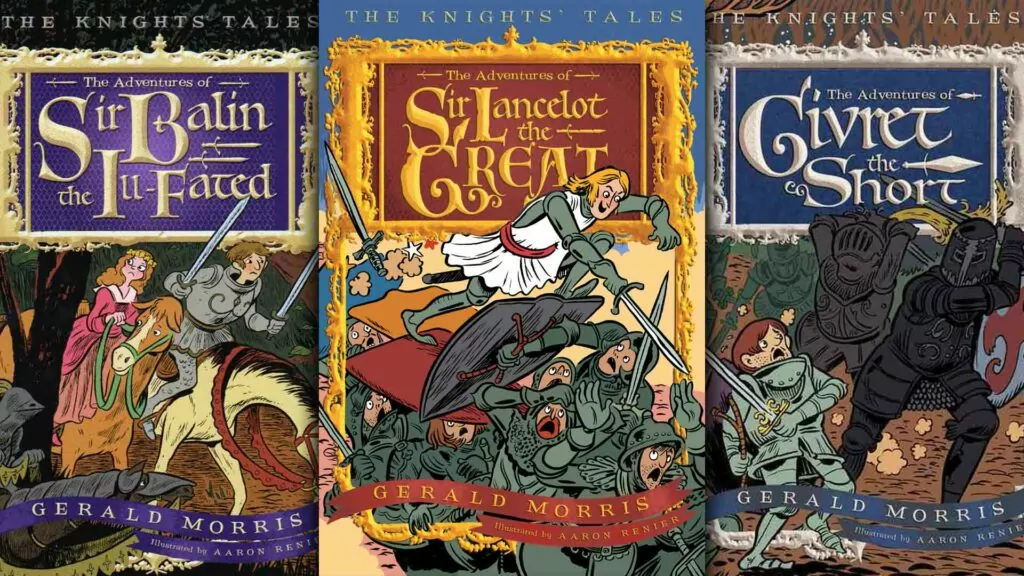
The Adventures of Lancelot the Great

by Gerald Morris 92 pages / 2008 Rating: Good/GREAT/Give This has all the adventure you’d expect from an Arthurian tale, but way more humor. And maybe the best way to review it is to share one of those jokes. Sir Lancelot wants to be one of King Arthur’s knights because “They have the bravest hearts, the noblest souls and the shiniest armor in all the world.” Lancelot is a little obsessed with his appearance but on his journey to Camelot, (to introduce himself to the King) he gets caught in a rainstorm, and his armor ends up getting “splashed all over with dirty spots.” When at last the rain stopped, Sir Lancelot turns his attention to his spattered appearance. Moving his lance to his left arm, he draws a towel from his saddlebags and begins scrubbing at his armored legs. Soon he is absorbed in the task, paying no attention to where his horse is taking him. When he does finally look up, Lancelot sees a knight bearing down on him. Thinking it one of those roving evil knights and “having no time to shift his lance to his right arm…he met the knight’s charge left-handed, popping his attacker very neatly from his saddle.” Almost without pause, another knight attacks him, and then another and another, which gets Lancelot quite annoyed, as this near constant assault really interferes with his cleaning efforts. But he quickly dispatches them one after another. This happens 16 times in all, and after the 16th knight was dispatched, Lancelot hears clapping. It turns out he had wandered into a tournament unawares and won it quite unintentionally while using his lance left-handed. Then, when he finds out the King himself is the host of the tournament and wants the noble knight to join the Round Table, Lancelot is distraught. Why? “Look at me! I’m all covered with mud! And I did want to make a favorable first impression!” The rest of the book is more of the same – my girls were laughing out loud, and I was having a great time too. Wizards, and sorcerers, and magicians, oh my! I have no real cautions to offer for this book. The most juvenile humor in the book is when Sir Lancelot gets shot in the behind with an arrow. That gets some good laughs from the kids, but doesn't get anywhere near the realm of potty humor. I will say I was a little surprised when one knight ended up dying (after eating a poisonous pear) because Death doesn't make an appearance in most kids books. But it isn't a big part of the story and didn't seem to shock my girls. So the only real reservation I have has nothing to do with this book, but rather Book 3 in the series. Morris has written 4 books in all in this The Knights' Tales series, and as happens in the Authurian original magic and sorcerers make appearances. In the Bible God condemns sorcery, so when a positive portrayal of it pops up in fiction, that should give us pause. In Book 2, Sir Givret the Short, the only magical reference is where the magic is clearly and admittedly fake - Givret pretends to be a sorcerer to scare an evil knight (Givret is short, but he knows how to use his brains). So no reason to be concerned here. And in Book 4, Sir Balin the Ill Fated, a seer pronounces doom and gloom, though by book's end it seems that she was, most likely, a fraud. The problem is, kids might not get that. There is also a wicked invisible knight who can use magic to turn himself invisible - I don't have much of a problem with that, as the wicked do indeed try to make use of magic. My concern is about when magic use – which God condemns – is portrayed positively. That's what happens in Book 3, Sir Gawain the True, where a friendly sorcerer befriends Sir Gawain. Friendly sorcerer? Now, the sorcerer is not Morris's creation – he is a part of the original Arthurian legends – and that seems a factor to consider. But I have to admit as to not knowing quite what to think – good sorcerers are a lie, so should we be encouraging our kids to read books where this lie is furthered? And at the same time, Arthurian stories have history to them, and it strikes me that this is a lot like learning about Greek gods – they can do "magic" too – but knowing about them is simply a part of being educated. Of course there is a big difference between reading about something for educational reasons and reading the same things simply for entertainment. We can tolerate some things for educational reasons – for example, news reports that might have graphic violence – that we would have reason to avoid when it comes to entertainment. So it would seem positive portrayals of sorcerers are more problematic in entertainment than they would be in strictly educational settings. And as this is more entertainment than educational, I do continue to have problems with Book 3. Conclusion Three out of the four books in this series are just good, silly, feudal fun. They could be, and I'll predict, most certainly will be enjoyed by kids all the way through Grades 5 and 6....

Red heart icon with + sign.
Book Reviews, Children’s picture books

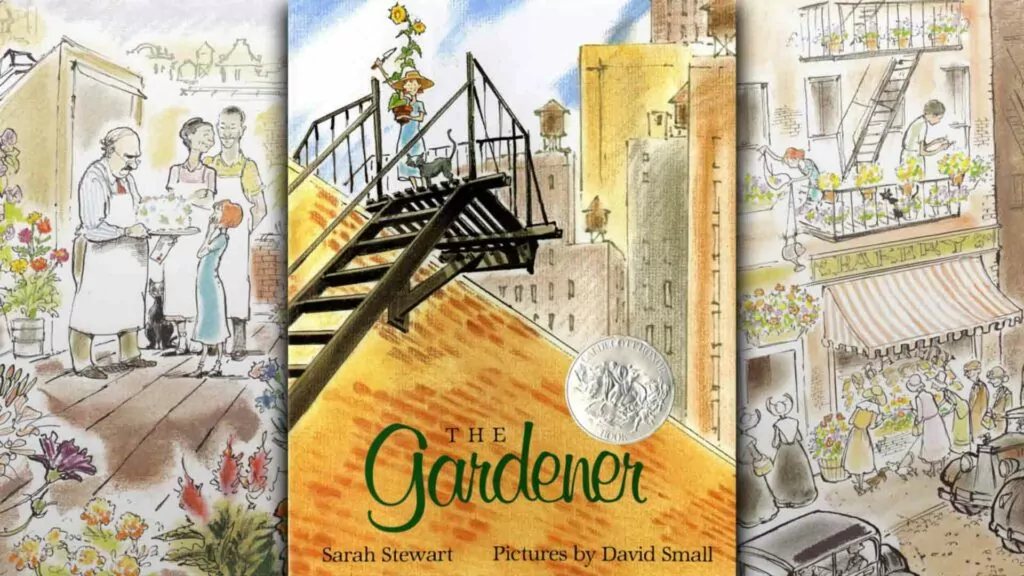
The Gardener

by Sarah Stewart and David Small 38 pages / 1997 Rating: Good/GREAT/Give Lydia Grace Finch's family has fallen on hard times. So their little girl is being sent off to the big city to live with her baker uncle Jim to help him around the shop. The story is told via Lydia's short letters home, where she updates the family on her efforts at making her somber uncle smile. She's also, as the title indicates, quite the gardener, an interest she shares with her grandma back home. One of the care packages from her grandma even contains little plants that amazingly survive the postal trip. Though she's living in her uncle's apartment, Lydia fills everything she can with plants, and finds room on the roof to create her own secret garden. Will all her flowery beauty manage to prompt a smile from her uncle? This is a sweet story, and the art fills every corner of every page. Two thumbs way up! If you liked this, you'll also enjoy three others by David Small. One Cool Friend is about a boy, Elliot, and his father visiting the aquarium. When the boy spots a penguin exhibit, he asks his dear old dad for one. Dad thinks he means a stuffed one, and says yes. But Elliot did not. The confusion continues as Elliot takes a smallish one home in his backpack and turns his room into an antarctic setting. Fun throughout, with a twist at the end just for parents (as I don't know that kids will catch this last joke). In Imogene's Antlers, a girl is surprised to wake up one morning with a set of antlers on her head. It doesn't phase her, though, and she runs with it, using them to dry laundry and hang donuts. It's her optimistic outlook that makes this such fun. In the sequel, Imogene Comes Back, her antlers are gone, but now she has a giraffe neck, and the next day an elephant nose... and she's still as upbeat as ever!...

Red heart icon with + sign.
Book Reviews, Graphic novels

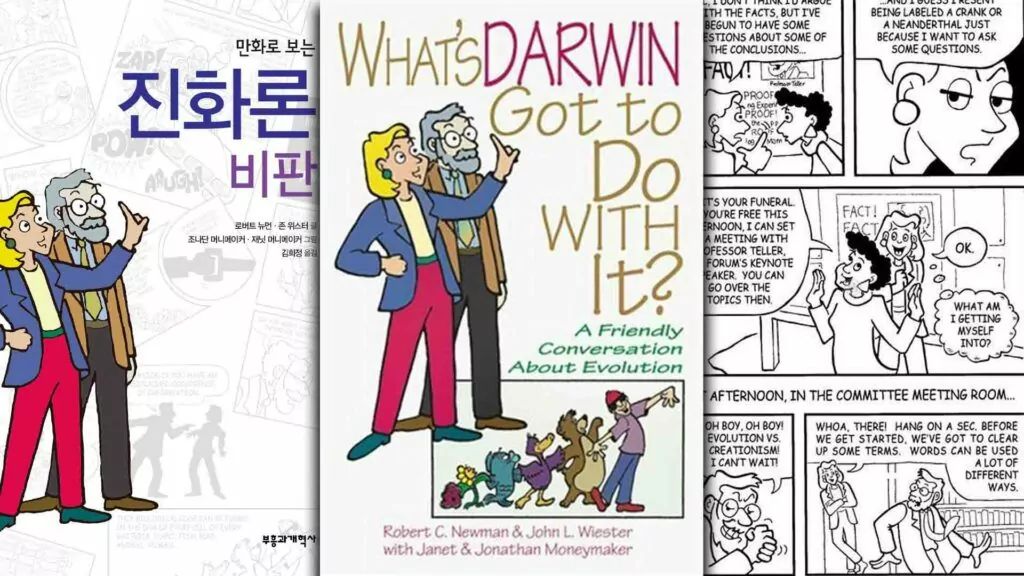
What's Darwin got to do with it? A friendly conversation about Evolution

by Robert C. Newman & John L. Wiester 146 pages / 2000 Rating: Good/GREAT/Gift A graphic novel about evolution vs. intelligent design? Now that's got my attention! The plot here revolves around an upcoming forum put on by Professor Teller, a Darwinist who believes evolution is a "Fact! Fact! Fact!" Of course, forums involve speakers from two different sides, so Intelligent Design proponent Professor Questor steps in to offer up another perspective. One of the first points Professor Questor makes is how important it is to define terms in this debate. Evolution is often defined simply as "change over time"  and if that was all there was to it, even creationists would agree that evolution happens. (After all, we believe that all the dog species – the vast array of them – came from just a couple or so types on Noah's Ark. We certainly believe change can happen over time!) The actual debate is over the limits and direction of this change over time, so when we debate evolution, the disagreement is over whether molecules can, over millions of years, evolve into Man. But in defining her terms, Professor Questor also makes it clear she is not a creationist. She doesn't attack creationists, but in distancing herself from them, it does leave the impression that creationism isn't quite as... legitimate as Intelligent Design. But that's a minor quibble in a wonderful book. Other issues and topics the two professors discuss include: Is there room in science for any supernatural explanations? And if we rule out supernatural explanations at the start, then is it any wonder we don't find evidence for God in our scientific explanations? Are Peppered Moths a "proof" of evolution? Are the changing beak sizes of "Darwin's finches" really evidence for evolution? Why do so many creatures have similar (homologous) body structures if we aren't all descended from a common ancestor? What is the real role of mutation? Can it do all that evolutionists say it does? Is "bad" design evidence of evolution? (And is it actually bad?) This might seem like the discussion could get quite dry and dusty, but the authors bring in all sorts of analogies and illustrations to keep things hopping. For example, Dr. Watson and Sherlock Holmes make a couple of appearances, and mutation and natural selection are personified as two superheroes (with less than effective superpowers) Mutaman and Selecta. And there's lots more! The result is a very fun book which is also highly educational. It would be a great resource for any high school science class to go through because it touches on a lot of the big issues, and it does so with wit and impressive clarity - pictures are used here to boil down pretty complex concepts into only a few pages or a few panels. And for any comic-loving teen, this would make a wonderful present, expanding and stretching them, without overly taxing them. ...

Red heart icon with + sign.
Book Reviews, Children’s fiction

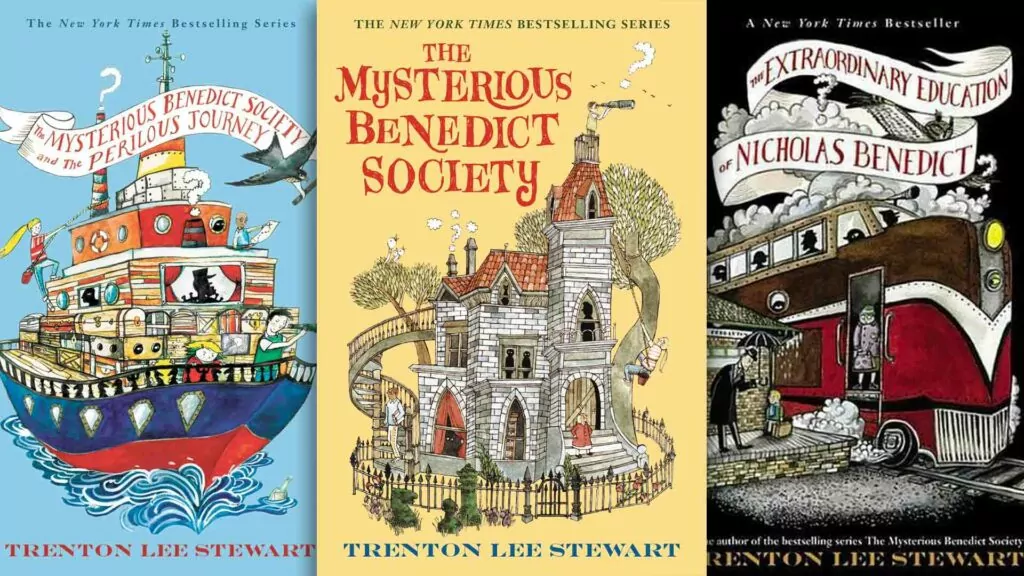
The Mysterious Benedict Society

by Trenton Lee Stewart 512 pages / 2008 Rating: Good/GREAT/Give Reynie Muldoon is an 11-year-old orphan who knows he is smart – he certainly reads more than any of the other boys at the orphanage – but he doesn't quite understand just how smart. The orphanage administrators seem to have an inkling, assigning him his very own tutor. His tutor, Miss Perumal, is certainly aware, so when she notices an ad in the newspaper offering a scholarship for gifted children who pass a special exam, she signs Reynie up. It might seem just a multiple choice exam, but there's more being tested here than knowledge. I don't want to give too much of the fun away, but I'll share just one example. The children are told to take one pencil, and one pencil only; not any less or any more. Simple enough, except that as Reynie and several other children approach the exam building, the girl in front of him manages to drop her pencil down a sewer grating. The exam is just about to begin, and she has no pencil. Reynie stops to help but she tells him to just go – he doesn't have an extra pencil, so what can he do anyway? That's when Reynie takes out his pencil and breaks it in half. Problem solved. All it took was some creative thinking by a kind soul. The first half of the book is full of all sorts of puzzles like that, that involve not only clever thinking, but often thoughtfulness. While dozens of children take the test, only Reynie, and three others pass. Like Reynie, they are all missing their parents, and they all have their own unique way of looking at the world, and their own gifts. George "Sticky" Washington can remember everything he reads, Kate Wetherall is quick thinking, athletic, and always positive, and Constance Contraire... well the children aren't quite sure what Constance is, other than grumpy. After passing the tests, they meet Mr. Benedict, the man behind it all. He explains to them that the world is facing a mysterious danger, that the world is only aware of as "The Emergency." No one quite seems sure what the emergency actually is, but it has everyone feeling discombobulated, and looking to their leaders for direction. Mr. Benedict reveals that the Emergency is actually being caused by subliminal messages being sent over the radio and television airwaves. And the messages are coming from an elite children's school called the Learning Institute for the Very Enlightened or L.I.V.E. (and note also, what it spells backwards). Mr. Benedict wants them to go undercover as his operatives at the school to find out what's really happening. I loved the first half of the book best, with all its different puzzles to solve. But another highlight was the creepy L.I.V.E. Institute, and their rules. Kids might not catch it, but if parents are reading this out loud, it might be worth noting to your children that the double-speak here is of the sort we hear from our own political leadership, who will transform tolerance to mean its opposite, and love to mean embracing what shouldn't be. Here are a few of the Institute rules: There are no rules here! You can wear whatever you like. However, trousers, shoes and shirts are required at all times. You don't have to bathe if you don't want to. Simply be clean every day in class. You may stay up as late at night as you wish. Lights are turned off at 10 PM and you must be in your room at that time. You are free to go where you please. Please note, however, that you must keep to the paths and the yellow-tiled corridors. Cautions A common and troubling theme in children's books is for the kids to be much smarter than their parents, such that they don't feel a need to listen to the authorities in their lives. After all, their dumb parents just don't get them.  That the protagonists here are four pre-teen geniuses mean there is at least a little of that, but it's balanced off by the fact that Mr. Benedict himself is a genius and several of the other adults – his assistants Milligan, Number Two, and Rhonda – are highly capable. But there are still occasions – particularly in the first sequel – where the kids ignore an adult's order because they know better. And because they are geniuses, they often do actually know better! The author balances that out by the number of times the adults are involved in rescuing them – sometimes adults know best too. There are 5 books in the series, with each clocking in at 400+ pages, so with the amount of time a child might put into it, it is worth noting the complete lack of spirituality in the series. This is 2,000+ pages of God being almost entirely ignored. The only exception I can recall is in the prequel, Book 5, in which a mention is made of a chapel service. Conclusion Overall, this is a fairly gentle series – it could make for bedtime reading without much danger of giving anyone nightmares. I appreciated it for making television one of the tools of the bad guys, as it so often is in real life too. There is also an implicit warning against overreaching government control, with the bad guys trying to use the Emergency as an excuse for them to seize the political reins of power. This isn't really a political book, but what politics is has, I rather like. There are three sequels to The Mysterious Benedict Society, then a prequel for #5 telling the young life of their mentor Mr. Benedict, and finally, a companion puzzle book for #6 that invites us to become a puzzle-solver too, just like the Benedict Society. The series, in order, is: The Mysterious Benedict Society (2007, 512 pages) The Perilous Journey (2008, 440 pages) The Prisoner's Dilemma (2009, 400 pages) The Riddle of Ages (2019, 416 pages) The Extraordinary Education of Nicholas Benedict (2012, 480 pages) Mr. Benedict's Book of Perplexing Puzzles, Elusive Enigmas, and Curious Conundrums (2011, 176 pages). I'd recommend the first two and last two. The first of the bunch has an originality to it, and a very clever reveal at the end that'll have you saying "Of course!" even as you had no inkling of it before that moment! The second doesn't reach the same heights... but how could it? It is, however, very fun. The second-best book in the series is actually the fifth, the prequel about the young Mr. Benedict, and his own adventures in an orphanage. I read about 15 minutes of this to our girls each night, for about 2 months straight, and they were always asking for more. While the puzzle book was interesting, I was glad we got it out of the library and didn't buy it. I wouldn't bother with books 3 and 4. In these two, Constance has developed telepathy, and since mind-reading is beyond all of us (even as figuring out puzzles isn't) this development makes these two books a good deal less relatable, and consequently less interesting. Telepathy also seems a cheat – how hard is it to outwit your enemies when you can read their minds? To top it off, Constance also learns how to manipulate minds with her telepathy, influencing them to think as she wants them to. This takes us into the realm of mind-control, not by machine as in the first book, but by supernatural powers, and for a decidedly unspiritual book, this is getting too weird for my liking. Thankfully each book is entirely self-contained, so it is easy to get just 4 out of the 6, without any sense of incompleteness. Books 1 and 2, along with 5 and 6 total more than 1,500 pages of reading, which should keep even the most avid bookworm in your family chewing for a long time....

Red heart icon with + sign.
Book Reviews, Graphic novels

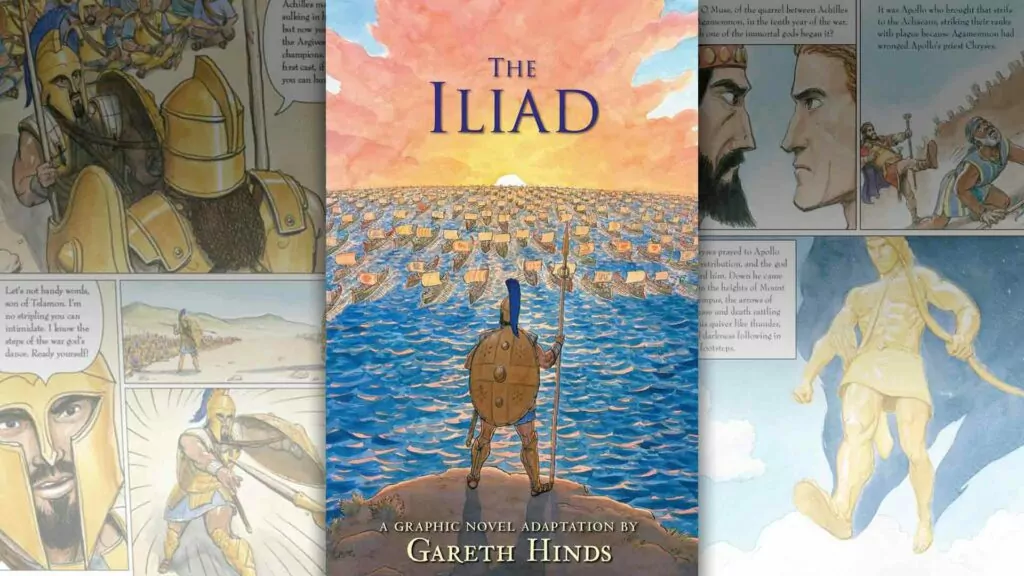
The Illiad

by Homer and adapted by Gareth Hinds 2019 / 272 pages Rating: Good/GREAT/Gift The Illiad is a Greek epic that depicts just a part of the siege of Troy. It begins with a helpful intro that shares how Helen was kidnapped by the Trojan's Prince Paris, much to the dismay of her Greek husband, the Spartan King Menelaus, who rallied his allies to besiege Troy to get her back. But there was no quick rescue to be had. Our story begins in the tenth year of the siege, and focuses on all sorts of subplots and subcharacters including many a Greek god. The gods squabble, picking favorites among the soldiers, and offer secret help to them – secret because Zeus also has his favorites and he doesn’t want any interference. Two characters star: the Trojan's Prince Hector, brother of Paris, and the Greek half-god Achilles, who seems capable of defeating armies almost by his ownsome, in large part because he is favored by Zeus. However, neither he, nor Hector, are fated to live long. The story ends with Hectors death, and the story really doesn’t feel all that complete, even as it is loyal to the original in this respect. For how the siege of Troy ends, we’d have to turn to Homer’s The Odyssey (Gareth Hinds has an adaptation of The Odyssey too, but it is marred by a few panels depicting naked women). As a graphic novel adaptation, this is impressive. There is some gore – this is a war story after all – but any kid up for reading this would be old enough to deal with the not-overly graphic pictures of spear and sword wounds. The large size gives the author room to go quite deep (though it is still abridged some) and the visual format, along with key footnotes here and there, help make the story more accessible than it is in the original. Now, why should Christians even care to read about Greek gods and myths? We don't study much about Baal and Asherah after all, and they even make an appearance in the Bible. Well, whereas Baal is almost entirely forgotten, the Greek gods, and the mythos around them, continues to make appearances in today's culture, whether in teen fiction (Percy Jackson), the comics and TV (Hercules), or on the silver screen (Zeus, the Amazons, etc.) References to Achilles' heel, and the Trojan Horse are still in use too. Many of us may not have the time or inclination to study the book, but this comic adaptation allows a reader to quickly get a passing acquaintance with one of Western Civilization's key epics. That seems a very good tradeoff for the minimal time required. So who'd enjoy this? Most kids will find it too tough, so it really is limited to anyone interested in delving into the classics. Even those who intend on reading the book should give this a look – I suspect it could make taking on The Illiad much easier. Two thumbs up for a very good adaptation....

Red heart icon with + sign.
Adult biographies

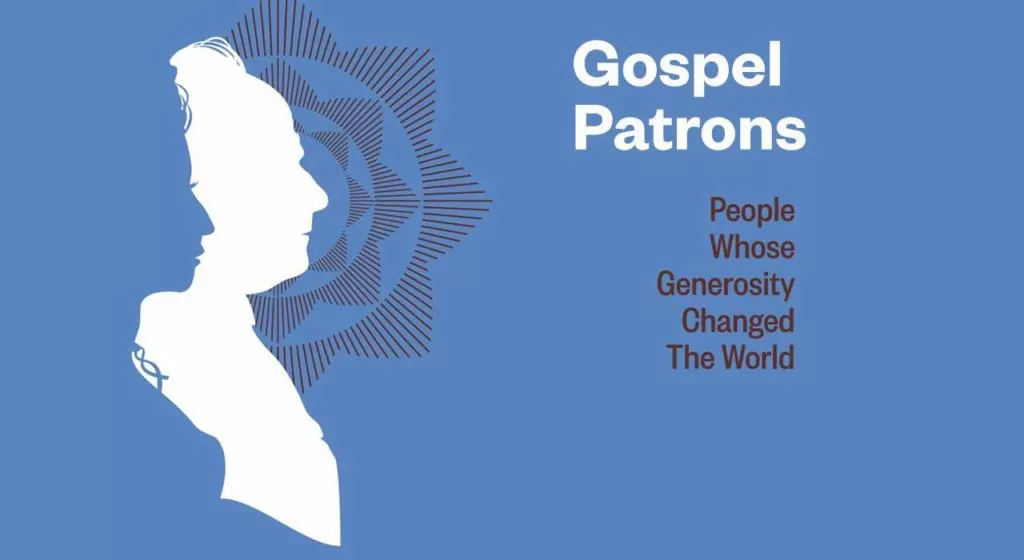
Gospel Patrons: people whose generosity changed the world

by John Rinehart 2013 / 170 pages Rating: Good/GREAT/Give Are you a giant? Church history is full of such people. William Tyndale translated the Bible into English. George Whitefield was used by God to spark the Great Awakening, while John Newton was the ex-slave trader who wrote Amazing Grace and helped William Wilberforce end the British slave trade. These were Christian giants; their stories well known. But, as author John Rinehart notes, not all of us are called to these leadership positions. Many are called to supporting roles. In Gospel Patrons Rinehart tells the stories of three people who enabled Tyndale, Whitefield, and John Newton to do their work. Humphrey Monmouth was the man who financed Tyndale’s translation work (and spent a year in the Tower of London as reward). Lady Huntingdon used her position and influence to have the richest in England come to hear George Whitefield preach the Gospel and she funded his work reaching the rest of England and America. John Thornton placed John Newton in an influential church and encouraged him to publish a book of his hymns, one of which was Amazing Grace. Their stories are not well known, but their roles were vital too. Most of us are not giants like Tyndale, Whitefield, and Newton, and we might think that we don’t have the funds to act like Monmouth, Lady Huntingdon or Thornton either. But while few of us have the funds they did, most of us are in a position where we can spare money or time to support worthy causes. In sharing these three biographies, what author John Rinehart wants us to realize is the importance of this supporting role. God has a part for each of us to play. And if we understand how important the “lesser” roles are, perhaps we will more willingly take them on, sacrificially donating our money and our time. If I were to offer one critique, it would be on the topic that Gospel Patrons doesn't tackle: making sure that who you give to is going to use your money to good ends. Christians need to be generous and discerning. That said, this is a short book with a tight focus – to encourage and inspire Christians to be generous – so maybe discernment in giving is a topic for a different book. Meanwhile, Gospel Patrons is a very readable, very challenging, and much-needed book. I highly recommend it for all ages. The hardcover was originally released en masse and quite cheap, but has become harder to find now, and where you can get it, it's expensive. However, the e-book can be had for a reasonable price. TO EXPLORE FURTHER: If you want to get a flavor of this "gospel patron" idea, author John Rinehart has also written a series of articles and created some short videos, all of them freely available on his website GospelPatrons.org. Here are two examples that might be of particular interest: The Gospel Patron behind RC Sproul ...

Red heart icon with + sign.
Book Reviews, Children’s fiction

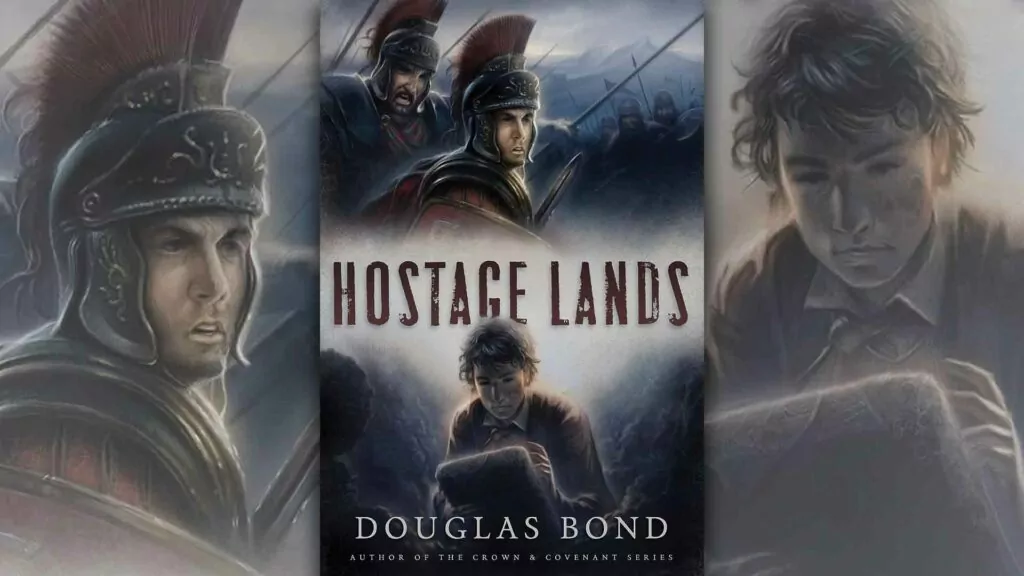
Hostage Lands

by Douglas Bond 2006 / 235 pages Rating: Good/GREAT/Give “When am I ever going to use this?” It’s a question that comes up frequently in classrooms around the world. And it’s a question Neil Perkins, a British lad, is asking about his Latin class. But while some students have to wait years to put the lessons they learn to practical use, Neil only has to wait until later that same day. On his way home from school Neil takes a nasty spill off of his ATV, creating a small crater where the machine lands. In this crater he discovers tablets covered in Latin. So Neil, with the help of his previously underappreciated Latin teacher, starts translating them. He finds out they comprise a story told by a Roman centurion who lived two thousand years ago! This is really two stories in one, the first a short one about a boy named Neil who doesn’t like his Latin class and doesn’t talk much with his dad. This accounts for 6 of the book’s 37 chapters, serving mostly as an introduction and conclusion to the larger story about Roman Centurion Marcus Aurelius Rusticus. The Centurion’s story starts with his account of what he suspects will be a suicide mission into the lands north of Hadrian’s Wall, the territory of the savage Celts. Rusticus only manages to escape death with the help of a friendly Celt, Calum, who he soon discovers is a very different sort of man, for Calum is a Christian. Bond’s book is a great read, and also has a strong message, contrasting Christianity with worldviews that elevate power, the State, and honor as supreme. This is a boy’s book, for the ten to early teens range, but adults could enjoy it too, especially reading it aloud to their kids....

Red heart icon with + sign.
Adult fiction, Book Reviews

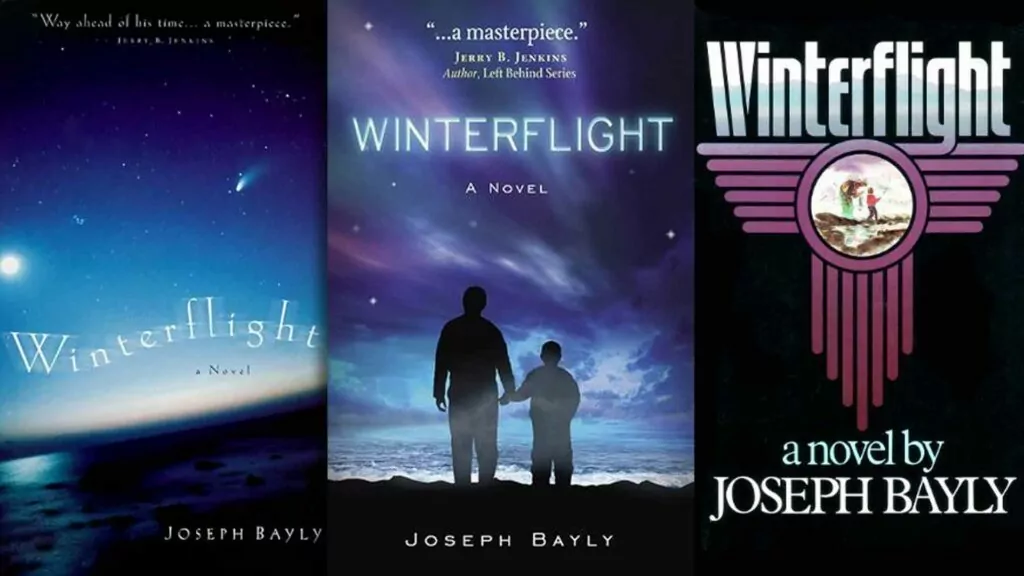
Winterflight

by Joseph Bayly 1981 / 216 pages Rating: Good/GREAT/Give In this dystopian novel, Joseph Bayly takes us to a not-so-distant future in which abortion for disabled children is mandatory, euthanasia is compulsory soon after 75, and Christians are so confused about Romans 13 they think God wants them to submit to even these demands. When Jonathan and Grace Stanton’s six-year-old son Stephen falls off his bike, they don’t know what to do. The fall was minor, but their son has hemophilia and he needs treatment. But the law says he shouldn’t exist: had his condition been diagnosed prenatally the State would have required that he be aborted. Stephen survived only because he mother never visited a doctor during her pregnancy, and when the time came a friend helped her have a home birth. Now the Stanton’s wonder what the State might do, even six years later, if they bring their son in to see a doctor. Do they dare find out? Winterflight was written over 40 years ago, but it got my heart racing – it all seemed far too probable for my liking. Abortion is already being used to “cure” genetic disabilities like Down Syndrome and while it isn’t mandatory, pressure from doctors and culture are such that in some countries 98% of Down Syndrome children are killed before birth. When it comes to killing the elderly, we don’t demand their deaths at 75, but we are already exploring the cost savings that can be had from their early departure. In countries where euthanasia has been legal longer, there are regular reports of involuntary killings. In Canada, attempts are already being made to make involvement on some level mandatory for all doctors. But what hits closest to home is Bayly’s portrayal of the confused Christian response to these government abuses. When Grace’s elderly father is told he must report soon to be euthanized, their misunderstanding of Scripture has them thinking that they need to obey the governing authorities even in this, since those authorities are appointed by God (Romans 13:1). But at the same time, in saving their son, the Stantons show that on some level they do understand we must sometimes defy the State. Is their confusion realistic? We’d never march ourselves off to the local euthanasia clinic just because the government demanded it. But why would we resist? Do we understand on what biblical basis we could reject such demands from the “governing authorities”? During World War II there was confusion on this point among some good Reformed Dutchmen. Among those who joined the Resistance, some felt guilty about it because they were worried that in acting against the Nazis they were resisting God’s chosen rulers. The confusion persists today. Even as we know the government shouldn’t mandate euthanasia – even as we recognize that there are limits to their power – many Christians will still turn to the government asking it to solve our problems. We understand the government has limits, and yet we’ll also ask them to do more and more. We are double-minded.. And that’s what makes this book such a fantastic read – the discussion it’ll prompt is one we need to have. Cautions There are just a couple cautions to note. First, there is a small bit of language – I think “damn” might be used two or three times. Second, without giving away the ending, when the book was first published some Christians misunderstood the ending as being prescriptive – they thought the actions of the book’s confused Christians were what we should do. So it’s important to understand that’s not so. These are confused Christians, under enormous pressure, acting in a confused way and the author is not endorsing their actions. In fact, the book is primarily about warning us not to do as they do. Conclusion This is a fantastic dystopian novel, as prophetic as they come, and certainly unlike any other Christian fiction you’ve read. The topic matter is weighty, but because there’s nothing graphic this could be appropriate for as young as early teens. However the younger a reader might be, the more they’ll need a guide to steer their interaction with the story, and particularly the not-at-all happy ending. It would also make great book club material, with fodder for some fantastic discussions....

Red heart icon with + sign.
Adult non-fiction, Book Reviews

How in the world did we get here?

by Jim Witteveen 2022 / 183 pages Rating: Good/GREAT/Gift Ten years back, anyone who’d said that cultural forces already in play would soon have our public schools teaching boys can get pregnant… well, he would have been dismissed as a nut. What Jim Witteveen shares in his new book about an “open conspiracy” among the power-hungry will at first sound so outrageous as to be unbelievable too. But make no mistake, this is fact, not fiction. Chapter by chapter, Pastor Witteveen highlights ideologies and organizations that would seem to have little in common: global warming catastrophists, sexual hedonists, the public school system, overpopulation proponents, evolutionists, Big Tech, and Big Government. They are united, though, in their arrogance that they know – and God does not – what is best for all the rest of us. While their utopias differ, the route forward is the same for them all: a quest for more and more power so they can implement their vision. And, as Witteveen details, these ideologies and organizations are grabbing hold of the reins of power. If that was all he shared, this would be quite the devastating read, so thankfully, the conclusion is all about a way forward for God’s people that explores the many opportunities that exist to faithfully honor and obey our Lord as we contend with the forces marshaled against us. How in the world did we get here? will be a slap upside the head to the many sleepy Christians who haven’t yet recognized we are in a battle, and who consequently haven’t yet answered God’s call to go out and contend. Timely and much-needed, what Witteveen has given us is made all the more valuable for its brevity and accessibility – everyone should read this, and most everyone will be able to. Contact the author at Dan1132.com to pre-order. For more on the book, check out Lucas Holtvluwer's interview Pastor Witteveen in the latest Real Talk episode. Watch it below on YouTube, or find it on your favorite podcast platform at RealTalkPodcast.ca. ...

Red heart icon with + sign.
Adult non-fiction, Book Reviews

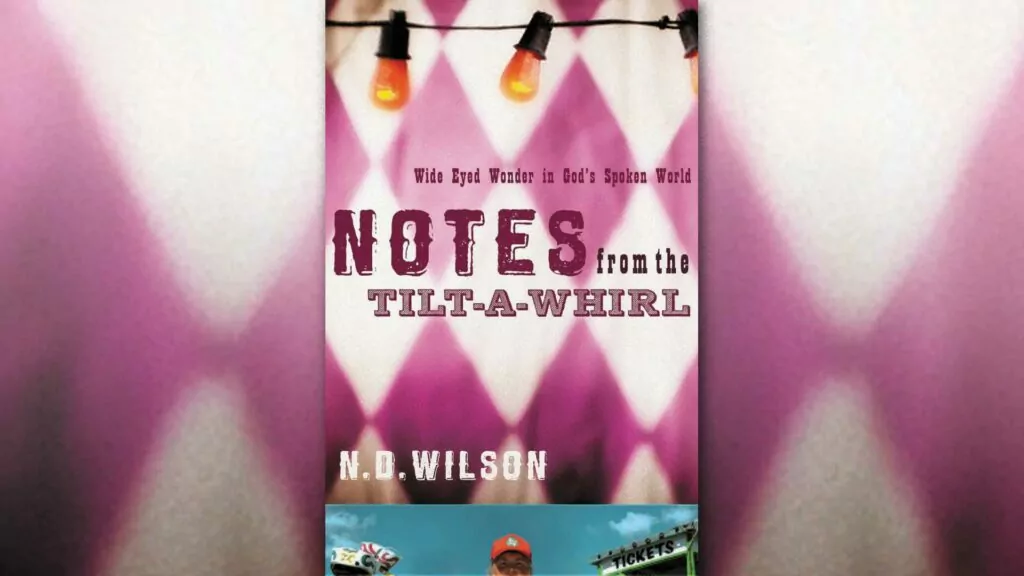
Notes from the Tilt-a-Whirl

Wide-Eyed Wonder in God's Spoken World by N. D. Wilson 2009 / 203 pages Rating: Good/GREAT/Gift The world is a wild ride, isn't it? The fun starts already in the title of N. D. Wilson's book. Those of you who have ridden the Tilt-a-Whirl will recognize the analogy to our own spinning planet with an axis that is 23.5 degrees off the vertical. Of course, the world is not just physically askew; it is off-kilter in just about every way you can think of. The presence of evil in the world is the argument that is typically thrown at Christians whenever we affirm God's claims on all of us. Wilson makes some important points throughout his book that undo (or cut through) this Gordian knot. First, he asserts that evil is not a "thing," not a noun; rather, it is an adjective describing that which displeases God. Because He is good, whatever displeases Him is evil. Secondly, in response to those who then wonder why the world is still such an unpleasant place, Wilson does not use the oft-quoted answer that this is the best of all possible worlds; rather, he says, this is the best of all possible masterpieces, the best of all possible stories - and we are not, in our egocentricity, the best of all possible critics. Rather than setting ourselves up as critics of God's story, Wilson insists, we need to learn to be good characters - to approach life with wonder, to laugh at ourselves and our often gloriously ridiculous place in the story - to glorify the Author, rather than to try to rewrite His work. What makes Wilson's work so amusing is that he is willing to follow his own advice. To give just two examples: When Wilson's son gets his wish of having a butterfly land on him, but Wilson warns him that "lightning does not strike twice" - that the butterfly will not be coming back, Wilson enjoys how God makes a fool of him by sending the butterfly to land on his son's shoulder a second time. Wilson laughs just as much when he trips over the step that he is sure must have moved as he does when the seeming squashed frog inexplicably springs back to life. In the end, Wilson reminds us that it is the end that we have to cope with – our own earthly end, and the end of all current earthly things when the Author (the same one who became a Word in His own story) returns to wrap up the current chapter with His judgments on His cast of characters. This is far too brief a look at a book that spends as much time mocking Christian sentimentality as it does attacking atheist defiance of our Author, but if Wilson helps you better understand and cope with our crazy, tilted world, you'll want to check out his documentary of the same name!...

Red heart icon with + sign.
Adult non-fiction, Book Reviews, Economics

Christian Economics in One Lesson

by Gary North 2015 / 268 pages Rating: Good/GREAT/Gift Henry Hazlitt’s Economics in One Lesson is what its title suggests, just one economic lesson explained in the first chapter – that we focus on the obvious impact of a government program, and don’t consider what otherwise might have happened with those dollars. It’s the seen vs. the unseen. That one lesson is then repeatedly applied to different situations in the 24 chapters that follow. In chapter 4, it is applied to public work projects: when the government builds a new sports stadium we can see the job created by its construction. What’s unseen is all the jobs that might have been created by businesses if they hadn’t had to pay the taxes to build that stadium. Overall, Hazlitt is making a general argument for less government and more economic freedom, but is making it on the basis of practicality: that a free market approach will make us all, overall, more prosperous (download the book for free). Effectiveness is the fruit, not the goal In his Christian Economics in One Lesson, Gary North makes his argument for free market economics on a very different basis: obedience. He also thinks the free market is the most effective way of making us all richer, but he sees that, not as a goal, but as a side effect – the fruit – of being obedient to God’s commands do not covet, and do not to steal. As his title suggests, he is riffing off of Hazlitt, and his chapters are a reworking of each of Hazlitt's. Economics is sometimes treated as a being simply about the math, about some sort of neutral accounting, pitting the different economic systems against each other to find out which creates the greatest benefit for society. Both socialists and capitalists could even agree that economics is about dealing with the problem of scarcity – there is only so much to go around, so how do we make the most of it? But North is arguing that economics is really a matter of ethics, and applying God's guidance on money, work, property, and covetousness to the real world. Then the better way is the way that obeys God’s commands. Now, like Hazlitt, North thinks the best system is the free market, and not the sort of so-called capitalism that involves getting government contracts and special favors. None of that crony "capitalism." This is, instead, a free market where people make exchanges voluntarily, and consequently, both sides benefit. No temptation to tweak But even as Hazlitt and North both hold to the free market system, it is significant that they got there very different ways. Hazlitt got there because the free market works – it is the most prosperous of all systems, doing more to raise people out of poverty than any other economic system before it. North arrives there because the free market is what results when we are obedient to God, respecting our neighbor's property and pushing back against our own covetousness. So, both support the free market. But for those like Hazlitt who arrived there for practical reasons, there will always be the temptation to tweak, and in doing so, to succumb to socialism. If capitalism works best, who's to say if capitalism plus just a smidge of socialism might not be better? Maybe just 5%? Or 10? How can we know unless we try? But there isn't the same temptation to tinker for Christians who choose the free market for its alignment with God's Word. We won't want to be 5% or 10% less obedient. And it is worth noting it is no coincidence that the economic system that most aligns with God's Word is also the one that best raises people out of poverty. That's simply God's love – He knows what is best for us, and when we obey, especially when we do so on a societal level, it goes better for us. Conclusion North's insight – that economics is about ethics, not efficiency; it is about obedience, and not prosperity – is a brilliant one, and worth the reinforcement that comes in the repeated applications that follow. If this isn’t the most important book I read last year, it is certainly in contention… and it can be downloaded for free here....
Red heart icon with + sign.
Book Reviews, Teen fiction

Urchin of the Riding Stars

by M.I. McAllister 2021 / 299 pages Rating: Good/GREAT/Give This was so good I just had to read bits of it out loud to my wife. It's an animals-with-swords tale, the hedgehogs, otters, moles, and squirrels all living together in the same island kingdom under the good King Brushen. But all is not well in the kingdom of Mistmantle – there are “cullings” being done to the newborn handicapped children. This is quite the somber subject for a children’s book, and as the cullings are considered for the elderly too, it’s clear that the author is speaking to both abortion and euthanasia. The young Urchin is very much opposed, but his heroes, Captains Crispin and Padra, don’t seem to be doing anything to stop it, and the third captain, Husk, seems to be enjoying it! So who are the good guys then? Who can Urchin turn to for help to save these children? It turns out some of the good guys are indeed good, but, on the other hand, some turn out to be really, really bad. This a fairytale that takes seriously the Chesterton quote about dragons: “Fairy tales, then, are not responsible for producing in children fear, or any of the shapes of fear; fairy tales do not give the child the idea of the evil or the ugly; that is in the child already, because it is in the world already. Fairy tales do not give the child his first idea of bogey. What fairy tales give the child is his first clear idea of the possible defeat of bogey. The baby has known the dragon intimately ever since he had an imagination. What the fairy tale provides for him is a St. George to kill the dragon.” There is evil in this book, and that might even turn off some of its target preteen to early teen audience. But it gets to be quite the rollicking adventure soon enough, full of courtly intrigue, conspiracies, and heroes being heroic. I think the author is Christian, and the God of this story is referred to as “the Heart.” This spiritual element isn’t huge, but it is persistent, and doesn’t stray into anything weird or wacky. I know this will be a book I’ll enjoy reading to my kids. An otherwise entertaining second book in this Mistmantle Chronicles series is marred by an agenda-pushing, albeit passing, mention of a female priest. The first book stands well enough on its own, though, so in our house, I think we’re going to start and stop with number one....
1 2 3 4 5 6