Transparent heart icon with white outline and + sign.

Life's busy, read it when you're ready!

Create a free account to save articles for later, keep track of past articles you’ve read, and receive exclusive access to all RP resources.

White magnifying glass.

Search thousands of RP articles

Helping you think, speak, and act in Christ.

Open envelope icon with @ symbol

Get Articles Delivered!

Helping you think, speak, and act in Christ. delivered direct to your Inbox!

smiling businessman
Economics

If work is worship, does that mean I just gotta be warm and fuzzy all day?

In an earlier article we peered into God’s design for business and how that changes one’s outlook on vocation and the marketplace. Our work done His way reflects God’s character and unleashes His beauty. Because faith and work are seamless, our work is worship.

But some of us stand on the proverbial shores unsure, skeptically dipping our feet into these new waters. A first response is often, “So we’re gonna sing “Kumbaya” around the water cooler all day? Do you expect me to turn my business into some charity and not make any money? That’s all very nice, but it’s not the real world. We have to get stuff done here!”

Do you feel the tension in doing your work as worship? Is there a strain between serving others and making sure that your business gets its needed results? Herein lies the false dilemma that often brings us unneeded guilt. But there’s hope!

GOD’S MODE

In His image, reflecting His beauty, God perfectly designed us for every aspect of work. He loves our work – because of its purpose. In the last article we learned that even our work is an expression of Him. God is deeply interested in every part of it. How we care for people, balance books, run systems, innovate, hire and fire and make healthy profit – it all matters to Him! He designed us to run our businesses with excellence, reflecting His character. That means He’s deeply interested, involved, and holds us accountable in our businesses’ customer service, sales, finances and operations. So yes, he even cares about your bottom line. It too is an act of worship!

Proverbs encourages us in pursuing excellence and shows how honest gain is an outcome of God’s blessing on hard work. Competency and profits increase our capacity to do more good As we read in Proverbs 14:23: “All hard work brings a profit, but mere talk leads only to poverty.” Proverbs 22:29 tells us that if we are skilled at what we do, we’ll always be in demand.

Bruce Ashford practically writes

“God often works through our jobs to love his image-bearers. In other words, God uses the products of our work to provide for our fellow citizens. When God wants to feed a hungry child, He does not usually do so in miraculous manner; He usually does so through farmers, truck drivers, grocery store owners, contractors, electricians, plumbers and a myriad of other types of workers… In conclusion, our callings are our primary means to bring God glory by loving Him and our neighbour. If we are seeking to fulfill these callings faithfully and with excellence, we can multiply our faithfulness in every dimension of society and culture, and across the fabric of our shared human existence.”

OUR MODEL

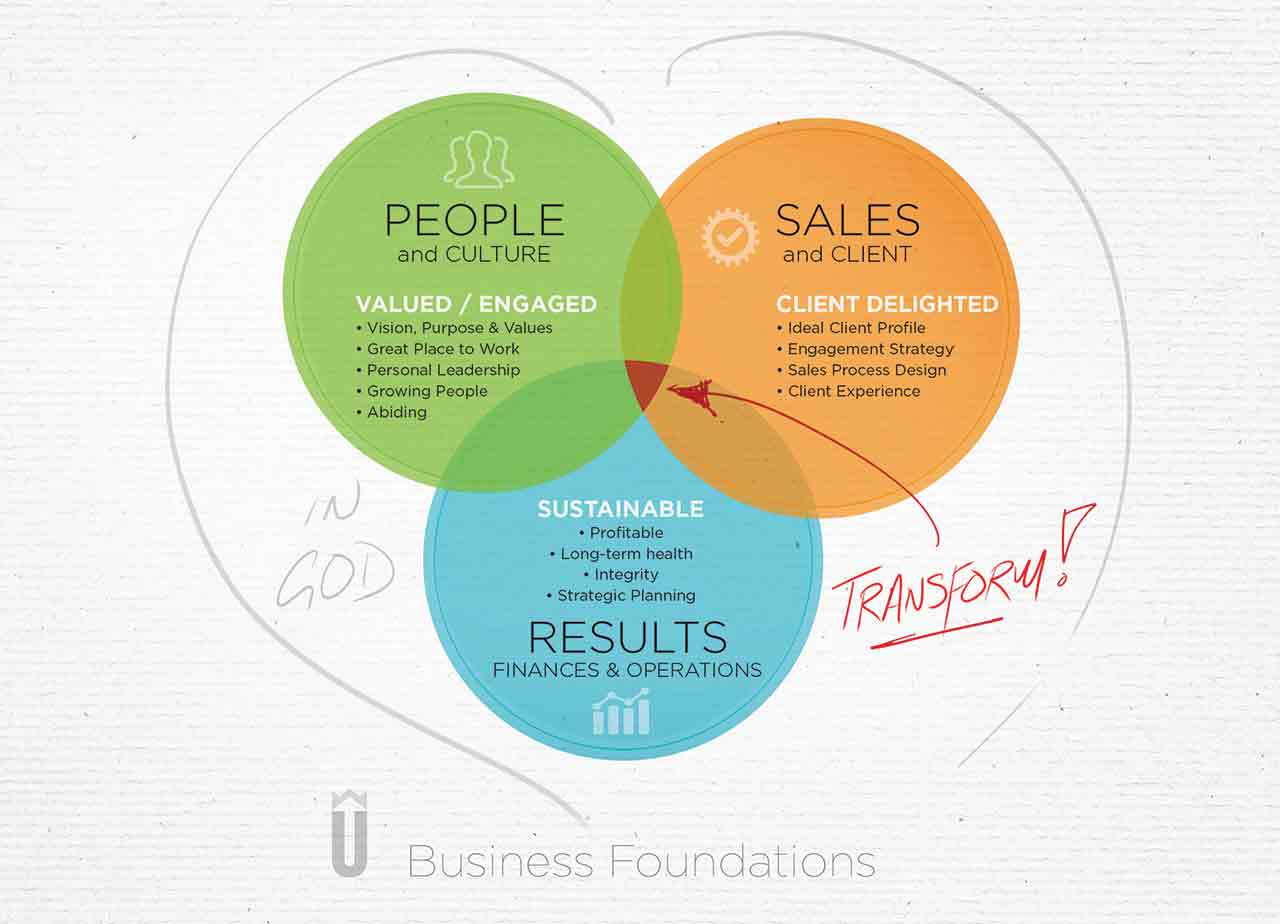
So what does this look like in business terms? I work in a Christian leadership mentoring firm called DeliberateU, where we’ve honed the art of business down to three foundational pillars. Wrapped in a kingdom-focused culture these are:

  1. People: Creating a great place to work where people are growing and led by clear purpose and values.
  1. Sales: Serving others, not self. Creating a “wow” experience with a great product and service.
  1. Results: Building a healthy, sustainable business that is well positioned to grow and give back.

When these spheres work in synergy something stunningly beautiful takes place! Rooted in the essence of the Great Commandment of Matthew 22:36-40 they unleash in us the capacity to reflect God’s creativity, excellence, grace and truth. They allow us to worship Him by blessing and serving our neighbor. But here’s the scoop: it always starts with people.

Why’s that you say? Well, who has God made the pinnacle of His creation? People. So as business owners we are entrusted with God’s greatest creation. Whether staff, customers, or janitors, people like you and I are His craftsmanship made in His image. If we as Christian business leaders saw all people as our neighbors, how might that change the way we steward His most precious creation? What a privilege!

How can we glorify God in the spheres of team and customer experience together with business processes, all while producing a healthy bottom line? In this 2013 video, Cardone Industries shares how it is trying to deliver on all three.

When we intentionally lead the businesses entrusted to us in a God-focused way, to His design, our work is worship. Our work opens up opportunities to practically serve people while blessing them, their families, and communities. Is your business an act of worship?

DELIBERATE APPLICATION:

  1. If work is worship, do I view my business as something I built or something God entrusted me with? How does that change how I view work as worship?
  2. Look in the mirror and ask yourself. “What primarily drives our business: People, Production, Profit or Pride”?
  3. If I’m to lead with “truth and love” do I care for people, carry people or care less for people?

This is part 2 in the “Work is the Worship” series – you can find part 1 hereDarren Bosch is a partner at DeliberateU - leadership mentors for Christian business owners looking to grow in their workplace, families and communities. Their conviction is that God uniquely uses the marketplace to expand His kingdom purpose – serving others while growing in faith, hope and love. This article was first published in the July/Aug 2018 issue of the magazine.

Red heart icon with + sign.
Theology

The best news ever!

“Truly, I say to you, today you will be with me in Paradise” (Luke 23:32-43) **** Three people were taken that day to a hill outside Jerusalem to be crucified. One died in sin. One died to sin. One died for sin. Two were guilty. One was innocent. Two were paying their debt to society. One was paying our debt of sin. Consider, for a moment, the one who died to sin: the repentant thief. He made some remarkable observations. His was a remarkable conversion. Of all the converts among the rich, the religious and the rejected, his is the most amazing. Both of these men asked Jesus to save them. One of the men being crucified said, "Are you not the Christ? Save yourself and us!" (v.39). His words were sarcastic and sneering. The other man said, "Jesus, remember me when you come into your kingdom" (v.42). His words were simple and sincere. Hear the response of Christ: "Truly, I say to you, today you will be with me in Paradise." The repentant thief rebukes the other criminal. He recognizes his own guilt and admits that he and the other man both fully deserve death, “we are receiving the due reward of our deeds; but this man has done nothing wrong" (v.41). Pilate and Herod said this but did not respond appropriately to that knowledge. There was one essential difference between these two convicted criminals. One sought to be saved from his situation. The other sought to be saved from his sin, and he would hear the best news ever, “...today you will be with me in Paradise." Conviction comes before conversion Notice how conviction comes before conversion. The repentant thief says, “…we are receiving the due reward of our deeds” (v.41). What was happening in this man’s life? Was he afraid of falling into the hands of the living God? The Bible says, "It is a fearful thing to fall into the hands of the living God" (Hebrews 10:31). He understood what was happening. He sensed the eternal significance of the occasion. Scripture also says, "The fear of the LORD is the beginning of wisdom, and the knowledge of the Holy One is insight" (Proverbs 9:10). Here in this unfolding drama there are two very different attitudes to Christ. The repentant thief admits his own sinfulness. What led to his conviction and conversion? Was it fear or was it that he heard Jesus say, “Father, forgive them, for they know not what they do” (v.34). Was it the fact that Jesus forgave His tormentors? Maybe he had heard about Jesus. God was certainly working in his heart. He not only rebuked the other thief, he not only admitted his guilt, but he confessed Jesus as the innocent one. And then he did one more thing for which he will always be remembered. He said, "Jesus, remember me when you come into your kingdom" (v.42). He looked at the battered and bruised body of Jesus and saw a king! And he anticipated Christ's resurrection, and coming of his kingdom. What a remarkable insight! He didn’t ask for a place of honor. All he dared to ask was to be remembered. But he was speaking to the one who is able to do immeasurably more than we can imagine. In all his agony and anguish Jesus had time to win one more soul. The promise of paradise is great news. We know so little about this man. What we do know is that at this point in his life he recognized he was a sinner and that Jesus could help him. That is all he needed to know. Two responses to Christ and the cross Our personal prejudices will sometimes have us writing off this person or that as "not salvageable." Perhaps we have our petty excuses for not reaching others. But in all the discomfort of the cross Jesus reaches out to this undeserving man. This shows the selfless nature of Christ. This shows that the excuses we offer for not reaching out to others are so petty. We should never give up on sinners. The paths of three men met in death. Much of humanity is represented in these two responses to Christ and the cross. The cross is not good news for everybody. One of the dying men mocked Christ. The words of the hymn Three Crosses by Helen Franzee Bower, put this idea beautifully: Three crosses on a lonely hill, A thief on either side, And, in between, the Son of God... How wide the gulf, how wide! Yet one thief spanned it with the words, "Oh Lord, remember me"; The other scoffed and turned aside To lost eternity. Forsaken is the hilltop now, And all the crosses gone, But in believing hearts of men The center cross lives on. And still, as when these sentinels First met earth’s wondering view, The presence of the Lord divides. Upon which side are you? Christ’s Empire This repentant thief looked at Jesus and saw himself as he really was. When we look to Jesus we too see ourselves as we really are. This thief was deemed unfit to live in the Roman Empire but God gave him a place in his empire. Remarkably, the man who asked to be remembered expects Jesus to complete his work. All those who trust in the completed work of Christ can have the same assurance, “...today you will be with me in Paradise.” This passage of Scripture shows us that it is possible to have (in this life) the assurance of sins forgiven and that we can be sure of heaven after death. This must be the best news ever!...

A set of lesbian wedding cake toppers
Red heart icon with + sign.
Homosexuality, News

When a gay couple wants you to help them celebrate sin

Back in 2012, an American couple that rented out their barn for weddings ran into trouble when two ladies wanted to reserve it for a gay “marriage” ceremony. Cynthia and Robert Gifford, both Catholic, refused – they didn’t want their farm used to celebrate what God condemns. The lesbian couple lodged an official complaint, and the New York Division of Human Rights ruled in their favor, fining the Giffords a total of $13,000 for their refusal. Two years later New York’s Supreme Court Appellate Division upheld the ruling. The appeals judge, Karen Peters, said that the Giffords could “profess their religious beliefs that same-sex couples should not marry,” but as long as they allowed heterosexual couples to use their farm, they had to let same-sex couples do so too. The “perfect solution”? So what could the Giffords do? A March 23 Faithwire.com article detailed the couple’s response. They are continuing to rent out their barn and farm, but on their website they’ve announced that a portion of the proceeds from any wedding will be donated to support traditional marriage. The notice reads: At Liberty Ridge Farm, our deeply held religious belief is that marriage is the union of one man and one woman, and the Farm is operated with the purpose of strengthening and promoting marriage. In furtherance of this purpose and to honor and promote our moral and religious beliefs, we donate a portion of our business proceeds to organizations that promote strong marriages such as the Family Research Council. The couple’s response got a couple of media outlets quite excited, with Faithwire’s Will Maule suggesting they “may have just solved the gay marriage dilemma” and The DailyWire’s Hank Berrien describing it as the “perfect solution.” This, they thought, was the way forward for Christian wedding cake bakers, and wedding photographers, and wedding venue owners. By declaring their support for traditional marriage, the Giffords are sure to dissuade many gay couples from even considering their farm. And the activist sorts who want to push the issue and rent it anyway? Well, if they know that using the Giffords' barn means, in effect, making a donation to the conservative Christian lobby group, the Family Research Council, that might just dissuade them too. This would seem an approach that Christian wedding photographers, and wedding cake makers, and more, could readily imitate. But it is it really the perfect solution? On the very same webpage the Giffords promise that all “couples legally permitted to marry in the state of New York are welcome to hold their wedding at Liberty Ridge Farm. We serve everyone equally.” This statement is probably a requirement from the judgment against them, but it would seem to concede too much. On the one hand the Giffords are speaking up for traditional marriage, but on the other, they are promising to host and help with same-sex “marriages.” This is a muddled message. Still, is there something that we can be inspired by here, and perhaps improve on? Shrewd and innocent In Matthew 10:16 Jesus told his disciples that in their dealings with the world, they should be shrewd and innocent: I send you out as sheep in the midst of wolves; so be shrewd as serpents and innocent as doves. The Giffords’ approach is certainly shrewd. It seems sure to decrease and maybe even eliminate the requests they might otherwise get from homosexual couples. What might be missing in the Giffords’ approach is the “innocent as doves” part. When Christians oppose gay “marriage” we’re not going to be portrayed as innocent doves, but as bullying bigots – we’re going to be accused of simply hating those who are different. That’s why it’s important we explain ourselves. And it’s just as important that our motivations be truly godly. We can applaud the Giffords for their desire to stand up for traditional marriage but if we’re going to build on what they’ve done, we shouldn’t overlook where there is room for improvement. In their explanation, they speak of honoring and promoting their “moral and religious beliefs.” They also speak of traditional marriage as being a “deeply held religious belief.” Something is missing here. Or, rather, Someone. We don’t oppose gay “marriage” because of our deeply held religious beliefs. We oppose it because God made us male and female (Gen. 1:27), and because a man is to leave his mother and father and be joined to his wife and they shall become one flesh (Gen. 2:24). We oppose gay “marriage” because that is not how God intended marriage to be. We oppose it because we know that homosexuality is a sin, and that unrepentant sin separates a person from God. We oppose it, because if we love our gay neighbor then we want them to know that a commitment to continuing to live this sinful lifestyle “until death do us part” is a commitment to rebellion against God. It sets them on the road to hell. That’s why we can’t help them celebrate. Out of concern for the couple themselves, we don’t want any part in these ceremonies – we know it’s going to harm them! Of course, a reporter from the 6 o’clock news isn’t going to give us the time and space to communicate our concerns. But when it comes to our own websites, we have all the time and space we might need, so let’s spell it out there, with clarity and love. “Ewww!” is not an option To be clear, this isn’t simply about finding the right words, so we can say just the right thing. This is about living out the love God calls us to. If we’re saying we oppose gay “marriage” out of concern for the salvation of homosexuals, but we don’t actually feel that in our hearts, it’s going to come out. We can’t be a light to the world, if we’re faking it. So if we’re not feeling concern for them, then, before anything else, we need to ask God to work on our hearts, and to help us better love our neighbor as ourselves. Conclusion While the Giffords’ approach is shrewd, it’s also more than a little confusing. That’s in large part because, even as they are conceding they will host gay “marriages” but don’t want to, they don’t make it clear why they are opposed. Christians still have the freedom to speak our beliefs, including what we know to be true about marriage and homosexuality. What would happen if all the Christian wedding cake bakers, and wedding photographers, and wedding venue owners did so? What would happen if we all stated our concerns that these sinful commitments separate the couple from God? And what if we stated that, if a gay couple uses the law to compel us to be a part of their ceremony, then we are going to donate all funds to homosexual outreach so we can express these concerns to many more? Is that a stance we can, in good conscience, take? Or does it concede too much? Might there be another better way for us to be both clever and clear? If it’s not clear just yet what exactly the “perfect solution” is, this much is clear: Christians need to explain our opposition to gay “marriage” with clarity and charity. Our opposition isn’t first and foremost because it undermines traditional marriage, or because it offends our “deeply held religious beliefs.” We oppose gay “marriage” because it is a commitment to life-long rebellion against the one true and holy God, and if the couple keeps to that commitment, then they are going to hell. That’s the clarity. And the charity is in expressing that in all sincerity, and with genuine concern....

Red heart icon with + sign.
Evangelism

Help wanted: Prophets

Our leaders, and neighbors, need to hear God’s Word from us **** God’s Word cuts. We acknowledge that is “living and active, sharper than any two-edged sword” (Heb. 4:12). It may even be that it's because we know it can have such strong and contrasting reactions that we don’t often hear God’s Word directly referenced or quoted, even by Christians, in our work places, the mainstream media, our legislatures and courts, or other places in the public square. Ready reasons come to mind for our silence. “I’m just a grandma / just a laborer / just a teen / just a _______ .” Or, “I’m not gifted with words.” When it comes to speaking God’s Word to the world, we might like to leave this job to our pastors, missionaries, or maybe people who get paid to bring a Christian perspective to our secular leaders. Another common hurdle is our concern of throwing the pearl of the Gospel before the secular swine, resulting in a mess we would rather avoid. Nothing new under the sun So God's Word is generally excluded from the public square, and not by governmental dictate, but by Christians' own reluctance to speak it. What might happen if we decided again to speak God’s Word out loud, in public discussion and debate? Well, we can’t control how our neighbors will respond to God’s Word, but we can have a hand in determining whether they are even exposed to it. Two remarkable Old Testament stories illustrate this well, and serve as good lessons for today. They feature two kings of Judah who lived shortly before the kingdom was conquered and the people exiled to Babylon. A king with ears to hear The first king, Josiah, assumed the throne at age 8. According to 2 Kings 23:25, “Before him there was no king like him, who turned to the LORD with all his heart and with all his soul and with all his might, according to all the Law of Moses, nor did any like him arise after him.” When we think of righteous kings, David and Solomon often come to mind. But neither compared with Josiah. When Josiah was 18, he made orders to make repairs to the temple. Then something strange happened. Apparently when renovating the temple, Hilkiah the high priest found the Book of the Law. He proceeded to give it to the king’s secretary, who passed it on to the king with these rather uninspiring words “Hilkiah the priest has given me a book.” I call this strange because it suggests that the Book of the Law was lost and forgotten – even by the high priest and in the temple! What does it say of the spiritual health of the covenant nation of Judah when the Book of the Law is forgotten? There may have be a form of spirituality in the land, but clearly there was little faithfulness. When Josiah heard the words of the law, it struck him to the heart. He immediately tore his cloths and asked the priest, and others, to inquire of the LORD, recognizing that he and the people had not been faithful. After hearing God’s response of judgment and grace, Josiah demonstrated true leadership. He gathered all the people together and “he read in their hearing all the words of the Book of the Covenant that had been found in the house of the LORD” (2 Kings 23:2). He then covenanted before the LORD, “and all the people joined in the covenant” (23:3). These were not just words and good intentions. In the following weeks, Josiah proceeded to reform the entire nation. He destroyed the idols, broke down the houses of the cult prostitutes, eradicated child sacrifices, and went from place to place removing the high places and shrines. After this he commanded the people to celebrate the Passover, “for no such Passover had been kept since the days of the judges who judged Israel or the of the kings of Israel or of the kings of Judah (23:22). Based on what we know of Josiah, it seems he stayed faithful in his leadership till he died in battle. A king who loved darkness rather than the Light As was so often the case with the kings of Israel and Judah, a faithful father did not at all mean a faithful son. Josiah had a son named Jehoiakim, who became king after his younger brother Jehoahaz’s very short three-month reign ended in captivity. Jehoiakim had no use for God’s Law or his father’s reforms. Rabbinical literature describes him as a very evil man, guilty of much incest, murder, and adultery. But for those familiar with the Bible, most of us will better know Jehoiakim as the king who burned God’s Word, as recounted by the prophet Jeremiah. God instructed Jeremiah to write down all the words that He had told him. He added “It may be that the house of Judah will hear all the disaster that I intend to do to them, so that every one may turn from his evil way, and that I may forgive their iniquity and their sin” (Jeremiah 36:3). Through his scribe Baruch, Jeremiah wrote all the words down on a scroll. Since he was banned from going to the temple, Jeremiah had Baruch go there instead, and he read God’s Word to the people. Word made its way to the government officials, and Baruch was ordered to take his scroll and read it to them. God’s Word filled them with fear and they decided “we must report all these words to the king” (36:16). Eventually king Jehoiakim had the scroll read to him. When he would hear three or four columns “the king would cut them off with a knife and throw them in the fire in the fire pot, until the entire scroll was consumed in the fire” (36:23). Unlike his father Josiah’s response to the finding of the law, Jehoiakim was not fearful or repentant. Rather he ordered that Baruch and Jeremiah be captured. God’s word still cuts Repentance and reform, or fire and persecution. Two kings, two generations, and two very different responses to God’s Word. Both kings responded with conviction. But the conviction went in two very different directions. Western society today likes to be nice. We are known for wanting to avoid controversy. Christians aren’t immune to these societal trends. We generally don’t like to rock the boat of culture. And citing Scripture tends to do just that. It is one thing to quote the Bible at a Bible study or in the privacy of our home. It is another to bring it to our civil leaders, our business associates, or community friends. The temptation we all face is to avoid using Scripture in public discourse. Out of a desire to reach a secular and pluralist audience, we stick to language that doesn’t turn people off. There are indeed times when it is appropriate to communicate biblical truth in a way that our neighbors will listen. If we don’t know who our readers or listeners are, there can be wisdom in not triggering them before our point is made. For example, a hardened atheist or jaded ex-Christian may read our letter to the editor, see a reference to Scripture, and immediately stop reading. If it is possible to communicate the same truth without directly quoting Scripture, there may be wisdom in doing so. There are also times when we simply are not the gate-keepers of communication. If we know that those gate-keepers will not allow their publication to become a forum to communicate Scripture, there again may be wisdom in putting that Scripture into our own words. For example, when staff from the organization I work for contribute articles to large secular newspapers for publishing, we have learned that Scripture may not be welcomed. If we want to still get published, we have to show some creativity. But that said, we may be surprised by a new generation that is far more open to considering a faith-based perspective than their baby-boomer parents. Whether it is through direct quotations, or by means of rephrasing it to be appropriate for the context, the bottom line is that the communication of Scripture is not only still acceptable, it is absolutely necessary. We know that hearts are changed by the Holy Spirit through the Word. And it is our job to communicate that Scripture. Lord’s Day 12 of the Heidelberg Catechism asks what it means that we are called Christians. We confess that it means we carry the three-fold office of Christ: Prophet, Priest, and King. That means that every Christian is called to “confess His Name.” Prophets carry the words of God to those who need to hear it. This country is full of people who need to hear God’s truth. This isn’t a job we can pass off. It is an integral part of the job description of every Christian. We don’t know whether the person we speak to will respond like Josiah or Jehoiakim. But changing hearts is not our job. It is God’s. God calls us to be His agents. We really are modern-day prophets. None of us can do this well in our own strength. Let us constantly pray to “set a guard, O LORD, over my mouth, keep watch over the door of my lips” (Psalm 141:3)! We can also ask God to open our eyes to see opportunities to testify to Him, and embolden us to seize those opportunities while we still have them. As with many difficult things, the best way to learn is by simply trying, and not giving up. Let’s encourage each other to shine the light of God’s Word across our nation. Mark Penninga is the executive director of ARPA Canada.  ------- SIDEBAR: Citing Scripture doesn’t give us immunity: Two cautions Although we need God’s Word shared, it is also important to remember that the way we share it should reflect the grace and truth that Christ exemplified. There are two common and related mistakes to avoid. First, simply because we quote Scripture does not mean that we are in the right. The Pharisees knew Scripture well, and quoted it endlessly. But they lost perspective and didn’t recognize God Incarnate, right in front of them. If we are wrong, or simply misguided, adding a Bible text doesn’t change that. In fact, it can reflect very poorly on Christ Himself. Second, even if we are communicating truth, if it doesn’t come alongside grace it isn’t faithfully representing Christ. Christ never communicated truth without grace, just as He never communicated grace without truth. We humans naturally don’t do that. Some of us tend to want to always get to the truth of the matter. And people get hurt in the process. Others emphasize grace, and compromise truth in the process. There are no shortage of examples of Christians who throw out Bible texts in their letters and meetings, while showing little love and grace to those who they are addressing. We need to realize that the person we are speaking with likely does not share our belief about the authority of God’s Word, nor do they understand its context. And this will be compounded if we never actually meet (e.g. if our communication is written). Put ourselves in the shoes of our readers. What happens when we hear a Muslim referencing the Koran and urging the West to submit to Mohammed? Not only do we disagree, we end up not listening to anything else they say. We write them off. So it is so important that our communication makes it clear that we too have to measure up, and we too struggle and fail when trying to do so. God’s Word is for us as much as it is for the people we are addressing. Truth without grace and love is a clanging gong. This world doesn’t need more noise....

Red heart icon with + sign.
Evangelism

"And behold, I come quickly" - the dying need to hear the gospel

He that is unjust, let him be unjust still; and he which is filthy, let him be filthy still; and he that is righteous, let him be righteous still; and he that is holy, let him be holy still. And behold, I come quickly; and my reward is with Me, to give every man according as his work shall be. (Rev. 22:11-12)  ****  Many people harbor the delusion that when they will die, they will simply continue in the state they are in. They exhibit no visible doubt, no terror, about the passage from this brief life to eternity. Nearing the end In the fall of 2015, during the course of a sunny morning, my husband, daughter, and daughter-in-law were beginning to slaughter fourteen meatbirds by our chicken coop. They were skinning and gutting with gusto, each heartily approaching their respective jobs, when the dog began to bark and bark. He generally only barks when people approach. As it was my job to wash and bag the birds, and as none were ready yet, I took it upon myself to investigate. Following the sound of the barking, I walked past the side of our house towards the driveway. There was a small car parked at the very end of the driveway, close to the road. My first thought was that it was the mailman who sometimes personally delivers packages. As I began to approach the car, thinking the man might be a little worried about encountering our still barking canine, a voice spoke behind me. "Hello there." Turning, I saw an older fellow emerge from our garage. He rather startled me. Very well-dressed in a grey suit, it occurred to me immediately that our mailman had changed, had grown older, and had discarded his usual tee shirt. But it was not the mailman. I observed this in the second instant as I noted the Bible and a Watchtower tract clasped in the gentleman's veined hands. He smiled, exhibiting wonderfully white dentures, reminding me strongly of a friend we had a long time ago – a Dutch gentleman who has since died. It's strange how many thoughts can pass through your mind in the space of a few seconds. The old fellow extended his hand and I shook it, admonishing Spurgeon, our faithful watchdog, to stop barking. (But the truth was that he was being a faithful Spurgeon.) "You are a Jehovah's Witness," I said. He nodded in agreement. Perhaps I should have given him time to get into his spiel but thinking of the chickens to which I had to return, I immediately followed with, "I'm sorry, but you and I are going to disagree on a very basic truth - the truth that Jesus Christ is God." He nodded happily and enthusiastically in apparent total agreement. "Jesus was a good man," he smiled, “and a god." There is a certain amount of sadness about disagreeing with pleasant people. It is much easier to disagree with nasty people. Here was a feeble, old man, possibly 90 plus, with one foot in the grave, willfully denying the Savior. There is nothing more dismal. "Yes", I replied, "I know that you believe that He is a good man, but He is also God. I do respect your zeal in going door to door, but your zeal is not based on the right knowledge." "The doctor has only given me a year to live," he responded, "I have cancer." I was totally caught off guard and shocked at this revelation and asked what kind of cancer he had. He told me it was bone cancer and prostate cancer. "I've stopped taking the radiation and chemo treatments," he said, "and feel so much better since I have stopped. And now I spend time doing this." I told him he had done well to stop the treatments and passed on some information about natural treatments he could look into. I also asked him over for supper some time in the future as he lived in a town not too far from our home. And, guess what? He was Dutch. He said he'd check it out with his wife who was waiting in the car. He was, humanly speaking, such a very nice gentleman. I patted his arm, gave him our name, and said, "Before you leave I have to tell you once more that Jesus is the only way. He is truly God and our only Savior." And there he went, smiling affably, thin as a rail, cheerfully on his way to hell unless God opened his eyes. Unsure of the end The next day there was another strange encounter as I was waiting in the line-up at the TD bank. It was raining outside and leaves were swirling around on the sidewalk. The sixty-plus lady waiting in front of me turned around. She was very talkative. "You look happy," she said to me, "Why is that?" Not waiting to hear an answer, she went on to conduct a diatribe against the weather. I interposed by saying it was rather cozy and that when she went home, she could turn on the lights and curl up in a comfy chair with a good book. She thought this was a good idea but then, jumping from one thought to another, said she was sorry she was getting older. "Well," I replied," you wouldn't want to not get older." "Yes, I would," she said, "I don't like getting older.” She was a well-groomed woman, a trifle shorter than I was, with an immaculate hairdo and tailored clothes, and she repeated emphatically, "I don't want to get older." "Well," I countered, "you know what the alternative is." For a minute she gazed at me, wide-eyed, and then I asked her if she was a Christian. The immediate response was “Yes.” "Well, in that case," I smiled, "you know where you are going in the long run." She broke up laughing at this statement, as if I had told her a joke. "Heaven or hell," she chortled. I nodded and then, again changing the subject, she asked if I didn't just love the pope? Wasn't it marvelous how he identified with the poor, and wasn't he a wonderful example? I responded by saying that we should all be examples, but that we couldn't be unless our hearts were changed. She eyed me a little warily now, and I added that I would like to hear the pope say that people's hearts should be changed instead of hearing him speak about climate change. She pondered this, clearly at a loss for words for a moment, but then was called to the bank wicket. "Nice chatting," she said. What a strange bank visit! **** We did visit the Jehovah Witness gentleman and his wife several times. We were received graciously. He died several months later, confident that he had no need of Jesus as God at all. In pursuit of exceptions It is a sobering thought, as Octavius Winslow, (1808-1878), pointed out in one of his devotions, that human character, …which time has been shaping for years, yields to the demands of eternity in the precise mold in which it was formed. Death hands over the soul to the scrutiny and the decision of the judgment exactly as life relinquished it. , the “king of terrors,” has received no commission and possesses no power to effect a moral change in the transit of the spirit to the God who gave it. Its office is to unlock the cell and conduct the prisoner into court. It can furnish no plea, it can suggest no argument, it can correct no error, it can whisper no hope to the pale and trembling being on his way to the bar. The warden must present the criminal to the Judge precisely as the officer delivered him to the warden, with all the marks and evidences of criminality and guilt clinging to him as at the moment of arrest.... Do not men die mostly as they have lived? The infidel dies in infidelity, the profligate dies in profligacy, atheists die in atheism, the careless die in indifference, and the formalist dies in formality. There are exceptions..." We will, all of us, have encounters each day with neighbors and strangers, on driveways and in shopping malls, encounters in which possibly we might be allowed to address that exception.   Christine Farenhort’s new devotional The Sweet Taste of Providence is available in Canada at www.Sola-Scriptura.ca/store/shop and can be ordered by phone 1-800-563-3529....

Red heart icon with + sign.
Transgenderism

3 problems with transgender surgeries

This summer Pullman Regional Hospital in eastern Washington State announced they might offer transgender surgeries and asked the public for feedback. They got hundreds of responses. On the one side there was the editorial staff of The Daily Evergreen, a student paper at the nearby Washington State University. In a June 14 editorial they argued for the surgeries, but against the public consultation. “The public is not qualified to make decisions on a ‘very complex procedure’….These decisions should be left to trained medical professionals and based on the availability of resources and the needs of the patient.” Among those on the other side was Christ Church pastor Douglas Wilson. In an open letter also posted to his church website he explained the Christian position in a manner so clear it’s of benefit to both Christians and non-Christians alike. Three problems These surgeries, he wrote, would be, “misguided, unethical, and wrong” and involve “complexities that we are manifestly not prepared for.” 1) Objective vs. subjective First, the surgery involves the removal of “a perfectly healthy functional organ, doing so in an irreversible way.” It is “objective damage for the sake of a subjective desire.” What happens if the patient’s feelings change? Such subjective feelings do. But meanwhile the objective damage can’t be undone. 2) Genital mutilation only for some? If parents can request this surgery for a son or daughter, how would the hospital respond, Wilson asks, if a couple from the Middle East brought their daughter in for a clitectomy? This is more commonly called “female circumcision” but it bears no resemblance to male circumcision; it isn’t simply a snip of skin that is cut, but a good portion of a woman’s external genitals that are removed. It is often done for the specific purpose of reducing or eliminating a woman’s pleasure during sex. “If you refuse because it is ‘genital mutilation,’ how would you justify this refusal? ….Why is Pullman Regional endorsing the subjective reasoning of someone who is sexually confused while rejecting the subjective reasoning of a culture that is sexually repressed?” 3) Amputation only for some? And what if someone were to ask for the amputation of an arm or leg? This is already happening – there is a group who called themselves “transabled” and though they are able-bodied, they “identify” as being amputees and want the assistance of doctors to cut off limbs, or perhaps become blind. Wilson asks: “If you are willing to remove healthy organs or limbs for some patients but not others, what standard are you using to discount one subjective preference while endorsing another?” And in a letter full of memorable illustrations there is one that stands out: “Would you be willing to supply the music department with castrati?” Wilson is referring to boys who, in centuries past, were castrated so as to prevent them going through puberty and to preserve their pre-pubescent voices. “It is easy to retort with an indignant ‘of course not!’ But why not? ….It seems bizarre to us that there was a time when choral music had such a high value that they were willing to sacrifice sex organs for the sake of purity of voice….. And in just the same way, subsequent generations will stare at us in disbelief…. We want to cater to a profound emotional, psychological, and spiritual confusion. Conclusion A non-Christian might be able to offer up many of these same arguments, but they couldn’t do so while glorifying God. That’s a final lesson we can learn from Wilson's letter. When God’s truth is denied – when a biblical doctrine the likes of “God made them male and female (Mark 10:6) is attacked – then let us sally forth to defend it as Christians. And Wilson does, making it clear that his insight on this issue comes straight from God’s Word. You can read his letter (and it is well worth a read) here....

Red heart icon with + sign.
Transgenderism

Transgenderism 101: Share the truth with compassion

Transgenderism is the latest political cause du jour, dominating media headlines, saturating academic deliberation, the subject of new laws and radical educational policies across the country. Lost in the debate, from either side, are the kids themselves. It is important that, in so far as we are able, we ensure our part in this debate isn’t confused as being an attack on the dignity of individuals genuinely struggling with gender identity disorder. As psychologist Dr. Mark Yarhouse notes, in his 30 years of counseling patients struggling with gender identity, most who come into his office are not seeking to tear down the “social constructs” of maleness or femaleness. They are simply looking for help as they navigate these very troubled waters in these times of social change. Today people who believe they were born the wrong gender are being encouraged by the intellectual elite in media, politics and academia to embrace that notion and run with it. That might mean they start identifying as the other gender, or it might mean undergoing surgery to try to resemble the other gender. This must be strongly opposed. Why should Christians oppose it? Because we know it will hurt people! As one Canadian Reformed pastor said at a recent political rally, these new policies require us to love less. They silence genuine concern for transgendered kids, while advocating a celebration of an ideology that, by any measure of science and common sense, will do irreparable harm. What is transgenderism? The term “transgendered” is an umbrella term for the different ways in which some people might experience or express their gender – their maleness or femaleness – differently from people whose gender matches their biological sex. Put another way, transgenderism describes the experiences or expressions of a small proportion of the population who say there is a difference between their mind and their body when it comes to the question of whether they are male or female. One of the debates within the social sciences today revolves around the question of whether we should bring the body into conformity with the mind (via hormone injections, male genitalia removal, breast augmentation, or other surgery) or bring the mind into conformity with the body (via counseling). Perhaps the group that captures the most attention today are those who struggle with gender identity disorder, also known as gender dysphoria, a psychological phenomenon. We might hear them say something like, “I’m a woman trapped in a man’s body” or vice versa. According to the revised language of the Diagnostic and Statistical Manual of Mental Disorders, 5th Edition (the DSM‑5), gender dysphoria refers to the distress that may accompany the incongruence between one’s experienced or expressed gender and one’s assigned gender. Gender dysphoria is a rare ailment: according to the same manual, it manifests in only 0.005% - 0.014% of adult men and 0.002% - 0.003% of adult women. However, we can expect those numbers to increase dramatically as the popularity of the phenomenon increases with the fawning media coverage of transgender celebrities like Bruce/Caitlyn Jenner and the gender-bending behaviors of Jaden Smith (the son of actor Will Smith who “challenges gender stereotypes” by regularly wearing dresses and make-up, etc.). The celebration and indoctrination happening more and more in elementary schools across the country only exasperates the problem. A somewhat related but separate condition happens when, due to genes, hormones, or body structures that differ from the norm, a child may have an “intersex condition” (in older literature, “hermaphrodites”). This could make it difficult to identify a child’s gender at birth – we live in a fallen world, and one of the results of that brokenness is that some people are born with malformed genitalia. This is not, however, what we’re talking about with transgenderism. An intersexed condition is a biological disorder, and should be distinguished from a transgendered person’s gender dysphoria, which is a psychological disorder. It is important to note that most intersex people are not lobbying to pass as the other sex or as a third sex, but are simply seeking to discover to which sex they belong. Their biological sex identification can typically be discovered through a chromosomal or blood test. Truth with grace We know from the creation story (see Gen. 1:27 and 2:18) that God created humankind in his image (imago dei) and that the wonderful mystery of that design includes the binary reality of the sexes: we are made either male and female. That means a woman’s femaleness reflects something of the image of God, and that a man’s maleness reflects something of the image of God. The binary nature of humanity is implicitly confirmed in the words of Jesus in his discussions on marriage (see Matt. 19:4 and Mark 10:6) and in Paul’s directions to the new Christians in Corinth and Ephesus and to Timothy on the distinct responsibilities and natures of men and women. (See, for example, 1 Cor. 11:7-9; Eph. 5:22-33; 1 Tim. 2:12-14.) To mar or to diminish the masculine and feminine diminishes our God-given identity as males or females. Both reflect the glory of God. This is probably why God forbade cross-dressing in Deuteronomy 22:5. This prohibition goes beyond whether boys can wear dresses (the clothing of men at the time of the exodus from Egypt probably resembled something more akin to modern female clothing today). The point is not the article of clothing per se; it’s the intentional diminishing or obscuring of masculine or feminine differences, which is an assault on our design. It should be unsurprising that the sciences confirm this binary reality. With the exception of a few simple organisms, all creatures (including humans) are marked by a fundamental binary sexual differentiation: male or female markers are imprinted on every one of their trillions of cells. The testimony of biology, chromosomal data, and social-scientific evidence all confirm the essential biological binary of the sexes. (For more on this point, see my book review of Why Gender Matters.) But the Bible does not only speak to the issue of gender confusion, it also speaks to how we should relate and communicate on this issue. The Bible reminds us that gentle answers turn away wrath, but harsh words stir up anger (Prov. 15:1) and that “gracious words are like a honeycomb, sweetness to the soul and health to the body” (Prov. 16:24). Jesus Christ fulfills this in his ministry and example. “In the beginning was the Word, and the Word was with God, and the Word was God… And the Word became flesh and dwelt among us, and we have seen his glory, glory as of the only Son from the Father, full of grace and truth” (John 1:1,14). Randy Alcorn calls this pairing of grace with truth a paradox, and one Christians must emulate: our speaking and relating and communing on this issue of transgenderism must be characterized by grace and truth. Where truth is conveyed without love, it is nothing but noise (1 Cor. 13:1). The truth needs love, and the truth communicated in love will be kind, patient, and will not be rude, irritable or boastful. (1 Cor. 13:4,5). But love also “rejoices in the truth” (1 Cor. 1:6) meaning that we cannot let our instinctive compassion run unfettered because that will end up hurting, not helping. Having established this foundation, let’s examine some of the science and policy surrounding this phenomenon. When helping hurts – medical testimony Celebration of transgenderism is seen by some as the best way to assist transgender individuals. There is no evidence, however, that the negative outcomes associated with transgender identification – including higher rates of suicide and attempted suicide, overall mortality, and need for psychiatric inpatient care – are alleviated by accepting and encouraging alternative gender identities in those with gender identity issues. The theory behind this celebratory approach to transgenderism is not scientific – it is political. Gender dysphoria is a psychological phenomenon. Gender fluidity – the idea that we can shift from one gender to another – is a concept that is socially constructed and normalizes gender dysphoria, and thereby impedes its diagnosis and treatment. To leave the dysphoria untreated is to leave struggling individuals without help, and to ignore experienced researchers in this field. Johns Hopkins Hospital was one of the first institutions in the United States to perform so-called “sex change” operations. Dr. Paul McHugh, the chief psychiatrist there in the late 1970s, commissioned a study of the sex change program. Its authors found that In a thousand subtle ways, the re-assignee has the bitter experience that he is not – and never will be – a real girl but is, at best, a convincing simulated female. Such an adjustment cannot compensate for the tragedy of having lost all chance to be male, and of having in the final analysis, no way to be really female. Some 40 years later, Dr. Sander Breiner concurs, explaining that she and her colleagues had to tell the surgeons that “the disturbed body image was not an organic at all, but was strictly a psychological problem. It could not be solved by organic manipulation (surgery, hormones)”. Many Canadian experts in the field of psychiatry, including those who regularly work with transgendered youth, have grave concerns about the politicization of this psychiatric issue. Toronto psychiatrist Dr. Joseph Berger says that some transsexuals “have claimed that they are ‘a woman trapped in a man’s body’ or . Scientifically, there is no such thing.” Dr. Ken Zucker sees the political approach to gender identity and fluidity as unsound. And Dr. Susan Bradley considers the political moves of some activists “disgraceful.” Dr. Paul McHugh, cited above, points out, “This is a disorder of the mind. Not a disorder of the body.” Canadian policy makers should take these warnings to heart. Apotemnophilia: a comparison Apotemnophilia is a neurological disorder characterized by an individual’s intense and long-standing desire for the amputation of a specific limb. It is a type of Body Integrity Identity Disorder (BIID). Some with this condition look for surgeons willing to perform an amputation of a healthy limb and some apotemnophiles have purposefully injured limbs in order to force emergency medical amputation. In 1997, Scottish doctor Robert Smith was performing these amputations before a public outcry brought them to a halt. What would the compassionate option be: to accommodate the person’s self-perception by amputating healthy limbs as Dr. Smith did, or to treat the psychological condition itself? The comparisons between gender identity disorder, anorexia, apotemnophilia and other similar conditions are clear. As Dr. McHugh says, It is not obvious how this patient’s feeling that he is a woman trapped in a man’s body differs from the feeling of a patient with anorexia that she is obese despite her emaciated, gaunt state. We don’t do liposuction on anorexics. Why amputate the genitals of these poor men? What ought we to do as a compassionate society? Alleviating the psychic distress of transgendered individuals requires nuanced answers. We hear about the high rates of suicide among the transgendered. Well, if we want to address this, we must distinguish between suicides that result from rejection by family, isolation, bullying, etc., (all of which are unacceptable) and suicides where psychiatric care is offered that seeks to resolve the dysphoria in keeping with their birth sex. This is not to say that bullying, rejection by family, isolation, etc., are not an issue for transgender people. They can be, and that type of behavior must be corrected. But the reality is that family rejection, isolation and bullying increase suicide risks for all youth, not just transgender youth. The unfortunate politicization of this issue results in the condemning of anything less than full affirmation, reinforcement and celebration of the gender incongruence in transgender youth, a “solution” that compounds the problem. Where family and community walk alongside a transgender individual with love and compassion, all with the goal of resolving the dysphoria in keeping with the patient’s birth sex as much as possible, we predict the suicide rates will dramatically decrease, particularly because other coexisting issues can also be properly treated. The way we frame our approach to this issue is of the utmost importance. A compassionate society must recognize the mental illness dimensions of gender identity disorder and reject the dangerous and unhealthy human experimentation of hormone treatments and surgical amputations and modification. A compassionate society gives space for expression of struggles and helps to answer the questions “who am I?” and “where do I belong?” without deconstructing gender. And a compassionate society affirms the inherent dignity and intrinsic value of every human being as either male or female, including those who struggle with confusion regarding their sexuality and gender. Recommendations In terms of scientific and social research, the field of gender identity is still relatively new. Unfortunately, when the State attempts a radically new policy response to transgenderism, it becomes an agent of forced social and cultural change without any standard or criterion of success, and without clearly understanding the possible outcomes. Take just one example that illustrates this concern: in an effort to accommodate transgendered children, the provincial government in Alberta wants every school to work towards eliminating gender differences not only in the classroom, but even on sports teams and in change rooms. This is not the well-reasoned, scientifically-based public policy we should expect of our representatives. Here are a few suggestions for better public policy as it relates to protecting transgendered youth and enhancing social and public policy. State actors must cease to use the phrase “sex assigned at birth” and maintain the scientifically accurate term “sex.” Sex is a biological reality. It is not assigned. To use the language of “assigned” instils a flawed assumption that any incongruence is a biological error, rather than a psychological Provinces must ban all gender reassignment surgery on children before the age of 18. Further, in light of the fact that those who have had sex reassignment surgery have higher rates of attempted suicide, surgical transition should be abandoned as a treatment option even for adults. Provinces must ban all cross-gender hormone treatment on children, including puberty suppressants, due to unacceptably high risks of depression, suicide and sterility. To chemically alter the natural and healthy development of a child with such incredible risks before the child can give their own informed consent is nothing short of child abuse. The State must provide ample room for civil society to respond to this issue. Parents, the medical profession, churches and other community groups must have the freedom to address gender dysphoria in their families and communities without threat of enforced ideological conformity by the State. Provinces must abandon laws that make gender reinforcement illegal. Such laws violate children’s rights and doctors’ conscience rights and interfere with parental decisions regarding the best interests of their children. For example, Ontario’s Bill 77 – which amended the Health Insurance Act and the Regulated Health Professions Act to prohibit services that seek to change the sexual orientation or the gender identity of patients – should be repealed. This law, and others like it, promote an ideological blindness at odds with the best interests of the patient. The terms “gender identity” and “gender expression” should be removed from law because the terms are based on subjective perceptions and cannot be objectively evaluated or measured. There is no consistent policy reason to protect transgenderism, but not protect trans-racism, trans-ageism, trans-ableism, or even trans-speciesism (all of which have manifested in recent years). Further, laws that add the terms “gender identity” and “gender expression” as protected grounds of discrimination such as those passed in Ontario and Alberta and being contemplated federally with Bill C-16 are unnecessary since all transsexuals are already protected in law, no less than anyone else. In the interim, we urge that a better balance of rights occur. In places where a reasonable expectation of privacy exists, (washrooms, women’s gyms, etc.) the biological measure of a person’s sex must be the determining factor for access. Due to the reality that there is no objective means to identify a transgendered person, this measure of preventative access can help protect against devastating consequences. Interestingly, spaces of privacy have become "gender-neutral." Adding different genders has had the pernicious effect of subtracting the difference between the sexes expected in public, and removing the privacy and the shield for natural modesty appropriate to them in certain social contexts. Conclusion Gender matters because people matter. Maleness and femaleness are distinct and complimentary realities that correspond to our biological selves and go to the core of what it means to be human. When governments ignore or undermine this reality they do so to society’s detriment. While some children struggling with gender identity disorder may need exceptional care in their various situations, the State helps no one by “breaking down gender” across the province or country. Canadian politicians must be willing to take a stand for good public policy as it relates to gender and sexuality. With sound public policy, we can help our transgendered neighbors as they navigate these troubled waters in times of social change. Out of compassion for our transgendered neighbors, inspired by our duty to love them as ourselves, we need to speak out against an ideology that harms them. It won’t be easy, but the right thing to do rarely is. This article is adapted from a fully footnoted 2016 Policy Report for Parliamentarians on Gender Identity which is available at ARPACanada.ca. This first appeared in the Nov/Dec 2016 issue....

Red heart icon with + sign.
Culture Clashes

Overpopulation is a myth, and we should have known

While overpopulation fears aren't causing the same panic they once did, this bogeyman hasn't disappeared entirely. The United Nations still has their Population Fund, advising nations on how to handle, as their mandate puts it, "population problems." While China has moved away from a One-Child-Policy – couples were fined, or even forced to have abortion if they had a second child – the government still has a Two-Child Policy. And while India's Supreme Court shut down that country's mass sterilization camps just this past year, the country is still committed to population control. So why does the myth persist? Two reasons: Most aren't familiar with the current state of the world. We don't hear about how things are improving, and how poverty is decreasing even as population is growing. Many still trust these doom and gloom prophets because they aren't familiar with the predictions that were made back in the 60's and 70s. The younger generation, especially, doesn't understand just how outrageously and how disastrously wrong these experts were. The world today Last year Japan’s birthrate fell below 1 million for the first time, while 1.3 million deaths were recorded. Since 2010 Japan’s population has shrunk by approximately 1.2 million (or roughly 1%). And they aren’t the only country shrinking; Russia has roughly 4 million less citizens than it had in 1995. We can see in Europe that population has leveled off, with deaths exceeding births for the first time in 2015, so growth is due only to immigration, not procreation. In Canada, too, we are not having children at replacement levels – whereas we would need 2.1 children born per woman to maintain a stable population (this number is slightly over 2, to account for children who don’t survive childhood), our birthrate is only 1.6. The United States, Australia, and the Western world in general are all under 2. There are problems that come with this, as an aging population doesn't have enough young people to care for it. The overall world population does continue to grow, with the growth focussed primarily in the developing world. For example, Africa's population has just passed 1.2 billion, up from roughly half that in 1990. But even as world’s population increases, we’ve seen not a shortage of food, but an increase in our ability to feed the planet. And poverty continues to decline worldwide – by one measure, extreme poverty has been more than halved over the last 30 years, even as the population has grown from 5 billion to more than 7 billion. Starvation does still occur, but that is due more to government corruption and war than to an inability to produce enough. The predictions of the past But how can things be getting better even as the world population increases? As one of the best-known population alarmists, Dr. Paul Ehrlich, noted, a finite planet cannot sustain infinite growth – at some point the Earth is going to run out of food, room, and resources. That seems to be a matter of basic math. And it's this basic math that had Ehrlich make this prediction in his 1968 book, The Population Bomb: "The battle to feed all of humanity is over. In the 1970s hundreds of millions of people will starve to death in spite of any crash programs embarked upon now. At this late date nothing can prevent a substantial increase in the world death rate..." People under 40 may not understand the scope of the disaster population alarmists were predicting. Ehrlich said England wouldn't exist by the year 2,000 – this was end-of-the-world-type rhetoric, and people were taking it seriously. This New York Times video does a good job of capturing just how scared people were. https://youtu.be/W8XOF3SOu8I Clearly Ehrlrich was wrong. But to many it is less than clear as to why. One reason is a revolution in agriculture that was deemed "the Green Revolution." Even as Ehrlich was making his doom and gloom predictions, an American innovator, Dr. Norman Borlaug, was developing new strains of wheat and new farming techniques that dramatically increased crop yield. As Henry Miller wrote in Forbes: "How successful were Borlaug’s efforts? From 1950 to 1992, the world’s grain output rose from 692 million tons produced on 1.70 billion acres of cropland to 1.9 billion tons on 1.73 billion acres of cropland." Ehrlich was about as wrong as wrong can be. The world has not ended; things have dramatically improved. And lest we attribute it simply to luck – Norman Borlaug just happening to come around just when we needed him to save us from disaster – we need to view this from a Christian perspective. Ehrlich, and population alarmists viewed each new baby as being a drain on the planet. They didn't see them as human beings given a task to develop the planet. They didn't recognize that while each human being does come with a mouth that needs to be fed, we are also gifted by our Creator with a brain, and with two hands, with which we can produce. We not only consume, we create (and in doing so reflect our Creator God). That's how more people can mean more, not less, resources - that's why food production has gone up, and poverty down, even as population continues to rise. Not just wrong but dangerous Overpopulation alarmism isn't just wrong, it's dangerous. This end-of-the-world rhetoric had a role in the Roe vs. Wade decision which legalized abortion in America. It has been used to justify government-funded abortion, forced sterilizations, and actions like China’s One-Child Policy, and now Two-Child Policy, under which tens of millions of Chinese babies have been aborted, many against their parents' wishes. Meanwhile, in Africa, where the population is growing, the first annual Africa-China Conference on Population and Development was just held in Kenya and hosted by the Chinese government and the United Nations Population Fund. Mercatornet.com’s Shannon Roberts shared how some of the speakers pointed to China’s coercive population controls as worthy of imitation. And at least one Kenyan media outlet thought that wasn’t such a bad idea. The Daily Nation commented: “With a controlled population, the Chinese economy boomed, benefiting from cheap labour from its many people and rising to be the second largest after the United States. Should Kenyans do the same?” Population controls are not just a problem of the past – they exist and are still being advocated for today. That's why we need to bury the overpopulation bogeyman once and for all, before it kills millions more. Christians falling short The Bible doesn't speak to all issues with the same degree of clarity. But when it comes to the population alarmism, God couldn’t be clearer: children are not a curse to be avoided but a blessing to be received (Gen. 1:28; 9:1, 9:7, Prov. 17:6, Ps. 127:3-5, Ps. 113:9, etc.). Back already in the 1960s Christians could have spoken out against overpopulation alarmism, based on the clarity of these texts. And some did. But the Church is so often impacted by what we hear from the world around us. We let ourselves be muted, we let ourselves become uncertain. We start to ask, "Did God really say?" And then, like the watchman on the wall who failed to give warning (Ez. 33:6) we become responsible for the deaths we might have been able to prevent, if we'd only spoken out. It's back? While the overpopulation hysteria has died down in recent years, this bogeyman is primed for a resurrection. Global warming and concerns about CO2 emissions have some questioning "Should we be having kids in the age of climate change?" The argument, so it goes, is that people can't help but have some sort of carbon footprint, so the only sure way of reducing carbon emissions is to have less people on the planet. Once again we are being urged to have "one and be done." Once again children are being portrayed as a problem rather than as a blessing. The Bible doesn't address climate change as clearly as it does overpopulation alarmism, but what we can be certain of is this: obedience to God is not going to destroy our planet. While obeying God doesn't always lead to a smooth life for Christians here on Earth – following God can lead to a loss of friends, or business opportunities, or result in persecution – when we as a society turn to God then prosperity follows. Then we end slavery, open hospitals, develop Science, create industry. This obedience doesn't even need to be of the heart-felt sort to still reap benefits – even unbelievers, when they follow God's commands for marriage, sex, and parenting will have better results (for a book-length treatment of this thought, see Vishal Mangalwadi's The Book That Made Your World). Our disobedience can be destructive – our self-centeredness, greed, jealousy, and hatred can cause real harm. But not our obedience. That's why the begetting of many children is not something we need feel guilty about, or refrain from, out of concern for the climate. We can be certain that the world’s doom will not be caused by us, in obedience, listening to God and having children. God has spoken out against overpopulation alarmism, so we need to. The next time you hear someone talking about overpopulation, point them to the Bible and share how spectacularly incorrect all the doom and gloom predictions have been. We need to bury this bogeyman....

Red heart icon with + sign.
Pornography

Is Porn more like heroin, or driving a car?

Explaining why it's evil to our non-Christians friends ***** In recent weeks, I’ve come across what seems like a multitude of articles on the subject of pornography, especially articles focused on the fact that more and more teenagers and children are now viewing pornography on a regular basis. The latest piece to catch my eye came from Rod Dreher on The American Conservative website. At one point, Mr. Dreher writes a paragraph in which you can almost hear him weep in sorrow as you read it: “This society has a death wish. I wish I had some idea how it could be saved. What concerns me most of all right now is the horrifying complicity of conservative, even conservative Christian, parents in the spiritual, moral, and emotional ruin of their children and of their moral ecology because they, the parents, are too damn afraid to say no, my kids will not have a smartphone, I don’t care what they and society think of me.” I hope that readers will share his sorrow, and that it might induce parents who have perhaps been blasé to take a long, hard look at their situation and take whatever action they can to protect their children’s innocence. The issue of pornography is a difficult one to even talk about, but we must. I want to consider the societal phenomenon, addressing what I believe is one major way we are being deceived, and how we can communicate the nature of that deception to our non-Christian friends and neighbors. It’s not just a problem for children I would assume that all Christians reading this know instinctively that pornography is wrong. At the same time, I am also aware that we can often fall into the world’s way of thinking on issues, and that this can mean that we accept its solutions to problems and fail to see the real issue. One of the ways we are doing this around pornography is increasingly seeing the major problem as being its spread to children, rather than pornography itself. Of course the spread to children is a massive problem, but it is not the problem. Here’s an example: an article by Conor Friedersdorf in The Atlantic quotes one of the world’s biggest “porn stars” expressing concern that we’re not doing enough to stop pornography getting in front of children. Yet the same article states that “accessing hard core porn is (properly) legal.” This now seems to be the default position: pornography is fine for adults, but we just need to keep it from children. Now it is of course true that pornography filtering down to children is a very great evil. Young minds are more susceptible to habit-forming from new stimuli in ways which adult minds are perhaps not. Nevertheless, if we concentrate all our efforts on simply stopping pornography getting into the hands of children, we miss the point completely. For the problem is not primarily that pornography is falling into the hands of children, but rather that as a society we have opened the floodgates to allow porn in and normalized it. It is absurd to think that it is possible to normalize something like this, and for it not to filter down to children. Children, by their very nature, want to grow up to be adults, and they often want to do adult things before their time. So if we have largely normalized pornography amongst adults – and we have – then no amount of paywalls and banning of smartphones or anything else is going to make much difference. We have become a pornographic society, and children, who aspire to do what adults do, will generally find ways of getting their hands on it by hook or by crook (though of course responsible parents will take as much action as they can to prevent their children coming into contact with it). Drugs? Or driving? Look at it like this. There are two types of activity that adults seek to protect children from. First, there are perfectly good activities that we want them to grow up into, but for which they need to come of age before we allow it. For instance, driving a car. Then there are activities which are bad in and of themselves, and which we try to protect them from not just because they aren’t old enough to do them, but because we don’t ever want them to do them. Taking heroin would fall into this category. So which category does porn fit into? Is it like driving? Or is it like heroin? Is it something a child should one day be able to do, only not just now? Or is it like heroin; something that no sane parent would ever want their children to get into, no matter how old? If our culture puts it in the same category as driving a car, something to be avoided as a child, but something that is perfectly normal once you turn a certain age, then it can be safely said that we have lost all moral compass and are quite sick. If, on the other hand, we see it in the same category as heroin, then at least we would be acknowledging it as a problem to be dealt with. But why don’t we want kids seeing it? Sadly, I would say that we have moved in the last ten years from treating it in the heroin category to the driving category. “We don’t want you to touch it now, but of course there will come a time when it becomes your right to consume as much of it as you like,” is essentially the message. And yet the schizophrenic nature of this is obvious when you think about why it is we don’t want children seeing it. Isn’t it because we know it pollutes their minds? Isn’t it because we instinctively know that it demeans and degrades them? Isn’t it because we are well aware that it will give them a terribly unhealthy and warped view of the opposite sex? Of course it is, but are we really naïve enough to think that it doesn’t have the same sorts of effects on adults? But they’re adults, and we can’t stop their rights, can we? And, of course, if we did enact a law that bans it all, such a law at the point we currently find ourselves at would be as effective as King Canute commanding the sea to go back. What I am suggesting is that our culture urgently needs to stop looking at the main problem as being one of trying to prevent pornography falling into the hands of children. That is only byproduct of the much larger problem society needs to acknowledge: the normalization of pornography among adults. Rob Slane is the author of “A Christian and Unbeliever Discuss: Life, the Universe and Everything.” A version of this article first appeared on SamaritanMinistries.org and is reprinted here with the author’s permission....

Red heart icon with + sign.
Media bias

Don’t read the news, read a book!

No, you’re not paranoid, the media really is out to get Christians. In his book How the News Makes Us Dumb, C. John Sommerville argues that news by its very nature is incapable of portraying Christians (or any conservatives) positively. He also insists that reading the daily news is bad for our brains, and that news media is beyond repair. Instead of reading the news, Sommerville wants people to stay informed by reading books. Fluff, fluff and more fluff But how could following the news make us dumb? The news is filled with important events from around the world. Shouldn’t we know stuff like that? There are a few reasons to think, no, it isn't important at all. As Sommerville notes, “Important people don’t like to be in the news.” The people out there actually getting things done don’t have time to deal with the press. Celebrities on the other hand, love to be covered, and so they are. Instead of leaders of industry we hear all about TV and movie stars. We might watch the news to keep abreast of important issues, but all too often we hear celebrity gossip instead. Our brains grow fat and flabby hearing about President Trump's latest tweet or Beyonce's latest publicity stunt. Our daily dose of news is also time consuming. Many of us feel compelled to read or watch the news daily but we don’t feel the same compulsion for daily study in other fields like science, history, or sometimes even the Bible! How many people spend as much time on their Bible study as their news intake? The daily nature of news also undermines its importance. News doesn’t occur regularly; it occurs in erratic spurts. However, reporters have to provide news on a daily or even hourly basis, even if nothing is happening. Busy news day or not, a newspaper will still have to be delivered the next day, and the evening news will still have to last a full hour. So a story that was too insignificant to broadcast one day can suddenly become the lead story on a slow day. It wasn't important 24-hours ago, but now it's trumpeted as something we absolutely need to know. You’ll also never hear life’s big questions, the really important ones, answered on the news. Why are we all here? What does it all mean? The important questions in life are simply beyond 20-second sound bites, and 400-word articles. Novelty-focus is inherently anti-Christian Of course, if the media ever did answer the big questions they would put themselves out of work. Why would anyone tune in the next day? And so instead of focussing on important matters, the media focuses on change. It’s this focus on change that makes the media unavoidably anti-Christian. Churches that have held steadfastly to the word of God, and haven’t changed, don’t appear anywhere in our news. The churches making radical changes – ordaining homosexual priests, or denying the existence of God, or endorsing transsexuality – these churches can even make the headlines. Of course, this bias isn’t aimed specifically at the churches. It is actually a broader anti-conservative bias. Conservatives, by their very nature want to conserve, and preserve things the way they are. Conservatives don’t like change. By focusing on change the media has turned itself into an anti-conservative organization. This is one of the reasons why Sommerville thinks the media is beyond repair. Entertainment, not information Many news broadcasts end with a feel-good story about some lost puppy finding their way home, or maybe a story about a panda birth at the zoo. We all recognize the entertainment nature of this type of new s, but do we recognize that even hard news has the same entertainment focus? Just think about how the media reports scandals. Day after day we hear just a little bit more, but we never hear it all. Sommerville calls it news as a “striptease.” He notes that, “the last thing news people want to do is end a good story….The longer it takes the more news gets sold.” And when there is nothing new to report, the investigation itself often becomes the story. Sommerville blames us for this type of feeding frenzy mentality. He says if we really just wanted the truth we would wait for the investigation to conclude and then read a book about it. Why a book? Because a book has the space to provide the depth that the news media misses. The daily nature of media means they can’t offer real analysis because they don’t have the time. Sommerville offers a number of contrasting headlines throughout his book to make this point (these are old examples, but familiar newspapers): "Prosperity Eludes Grenada 5 Years After Invasion” – Washington Post, Oct. 25, 1988 “5 Years Later, Grenada Is Tranquil and Thriving” – New York Times, same day “In Autos, U.S., Makes Strides” – New York Times, March 24, 1989 “U.S. Vehicle Sales Are Sluggish” – same paper, same day “Scores on College Entrance Tests Fall” – Wall Street Journal, Sept. 12, 1989 “SAT Scores End ‘80s Up” – USA Today same day “Minority Students Gain on College Entrance Tests” – New York Times, same day “SAT Scores Take Dip for Women, Minorities” – Westchester-Rockland Daily News, same day Which of these media outlets got it right? If you’re relying on them to keep you informed – if you’re relying on their analysis – then you’re obviously in trouble. Instant analysis is going to be hit and miss The emphasis on immediacy and up-to-the-minute reports guarantees that news will be over-hyped. Remember the Ebola outbreak in 2014? It was constant coverage for months as the media explored what might happen if Ebola broke out in North America. In total, two people on this continent died. But the constant and terrifying coverage kept people tuned into their news feeds. The need for speed also leads to the use of shorter words in headlines. Sommerville uses the example of the word “cut” (as in “Budget Cut”) in his book. It’s a short word, and it gets the reader’s attention but it doesn’t always mean what the reader thinks. Some cuts are merely lower than average increases! When we consider how many people now get their news just from reading headlines, the ambiguity these short words add to headlines really “cuts” into the actual information we receive. The harm done All these problems undermine the informative nature of news, but can watching or reading the news actually harm us? Well, we’ve already seen how the media’s focus on change promotes anti-Christian ideals. The same holds true when the media pretends to be unbiased. All these panel discussions with one person "for" and another person there to represent the "against." There can be a benefit to having two people on opposites sides debate an issue (Prov. 18:17).  Just imagine what would result if we had a pro-choice and pro-life representative really debate the issue of abortion. Lies could be exposed, the truth could be presented – wouldn't that be wonderful! But the segments we see on the nightly news don't allow the time for any sort of fruitful discussion. What we see is simply quarreling – fighting for fighting's sake (or, rather, for entertainment's sake) – which God warns us against (2 Tim 2:23-24, Prov. 20:3). This is a reason why reading books is a better idea. In a book we have the space to really explore an issue, and have the truth come out. If the media was truly unbiased it would seek the truth; instead it seeks disagreement. And in doing so, in pitting two sides against one, giving them equal time, they leave the impression that the two viewpoints are both valid, and that there is no absolute truth. This again is in direct opposition to our Christian worldview. The news media also hurt our governments. While the media likes to promote itself as a watchdog carefully monitoring the government for us, the truth is quite different. An effective government that goes about its business and doesn’t change too much, and doesn’t hand out much money will never make the news…until they mess up something. Then they’ll make the news but for all the wrong reasons. Voters will hear about the scandal, but they won’t know anything about all the quiet good the government has done in the past. To counter this negative publicity the government will become more inclined to change things and start handing out money. And if they hand out enough money, and pass enough laws, maybe the public will forget about the scandal. And so the media, by their very nature, encourage big interfering governments. Conclusion When I started reading Sommerville’s How the News Makes Us Dumb, I was also reading four newspapers a day. That didn’t leave me with much time to read anything else so it took me almost three weeks to read the first half of the book. At the halfway mark I cut down to only one paper a day and managed to finish the book in another couple of days. I’m still a news addict, so I still check out the news online every day, but by cutting down my news intake I have found more time to read better material. Sommerville also forced me to evaluate the news I do read in a much more critical light. I would recommend his book as a must read for anyone addicted to their daily dose of news. A version of this article was first published in 2000, under the headline, "Don't read a newspaper, read a book." And yes, the author does realize the irony of writing an article that encourages readers to read less articles. This is a follow-up to Michael Medved's article Don't watch the news, read it!...

Red heart icon with + sign.
Transgenderism

You think feelings can redefine reality? What if I told you I feel like they don’t?

There’s a special sort of tyranny at work these days – it is the sort that not only ignore reality itself, but demands that everyone else do so too…or else. There are many examples of this. For instance: there is the idea that there really are no differences between men and women, and that both can perform all tasks to the same degree. there is an idea that the unborn only become human beings when the mother decides they are human beings. there is the idea that marriage is something that can take place between two men or two women. there is the idea that a person who was born biologically male can transition to become female, and vice versa. How they’re pulling off this trick Transgenderism offers a good case in point. Take the recent Gender Identity Guidance issued by the Massachusetts Commission Against Discrimination. According to Eugene Volokh, writing in the Washington Post:  “Under Massachusetts law, refusing to use a transgender person’s preferred pronoun would be punishable discrimination. (At least this is true of “he” or “she” — I saw nothing in the document about “ze” and other newly made-up pronouns.) The Massachusetts document … makes that clear in the employment context, and it also makes clear that the antidiscrimination law rules apply to places of public accommodations (including churches, in “secular events” “open to the public”) just as much as to employment.”  Now, let’s notice the sleight of hand that has taken place in the whole transgender issue. Take the imaginary case of Bob, who is transitioning to become Carol. He is objectively male, right? That is his factual, actual biological sex. By which I mean that at some point in the past, the midwife present at his birth pronounced him to be a boy, and we can assume that she made this assessment on the basis of objective data, rather than on a personal whim. Indeed, had she pronounced Bob to be a girl, or even non-gender specific, despite the clear evidence to the contrary, Bob’s parents would no doubt have corrected her and, had she still insisted on ignoring the evidence, made a complaint.  But at some point after that, Bob came to believe that the objective data was wrong. So he chose to undergo a process of bodily mutilation. Note, however, that the objective data was not wrong. How could it be? It is objective, including physically provable characteristics and XY chromosomes. As a report by two American College of Pediatricians doctors put it: “Human sexuality is an objective biological binary trait: “XY” and “XX” are genetic markers of male and female, respectively – not genetic markers of disorder.” They go on to say that: “No one is born with a gender. Everyone is born with a biological sex. Gender (an awareness of oneself as male or female) is a sociological and psychological concept; not an objective biological one.” In other words, while we can state with absolute certainty that biological sex is a demonstrably objective reality, Bob’s decision to transition away is based on a subjective feeling. Indeed, the very fact that Bob needs surgery to make the transition rather proves the point. (As an aside, those arguing for transgenderism need to answer the question of why the body, which is objectively one thing or the other, should be made to conform to a subjective feeling of the mind, rather than the other way around.) But having made this demonstrably feelings-based decision, what happens next? Having taken a decision which is contrary to objective reality, Bob now not only identifies as a sex which is opposite to his objective biological one, but now expects everyone else to accept his feelings as having the power to redefine objective reality. Do you see what has happened? We’ve gone through four stages: Objective reality Denial of objective reality The presentation of a subjective experience The insistence that this new subjective experience is now objective truth to be assented to and obeyed Oh and there is now a fifth stage, which is that if we don’t play along, and also pretend that feelings can redefine reality, we get a label pinned to us – hater, transphobe, bigot etc – and possibly accused of a “hate crime.” If feelings beat facts…  Here are a couple of questions that we should be asking those who insist on this: If someone acts contrary to objective reality, what grounds do they then have for insisting that everyone else treat their feelings as objectively true facts? If someone chooses to make their identity a matter of feelings, what grounds do they have for saying that the rest of us cannot do the same, and call them “him” or “her” depending on how we feel? The answer to both these questions is that they have no grounds whatsoever. Having denied objective reality in favor of subjective feelings, they have no grounds to then demand that we all accept their subjective feelings as being objective facts. Secondly, having insisted on their own subjective experience as being the ultimate authority, they have no grounds for denying anyone else the same right to exercise their subjective feelings on the subject. So if someone believes Bob to be a box of breakfast cereal, for instance, I can say that they are wrong, and I can do so on the basis that the objective data shows clearly that Bob is not a box of breakfast cereal, but rather a human being. However, if Bob tries to deny someone the right to believe and openly state that he is a box of breakfast cereal, this flies in the face of the logic he used in the first place to proclaim against his own objective biological sex. Who knows – perhaps denying people their subjective rights to call other people boxes of breakfast cereal might even be a new hate crime. Bransphobia? It’s not going to get better soon And yet despite having no grounds to insist on these things, they are insisting on it in increasingly vitriolic tones, and with the threat of the law behind them. This is how the new sort of tyranny works. It tears up objective reality, then imposes a new subjectivity in its place. But it doesn’t stop there. It then insists that society embraces that subjectivity as now being objectively true, and censure, shout down, and even prosecute those who refuse to play ball. The bad news is that things aren’t going to get better anytime soon. Those who are busy denying reality as God has given it and defined it, are too invested in their delusions to give them up. They aren’t suddenly going to say, “Hey, I guess it is really rather stupid to insist that there are no differences between men and women, or that two men can marry.” No, they will double down, and triple down on it for the foreseeable future. And as they do, there will come more assaults on objective reality, more attempts to force others to embrace their delusion, and more efforts to get us all to put our rubber stamp of approval on this folly. Those who dissent will be stigmatized, penalized and coerced into silence. This is what this newest sort of tyranny does. Our hope and our response? But the good news? It is that the Triune God of Heaven and Earth – not these tyrants – is actually the final arbiter of what is real and what is true, and He will not allow this situation to go on indefinitely. It’s his world and his reality, and He will at some point overthrow those who attempt to overthrow his order. Time and time throughout history, He has risen up to overthrow his enemies and deliver his people. And He will do so again. However, these deliverances ordinarily come when his people truly “cry out to the Lord.” So let me finish up by asking a very searching question. I recently held a discussion group with some Christian friends, where I covered a little of the history of how we ended up with transgenderism, same-sex marriage, no-fault divorce, family breakdown, tolerance and diversity, sex education, egalitarianism, feminism, “homophobia” and “hate” crimes. Having gone through it all, and having unanimously agreed that it was all quite mad and more than a little disquieting, I asked the following question: “Put your hand up if you are praying fervently to the Triune God on a regular basis to come and save us and our culture from this mess.” No hands went up. How about you? Rob Slane is the author of “A Christian & an Unbeliever Discuss: Life, the Universe & Everything” which is available at Amazon.ca here and Amazon.com here....

Red heart icon with + sign.
Transgenderism

A is A…except when it wants to be S?

The transsexual debate and the death of logic “Hi A. It is A, isn’t it? I hardly recognized you there. It’s B. Remember me? How are you doing?” “I’m fine. Well I’m … well it’s just … I’m …” “What is it A? Is something the matter? You don’t look quite yourself.” “Look, B. There’s something I need you to know. I’m no longer known as A.” “What do you mean you’re no longer known as A, A?” “I mean I no longer identify as A. In fact, from now on I’d like you to call me S.” “S?” “Yes. S.” “I’m afraid you’ve lost me.” “Look, it’s quite simple. You’ve always known me as A, and all my life everyone told me I was A. But recently I started to question whether that’s really who I am. And the more I questioned it, the more I realized I was just the victim of social conditioning and prejudice. To put it bluntly, I’ve been brainwashed into thinking that I’m A.” “Social conditioning? Brainwashing? But A, you are A. How could you be anything else? Remember the first rule of logic: A = A and so A can’t = non-A.” “Well I simply don’t agree. In fact I believe that’s nothing but an outdated social construct.” “Social construct? But it’s an obvious truth. And it’s true for all times and all places.” “There’s nothing obvious about it whatsoever, and frankly I’m amazed that anyone living in our post-modern culture could still think it is.” “Ah, I thought as much. You’ve been listening to the post-modernists haven’t you? Well frankly I don’t much care what they say about it. It’s self-evidently true that A = A and there’s an end to it.” Do feelings make the man? “You know, B, I had always thought of you as a fairly open-minded letter. But I’m beginning to detect a quite shocking level of intolerance in you. Listen. Maybe this will persuade you. All my life I’ve had this nagging suspicion that I might be different. I’ve never much liked the way I look. That silly pointy bit at the top and that even sillier horizontal bar in the middle. And that’s just the capital “me.” Don’t get me started on the little “me”! But I’ve always admired S. Beautiful curvy letter is S. Well thankfully we’ve moved on from outmoded stereotypes that would have meant that I stayed an S trapped inside an A’s body, and I can now be any letter I want.” If gender, why not species? “But you can’t be an S. Surely you can see that?” “You know, I don’t think I’ve ever come across such a shocking level of bigotry. Why can’t I be another letter entirely, if I want to? Who are you to say what I can and can’t be?” “Why stop at a letter then? Maybe you could identify as a number. I could call you 1. Or 19 if you like. Or maybe even a duck.” “Adding sarcasm to hate speech doesn’t make it any less hateful.” “Hate speech? I said nothing hateful. But A, do you not see what will happen all if you insist on calling yourself S?” “Such as?” You already have a role to fill “Well, I don’t know how we’d get along without an A. I mean, imagine if we tried driving to Alberta without you.” “What do you mean?” “Ever tried driving to Slberts? And what about that fellow who got caught up in the tree after trying to topple his father from the throne. Now what was his name?” “Absalom?” “No. Sbsslom I think it was. Not to mention what we’ll do with the poor old SSrdvsrk. Can’t you see how ridiculous it all is?” “Well I’m not going to stand here all day being lectured by someone who is clearly a Hater and a Transletterphobe.” “You mean ‘someone who is clesrly s Hster snd s Trsnsletterphobe’? You see, all you’ve succeeded in doing by refusing to abide by the simple truth that you are A and that you cannot therefore = non-A is to sow chaos and confusion. Imagine what will happen if T wants to become C, or Y wants to become X.” “As it happens, Y is already well on her way to becoming X thank you very much. She’s a chromosome, you see. She used to be male but now identifies as X. And as for X, he’s sometimes identifying as Y. You have a problem with that?” “Well yes, actually. It’s just a clear denial of objective reality.” “Objective reality? Hah! What you need to realize is that every letter has the right to identify as whichever letter they want, and every other letter ought to respect their feelings.” Why should your feelings win? “Hmm! Fair enough. You win. I will no longer identify you as A.” “Good. Thank you.” “Instead, I shall now identify you as H.” “H? But I just told you I identify you as S, didn’t I.” “Yes you did, but your basis for doing so was based firstly on a denial of objective reality, and then on making subjective opinions and feelings your standard. And, I might add, you said we all have to respect that. Well okay, in my subjective opinion, I no longer identify you as A, or indeed as S, but as H. Are you prepared to respect that?” “But I’m S and you have no right to call me H.” “No right? So let me get this straight. You decree that there is no such thing as objective reality (A = A) and that your feelings are king. Then you insist that I accept your definition as truth and call me a hater, a bigot and a phobe if I don’t. So what you have done is to use your subjective feelings to create your own new ‘objective reality’ and insist that I accept it. Well sorry, I refuse. Two can play at that game and I say you’re an H! Now you’re not going to be a Transletterphobe, a bigot, and a hater and deny me my rights are you? Or is subjectivism taken to its logical conclusion as hard for you to bear as it is for me?” Postscript After this exchange the letter B was hauled off for tolerance training where he is learning that the right to define objective truth is the sole preserve of the Cultural Marxists who denied it in the first place. Rob Slane is the author of "A Christian & an Unbeliever Discuss: Life, the Universe & Everything" which is available at Amazon.ca here and Amazon.com here....

Red heart icon with + sign.
Christian education, Indigenous peoples

No other gods

The Truth & Reconciliation Commission’s Call to Action #64 is a challenge to Christian churches and schools… and the First Commandment **** Last year Canada’s Truth and Reconciliation Commission (TRC) published its final report as well an accompanying document with 94 “calls to action.” The TRC report resulted from over seven years of hearing abuse allegations from aboriginal Canadians who had been students in the country’s Indian residential schools (which operated from the 1870s until the last school closed in 1996). The exact extent of the abuse that took place may never be known because the Commission heard complaints but had no power to compel testimony. That meant abuse claims could be heard, but not fully investigated – the accused individuals were never brought forward to either answer for or defend their actions. When the TRC released their 94 calls to action the Liberal Party quickly promised to implement every one of them, and reaffirmed this promise after forming the government of Canada. Promoting truth and reconciliation sounds noble, but the conclusions of this report are radical, promoting one culture and religion over all others. This article will limit its focus to a key recommendation that pertain directly to Christian churches and schools. Requiring native spirituality at school Because some of the abuse occurred at Christian residential schools, some of the report’s calls to action were directed towards Christian schools and the churches associated with them today. Call to action #64 states: "We call upon all levels of government that provide public funds to denominational schools to require such schools to provide an education on comparative religious studies which must include a segment on Aboriginal spiritual beliefs and practices developed in collaboration with Aboriginal elders." By “denominational” schools, the report is likely targeting all religious schools, regardless of their formal connection to specific church denominations. Forcing religious schools to promote aboriginal spirituality, even if such spirituality violates the Christian faith, flows from a consistent message in the TRC report that requires churches and religious institutions to “affirm Indigenous spirituality in its own right.” These institutions are being called on to “formally recognize Indigenous spirituality as a valid form of worship that is equal to their own.” Freedom of religion should mean being free from State coercion If someone were to ask me, or the Christian school I’m a member of, to teach that aboriginal spiritual beliefs are equal to my own Reformed Christian faith, I would respectfully point out to them that they are wrong and there is no way I will comply. Doing so violates the first commandment – it is idolatry. Pagan aboriginal spirituality has little in common with the gospel of Jesus Christ and I’m not going to confuse my children by claiming that the competing faith claims are the same. But Natives are free to try to convince me otherwise, just as I will encourage my neighbors to consider the good news of salvation through Jesus Christ. But it is a different matter altogether when the TRC demand that the State compels its citizens to undermine their beliefs by forcing the indoctrination of pagan spirituality. And when the Liberal government promises to follow through, then our fundamental freedoms are at risk. Section 2 of the Charter of Rights and Freedoms lists the fundamental freedoms that all Canadian possess and that must be protected from any actions by the State. They include freedom of conscience, religion, and association. All three are involved here - when Christians come together to form churches and schools, they do so protected by the freedom to associate, and the freedom to live according to their religion. When the State forces these churches and schools to promote a religion that undermines their own, these constitutional rights are violated. Natives don’t want to be treated this way Even aboriginal Canadians should speak up against this assault on freedom. In fact, the very same TRC calls to action includes the demand that all faith groups commit to: "...respecting Indigenous people’s right to self-determination in spiritual matters, including the right to practice, develop, and teach their own spiritual traditions, customs, and ceremonies…" So all faith groups may not interfere in indigenous spirituality, but the TRC report, supported by Canada’s government, demands that interference into the religious teachings of all other faith groups. It is a one-way street. This is the very reason why we have a Charter of Rights and Freedoms – to protect citizens from the State including when the State thinks it can tell people what to believe! Conclusion The politicization of the residential schools has made it difficult to get a firm handle of what really happened in these schools. It is indisputable and unjustifiable that abuse occurred. It is also completely inappropriate for the State to require the removal of children from their homes to be placed in institutional care, except in extreme circumstances. Where wrong was done, justice must be served, also when churches or governments are responsible. But we also know that the residential schools were well-intentioned and went a long way towards helping disadvantaged people with education, nutrition, skills, and medical care. When good was done, that too must be acknowledged. Canada’s federal government is not helping anybody, especially Canada’s aboriginal peoples, by endorsing all of the demands from the TRC....

1 2 3 4 5 6 7 8 9 10 11 12 13 14 15 16 17 18 19 20 21 22 23 24 25 26 27 28 29 30 31 32 33