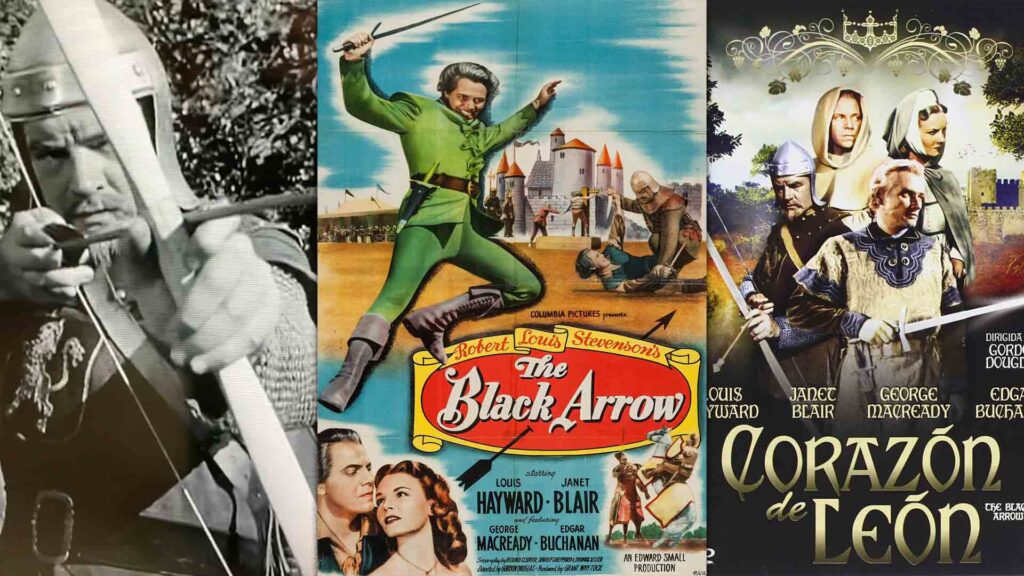
Drama / Family
1948 / 76 minutes
Rating: 7/10
Sir Richard Shelton is a young knight returning from three years away fighting in the latest installment in the ongoing “War of the Roses” (1455-1487). He is a loyal soldier for the House of York side, the side which, for the moment, is the winning side. And their rivals, those who supported the losing House of Lancaster, are now having their lands and manors taken, and given over to York supporters.
If you’re not a big English history buff, that’s okay, because that’s all you need to know. What surprised me at the start was that Richard, clearly our hero-to-be, is fine with Lancaster lands being taken, even when they belonged to a long-time friend and neighbor Sir John Sedley.
Before Richard arrives home an arrow narrowly misses him, striking the tree trunk next to him. Attached to the black arrow is a poetic warning:
Sir Richard Shelton best beware
When to Turnstall Keep he goes
Treachery is lurking there –
Take the word of one who knows.
One home he discovers his father has been murdered, and his uncle and three trusted advisors all tell him Sir John Sedley did it, angered at his lands being taken. But what of this treachery Richard has been warned of? Can he trust the word of these four men?
While he’s not sure who to believe inside the castle, outside of it there is a roving band of outlaws delivering more messages – some deadly – via their black arrows.
So who are the bad guys? Who should Richard trust? The warnings from the Black Arrow band? Or his own uncle, who supports the House of York just as he does too? The choice might seem obvious… but then Sir John Sedley’s daughter enters the scene. Now the question is, how can the daughter of the man who murdered Richard’s father say anything that would sway him?
This is a good story, and got a bit of depth to it, even it is is a very truncated version of the Robert Louis Stevenson (185o-1894) novel of the same name.
Cautions
As might be expected in a medieval swashbuckling epic with “arrow” in the title, there are lots of folk getting shot with arrows and also lots of knights and soldiers falling to the ground via a well-placed sword thrust. All these deaths are bloodless – there is no gore – but there are still quite a number of them. Kids 10 and up won’t find it scary, but it might be for youngers.
Conclusion
There’s some echos here of Robin Hood for sure, though this Black Arrow band laughs a little less. The film’s short length, loads of action, touch of true history, and the fact it was based on a classic work of fiction means there’s could be something for almost everyone in your family. Our family all liked it, but also weren’t gripped by it. We liked it, but I don’t know that we’ll watch it again.
I couldn’t find a movie trailer, but did find the clip below where Richard is forced to duel his old sword-fighting instructor. It highlights how, even though this is a black and white movie, the strong crisp contrasts make this an attractive watch. There are colorized versions available, but they mar, rather than improve, on the original.