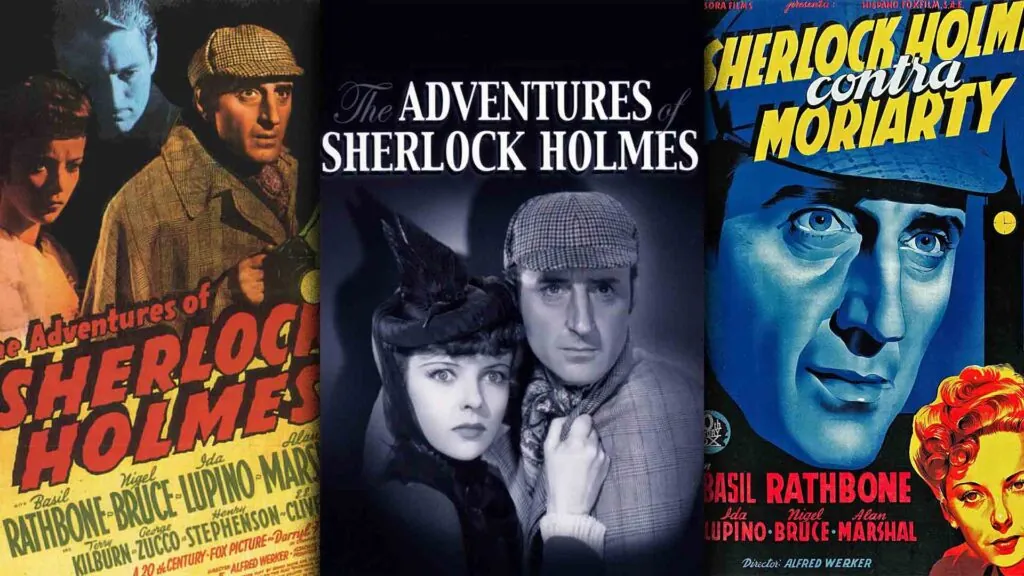
Basil Rathbone's classic 14-film (1939-1946) go as Sherlock Holmes
If there's any one film that deserves credit as the inspiration for the innumerable cinematic Holmesian interpretations that followed, it'd be Basil Rathbone's 1939 performance in The Adventures of Sherlock Holmes. This was the second, and probably the best in a 7-year, 14-film series of Holmes films starring Rathbone as the world's most famous detective and Nigel Bruce as his faithful companion Dr. John Watson.
While this film shares the name of one of Arthur Conan Doyle's collections, the plot is original. In the opening scene we see Holmes' arch-nemesis, the brilliant, villainous Professor Moriarty, quite literally getting away with murder. He is in court, standing trial, and the jury has returned to declare they find him "not guilty," not because they think him at all innocent, but only because they don't have the evidence they need. So what is Moriarty going to do now that he has been set free again? He pledges to Holmes that:
"I am going to break you, Holmes. I am going to bring out, right under your nose, the most incredible crime of the century and you will never suspect until it is too late. And that will be the end of you, Mr. Sherlock Holmes."
And with that, the game is afoot!
Part of Holmes' appeal is in seeing wrongs righted, whether that's murderers caught or stymied, or thefts recovered or averted. Even when these were written, the world was being overturned, with Darwin's theories causing people to question long-held truths. So, to have a logician calmly calculating what is indeed true was an encouragement. Truth could be known!
Of course, that trust in man's reasoning abilities overlooks how able we are to tell a convincing lie to ourselves – Darwin's tall tale was only compelling (then and now) because so many wanted to deny the evidence of God's fingerprints that are everywhere evident in His creation around us. So, yes, Holmes' logic is impressive, but if there is a warning we should give to our kids in watching these films, the most pressing might be that our fallible rationality isn't the firm foundation that Holmes makes it out to be.
The first and this second film in this series are set in the novels' original Victorian era, giving us a good exposure to this classic character in his proper setting. But in a most intriguing twist, the next dozen take Holmes and Watson forward in time to World War II, when these films were actually being produced. That's a fun bit of time travel starting with Sherlock Holmes and the Voice of Terror (1942) where we get to see Holmes' brilliance pitted against conniving Nazis. The duo aren't the only time travelers, however – Professor Moriarty makes his presence felt further on in the series, tag-teaming with Hitler!
Cautions
While two people are murdered In Adventures of Sherlock Holmes, it happens off screen. The scariest part is probably the mood music. The only other concern is the question of whether Sherlock Holmes needed to bring this to the resolution he did. I don't want to give spoilers, so I'll just say, a discussion might be had about what happens at precisely the 77-minute mark.
Other cautions concern not this film, but others in the series. The author of the Sherlock Holmes books, Sir Arthur Conan Doyle (1859-1930), was a spiritualist who sought out communication with the dead via séances. That side of Doyle doesn't seem to fit with Holmes, who comes off as a materialist. But in the first film, The Hound of the Baskervilles, a brief impromptu séance is had at a dinner party. It's presented as hardly controversial, and seemingly akin to an entertaining "party game," as if some might play cards after the meal, while others try to contact the dead. Holmes isn't present, and that makes sense – he'd have had to uncover the chicanery. The whole thing isn't key to the story, but does add to the eeriness. It also serves as a reminder that while Sherlock Holmes is a cultural icon in the West best known for being logical, he isn't always logical, and he isn't the G-rated character parents might remember.
Another example: in the opening of the second novel, The Sign of Four, we find Holmes using opium to quell his restless mind. This addiction comes up in the Hound of the Baskervilles film, though not in a way that kids would understand. It is the last line of the movie, when Holmes says goodnight to everyone, then turns back and says, "Oh, Watson. The needle."
This gives you a representative idea of what to watch out for in the rest of the films.
Conclusion
Almost the whole of this film series is quite entertaining, with one notable flaw being in how they've made Watson more a doddering bumbler than the capable veteran surgeon he is in the books. This was probably done to show the more sharply how brilliant Holmes is. But the books' thoughtful Watson was still struck by Holmes' brilliance, so this downgrade just isn't needed.
As to age appropriateness, there are murders aplenty throughout the series, so this isn't for the very young. But the lack of gore, and the black and white film, take a lot of the edge off of any scariness. Kids over 12 likely won't have any problems with the tension.
I've listed the whole series below, noting which ones were set in the Victorian Era, and which take place in WWII. Four films ended up in the public domain when their copyright wasn't renewed, and they were popular enough to be colorized, making them more of an attractive watch for modern audiences, so I've noted that too. I've rated each with the idea that the 8s will be of interest to many, the 7s to quite a few, but the 6s are only for those who just can't get enough of Rathbone's Holmes. And even they won't want to bother with The Woman in Green, a stinker which I'm giving only a 5.
VICTORIA ERA
1. The Hound of the Baskervilles – 1939, 80 minutes – 7/10
2. The Adventures of Sherlock Holmes – 1939, 79 minutes – 8/10
SET DURING WWII
3. Sherlock Holmes and the Voice of Terror – 1942, 65 minutes – 6/10
4. Sherlock Holmes and the Secret Weapon – 1942, 68 minutes – 6/10 (colorized)
5. Sherlock Holmes in Washington – 1943, 71 minutes – 7/10
6. Sherlock Holmes Faces Death – 1943, 68 minutes – 6/10
7. The Spider Woman – 1944, 62 minutes– 8/10
8. The Scarlet Claw – 1944, 74 minutes – 7/10
9. The Pearl of Death – 1944, 69 minutes – 8/10
10. The House of Fear – 1945, 69 minutes – 7/10
11. The Woman in Green – 1945, 68 minutes – 5/10 (colorized)
12. Pursuit to Algiers – 1945, 65 minutes –8/10
13. Terror by Night – 1946, 60 minutes – 7/10 (colorized)
14. Dressed to Kill – 1946, 72 minutes – 7/10 (colorized)
These are widely available in DVD collections (probably available to reserve at your local library or cheap on Amazon), and can also be found on all sorts of streaming services. I couldn't find a proper movie trailer, but here's a clip of The Adventures of Sherlock Holmes' opening scene that'll give you a good taste of what is to come.
...