Transparent heart icon with white outline and + sign.

Life's busy, read it when you're ready!

Create a free account to save articles for later, keep track of past articles you’ve read, and receive exclusive access to all RP resources.

White magnifying glass.

Search thousands of RP articles

Helping you think, speak, and act in Christ.

Open envelope icon with @ symbol

Get Articles Delivered!

Helping you think, speak, and act in Christ. delivered direct to your Inbox!


Most Recent


The Rest


Red heart icon with + sign.
Book lists, Book Reviews, Children’s picture books

7 (or is it 8?) great board books!

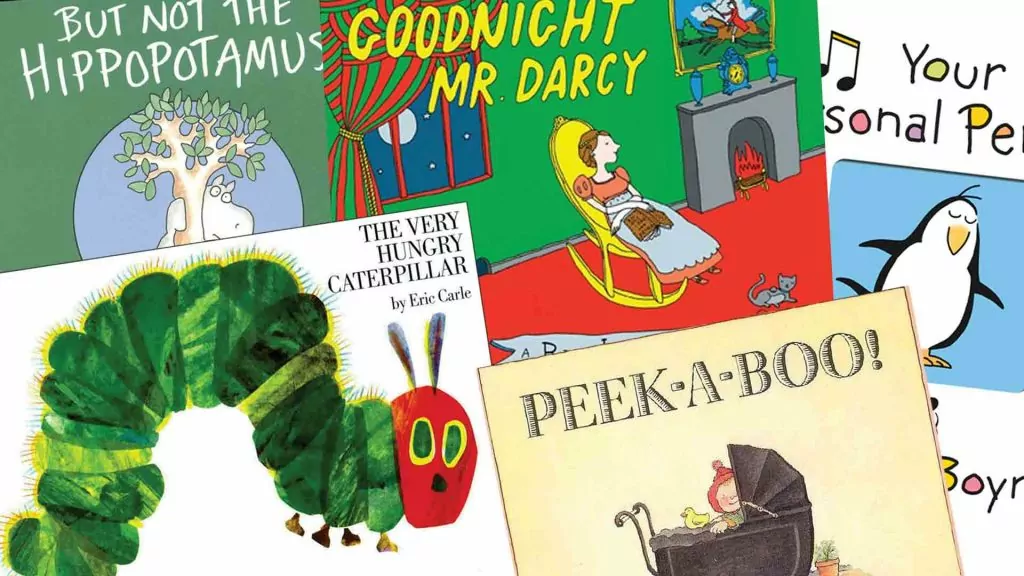
If you want to foster a love for reading in your children, it's never too early to start reading to them. Even newborns will tune in when a parent cracks open a book – a baby doesn't need to understand the story to appreciate mom or dad's calming voice. And if they get to hold the book in their chubby little hands, all the better! The ingredients for a good board book are pretty simple. The most important is probably that it have no sharp corners and be printed with lead-free paper because this is going to be as much a food item as anything else. Eat books, we are told, and babies do! Next, it should be a book parents won't mind paging through again and again. It's on this point that repetitious "classics" like Goodnight Moon and Chicka Chicka Boom Boom have been disqualified. Loved by children though they may be, I know I'm not the only dad to begrudge even one more reading (strangely, I've yet to meet a mom who has the same strong feelings). On a more serious note, board books have become the latest front for our cultural war, with Anti-Racist Baby, Woke Baby, A is for Activist and Feminist Baby in the mix on your local bookstore's board book section. On the other side of the political spectrum, conservative commentator Matt Walsh decided that he'd also entered the board book marketplace. His Johnny is a Walrus is about: a kid who "identifies" as a walrus, the mother who takes him way too seriously, and the doctor who suggests a surgery that turns "feet into fins." Walrus is a satiric take on transgender nonsense, and, in what might be a demonstration of our Sovereign God's sense of humor, it actually ended up on the top of Amazon.com's LGBTQ bestseller list. Really! But whether it be left or rightwing, the point is, politics have invaded even the board book section, so be sure to read before you buy. And, fortunately, with board books that'll only take you a minute. Now let's return to children's fare. The 7 suggestions below are arranged by age, with the first ones best for the very young, and the later ones with material that older sorts can enjoy. Peak-a-boo! by Janet and Allan Ahlberg 1997 / 32 pages The setting is England, and it appears to be right around World War II (judging from the daddy's uniform). The "plot" is very simple – the story starts with a baby in his crib, waking up in the morning and looking around to see what he can see. We follow him through the day, always seeing through his eyes, until his day ends and he heads to bed. It's the book's construction that fascinated my daughter. On the first two-page spread the baby is in her crib on the left-hand side, and the right page is all white, but with a large round hole cut through it so that we (and the baby) can "peek" to see what is on the next page. Once we are done peeking, we can turn the page, and look at a full page of activity – illustrator Janet Ahlberg fills her pictures with layers of detail. There is so much to see Daddy doesn't even mind paging through it again and again and again! Readers get to play peek-a-boo five times, peering through each hole to see what comes next. The Very Hungry Caterpillar by Eric Carle 1969 / 22 pages It's over 50 years old and as popular as ever. The plot is summed up by the book's title: it is about a very hungry caterpillar who eats and eats and eats for a week, and then builds a cocoon and turns into a beautiful butterfly. There are two different aspects of this book that made it one of my daughter's favorites: First, the inside pages are very easy for little hands to turn because they vary in width. On Monday the caterpillar eats through one apple, and the page with the apple is only a fifth as wide as the rest of the book; on Tuesday he eats through two pears, and that page is two fifths as wide, and so it continues with three plums (three fifths as wide), four strawberries, and finally five oranges. Second, the page covering what the caterpillar eats on Saturday is a two-page spread of colorful cake, ice cream, cheese, sausage pie, watermelon, and more, and it looks good enough to eat. Our little ones liked to turn to this page first, and flipped back to it again and again and again. But Not The Hippopotamus by Sandra Boynton 1984 / 14 pages Hippo doesn’t seem to be included in much of what her friends are up to. For example, we learn on the very first page of this board book, that “A hog and a frog cavort in the bog… but not the Hippopotamus.” On the next page, it's more of the same: “A cat and two rats are trying on hats… but not the Hippopotamus.” Poor Hippo! She is always being left out. After a few more pages of forlorn Hippo looking wistfully at what others are up to, (and the repeating refrain, “…but not the Hippopotamus”) the rest notice how neglectful they’ve been, and invite Hippo to “come join the lot of us!” Now as we all know invitations are nice, but sometimes people turn them down, even when they really want to go. So we are in suspense as shy Hippo ponders what to do: “She just doesn’t know – Should she stay? Should she go?” So it is with joy that we turn the page to see her exclaim: “BUT YES THE HIPPOPOTAMUS!” That is not, however, the end of the book. One line follows: “…but not the armadillo.” This small creature is staring sadly after Hippo as she joins the group. It is a great end to a remarkable little book. Yes, it is full of fun rhymes, a great rhythm, and has friendly engaging pictures too, but it is this final line that really sets it apart. Here we see that not only should we include others in our groups, but even when we do step outside ourselves, and make that invitation, doing it once, to one person is only a start. There are still others who are being forgotten and could use a friend. And if your son or daughter is in Hippo's position, a different sort of lesson can be taught, to show them that they have to seize opportunities when they come. Poor Hippo would still have been lonely if she had said no. Good Night Gorilla by Peggy Rathmann 1994 / 36 pages When a zookeeper does one last walk-thru before heading for bed himself, he says "good night" to each animal, starting with the gorilla. But as he visits each animal in turn, there is a little gorilla and his mouse friend, trailing behind, and unlocking all the cages. Eventually, a whole train of critters follows the keeper to his house and right into his bedroom. It's only when his wife says "good night " to him in the dark, and gets a chorus of "good night"s from all around the room, that the gorilla's entourage is discovered. But it seems the weary zookeeper has dropped right off to sleep, so it's up to his wife to lead all the animals back to the zoo. Well, not all the animals. As she makes her way back home we see that she has some quiet company – the gorilla, and his little mouse friend, won't be left behind! You Are Special by Max Lucado 2000 / 28 pages Punchinello is a wooden "Wemmick" living in a town of other wooden people. These Wemmicks have made a habit of placing stickers on one another, gold stars for good, gray dots for bad. The pretty ones and talented ones always got stars..." but not poor Punchinello. When he tries to jump or run like the others, he trips. And then the others give him dots. "Then when he would try to explain why he fell, he would say something silly, and the Wemmicks would give him more dots." It gets so bad that he doesn't feel like going outside, and he starts to believe what the other Wemmicks are saying about him, that he deserves these gray dots. Things turn around when Punchinello meets a Wemmick, Lucia, who doesn't have any stars or dots. They just don't stick to her. Punchinello wants to know how he can be like that. Lucia tells him to go visit Eli the woodcarver who tells Punchinello that he matters because Eli, his maker, thinks he matters. And the dots and stars won't stick if Punchinello remembers that. Parents will understand that Eli is to Punchinello as God is to us, but some children may need some help understanding this metaphor. This is a great book that older kids can benefit from, perhaps while reading it to their younger siblings. School can be such a battleground, even at a Christian school, with so many children trying to get ahead by putting others down. Parents will appreciate the impact this book's message could have for their children if they really understand that it doesn't matter what others say about us, because we are God's own children, made in His own Image. The one danger here is that the lesson could be readily misunderstood by a child as countering what others think by elevating the child, rather than countering what others think by elevating the thoughts of God. That's a bit of a fine point, but one that parents can help their children understand. This is available as a board book or a slightly bigger picture book, and it is worth getting the one, and then the other as your child ages. Your Personal Penguin by Sandra Boynton 2006 / 21 pages This is my favorite board book of all, but that might be colored a bit by the fact my wife gave it as a gift when we were dating. But what cemented it as a favorite for our kids is the free sing-a-long song you can download for it. Davy Jones of The Monkees does a fantastic job with this little ditty. The tune is memorable, which meant that even I could do a pretty decent rendition singing it to our kids. It's about a penguin who loves a hippo and has a proposal: I want to be your personal penguin I want to walk right by your side I want to be your personal penguin I want to travel with you far and wide... Sanda Boynton has many other great board books including The Going to Bed Book, Fifteen Animals, and Barnyard Dance and while I haven't run across any that aren't great, I did just notice that she's started listing her personal pronouns as "she/her" which is better than going with "he/zer" but still shows she's bought into this "more than two genders" nonsense. So, again, read before you buy. You can check out the Your Personal Penguin song (and other Boynton hits) here. Goodnight Mr. Darcy by Kate Coombs 2015 / 20 pages This is a gimmick, but so brilliantly done it deserves a spot on this list. As you may have already deduced from the title, this is a mash-up of the board book classic Goodnight Moon and a classic of another sort, Jane Austen's Pride and Prejudice.  As stated earlier,  I am not a fan of Margaret Wise Brown's 1947 Goodnight Moon. I could handle it once or twice, but the simple repetitions started driving me a little batty even going on thrice. So when I saw this, in the same coloring, and a similar rhythm, but much more clever, I thought it might be the perfect substitute. And it was! Here's a little taste: In the great ballroom There was a country dance And a well-played tune And Elisabeth Bennet – This really is intended for adults, but the rhythm and rhyme will grab your children's interest too. This is not the only board book version of Pride and Prejudice, but as the others lack the same charm, be sure if you have the right author....

Red heart icon with + sign.
Documentary, Drama, Movie Reviews

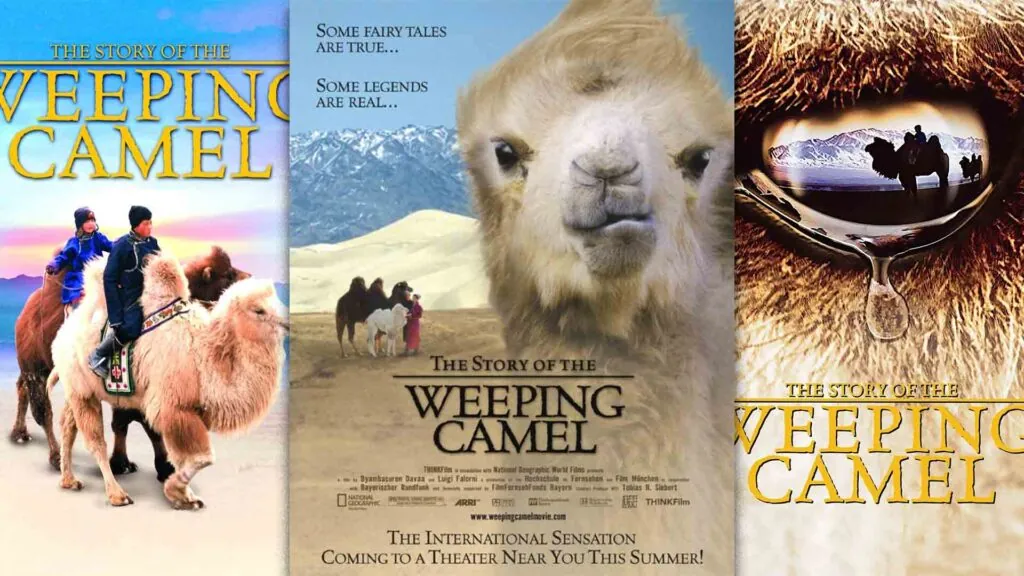
The Story of the Weeping Camel

Foreign film / Docudrama 2003 / 87 minutes RATING: 7/10 This is as much drama as documentary because, as film critic Roger Ebert described it, “It uses real people in real places and essentially has them play themselves in a story inspired by their lives. That makes it a ‘narrative documentary,’ according to the filmmakers.” What we get is a peek inside a Mongolian nomad family during their camel birthing season. The camel of the title takes three days to give birth and then refuses to suckle her calf. It will die unless she changes her mind so two young brothers go off on a 50-kilometer journey to bring back a musician from the closest village. They hope his music will soothe the mother camel into accepting her offspring. The legend is, if the camel does finally start to feed her calf, then that will cause the mother to weep. Cautions At one point a little boy is bathed, and we can briefly see him naked from the front. If you are watching this with little kids, the camel birthing scene might be a little intense - we see the calf delivered, still covered in the membrane and a little bloodied. Conclusion This is for the adventurous... and patient. Weeping Camel is too slow for children, and probably most adults, but if you like learning about other people and countries, and are a fan of documentaries, then this is for you, offering an up-close and fascinating look at such a completely different culture. There's certainly a reason this got a 2005 Oscar nomination for best documentary. I could only find a low-rez trailer online, but it'll give you a good feel for the film. ...

Red heart icon with + sign.
Family, Movie Reviews

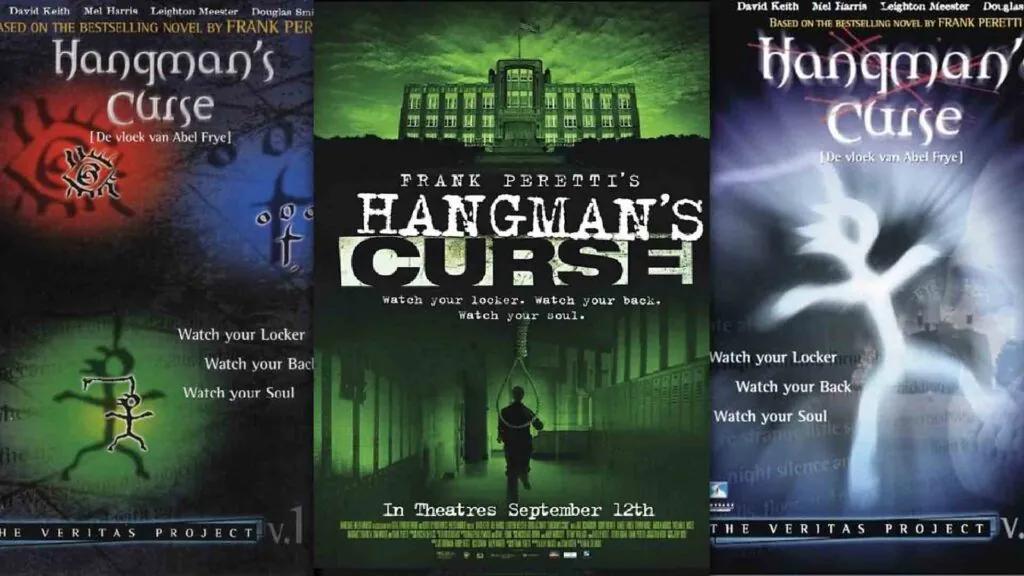
Hangman’s Curse

Teen Suspense / Mystery 2003 / 106 minutes RATING: 7/10 Bullies at Rogers High School are all getting deathly sick. Is this the work of Abel Frye’s ghost, a student who committed suicide ten years earlier? The Veritas Project, a family of investigators, is brought in to uncover the truth and they quickly find things are not at all as they appear to be. If you were going to judge this movie by its cover you would probably dismiss it as some weird supernatural thriller, but the villains in this story turn out to be familiar foes. At its core this is a movie about bullies and the bullied, about cliques and trying to belong. This is campy, for sure, but could still be an interesting one to watch with your teens and discuss. Cautions That said, Hangman's Curse begins with a student’s suicide and delves into the practice of witchcraft so this clearly isn’t suitable for anyone under 10. In fact, parents should really preview this before watching it with their kids. This has been billed as "Christian horror" and if you can't deal with spiders, you really should give this a miss. The tagline is: "Watch your locker. Watch your back. Watch your soul" and that just about sums up why this film is going to be too much for many viewers – we just aren't expecting a Christian film that'll make you jump. In some countries this has been restricted to 16+, though I'd say that might be more because folks rate anything with bullying (or cigarettes) rather severely, as compared to what they do with sexuality or language. Conclusion Horror, suspense, and more than a little cheese – whatever you want to call it, you haven't seen a Christian movie like this before. Based on a Frank Peretti teen novel of the same name, Hangman’s Curse is a Christian film that manages to get us thinking, at least a little. It's got some humor too, and it gets its anti-bullying message across crystal clear but in such a campy way that it isn't all that preachy. To get a good feel for it, check out the trailer below. ...

Red heart icon with + sign.
Animated, Movie Reviews

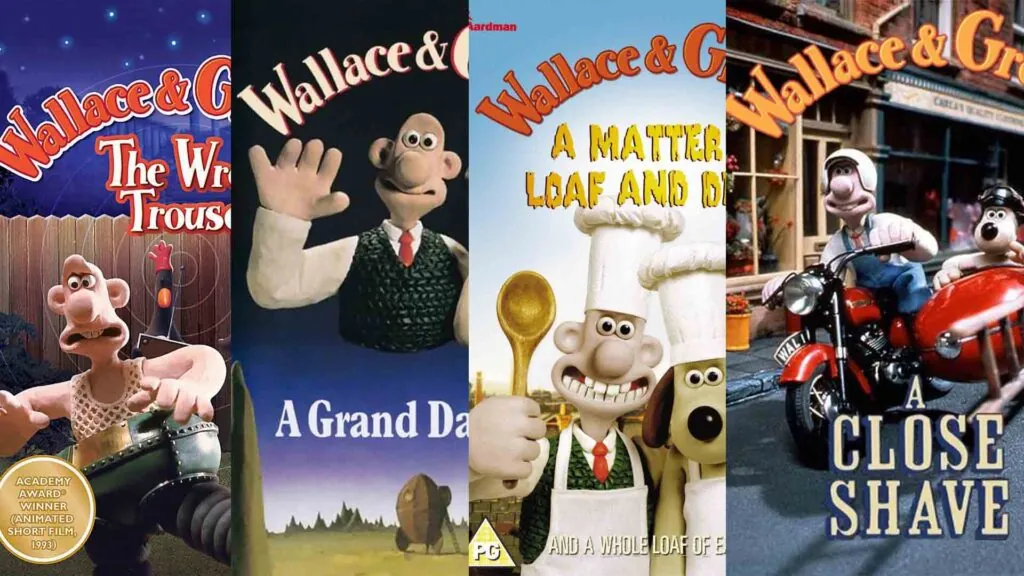
Wallace and Gromit: four short films

Animated / Comedy 1989-2008 / 114 minutes RATING: 8/10 It's been 35 years now, since student filmmaker Nick Park crafted his leading man out of clay. He made Wallace lovable and oh so inventive, but also more than a bit thick. Then Park carved up Gromit, Wallace's loyal, long-suffering dog who can't quite manage to keep Wallace out of trouble entirely, but who does manage to keep his master from getting in too deep. Wallace might be a brilliant inventor, but Gromit is the wise one. Since his first stop-motion claymation film, A Grand Day Out (where the duo managed to make it to the moon), Park has featured this duo in three more shorts and a couple of feature films; they've won a few Oscars, and spawned spin-off TV shows (Shaun the Sheep being the most notable). Not bad for a dim bulb and his dog. Part of the charm here is that the two of them do care for each other. Of course, that doesn't mean Wallace knows how to express his affection. He'll build an automatic patting machine, for example, rather than give Gromit the scratch behind the ears that his canine companion really wants. And when Gromit wants to go for "walkies," like every dog does, Wallace builds a set of "techno trousers" that he can attach Gromit's leash to, so the robot pants can take Gromit for his walk. Really Wallace, really? Gromit can't even talk, but the expressive dog sure can communicate. (They actually write dialogue for Gromit, even though he isn't going to speak it, so the animators will know how to shape Gromit's expressions.) Right behind this duo, third billing goes to the inventions – Wallace has more gadgets than James Bond, and they're twice as cool. He's built a machine that automatically throws him out of bed, sliding Wallace down a chute so he can land at his breakfast table, where another machine dresses him and yet another makes his breakfast. This process rarely goes off without a hitch, and the malfunctions are as fun as the successes. Another of Wallace's crazy contraptions is a knitting machine that just needs you to pop a sheep in one end, and a sweater will come out the other. Park has made four short claymation Wallace and Gromit films in all. A Grand Day Out 1989 / 24 minutes Wallace and Gromit need a vacation, and when Wallace discovers they are out of cheese, they decide the best getaway destination is the moon, what with all its bounty of green cheese. How are they going to get there? By building a rocket ship in the basement, of course! The Wrong Trousers 1993 / 30 minutes Wallace and Gromit’s happy home life is disrupted by a mysterious penguin who rents one of their rooms. Soon the shifty-eyed flightless foul is trying to replace Gromit in Wallace’s affections. But never fear, the loyalty of this tried and true dog does win out in the end. The moral of this tale? Either never neglect your dog, or don’t trust shifty-eyed penguins. Fun and silly, it won an Oscar. They even made a sequel, the feature film Wallace and Gromit: Vengeance Most Fowl. A Close Shave 1995 / 31 minutes To make ends meet, Wallace and Gromit have started their own window-washing business. A wool merchant, Wendolene Ramsbottom, asks them to clean her shop windows, and, of course, Wallace falls in love. There are two mysteries to solve: first, where has the country's wool gone? and, second, what or who is destroying the interior of Wallace and Gromit's house? (One hint: this is where Shaun the Sheep makes his very first appearance.) A Matter of Loaf and Death 2009 / 29 minutes Wallace and Gromit are now bakers, and great at it. It doesn't hurt their business, either, that all the other bakers in town are being bumped off one by one. Wallace is in love again, this time with Piella Bakewell, the spokesmodel for Bake-O-Lite breads. The ever loyal Gromit gets stuck doing Wallace's work in the bakery, even as he's also trying to prevent the two of them from becoming the "cereal" killer's next victims. The description pitched this as a "who-doughnut" in the tradition of Alfred Hitchcock, and I was skeptical; how could they pull that off in claymation? But they did! Cautions While A Grand Day Out would be safe for all ages, The Wrong Trousers has a somewhat creepy villain that the pre-school set could find a bit disturbing. The last two films amp up the tension more, with first sheep, and then bakers, getting killed. One baker even gets killed off screen but then falls back into the shot, face first into a cake. It's all claymation, so, not at all realistic (and there is no blood or gore). But it underscores how these aren't really intended as family fare. Some animation is for kids, with some jokes for adults thrown in. I'd say this is for adults, and some older kids  – 10 and up – could enjoy it too. Language concerns would be limited to a few uses of "heck" and "flipping" and I think an "oh my gracious." Finally, in A Matter of Loaf and Death, a bomb blows a hole in Wallace's pants, and we see a brief shot of Wallace's naked, claymation butt. Again, the claymation aspect of it means this is far from titillating, though it might get little boys tittering. Conclusion The appeal here is the spectacle of all of Wallace's crazy inventions, and the simple beautiful loyalty of these two friends. It's clever, and might even inspire some kids to give stop motion filming a try. I remember making one, not with clay, but with a pair of my shoes doing a dance across the floor. There are so many tools online to get an inventive kid going, and this might be just the thing to inspire them. That said, these are not all for the very young. The Brits rate these as 7+ but I'd say that especially A Matter of Loaf and Death should be 10 and up. For a taste of what Wallace and Gromit are all about, check out this compilation of their "cracking contraptions" –  8 two-minute videos of Wallace at his most inventive. ...

Red heart icon with + sign.
Culture Clashes

Are some cultures better than others?

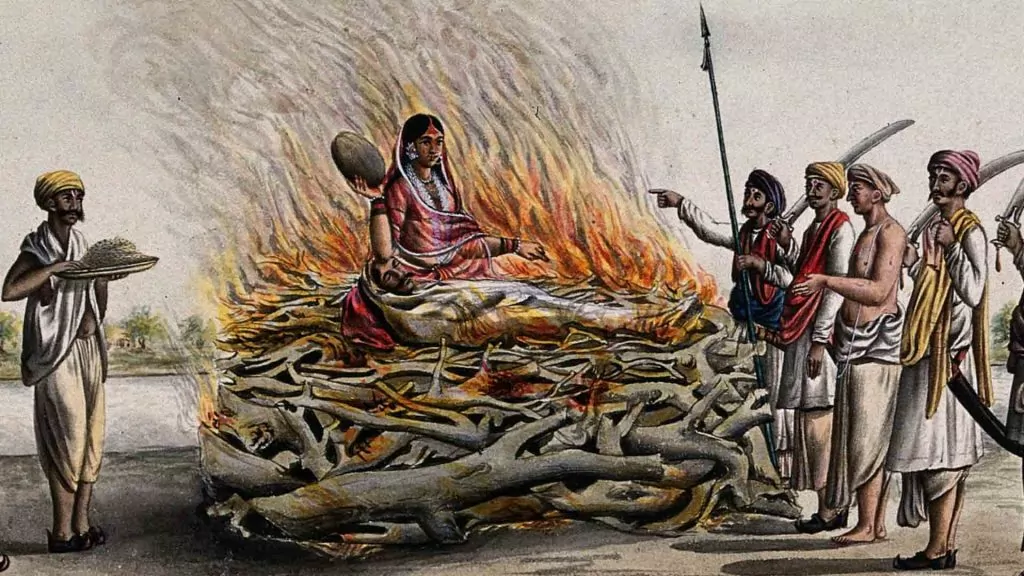
We know all people are equal because every one of us is made in the very Image of God (Gen. 9:6). So wouldn't it be wrong to think that some cultures are better than others? Isn't saying one particular culture is superior, pretty much the same thing as saying "whites are superior to blacks"? Or saying "Jews are inferior"? Culture clash If it feels that way to you, consider this story. While working in India, the British general, Sir Charles James Napier (1782-1853), was confronted by Hindu priests who were protesting the British prohibition against Sati (or suttee). This was a custom in India that involved a dead man’s widow being burned alive on his funeral pyre, and the priests wanted to be allowed to continue their custom. In response, Napier reportedly replied: "Be it so. This burning of widows is your custom; prepare the funeral pile. But my nation has also a custom. When men burn women alive we hang them, and confiscate all their property. My carpenters shall therefore erect gibbets on which to hang all concerned when the widow is consumed. Let us all act according to national customs." Was Napier saying that the British are better than the Indian people? That wasn't his point. He was making something very clear about their two cultures though, and it's a point everyone gets at a gut level. Were there no other differences between two cultures other than that one burned their widows alive and the other did not, we'd know which was superior. Some confused college student might try insisting that these different cultural practices are equally valid. "Judge not," he'd remind us, referencing the one half verse of Scripture he knows. But if the young man wants to push his relativism you could ask him how he'd respond if you were to swipe his phone – would his "judge not" scriptural misapplication still apply when he's the victim? Or would he now concede that some beliefs – like "do not steal" – are better than others? Swiping phones is wrong, and burning widows is wronger, and a culture that opposes either is superior to one that won't. Why isn't it racism? So if some cultures really are better and worse than others, why does saying so still come off as racist? It's because some on the Left deliberately conflate race and culture, pretending they are one and the same. Then they'll use the confusion they've created to frame arguments to their advantage, making opponents out to be bigots. Praise limited constitutional government, and they'll try to dismiss you for loving the "old dead white men" who brought it to us. Or if you wanted to discuss why it is that in the US so many more black than white children grow up without a father in the house, you might be attacked for hating on blacks. The other side doesn't have to debate your facts if they can just tar you with a label. But the label shouldn't stick because culture and race are very different. Race is about your skin color, and where you or your ancestors might have come from. And all of that is morally irrelevant. As Martin Luther King Jr. reminded us, the amount of melanin in your skin doesn't say a thing about the content of your character. To put it in more biblical terms,  when we're talking about where someone's ancestors might have come from, it all traces back to Adam and Eve, or more recently Noah and his wife. So you shouldn't be racist because we're all the same race – Adam's. You should be "culturalist," however, because culture is all about a group's shared values, customs, and behaviors. Whereas skin color isn't a right/wrong kind of difference, different values, customs, and behaviors can be better or worse. A culture that values intact marriages is better than one that embraces living together, or faultless divorce. And a culture that allows burning widows has something deeply wrong with it. As does a culture that celebrates the right to kill unborn babies. Matthew 7 and judge notting But what about Matthew 7 and not judging? In context, this isn't a ban on judging, but instead a guide on how to do it. God says: “Do not judge, or you too will be judged. For in the same way you judge others, you will be judged, and with the measure you use, it will be measured to you." It also highlights why racism is wrong and culturalism isn't. Racists base their judgment of a person’s worth on an inconsequential criterion. Would a Ku Klux Klan member want to be told “Sorry, you have the wrong skin color, so you can’t sit at this counter”? Nope, which highlights how stupid their racist standard is. In Sir Napier's case, a culture can be evaluated as better or worse on the basis of how closely it aligns with, or how far it departs from, God's standard. What made British culture superior here was that – for whatever other faults it had – it aligned more closely with God's law regarding the right treatment of His female Image-bearers. And that's no insignificant standard – both the 6th commandment (Ex. 20:13) and the second greatest (Matt. 22:38-39). Closer to home The importance of being able to evaluate cultures, and being able to fend off accusations of racism as you do it, is as important today as it was in Napier's time. Measuring other cultures against God's standard enables us to confidently critique some behaviors. We can rightly condemn a society that surveils its citizenry, or confiscates their property, or threatens death to anyone who converts from Islam. Closer to home, we need to be able to evaluate our own culture against the biblical measure to show us how progress can be made. We don't burn our widows, but we will euthanize them... and no one will be hanged for it. We've made murdering unborn babies something to celebrate, and irreversible transgender surgical mutilations a perverse right. It's also a mark against our culture that it holds only to the first half of the first verse of Matthew 7 – "Do not judge" – and none of what follows. Closer yet, the larger Church has its own cultures too, including groups who condemn any judging other than their own. They aren't objecting to hypocritical judgments like those of the racists, or the Pharisees of old (John 8:2-11). They aren't faulting conservatives for applying a standard we aren't willing to apply to ourselves. Nope, they are going the relativist route, judging us for being willing to judge at all. The key in all of this, then, is to understand that some judging is wrong, and other judging right. How can we know which is what? By turning to our Standard-maker, Who tells us what criteria matter and which don't because He knows what rules are best for us and everyone. A version of this article first appeared in the January 2012 issue....

1 2 3 4 5