Transparent heart icon with white outline and + sign.

Life's busy, read it when you're ready!

Create a free account to save articles for later, keep track of past articles you’ve read, and receive exclusive access to all RP resources.

White magnifying glass.

Search thousands of RP articles

Helping you think, speak, and act in Christ.

Open envelope icon with @ symbol

Get Articles Delivered!

Helping you think, speak, and act in Christ. delivered direct to your Inbox!


Most Recent


The Rest


Red heart icon with + sign.
Book Reviews, Teen non-fiction

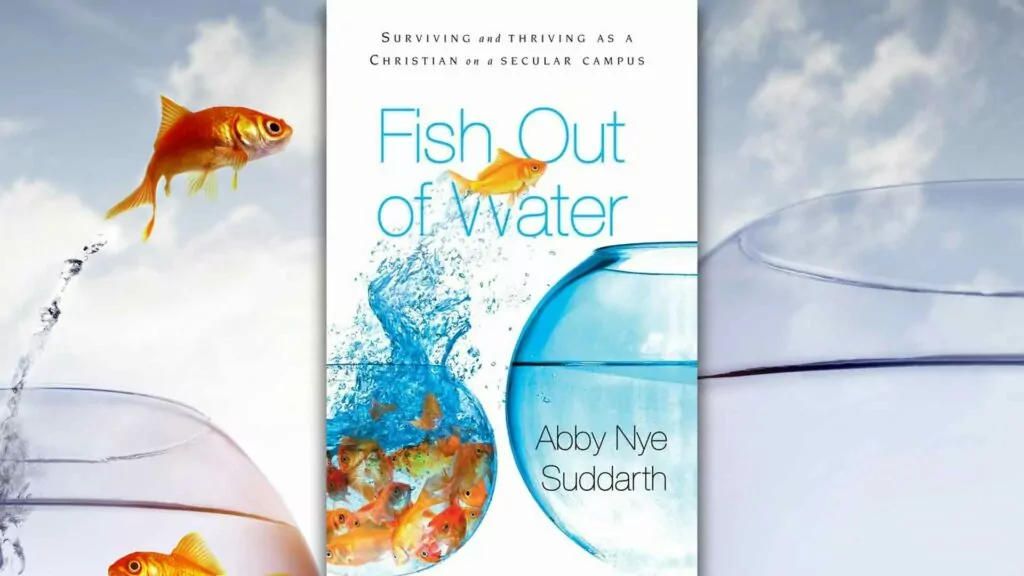
Fish out of Water: Get equipped for college

by Abby Nye 2005 / 229 pages Rating: GOOD/Great/Give Nye wrote Fish out of Water, while in the third year of university, at the suggestion of her journalist parents. She was shocked, and overwhelmed by her first year on campus, but stuck it out, and started taking notes on the strange and perverse goings on at today’s secular campus. It started with her Welcome Week orientation activities, which included a meet and greet where guys and girls who had just met were greeting each other with a French kiss. Throughout the year, the weirdness continued – some of the activities included “National Condom Day” followed shortly after by a “campus-sponsored activity called ‘Just How Kinky Are You?’” The campus “Counseling and Consultation Center” prepared for February by handing out a flyer title, “Road Trip?” which advised students to set up a “drinking plan” for Spring Break and gave tips on what to do if your drinking buddy was so drunk he stopped breathing. But it isn’t just the weirdness that Nye addresses. She also tackles some of the day-to-day challenges Christians will face. She notes the hypocrisy many colleges have towards everything and anything, except Christianity, in a chapter titled, “We will not tolerate intolerance.” Her most helpful and practical advise can be found in the chapter “Pick your battles” where Nye shows how to stand up in a godly, respectful and effective way, and also shares thoughts on when it is probably best to just walk away instead. While Nye probably isn’t Reformed, her advice is biblically sound. This is a great volume for parents and college-bound students to read. The entire contents of the book can be read for free at AnswersInGenesis.org/articles/foow but for this to be properly digested you should pick it in paperback....

Red heart icon with + sign.
Drama, Movie Reviews

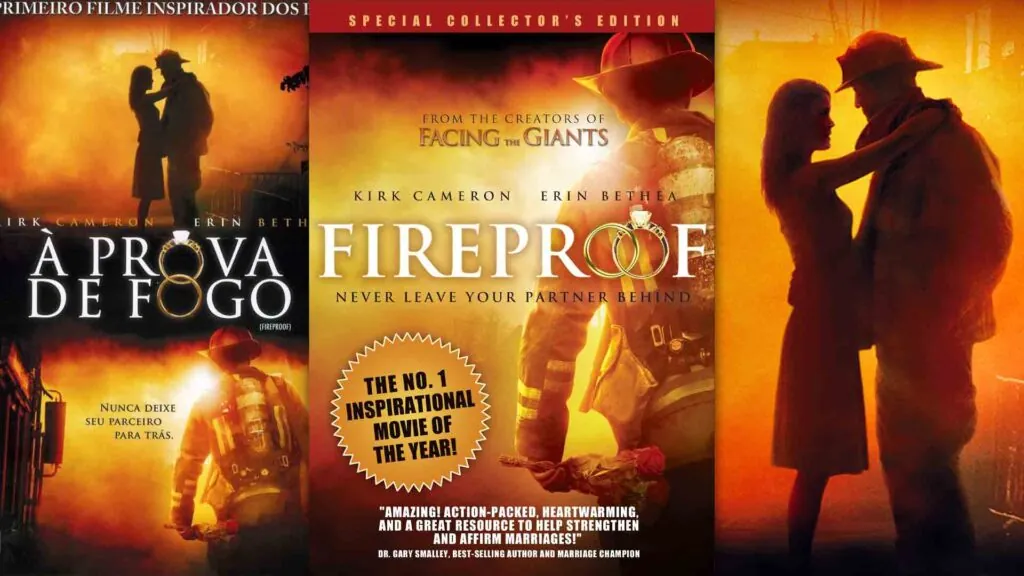
Fireproof

Drama / Christian 2008 / 122 min RATING: 6/10 This is powerful, funny film that gets off to a lousy start. Film critic Warren Cole Smith was so overwrought by the first twenty minutes – the “bad acting…bad dialogue… and bad directing” – that he left. I get it. Fireproof won’t win any Oscars, but if Smith had stuck around just past those 20 minutes he would have seen the acting, dialogue, and even the directing dramatically improve. Fireproof is produced by brothers Alex and Stephen Kendrick, and, like their earlier film Facing the Giants, it has an overtly Christian message. The focus this time is on marriage, and specifically the disintegrating marriage of Caleb Holt (played by Kirk Cameron) and his wife Catherine (Erin Bethea). Holt is a well-respected firefighter who doesn’t understand the lack of respect he gets at home. Catherine is a publicist at the local hospital who sees little reason to respect a husband who spends time on the unsavory side of the Internet. So she turns to her friends and coworkers for sympathy, and starts spending extra time with a young doctor who is always available to talk. When the topic of divorce comes up it’s the first time in a long time that Catherine and Caleb can agree about something – they both want out. Fortunately Caleb’s father isn’t as ready to give up – he challenges his son to try saving his marriage and gives Caleb a book called The Love Dare. The book is filled with forty tasks, one to be done each day for the next forty days. The first few tasks seem simple, but present challenges to a husband who isn’t used to showing affection, and to a wife who isn’t used to receiving it. So when, on Day 2, Caleb has to do an “unexpected act of kindness” for his wife, the best he can think of is making her a cup of coffee… which she leaves behind on the counter. Two weeks later the tasks become more difficult: Love Dare #16 asks Caleb to pray for his wife. Up until this moment Caleb has had no time for God, but as his father tells him, Caleb cannot truly love unless he know the God who is love, the God who expressed His love to us by dying for our sins. It’s here that the movie’s theology comes to the fore, highlighting both strengths and superficialities. Like many Christian movies, Fireproof has a “conversion moment,” but the Kendricks take it much further. In other films the principal character’s conversion concludes the movie (and viewers are left with the impressions that life will proceed on in a happily-ever-after fashion) but in Fireproof Caleb’s conversion takes place about halfway through the film and drives the rest of the action. Here, as in real life, conversion is just the beginning of something – a life with God that while wonderful isn’t necessarily easy. However, it’s in this same scene that Fireproof reveals a rather man-centered theology: Caleb’s motivation for turning to God seems to be based more on seeking help for his marriage than seeking reconciliation with his Holy Creator. Caleb’s marriage occupies the top spot in his priorities, the spot that should belong to God. The final word? This is a film couples could enjoy and benefit from. Fireproof may start slow, but it ends strong and earns a solid 6 for enjoyment. It should probably get the same rating for its theology – weak on some Christian basics, but its message on marriage is right on the mark: “never leave your partner behind.” This review first appeared in the February 2009 issue under the title "Love is never leaving your partner behind."...

Red heart icon with + sign.
Pro-life - Abortion

Abortionists as euphemists

The curious case of the shifting language **** Most abortionists are euphemists. By which I mean merely, to quote Chesterton, “that short words startle them, while long words soothe them. And they are utterly incapable of translating the one into the other, however obviously they mean the same thing.” If, for instance, you say to an abortionist, “The excessive burden upon the mother, particularly in light of the rights to autonomy, privacy and reproductive freedom, of an unplanned pregnancy precludes any ethical objections to surgically removing the products of pregnancy post-viability, but prior to completion of delivery,” a gentle, indeed a radiant smile will cross his face, and he will dose off as if to a lullaby. Say, on the other hand, in a forceful, straight-forward way, “Crush the skulls and suck out the brains of your children!” and he will leap from his seat, startled and full of objections. But the two sentences mean precisely the same thing. Or, if you were to say, “An analysis of the cost-benefit ratio of carrying to term a fetus found via amniocentesis to have non-disjunction of the 23rd chromosome invariably leads to the conclusion that medical resources would be better allocated by discontinuing the pregnancy,” your average abortion supporter will sway like a child borne carelessly upon the waves of a warm summer sea. But unapologetically bellow forth the declaration, “Save money! Kill all the disabled kids!” and you will get a very different reaction indeed. But, once again, cold logic says that the two propositions propose precisely the same thing. Hiding the baby Abortionist literature is chock full of a million similar instances. Pro-abortion writers keep a whole stash of such long words at their disposal, which are ushered forth to carefully hide the tracks of any stray meaning that might have crept into their sentences. I need only reach out my hand and grab the mostly excellent book What to Expect When You are Expecting, which my wife, who is pregnant with our first child, has been reading. On pages 42 and 43 we find information about prenatal diagnosis and we are told that in case of fetal abnormalities there are two options: to continue the pregnancy or to terminate the pregnancy. Already, I would argue, we have taken our first steps into the weird world of abortionist euphemisms with the ambiguous and oddly mechanical word “terminate.” But I won’t press the point. What especially interests me is not this, but that in the paragraph about continuing the pregnancy, we are told all about a “baby.” But in the next paragraph, which is all about “terminating” the pregnancy, there is no mention of a baby; the baby has been completely replaced with the “products of pregnancy.” What, then, has become of the baby? Nothing at all, of course. It’s still right where it was and no matter how much they wish to do so, our illustrious authors cannot actually make the baby go away merely by changing their language; but what they can do is the next best thing – they can hide the baby, shove it behind the sofa or under the rug, like an embarrassing mess they haven’t yet had the chance to clean up, and the guests are already arriving. In other words, they can come up with a long word. And so they come up with “products of pregnancy.” And when the “products of pregnancy” are safely and properly “terminated” we can all get on with our lives, displeased that the pregnancy did not "turn out favorable" (an actual quote from the book), but unbothered by either our consciences or any of those pesky handicapped children. Please ignore the obvious Of course, if we were to press the point and ask, “But what are the products of pregnancy?” the authors would have to respond, “A baby.” But they are hoping that no one will ask the question. And many (including, I suspect, themselves) don’t. Which is why up to 95% of babies diagnosed with Down syndrome are never born: because all we’re doing is “terminating” the “products of pregnancy,” and what could be wrong with that? The answer is nothing at all, unless you happen to prefer precision to muddleheadedness and replace the comfortably cumbrous word “terminate” with the uncomfortably curt “kill,” and the melodious “products of pregnancy” with the wholly unpoetic “baby.” That would leave us with “kill the baby,” or, to use another short and unpopular word, “murder.” I recall hearing a story somewhere, told by a fellow who attended an abortion debate, where the representative of the pro-life position repeatedly spoke of “killing the unborn baby.” After the debate this fellow happened to step into an elevator full of pro-aborts, and as the elevator slid down everything was silent, until somebody soberly observed, “‘Kill the baby’ You just can’t argue with that.” If the speaker had ever stopped and questioned why you can’t argue with that, he might now be pro-life. Words with no meaning I take another example at random. In a 2003 article published in The Nation, Katha Pollitt complained that “anti-choicers” had coined what she termed the “imprecise” phrase “partial-birth abortion.” This phrase, she says, “has no precise medical meaning and cannot be found in any medical text,” but has nevertheless been widely used by the mainstream media, possibly out of a “fear of seeming too liberal” (not a fear that I myself have ever detected in the media). Instead, Pollitt very helpfully suggest the terms "dilation and extraction" and "dilation and evacuation." These terms, she says, are much better than what she calls the “oxymoronic” phrase “partial-birth abortion,” which “with accompanying gory description - crushed skull, sucked-out brains, half-delivered fetus - was a stroke of public relations genius.” According to Pollitt dilation and extraction (D&E) and dilation and evacuation (D&E) are the proper terms because they describe “actual methods” used for abortions in the second or third trimester. But, of course, if there is one thing that these terms do not do, it is “describe.” She might as well say that the media should always speak of “mastication” instead of “chew” and “perambulate” instead of “walk” because “masticate” and “perambulate” describe actual methods of eating and moving. The thing is absurd. To most everybody the two D&Es convey not a thing, which is precisely how Pollitt wants it. Stop a man or a woman on the street and say to them, “Dilation and extraction. Define it!” and odds are (unless you’ve stopped a doctor or Katha Pollitt) they won’t have a clue what you’re talking about. Or if you were to say to an acquaintance, “I’m going in for a dilation and extraction today,” they might smile and say, “I pray that it goes well,” and walk away with the vague sense of sympathy that we reserve for people who are undergoing obscure and technical sounding medical treatments that we don’t understand. They very probably wouldn’t at all suspect that you were about to authorize a doctor to suck out the brains of your own child. If Pollitt really wants words that “describe” the “actual procedures” used in killing a fully formed baby moments before birth she has no option but to fall back on such things as, “punch a hole in the back of the baby’s head,” and “vacuum out the brains,” and, “crush the skull” and “corpse,” which, undoubtedly, are not nearly as long as “dilation and evacuation,” and not nearly as useful in conveying absolutely no meaning at all. Let clarity reign However much Pollitt may object, she will have to face the fact that if medical doctors applied the standards she is advocating to every other medical procedure, all the patients in our hospitals would be extremely confused. If Pollitt fell ill, for instance, and her physician would only tell her that she had Retroperitoneal Fibrosis (an actual name for a condition found in medical textbooks) and that they would have to remove the “products of the illness,” I’m sure Pollitt would be quite put out. She would certainly want to know what the “products of the illness” are and how they are to be removed. But in her world the doctor would merely cluck his tongue at her plebian ignorance and get on with the thing. So far I have only discussed euphemisms in the abortion debate. But you will find that whenever a “progressive” bioethicist or politician is doing something naughty and not at all popular, they will create a host of long words to ensure that they are misunderstood by everybody except their like-minded colleagues. At the beginning of this piece I quoted Chesterton on this issue. The thing is that Chesterton was not himself writing about abortion, but about eugenics - another horror which very erudite and progressive scientists and politicians were attempting for foist on the British at the time, always under the cover of long words and sentences. And so it is with most every other branch of the culture of death, whether it be abortion, eugenics, embryo research, and all the rest; the culture of death always makes its greatest strides under the disorienting and heady fog of ambiguity. Reprinted with permission from the January 9, 2009 LifeSiteNews.com. This appeared in the February 2009 issue of Reformed Perspective....

Red heart icon with + sign.
Adult fiction, Book Reviews

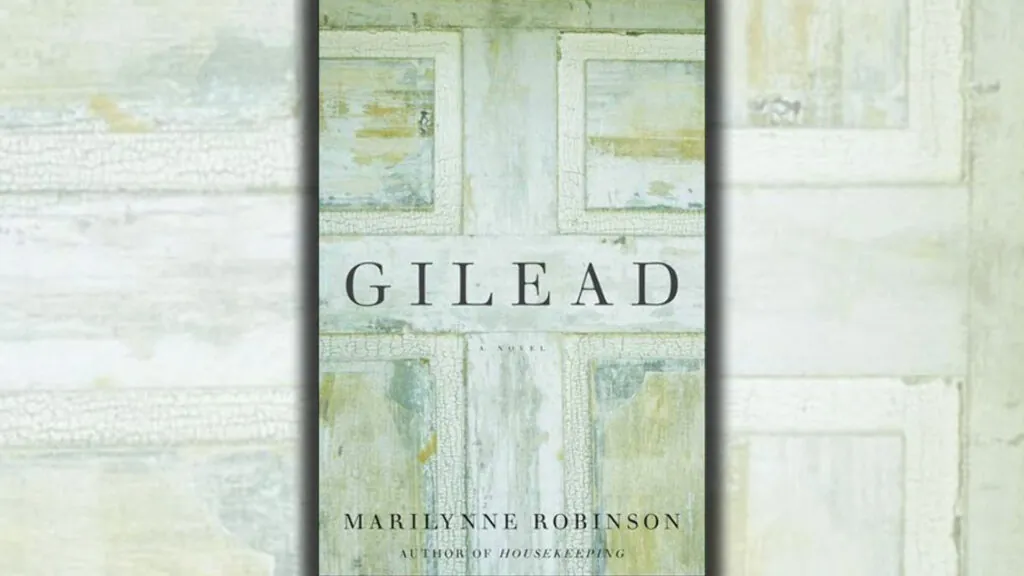
Is There Balm in Gilead?

There is a balm in Gilead To make the wounded whole; There is a balm in Gilead To heal the sin-sick soul. Some times I feel discouraged, And think my work’s in vain, But then the Holy Spirit Revives my soul again. There is a balm in Gilead To make the wounded whole; There is a balm in Gilead To heal the sin-sick soul. If you can’t preach like Peter, If you can’t pray like Paul, Just tell the love of Jesus, And say He died for all. ***** By Marilynne Robinson 2004 / 256 pages Rating: Good/GREAT/Give Reformed Christians often assume – generally accurately – that anything produced by the culture around us is motivated by rebellion against God’s word. Our recognition of our culture’s hostility to God makes it seem very strange that a recent Pulitzer-Prize-winning novel should have a title, a cover, a setting, a main character, and themes that are compelling to Reformed Christians. Perhaps it should not be so surprising when we think about the background of the author, Marilynne Robinson, who – like the main character – attends a Congregationalist Church in Iowa. After all, since Congregationalism arose originally in England partly as a Calvinist response to the corruption in the state church in England, there should be some harmony between Robinson and Reformed people. Is there balm in Gilead? Cover gives more than a clue First, let’s look at that title, and the cover. Gilead, Iowa, the hometown of the main character – John Ames, a Congregationalist minister – was heavily involved in the abolitionist movement that sought to bring freedom to black slaves in America before the Civil War. Black slaves themselves would have often sung the spiritual “There Is a Balm in Gilead,” which was based loosely on a couple of verses in Jeremiah (8:22, 46:11) that are “about the presence in Gilead of a messiah, a word very similar in its origin to the meaning of balm, or purifier” (Wikipedia). Wikipedia says further that “Christians believe that the balm, the messiah, appeared in Gilead in the person of Jesus Christ and for that reason the term has come into spiritual meaning in the English language, including its songs and literature.” The cover of the edition that I read of Gilead confirms that view of the “Balm of Gilead.” It shows a portion of a door panel – probably from the old church in which Reverend John Ames preaches – in which the crosspieces between the wooden panes of the door form a cross. In this sense the balm of Gilead certainly appears to be identified on the cover as the gospel of Christ. Real balm for real woes Reverend John Ames certainly is in need of balm, of comfort, both for himself and for others. The conflict in the novel centers not so much on whether Christ is that comfort (as Lord’s Day 1 of the Heidelberg Catechism tells us), but whether we can feel His comfort in the Gilead of our difficult daily lives. Many of us perhaps find it easier to believe in Christ’s comfort in the abstract than to apply it in the concrete gritty details of sometimes strained family relationships and the aging of ourselves and others. John Ames reveals his struggles with his loneliness and envy of others’ large families after losing both wife and newborn son at a young age. Then at seventy-six, deeply in love with his second, much younger wife, who has borne him a son, he suffers from the knowledge that his heart is dangerously weak. The entire novel is his letter to his seven-year-old son, so that if John Ames dies suddenly, the son will have some understanding of his absent father. The minister reveals that his father and grandfather, also preachers, have also felt a need for comfort in the face of what they perceived as the barrenness of Gilead. His grandfather, an abolitionist before and during the American Civil War, is broken finally by the fact that neither the people of Gilead nor his own son (the narrator’s father) shares his burning passion for justice for the slaves. John Ames’ father has nearly the opposite concern in his reaction to his own father’s involvement in abolitionist violence, and becomes a strong pacifist. John Ames himself struggles with just how to integrate his own convictions into his preaching without doing violence to his calling or the word of God. Both he and his father also struggle with how to relate to and remember John Ames’ spiritually strayed brother Edward. Finally, and most importantly, John Ames struggles with how to deal with another prodigal, the son Jack of his Presbyterian minister friend Boughton. What makes this central conflict more poignant is the fact that the young Jack Boughton is actually originally named after John Ames. Jack’s return to Gilead after more than twenty years away continually strains Reverend Ames’ spiritual resources. Reverend Ames does not know whether to forgive Jack (who has never offended him personally in any meaningful way), to warn others against him (without any certain knowledge of Jack’s intentions), or to minister to him in some way (even as Jack seemingly mocks Reverend Ames’ Calvinist beliefs). One of the ways Reverend Ames’ struggles are shown is in his difficulty with getting sufficient sleep. He feels both that he needs to pray more to sleep well, and that he needs to sleep more to pray – and love – properly. When we suffer emotionally or spiritually (for ourselves or others), we feel these same strains and tensions. Well-expressed wonder Part of what sustains Reverend Ames in all his troubles is his keen sense, over and over, of the beauty of life (even in the shadow of death) and of the joy awaiting us in heaven. Here are just two samples of such a poetic appreciation of both this life and the next: I have been thinking about existence lately. In fact, I have been so full of admiration for existence that I have hardly been able to enjoy it properly. As I was walking up to the church this morning, I passed that row of big oaks by the war memorial – if you remember them – and I thought of another morning, fall a year or two ago, when they were dropping their acorns thick as hail almost…. here was such energy in the things transpiring among those trees, like a storm, like travail…. and I thought, It is all still new to me. I have lived my life on the prairie and a line of oak trees can still astonish me. (56-57) Boughton says he has more ideas about heaven every day. He said, “Mainly I just think about the splendors of the world and multiply by two….” So he’s just sitting there multiplying the feel of the wind by two, multiplying the smell of the grass by two. (147) Although Reverend Ames copes with life (and his approaching death) through a simple gratitude for God’s creation, dealing with Jack Boughton is not so easy. The end of the novel shows some of Reverend Ames’ tensions resolved by his willingness (worked by God’s grace) to do two things – to risk himself emotionally by loving (rather than simply tolerating) the prodigal, and to then leave that prodigal to God’s working. After Jack reveals a secret about his own past that Reverend Ames cannot pass on even to the young Boughton’s father, Reverend Ames finally blesses Jack with the same blessing that we receive from Numbers 6:24-26 in church. Since Jack is leaving Gilead, Reverend Ames cannot, of course, tell the effect of his benediction, but significantly, the novel ends with echoes of two earlier themes. First, Reverend Ames stresses to his son his belief that Gilead is, in all its backwater barrenness, a beautiful place in God’s creation: To me it seems rather Christlike to be as unadorned as this place is, as little regarded. I can’t help imagining that you leave sooner or later, and it’s fine if you have done that, or you mean to do it. This whole town does look like whatever hope becomes after it begins to weary a little, then weary a little more. But hope deferred is still hope. I love this town. I think sometimes of going into the ground here as a last wild gesture of love – I too will smolder away the time until the great and general incandescence. (246 -247) Finally, Reverend Ames changes his attitude to prayer and rest in his fading life. Instead of praying for the peace that will give him better sleep, or sleeping so that he can pray more properly, he looks forward confidently in the peace of Christ to refreshment in both prayer and slumber: I’ll pray that you grow up a brave man in a brave country. I will pray you find a way to be useful. I’ll pray, and then I’ll sleep. (247) Two cautions Two cautions: First, I realize that the hymn at the beginning of this article could be seen as Arminian, depending on whether you interpret the line “He died for all” as violating the idea of limited atonement spoken of in our Canons of Dort. In the same way, the novel’s treatment of prodigals like Ames’ brother Edward and Jack Boughton could be seen either as naïvely universalist (“In the end, God loves everybody…”), which is wrong; or as simply hopeful (“Who knows what God may do in the lives of the straying sheep, even when we have lost contact with them?”), which is right. Secondly, Marilynne Robinson distances herself from what an interviewer calls “fundamentalists” by stressing the complexity of Scriptural interpretation. Some of her minister narrator’s applications of the Old Testament, or of Protestant theology, may strike readers as rather strained. In the same interview, she also criticizes some of those who apply their faith to politics in what she feels is a “coercive and exclusivist” way. It is not clear to me what her attitude to Reformed participation in politics might be. Thoughtful readers and listeners can draw their own conclusions. In the end, thoughtful readers can indeed draw not just conclusions, but some real insight into the nature of Christian compassion, from a novel that makes its readers both think and feel deeply. Works Cited or Consulted “Balsam of Mecca.” Wikipedia. http://en.wikipedia.org/wiki/Balsam_of_Mecca. (June 7, 2008.) Robinson, Marilynne. Gilead. New York: Farrar, Strauss, and Giroux, 2004. “There Is a Balm in Gilead.” THE CYBER HYMNAL. http://www.hymntime.com/tch/htm/t/i/s/a/tisabalm.htm. (June 7, 2008.) “Writer Marilynne Robinson on 'Gilead.'” February 8, 2005. Radio interview on Fresh Air by Terry Gross with Marilynne Robinson. NPR. www.npr.org/templates/story/story.php?storyId=4490635. (June 7, 2008.) This was first published in the September 2008 issue....

Red heart icon with + sign.
Pro-life - Abortion

What Exodus 21:22 says about abortion

Is there a biblical case for abortion? This argument is coming up more and more often and it centers around one particular text in the Torah about accidental "miscarriage." Is this text pro-life or pro-abortion? Here are the facts. You decide. ***** Most attempts to argue against abortion from biblical texts are misdirected. In the absence of specific prohibitions against abortion in the Scripture, Christian pro-lifers quote equivocal passages. Some verses use personal pronouns to describe the unborn, but many of these are in poetry texts, so the conclusion is not entirely convincing. God's personal acquaintance with the unborn can be explained by His omniscience. After all, some texts make it clear that God "knows" us even before we're conceived. One text, however, is strong. Exodus 21:22-25 is usually used to argue that the Bible assigns a lower value to the unborn than to other humans. Rabbis and Jewish thinkers I've discussed this point with on the radio have been especially adamant – even irate. I think the evidence shows, though, that Moses taught just the opposite. If I'm right, we have a powerful argument for the value Scripture puts on the life of the unborn. Dead or Alive? The New American Standard Bible (NASB) renders Exodus 21:22-25 this way: And if men struggle with each other and strike a woman with child so that she has a miscarriage, yet there is no injury, he shall surely be fined as the woman's husband may demand of him; and he shall pay as the judges decide. But if there is any injury, then you shall appoint as a penalty life for life, eye for eye, tooth for tooth, hand for hand, foot for foot, burn for burn, wound for wound, bruise for bruise. 1 This translation suggests that if a miscarriage takes place and the child is lost, the antagonists are simply fined, but if the mother dies in the scuffle, then the penalty is "life for life." In the Torah, it seems, the unborn is not considered fully human. Theologian Millard Erickson notes that in this view, "the lex talionis is applied only if the mother is harmed. On this basis it is concluded that the fetus was not considered a soul or a person, and thus is not to be thought of as fully human."2 At issue is the phrase translated "she has a miscarriage." There is an assumption made about this word that is crucial. In English, the word "miscarriage" implies the death of the child. Webster's New World Dictionary defines miscarriage as, "The expulsion of the fetus from the womb before it is sufficiently developed to survive."3 In the struggle, the child is aborted, and so a fine is levied. Here's the crux of the issue: Does the Hebrew word carry the same meaning? Is it correct to presume that the miscarriage of Exodus 21:22 produces a dead child, just like an abortion? This is the single most important question that needs to be answered here. If it does, the English word "miscarriage" is the right choice. If it does not, then the picture changes dramatically. Are we justified in assuming that the child is dead? The answer is in the original language. There's a history of how these words are used in the Hebrew Bible, and that history is important. Let's look at it. Yeled and Yasa A word's meaning in any language is determined in two steps. We learn a word's range of meaning – its possible definitions – inductively by examining its general usage. We learn its specific meaning within that range by the immediate context. The relevant phrase in the passage, "...she has a miscarriage...," reads w˚yase û ye ladêhâ in the Hebrew. It's a combination of a Hebrew noun – yeled – and a verb – yasa – and literally means "the child comes forth." The NASB makes note of this literal rendering in the margin. The Hebrew noun translated "child" in this passage is yeled4 (yeladim in the plural), and means "child, son, boy, or youth."5 It comes from the primary root word yalad,6 meaning "to bear, bring forth, or beget." In the NASB yalad is translated "childbirth" 10 times, some form of "gave birth" over 50 times, and either "bore," "born," or "borne" 180 times. The verb yasa7 is a primary, primitive root that means "to go or come out." It is used over a thousand times in the Hebrew Scriptures and has been translated 165 different ways in the NASB – “escape,” “exported,” “go forth,” “proceed,” “take out,” to name a few. This gives us a rich source for exegetical comparison. It's translated with some form of "coming out" (e.g., "comes out," "came out," etc.) 103 times, and some form of "going" 445 times. What's most interesting is to see how frequently yasa refers to the emergence of a living thing: Genesis 1:24 "Then God said, 'Let the earth bring forth living creatures after their kind: cattle and creeping things and beasts of the earth after their kind'; and it was so." Genesis 8:17 "Bring out with you every living thing of all flesh that is with you, birds and animals and every creeping thing that creeps on the earth...." Genesis 15:4 "This man will not be your heir; but one who shall come forth from your own body...." Genesis 25:25-26 "Now the first came forth red, all over like a hairy garment; and they named him Esau. And afterward his brother came forth with his hand holding on to Esau's heel, so his name was called Jacob." 1 Kings 8:19 "Nevertheless you shall not build the house, but your son who shall be born to you, he shall build the house for My name." Jeremiah 1:5 "Before I formed you in the womb I knew you, and before you were born I consecrated you; I have appointed you a prophet to the nations." 2 Kings 20:18 "And some of your sons who shall issue from you, whom you shall beget, shall be taken away; and they shall become officials in the palace of the king of Babylon." As you can see, it's common for yasa to describe the "coming forth" of something living, frequently a child. There is only one time yasa is clearly used for a dead child. Numbers 12:12 says, "Oh, do not let her be like one dead, whose flesh is half eaten away when he comes from his mother's womb!" Note here, that we don't infer the child's death from the word yasa, but from explicit statements in the context. This is a stillbirth, not a miscarriage. The child is dead before the birth ("whose flesh is half eaten away"), and doesn't die as a result of the untimely delivery, as in a miscarriage. Yasa is used 1,061 times in the Hebrew Bible. It is never translated "miscarriage" in any other case. Why should the Exodus passage be any different? Clues from the Context This inductive analysis shows us something important: Nothing about the word yasa implies the death of the child. The context may give us this information, as in Numbers 12:12, but the word itself does not. This leads us to our next question: What in the context justifies our assumption that the child that "comes forth" is dead? The answer is, nothing does. There is no indication anywhere in the verse that a fine is assessed for a miscarriage and a more severe penalty is assessed for harming the mother. This becomes immediately clear when the Hebrew words are translated in their normal, conventional way (the word "further" in the NASB is not in the original): "And if men struggle with each other and strike a woman with child so that the child comes forth, yet there is no injury, he shall surely be fined as the woman's husband may demand of him; and he shall pay as the judges decide. But if there is any injury, then you shall appoint as a penalty life for life...." The text seems to require a fine for the premature birth, but injury to either of the parties involved incurs a more severe punishment.8 Millard Erickson notes that "there is no specification as to who must be harmed for the lex talionis to come into effect. Whether the mother or the child, the principle applies."9 Gleason Archer, Professor of Old Testament and Semitic Studies at Trinity Evangelical Divinity School, concludes: "There is no ambiguity here, whatsoever. What is required is that if there should be an injury either to the mother or to her children, the injury shall be avenged by a like injury to the assailant. If it involves the life (nepes) of the premature baby, then the assailant shall pay for it with his life. There is no second-class status attached to the fetus under this rule; he is avenged just as if he were a normally delivered child or an older person: life for life. Or if the injury is less, but not serious enough to involve inflicting a like injury on the offender, then he may offer compensation in monetary damages..."10 Two Rejoinders Two further objections need to be dealt with. First, if this is a premature birth and not a miscarriage, why the fine? Babies born prematurely require special care. Because their prenatal development has been interrupted, they are especially prone to difficulty. Pre-term babies often can't breast feed, and there can be respiratory problems leading to permanent brain damage. The fine represents reimbursement for the expense of an untimely birth, and punitive damages for the serious trauma. Anyway, even if the fine was for the miscarriage, this wouldn't prove the child was less than human. A few verses later (v. 32), Moses imposes a fine for the death of a slave, but this doesn't mean the slave is sub-human. Second, was this the only word that could be used to indicate a miscarriage? No. Two other words were available to convey this particular meaning, if that's what the writer had in mind: nepel and sakal. These are used seven times in the Hebrew text. The noun nepel11 means "miscarriage" or "abortion," and is used three times: Job 3:16 "Or like a miscarriage which is discarded, I would not be, as infants that never saw light." Eccl. 6:3-4 "If a man fathers a hundred children and lives many years, however many they be, but his soul is not satisfied with good things, and he does not even have a proper burial, then I say, 'Better the miscarriage than he, for it comes in futility and goes into obscurity.'" Psalms 58:8 "Let them be as a snail which melts away as it goes along, like the miscarriages of a woman which never see the sun." The verb sakal12 means "to be bereaved" and is used four times, including one time when it's actually translated "abort:" Genesis 31:38 "These twenty years I have been with you; your ewes and your female goats have not miscarried, nor have I eaten the rams of your flocks." Exodus 23:26 "There shall be no one miscarrying or barren in your land; I will fulfill the number of your days." Hosea 9:14 "Give them, O Lord-- what wilt Thou give? Give them a miscarrying womb and dry breasts." Job 21:10 "His ox mates without fail; his cow calves and does not abort. Moses had words in his vocabulary that literally meant abortion or miscarriage, but he didn't use them in Exodus 21:22. Instead, he chose the same word he used in many other places to signify a living child being brought forth. Yasa doesn't mean miscarriage in the sense we think of that word. Instead, the combination of yeled with yasa suggests a living child coming forth from the womb. Nowhere else is this word ever translated "miscarriage." Why? Because the word doesn't mean the baby is stillborn. It simply means the child comes out. Three Questions When someone raises this issue with you, ask these three questions. First, why presume the child is dead? Though the English word "miscarriage" entails this notion, nothing in the Hebrew wording suggests it. Yasa doesn't mean miscarriage; it means "to come forth." The word itself never suggests death.13 In fact, the word generally implies the opposite: live birth. If it's never translated elsewhere as miscarriage, why translate it that way here? Second, what in the context itself implies the death of the child? There's nothing that does, nothing at all. The fine does not necessarily mean the child is dead, and even if it did this wouldn't indicate that the child wasn't fully human (as in the case of the slave in v. 32). Third, ancient Hebrew had a specific word for miscarriage. It was used in other passages. Why not here? Because Moses didn't mean miscarriage. When his words are simply taken at face value, there is no confusion at all. The verse is clear and straightforward. Everything falls into place. Regardless of the translation, it's clear that killing the child – and the text does refer to the unborn as a child – is a criminal act. There is no justification for abortion-on-demand from the Torah. Instead, we have a reasonable – even powerful – argument that God views the unborn as valuable as any other human being. Footnotes 1 The 1995 updated version of the NASB now renders this verse, "If men struggle with each other and strike a woman with child so that she gives birth prematurely, yet there is no injury, he shall surely be fined..." etc. 2 Millard Erickson, Christian Theology (Grand Rapids: Baker Book House, 1985), p. 555. 3 Webster's New World Dictionary, Second College Edition (New York: Prentice Hall Press, 1984). 4 Strong's Index word #3206. 5 Definitions come from the New American Standard Exhaustive Concordance. For further documentation, see the Hebrew/English Lexicon of the Old Testament, by Brown, Driver and Briggs, the standard lexicon of ancient Hebrew. 6 Strong's Index word #3205. 7 Strong's Index word #3318. 8 The New International Version is correct in rendering this passage, "If men who are fighting hit a pregnant woman and she gives birth prematurely but there is no serious injury, the offender must be fined whatever the woman's husband demands and the court allows. But if there is serious injury, you are to take life for life." 9 Millard Erickson, Christian Theology (Grand Rapids: Baker Book House, 1985), p. 556. 10 Gleason Archer, Encyclopedia of Bible Difficulties (Grand Rapids: Zondervan, 1982), p. 248. 11 Strong's Index word #5309. 12 Strong's Index word #7921. 13 Again, in the Numbers passage the context indicates the death, not the word yasa itself. This article is reprinted with permission from a transcript of the radio show Stand to Reason. This article was first published in the February 2005 issue of the magazine....

Red heart icon with + sign.
Book Reviews, Popular but problematic

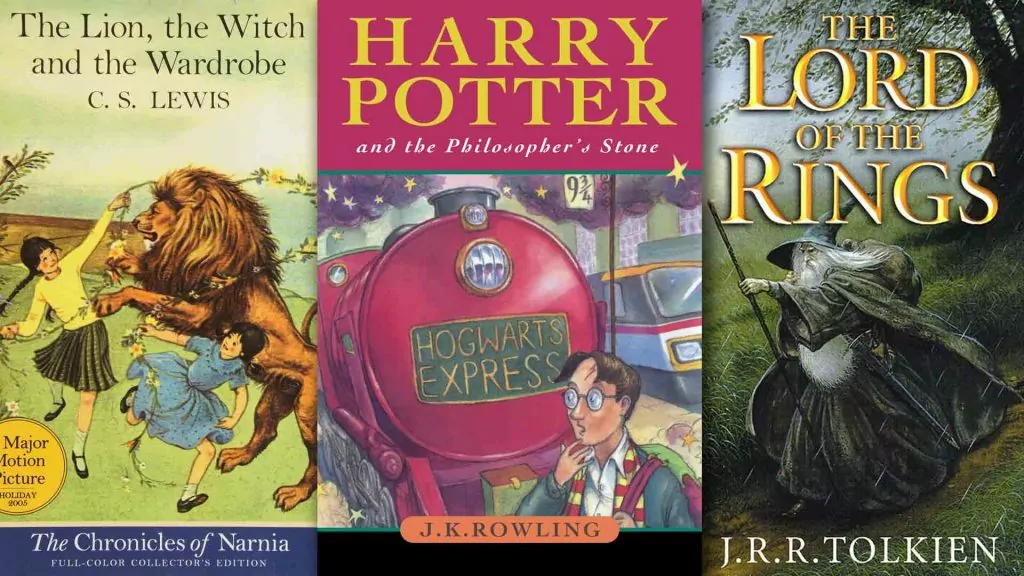
To read or not to read: Harry Potter, Narnia & The Lord of the Rings

I was only eight years old when I first stumbled across C.S. Lewis’ Narnia series. It was 1956 and Wednesday and Saturday afternoons were often devoted to library time. I still remember sitting on my knees in front of a huge, musty wall lined with books, fascinated with the world that Lewis portrayed. I loved all seven of the chronicles and understood without any question the allegory he put forth. The Christian theology depicted in his characters was clear. To my young mind there was never any doubt but that the evil characters were devilish and that the good characters were to be directly associated with Christian thoughts and deeds. Now a lot has been written of late about the Harry Potter books. Much good has been penned about them. For example Chuck Colson, founder of Prison Fellowship and former special Counsel to President Richard Nixon, has defused the Potter books as harmless fantasies with characters who demonstrated courage, loyalty and a willingness to sacrifice for one another; Christianity Today touted the series as a “book of virtues with... wonderful examples of compassion, loyalty, courage, friendship and even self-sacrifice... a present we can be grateful for.” On the other hand, the Potter books have also been vilified as wicked literature. Harry Potter and the Bible So what are you to think? I’ll tell you that I was predisposed not to read Harry Potter’s adventures. I’d read reviews by people whom I respected and felt that the scale tipped on the side of those who warned against. And yet, as my youngest daughter so aptly pointed out, I would not be able to defend my “anti” stand firmly until I picked up a volume and read it for myself. So against my better judgment, I picked up the first volume of the Potter series from our local library and read it from cover to cover. I also read another book entitled Harry Potter and the Bible by Richard Abanes. It is this book, Harry Potter and the Bible, which I would like to review in this article. Although, after reading the first volume of the Potter series, Harry Potter and the Philosopher’s Stone, I do feel qualified to make a negative statement with regard to Rowling’s writing, Richard Abanes has done such a thorough job of research and writing that I would like to share his insights on, not just the first, but the first four of Rowling’s books. Abanes, by the way, is a well-published expert in cults and the occult. The Philosopher’s Stone First a short overview of the first volume of Rowling’s work - The Philosopher’s Stone also known as The Sorcerer’s Stone. In this introductory story, Harry Potter, a baby orphan, is placed on the doorstep of an uncle’s house. He is an orphan because his parents, a witch and a wizard, were both killed by the evil wizard Voldemort. Harry is severely mistreated by his aunt and uncle, who are normal humans and referred to as Muggles. When Harry turns eleven he goes to Hogwarts, a special school for witches and wizards. While at the school, Harry uncovers a plot in which Voldemort tries to steal the sorcerer’s stone - a stone which can create an elixir of life - that is to say, immortality. At the end of the story Harry saves the stone but Voldemort escapes. Rowling has stated expressly in interviews that she is truly bemused that anyone who has read her books could think that she is a proponent of the occult in any serious way because she doesn’t believe in witchcraft in that sense. Interestingly, however, Rowling has said that she believes the number seven is magical and mystical and that seven will see the conclusion of the series. Rowling has also admitted that she has studied mythology and witchcraft in order to write the books more accurately. She says that roughly one-third of the sorcery-related material she has used is material people genuinely used to believe. According to Abanes, something Rowling has failed to mention is that a vast amount of the occult material she has used from historical sources still plays a significant role in modern paganism and witchcraft. Consequently, her writings merge with contemporary occultism. Some of this information is not widely known by persons other than those actually involved in occultism. As a matter of fact, during one radio call-in program a self-professed magus asked Rowling if she was a member of the “Craft” (i.e., Wicca). When Rowling answered in the negative, he was shocked and replied, “Well, you’ve done your homework quite well.” He went on to express his love for the Harry Potter series not only because it contained so much occultism, but also because it had served to make his daughter more comfortable with his own practices as witch-magickian. Rowling hides many references to the occult in people’s names, disguising them in minor characters. The philosopher’s stone, for example, is described in the Encyclopedia of Occultism and Parapsychology as the legendary substance that supposedly let alchemists turn base metals into gold or silver. In Rowling’s book, the stone was created by an alchemist named Nicholas Flamel. The truth is that Flamel really existed in the late 1300s. According to history and occult tradition, Flamel created the philosopher’s stone and by doing so, never died. Current Wiccan thinking on death is passed on through Rowling’s Flamel. This thinking defines death as a stage in the cycle that leads on to rebirth. After death the human soul ... grows young and is made ready to be born again. Aside from these obvious error-filled ideas, Rowling’s gruesome descriptions of ghosts, ghouls and gross creatures are not something young children (or adults) should read. The paragraph which details Voldemort’s possession of the body of one of Hogwarts’ teachers is demonic in nature and totally in opposition to Paul’s admonition: “Finally, brothers, whatever is true, whatever is noble, whatever is right, whatever is pure, whatever is lovely, whatever is admirable – if anything is excellent or praiseworthy – think about such things" (Phil. 4:8). The Chamber of Secrets In Rowling’s follow-up Potter book, The Chamber of Secrets, Harry’s second school year is recorded. During this year many students unaccountably turn into stone. Voldemort once more tries to make a comeback, this time through possessing the body of a young female student. Again Harry defeats him. Abanes notes that it is significant that Hogwarts’ students go through a process of mastering spells very similar to the process actual occultists go through to become adept at their magical phrases. Again the Encyclopedia of Occultism and Parapsychology casts light on the issue, stating, “Not only were the formulas of spells well fixed, but the exact tone of voice in which they were to be pronounced was specially taught." This is precisely what Harry and other students are taught at Hogwarts. Rowling’s characters in this second volume continue to communicate with ghosts, magical creatures and enchanted objects. As a matter of fact, one of the teachers is a ghost. Another ghost, Moaning Myrtle, is the tormented spirit of a murdered Hogwarts student. She haunts the bathroom where she was murdered. To illustrate the black humor Rowling uses, one scene with Myrtle reads as follows: "My life was nothing but misery at this place and now people come along ruining my death... I came in here and tried to kill myself. Then, of course, I remembered that I’m — I’m —" "Already dead," said Ron helpfully. Myrtle gave a tragic sob, rose up in the air, turned over, and dived headfirst into the toilet." This kind of depiction of afterlife not only degenerates those who read it but it also gives plenty of fuel for nightmares and strange ideas. Hogwarts school supplies parallel tools used by contemporary witches and sorcerers: wands, black robes and cauldrons. Owls are used to send messages back and forth. Abanes comments that owls were thought to be “associates of witches and the inhabitants of dark, lonely and profane places, a foolish but feared spectre whose appearance signaled imminent death or nearby evil.” The Prisoner of Azkaban Rowling’s third book, The Prisoner of Azkaban, deals with a plot against Harry Potter’s life. The would-be murderer occupies the body of a rat. Throughout these first three volumes it should be noted that rules and regulations are continually broken by young Potter and his fellow students. If a rule does not serve one’s self-interest, a character seems bound to break it. Lying is seen as an acceptable method to achieve a desired end. This particular way of life seems to be consistent with modern Wicca, as the Wiccan Creed says: "If it harm none, do what you will." In this third volume, Harry and the other students in his class continue to study the black arts. Palmistry, reading tea leaves and crystal ball gazing or scrying, are all described. This particular book also uses a profanity for the first time. Grossness, vileness and crude humor continue to be the order of the pages turned. The Goblet of Death In Rowling’s fourth book, The Goblet of Death, Harry is chosen to represent Hogwarts in a Tri-Wizard Tournament. There are four magical tasks he has to complete. Voldemort, who through a horrible spell has been brought back to life, shows up at the last task and tries to kill Harry. This attempt, however, is foiled. Harsher, more violent and darker than the preceding books, this fourth volume contains visions, clairvoyance and divination. Again profanity is used. The Goblet of Fire has already been compared to Stephen King’s horror novels. Upon reading some of the collated data in this fourth book, this is no surprise. Muggle killings just for fun by Voldemort’s cohorts; a good wizard and his witch wife being tortured to the point of insanity; someone severing off his own hand to put in a boiling cauldron; a child killing his father, turning the body into a bone and burying it. Where wishful thinking leads Abanes, who has researched Rowling’s past, states that as a child she used to dress up as a witch all the time. She concocted secret potions for friends and play-acted with them about being witches and wizards. This fascination with the occult culminated in her chronicles – chronicles which influence countless children and teenagers across the world. Seduced by the powerful images Rowling portrays, they often forget that Harry Potter is fictional. Rowling confirmed this in an interview with Newsweek: I get letters from children addressed to Professor Dumbledore, and it’s not a joke, begging to be let into Hogwarts, and some of them are really sad. Because they want it to be true so badly they’ve convinced themselves it’s true. Many kids use the Internet to reach a web site called "Harry Potter – Excellent Adventure." This page actually includes the photo-image of a real astrological birth chart for Harry Potter plotted by an astrologer who is a published occultist. Children can take themselves to this astrologer’s site via another link which reads: “Click here for your own Horoscope!” Other teens who desire to emulate Potter might join the London based Ordo Anno Mundi, a sect of occultists who practice Ophidian Witchcrat (i.e. serpent-venerating). This sect takes wizards through seven years of training including classes strikingly similar to those offered at Hogwarts. Tolkien and C.S. Lewis As I said at the onset of this review/article, when I first read Lewis’ Narnia chronicles, I was totally aware of what they meant. Richard Abanes puts Lewis’ children’s books, as well as Tolkien’s Ring series, into the category of mythopoetic literature, meaning that they take place in worlds disassociated from the real world in which we live. In other words, children know that they are reading fantasy. The Potter books, however, are not mythopoetic. Rowling’s stories are set in the twenty-first century, complete with contemporary forms of occultism (e.g., astrology and divination) and references to persons and events from our own human history (e.g., Nicholas Flamel, Witch Hunts). Furthermore, the Harry Potter series promote a concept of right and wrong that is not the same as the one presented by Lewis and Tolkien. If you are not familiar with Tolkien (1892-1973), whom I began to read as a teenager and thoroughly enjoyed, please note that he was a professor of English literature. His most well-known books are The Hobbit, and The Lord of the Rings trilogy. These four books all take place in Middle-Earth, a world Tolkien created through an amazing use of linguistics, history and mythology. A number of people have compared Rowling to Tolkien but the books don’t even come close except for superficial similarities. One alleged similarity is that both include a struggle between good and evil. Tolkien, however, who was a devout Christian, created his good characters as truly good and his evil characters as just that - evil. Rowling, on the other hand, plays off a horrible evil against a lesser evil. Another alleged similarity is found in the use of the word “magic” by both authors. Tolkien made it clear that his definition of magic in the context of Middle-earth does not include any kind of supernatural power. He present it as natural ability, an art, given only to Elves. No other race in his trilogy has magical capabilities. Rowling’s magic includes bewitchments, enchantments, and objects that are supernatural. A third similarity people dwell on as they compare the works of Rowling and Tolkien is the fact that both have “wizard” characters. It is noteworthy that Rowling’s wizards are human whose power comes from tapping the occult, whereas Tolkien’s wizards are not human at all. They are angelic-like beings which have taken on human form. According to Tolkien, these beings were sent into Middle-earth by a higher order of angelic beings to render assistance to Elves and Men. His wizards actually illustrate good and fallen angels whose powers are simply exercising God-given abilities either for good or evil. Besides this there is no God overseeing the battle between good and evil in Rowling’s books. This is by far the most profound difference between Rowling’s books and the works of Tolkien. Tolkien who had a decidedly Christian worldview, wrote in one of his letters: "With regard to The Lord of the Rings... I actually intended it to be consonant with Christian thought and belief, which is asserted elsewhere." He also said: "So it may be said that the chief purpose of life, for any one of us, is to increase according to our capacity our knowledge of God by all the means we have, and to be moved by it to praise and thanks. To do as we say in the Gloria in Excelsis... ‘We praise You, we call You holy, we worship You, we proclaim Your glory, we thank You for the greatness of Your splendour.’" Lewis’ children’s books, (The Narnia series), have actually been turned away by some Christian libraries because of the word “witch” in the title of one of them. This is sad not only because the readers are depriving themselves of a very good read, but also because they have clearly not taken the trouble to investigate exactly what Lewis meant by his work. In his series, conflict involves two opposing forces of entirely different origins. One source of magic is good because it comes from, is controlled by and operates through One who has legitimate authority over all things, (i.e. the Emperor beyond the Sea). The other source of magic is evil because it springs from an illegitimate authority which has usurped control over Narnia (i.e. the White Witch). The evil in Lewis’ story is overcome by Aslan, the Christ figure who eventually conquers. Servanthood plays a large role. Rowling, on the other hand, has her characters overcome evil by employing evil. Lewis’ ultimate question as he penned his books was how creation, the fall, redemption and the resurrection could be portrayed so that children would understand it. If you have not read either Lewis or Tolkien to your children, you are in for a treat and I heartily recommend both authors. But if you have permitted Rowling into your home, please know that you have committed a spiritual faux pas and one that you must make right. Speak to your children about what they have read or are reading. The inconsistent morality, the muddled ethics and the gruesome scenery they are storing within their hearts will have long-lasting effects. Children (and teenagers) need guidance when it comes to literature. Help your children to recognize the boundaries between good reading material and deceptive works. This first appeared in the July/August 2002 issue. ...

Red heart icon with + sign.
Economics

If strikes are bad can unions be good?

I grew up hearing horror stories about unions but little else. Unions were bad because union members threw bottles and sticks at their opposition. Later on I found that unions often supported political parties that favored abortion. There was more harsh criticism when a teacher's union went on strike, demanding more money and holding the students for ransom. Unions were bad because their actions were bad. But is it possible to have a good union, even a Christian union? What if such a Christian union took a stand against picket line violence, didn't support political parties, and didn't strike? Would there be a place for this type of union? Maybe. Is there such a union now? No. The Christian Labour Association of Canada (CLAC) almost fits the bill. It's certainly against picket line violence, and doesn't support any political parties. That already elevates it above almost every other union but the CLAC is better than other unions in still other ways. Secular unions' are condemned in most Reformed circles for several reasons, including: Many require an oath of allegiance promising unconditional obedience to the principles of that union's constitution. Christians can't promise this type of obedience to anyone or anything besides God. Secular unions promote a class struggle between employers and employees, as if the two were natural enemies. Whereas the Bible instructs us to love our neighbor as ourselves, these unions encourage animosity between owners and their employees. The idea of a class struggle between the rich class and the poor class is accepted as inevitable by these unions (Karl Marx also thought it was inevitable). Unions strike. In contrast the CLAC recognizes God's supremacy and encourages a cooperative environment between employer and employee. Instead of advocating a class struggle they repeatedly emphasize respect and cooperation. But while the CLAC differs from most unions in these respects, it still shares the other unions' willingness to go on strike. They go on strike a lot less often, but they still go on strike. So the question is, can Christians go on strike? What Are Strikes? Employees have always had the ability to leave their jobs when they're unhappy with either the working conditions or their salaries. All they have to do is quit. When employees strike, however, they leave their jobs and prevent anyone else from taking them. They retain a claim to their job even as they vacate it. There is also a coercive element to strikes. They are designed to force employers to capitulate to employee demands. And what's wrong with that? The first problem is the harm caused by just such a strike. Whenever a business is shut down by a strike the people who have come to depend on that business suffer. The most obvious example is a teacher's strike, where the students suffer, but the same thing happens no matter what type of business is involved. A strike at a tire manufacturer will hurt (and maybe even shutdown) the automaker that's dependent on that tire supplier. The striking workers hurt innocent third parties. I once heard a union representative argue that there was no such thing as innocent third parties. He reasoned that if company B bought supplies from company A because of A's good price, and A had a good price because he unjustly underpaid his workers, then B was at least partially responsible for this injustice. B was encouraging injustice by supporting an unjust employer and so B would only get what he deserved if he was hurt by a strike at company A. This whole argument hinges on the union representative's idea of justice. He thought it was unjust to underpay workers. It might very well be, but who exactly is supposed to decide what a just wage is? Is $5 just? How about $10? Obviously it depends on the type of work. A McDonald's employee can't expect to get paid as much as computer engineer. But still the question remains, exactly how do you determine a just wage for these two positions? Wages, just or not, were at one time determined by free enterprise ideas of supply and demand. The lower the supply of qualified workers, and the higher the demand for those workers, the higher the wage would be. And vice versa. So an entry-level unskilled position at McDonald's, a position anyone could fill, receives a low wage, and a highly skilled, sought after computer engineer makes hundreds of thousands. On a basic level this seems fair, and even just to most people. We can clearly understand why some people are paid more and others are paid less. Skilled people get paid more and people in unpopular jobs get paid more because they are skilled, and because they are willing to do jobs no one else will. But when unions are thrown into the mix things get a bit peculiar. Have you ever wondered why mailmen get paid so much? Well back in the good old days of my father's youth (long, looooong ago) they weren't paid much more than an entry-level wage. After all, it didn't take a lot of brains to deliver mail, (really, how different is it from what your paperboy does?), so the post office didn't have to offer a high wage to attract employees. But then unions got involved and someone decided that mail delivery wasn't an entry-level position, it was a career. Minimum wage obviously wasn't good enough for a career position (perhaps it was even called unjust) so with the help of a number of strikes the union managed to substantially increase their workers wages. And they managed to substantially increase the cost of mail too. But why did their wages increase? Only because the union decided their jobs were career positions, not entry level. The union decided, and it had nothing to do with justice or fairness. And when steel workers, or grocery store clerks go on strike for another 25 cents an hour, it again is simply a union decision, and it has absolutely nothing to do with justice. Any attempt to link pay increases to justice is simply rhetoric meant to disguise the harm being done to the truly innocent third parties. And that's what's wrong with strikes. Strikes hurt third parties, not to further the cause of justice, but to further the striking workers' own welfare. The striking workers are thinking only of themselves. Non-striking Unions? Selfishness is only one problem with strikes. The coercive nature of strikes, where the employees try to bring their employer to his knees, isn't exactly in keeping with a Biblical theme. But if strikes are bad can unions be good? Yes, because unions don't have to go on strike. As mentioned before, employees have always had the option of quitting their jobs if they were unsatisfied with either the working conditions or the wages. If employees didn't have this ability they would be little more than slaves. Now, if a certain employer decides to pay unreasonably low wages, this non-striking union could advise its members to quit and seek employment in more profitable fields. But that isn't all such a union could do. As it stands now the CLAC already has a retraining center for employees who have lost their jobs. The center is paid for with union dues, and is used to retrain workers for new jobs usually with their same company. This center could be used to train employees to find new jobs in new fields of employment with other companies. Then when an employer decided to be unreasonable, his workers wouldn't be limited to just the jobs he was offering, at the unreasonable wage he was offering. If he wanted to retain them, he would have to start paying them a reasonable amount. A naïve dream? Perhaps a bit...but all the good dreams are....
Red heart icon with + sign.
Science - General

Star gazing and star guessing

The night sky has always fascinated mankind. Ancient people were able to identify many constellations and follow their annual paths across the sky. In the oldest, perhaps, book in the Bible, God asks Job if the latter has any influence in the sky. "Can you bind the chains of Pleiades or loose the cords of Orion? Can you lead forth a constellation in its season and guide the Bear with her satellites?" (Job 38:31). Already in an earlier chapter we were informed that it is God who made all these objects. Even today the Pleiades and the Hyades (open star clusters in the constellation Taurus or the Bull) are interesting to astronomers. The Hyades are considered to constitute the nearest moderately rich star cluster. As a result, these stars have been assigned a central role in calibrating a measuring stick in space. The procedure has been to compare objects of unknown distance with an object of known distance. By means of mathematical equations the unknown distance can generally be calculated. For example, if star A is a known distance away, then it is easy to calculate how far it is to an equally energetic star that appears to be dimmer. The distance to the latter star is proportional to the reduced light that we perceive from that star. The problem is how ever that astronomers do not actually know how energetic (bright) a star is, if they do not know its distance. Bad Guesses It is evident that we must know the distance to a source of light before that we can estimate how energetically that body is emitting light or in other words how bright it actually is. For example, a flashlight, an airplane and a star may all look equally bright to an observer. If they were all located an equal distance away from the observer however, dramatic differences would be apparent. Indeed, as astronomer Michael Perryman remarks, "Almost everything in astronomy depends in some way on knowing star distances. This is particularly true of the cosmic distance scale extending out to the farthest galaxies and quasars. And the cosmic distance scale determines how well we know the true sizes, brightness, and energy outputs of nearly everything in the universe" (Sky and Telescope, June 1999 p. 42). In view of the importance of the initial measuring stick, one would hope that astronomers have based their calculations on very reliable numbers for the distance to the Hyades, their base point. This however has not been the case. As Dr. Perryman confides, "Many creative methods have been brought to bear on the Hyades distance problem over the last 100 years - with tantalizingly discordant results. This has been quite frustrating for a cluster so close" (p. 45). Yet William J. Kaufmann II wrote in the 1994 edition of his text: "Because the distance to the Hyades cluster is the most accurately determined of all stellar distances, it provides the basis upon which all other astronomical distances are determined" (Universe, Fourth Edition, p. 341). Dr. Kaufmann felt complacent enough, at the time, to assure us concerning the state of astronomy, that "In recent years, a remarkably complete picture has emerged, offering insight into our relationship with the universe as a whole and our place in the cosmic scope of space and time" (p. 337). Some observers might have suggested that Dr. Kaufmann couch his remarks in more cautious terms. Better Results The complacency of astronomers has however been somewhat shaken by data released in 1997. In 1989 the European Space Agency (ESA) had launched a satellite called Hipparcos (an acronym for High Precision Parallax Collecting Satellite). This device was designed to use trigonometry to directly measure distances to the closest stars. The data have proved very interesting and there have been plenty of surprises. The good news is that accurate distances (to within ten percent of the true value) have been achieved for more than 22,000 stars. Previously, such results were possible only for several hundred stars. These stars all lie within three hundred light years of Earth. Another 30,000 stars have been measured to within twenty percent of their true value. Such numbers represent a cornucopia of information. The measurements made by the Hipparcos satellite are based on trigonometry. Just as it is possible to measure distances on earth by means of imaginary triangles, astronomers achieve similar results in space. Their triangle needs a very long base so that the angles at the corners will be large enough to measure. The base of the triangle is taken to be the diameter of Earth's orbit at its maximum extent. Since the orbit is an ellipse, the diameter changes throughout the year. We use the maximum distance. The astronomer photographs a star on two occasions, six months apart. In this way, observations are made from opposite sides of Earth's orbit. The angles of the triangle are then calculated by comparing the star's shift in position compared to a backdrop of more distant stars. The length of one side of the triangle is the distance from Earth to the star. Prior to Hipparcos, astronomers were able to obtain good results only up to 65 light-years away. The closest one is Alpha Centauri, a mere 4.3 light-years from us. Now however with the European satellite, accurate measurements of much smaller angles are possible. This has astronomically expanded the number of accurately measured objects in the sky. The time had now come to compare previous estimates with the new numbers. Something Doesn't Fit Hipparcos was the first space mission specifically designed to measure star positions. Data were collected for four years. This was followed by a further three years in which the results were analyzed. Among unexpected findings, two hundred relatively close but dim stars were discovered. In addition, many well known stars turned out to be much farther away (and thus more energetic) than previously believed. As a result, fewer nearby stars could be identified as "main-sequence stars" and there was only half as many giants as previously estimated. "Main-sequence stars" are identified according to the Hertzsprung-Russell diagram that plots stars' rate of light production against their temperature. Temperature is estimated from color but estimates of light or energy production are highly dependent on distance. The significance of the Hertzsprung-Russell sequence is that it has traditionally been interpreted as reflecting the evolution of stars. In the light of Hipparcos data, however, astronomers have come to suspect that their previous conclusions were "too simplistic. Something else sees to be going on" (Perryman p. 47). Particularly surprising are the values obtained for the Pleiades cluster. At 375 light-years, this group of stars seems to be located 15% closer than previous estimates. The result, says Dr. Perryman, is that the stars in the Pleiades cluster can "no longer easily be accommodated into existing pictures of star formation or evolution" (p. 47). In other words these stars no longer qualify as main sequence stars. The Hyades, on the other hand, were located considerably further away than expected. People who enjoy the beauty of the night sky but who do not wish to be encumbered with jargon and trigonometry, may wonder why we should care about the Hipparcos data. The point is that these numbers are reliable because the calculations include only values that are established by direct observation. Beyond 200 or 300 light-years however, nearly all other measuring techniques are indirect. Consequently the calculated results are only as dependable as the assumptions upon which they are based. The general public seems not to be aware of that fact. Particularly in astronomy where small numbers are extrapolated into huge conclusions, you and I, as consumers of information, should be very wary. The whole issue reminds me of a little ditty from a Victorian era operetta. In Act II of Pirates of Penzance, Little Buttercup warns us not to be fooled by casual observation. Pay attention to the details. As she puts it: Things are seldom what they seem Skim milk masquerades as cream; Storks turn out to be but logs; Bulls are but inflated frogs. So they be. Frequentlee. This does not mean that we should ignore astronomy. It merely means that we should be aware of the uncertainties....

1 2 3 4 5 6 7 8 9 10