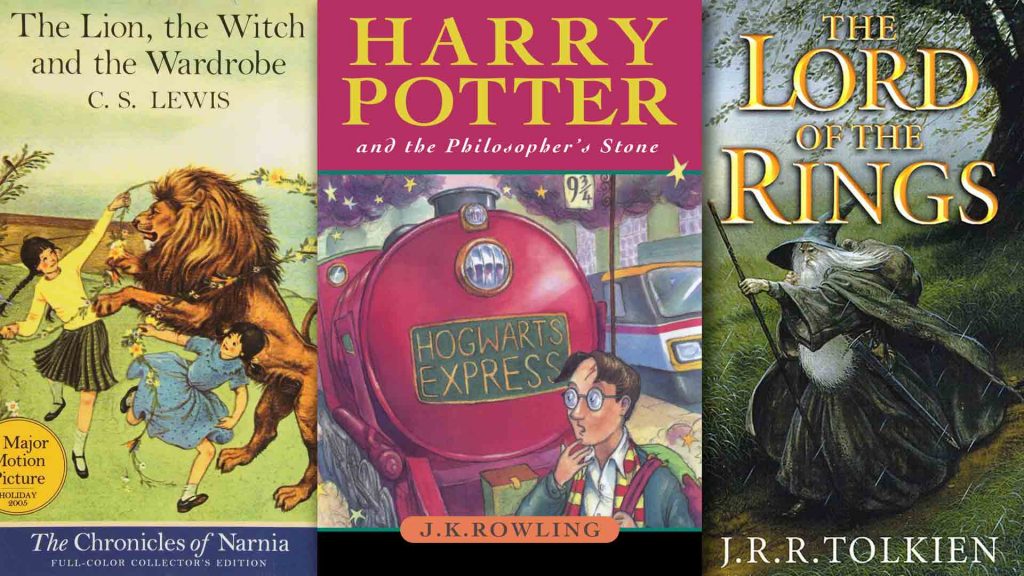
I was only eight years old when I first stumbled across C.S. Lewis’ Narnia series. It was 1956 and Wednesday and Saturday afternoons were often devoted to library time. I still remember sitting on my knees in front of a huge, musty wall lined with books, fascinated with the world that Lewis portrayed. I loved all seven of the chronicles and understood without any question the allegory he put forth. The Christian theology depicted in his characters was clear. To my young mind there was never any doubt but that the evil characters were devilish and that the good characters were to be directly associated with Christian thoughts and deeds.
Now a lot has been written of late about the Harry Potter books.
Much good has been penned about them. For example Chuck Colson, founder of Prison Fellowship and former special Counsel to President Richard Nixon, has defused the Potter books as harmless fantasies with characters who demonstrated courage, loyalty and a willingness to sacrifice for one another; Christianity Today touted the series as a “book of virtues with… wonderful examples of compassion, loyalty, courage, friendship and even self-sacrifice… a present we can be grateful for.”
On the other hand, the Potter books have also been vilified as wicked literature.
Harry Potter and the Bible
So what are you to think? I’ll tell you that I was predisposed not to read Harry Potter’s adventures. I’d read reviews by people whom I respected and felt that the scale tipped on the side of those who warned against. And yet, as my youngest daughter so aptly pointed out, I would not be able to defend my “anti” stand firmly until I picked up a volume and read it for myself. So against my better judgment, I picked up the first volume of the Potter series from our local library and read it from cover to cover. I also read another book entitled Harry Potter and the Bible by Richard Abanes.
It is this book, Harry Potter and the Bible, which I would like to review in this article. Although, after reading the first volume of the Potter series, Harry Potter and the Philosopher’s Stone, I do feel qualified to make a negative statement with regard to Rowling’s writing, Richard Abanes has done such a thorough job of research and writing that I would like to share his insights on, not just the first, but the first four of Rowling’s books. Abanes, by the way, is a well-published expert in cults and the occult.
The Philosopher’s Stone
First a short overview of the first volume of Rowling’s work – The Philosopher’s Stone also known as The Sorcerer’s Stone. In this introductory story, Harry Potter, a baby orphan, is placed on the doorstep of an uncle’s house. He is an orphan because his parents, a witch and a wizard, were both killed by the evil wizard Voldemort. Harry is severely mistreated by his aunt and uncle, who are normal humans and referred to as Muggles. When Harry turns eleven he goes to Hogwarts, a special school for witches and wizards. While at the school, Harry uncovers a plot in which Voldemort tries to steal the sorcerer’s stone – a stone which can create an elixir of life – that is to say, immortality. At the end of the story Harry saves the stone but Voldemort escapes.
Rowling has stated expressly in interviews that she is truly bemused that anyone who has read her books could think that she is a proponent of the occult in any serious way because she doesn’t believe in witchcraft in that sense.
Interestingly, however, Rowling has said that she believes the number seven is magical and mystical and that seven will see the conclusion of the series. Rowling has also admitted that she has studied mythology and witchcraft in order to write the books more accurately. She says that roughly one-third of the sorcery-related material she has used is material people genuinely used to believe. According to Abanes, something Rowling has failed to mention is that a vast amount of the occult material she has used from historical sources still plays a significant role in modern paganism and witchcraft. Consequently, her writings merge with contemporary occultism. Some of this information is not widely known by persons other than those actually involved in occultism. As a matter of fact, during one radio call-in program a self-professed magus asked Rowling if she was a member of the “Craft” (i.e., Wicca). When Rowling answered in the negative, he was shocked and replied, “Well, you’ve done your homework quite well.” He went on to express his love for the Harry Potter series not only because it contained so much occultism, but also because it had served to make his daughter more comfortable with his own practices as witch-magickian.
Rowling hides many references to the occult in people’s names, disguising them in minor characters. The philosopher’s stone, for example, is described in the Encyclopedia of Occultism and Parapsychology as the legendary substance that supposedly let alchemists turn base metals into gold or silver. In Rowling’s book, the stone was created by an alchemist named Nicholas Flamel. The truth is that Flamel really existed in the late 1300s. According to history and occult tradition, Flamel created the philosopher’s stone and by doing so, never died. Current Wiccan thinking on death is passed on through Rowling’s Flamel. This thinking defines death as a stage in the cycle that leads on to rebirth. After death the human soul … grows young and is made ready to be born again.
Aside from these obvious error-filled ideas, Rowling’s gruesome descriptions of ghosts, ghouls and gross creatures are not something young children (or adults) should read. The paragraph which details Voldemort’s possession of the body of one of Hogwarts’ teachers is demonic in nature and totally in opposition to Paul’s admonition: “Finally, brothers, whatever is true, whatever is noble, whatever is right, whatever is pure, whatever is lovely, whatever is admirable – if anything is excellent or praiseworthy – think about such things” (Phil. 4:8).
The Chamber of Secrets
In Rowling’s follow-up Potter book, The Chamber of Secrets, Harry’s second school year is recorded. During this year many students unaccountably turn into stone. Voldemort once more tries to make a comeback, this time through possessing the body of a young female student. Again Harry defeats him.
Abanes notes that it is significant that Hogwarts’ students go through a process of mastering spells very similar to the process actual occultists go through to become adept at their magical phrases. Again the Encyclopedia of Occultism and Parapsychology casts light on the issue, stating, “Not only were the formulas of spells well fixed, but the exact tone of voice in which they were to be pronounced was specially taught.” This is precisely what Harry and other students are taught at Hogwarts.
Rowling’s characters in this second volume continue to communicate with ghosts, magical creatures and enchanted objects. As a matter of fact, one of the teachers is a ghost. Another ghost, Moaning Myrtle, is the tormented spirit of a murdered Hogwarts student. She haunts the bathroom where she was murdered. To illustrate the black humor Rowling uses, one scene with Myrtle reads as follows:
“My life was nothing but misery at this place and now people come along ruining my death… I came in here and tried to kill myself. Then, of course, I remembered that I’m — I’m —”
“Already dead,” said Ron helpfully.
Myrtle gave a tragic sob, rose up in the air, turned over, and dived headfirst into the toilet.”
This kind of depiction of afterlife not only degenerates those who read it but it also gives plenty of fuel for nightmares and strange ideas.
Hogwarts school supplies parallel tools used by contemporary witches and sorcerers: wands, black robes and cauldrons. Owls are used to send messages back and forth. Abanes comments that owls were thought to be “associates of witches and the inhabitants of dark, lonely and profane places, a foolish but feared spectre whose appearance signaled imminent death or nearby evil.”
The Prisoner of Azkaban
Rowling’s third book, The Prisoner of Azkaban, deals with a plot against Harry Potter’s life. The would-be murderer occupies the body of a rat.
Throughout these first three volumes it should be noted that rules and regulations are continually broken by young Potter and his fellow students. If a rule does not serve one’s self-interest, a character seems bound to break it. Lying is seen as an acceptable method to achieve a desired end. This particular way of life seems to be consistent with modern Wicca, as the Wiccan Creed says: “If it harm none, do what you will.”
In this third volume, Harry and the other students in his class continue to study the black arts. Palmistry, reading tea leaves and crystal ball gazing or scrying, are all described. This particular book also uses a profanity for the first time. Grossness, vileness and crude humor continue to be the order of the pages turned.
The Goblet of Death
In Rowling’s fourth book, The Goblet of Death, Harry is chosen to represent Hogwarts in a Tri-Wizard Tournament. There are four magical tasks he has to complete. Voldemort, who through a horrible spell has been brought back to life, shows up at the last task and tries to kill Harry. This attempt, however, is foiled.
Harsher, more violent and darker than the preceding books, this fourth volume contains visions, clairvoyance and divination. Again profanity is used. The Goblet of Fire has already been compared to Stephen King’s horror novels. Upon reading some of the collated data in this fourth book, this is no surprise. Muggle killings just for fun by Voldemort’s cohorts; a good wizard and his witch wife being tortured to the point of insanity; someone severing off his own hand to put in a boiling cauldron; a child killing his father, turning the body into a bone and burying it.
Where wishful thinking leads
Abanes, who has researched Rowling’s past, states that as a child she used to dress up as a witch all the time. She concocted secret potions for friends and play-acted with them about being witches and wizards. This fascination with the occult culminated in her chronicles – chronicles which influence countless children and teenagers across the world. Seduced by the powerful images Rowling portrays, they often forget that Harry Potter is fictional. Rowling confirmed this in an interview with Newsweek:
I get letters from children addressed to Professor Dumbledore, and it’s not a joke, begging to be let into Hogwarts, and some of them are really sad. Because they want it to be true so badly they’ve convinced themselves it’s true.
Many kids use the Internet to reach a web site called “Harry Potter – Excellent Adventure.” This page actually includes the photo-image of a real astrological birth chart for Harry Potter plotted by an astrologer who is a published occultist. Children can take themselves to this astrologer’s site via another link which reads: “Click here for your own Horoscope!” Other teens who desire to emulate Potter might join the London based Ordo Anno Mundi, a sect of occultists who practice Ophidian Witchcrat (i.e. serpent-venerating). This sect takes wizards through seven years of training including classes strikingly similar to those offered at Hogwarts.
Tolkien and C.S. Lewis
As I said at the onset of this review/article, when I first read Lewis’ Narnia chronicles, I was totally aware of what they meant. Richard Abanes puts Lewis’ children’s books, as well as Tolkien’s Ring series, into the category of mythopoetic literature, meaning that they take place in worlds disassociated from the real world in which we live. In other words, children know that they are reading fantasy.
The Potter books, however, are not mythopoetic. Rowling’s stories are set in the twenty-first century, complete with contemporary forms of occultism (e.g., astrology and divination) and references to persons and events from our own human history (e.g., Nicholas Flamel, Witch Hunts). Furthermore, the Harry Potter series promote a concept of right and wrong that is not the same as the one presented by Lewis and Tolkien.
If you are not familiar with Tolkien (1892-1973), whom I began to read as a teenager and thoroughly enjoyed, please note that he was a professor of English literature. His most well-known books are The Hobbit, and The Lord of the Rings trilogy. These four books all take place in Middle-Earth, a world Tolkien created through an amazing use of linguistics, history and mythology.
A number of people have compared Rowling to Tolkien but the books don’t even come close except for superficial similarities. One alleged similarity is that both include a struggle between good and evil. Tolkien, however, who was a devout Christian, created his good characters as truly good and his evil characters as just that – evil. Rowling, on the other hand, plays off a horrible evil against a lesser evil. Another alleged similarity is found in the use of the word “magic” by both authors. Tolkien made it clear that his definition of magic in the context of Middle-earth does not include any kind of supernatural power. He present it as natural ability, an art, given only to Elves. No other race in his trilogy has magical capabilities. Rowling’s magic includes bewitchments, enchantments, and objects that are supernatural. A third similarity people dwell on as they compare the works of Rowling and Tolkien is the fact that both have “wizard” characters. It is noteworthy that Rowling’s wizards are human whose power comes from tapping the occult, whereas Tolkien’s wizards are not human at all. They are angelic-like beings which have taken on human form. According to Tolkien, these beings were sent into Middle-earth by a higher order of angelic beings to render assistance to Elves and Men. His wizards actually illustrate good and fallen angels whose powers are simply exercising God-given abilities either for good or evil. Besides this there is no God overseeing the battle between good and evil in Rowling’s books. This is by far the most profound difference between Rowling’s books and the works of Tolkien.
Tolkien who had a decidedly Christian worldview, wrote in one of his letters: “With regard to The Lord of the Rings… I actually intended it to be consonant with Christian thought and belief, which is asserted elsewhere.” He also said: “So it may be said that the chief purpose of life, for any one of us, is to increase according to our capacity our knowledge of God by all the means we have, and to be moved by it to praise and thanks. To do as we say in the Gloria in Excelsis… ‘We praise You, we call You holy, we worship You, we proclaim Your glory, we thank You for the greatness of Your splendour.’”
Lewis’ children’s books, (The Narnia series), have actually been turned away by some Christian libraries because of the word “witch” in the title of one of them. This is sad not only because the readers are depriving themselves of a very good read, but also because they have clearly not taken the trouble to investigate exactly what Lewis meant by his work. In his series, conflict involves two opposing forces of entirely different origins. One source of magic is good because it comes from, is controlled by and operates through One who has legitimate authority over all things, (i.e. the Emperor beyond the Sea). The other source of magic is evil because it springs from an illegitimate authority which has usurped control over Narnia (i.e. the White Witch). The evil in Lewis’ story is overcome by Aslan, the Christ figure who eventually conquers. Servanthood plays a large role. Rowling, on the other hand, has her characters overcome evil by employing evil. Lewis’ ultimate question as he penned his books was how creation, the fall, redemption and the resurrection could be portrayed so that children would understand it.
If you have not read either Lewis or Tolkien to your children, you are in for a treat and I heartily recommend both authors. But if you have permitted Rowling into your home, please know that you have committed a spiritual faux pas and one that you must make right. Speak to your children about what they have read or are reading. The inconsistent morality, the muddled ethics and the gruesome scenery they are storing within their hearts will have long-lasting effects. Children (and teenagers) need guidance when it comes to literature. Help your children to recognize the boundaries between good reading material and deceptive works.
This first appeared in the July/August 2002 issue.