Transparent heart icon with white outline and + sign.

Life's busy, read it when you're ready!

Create a free account to save articles for later, keep track of past articles you’ve read, and receive exclusive access to all RP resources.

White magnifying glass.

Search thousands of RP articles

Helping you think, speak, and act in Christ.

Open envelope icon with @ symbol

Get Articles Delivered!

Helping you think, speak, and act in Christ. delivered direct to your Inbox!


Most Recent


The Rest


Red heart icon with + sign.
Documentary, Movie Reviews

The Green Prince

Documentary 101 minutes/ 2014 Rating: 8/10 Mosab Hassan Yousef is the son of one of the founders of the terrorist group Hamas, and served as his father’s right-hand man. But at the same time, he was working as an informant for the Israeli secret police, the Shin Bet. This is his unbelievable story. While the Israeli-Palestinian conflict is the background to everything, it’s clear that director Nadav Schirman is most interested in what was going on in Yousef’s head and heart. Yousef is adamant that “I would never betray my father,” but Shin Bet agent Gonen Ben Yitzhak also found him surprisingly easy to turn. The same young man who bought weapons to attack the Israelis later becomes passionate about working with the Israelis to save Jewish lives. One of the explanations for this dramatic turnaround is Yousef’s conversion to Christianity. But he starts working for the Shin Bet before he becomes a Christian: perhaps his willingness to work with the Israelis is evidence of how God was already stirring his conscience? Another part of the explanation might be the type of man his Shin Bet handler was. Ben Yitzhak was supposed to see Yousef as simply a tool, but he wasn’t able to distance himself like that and today Yitzhak’s children call Yousef “Uncle Mosab.” This is an excellent production, with dramatic re-enactments that give the whole thing a cinematic feel – at times this seems like an espionage thriller. It is a longer documentary and might be overly so for anyone not already interested in the Israeli-Palestinian conflict, but for the rest of us, this is about as good as any documentary you will see. Yousef has also told his story in a fascinating book, Son of Hamas. Watch the trailer below. ...

Red heart icon with + sign.
Book Reviews, Children’s non-fiction

Faithfulness Under Fire: the story of Guido de Brès

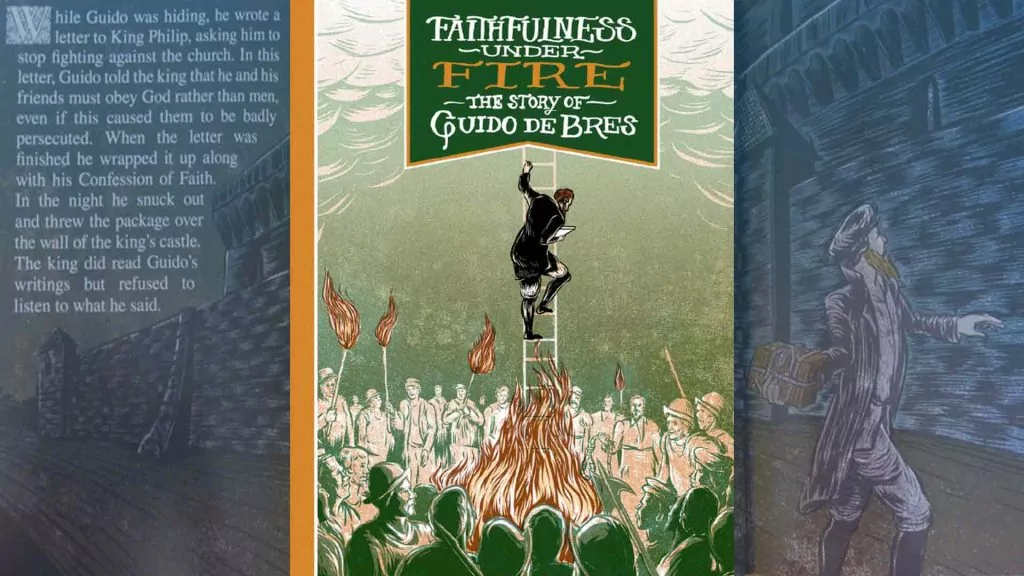
by William Boekestein 2010 / 32 pages Rating: GOOD/Great/Give “Church history” and “picture book” are almost mutually exclusive terms, but William Boekestein, author (and URC pastor), and Evan Hugues, illustrator, show that they don’t need to be. Faithfulness under Fire is the story of Guido de Brès and how God used this man to craft the Belgic Confession. De Brès was born in 1522, and once he learned to walk, always seemed to be on the run. Persecution drove him to leave his hometown of Mons, Belgium, and head across the Channel to England. We learn that, for the brief period of Edward VI’s reign, Protestants could find refuge here, but the king’s death prompted Guido to return to Belgium, where he became a traveling preacher. Preaching was against the law, so he was always on the move, and didn’t even dare use his real name. About midway through the book, we see a great picture of de Brès throwing the Belgic Confession over a tall castle wall. This is where the Catholic King of Spain lived – de Brès hoped he would read the Confession and stop persecuting Protestants. That didn’t happen. But God decided to use de Brès’s efforts another way – the Confession has since spread around the world and been a gift to strengthen and instruct millions of Christians. As you may recall, Guido de Brès was eventually captured, imprisoned and hanged. A hanging might not seem a good way to end a children’s book, but as Boekestein makes clear this was not the end of the man, but only the means by which he entered “the comfort of his Lord” (and the hanging is never pictured). I’m not sure if this is a book children will read on their own, but the readable text and fantastic illustrations will certainly keep their attention if mom or dad reads it to them. ...

Red heart icon with + sign.
Book Reviews, Children’s non-fiction

The Quest for Comfort: the story of the Heidelberg Catechism

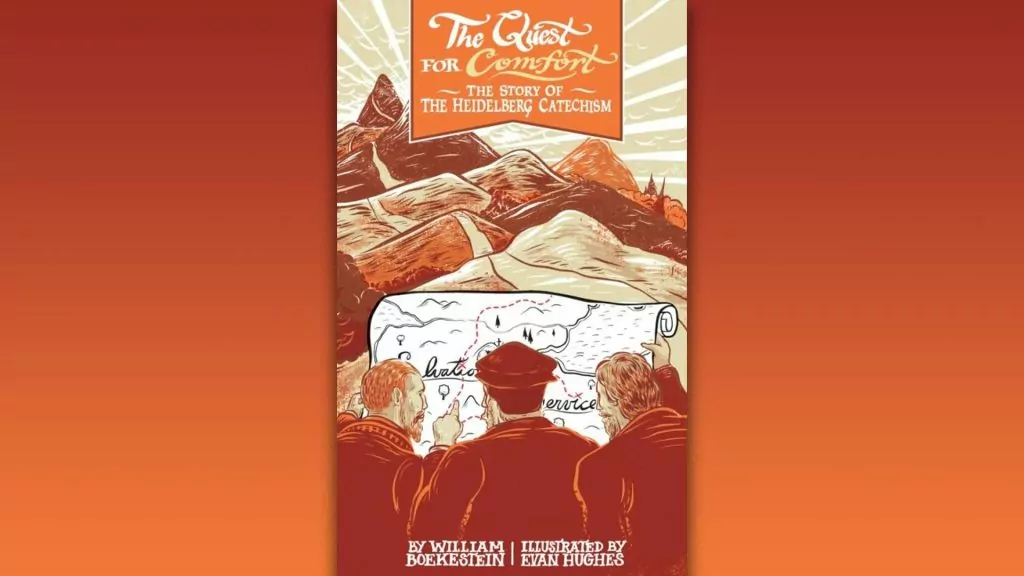
by William Boekestein 2011, 32 pages, $10 US Rating: GOOD/Great/Give A while back I had the privilege of reviewing a previous children’s book by this author on the life of Guido de Brès.  I was impressed with Faithfulness Under Fire.  It was not only accurate, but also well-written and artfully illustrated.  The Quest for Comfort follows the same model and deserves the same accolades. This is a brief account of how the Heidelberg Catechism came to be.  In a simple way, Boekestein shares the stories of Caspar Olevianus, Zacharias Ursinus, and Frederick III.  He tells of how their lives came to be intertwined in that German city along the Neckar River.  Along the way we learn something about the character and structure of the Catechism.  It was designed to be a pastoral teaching tool for the youth of the church and deliberately based on the arrangement of Romans. I read The Quest for Comfort to our four children, a 3-year-old, an 8-year-old, an 11-year-old and a 13-year-old.  They all enjoyed it and it kept their attention.  Our 3-year-old daughter said, “I wuv it Daddy!” I think she probably enjoyed the pictures more than anything else.  But hey, the pictures are well done.  There’s no doubt that Evan Hughes is a gifted illustrator. Kudos to Reformation Heritage Books for publishing these excellent children’s books.  Let’s hope they make it a trilogy with one on the Canons of Dort.  Imagine that:  a children’s book on the Canons of Dort!  Writing and publishing these sorts of books helps keep up the level of confessional consciousness for generations to come.  Obviously what also helps is buying these books for and reading them to our children and grandchildren – and then, from there, teaching them to know the Catechism itself and the biblical truths it contains. ...

Red heart icon with + sign.
People we should know

A Rare Principled Politician: Ron Paul

The practice of politics notoriously requires compromise. Every politician must bend at some point in order to be electable. Many politicians are very malleable and change their views with the currents of popular opinion. This contributes to their continuing electoral success. Those who won’t go with the flow have a harder time succeeding and will get weeded out over time. Occasionally there are exceptions to this rule. One of the most outstanding examples in recent years has been Congressman Ron Paul who ran for the Republican nomination for president in 2008 and 2012. His career and the principles he represented are described in a book by journalist Brian Doherty called Ron Paul's Revolution: The Man And The Movement He Inspired (Broadside Books, 2012). Paul is best known as a “libertarian” but his views also appeal to many conservative Christians. Doctor to politician Ron Paul was originally a medical doctor who became involved in politics. In his medical career he delivered about 4000 babies, and his knowledge of fetal development contributed to his pro-life views. But it wasn’t the abortion issue that ignited his participation in electoral politics. Instead, it was his views about money and government finance. While practicing medicine, Paul had been reading a lot about the importance of free enterprise economics as the basis of prosperity. Then, in the early 1970s, President Nixon implemented wage and price controls to curb inflation. Paul was incensed that an American president would implement such socialistic policies and he decided to do something about it. He ran as a Republican candidate for the US House of Representatives in the 1974 midterm election but lost. When the victorious Democratic candidate later resigned the seat, Paul was again the Republican candidate in a special election and this time he won. He served a few months as a Congressman but lost the seat in the 1976 general election. He ran again in 1978 and won. He kept the seat until he decided to run for the Republican nomination for a Senate seat in 1984, but lost that contest to Phil Gramm. Libertarian Party Although Paul had been a strong supporter of Ronald Reagan during the 1970s, he became disillusioned with Reagan’s presidency during the 1980s because of the lack of progress in shrinking the size of the federal government. Thus he joined the Libertarian Party and became that party’s presidential candidate in 1988. With the failure of his Libertarian Party presidential campaign, Paul went back to his medical practice and also produced newsletters on financial and political matters. He decided to run for Congress again in 1996. Although he had rejoined the Republican Party, party leaders were no longer supportive of him and tried to derail his candidacy. They convinced the local congressman to switch from the Democratic Party to the Republican Party, and they supported that guy with money and prominent endorsements. As Doherty puts it, “The Republican Party did not want Ron Paul to be a congressman again.” Dr. No Nevertheless, Paul won and remained in office until 2012. During his time in office Paul became known as “Dr. No” because he voted against so many measures. He believes that the US federal government should be restricted to the powers authorized under the US Constitution. Much of what the federal government currently does is very questionable from a constitutional perspective. It has grown far beyond the bounds of its stated authority. Paul is thus known as a “constitutionalist” for this view. He is more popularly known as a “libertarian” because his views involve a very minimal role for the government. He does not compromise his views on these matters even when standing by principle makes his own constituents angry with him. Doherty quotes one congressman as saying that Paul is very predictable: If proposed legislation expands government or involves activities which he does not consider specifically authorized by the Constitution, then he will vote No. And Paul does not shy away from unpopular stances, even when they involve going against the flow. Doherty quotes Paul as saying, “when I take a vote contrary to a prevailing attitude, instead of hoping no one will notice I send out a press release.” There are 435 members of the House of Representatives, and sometimes the vote tally would be 434-1, with Paul being the odd man out. Some people believe Paul’s pro-life position contradicts his libertarian views. But that is not so. As Doherty points out, if an unborn child is a person (and he or she is), then “a libertarian believing in laws against abortion makes exactly as much sense as a libertarian believing in laws against murder.” Paul’s appeal Paul’s constitutionalist and libertarian views have made him very unpopular in many places including large portions of the Republican Party. On the other hand, during his presidential campaigns, his stances have resulted in a great diversity of people supporting his candidacy. Doherty notes that Paul campaign meetings would often bring together the usual Paul fan motley: concerned veterans, pierced anarchists, conservative Christian moms, real estate brokers and homeschoolers and weapons enthusiasts and peace hippies. Although Paul’s core supporters have usually been libertarians, he has also gathered a good number of conservative Christian supporters. Doherty writes, Paul could appeal to the religious right not just on the economic libertarianism and hard-money stuff – which resonated well with them then and now – but on social liberty issues such as free speech and just being left alone by the government to shape your own life in your own way. He could remind these people who valued homeschooling and the health of their own small religious communities that they should fear a government that interferes in their personal cultural choices – even if it means having to let the government respect choices they don’t personally like. Doherty also notes that Paul’s personal life should endear him to conservative Christians. He is a “serious family man, devoted to one woman, successfully raised five children with many happy devoted grandchildren and even great-grandchildren in their wake, a serious Christian.” Wikipedia lists him as being Southern Baptist. Republican presidential candidate Paul created a stir during both of his attempts to win the Republican presidential nomination, but he was never a front-runner. However, his campaigns did create a lot of excitement among libertarians, constitutionalists and some other segments of the conservative movement. He refused to endorse John McCain as the Republican nominee in 2008 and was therefore not allowed to speak at the Republican convention in Minneapolis. As a result, his supporters organized another event, the “Rally for the Republic,” that ran concurrently with the Republican convention in Minneapolis. The Rally for the Republic drew over ten thousand people and celebrated the constitutionalist and libertarian ideas promoted by Ron Paul. Doherty writes, “It had Ron Paul singers and Ron Paul intellectuals and Ron Paul economists and Ron Paul celebrities and, most of all, it had Ron Paul.” During his 2012 campaign for the Republican nomination, Paul decided not to run again for Congress, so his career as an elected official was over. However, his son, Rand Paul, was elected as a Senator from Kentucky in 2010 and is currently seeking the Republican presidential nomination for 2016. The Revolution: A Manifesto During 2008 Paul wrote a book explaining his principles and policy positions. It is entitled The Revolution: A Manifesto (Grand Central Publishing) and it became a New York Times number-one bestseller. One of the most important matters that Paul addresses in this book is his controversial views on foreign policy. Unlike most conservatives, he believes the United States should have a non-interventionist foreign and military policy. That is, the US should not become involved militarily unless it has been threatened or attacked. “Americans have the right to defend themselves against attack; that is not at issue,” he writes. But what is an issue is the use of American military power against other countries that have not harmed the US. The most famous example of interventionist foreign policy was the invasion of Iraq under President George W. Bush in 2003. But there have been other recent examples such as President Clinton’s attack on Serbia in 1999. And in 2011 President Obama authorized the use of offensive military force against Libya despite the lack of any threat against the US coming from this country. This is what Paul opposes. In fact, Paul points out that the unnecessary use of American military power abroad causes more problems than it solves. He writes that, “when our government meddles around the world, it can stir up hornet’s nests and thereby jeopardize the safety of the American people.” Perhaps his most controversial position is his belief that attacks against Americans abroad, and even against the US itself such as 9/11, can result from people who think they must fight back against what they see as American imperialist aggression. Paul cites Michael Scheuer, chief of the CIA’s Obama bin Laden Unit in the late 1990s (and a conservative), in support of this view. Paul writes, His point is very simple: it is unreasonable, even utopian, not to expect people to grow resentful, and desirous of revenge, when your government bombs them, supports police states in their countries, and imposes murderous sanctions on them. That revenge, in its various forms, is what our CIA calls blowback – the unintended consequences of military intervention. Small government, at home and abroad Interestingly, Paul’s foreign policy views reflect those of the original conservative movement before the Cold War. As he notes, The so-called old Right, or original Right, opposed Big Government at home and abroad and considered foreign interventionism to be the other side of the same statist coin as interventionism at home. Being in favor of limited government means supporting a small role for the government in domestic policy, but also a small role (or no role) in the affairs of other nations. This is a consistent and principled position. Furthermore, it is useful to note that the aggressive use of military power abroad involves a huge cost in money and lives. As Paul puts it, “we waste a staggering amount of manpower, hardware, and wealth on a bloated overseas presence that would be better devoted to protecting the United States itself.” A considerable amount of money is wasted on foreign aid as well. Over the last few decades there has been tremendous progress in raising the living standards of millions of people in underdeveloped countries. But foreign aid is not the reason for that. Paul notes that, the economic success stories of the past half century have arisen not from foreign aid but out of the extraordinary workings of the free market, the great engine of human well-being that everyone is taught to hate. Conclusion All in all, Ron Paul’s view is that many problems would be solved if the US federal government was restricted to the role authorized for it by the US Constitution. In both domestic and foreign policy the federal government has grown far beyond its constitutional limitations. The framers of the Constitution did not envision such a large and interventionist federal government. One might think that many American politicians would support following the Constitution. In rhetoric many will speak well of it when doing so is convenient. But in recent years it has primarily been left to Ron Paul to publicly argue for constitutional limitations on government power, especially when doing so is politically unpopular. Receiving harsh criticism for supporting unpopular positions has not caused him to back down. That is because he stands on principle. He will not waver even when the political consequences are harmful to his career. This marks him as a rare bird in contemporary politics....

Red heart icon with + sign.
Homosexuality

One in ten? Alfred Kinsey’s most famous lie

Even if you haven’t heard of Alfred Kinsey you probably have heard about one of his key “findings” – that 10% of all people are homosexual. Dr. Judith Reisman (in her book Kinsey: Crimes & Consequences, 1998) asks, “who, indeed, today has not heard the mantra that homosexuals make up 10 percent of the US population?” She points out that the 10% figure is based “on Kinsey’s authority alone.” In fact, “Kinsey claimed to prove that homosexuals represented between 10% and 37% of all males.” How did Kinsey arrive at such a figure? It was simple. He deliberately set out to interview a large number of homosexuals to include in his database of human sexual behavior. During the 1940s, when he was conducting his research, this was no easy feat. Back in those days homosexuality was considered shameful, and many states in the USA had laws forbidding such conduct. Therefore Kinsey and his associates had to make a special effort to contact the homosexual enclaves that existed in large American cities in order to be able to solicit interviews with homosexuals. They were very successful, and hundreds of homosexual case histories were included in Kinsey’s data. In fact, the large number of homosexuals in Kinsey’s data meant that they were clearly over represented in relation to the normal population. Thus it was inescapable that the frequency of homosexuality would be exaggerated in Kinsey’s findings. And this is exactly what Kinsey intended. Reisman puts it succinctly: “Much of Kinsey’s work is designed to advance several revolutionary notions about homosexuality: that secret homosexuality was relatively commonplace; that most normal Americans hypocritically and secretly engaged in illicit sex of various kinds including homosexuality; that people were commonly bisexual meaning they were both homosexual and heterosexual; thus prejudice against homosexuality was hypocritical and based on ignorance of normal sexual behavior; and children and adults should experience and experiment with both their homosexual and heterosexual sides. Kinsey’s “research” was definitely agenda-driven and meant to normalize sexual perversion and overturn traditional morality. Among other things, he wanted to advance the cause of homosexuality. This purpose could be served by convincing people that homosexuality was relatively common. Thus he produced the figure that 10% of the population was homosexual, and it has been the generally accepted figure since then. But it is certainly not true. This was first published in the March 2015 issue....
Red heart icon with + sign.
Adult non-fiction, Book Reviews

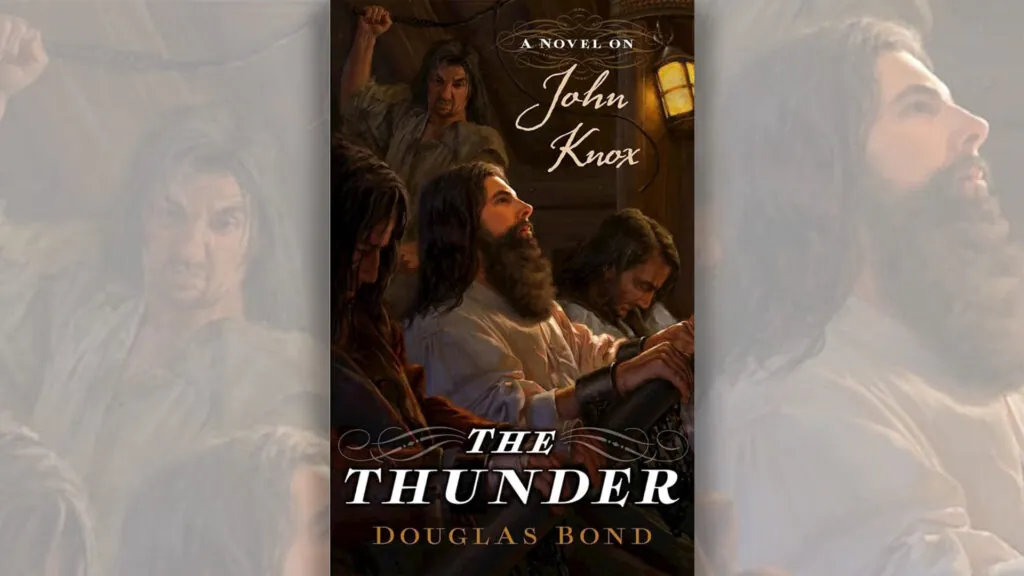
The Thunder: A novel on John Knox

by Douglas Bond 2012 / 400 pages Rating: Good/Great/GIFT John Knox turns five hundred this year and I can't think of a better way to mark the occasion than to read Douglas Bond's biographical novel of the man. All I knew of Knox before reading this was that he was supposed to be the Scottish John Calvin. But after The Thunder I think a better comparison might be some combination of action hero and Scottish Elijah. His first notable foray as a Reformer was as a bodyguard, wielding a two-handed sword in protection of a preacher. He was then ordained himself, and shortly thereafter imprisoned and sent to a French galley to row for almost two years. And when finally freed, though the trial left a permanent impact on his health, Knox then made a habit of speaking Truth to power, chastising the regent of England, encouraging the child King, Edward VI, and then admonishing Mary, Queen of Scots as well as her mother, the Dowager Queen Mary of Guise. This was a guy, weak though he was in body, who would not back down! So that's the man, but what about the novel? Douglas Bond does a smashing job, telling the tale from the perspective of one of Knox's students. This device allows Bond to tell one near unbelievable tale after another about his principle figure, but make it all believable by having the young student also marvel at the spiritual might of this Reformation giant. This is a great novel for anyone who likes history, older teens through adults, and simply an amazing tale told exceptionally well. It is available on Amazon.com....
Red heart icon with + sign.
Book Reviews, Popular but problematic

The Hunger Games: doesn’t tackle the issue it raises

A book about kids killing other kids, that is written for the teen market? If that doesn’t grab your attention, then you must not be a parent. The Hunger Games is the first book in a trilogy by Suzanne Collins that has, since 2008, sold more than 5 million copies. On March 23 a movie adaptation of the first book hit theatres and made a quarter of a billion dollars in just 10 days. This is the latest big thing in teen fiction. And like Twilight before it, a pivotal element of the plot is causing concern for Christian, and even non-Christian parents – this is a story about kids killing other kids. Deadly plot does not a bad book make Sixteen-year-old Katniss Everdeen lives in a post-apocalyptic world where what’s left of the United States has been divided up into 12 Districts, all subservient to “the Capital.” We learn that there was once a 13th district, but it rebelled, and in the resulting war the Capital destroyed it. Every year since then, as show of their submission, each of the Districts has had to provide the Capital with two Tributes, a boy and a girl, to fight to the death in a made-for-TV spectacle reminiscent of the Roman gladiatorial games. Katniss becomes the District 12 female Tribute after she volunteers to take her 12-year-old sister’s place. Now the setting is grim, but a grim setting does not necessarily a bad book make. After all, “kids killing kids” would serve as a good summary of Lord of the Flies. In William Golding’s classic, he makes use of grim plot elements to talk about Man’s depravity, and how even “innocent” children are fully capable of murder (or as the catechism puts it: “we are all conceived and born in sin”). A great writer can use a dark setting to present an important Truth. Rooting for the anti-hero However, Colllins is no William Golding. Her premise is intriguing - the hero of our story is placed between a rock and hard place. Since there is only one final winner in these “Hunger Games” Katniss would seem to have a terrible decision to make: to kill or be killed? But Katniss never makes that decision. Collins has created a moral dilemma that, on the one hand, drives the action, but on the other, is hidden far enough in the background that it never needs to be resolved. Neither Katniss nor any of the other Tributes ever consider the morality of what they are being told to do. And Collins so arranges the action that Katniss is not put in a situation where she would have to murder someone to win the game - she does kill several in self-defense, but the rest of the Tributes kill each other, and Katniss’s only immoral kill (which the author clearly doesn’t think is immoral) is a “mercy kill” near the end. This is quite the trick, and it is the means by which Collins maintains tension throughout the book: we’re left wondering right to the end, will she or won’t she? But consider just what we’re wondering: will the “hero” of our story murder children to save her own life, or won’t she? When the plot is summarized that way, it’s readily apparent why Collins never presents the moral dilemma clearly; if it is set out in the open, it isn’t a dilemma at all. It’s wrong to murder. It’s wrong to murder even if we are ordered to. And it’s wrong to murder even to save our own life. That’s a truth Christians know from Scripture, but one even most of the world can intuit. Conclusion Golding used his grim setting to teach an important Truth. Collins uses her grim setting to the opposite effect, confusing right and wrong for her young auidence by not directly confronting the sinfulness of obeying obscene orders: “You have been chosen to go kill other children for the enjoyment of a viewing audience.” Yes, there was a time when even the world understood it was no defense to say "we were just following orders" but that's far from common sense today (our culture has forgotten that all will have to answer to God for what they've done). Collins obscures the Truth when her unquestioning Tributes, Katniss included, are portrayed as just doing what they have to do. Many among her teenage readership won't have the wisdom yet to recognize that there is another choice: that the players could decide it is better to suffer evil than to perpetuate it. So this is not a book that will help our young people think God’s thoughts after Him. If your teens have already read or watched the "The Hunger Games" they may be eager to defend it, and explain why this review is quite unfair. If so, that's quite the opportunity. Parents, let them tell you all about it, but require from them that they defend it using God’s standards....
Red heart icon with + sign.

Adult non-fiction, Book Reviews

THE DISCIPLINE OF GRACE: God's Role and Our Role in the Pursuit of Holiness

by Jerry Bridges 2006 / 144 pages The title of Discipline of Grace seems to express a contradiction. Isn’t grace a free gift and discipline something we have to work at? How do these terms relate? Isn’t he confusing faith and works? Author Jerry Bridges focuses on the terms “dependence” and “discipline” and uses the analogy of a farmer. The farmer is completely dependent on God for the miracle of germination and for favorable weather conditions. Without these things there is no crop. However, he cannot just sit around waiting for God to produce crops for him. Cultivating, planting, fertilizing and harvesting are his responsibilities or the tasks in which he must be disciplined. In the same way, we are all completely dependent on God’s grace and the righteous work of Jesus Christ. Without this we are all nothing and not one of us can ever present God with a glowing personal report card based on our own merit or accomplishments. Understanding this eliminates all haughtiness and self-righteousness, but we must also understand that this same grace transforms and motivates us in the disciplines of holy living. The author emphasizes several times throughout the book that we must first and continuously preach the gospel to ourselves, and we must never feel complacent in our walk of faith, must never feel that we have arrived because we go a church with the right doctrines and do all the right things. Over and over he brings us back to our dependence on grace and the sanctifying work of the Holy Spirit, and once that is clearly established he shows how that grace enables us to live a life of gratitude and holiness. He outlines five different kinds of discipline. The discipline of commitment must be to God and serving Him, not ourselves or a set of moral values. The discipline of convictions explains that a conviction is something we believe so strongly that it affects the way we live. For the discipline of choices, he explains that, “Every day…we are disciplining ourselves in one direction or another by the choices that we make.” The discipline of watching cautions us to always be alert to those things which could cause us to fall, and the discipline of adversity encourages us to accept the Lord’s discipline. I highly recommend this very biblical book that is both liberating and inspiring and leads well into its companion book, The Pursuit of Holiness. This review appeared in the December 2011 issue....

Red heart icon with + sign.
Adult non-fiction, Book Reviews

RESPECTABLE SINS: Confronting the Sins We Tolerate

by Jerry Bridges 2007 / 192 pages Rating: Good/GREAT/Gift We’re not into drugs, or pornography; we’re not committing adultery or stealing or beating our children. We go to church and read the Bible at mealtimes. So we can consider ourselves good people, right? Well, no. In Respectable Sins, author Jerry Bridges exposes all those subtle sins that we don’t always recognize as sins - sins that we find so acceptable, especially in ourselves, like selfishness, lack of self-control, irritability, anger or envy. Bridges explains that as Christians we are saints set apart by God for God, and that any conduct (even thoughts) that is unbecoming a saint is sin. It is so easy to look out at the “world” and see all the sins committed by the unsaved and forget that we are sinners too “but the fact still remains that the seemingly minor sins we tolerate in our lives do indeed deserve the curse of God.” He goes on to explain that these sins, if they are not recognized, repented of and fought against, will spread like a malignancy throughout our lives, especially in our families where the brunt of these sins is felt most, but also in our church and work relationships. The author completes the first part of the book by emphasizing our dependence on the gospel and the work of the Holy Spirit and gives instructions on how to deal with these subtle sins, which is an effective setup for what comes next. When he then begins to expose in detail all our “respectable sins” the reader will begin to squirm. Is there any part of our lives in which we have made God irrelevant? Have we been anxious or worried? Have we griped about the circumstances of our life? Have we bragged about anything lately? Felt smug? Put ourselves first? Lost our cool? Snapped at the kids or the spouse or anybody? Been sarcastic? Looked down our nose at somebody else? Coveted? Gossiped? Let worldly standards affect our decision making? By this time we’re ducking our heads and slinking pretty low in our chairs. We’re left with no doubt about who needs God’s grace and are thankful to receive it. Mr. Bridges finishes off with the encouraging reminder that our progressive sanctification rests on the righteousness of Christ and the power of the Holy Spirit. This book is a must read for Christians! This review appeared in the December 2011 issue....

Red heart icon with + sign.
Adult non-fiction, Book Reviews

Prodigal God

by Timothy Keller 2009 / 240 pages Rating: Good/GREAT/Gift My pastor recently concluded a series of sermons on a single 21-verse passage of Scripture. I was delighted to discover just how much God has to tell us in the Parable of the Prodigal Son. I felt that same delight while reading Tim Keller’s Prodigal God, which is also on Luke 15:11-32. Keller begins by explaining why he doesn’t call this passage the Parable of the Prodigal Son. He notes that the word “prodigal” means “recklessly spendthrift” and the term is “therefore as appropriate for describing the father in the story as his younger son” since the father “was literally reckless because he refused to ‘reckon’ or count his sin against him or demand repayment.” Thus Keller arrives at his book’s title, Prodigal God. But that is still not what he calls the parable. He calls it the parable of “The Two Lost Sons.” Two lost sons? Wasn’t there just one? After all, the older brother never left home! But as Keller explains, the older son was just as lost as the younger. The younger son’s rebellion was more obvious, but the older son shows that he isn’t interested in his father’s happiness either. If he had been, he would have rejoiced when his father rejoiced. Instead it becomes clear that he has only been obedient with the expectation of reward, so when that reward doesn’t come to him like he expected, he gets bitter. Keller argues there are a lot of older brothers in the Church. We all know we are sinners, but because we don’t fully understand how all we receive is a matter of grace, we still find ourselves looking down on “younger brothers” caught up in “big sins” like homosexuality or prostitution (we may be sinners, but at least we don’t sin like that!). This is rebellion of a more subtle kind – it is a form of works righteousness, because even as we acknowledge we aren’t sinless, our gracelessness to those caught in “big sins” shows we think ourselves in some way deserving of the goodness God has showered on us. Prodigal God is very engaging and quick read. I believe it is a very relevant and challenging book for our churches and would recommend it to anyone 16 and up. The only caution I would note is that Pastor Keller is a leading proponent of theistic evolution. That doesn't impact this book, but in his other writings Keller doesn't treat Genesis 1-2 with the same care, rigor and reverence with which he plumbs the depths of Luke 15 here. But a very enthusiastic two thumbs up for Prodigal God....

Red heart icon with + sign.
Adult fiction, Book Reviews

When Crickets Cry

by Charles Martin 2006 / 352 pages Rating: GOOD/Great/Give He is unkempt, a recluse, and heartsick. She is a pale thin young girl with a very sick heart. The pair first meets on the sidewalk when he makes one of his rare trips into town. The girl, Annie, is a bright spot in this small Georgia town, doing brisk business selling lemonade. The townspeople respond readily to this cheerful vender and buy her 50-cent lemonade – but it’s the water jug at her feet filled with twenty-dollar bills dropped in by generous patrons that intrigues the man. It turns out that Annie is raising money for her own heart transplant. In spite of her critical need, she’s full of hope for the future. Life’s circumstances have robbed the man of hope. Reece looks like someone whose been hanging Sheetrock, yet he was once a highly skilled surgeon of national acclaim. Since the death of his wife, he has been living the life of a recluse, forsaking his ability to bind up broken hearts. Meeting Annie will change both of their lives forever. If you haven’t yet read any of the books of Charles Martin, you are in for a treat. Published in 2006, When Crickets Cry is his third book, and since that time he has published four more. With picturesque language, he weaves a tale that is filled with notable characters whose life struggles you won’t soon forget. In When Crickets Cry, Martin tells the story in two parts. In quick sketches we learn of Reece’s early years and his falling in love with his childhood friend Emma. We hear how his desire to restore Emma’s failing heart drives his hunger to learn all he can about the art of healing the heart, the wellspring of life. Interspersed with the reminiscing sections, we watch him meet and come to know Annie. Throughout, you also get to know the blind brother-in-law who sees so much, the former monk who interlaces running the local tavern with spreading the gospel, the aunt burdened with worries too heavy to carry alone, and a young man who is looking for meaning in all the wrong places. In contrast to today’s culture which embraces hopelessness, Martin writes stories that are filled with hope. Along the way, he interweaves truths about God as the source of hope and love. Broken characters become a little less broken, and with skillful strokes, Martin tells a beautiful tale of restoration that leaves the reader buoyed and encouraged....

Red heart icon with + sign.
Book Reviews, Teen non-fiction

Fish out of Water: Get equipped for college

by Abby Nye 2005 / 229 pages Rating: GOOD/Great/Give Nye wrote Fish out of Water, while in the third year of university, at the suggestion of her journalist parents. She was shocked, and overwhelmed by her first year on campus, but stuck it out, and started taking notes on the strange and perverse goings on at today’s secular campus. It started with her Welcome Week orientation activities, which included a meet and greet where guys and girls who had just met were greeting each other with a French kiss. Throughout the year, the weirdness continued – some of the activities included “National Condom Day” followed shortly after by a “campus-sponsored activity called ‘Just How Kinky Are You?’” The campus “Counseling and Consultation Center” prepared for February by handing out a flyer title, “Road Trip?” which advised students to set up a “drinking plan” for Spring Break and gave tips on what to do if your drinking buddy was so drunk he stopped breathing. But it isn’t just the weirdness that Nye addresses. She also tackles some of the day-to-day challenges Christians will face. She notes the hypocrisy many colleges have towards everything and anything, except Christianity, in a chapter titled, “We will not tolerate intolerance.” Her most helpful and practical advise can be found in the chapter “Pick your battles” where Nye shows how to stand up in a godly, respectful and effective way, and also shares thoughts on when it is probably best to just walk away instead. While Nye probably isn’t Reformed, her advice is biblically sound. This is a great volume for parents and college-bound students to read. The entire contents of the book can be read for free at AnswersInGenesis.org/articles/foow but for this to be properly digested you should pick it in paperback....

Red heart icon with + sign.
Drama, Movie Reviews

Fireproof

Drama / Christian 2008 / 122 min RATING: 6/10 This is powerful, funny film that gets off to a lousy start. Film critic Warren Cole Smith was so overwrought by the first twenty minutes – the “bad acting…bad dialogue… and bad directing” – that he left. I get it. Fireproof won’t win any Oscars, but if Smith had stuck around just past those 20 minutes he would have seen the acting, dialogue, and even the directing dramatically improve. Fireproof is produced by brothers Alex and Stephen Kendrick, and, like their earlier film Facing the Giants, it has an overtly Christian message. The focus this time is on marriage, and specifically the disintegrating marriage of Caleb Holt (played by Kirk Cameron) and his wife Catherine (Erin Bethea). Holt is a well-respected firefighter who doesn’t understand the lack of respect he gets at home. Catherine is a publicist at the local hospital who sees little reason to respect a husband who spends time on the unsavory side of the Internet. So she turns to her friends and coworkers for sympathy, and starts spending extra time with a young doctor who is always available to talk. When the topic of divorce comes up it’s the first time in a long time that Catherine and Caleb can agree about something – they both want out. Fortunately Caleb’s father isn’t as ready to give up – he challenges his son to try saving his marriage and gives Caleb a book called The Love Dare. The book is filled with forty tasks, one to be done each day for the next forty days. The first few tasks seem simple, but present challenges to a husband who isn’t used to showing affection, and to a wife who isn’t used to receiving it. So when, on Day 2, Caleb has to do an “unexpected act of kindness” for his wife, the best he can think of is making her a cup of coffee… which she leaves behind on the counter. Two weeks later the tasks become more difficult: Love Dare #16 asks Caleb to pray for his wife. Up until this moment Caleb has had no time for God, but as his father tells him, Caleb cannot truly love unless he know the God who is love, the God who expressed His love to us by dying for our sins. It’s here that the movie’s theology comes to the fore, highlighting both strengths and superficialities. Like many Christian movies, Fireproof has a “conversion moment,” but the Kendricks take it much further. In other films the principal character’s conversion concludes the movie (and viewers are left with the impressions that life will proceed on in a happily-ever-after fashion) but in Fireproof Caleb’s conversion takes place about halfway through the film and drives the rest of the action. Here, as in real life, conversion is just the beginning of something – a life with God that while wonderful isn’t necessarily easy. However, it’s in this same scene that Fireproof reveals a rather man-centered theology: Caleb’s motivation for turning to God seems to be based more on seeking help for his marriage than seeking reconciliation with his Holy Creator. Caleb’s marriage occupies the top spot in his priorities, the spot that should belong to God. The final word? This is a film couples could enjoy and benefit from. Fireproof may start slow, but it ends strong and earns a solid 6 for enjoyment. It should probably get the same rating for its theology – weak on some Christian basics, but its message on marriage is right on the mark: “never leave your partner behind.” This review first appeared in the February 2009 issue under the title "Love is never leaving your partner behind."...

Red heart icon with + sign.
Adult fiction, Book Reviews

Is There Balm in Gilead?

There is a balm in Gilead To make the wounded whole; There is a balm in Gilead To heal the sin-sick soul. Some times I feel discouraged, And think my work’s in vain, But then the Holy Spirit Revives my soul again. There is a balm in Gilead To make the wounded whole; There is a balm in Gilead To heal the sin-sick soul. If you can’t preach like Peter, If you can’t pray like Paul, Just tell the love of Jesus, And say He died for all. ***** By Marilynne Robinson 2004 / 256 pages Rating: Good/GREAT/Give Reformed Christians often assume – generally accurately – that anything produced by the culture around us is motivated by rebellion against God’s word. Our recognition of our culture’s hostility to God makes it seem very strange that a recent Pulitzer-Prize-winning novel should have a title, a cover, a setting, a main character, and themes that are compelling to Reformed Christians. Perhaps it should not be so surprising when we think about the background of the author, Marilynne Robinson, who – like the main character – attends a Congregationalist Church in Iowa. After all, since Congregationalism arose originally in England partly as a Calvinist response to the corruption in the state church in England, there should be some harmony between Robinson and Reformed people. Is there balm in Gilead? Cover gives more than a clue First, let’s look at that title, and the cover. Gilead, Iowa, the hometown of the main character – John Ames, a Congregationalist minister – was heavily involved in the abolitionist movement that sought to bring freedom to black slaves in America before the Civil War. Black slaves themselves would have often sung the spiritual “There Is a Balm in Gilead,” which was based loosely on a couple of verses in Jeremiah (8:22, 46:11) that are “about the presence in Gilead of a messiah, a word very similar in its origin to the meaning of balm, or purifier” (Wikipedia). Wikipedia says further that “Christians believe that the balm, the messiah, appeared in Gilead in the person of Jesus Christ and for that reason the term has come into spiritual meaning in the English language, including its songs and literature.” The cover of the edition that I read of Gilead confirms that view of the “Balm of Gilead.” It shows a portion of a door panel – probably from the old church in which Reverend John Ames preaches – in which the crosspieces between the wooden panes of the door form a cross. In this sense the balm of Gilead certainly appears to be identified on the cover as the gospel of Christ. Real balm for real woes Reverend John Ames certainly is in need of balm, of comfort, both for himself and for others. The conflict in the novel centers not so much on whether Christ is that comfort (as Lord’s Day 1 of the Heidelberg Catechism tells us), but whether we can feel His comfort in the Gilead of our difficult daily lives. Many of us perhaps find it easier to believe in Christ’s comfort in the abstract than to apply it in the concrete gritty details of sometimes strained family relationships and the aging of ourselves and others. John Ames reveals his struggles with his loneliness and envy of others’ large families after losing both wife and newborn son at a young age. Then at seventy-six, deeply in love with his second, much younger wife, who has borne him a son, he suffers from the knowledge that his heart is dangerously weak. The entire novel is his letter to his seven-year-old son, so that if John Ames dies suddenly, the son will have some understanding of his absent father. The minister reveals that his father and grandfather, also preachers, have also felt a need for comfort in the face of what they perceived as the barrenness of Gilead. His grandfather, an abolitionist before and during the American Civil War, is broken finally by the fact that neither the people of Gilead nor his own son (the narrator’s father) shares his burning passion for justice for the slaves. John Ames’ father has nearly the opposite concern in his reaction to his own father’s involvement in abolitionist violence, and becomes a strong pacifist. John Ames himself struggles with just how to integrate his own convictions into his preaching without doing violence to his calling or the word of God. Both he and his father also struggle with how to relate to and remember John Ames’ spiritually strayed brother Edward. Finally, and most importantly, John Ames struggles with how to deal with another prodigal, the son Jack of his Presbyterian minister friend Boughton. What makes this central conflict more poignant is the fact that the young Jack Boughton is actually originally named after John Ames. Jack’s return to Gilead after more than twenty years away continually strains Reverend Ames’ spiritual resources. Reverend Ames does not know whether to forgive Jack (who has never offended him personally in any meaningful way), to warn others against him (without any certain knowledge of Jack’s intentions), or to minister to him in some way (even as Jack seemingly mocks Reverend Ames’ Calvinist beliefs). One of the ways Reverend Ames’ struggles are shown is in his difficulty with getting sufficient sleep. He feels both that he needs to pray more to sleep well, and that he needs to sleep more to pray – and love – properly. When we suffer emotionally or spiritually (for ourselves or others), we feel these same strains and tensions. Well-expressed wonder Part of what sustains Reverend Ames in all his troubles is his keen sense, over and over, of the beauty of life (even in the shadow of death) and of the joy awaiting us in heaven. Here are just two samples of such a poetic appreciation of both this life and the next: I have been thinking about existence lately. In fact, I have been so full of admiration for existence that I have hardly been able to enjoy it properly. As I was walking up to the church this morning, I passed that row of big oaks by the war memorial – if you remember them – and I thought of another morning, fall a year or two ago, when they were dropping their acorns thick as hail almost…. here was such energy in the things transpiring among those trees, like a storm, like travail…. and I thought, It is all still new to me. I have lived my life on the prairie and a line of oak trees can still astonish me. (56-57) Boughton says he has more ideas about heaven every day. He said, “Mainly I just think about the splendors of the world and multiply by two….” So he’s just sitting there multiplying the feel of the wind by two, multiplying the smell of the grass by two. (147) Although Reverend Ames copes with life (and his approaching death) through a simple gratitude for God’s creation, dealing with Jack Boughton is not so easy. The end of the novel shows some of Reverend Ames’ tensions resolved by his willingness (worked by God’s grace) to do two things – to risk himself emotionally by loving (rather than simply tolerating) the prodigal, and to then leave that prodigal to God’s working. After Jack reveals a secret about his own past that Reverend Ames cannot pass on even to the young Boughton’s father, Reverend Ames finally blesses Jack with the same blessing that we receive from Numbers 6:24-26 in church. Since Jack is leaving Gilead, Reverend Ames cannot, of course, tell the effect of his benediction, but significantly, the novel ends with echoes of two earlier themes. First, Reverend Ames stresses to his son his belief that Gilead is, in all its backwater barrenness, a beautiful place in God’s creation: To me it seems rather Christlike to be as unadorned as this place is, as little regarded. I can’t help imagining that you leave sooner or later, and it’s fine if you have done that, or you mean to do it. This whole town does look like whatever hope becomes after it begins to weary a little, then weary a little more. But hope deferred is still hope. I love this town. I think sometimes of going into the ground here as a last wild gesture of love – I too will smolder away the time until the great and general incandescence. (246 -247) Finally, Reverend Ames changes his attitude to prayer and rest in his fading life. Instead of praying for the peace that will give him better sleep, or sleeping so that he can pray more properly, he looks forward confidently in the peace of Christ to refreshment in both prayer and slumber: I’ll pray that you grow up a brave man in a brave country. I will pray you find a way to be useful. I’ll pray, and then I’ll sleep. (247) Two cautions Two cautions: First, I realize that the hymn at the beginning of this article could be seen as Arminian, depending on whether you interpret the line “He died for all” as violating the idea of limited atonement spoken of in our Canons of Dort. In the same way, the novel’s treatment of prodigals like Ames’ brother Edward and Jack Boughton could be seen either as naïvely universalist (“In the end, God loves everybody…”), which is wrong; or as simply hopeful (“Who knows what God may do in the lives of the straying sheep, even when we have lost contact with them?”), which is right. Secondly, Marilynne Robinson distances herself from what an interviewer calls “fundamentalists” by stressing the complexity of Scriptural interpretation. Some of her minister narrator’s applications of the Old Testament, or of Protestant theology, may strike readers as rather strained. In the same interview, she also criticizes some of those who apply their faith to politics in what she feels is a “coercive and exclusivist” way. It is not clear to me what her attitude to Reformed participation in politics might be. Thoughtful readers and listeners can draw their own conclusions. In the end, thoughtful readers can indeed draw not just conclusions, but some real insight into the nature of Christian compassion, from a novel that makes its readers both think and feel deeply. Works Cited or Consulted “Balsam of Mecca.” Wikipedia. http://en.wikipedia.org/wiki/Balsam_of_Mecca. (June 7, 2008.) Robinson, Marilynne. Gilead. New York: Farrar, Strauss, and Giroux, 2004. “There Is a Balm in Gilead.” THE CYBER HYMNAL. http://www.hymntime.com/tch/htm/t/i/s/a/tisabalm.htm. (June 7, 2008.) “Writer Marilynne Robinson on 'Gilead.'” February 8, 2005. Radio interview on Fresh Air by Terry Gross with Marilynne Robinson. NPR. www.npr.org/templates/story/story.php?storyId=4490635. (June 7, 2008.) This was first published in the September 2008 issue....

Red heart icon with + sign.
Economics

If strikes are bad can unions be good?

I grew up hearing horror stories about unions but little else. Unions were bad because union members threw bottles and sticks at their opposition. Later on I found that unions often supported political parties that favored abortion. There was more harsh criticism when a teacher's union went on strike, demanding more money and holding the students for ransom. Unions were bad because their actions were bad. But is it possible to have a good union, even a Christian union? What if such a Christian union took a stand against picket line violence, didn't support political parties, and didn't strike? Would there be a place for this type of union? Maybe. Is there such a union now? No. The Christian Labour Association of Canada (CLAC) almost fits the bill. It's certainly against picket line violence, and doesn't support any political parties. That already elevates it above almost every other union but the CLAC is better than other unions in still other ways. Secular unions' are condemned in most Reformed circles for several reasons, including: Many require an oath of allegiance promising unconditional obedience to the principles of that union's constitution. Christians can't promise this type of obedience to anyone or anything besides God. Secular unions promote a class struggle between employers and employees, as if the two were natural enemies. Whereas the Bible instructs us to love our neighbor as ourselves, these unions encourage animosity between owners and their employees. The idea of a class struggle between the rich class and the poor class is accepted as inevitable by these unions (Karl Marx also thought it was inevitable). Unions strike. In contrast the CLAC recognizes God's supremacy and encourages a cooperative environment between employer and employee. Instead of advocating a class struggle they repeatedly emphasize respect and cooperation. But while the CLAC differs from most unions in these respects, it still shares the other unions' willingness to go on strike. They go on strike a lot less often, but they still go on strike. So the question is, can Christians go on strike? What Are Strikes? Employees have always had the ability to leave their jobs when they're unhappy with either the working conditions or their salaries. All they have to do is quit. When employees strike, however, they leave their jobs and prevent anyone else from taking them. They retain a claim to their job even as they vacate it. There is also a coercive element to strikes. They are designed to force employers to capitulate to employee demands. And what's wrong with that? The first problem is the harm caused by just such a strike. Whenever a business is shut down by a strike the people who have come to depend on that business suffer. The most obvious example is a teacher's strike, where the students suffer, but the same thing happens no matter what type of business is involved. A strike at a tire manufacturer will hurt (and maybe even shutdown) the automaker that's dependent on that tire supplier. The striking workers hurt innocent third parties. I once heard a union representative argue that there was no such thing as innocent third parties. He reasoned that if company B bought supplies from company A because of A's good price, and A had a good price because he unjustly underpaid his workers, then B was at least partially responsible for this injustice. B was encouraging injustice by supporting an unjust employer and so B would only get what he deserved if he was hurt by a strike at company A. This whole argument hinges on the union representative's idea of justice. He thought it was unjust to underpay workers. It might very well be, but who exactly is supposed to decide what a just wage is? Is $5 just? How about $10? Obviously it depends on the type of work. A McDonald's employee can't expect to get paid as much as computer engineer. But still the question remains, exactly how do you determine a just wage for these two positions? Wages, just or not, were at one time determined by free enterprise ideas of supply and demand. The lower the supply of qualified workers, and the higher the demand for those workers, the higher the wage would be. And vice versa. So an entry-level unskilled position at McDonald's, a position anyone could fill, receives a low wage, and a highly skilled, sought after computer engineer makes hundreds of thousands. On a basic level this seems fair, and even just to most people. We can clearly understand why some people are paid more and others are paid less. Skilled people get paid more and people in unpopular jobs get paid more because they are skilled, and because they are willing to do jobs no one else will. But when unions are thrown into the mix things get a bit peculiar. Have you ever wondered why mailmen get paid so much? Well back in the good old days of my father's youth (long, looooong ago) they weren't paid much more than an entry-level wage. After all, it didn't take a lot of brains to deliver mail, (really, how different is it from what your paperboy does?), so the post office didn't have to offer a high wage to attract employees. But then unions got involved and someone decided that mail delivery wasn't an entry-level position, it was a career. Minimum wage obviously wasn't good enough for a career position (perhaps it was even called unjust) so with the help of a number of strikes the union managed to substantially increase their workers wages. And they managed to substantially increase the cost of mail too. But why did their wages increase? Only because the union decided their jobs were career positions, not entry level. The union decided, and it had nothing to do with justice or fairness. And when steel workers, or grocery store clerks go on strike for another 25 cents an hour, it again is simply a union decision, and it has absolutely nothing to do with justice. Any attempt to link pay increases to justice is simply rhetoric meant to disguise the harm being done to the truly innocent third parties. And that's what's wrong with strikes. Strikes hurt third parties, not to further the cause of justice, but to further the striking workers' own welfare. The striking workers are thinking only of themselves. Non-striking Unions? Selfishness is only one problem with strikes. The coercive nature of strikes, where the employees try to bring their employer to his knees, isn't exactly in keeping with a Biblical theme. But if strikes are bad can unions be good? Yes, because unions don't have to go on strike. As mentioned before, employees have always had the option of quitting their jobs if they were unsatisfied with either the working conditions or the wages. If employees didn't have this ability they would be little more than slaves. Now, if a certain employer decides to pay unreasonably low wages, this non-striking union could advise its members to quit and seek employment in more profitable fields. But that isn't all such a union could do. As it stands now the CLAC already has a retraining center for employees who have lost their jobs. The center is paid for with union dues, and is used to retrain workers for new jobs usually with their same company. This center could be used to train employees to find new jobs in new fields of employment with other companies. Then when an employer decided to be unreasonable, his workers wouldn't be limited to just the jobs he was offering, at the unreasonable wage he was offering. If he wanted to retain them, he would have to start paying them a reasonable amount. A naïve dream? Perhaps a bit...but all the good dreams are....

Red heart icon with + sign.
Science - General

Star gazing and star guessing

The night sky has always fascinated mankind. Ancient people were able to identify many constellations and follow their annual paths across the sky. In the oldest, perhaps, book in the Bible, God asks Job if the latter has any influence in the sky. "Can you bind the chains of Pleiades or loose the cords of Orion? Can you lead forth a constellation in its season and guide the Bear with her satellites?" (Job 38:31). Already in an earlier chapter we were informed that it is God who made all these objects. Even today the Pleiades and the Hyades (open star clusters in the constellation Taurus or the Bull) are interesting to astronomers. The Hyades are considered to constitute the nearest moderately rich star cluster. As a result, these stars have been assigned a central role in calibrating a measuring stick in space. The procedure has been to compare objects of unknown distance with an object of known distance. By means of mathematical equations the unknown distance can generally be calculated. For example, if star A is a known distance away, then it is easy to calculate how far it is to an equally energetic star that appears to be dimmer. The distance to the latter star is proportional to the reduced light that we perceive from that star. The problem is how ever that astronomers do not actually know how energetic (bright) a star is, if they do not know its distance. Bad Guesses It is evident that we must know the distance to a source of light before that we can estimate how energetically that body is emitting light or in other words how bright it actually is. For example, a flashlight, an airplane and a star may all look equally bright to an observer. If they were all located an equal distance away from the observer however, dramatic differences would be apparent. Indeed, as astronomer Michael Perryman remarks, "Almost everything in astronomy depends in some way on knowing star distances. This is particularly true of the cosmic distance scale extending out to the farthest galaxies and quasars. And the cosmic distance scale determines how well we know the true sizes, brightness, and energy outputs of nearly everything in the universe" (Sky and Telescope, June 1999 p. 42). In view of the importance of the initial measuring stick, one would hope that astronomers have based their calculations on very reliable numbers for the distance to the Hyades, their base point. This however has not been the case. As Dr. Perryman confides, "Many creative methods have been brought to bear on the Hyades distance problem over the last 100 years - with tantalizingly discordant results. This has been quite frustrating for a cluster so close" (p. 45). Yet William J. Kaufmann II wrote in the 1994 edition of his text: "Because the distance to the Hyades cluster is the most accurately determined of all stellar distances, it provides the basis upon which all other astronomical distances are determined" (Universe, Fourth Edition, p. 341). Dr. Kaufmann felt complacent enough, at the time, to assure us concerning the state of astronomy, that "In recent years, a remarkably complete picture has emerged, offering insight into our relationship with the universe as a whole and our place in the cosmic scope of space and time" (p. 337). Some observers might have suggested that Dr. Kaufmann couch his remarks in more cautious terms. Better Results The complacency of astronomers has however been somewhat shaken by data released in 1997. In 1989 the European Space Agency (ESA) had launched a satellite called Hipparcos (an acronym for High Precision Parallax Collecting Satellite). This device was designed to use trigonometry to directly measure distances to the closest stars. The data have proved very interesting and there have been plenty of surprises. The good news is that accurate distances (to within ten percent of the true value) have been achieved for more than 22,000 stars. Previously, such results were possible only for several hundred stars. These stars all lie within three hundred light years of Earth. Another 30,000 stars have been measured to within twenty percent of their true value. Such numbers represent a cornucopia of information. The measurements made by the Hipparcos satellite are based on trigonometry. Just as it is possible to measure distances on earth by means of imaginary triangles, astronomers achieve similar results in space. Their triangle needs a very long base so that the angles at the corners will be large enough to measure. The base of the triangle is taken to be the diameter of Earth's orbit at its maximum extent. Since the orbit is an ellipse, the diameter changes throughout the year. We use the maximum distance. The astronomer photographs a star on two occasions, six months apart. In this way, observations are made from opposite sides of Earth's orbit. The angles of the triangle are then calculated by comparing the star's shift in position compared to a backdrop of more distant stars. The length of one side of the triangle is the distance from Earth to the star. Prior to Hipparcos, astronomers were able to obtain good results only up to 65 light-years away. The closest one is Alpha Centauri, a mere 4.3 light-years from us. Now however with the European satellite, accurate measurements of much smaller angles are possible. This has astronomically expanded the number of accurately measured objects in the sky. The time had now come to compare previous estimates with the new numbers. Something Doesn't Fit Hipparcos was the first space mission specifically designed to measure star positions. Data were collected for four years. This was followed by a further three years in which the results were analyzed. Among unexpected findings, two hundred relatively close but dim stars were discovered. In addition, many well known stars turned out to be much farther away (and thus more energetic) than previously believed. As a result, fewer nearby stars could be identified as "main-sequence stars" and there was only half as many giants as previously estimated. "Main-sequence stars" are identified according to the Hertzsprung-Russell diagram that plots stars' rate of light production against their temperature. Temperature is estimated from color but estimates of light or energy production are highly dependent on distance. The significance of the Hertzsprung-Russell sequence is that it has traditionally been interpreted as reflecting the evolution of stars. In the light of Hipparcos data, however, astronomers have come to suspect that their previous conclusions were "too simplistic. Something else sees to be going on" (Perryman p. 47). Particularly surprising are the values obtained for the Pleiades cluster. At 375 light-years, this group of stars seems to be located 15% closer than previous estimates. The result, says Dr. Perryman, is that the stars in the Pleiades cluster can "no longer easily be accommodated into existing pictures of star formation or evolution" (p. 47). In other words these stars no longer qualify as main sequence stars. The Hyades, on the other hand, were located considerably further away than expected. People who enjoy the beauty of the night sky but who do not wish to be encumbered with jargon and trigonometry, may wonder why we should care about the Hipparcos data. The point is that these numbers are reliable because the calculations include only values that are established by direct observation. Beyond 200 or 300 light-years however, nearly all other measuring techniques are indirect. Consequently the calculated results are only as dependable as the assumptions upon which they are based. The general public seems not to be aware of that fact. Particularly in astronomy where small numbers are extrapolated into huge conclusions, you and I, as consumers of information, should be very wary. The whole issue reminds me of a little ditty from a Victorian era operetta. In Act II of Pirates of Penzance, Little Buttercup warns us not to be fooled by casual observation. Pay attention to the details. As she puts it: Things are seldom what they seem Skim milk masquerades as cream; Storks turn out to be but logs; Bulls are but inflated frogs. So they be. Frequentlee. This does not mean that we should ignore astronomy. It merely means that we should be aware of the uncertainties....

1 2 3 4 5 6 7 8 9