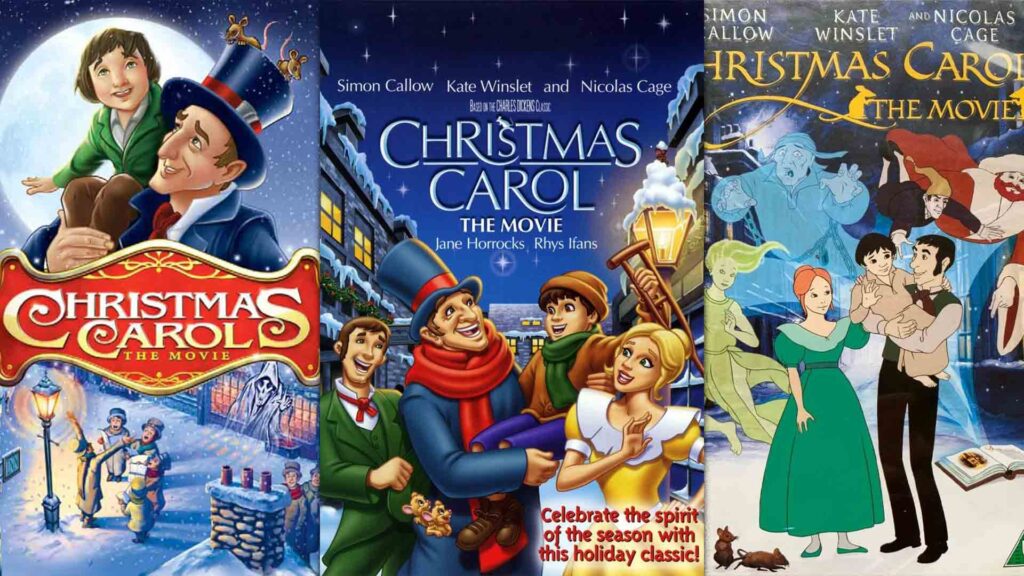
Animated
2001 / 81 minutes
Rating: 7/10
Dickens’ classic tale gets a child-friendly brush up, with a couple of cute mice companions added to the mix, and just a touch of romance too.
Though 95% of it is animated, it is book-ended with a set of live action scenes featuring author Charles Dickens doing a reading of his Christmas Carol novel to an appreciative audience. He offers them a story of ghosts, but the first scare of the night comes from a little mouse skittering through the theater. Responding to the excitement, Dickens decides to adapt his novel just a smidge, to begin it with a mouse, “making its way through London town.” And then off we go, into the rest of what is an animated tale.
For those who don’t know the story already, rich miser Ebenezer Scrooge has quite the Christmas Eve, getting visited by four ghosts, one after another.
Cautions
The two big concerns for Christians here would be Dickens’ portrayal of ghosts and his portrayal of Christmas.
The story’s repeated ghostly appearances can be divided into two sorts. First up, there’s Jacob Marley, Scrooge’s every-bit-as-evil but no longer living business partner who comes by with a warning about the three ghosts that will follow. So, what does the Bible say about ghosts? Only one ghostly visitation occurs in Scripture: Samuel appearing to Saul, with the involvement of the witch of Endor in 1 Samuel 28, and the text does seem to indicate it really was Samuel. While Samuel had his own warning, he didn’t have any of Marley’s chain-rattling theatrics.
Then there are the three spirits that follow, the ghosts of Christmas past, present, and future. The Bible speaks of an unseen spiritual dimension, where angels and demons alike exist. But spirits of Christmas? They don’t exist, and if they did, they would steer Scrooge towards Jesus, not simply generosity. That’s the biggest error in this, and every other version of Dickens’ tale – it offers Scrooge a works-based way to earn his righteousness, rather than the blood of Jesus to wash him clean.
So if you have young ones with you, a conversation will need to be had about Dickens’ “artistic license.” The author isn’t trying to teach us about the afterlife, but he is trying to teach us what it looks like to live right in the here and now. So kids will need to be alerted to what Dickens gets wrong about ghosts, but more importantly, what he gets wrong about the point of living. God does tell us to love our neighbor as ourselves, but that is the Second Great Commandment, and this story elevates it to the point of completely obscuring the First (Matt. 22:34-40).
Conclusion
So why would a Christian want to watch Dickens’ ghostly tale? Because it is a cultural icon, on par with the Greek myths, the tales of Sherlock Holmes, or Shakespeare’s plays – this is a story worth watching, and discussing with your family, simply because everyone knows it.
And while other accounts are more famous, this animated version is the most family-friendly, with the mice, and the romantic angle, taking just a bit of the edge off the ghostly apparitions. Check out the trailer below.