Transparent heart icon with white outline and + sign.

Life's busy, read it when you're ready!

Create a free account to save articles for later, keep track of past articles you’ve read, and receive exclusive access to all RP resources.

White magnifying glass.

Search thousands of RP articles

Helping you think, speak, and act in Christ.

Open envelope icon with @ symbol

Get Articles Delivered!

Helping you think, speak, and act in Christ. delivered direct to your Inbox!

A A
By:

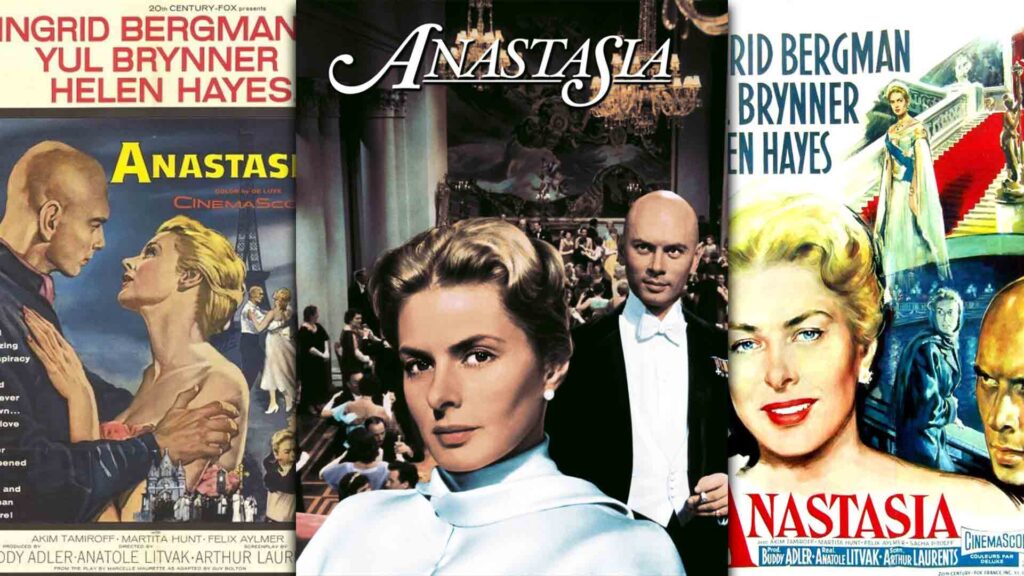
Anastasia

Drama / Mystery
1956 / 105 min
Rating: 7/10

In 1918 Communist revolutionaries murdered the Czar and his family, and for years afterwards rumors persisted that the Czar’s youngest daughter, Anastasia, survived the massacre. And because the Communists themselves kept telling different stories about the execution – from blaming it on others, to denying it happened – they created fertile ground for the rumors to grow and spread. And in the years that followed, several women stepped forward claiming to be Anastasia.

This film is based on premise never proven – the notion that one of those women really was the “Grand Duchess Anastasia Nikolaevna of Russia.”

The year is 1928, and an exiled Russian general has hatched on a scheme. He figures he can claim the Anastasia’s royal inheritance – worth 10 million pounds – if he can find a young woman of the right age and look to impersonate Anastasia. He settles on a young amnesiac and starts teaching her how to walk and talk and react as Anastasia would. But when the young woman seems to know far more about Anastasia than she has ever been taught, the general starts to wonder if this woman really is the royal princess!

Cautions

The concerns are really limited. Anastasia may or may not be insane. And she attempts suicide by trying to throw herself in a river, but she is stopped.

I’ll note that there is a 1997 animated film of the same name, telling roughly the same story, but this G-rated children’s version is, ironically, scarier. Unlike the live-action classic, the animated Anastasia brings in a villain, Rasputin, who was a real, manipulative person, but who wasn’t the spiteful sorcerer shown here, who calls on dark demonic forces to curse Anastasia, causing her loss of memory. So, for family viewing, stick with this 1956 classic.

Conclusion

If you like stories that bring the past to life, this will grab you. There’s also an air of mystery here, an intriguing story mom and dad can appreciate, free of any content concerns. But while it’s safe enough to view around children, it also won’t interest them. Anastasia is well acted, with Ingrid Bergman winning an Oscar for her performance, but this is dialogue-driven. It’s for the adults who can appreciate a well-written story, but Anastasia doesn’t have that whole family appeal.

Check out the trailer below.

Enjoyed this article?

Get the best of RP delivered to your inbox every Saturday for free.


Up Next


Red heart icon with + sign.
Drama, Movie Reviews

Ninotchka

Comedy / Romance 1939 / 110 minutes Rating: 8/10 Our story begins with three bumbling Soviet envoys, newly arrived in Paris, trying to figure out where to stay. They are in town to sell a set of jewelry that the Communists "confiscated" from the overthrown Russian aristocracy. And how do Communist Party members act when they are away from the watchful eyes, and snitching lips, of their country's fellow comrades? The trio find all sorts of very reasonable justifications for spending large amounts of the people's money, whether that's renting the grandest room in the hotel (because it has the biggest safe for their jewels), or getting themselves all decked out in crisp new suits (to, of course, better represent the importance of their homeland). But the jewels' former owner, the Grand Duchess Swana, is in town too. And when a former Russian count, now a Parisian waiter, gets wind of the jewels' proximity and alerts the Duchess. She's still living a regal life, even in exile, and that takes cash, so she could really benefit from getting those jewels back. So even as the Communists are trying to sell them, the Duchess tries to recover them. The trio's bumbling has Russia sending a new envoy, and this time she is a true believer – Comrade Ninotchka has nothing but disdain for all the West represents. This is where the film takes an intriguing twist. It's clearly a critique of the Communist Revolution, both its hypocrisy – with the trio representing how the new leadership was eager to live much like the aristocracy they overthrew – and even communism at its most correct, represented by the true-believer, Ninotchka. And do they then contrast that with Capitalism at its best? No the film don't stack the deck like that. Instead we get a bounder – Parisian playboy, Count Leon d’Algout – to represent the extravagant, consumerist, ridiculous West. It's quite a way to frame the debate, showcasing Capitalism's vices as still being a step up from Communism's supposed virtues. Cautions Teens should be warned that Count Leon isn't to be mistaken for any sort of hero – his motivations, at least initially, are simply money. At one point Count Leon takes Ninotchka to his house and you might wonder what is about to happen. They do kiss, but that's all before she leaves. There's also the old trope common to many a Hollywood production, of falling deeply, madly in love at just a glance. But this is not a story meant to be taken all that seriously, I think that's hardly a concern hear. Finally, Ninotchka and Leon get drunk, and while in her case it is do to inexperience with champagne, he doesn't have that excuse. Conclusion Russian spy Whittaker Chambers eventually rejected communism, converted to Christianity, and became a writer for TIME magazine. So when he reviewed Ninotchka, it was coming from someone who knows He said the film was: “....neither crude clowning nor crude prejudice, but a literate and knowingly directed satire which lands many a shrewd crack about phony Five Year Plans, collective farms, Communist jargon and pseudo-scientific gab.” The original pitch for this comedy was just three lines: "Russian girl saturated with Bolshevist ideals goes to fearful, capitalistic, monopolistic Paris. She meets romance and has an uproarious good time. Capitalism not so bad, after all." In pitting the best of Communism against the excesses of Capitalism Ninotchka offers up a fantastic critique of Marx. I'd recommend it for 15 and up, because it'd be a lot funnier for the youngsters if they've at least encountered Communism and the Soviet Union in their history class. ...


We Think You May Like