I grew up with dirt under my fingernails and the sound of machinery in my ears.
My grandparents’ farm sat on the arable land; our house was tucked into the wooded corner next door. Spring meant climbing onto my grandfather’s tractor while he disc’d the field, then four boys with a pipe planter each, dropping seed by hand, row after row.
We were working the same ground my family had farmed for five generations, learning to fix the pump when it failed and to weed, then weed again. The harvest fed us and brought in a little extra cash, but the real yield was teamwork, patience, diligence, and a sense of responsibility for land that fed our own people.
My father’s piano tuning/software business taught the same lessons with different tools. We learned to refurbish old computers, solder battery packs, fold brochures, pack shipments, and we learned to run a lathe and mill to fabricate specialty tools, where precision mattered because it could mean the difference between a salable part or wasted time and material. The wage was modest; the education was not.
None of that looked glamorous. It was just what our family did to survive. But those long days in the field and in the shop gave us children real work to do in a family economy where the stakes were tangible.
Children need to learn that their contribution isn’t busywork but real help that is needed and valued. If we slacked off, we harvested less; if we cut corners, customers noticed. The consequences showed up in food on the table and the ability to keep the lights on.
On the good days, when we’d done especially well, the reward was just as concrete: we might be chosen to pick raspberries – a rare treat for any eight‐year‐old who could mind the thorns.
Where I live, those conditions are becoming rare as family businesses are thinning out. And when they do, the church is losing not only jobs and independent income, but one of the most natural training grounds for Deuteronomy‐6‐shaped discipleship.
How we got here
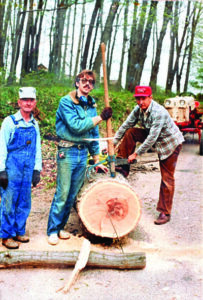
The family that works together…. This is a picture, back in the day, of the author’s father out logging with his own father and grandfather – three generations.
In my case, the farm and the shop were simply how our family made it. We were German‐Irish by blood, but living in the Dutch‐Reformed belt of West Michigan meant our views on work, worship, and family life ended up much the same.
From the 1930s to the 1950s, many Reformed immigrants landed in a bind. Industrial jobs were tied to unions whose class‐warfare ethos and loyalty oaths a confessional Christian could not accept in light of Christ’s command not to swear oaths beyond a simple yes or no (Matthew 5:34, 37).
So men did what they had to do: they started small construction crews, repair shops, trucking companies, print shops, and farms – not glamorous or easy, but theirs, and answerable only to Christ and His church.
Two and three generations later, those necessity businesses have grown into a dense ecosystem of family firms that roof our churches, pour their foundations, insure their buildings, employ their young people, and help fund the Christian schools scattered across our denominations – an ecosystem we have largely taken for granted.
But it won’t continue, at least not automatically.
Family businesses today are being squeezed from three sides.
Economically, many smaller outfits live in the shadow of consolidation. Regulations, insurance costs, and succession planning all get more complex as the founder ages. In some sectors, the only viable “exit strategy” is to sell to a larger competitor or investor – or, in the case of farms, to sell rich soil for development instead of fields.
Culturally, we have quietly absorbed the assumption that “success” means leaving the shop behind. We push sons and daughters toward university and white‐collar professions as the default measure of maturity. Staying in dad’s plumbing company or grandpa’s trucking business is too often presented as “settling.”
Ecclesiastically, we sometimes thin out the link between fathers, work, and children. A man may run a firm by day, then spend his evenings on church and school responsibilities – good things in themselves – while his kids mostly see him tired and absent.
In that environment, the business becomes just a source of income and perhaps a donor to the school, not a shared life. The next generation experiences it as background noise rather than as the place where they belong and are needed.
Deuteronomy 6 and the economy of the home
Deuteronomy 6 is one of those passages we know so well we stop seeing it.
“Hear, O Israel: The Lord our God, the Lord is one. Love the Lord your God with all your heart and with all your soul and with all your strength. These commandments that I give you today are to be on your hearts” (Deut. 6:4-6, NIV).
So far, so familiar. But notice where the text goes next:
“Impress them on your children. Talk about them when you sit at home and when you walk along the road, when you lie down and when you get up” (Deut. 6:7, NIV).
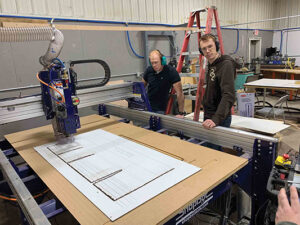
Brothers get ‘er done: Aaron (right) and his oldest brother Nate (left) using their new CNC machine to begin building new piano keyboards.
The picture is not of a family scattering to separate spheres every morning and reconvening briefly at night. It is of a household whose work, meals, travel, and rest are woven together enough that the commands of God can be explained “on the way” without scheduling a special event. When the Lord warns Israel about forgetting Him, He does so in economic terms:
“when you eat and are satisfied, when you build fine houses and settle down… then your heart will become proud and you will forget the Lord your God” (Deut. 8:12–14, NIV).
Climbing the corporate ladder might give us nicer things, but it is hard to impress much of anything on our children if we aren’t there to do it. A family business can better allow us to mix vocation, wealth, and worship. Parents are able to disciple their children in the middle of their actual labor – plowing, harvesting, buying, selling, paying wages, and resting on the seventh day.
Family businesses, at their best, have been one of the most natural ways for that kind of life to happen in a modern economy.
In the farm and shop I grew up in, we didn’t schedule a seminar on honesty; we watched my father explain to a customer why a job would cost more than he’d first estimated. We didn’t need a lecture on Sabbath; we saw machines sit idle on Sunday even if the weather was perfect. In many Reformed communities, the stories are similar. Children stand next to their father on a jobsite and see how he handles an unreasonable client. They hear their parents talk at the supper table about whether to take on a contract that will overload the crew and crowd out worship.
That is Deuteronomy 6 discipleship: not just catechism questions at the table, but a whole economy lived under the Lordship of Christ, with children close enough to see it.
When our work is hidden from our children – behind factory walls, office towers, and a firewall of “confidentiality” – we don’t just lose an apprenticeship. We lose one of God’s ordinary means for teaching the next generation what it looks like to love Him with heart, soul, and strength in the real world.
Inheritance is more than money
It’s tempting to think of succession almost entirely in financial terms. A business is an asset. It can be passed on, sold, or wound down.
All of that matters. But if we think only in those categories, we miss the deeper covenant issue.
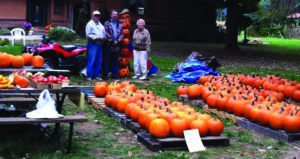
The fruit of their labors: The family farm roughly 20 years ago – in front of the stacked pumpkins are Aaron’s grandparents Larry and Janic, with his father.
On our five‐generation farm, we never inherited a corporation with a boardroom. What we inherited was a way of being in the world:
• You get up when the work needs you, not when you feel like it.
• You tell the truth about your work, even if it costs you.
• You remember that the land and the tools are the Lord’s first, yours second.
Similarly, in my father’s piano business, we didn’t learn a brand so much as a posture:
• Take difficult jobs seriously.
• Serve people who can’t quite afford you with the same care as those who can.
• Build something that will outlast your own two hands.
For many in Dutch‐Reformed circles, the inheritance has similar contours. A grandfather who refused a union oath starts a small firm. His children grow it. His grandchildren now run companies that sponsor the local Christian school and employ young people in the congregation.
Selling such a firm when there is no successor, the burden is crushing, or health demands a change, is not automatically wrong. But to treat the business only as a commodity, with no conversation about whether God might be calling a son, daughter, or son‐in‐law to shoulder the responsibility, is to miss the covenant dimension.
Inheritance, biblically, is not just “what you get when dad dies.” It is the whole package of land, vocation, name, and reputation that one generation entrusts to the next. It is the field where you teach your children to drop seed at the right depth and the shop where you let them solder their first shaky connections.
If we have sons and daughters who could, in principle, step into that inheritance – on the shop floor, in the office, or by reshaping the business for a new age – have we spoken to them about it as a calling question, not just a career option?
Why the Church should care
At this point someone might object: “Isn’t this just nostalgia? Not everyone can or should work in a family business. Many faithful Christians are employees, teachers, nurses, civil servants.”
That’s true. Scripture honors all honest work done as unto the Lord. Not every household will own land or a company. Not every child should take over dad’s trade.
But we should be honest about what we lose when family enterprises quietly disappear or become indistinguishable from any other professionalized asset.
We lose visible catechism in work. Children learn less from lectures on diligence than from watching their parents do good work under pressure. When work is invisible, that formation weakens.
We lose natural apprenticeship for the non‐academic. In many of our churches, there are young men and women whose gifts lie in their hands, eyes, and instincts rather than in essays and exams. Family businesses are often the first place those gifts are noticed, valued, and harnessed for the kingdom.
We lose a dense network of employers who “get” covenant life. When Christian schools rely on tuition flexibility and bosses who understand a young person might need time off for a cadet camp or a profession‐of‐faith class, they are often leaning on owners shaped by our own churches. If those owners sell to distant corporations, the culture changes, even if the logo stays the same.
This is not an argument that every elder must cut back on evenings or every father must start a company. It is a plea to recognize that in God’s providence, our churches and schools stand on the shoulders of men who, rather than yielding to certain pressures, built businesses that now sustain us. If that ecosystem decays, the fallout will be spiritual long before it is merely financial.
Where do we go from here?
What might it look like to take this seriously without turning it into a new law? A few modest proposals.
For business owners:
- Bring your children in intentionally – not as free labor to exploit, but as sons and daughters to form. Give them real responsibilities at age‐appropriate levels and show them how their contribution matters.
- Narrate your decisions. When you refuse a dubious deal, honor a warranty that technically expired, or decline work that would compromise Lord’s Day worship, explain why and tie it to the character of the God you serve.
- Talk about succession as calling. If there is a realistic path for a child or in‐law to carry the business forward, invite them into that discernment early. If there isn’t, be honest about that too, and help them see how the skills and instincts they learned can bless the broader church.
For churches and schools:
- See ordinary vocation as God does. Pray by name, from the pulpit, for tradesmen, small business owners, and farmers as you do for missionaries and office‐bearers, knowing that we all need God’s grace and support in every one of our endeavors.
- Encourage apprenticeship. When a young person is drifting, consider whether what they need is not another program but a place at someone’s side from 7–3, five days a week.
- Be realistic about meeting loads. If a father steps back from a board so he can spend one more evening a week in the shop with his teenagers, that can be a wise, praiseworthy choice – but it shouldn’t be beyond gentle questioning. Some men need encouragement to make family a priority; others need encouragement not to neglect the church. Wise elders will help discern which is which, so that neither the household nor the congregation is quietly sacrificed.
None of this is a guarantee that every family business will survive, or that every child will embrace the inheritance offered. In a fallen world, some shops will close and some children will walk away. God’s kingdom is bigger than our particular enterprises.
But Deuteronomy 6 will not be repealed. Until Christ returns, God will continue to call parents to teach their children when they sit, walk, lie down, and rise. The question before us is not whether we can recreate the 1950s, but whether we will steward the structures He has already given – farms, shops, firms, and offices – as places where that kind of life is even possible.
When a family business dies, it is not only a sign that comes down and a building that goes dark. A small ecosystem of covenant life dies with it: a place where children could see faith, work, risk, generosity, and repentance played out in real time. We won’t all reopen shops. We won’t all farm five‐generation land. But we can all fight, in our own callings, to keep work, wealth, and worship from drifting apart – and where God has given our communities family businesses with deep roots and wide branches, we can at least pause before we cut them down and ask whether the next generation might yet learn to climb them.
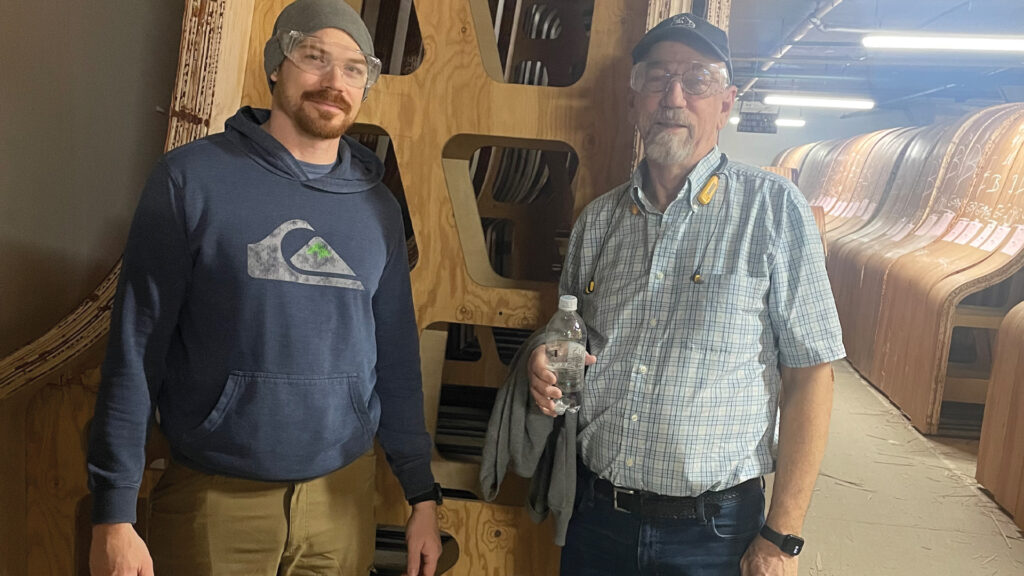
Aaron Reyburn grew up on a multigenerational family farm and now serves as shop foreman in a three generation piano service and rebuilding shop. He also enjoys writing, and owns a small Christian publishing house, Reyburn Press. The picture at the very top is of Aaron and his dad, while receiving training at the Steinway and Sons Piano Factory in New York, to further their education in the industry. Those are piano rims drying after being pressed into shape.