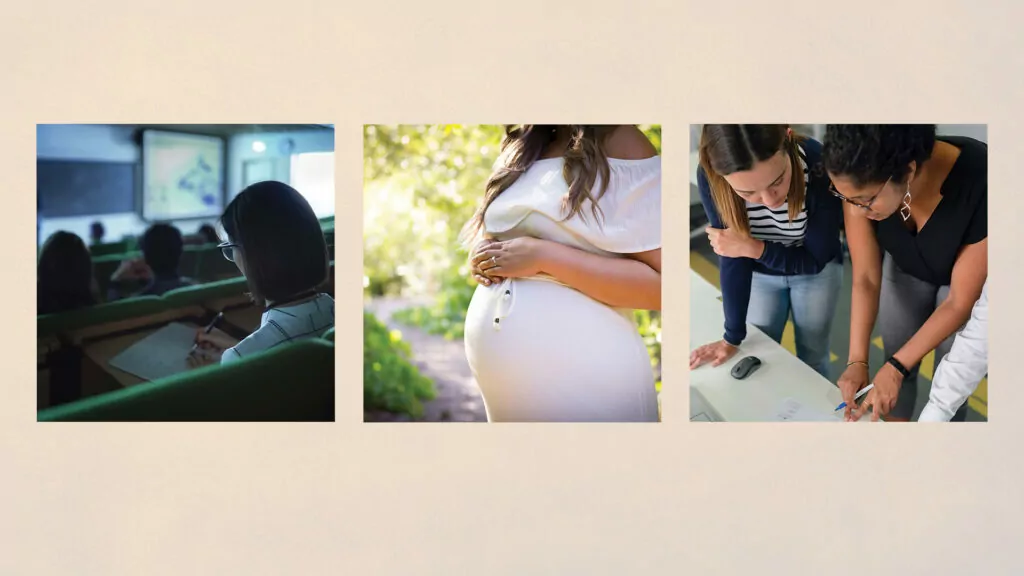
Have a child – change the world
In his best-selling book Atomic Habits, James Clear makes the case for committing to tiny changes in your life, for drastic change. “Here’s how the math works out,” he explains. “If you can get 1 percent better each day for one year, you’ll end up thirty-seven times better by the time you’re done.” The reverse is also true. “If you get 1 percent worse each day for one year, you’ll decline nearly down to zero.” With time, little changes cause exponential shifts.
That is exactly what is happening beneath the surface when it comes to the world’s fertility.
The challenge, simply put, is a lack of children. The world is aging quickly, with too few children to replenish the work force, let alone care for the seniors. We are on the brink of a population collapse.
Our opportunity is to welcome the gift of children even while the world isn’t.
The contrast between the two directions may hardly be noticeable in one year or even 10. But in 75 years (by the end of this century), it could result in a world filled with people who know the LORD. But that will only be true if Christians embrace new life, and raise these children with love and in the fear of the LORD. Unfortunately, God’s calling for us to do this is increasingly being shushed, including in Reformed churches.
The world is aging quickly
From the 1800s to the 1960s the average woman gave birth to 5 or 6 children. In the 6 decades since, the fertility rate has plummeted worldwide – in Canada, we’re down to 1.26 children per woman, and in BC it is even worse, at just 1 child per woman. That is even lower than China. To put this in context, for the world’s population to stay stable, the fertility rate must be 2.1.
This demographic challenge is widely recognized, but especially in some countries where fertility rates decreased a little sooner. For example, according to Pronatalist.org,
“at current birth rates, there will be six great-grandchildren for every hundred Koreans. This is equivalent to a disease that wipes out 94% of the population.”
And if we look at Italy, in just 30 years it is projected that 60 percent of Italians will have no brothers, no sisters, no cousins, no aunts, and no uncles.
In just the last year or two, the rest of the world has been waking up to the problem as well, as it’s become evident that decreasing fertility rates are far more widespread, and dropping faster, than previously thought. That includes countries like Iran, known for its hardline Muslim population, which has seen its fertility rate drop from 6.5 children per woman in 1982, to 1.68 in 2022. Two-thirds of the world’s population now have a fertility rate below replacement. Like Iran, the countries that have had high fertility are decreasing the fastest (1-3 fewer children per woman in just 20 years).
Most people still don’t see this as a big issue today because it feels like there’s no shortage of people. Indeed, the world’s population will likely keep growing for a few more decades as people live longer and we continue to experience the fruit of the higher birth rates that occurred in the 20th century.
But the effects of how the world is increasingly saying no to children will become far more acute soon. The first thing most people will notice is an aging population. The number of seniors in the world is expected to double to over 1.4 billion in just 30 years. Let that sink in. The number of seniors is projected to double in just 30 years!
Generally speaking, seniors need more care. Their health care costs increase substantially even as their employment income plummets. Normally we look to the next generation to step in, both through providing care for their parents and grandparents, and by becoming the new labor force to keep the economy moving. But in places like Korea, if there’ll be just 6 great-grandchildren to replace every 100 Koreans, how is that going to work out?
For those for whom fewer children has been a deliberate choice, efforts to change this attitude have so far been futile. According to the Globe and Mail, “no country has successfully reversed birth-rate decline.” And if that is true of individual countries, it is hard to be optimistic about the population of the world as a whole.
“Great civilizations are not murdered. They commit suicide.” These words are credited to the famed historian Arnold Toynbee, who wrote about the rise and fall of 26 civilizations. I believe it is fair to conclude that much of the world is committing civilizational suicide. Technology is allowing us to live according to our desires. What we are witnessing in the world today is, for the most part, not the result of sickness, calamity, or oppression. Much of humanity, and western civilization in particular, is choosing this.
The difference between the empires of centuries ago and now is that the challenge isn’t contained to a relatively small geographical area. Most of the world is succumbing, and the rest of the world is rushing even faster to join in.
There is no reason the Church has to follow course
In a world of birth control, having children is, increasingly, an act of faith that our life is a part of something much larger than ourselves. Perhaps this is why God’s first words to humanity were a command to “be fruitful and multiply, fill the earth and subdue it.”
One of our readers recently wrote to Reformed Perspective expressing concern that we’ve been trumpeting this topic, since fertility can be sensitive and personal. But this call to be fruitful and multiply isn’t just my opinion, or Reformed Perspective’s hobby horse. It is God’s commission to the world.
The goal isn’t political dominance, or to outbreed other religions. No, God has made it very clear from Genesis through Revelation that He is a God of the covenant. Already in the Bible’s third chapter we are promised that the seed of the woman – one of her offspring – would crush the head of the serpent. Likewise, most of us are very familiar with the encouraging words that “The promise is for you and your children and for all who are far off—for all whom the Lord our God will call.” Fertility is the means through which God grows His kingdom. That kingdom includes both those who become Christians mid-way through life and the children of believers born into the covenant.
And this calling isn’t the burden the world believes it is – it is a blessing! Psalm 127 is well known and loved for good reason: Children are a reward. We are blessed if we have many!
Imagine the impact on the world if Christians embraced God’s gift of children! Deciding to pursue a spouse, and then get married, and welcoming the children that the LORD gives is exactly what this world needs. It is exactly what the Church needs. Having a child, or another child, and raising them with love and in the fear of the LORD can be one of the most impactful things you do for God’s kingdom.
I got a glimpse of this when I spent time in a couple of American towns, such as Lynden, Washington, and Sioux Center, Iowa this past year. It is probably the closest thing I have experienced to seeing the gift of life welcomed. These places are strikingly different from most Canadian towns and cities, even than my own home town. Families are everywhere. Kids are the norm. Playgrounds are busy places. There is something very special there. And it’s no coincidence that these are very “churched” towns.
That the world wants to reject children is no reason for the Church to follow! It only means we can be a massive light to the world by bringing new life into the world. Notice how sad faces brighten when a child walks by. That child is a light! Want to be missional? Bring new life into the world!
Our decisions are more impactful than we realize
Not only does God want us to reproduce, He is looking for multiplication.
Here too, in His wisdom, God has designed life in a way where the cultural mandate is very realistic for most people. My parents were married in 1971. Unlike most Canadians, they didn’t contribute to the fertility rate decline. They were blessed with eight children. Now if a couple has 8 children, and this is maintained for just 10 generations, how many descendants will they have in about 200 years?
Over 1 billion! That is almost twice as many people as in North America.
Now, I didn’t have 8 children, at least not yet. We have 6. If each generation had 6 children, how many descendants would there be in 10 generations?
Over 60 million! That is one and half times the population of Canada.
What about 3 children? Even with three children per generation, there would still be 59,000 descendants – enough to fill an NHL stadium three times over.
How about two children? Unfortunately, it is very well possible that we never get to 10 generations. The family line will likely disappear.
The point here is that a decision to have another child, multiplied over successive generations, can have a monumental impact on the world.
What is holding us back?
So, what do the stats tell us about the fertility rate of Christians compared to the world?
Our fertility rate is higher than the “nonreligious,” but only a little bit more – just over 2 children per woman in America, and about 2.7 worldwide.
Looking at the Reformed community, it is evident that the fertility rate has dropped significantly in the past few decades. We still have more children than our neighbors, but we have far fewer than we had not long ago.
And the difference is more apparent in urban areas than rural. When I was doing presentations on this topic to Reformed communities across Canada over the past two years, it struck me how rural areas responded to the message very warmly. In contrast, in the more urban areas, I was clearly walking on sensitive ground.
Yes, fertility is a sensitive topic. There is no way that I can understand the pain and heartache that many women and couples face daily because they aren’t able to have children, or because they have lost children. Likewise, there are many singles who would love to be married and have children, but haven’t been blessed with a spouse. Or their spouse is no longer with them. To add to this, many people grew up in homes where their parents had many children, but then failed to provide the care that those children really needed – the impact of this neglect can carry on for a lifetime. We live in a very broken world, and the curse of the fall is still being felt daily. There are very good reasons why many people can’t have children. Likewise, there are good reasons to not have more children.
The challenge with sensitive topics like this is that, out of love for the hurting, we might feel a pressure to just stay quiet. But we so easily forget that encouraging God’s people to marry and have children isn’t just some opinion that we can choose to hold to or not. It is, instead, God’s express command to humanity. We are silent to our own peril.
And whatever our situation, all of us can play a role in welcoming the gift of life.
1. Considerations for couples with children
If you already have children and wonder if you should have more, I heard one Christian couple recommend that you literally write out each reason you may have for not having another. And then, for each reason, put it in a column. Is this reason an example of faith, trust, love, or fear, or selfishness? Since this is a self-administered test, it’d be easy to skew the results however you might wish. So be careful to use it to evaluate your thinking, not simply justify it. Remember that one day we will all stand before the Judge of the universe and it is His standard that matters.
If you are open to having more children, first confirm that your spouse is as well. God wants us to be faithful to the marriage and baptism vows that we have made, which means we have to have the physical and emotional capacity to love and care for our spouses and the children He has given us. The goal is not to have as many children as possible.
If, based on your feelings right now, you think there is no way you can have more children, it likely isn’t wise to take measures that would prevent you from changing your mind a few years from now. It is amazing how much our situation can change in just a couple of years. We can only see and feel this moment. God may have something very different for us in the future. I have had people pull me aside to tell me how much they regret taking steps to prevent more children. And I’m sure you are aware of many families who thank God almost daily for every child He has given them.
2. A thought for couples without children
If you are a couple who has decided that you want to wait with getting married, or wait with having children until you have reached certain milestones that have to do with studies, career, or finances, how does this align with this passage from James 4:13-17:
“Now listen, you who say, ‘Today or tomorrow we will go to this or that city, spend a year there, carry on business and make money.’ Why, you do not even know what will happen tomorrow. What is your life? You are a mist that appears for a little while and then vanishes. Instead, you ought to say, ‘If it is the Lord’s will, we will live and do this or that.’ As it is, you boast in your arrogant schemes. All such boasting is evil. If anyone, then, knows the good they ought to do and doesn’t do it, it is sin for them.”
The world promises that women can make plans to have it all – they can plot out their career track and after they are established then they can have their children. But as many women have discovered too late, fertility declines sharply in a woman’s thirties. We never know what tomorrow might bring us.
3. Singles
The number one reason for the declining fertility rate is that more women are childless. This is also evident in the Church. I have been struck time and again by the number of quality girls in Reformed churches who are age 20, then 25, then 30, and guys still haven’t snapped them up yet. I see groups of young adults where the guys and girls seem to prefer to hang out as singles rather than to date, get married, and start a family.
Single young men, it is your responsibility to find a girl and start a family. This takes courage and effort. But you can do it! What are you doing to make this a reality? If your fears, career, or your hobbies and sports are keeping you immobilized or too preoccupied, make changes starting tonight. Ask God to give you eyes to see a godly woman who could be a great wife. And when He shows you one, ask her out on a date!
Young women, are your decisions about career and studies making it harder for solid Christian guys to meet you? Are your standards for guys aligning with God’s will or your own?
Both guys and girls, if practical things like the cost of housing is keeping you from getting married, my encouragement would be to prioritize marriage. Trust in the LORD’s provision, and be open to changing some of your expectations if need be. As Christ tells us, “seek first His kingdom and righteousness, and all these will be yours as well.” If the cost of housing means you think you can’t get married or have children, consider moving to a new community where housing is less expensive, or be content with renting for the time being.
4. Everyone else
If God hasn’t given you children, or if you won’t be having more children, you can still be a massive help simply by looking beyond yourself and loving your neighbors, young and old alike. This can be through your job (we need teachers, nurses, and truck-drivers), and on the side (catechism teachers, baby-sitters, and coaches), and in hundreds of other ways.
Changing the world, while being sanctified
A lot of people are trying to change the world through activism, political engagement, and missions. These things matter a great deal – in fact, they flow from our identity as prophets, priests, and kings. But we can get so caught up in good things that we neglect our most basic callings.
One lesson that I have learned is that the greatest blessings I have are not the things that I have worked the hardest to make happen. They are the gifts that God freely gives. After high school I studied in university for 7 years and received a diploma, then a degree, then a Master’s degree. I then worked for 15 years and gave that job my blood, sweat, and tears. Around that same time, my wife and I worked very hard to tame a wild piece of land in northern BC to be a place where we could raise our family.
What has come of these things? All of them I have given away or would be willing to. My wife and I sold that land a few years ago because it was too difficult for me to stay on top of it with my other responsibilities. And I left that job about a year later. And if my degrees were taken away from me, it would make almost no difference in my life or to anyone else. But it is very clear to me that what matters the most is my marriage to Jaclyn, my six wonderful children, the many blessed relationships I have in church and beyond, and most of all, the promises of God.
These things are not a result of my effort. They are a gift from God. But I had to be willing to accept these gifts willingly and to prioritize life accordingly. It takes courage to ask a girl out, to leave a career to prioritize raising a family, to be open to having more children when there are already toddlers around our legs. Like many of you, I was scared about the prospect of having more children and about seven years ago the epicenter of a burnout I experienced was when our sixth child was born. It isn’t easy. But I wouldn’t trade these gifts for anything. There is incredible pressure in our culture for women to be something more than a mom. Yet a mom can have a monumental impact on this world for centuries to come. A career may come with perks like money and recognition, but these things can disappear overnight. Your offspring will change the world and will live into eternity.
As we get older, we go to more and more funerals. They are always hard, but I also can’t help but be convicted every time again when I go to a funeral. I get such clear perspective on what matters most in life. At a funeral, does it really matter if someone really nailed that hobby, or built up a successful business? Only if these things were a blessing to others. So many of the things they worked so hard for are not even considered at the funeral. What matters most is whether they loved their family and others, and whether they loved the LORD.
I don’t think I’m the only one who doesn’t know what is best for myself. I need to follow God’s Word, even if it clashes with how I feel – my fears, my ambitions, my desires. That is true for all of God’s children.
If you made it to the end of this article and still aren’t convinced, consider these two questions:
1) To Whom do you (and me) owe our own existence?
2) Shouldn’t we trust the One who made us to know what’s best for us, and best for the world He’s placed us in?...