Documentary
2022 / 95 minutes
Rating: 8/10
A comic popped up in my social media feed last month, that perfectly summed up this documentary. It featured a mom talking with a just-released genie.
“Equip me with the ability to homeschool,” wished the mom.
“Granted!” the genie replied.
“But I don’t feel any different,” the mom observed.
“Exactly,” said the genie.
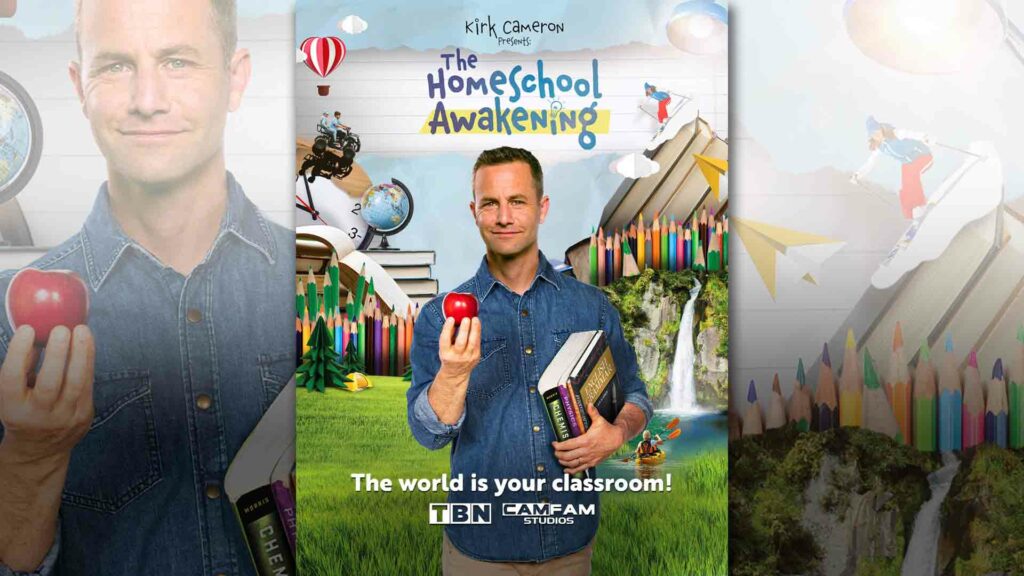
That’s the message producer and narrator Kirk Cameron wants us to hear: that ordinary average parents can do this. You may not have a teaching degree, or any post-secondary at all, but because you know and love your children best, you are already better equipped than you know.
To sell homeschooling, Cameron begins by taking on the most common worries and concerns. It’s quite comical to hear homeschooling families explain why they were once so sure they’d never homeschool themselves.
- “I’ve always viewed homeschooling as somewhat of a cult.”
- “I kind of thought homeschooling meant that you were Amish and that you made your bread from scratch.”
- “Homeschooling? I can’t teach my kids.”
- “Don’t you care about your children’s education? They aren’t going to have any friends. And how are they going to learn science? Are you a history teacher? A math instructor?”
For all sorts of reasons
Afterward we start learning why they went ahead anyway. The strength of the film is in the many different stories it explores. There’s a half dozen families here, all with their own reasons.
- Flexibility – Kirk Cameron did it for the schedule it allowed. He travels for his work as an actor, and when he came home, he could only see his kids after they got home and after their homework was done. Once they were homeschooling, his kids could come with him, and they could get more work done in less time, allowing him to see his children much more.
- If school is brutal – Some chose homeschooling because their child hated school. Socialization is often raised as an objection to homeschooling, but when it comes to socialization, school can oftentimes be brutal, with all the pressure from peers. And if a kid doesn’t “fit”? Then they’ll get ignored, or worse yet, bullied. Homeschooling allows kids to forget about what the 12-year-olds of the world think, and just work on becoming their adult self instead.
- Raising up a child in the way he should go – Parents also chose homeschooling because they didn’t want their children’s education to be in conflict with their values. They didn’t want their kids learning God got it wrong when it comes to gender, creation, marriage, and more.
- Meeting special needs – One couple had a special needs daughter that they thought they could help best.
- Individualized – Most of the families praised how individualized it could be – not every kid is “book smart” but that doesn’t mean they aren’t smart in other ways. Homeschooling can allow parents to explore what those other ways are.
Different smarts
One family started homeschooling because of the experience a dad had in his own public school years. One of his teachers had pegged him as stupid, and told him so. That impacted him all the way into university, where he finally figured out that, hey, I’ve got my own kind of smarts.
This idea of different kinds of smarts might be the part that most impacted me. We’ve all known people, maybe especially young men, who might not have been “school smart” but once they were out of school proved themselves to be incredibly capable out in the working world. Dr. Katy Koch puts it this way:
“So the question is not ‘Am I smart?’ The question is not, ‘Well, how smart am I?’ The question is, ‘How am I smart?’”
She then presents the 8 types of smart she’s identified. The first two below would fall under “school smart” and the next two under maybe “creative smart.”
- Word smart
- Logic smart
- Art or picture smart
- Music smart
- Athletic, coordinated, body smart
- Nature smart
- People smart
- Self smart
Some of the others are smarts that come from our interests – a kid who loves nature is eager to learn all about it.
It was this section in particular that had me thinking even families who don’t, and never will, homeschool could benefit from watching this documentary. We all are interested in helping our kids figure out their gifts, and many of them aren’t going to be school smart. So what other gifts can we help them explore?
Homeschooling is the quickest way to put a dent in public schooling
It also struck me that homeschooling would be the quickest way to put a dent in public schooling, and that’s important too. There’s a quote, that R.C. Sproul may or may not have said that highlights how public schools can’t be neutral.
“There is no such thing as a neutral education. Every education, every curriculum, has a viewpoint. That viewpoint either considers God in it or it does not. To teach children about life and the world in which they live without reference to God is to make a statement about God. It screams a statement. The message is either that there is no God or that God is irrelevant. Either way the message is the same.”
So, public schools aren’t just bad, but irredeemably so and they need to go. But our own Christian brick and mortar schools take time to build, and need more teachers than we’ve even been able to supply, and for other reasons too they aren’t an at-the-ready replacement for the public system. But with all sorts of online curriculum available right now, homeschooling could be.
But what about socialization?
The big knock with homeschooling is socialization – how are children going to learn to interact with their peers if they aren’t in a classroom with 20 other kids their age? The film offers up a whole bunch of answers to that question, so here’s just a few:
The real world isn’t like school
“There are a lot of people who grew up in school, so you’re friends with the girl who sits in the class with you, who you see. Then you grow up and you become an adult and you’re a mom and you’re at home and you have small kids and you look up one day and you say, ‘where are the friends?’… I know so many people who don’t know how to pursue a friendship that doesn’t just happen where they are in the same place with someone else.”
Why just their peers?
“We wanted our kids to be able to relate to people of all different ages.”
We do socialize!
“People wonder about socialization. There’s so much socialization outside of just the school. There was sports and extracurricular activities.”
“It gives us so much more time for extracurricular activities because they are not spending 7, 8 hours a day. You spend much less time; you get more done and then you have time for taking karate classes, or we’re taking cooking classes or taking art classes, or we’re just exploring on our own and we’re going to travel and do things.”
What about bullying?
“I actually love that question, because I like to flip it. What do you think the benefits are socially of combining academics with peers? How is that beneficial? What about when the social actually creates a barrier to learning? Bullying, maybe from a teacher, or from peers, or if there is an economic difference in terms of how I dress so I’m perceived differently and so maybe not given the same opportunities. So socially, that’s actually an inhibitor to learning.”
Whether you’ll ever homeschool or not, watch this film
Cameron is contrasting homeschooling with public schools – “Education really is discipleship. So who is going to disciple your kids? You or Caesar?” We are all on board with that challenge, but what’s left out of the film is the idea of Christian brick and mortar schools as an option to consider. So, what with many of us backing the option Cameron doesn’t even discuss, why is this a documentary we should see too?
I’m going to say, inspiration. It is inspiring to see parents in communities outside our own take up the educational task God has given them – and take it up with the same, or maybe even greater intent and earnestness. I don’t anticipate our family homeschooling any of our kids in the future, but this film is a reminder that I can and must be more involved in educating them here in our home. We love our school’s teachers, but they didn’t make our baptismal vows; my wife and I did. So Kirk Cameron is encouraging me to get at it helping my kids explore their interests, and develop their talents. Whether that’s giving them opportunities to get into baking, or asking a friend if they can come do a shift at their restaurant, there are educational opportunities of all sorts, that all sorts of parents can craft for our kids.
So watch this with your spouse, or a group of friends. Watch it with your whole Christian school and be inspired by a whole bunch of other parents who know God wants them to raise up our children in His ways. That can’t help but be a motivating message.