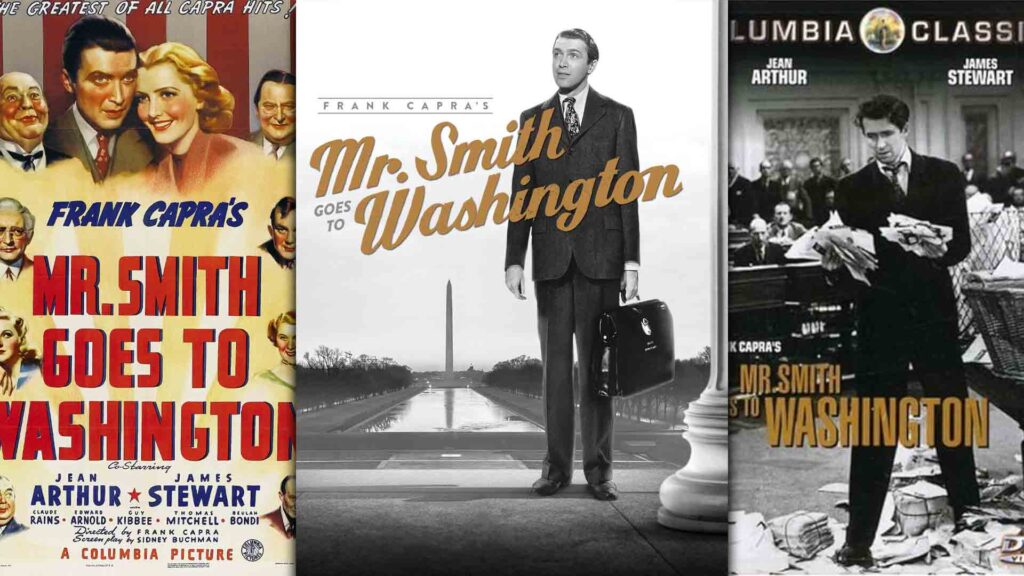
Comedy / Drama
1939 / 130 min
Rating: 9/10
Imagine if a director made a movie lauding Martin Luther’s Reformation, and then had the chutzpah to arrange for its debut showing to be at the Vatican in front of an audience of the pope and his cardinals. Now you’ve got an idea of what Frank Capra dared, when he got a packed audience of 4,000 government leaders, including senators, Supreme Court justices, and White House officials, to come out to the movie premiere of his Mr. Smith Goes to Washington.
The film asks, what would happen if a decent man somehow ended up in Washington as a US senator?
The answer it gives is, the corrupt, cowardly entrenched powers would try to tear him to shreds.
It all begins when the young Jefferson Smith – played by Jimmy Stewart – is appointed to serve out the term of a deceased senator. He’s been picked for his naiveté – political lobbyist and behind-the-scenes powerbroker Jim Taylor, and the politicians Taylor has bought, think Jefferson will be too inexperienced, and too blinded by his patriotism and trusting nature, to recognize, let alone expose, their backroom dealings. And to keep Jefferson too busy to even begin to uncover their graft, they’ve got a pretty girl to turn his head, and Jefferson’s own secretary in on it, set to misdirect him so long as she gets a good appointment out of it.
But what Jefferson might lack in a sense of discerning skepticism, he makes up for in his dogged determination to do right for the state that sent him here. He gets his very first bill proposed in record time, and it just happens to run right up against the latest project of Taylor and his gang. That won’t do, so Taylor decides to destroy Jefferson, and sets him up as the fall guy for the very corruption Taylor was actually guilty of. Taylor doesn’t just own politicians, he’s got control of the papers too, and he uses this one-two punch to blacken Smith’s name.
While much has changed in the 85 years since this film was made, one-sided media remains. It isn’t often as overt as the infamous 2020 video below shows – with one newscaster after another mouthing the exact same script – but we’ve seen the media decide for us what we’re allowed and not allowed to talk about. Just consider the transgender discussion, or COVID, or the value of the unborn – only one side is allowed.
Thankfully, like Smith in this film, there are ways to get around and past the gatekeepers. So when the press joins in on the assault of a good man, the people who know Jefferson best help him get his message out.
So why should everyone see this film at least once?
1. Because, like Jefferson Smith, we are called to fight for lost causes with all of our might
As Smith put it:
“I guess this is just another lost cause, Mr. Paine. All you people don’t know about lost causes. Mr. Paine does. He said once they were the only causes worth fighting for. And he fought for them for the only reason any man ever fights for them. Because of just one plain, simple rule: Love thy neighbor. In this world full of hatred a man who knows that one rule has a great trust. You know that rule, Mr. Paine. I loved you for it, just as my father did. You know that you fight harder for the lost causes. You even die for them.”
There is no earthly means by which we’re ever going to win the abortion battle. But do we still need to speak up for the unborn? Of course we do. And, humanly speaking, are we ever going to convince Canada to turn around and end euthanasia? No, we are not. And yet God can be glorified in the speaking of His truth. His is no earthly power, and He can do things no human can, so who knows but that He might work a miracle through us, fighting for a “lost cause.”
2. Because we mustn’t mix up our first and second priorities
Smith’s hero is a senator who came to Washington just as committed and courageous as Smith himself. But over the decades, that senator, Senator Paine, compromised. He compromised because he thought he needed power to fulfill his goals. But while power can be a valuable servant, it is a lousy master. It can help you achieve goals, but when it becomes your primary goal, then you’ll compromise anything and everything else to keep it. And then what goals are you actually going to accomplish?
Christians, and politicians among them, regularly censor ourselves, refusing to bring up God in the public square, even when His truth is what everyone most needs to hear. Consider the transgender debate, where no one understands Who determines our gender. How many Canadians have ever heard the worth of the unborn explained in biblical terms? Why do we keep quiet? Because we think it is the only way to be heard – we presume the secular world won’t be interested in an explicitly Christian message. But then, in an effort to be heard – in making getting heard our first priority – we compromise our message, and never even deliver the clear, God-given, God-glorifying, unshakeable truth.
Cautions
At the time this film was made, the population as a whole would have said they loved God, family, and country, but some of them might have gotten confused about the order. That seems a very American problem, even today, where the country is revered as almost akin to Christ – the last, best hope for the world. There’s more than a touch of that error here, with Jefferson’s patriotic zeal taking on a religious feel. He believes in America.
Thankfully, we aren’t forced to agree with Jefferson 100% or not at all – we can appreciate his heroism, honesty, and will to fight, and appreciate his repeated references to Scripture too, even as we topple “country” from atop the pedestal he’s placed it.
The only other cautions would be a prolonged scene where two key characters are drunk, but I don’t think anyone will imagine the film is encouraging this behavior. As to language, I think I heard a “damn,” “jackass,” and one kid say “gosh.”
Conclusion
This is a classic film, nominated for 11 Oscars for the acting, writing, directing, score, and more. Director Frank Capra and his star Jimmy Stewart later teamed up for It’s a Wonderful Life, and maybe that can be the hook you use to get folks watching this one.
And here’s a trick you can use to improve the experience. At 2 hours and 10 minutes, this is just a long story, and few of us are used to that anymore. Part of the length is because Jimmy Stewart is a bit of a slow talker, so if your DVD player or streaming service is capable of it, play this at 1.25 times speed. That’ll make it a more manageable 1 hour and 40 minutes. And the thing is, no one will even notice you sped it up – Stewart will just sound like he’s talking at a normal rate. Add in an intermission for snacks and ice cream, and everyone will make it through to the absolute smasher of an ending. Folks who make it to the end are going to cry and clap, guaranteed!
For quite the intriguing modern trailer, click here. For the original trailer, see here. And if you want to learn more about the chutzpah of the director debuting his film to a packed house of senators, check out the video below.