My first involved interaction with the Greek myths was in university, as a required classics course. But the professor wasn’t all that interested in the classic part – he was a pervert, and the Greek gods gave him plenty of material to wallow in. Adultery, rape, incest, pedophilia, bestiality, homosexuality, and transsexuality too – there wasn’t much of anything that the Greek gods didn’t get up to.
I don’t think he even had time to get into the demonic side of things, with Hades, harpies, Furies, and the underworld’s countless ghosts.
So when I first ran across Rick Riordan’s Percy Jackson books, their Greek myth source material left me with low expectations.
The appeal
But it was Percy’s “classical” connection that got some parents enthused. He and his friends are mostly all “halfbloods” – the demi-god offspring of a Greek god/mortal woman coupling – but with the twist that this is all taking place today.
In the first novel, The Lightning Thief, Percy doesn’t initially know he is a demi-god, or that the Greek myths and the gods in them are all real. So there is an educational aspect: we are alongside Percy as he learns more about his dad Poseidon, god of the sea, and as he learns about other gods like Apollo, and all sorts of mythic monsters and critters like the Minotaur, satyrs, Medusa, Cyclops, and centaurs. The Greek myths are a part of Western civilization, so that’s a reason to know about Zeus and his gang, just to be educated. If you have never heard of Hercules and his 12 legendary labors, or don’t know about the flying horse Pegasus, then you’re not going to get some cultural references (in articles, songs, and movies) that others will understand.
Another reason for Christians to study these myths is to learn about the Greco-Roman world that the Apostle Paul was speaking to in his missionary journeys. The Greeks and Romans shared the same pantheon of gods, though they each had different names for them. The Greco-Roman gods stand in stark contrast to the one true God. Whereas He is holy, merciful, and just, Olympus was populated by the petty – super-powered, sure, but morally no better, and often much worse, than the humans who worshipped them.
Education vs. entertainment
So there are good reasons to study the Greek gods. But what about looking to them for entertainment?
And as entertainment material, pointing our littles to the Greek myths strikes me as akin to pointing them to the 90s Friends TV series, and telling them it’s good binge-watching material because there are laughs to be had. There are indeed – and in the Greek myths too – but in both instances the sexual perversion should be putting us off.
Then there is the myths’ philosophy. When kids in a Christian school study the Greek myths they can be prompted to question them, which they probably won’t think to do reading the Percy Jackson stories for fun. What kind of questions should they ask?
- Where does this story say that right and wrong come from? Christians know right is defined by the very character of God. But in the Greek myths how can you even know what’s right or wrong? One god wants this, another that, and the top god in the Greek myths is the capricious, philandering Zeus, who makes rules that Percy and his friends sometimes try to circumvent. So how is right and wrong defined in this universe? Percy seems to be the one who most determines it – what he does is right, and those who oppose him are in the wrong – which offers up to the reader the implicit message that you define your own morality.
- What’s wrong with the world? Christians know that the brokenness around us came from Man violating God’s law. The myths largely flip that, teaching that trouble most often comes from the gods and their bickering.
- What is the solution? The myths offer a mix of fatalism – you can’t escape your fate – and relying primarily on yourself and your own smarts because the gods may or may not choose to help. Percy Jackson also adds in a lot of relying on your friends and, of course, relying on your superpowers. Will that save you? Only sort of, because in Percy’s world and the Greek myths generally, everyone is doomed to die. But it might save the day. This self-reliance stands in stark contrast to our need to turn to Christ, Who will do for us what we can’t do for ourselves – clean and perfect us.
- What gives life meaning? The Greek myths pitch honor, duty, and being so heroic you’ll be long remembered after you die, as pursuits worth spending your life on. But such pursuits may result in your life being cut short by a god who for reasons that have little to do with you, just doesn’t like you. Or maybe you were always fated to die tragically. For many, these pursuits are going to be literal dead ends. But we can fulfill God’s purpose for our lives, which is to glorify Him and enjoy Him forever.
If our children are reading these stories as entertainment, and they’re not contending with the philosophy being pitched – if they’re not even aware of it – then they won’t be sifting out what’s bad and will be influenced to some extent. Especially if they’re ingesting thousands of pages of it across these 25+ books. Just the original 5 books amount to more than 1,500 pages.
Aren’t they sanitized?
The Percy Jackson books are aimed at middle school readers, so maybe parents would expect author Riordan to skip over the Greek myths’ most lurid and depraved aspects? That’s not an unreasonable expectation… but what’s in need of sanitizing is going to depend on one’s definition of depraved, won’t it?
Our secular world still opposes rape, so I wasn’t surprised to learn that Riordan recasts the gods’ many rapes into romances instead. He’s not going to try to normalize or celebrate rape.
But our culture has been celebrating homosexuality for a decade or three now, and in the last five years it’s also jumped on the transgender train. So unless an author is explicitly swimming against the cultural stream – unless they are overtly Christian (or maybe Catholic or Mormon) – then we should expect them to go with the flow. We should expect them to go after the accolades available to any author who’ll add in a “brave” gay, transgendered, or maybe genderfluid character into their books.
That’s how it’s played out with Riordan.
Laying it on thick
When Percy Jackson first appeared two decades ago, his popularity got my attention, but The Lightning Thief didn’t seem good enough to recommend or bad enough to write up a warning, so the series dropped off my radar. But recently one of my daughters got interested, and that got me looking at them again. I figured, why not pick up one of the most controversial titles and start looking there?
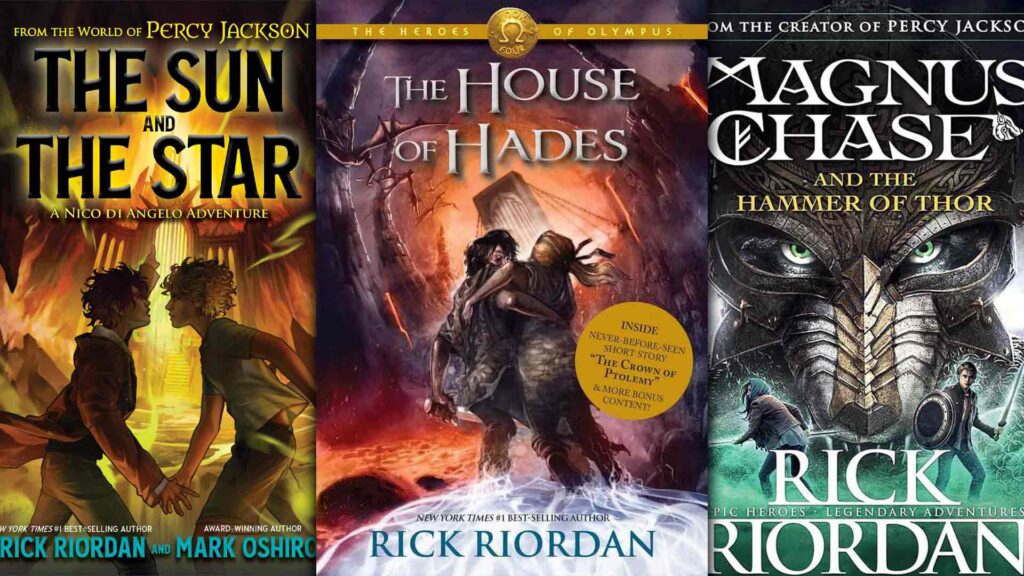
So I got the graphic novel version of The House of Hades – how’s that for a creepy title? – which was book 4 from the second series. It was published back in 2013, and already then, Riordan was really pushing homosexuality. Nico di Angelo has a significant role, and while he first appeared as a seemingly heterosexual character in 2007’s The Titan’s Curse, here he is forced to out himself as gay. And it isn’t just an announcement. Nico doesn’t want to let anyone know, and we learn that because he’s hidden that part of himself, he’s never been able to have close friends. So a ferocious, vicious version of Cupid (this is no cherubic baby with a bow) makes Nico admit that, while everyone thought he had a crush on Percy Jackson’s girlfriend, his crush was actually on Percy himself. Then, after Nico outs himself, his friend Jason tells him that it is possibly the bravest thing he’s ever seen anyone do.
So Riordan is laying it on thick here. Any kid wrestling with homosexual temptation has now been told that it is brave to embrace your sin, and it is a sin to deny your true self.
Series by series
There are 25 books in the Percy Jackson universe, not including the growing number of graphic novel adaptations, short story collections, at least one coloring book, and various other etceteras. And by all accounts, as the series has progressed since the first novel was published in 2005, it’s gotten queerer. I’ve been researching the series by reading through the many graphic novel versions available, with a particular focus on titles that were supposed to be the most LGBTQ friendly. So here is a very incomplete account of LGBTQ content, series by series, that I’ll expand on as I learn more. There’s also just been an announcement of a new 4-book Camp Half-Blood series to be released later in 2026.
Percy Jackson and the Olympians (7 books)
The first 5 books in this series, Percy Jackson and the Olympians, are the ones that today’s young parents grew up with. There’s hell hounds, snake demons, and all sorts of undead critters, whether that’s a mummified oracle, soooo many skeletons, or Percy’s friends summoning or even getting possessed by, the dead.
I haven’t heard of or spotted anything LGBTQ-related in the original 5, but I haven’t had a chance to read through the continuation of the series, which resumed in 2023. These were written recently so I was predicting Riordan would slip something in, and, sure enough, it seems he has in at least one of the two. And it sounds like he has plans for at least one more title before he’s done with Percy Jackson and the Olympians.
The Lightning Thief (2005)
- The Sea of Monsters (2006)
- The Titan’s Curse (2007) – Nico di Angelo is introduced here, given a tragic sympathetic background – little boy, orphaned along with his sister, and then Percy promises to, but fails to, protect Nico’s sister who dies as a result
- The Battle of the Labyrinth (2008)
- The Last Olympian (2009)
- Chalice of the Gods (2023) – From Plugged In‘s review online, it seems that the book does note Zeus made his male cupbearer Ganymede immortal because he’s attracted to him.
- Wrath of the Triple Goddess (2024)
The Heroes of Olympus (5 books)
A big plot element here is that Death is chained and restrained, and if you thought that would be a good thing, you’d be mistaken. While we’re grateful Christ conquered Death, in this series, one of Percy’s missions is to free Death so the monsters they kill will stay dead.
I’ve checked out the first four books in this series and discovered that in the 4th Riordan is using a sledgehammer to push homosexuality – no subtlety to it.
- The Lost Hero (2010)
- The Son of Neptune (2011)
- The Mark of Athena (2012)
- The House of Hades (2013) – Nico di Angelo is forced to out himself as gay, and that’s celebrated by a friend as the bravest thing he’s seen. For more details see the section “Laying it on thick” earlier in this article
- The Blood of Olympus (2014) – Nico has a developing relationship with Will Solace
The Trials of Apollo (5 books)
I haven’t looked at this one yet, but Apollo is a key character, and his bisexuality is said to feature prominently in the series. One reviewer put it this way: “I’m queer! You’re queer! That geyser is queer! Everyone is queer! …There are also a lot of new characters who are queer, including – yes – geyser spirits called palikoi. During the series, Apollo meets a pair of immortal warrior lesbians, a transwoman hunter of Artemis, and many, many bisexual gods and demigods.”
- The Hidden Oracle (2016)
- The Dark Prophecy (2017)
- The Burning Maze (2018)
- The Tyrant’s Tomb (2019)
- The Tower of Nero (2020) – Piper and Shel are in a lesbian relationship
The Nico di Angelo Adventures (2 books)
The whole series is focused on the relationship between Nico and his gay love interest.
- The Sun and the Star (2023) – First to focus on a queer couple, with an appearance by lesbian couple Piper and Shel too
- The Court of the Dead (2025)
Magnus Chase and the Gods of Asgard (3 books)
This involves Norse gods, but takes place in the Percy Jackson universe, so it’s a spin-off of sorts. Here we meet the shapeshifting, genderfluid Alex Fierro, who gets involved with a pansexual Magnus Chase.
- The Sword of Summer (2015)
- The Hammer of Thor (2016) – While I haven’t read it, I found a LGBTQ advocate celebrating that there is “a whole chapter” devoted to Alex explaining his trans experience, and then later building a “pottery golem” that he declares non-binary.
- The Ship of the Dead (2017)
The Kane Chronicles (3 books)
Riordan has also written a series on the Egyptian gods. Like the Greek myths, the Egyptian mythology this is based on has all sorts of dark demonic supernaturals. Those show up here, along with ghosts, sickness spirits, and all sorts of gods trying to kill or possess the Kane kids, their parents, and even their grandparents. Then there is a thong-wearing male god, and a well-endowed hippo goddess who gets ogled in the graphic novel version of book 2 (ugh!). Both reappear in book 3, where Carter Kane visits the “Land of Demons” with, you guessed it, demons, demons, and more demons – so many demons! – and with a murderous ghost as his guide. In a section that seems almost proselytizing, readers get an extended lecture on the ancient Egyptian understanding of the five parts of our soul. No explicit queer content exactly… but did I mention the demons?
- The Red Pyramid (2010)
- The Throne of Fire (2011)
- The Serpent’s Shadow (2012) – Sadie Kane is interested in Anubis, god of the dead, and also a boy, Walt Stone. When Walt dies, and Anubis possesses him, Sadie’s two love interests combine into one body and the ensuing relationship has been celebrated by some readers as a form of polyamory.