Transparent heart icon with white outline and + sign.

Life's busy, read it when you're ready!

Create a free account to save articles for later, keep track of past articles you’ve read, and receive exclusive access to all RP resources.

White magnifying glass.

Search thousands of RP articles

Helping you think, speak, and act in Christ.

Open envelope icon with @ symbol

Get Articles Delivered!

Helping you think, speak, and act in Christ. delivered direct to your Inbox!


Most Recent


The Rest


Red heart icon with + sign.
Theology

Will animals go to Heaven?

What happens when animals die? The question of whether animals exist in heaven has been debated for centuries. Do people share the same spirit and afterlife destination as animals? Will pet owners see their beloved pet again? Will their pet go to heaven? For many these are sentimental, frivolous questions. For others they are important. Children especially will want to know about the fate of their dead pets. What are we going to tell them when they ask? Cats, dogs, birds and more Children are routinely told that their pet has gone to heaven. Someone wrote to Randy Alcorn, the author of Heaven, "My children are hoping extinct animals will be in Heaven, maybe even dinosaurs." Alcorn thought it a possibility, arguing that the primary beings shown articulating God's praise in Heaven, along with the angels and human beings, are animals. Even in secular society many people tend to believe in an afterlife for our fellow creatures. Gift shops sell collector plates depicting “feline paradise” showing that the lost kitten enjoys a magnificent afterlife in paradise. A Hollywood version of dog afterlife is described in the full-length feature film All Dogs Go To Heaven. Evangelical author Angela Hunt argues in her 2005 novel Unspoken that birds and horses and creatures are in heaven now. For proof she refers, for example, to Elijah being taken to heaven by a chariot of fire and horses (2 Kings 2:11). She says that when her “buddy Justus” (a 275-pound mastiff dog) died, she promised him that she would meet him in heaven. “My heavenly Father loves me, he loves his creatures, and I am almost certain I'll meet my beloved Justus in eternity.” Cute little furry almost humans? Why have so many people in North America become so sentimental about their pets? Some suggest that the growth of cities and suburbs has deprived most North Americans of instrumental contacts with animals. Many suburbanites have never spent time on a farm and with farm animals. They have not seen what they are like. Consequently, they romanticize animals as quite human-like, though more innocent and pure. This humanization of pets encouraged sentimentalism. Many pet owners keep photos of their pets in their wallets or on their desks; some celebrate their pets' birthdays. Estates have been left to cats and dogs. Some even use the services of pet psychologists. While no one would wish to denigrate pets, our modern affluent society frequently puts more value on pets and even wild animals than on people. The current trend toward the humanization of animals contributes to the blurring of the boundaries between man and animals. The theory of evolution, New Age philosophy, and the rhetoric of the animal rights movement have greatly impacted our society's attitude toward animals. The recent movement for the protection of animals usually labeled "animal liberation" or "animal rights" is often in the news. The more uncompromising among the animal liberationists have demanded equal moral consideration on behalf of cows, pigs, chickens, and other apparently "enslaved and oppressed" animals. Many animal liberationists put their ethic into practice by becoming vegetarians. In Rattling the Cage. Toward Legal Rights for Animals Steven M. Wise, a lawyer promoting animal rights, declares that it should be obvious that "the ancient Great Wall" that has for so long divided humans from every other animal is biased, irrational, unfair, and unjust. He believes it is time to take it down. Consequently, in his book he strongly argues for the extension of personhood to chimpanzees. The “talking” gorilla But if chimpanzees are supposedly people, why can't we communicate with them? This type of thinking led to research on animal communication and intelligence. Several historic attempts were made to teach human language to animals. In the 1960s R.A. and B.T. Gardner, in extensive studies carried out in America, considered the possibility that although primates might be unable to vocalize speech, perhaps they could learn to communicate with their hands via sign language. So they set out to teach an eleven-month female chimpanzee – Washoe – the sign language used by deaf people. But it should be noted that the sign language they taught (called Ameslan) is constructed differently from spoken or written language, so direct comparison with human speech is difficult. Experiments have also been made with a gorilla. The American Gorilla Foundation portrays gorillas as part of the human family. In 1972 Penny Patterson began to teach sign language to Koko, a gorilla born in the San Francisco Zoo. This experiment promoted the idea that animals have human qualities. It also contributed to the animalizing of man. The Gorilla Foundation's funding appeal stated that Patterson's experiment resulted in "an astonishing breakthrough in our understanding of the world. The news is that a very remarkable gorilla named Koko has changed myth into fact...by speaking to humans." The public was invited to "become part of Koko's extend family." Christian author Angela Hunt expresses some interesting but speculative thoughts about animals in her novel Unspoken, a story about a talking gorilla. In the novel Unspoken Christian author Angela Hunt writes that many years ago she saw a video about Dr. Penny Patterson and Koko, and she thought then that their story contained the seeds of a novel. Recently she saw an updated version of the video and that's when she knew the time to write had come. Besides the video inspiration, Hunt's novel shows indebtedness to the views of Randy Alcorn, who combines Biblical exegesis, evangelical theology, and imaginative speculation about heaven and the new heaven and earth. It is not surprising, therefore, that Unspoken is highly recommended by Alcorn. The main characters in Hunt's novel are a young woman named Glee Ganger and Sema, a western lowland gorilla, who was entrusted to the care of Glee. Glee – not a Christian in the beginning of the book, conducts unique research in the field of interspecies communication. She teaches Sema, who is fascinated with words, how "to talk" by using American Sign Language. She says that her research has proven that Sema not only understands the words for most common things and activities; she also has a firm grasp on many abstract concepts. Glee believes that Sema is a thinking animal. She frequently evidences signs of advanced intelligence, even intuition. Glee treats Sema as her child and calls the young gorilla "sweetie" and other endearing names. She reads picture books aloud to her. She even asks, which book do you like to read? Sema answers: "Pumpkin Patch." Sema also knows God and communicates with Him. Glee asks, “Sema? Why did you talk about God?" Sema replies, "Because God is." Sema also says, "Word made world, word loves Sema, word made gorillas people apples bears." "Sema good gorilla Sema loves God thanks." Will Sema go to heaven? To be with God? Sema believes she will. "God make trees sky. God make home gorillas people." How does she know? Sema says a shiny angel had told her these things. At the novel’s conclusion Sema meets a tragic, but heroic end. She dies protecting Glee from a tiger which got loose in the zoo and charged at Glee. She saved Glee's life by tackling the tiger. As Sema is dying she says, "Shiny man say... Sema go now. Sema happy. Sema love." Glee, therefore, believes she will see Sema in heaven. Sema's sacrificial death is also instrumental in Glee becoming a Christian. And Glee testifies, "How ironic that animal could be used to bridge the gap between me and God." Many questions The humanization of animals, pretending they are so much like us, is also an animalization of humans. The humanization of animals and the belief that they go to heaven raises many questions. Historically, people didn't always view animals in a positive light. Negative qualities of animals are often mentioned in reference to humans such as "as evil as a hyena," "as sly as a fox." In the early fourteenth century, Dante had condemned to the eighth circle of his Hell those guilty of "the sins of the wolf": seducers, hypocrites, conjurers, thieves and liars. In the Bible there is also a reference to animals capable of being possessed by an evil spirit. Jesus allowed a demon to enter a herd of pigs who rushed into the lake and were drowned (Mark 5:1-13). William Barclay adds his comments about those who criticize Jesus for allowing the death of the pigs: "We do not, presumably, have any objections to eating meat for our dinner, nor will we refuse pork because it involved the killing of some pig. Surely if we will kill animals to avoid going hungry, we can raise no objection if the saving of a man's mind and soul involved the death of a herd of these same animals.... in God's scale of proportions, there is nothing so important as a human soul." Are animals able to "talk"? Alcorn claims that this is possible. He refers to the account of the serpent speaking to Eve in the Garden of Eden. He argues, "There's no suggestion Eve was surprised to hear an animal speak, indicating that other animals also may have spoken." He also mentions the story of Balaam and his donkey (Numbers 22). He suggests that the wording of the text doesn't suggest God put words in the donkey's mouth, as in ventriloquism – He "opened the donkey's mouth," permitting it to verbalize what appears to be actual thoughts and feelings. I believe Alcorn and Hunt are mistaken. For example, the vocal tracts of gorillas are constructed so they can't speak. They can be trained to make signs. But they can't produce verbalized speech. They do not have structured grammatical language. They are deprived of reason and forethought. And they cannot, which may be highly significant, draw representational pictures. Newspapers have reported on monkeys daubing on a canvass and receiving an art award. But at best they only doodle. Furthermore, it is not possible for them to search for a solution to a puzzle, let alone ask them what they see or hear or smell, or what they think of their cage-mates, or of us and our experiments. Man can verbalize his thoughts in speech. The uniqueness of human language reveals man's intellect, will, emotion and general ideas about space and time, and abstract concepts. It is man's key to communicate concerning the past, the present and the future. Calvin brings human speech in its proper Biblical framework. He notes: "The use of the tongue and ears is to lead us into the truth by means of God's Word that we may know how we were created incorruptible and that when we are passed out of this world there is a heritage prepared for us above, and in short to bring us to God." Do animals have a soul that continues to exist after death? On the one hand Alcorn argues that they have "non-human souls." On the other hand he says that though man continues to exist after death, it "may not be the case for animals." But the Bible does not say that animals have souls. But neither does the Bible deny this. The question whether animals have a soul is not new. The medieval theologian St. Thomas Aquinas decreed animals were soulless, and graded them according to their utility to people. Wolves, bears, and hairy beasts useless to human comfort were demonic. The twentieth century Reformed theologian R.C. Sproul observes: "Traditionally many have been persuaded that there is no future life for animals. The Bible does not teach that animals go to heaven. One of the key arguments against the idea that animals do not survive the grave is the conviction that animals do not have souls. Many are convinced that the distinctive aspect that divides humans from animals is that humans have souls and animals do not." Will animals be with the Lord in the intermediate heaven, the stage of eternal life before the coming of the New Heaven and Earth? An animal is not religious. Man is incurably religious. Even in his denial of God man struggles with the God question. Dr. J.H. Bavinck comments that: "in his religion man is aware that he is not alone because he knows that he is living in the immediate presence of someone who is infinitely greater than he." Only in man do heaven and earth meet each other. Animals were not created for a life in the heavenly realms. The Bible clearly states that eternal life is not merely "life after death" (cf. John 3:16). The twice born have eternal life right now. But the Gospel does not only mention heaven, but also hell. Apart from the saving work of God carried out when He gave his Son for our sin on the cross of Golgotha, He would have to assign us the agony of hell. The Gospel also proclaims that there is only one way to God the Father. "Salvation is found in no one else, for there is no other name under heaven given to men by which we must be saved" (Acts 4:12). Our Lord Jesus said, "No one can come to me unless the Father who sent me draws him" (John 6:44). These texts do not include animals being drawn to the Father through Jesus Christ. Only man is capable of having a personal relationship with the infinite personal triune God. Man created in the image of God The Bible affirms the dignity of man. Man is sharply distinguished from the rest of God's creation. He is unique! Nothing in creation can be greater or have more dignity than man, for God alone is greater (Ps. 8). Man is different from all other creatures; he is created in the very image of God. Man, as God's image bearer, is elevated above animals and destined to have dominion over all the world (Gen.1:16, Ps. 8:5-9). Of all God's acts of creation recorded in Scripture, this is the only one preceded by the statement that God, as it were, consulted Himself before acting ("And God said, 'Let us make man'" (Gen. 1:26)). This formal fact alone is of great importance because it shows that this creative act differs from all the others. It is the fact that God created only man and woman in His image and likeness (vv.16-27). In the New Testament mankind is also referred to as being "made in God's likeness" (Jam. 3:9). The apostle Paul describes Christ as the perfect image of God. He says, “And we, who with unveiled faces all reflect the Lord's glory, are being transformed into his likeness with ever increasing glory, which comes from the Lord, who is the Spirit" (2 Cor. 3:18). Scripture testifies that man is a worker and developer. He is the steward of God's world and has been called by God to responsibly enfold creation through his work. Animals and plants are under his dominion. Adam named the animals (Gen. 2:19,20). Scripture also shows that people are allowed to use animals as work animals and for food (Gen. 9:3). Man is the scientist at work in God's laboratory – earth. People may speculate whether animals go to heaven. But Scripture shows that the world is to be understood only in relation to man. Calvin notes, "The Lord Himself by the very order of creation has demonstrated that He created all things for the sake of man." The world created and endowed as a habitation for man in such a way as to serve his true destiny in the worship and adoration of God. The first question of The Westminster Larger Catechism asks, “What is the chief and highest end of man” The answer? “Man's chief and highest end is to glorify God, and fully enjoy him for ever.” The same belief is expressed by John Calvin. He states that God made man erect, unlike the other creatures, that he might know and worship God. He wrote, "God created us after His own image in order that His truth might shine forth in us." The New Heaven and Earth When our Lord establishes the New Heaven and Earth upon His return with renewed men and women, will animals also be redeemed? According to Hunt the new earth will be populated with animal life. Alcorn argues that animals will be on the New Earth, which is a redeemed and renewed old earth, in which animals had a prominent role. He believes that on the New Earth, after mankind's resurrection, animals (pets included) who once suffered will join God's children in glorious freedom from death and decay. Alcorn refers to Romans 8:21-23 for proof text. He assumes animals – as part of a suffering creation – are eagerly awaiting deliverance through mankind's resurrection. As I see it The first chapter of Genesis reveals that God's purpose was that nature in paradise be at peace with itself. Isaiah 66:22 says that the Lord will make the New Heaven and the New Earth. It is making something new from the old. Therefore, no new creation, but recreation, renewal. The New Earth will be the renewal of the old. Isaiah anticipates an eternal Kingdom of God on the New Earth. He describes the glorious future which God's people prayerfully and eagerly anticipate. He points to a time of the renewal of the old paradise where predator and prey will lie down together and be at peace. “The wolf and the lamb will feed together, and the lion will eat straw like the ox...They will neither harm nor destroy in all my holy mountains, says the Lord” (Is. 65:25). Will there be animals on this new world? Apparently there will be plants, rocks, trees and animals on the New Earth. But asked exactly what it will be like, we cannot say because Scripture has not revealed it to us....

Red heart icon with + sign.
Book Reviews, Graphic novels

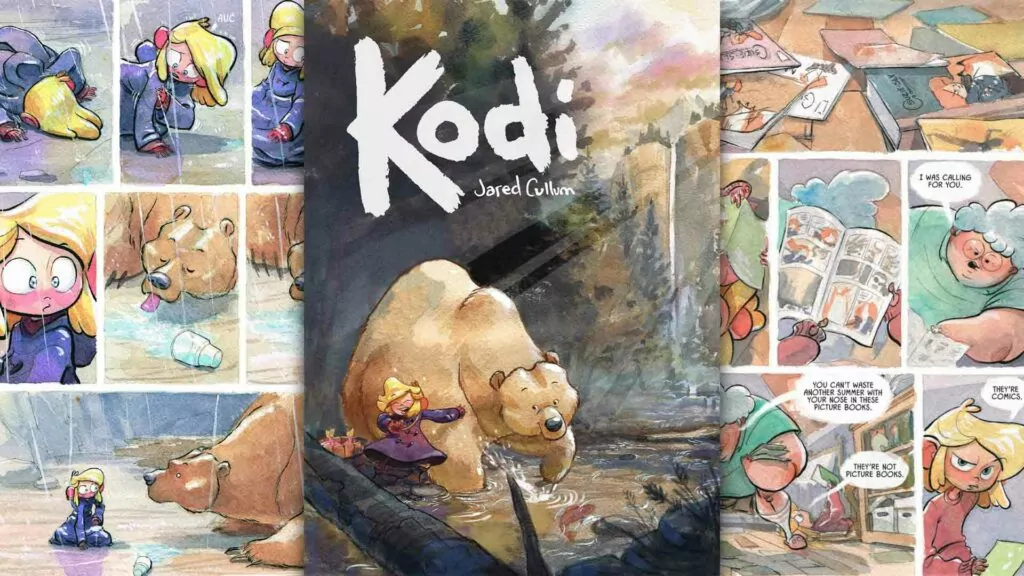
Kodi

by Jared Cullum 2020 / 176 pages Rating: Good/GREAT/Gift Katya is spending the summer in a cottage in the woods of Alaska with her "Meema" (or grandmother). And while she'd be content to spend her time just reading comics, Meema sends her to town to go buy a Slurpee, and maybe find a new friend too. On the way home through the forest, Katya takes a tumble into a ravine. The fall knocks the wind out of her, but there's someone else there in the ravine with her who is in a bit more trouble – an enormous bear has been pinned down by a tree. Katya does what every sensible kid should do when confronted with an injured bear – she sings to it, then rushes off to an adult to get help bringing it home. Up to this point the book had been fairly "realistic" – I'm not talking the drawing style, which, while gorgeous is definitely still cartoony. What I'm referring to is that nature was nature, and civilization was civilization, and so when Katya met the bear, we weren't expecting it to talk. It was an animal, and this didn't seem the sort of book where the critters were going to be anthropomorphized. But, the author goes halfsies here, with the bear, named Kodi by Katya, not exactly a 100% realistic wild animal, and not exactly a person either. Kodi turns out to be kind of half person/half pet. When Katya and her Meema have to fly back to Seattle to care for a sick relative, they have to leave Kodi behind. But Kodi isn't having that. He stows away on a cruise ship, gets off in Seattle, and starts searching the city streets for his friend Katya. There he meets a sailor who is willing to help, leading, eventually, to a reunion and a very happy ending. Cautions The one caution here concerns the sailor who has just one leg. In a flashback we see how he lost his leg – his boat landed on it, crushing it. That struck me as a bit out of keeping with this otherwise pretty lightweight fare. But it isn't shown in any detail, so, not much of a concern at all. I was wondering where Katya's mom and dad were – mom is mentioned only briefly and dad never is – but we can presume they are back in Seattle. It's never explained. Conclusion This is a beautifully painted comic. While it's intended for maybe 12 and under, older readers could enjoy it just for the artwork. Overall, this is just a wonderfully sweet and gentle story, a throwback to a simpler sort of comic that has no weird agendas to push. Highly recommended!  ...

Red heart icon with + sign.
Family, Movie Reviews

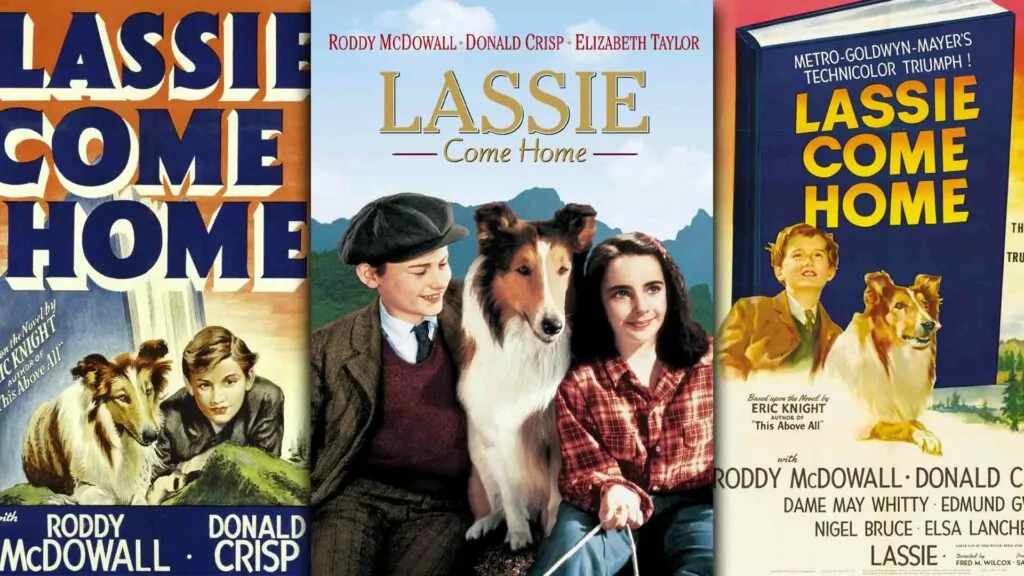
Lassie come home

Drama 1943 / 89 minuytes RATING: 8/10 No boy has ever had a more loyal and loving dog than young Joe Carraclough – each day when school is done, he can be sure his beloved collie Lassie will be there waiting for him in the schoolyard. Lassie is brilliant, too, able to tell time, bow on command, and carry Joe's school books. The two are inseparable. That comes to an end when the Depression hits England hard, and his family is forced to sell Lassie to the local Duke who has been trying to buy her for the last three years. Joe is crushed. But Lassie isn't away for long – the first chance she gets, Lassie escapes her kennel and heads back home. That'd make for a short movie, except that the Duke's dog handler knows just where to look for the missing dog, and takes her back from the Carracloughs. Twice. When the Duke takes Lassie to Scotland, it finally seems she is gone for good. But everyone is underestimating the loyalty of Joe's best friend. Lassie escapes again, and this time has to trek through wild forest, flee angry sheep farmers, swim through swamps, and fight off angry bandits. Thankfully, Lassie also meets some companions along the way, who help her when she most needs it. Cautions Lassie is attacked and bloodied, but the biggest concern here is what happens to one of her dog friends, a little mutt named Toots. When bandits ambush Toots' master, Lassie and Toots join the fight. They say it isn't the size of the dog in the fight but the size of the fight in the dog, but that doesn't prove true this time. The football-sized Toots gets kicked aside, never to get back up. That'll be a most unexpected tragedy to any children raised on modern fare. But Lassie Comes Home was made during WW II, and maybe everyone was tougher back then, including the kids. Those different sensibilities come out right at the start with the film's opening dedication to the author of Lassie Comes Home. We are told he, "survived the First World War as a British soldier, only to die in the Second World War, killed in the line of duty in the uniform of the country he had adopted... America. With reverence and pride, we dedicate this picturization of his best-loved story to the late Major Eric Knight." Yes, sometimes good men die for a good cause. So, would we expect less of a good dog? Conclusion This is the first and very best of the Lassie movies (and the only one to be nominated for an Oscar). And it is sure to make a dog-lover out of any boy watching. ...

Red heart icon with + sign.
Book Reviews, Graphic novels

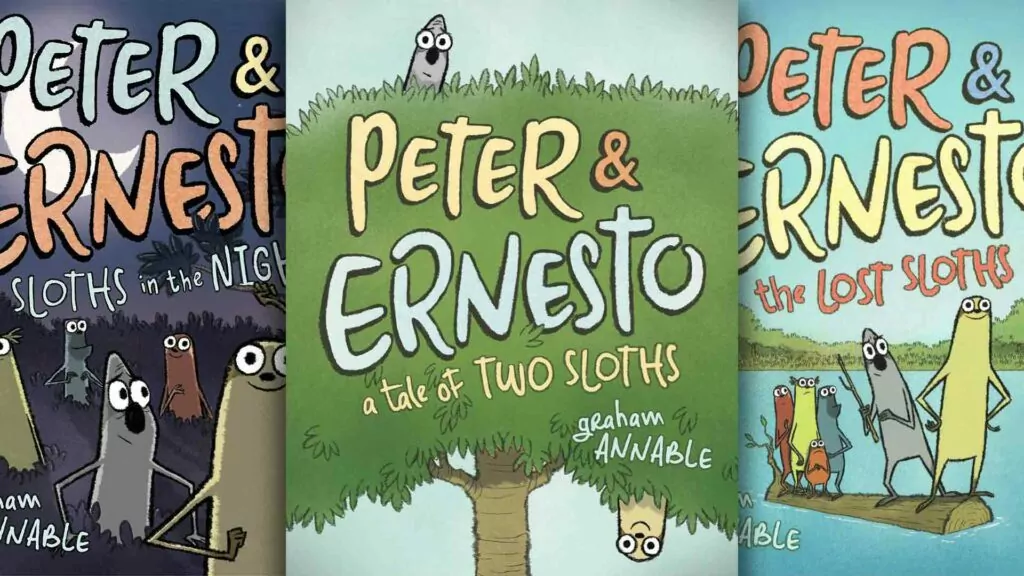
Peter and Ernesto: A tale of two sloths (3 books)

by Graham Annable 2018 / 128 pages Rating: Good/GREAT/Gift As this tale begins, two sloth friends are "cloud picturing" looking up in the sky for whatever shapes they can find: "Rabbit," "Bear," "Ooh that one looks a little bit like a weasel." It's a fun game, but it unsettles the bigger sloth, Ernesto. "I like this piece of sky," he tells his friend Peter, "But I must go... this is only one piece of sky, Peter. I want to see ALL of the sky! I must take a trip." Now, if you know a little bit about sloths, you'll understand why Peter is shocked. Sloths don't get out much, and what about the bears and lions? Peter is sure it must be dangerous!. But the Ernesto is determined to go. And with hardly a glance backward he is off. And his adventure starts almost immediately, as he ends up crossing the ocean on the back of a friendly blue whale named Louie. Peter is happy to stay behind... except that he is worried about his friend. So, some time later, he slowly, cautiously, and loyally sets out, determined to rescue Ernesto from whatever dangers are out there. He gets help too, from a friendly and encouraging parrot. More animals are encountered, and with exception of one slightly scary polar bear, all of them become new friends to the adventuring sloths. That makes this a gentle tale that kids in Grade One through Four will really enjoy, especially because at more than 100 pages, it is long enough to really savor.  There are two more in the series so far. In Peter & Ernesto: The Lost Sloths the friends’ tree gets taken out by a hurricane so they brave the forest to find a new home. And in Peter & Ernesto: Sloths in the Night the sloths set out to find a dragon. That might sound a little scary, but rest assured, this is another fun, gentle tale!...

Red heart icon with + sign.
Animated, Movie Reviews

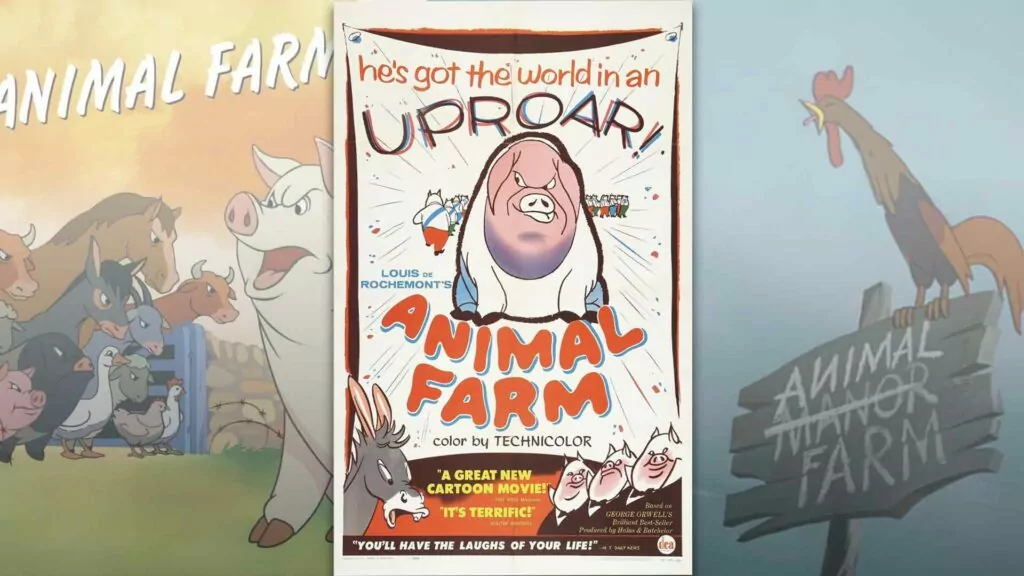
Animal Farm (1954)

Animated / Drama 1954 / 72 minutes RATING: 7/10 This is George Orwell's classic dystopian tale brought to the big screen. A farm setting is used to highlight a conflict between the "working class" – chickens, geese, cows, and pigs – and the wealthy, represented here by the farmer who owns everything. Orwell was anti-communist, but not blind to the problems of the arrogant elite who abused the poor, so his Farmer Jones here is a piece of work, shown whipping the animals in a drunken stupor. When Old Major, the most revered pig on the farm, calls a meeting, all attend. He gives a rousing speech, calling for solidarity against the oppressive farmer, and equality for all animals. But Old Major doesn't live to see the revolution he has called for – he punctuates his speech by collapsing at the end. But he has inspired action. The animals drive out Farmer Jones, and take over the farm for themselves. However, the animals soon learn the same lessons the poor Russians peasants learned when they overthrew the Tsar: being free of one tyrant isn't the same as being free. The pigs soon take the place of the farmer, because, after all, someone has to show some leadership. The pigs are soon eating the farmer's food, and sleeping in his bed too, even as the rest of the animals remain in the barn. All animals are equal, but some are more equal than others. Caution The cautions are of two kinds. Parents could see the trailer and think this could make for a good family night flick. While the simple 1950s animation does mute some of the violence, there are still creature killed both onscreen and off. At one point it is a full out war between a dozen armed humans and all the animals. Not a lot of blood is shown, but way too much for children. That's okay though, because this really isn't intended for an audience too young to understand the moral to the story. The other concern is that teens, and even some adults, might miss some of the nuance here, in part because of changes to the film that aren't in the book. This is a more hopeful version of the tale that ends with the dictator pig, Napoleon, getting overthrown, trampled to death by the other animals. In the book, it ends with the pigs still in charge, now making deals with the humans, and it is getting hard to tell the humans from the pigs and the pigs from the humans. The film's more hopeful ending was likely made because the film was, in fact, produced by the CIA. They may have wanted it to end on a more "democratic" note, the people rising up against their communist dictator. But Orwell's unresolved ending was likely meant to highlight the growing communist encroachment even in the West. And viewers will not get that from the film. But both book and film do critique the abuses that can happen under the arrogant. Orwell wasn't saying that the West was perfect and that only communism was a problem; he was highlighting that communism wasn't a solution to the problems happening in the West, and would only make things worse. Conclusion This is not a film to watch for entertainment; it rates only middling on that scale. But it is a great presentation of one of the more important novels of our time. At a time when "equity" is thought to be the ultimate goal, it's important to teach the next generation where that road really takes us. So, this would be a great one for 12 to 112. You may also be interested in Animal Farm: the Graphic Novel. ...

Red heart icon with + sign.
Family, Movie Reviews

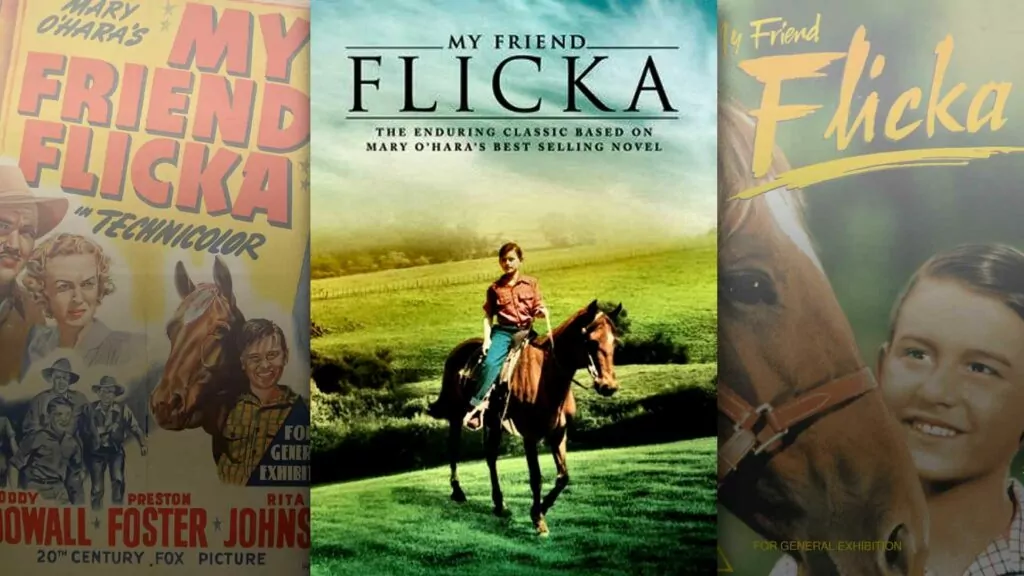
My friend Flicka

Family 1943 / 89 minutes Rating: 7/10 All Ken wants is a colt of his own, and seeing as his dad raises horses, that doesn't seem an unreasonable ambition. But all Ken's father wants is for his son to start using his head, and he's not sure when or if that's ever going to happen. The boy's fifth-grade report card is impressive in the worst possible way – Ken managed to get a zero in English. He daydreamed his way right through the hour-long test and never even got started. So it's against his better judgment that stern poppa does indeed give his underachieving son his choice of a colt. But dad is left shaking his head once again when his son picks Flicka, a colt from the most "loco" mare on the ranch – Ken has picked a colt that may not even be tameable! And shortly after getting picked, Flicka proves just as wild as the father feared, running straight into a barbed wire fence. There is a silver lining – the injured colt needs attention, and Ken shows himself both willing and able. Might this daydreaming boy be on the way to becoming a young man? Cautions Parents will want to know that one of the horses, a wild mare named Rocket (Flicka's mom), dies suddenly midway through the film. I was surprised – I figured the horse was just stunned, and even reassured our kids it would recover. But nope. This was shot in World War II so I think the times may have resulted in kids then that were made of a little sterner stuff, so one horse getting killed might have been no big deal to them. But it might be a bit of something to some of our sensitive ten-and-under kids, who have grown up on children's fare where the peril never results in anything permanent. Rocket's death makes Flicka's own brush with death – at one point dad gives the order to put him down – much scarier than it otherwise would have been. Shucks, it seems like there's no guarantees in this movie about who is going to make it to the end. But parents can reassure their kidlings that Flicka will indeed make it. Language concerns are limited to a few "doggone it" and "gee whiz"s. Conclusion One modern-day reviewer celebrated this as a "great movie for kids with no... sex, drugs or cursing." It is that. But it is also an older film that doesn't have the frenetic pacing of most of today's kids' stuff. That means it might test some children's attention spans, but that could be a very good thing. I'd suggest it for 10 and over, but I'm not quite sure whether its hundreds of horses might make this a great one for horse-crazy girls, or whether the death of Rocket might mean they'd be the worst possible audience. I'll also note that in our family of five, three quite liked it, one fell asleep, and one was quite distraught over poor Rocket. So, if you're looking for a sure-fire bet for family movie night, this might not be it. But if you want something from a more decent time, this could fit the bill. It's full of characters with character, whether that's a stern but loving dad, a compassionate capable mom, respectful ranch hands, or even the son, a kid who isn't measuring up but wants to. Check out a brief clip below. ...

Red heart icon with + sign.
Assorted

Puppy love: in praise of pets

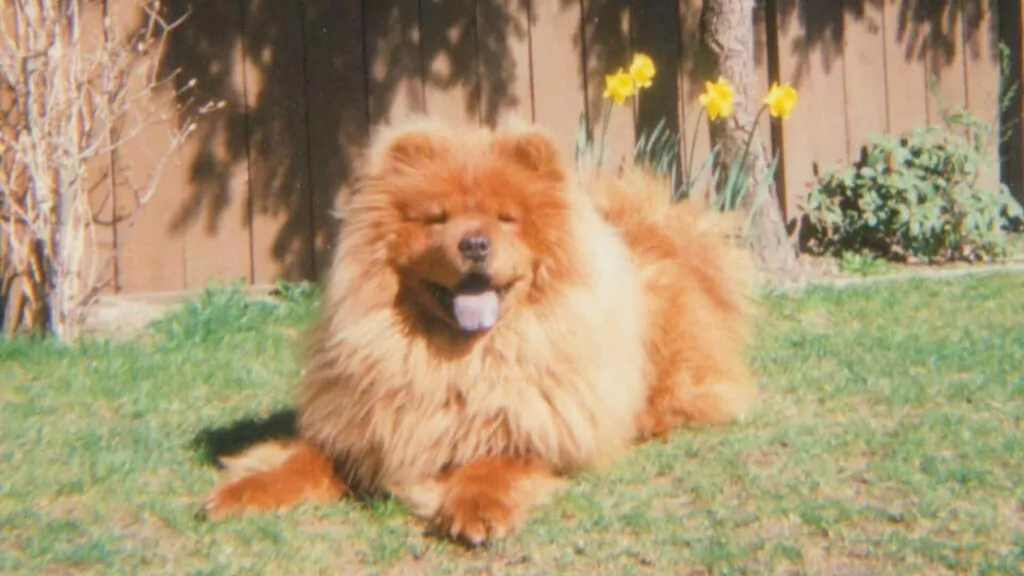
The inimitable Cody I was lucky enough to share my growing-up years with a big red chow chow. After deferring my request to get a dog for some time, my parents finally gave me the go-ahead when I was twelve; by this time I was old enough to take responsibility for a dog, and my paper-route and babysitting money would be enough to cover dog food and vet check-ups. My dad built a sturdy doghouse, we visited a shelter or two, I scoured the pet section of the classified ads, and eventually Cody joined our family. It had pretty much been love at first sight, and Cody was my faithful companion for the next thirteen years. He knew the sound of the school bus stopping a street away, and was always eagerly waiting for me when I got home. Our nightly walks were a calming and peaceful part of my day. Cody and I even won a pet/owner look-alike contest once (after an unfortunate hair experiment . . . the kit was supposed to turn my hair more blonde . . .) Cody’s been gone for many years now, but I’ve been thinking about him lately, and about the unique place that dogs and other pets can have in our lives. As humans, we’ve been created with a deep need for things like companionship, connection, and physical touch. And although pets can’t (and shouldn’t) replace human relationships, there’s something beautiful and simple about the love they give us: it’s unconditional and uncomplicated by the things that can add stress to human interactions. Dogs don’t judge or hold a grudge or carry anxiety-inducing expectations. I asked a few friends and family members about what their dogs meant to them, and quickly discovered that people love to talk about their furry companions, share photos and stories, and reminisce about past loved pets; “I could talk about our dogs all day!” commented one of my friends. And I loved hearing their stories. Cocoa Cocoa: a beautiful rescue One of my sisters-in-law, for example, told me about an abandoned dog named Cocoa that stole her heart. My sister-in-law spent some time living up north in Fort Smith, NWT; a lifelong dog lover, she regularly volunteered at the local dog shelter there. One evening she noticed a new arrival, a beautiful black mixed breed with brown markings, but was saddened to see the sign outside his pen: “Be careful, aggressive dog; don’t allow out with other dogs.” This angry, wary dog was slated to be euthanized the next time the vet came around, as he was too difficult for the volunteers to handle, and unlikely to find a new home. When she gently approached the dog, she found him scared and timid, but not vicious. Over time they formed a bond. The other volunteers noticed a change in Cocoa, and the plans to euthanize him were put on hold. Unfortunately, my sister-in-law’s rental didn’t allow pets, but she ended up moving just so she could adopt him. “He brought me companionship and friendship while living in such a remote Northern little town,” she remembers. “He brought me joy knowing he was happy and loved and able to live out the rest of his short life . . . knowing what being loved felt like.” It’s that combination of giving and receiving love that seems to be at the heart of the bond we have with our pets; they give us boundless affection, but they need us too. Both aspects are good for us. Luisa Luisa: takes good care of her owners One of my brothers says that having his dog Luisa (a rescue dog that he and his wife adopted a few years ago) is like living with a toddler in many ways: “Her needs come first.” He feels that dog ownership can lead to a certain sense of purpose and a more selfless attitude to life. When I see devoted dog owners trudging through the rain with their dogs, or going through the undignified process of cleaning up after them, I’m inclined to agree. Do our pet interactions cultivate character traits in us that, ultimately, help us in other relationships and areas of life? I would suspect so. Studies on the emotional, psychological, and even physical benefits of owning a dog or other pet have noted decreased stress and depression, and even lower blood pressure and better cardiovascular health. A truly objective study is almost impossible to design – what is cause, and what is simply correlation? – but the immediate benefits of positive pet interactions have been more definitely demonstrated. Simply petting a dog can reduce the stress hormone cortisol, and time spent with a loved pet raises levels of oxytocin, a feel-good hormone associated with bonding. And when stress goes down, other health markers tend to improve – with the reverse also true. Cypress and Winston Cypress: a gentle and calming companion Another sister-in-law initially had mixed feelings about bringing a dog into their home, after several years without one. Her teenage kids are growing up and building lives of their own, and she felt like they were past the little-kids-and-a-puppy-in-the-backyard stage of family life. But Cypress, a gentle “Goldendoodle,” has been a blessing to all of them. When her seventeen-year-old son has something on his mind, he’ll find Cypress for some “dog love,” and my sister-in-law says she can just see her son’s tension drain away. She says when she’s feeling stressed, Cypress will seek her out. Getting outside for regular walks with Cypress has also been beneficial. And coming home to a house that was getting to be a little too empty, but isn’t anymore, lifts her spirits. Others I’ve talked to agree that dogs seem to have a “sixth sense” about their owners’ moods, and are quick to comfort and give affection. My brother says that Luisa can seem to tell when he’s had a more difficult day at work; when he walks in the door, he gets an extra dose of exuberant affection. One of my friends, reflecting on her “Westie,” Winston, puts it this way: “He is completely devoted to me, always attuned to my mood. He celebrates with me when I laugh and comforts me when I’m sad.” Not surprisingly, the benefits of dogs or other pets is most noticeable among those who may be lonelier or struggling in some way. Pets provide companionship and that vital physical touch we all need; pets can also give a sense of purpose and structure, remind us that we’re needed, and take our minds off ourselves. A dog can be the catalyst that prompts a lonely senior to get up, get outside, and engage with life – all of which are good things that often lead to more good things. Pets in their place The affectionate and exuberant Winston Of course, pets replacing human relationships is problematic; the “pets instead of kids” phenomenon is disturbing, as is the astronomical amount of money that North Americans spend on their pets (Americans spend upwards of $100 billion every year). But in their place, pets are a unique blessing. God as our loving Father knows what we need, and delights in giving us the good gifts of His creation. And surely the human-pet bond is one of those gifts. As for me, I haven’t had a dog since Cody died. Family life is already busy and full. Do we really want to take on the time commitment and expense of a dog? Do I really want to vacuum that much? On the other hand, how can we argue with all those endorphins? For now, we’ve gotten some guppies, and our nine-year-old daughter is campaigning for gerbils. A slippery slope? Time will tell whether there will be any four-legged friends in our future . . . but either way, I’ll always be grateful that there was one inimitable chow chow in my past....

Red heart icon with + sign.
Book Reviews, Graphic novels

Allergic

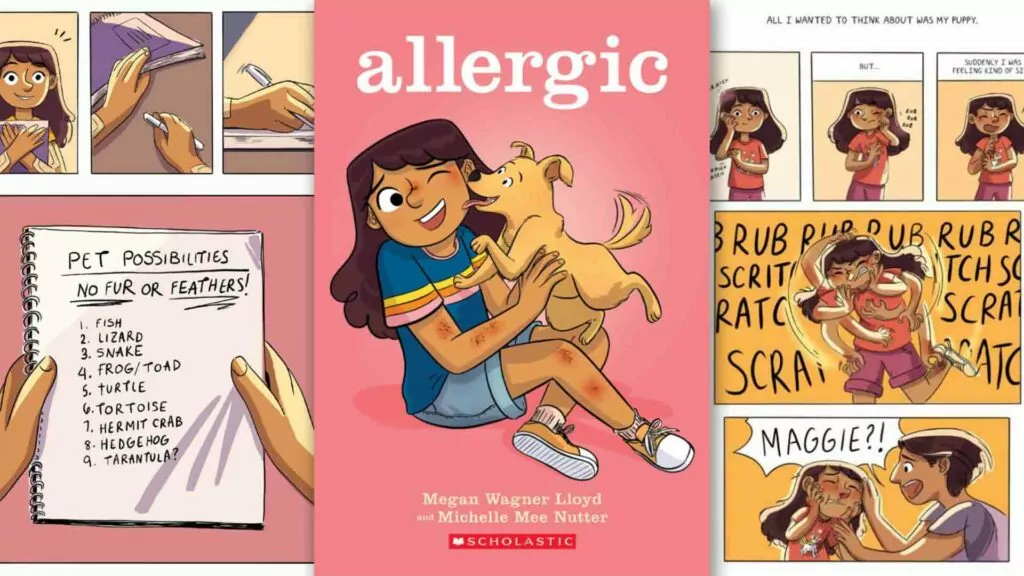
by Megan Wagner Lloyd illustrated by Michelle Mee Nutter 240 pages / 2021 Rating: Good/GREAT/Gift It's Maggie's 10th birthday and she's finally going to get the puppy she's always wanted! Of course, she's ready the moment she's dressed to head out to the animal shelter, but it takes a bit of prodding to get mom and dad out the door. Mom is pregnant and has to get her exercises in, and both her parents are more than a little distracted prepping for the baby's arrival. Maggie wants a puppy in part because she figures her parents are going to be focused on the baby and not her. Her younger twin brothers have each other, and Maggie figures if she has a puppy then she'll have her own best friend and someone who'll always pay attention to her. Those are big expectations for a little pup! The first plot twist is that, after finding just the puppy she wants, Maggie discovers she's allergic. And not just to this pup but everything with fur or feathers! Maggie is devastated. And feeling extra lonely. But she isn't defeated. Not all pets have fur and feathers, so Maggie makes a list and starts investigating options like turtles, hedgehogs, lizards, and even a tarantula. None of them are a good fit. Just when Maggie is feeling her lowest, a new girl and her dad move in right next door. Claire is just a grade older than Maggie and looking for a best friend – it's a wonderful match! Second plot twist: Claire gets a dog not realizing that means Maggie can't come to her house anymore. It's quite the rollercoaster ride for Maggie, with another big up and down to follow soon after, but thankfully it does end on a high happy note. Cautions There are a few cautions, mostly minor, with maybe the most notable simply that at one point Maggie sneaks a mouse and cage into her room without her parents knowing. Going behind your parents' backs isn't behavior we wanted modelled for our kids, but I'll add that Maggie gets her comeuppance. She thinks she knows better than her parents about what's good for her, but as the itching gets worse and worse, she discovers her parents really do know best. Language concerns amount to five instances of "OMIGOSH." Other considerations: the mom does yoga, but that pops up once, for a of couple pages, and then is over – the spiritual element isn't really hit on – and it's mentioned that the next-door neighbor's parents are divorced, but we're never told why. Another caution concerns the impact Maggie's disappointment might have on sympathetic young pet lovers. I'm sure this will get some sensitive souls crying on Maggie's behalf. Conclusion There are a number of pluses for this book, including the general education it offers on allergies. Maggie meets a boy at school who has his own food allergies, and we follow along as she gets her desensitization shots. As more and more kids these days seem to be getting various allergies, this is a book to show them that they are not alone in their struggles. And it can also clue classmates in on how hard those struggles might be. The reason I might buy this for my own kids (even though it is available at the library) is because a lot of kids' fiction today is about angst – about how no one else in the world understands them. That's something to watch out for because it reinforces an idea that's common enough, but isolating. What kid is going to turn to their mom or dad if they think their parents just don't get it? What I really liked about Allergic is that the parents, even when they are distracted and busy, aren't just written off as irrelevant. Maggie thinks no one is paying attention to her and that she's all on her own, but she learns that she's actually got it wrong. I'd say that's the moral to this story, but I'll also add that this point might evade many a young reader. But this is such an engaging story that I think you can count on your kids eventually getting it, because they're going to read this one again and again....

Red heart icon with + sign.
Book Reviews, Graphic novels

Hippopotamister

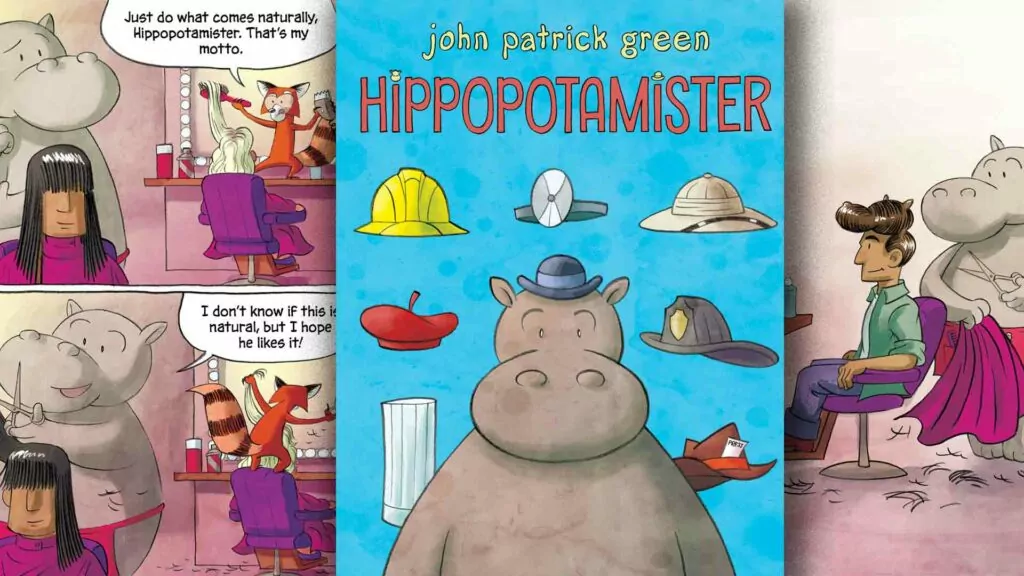
by John Patrick Green 88 pages / 2016 Rating: Good/Great/GIFT Hippopotamister isn't strictly a comic or a picture book – it is as much the one as the other – but regardless, it sure is fun. Hippo and Red Panda live in the City Zoo, which is falling down around them. Not only are the gates and habitats falling apart, the lion's mane "wasn't very regal" and "the walrus's smile wasn't very bright." So Red Panda decides to leave the zoo and get a job among the humans. And every now and again he comes back to the zoo to tell Hippo that "Life outside the zoo is great!" An observant child is going to notice that while Red Panda is always enthused, he's also always holding a different job whenever he reports back. It turns out, as we learn when Hippo finally decides to join him on the outside, that Red Panda is great at lining up new jobs, but not so great at holding on to them. So every day it's a new job and a new hat, and a new and funny way for Red Panda to mess up and get himself and Hippo fired once again. Hippo, though, turns out to be quite skilled at all sorts of jobs, and after trying on all sorts of hats, realizes that he might be just what his failing zoo is looking for. Maybe he can run it! The story concludes happily, bringing Red Panda back home, too, with a job that suits his own unique talents. CAUTION The only possible caution I can think of is that at one point Red Panda, instead of catching fish, ends up with a mermaid that may or may not be topless - we can't tell because she has her arms strategically and tightly crossed (see the picture). This is the only picture that is even mildly risqué. CONCLUSION Hippopotamister is a sweet funny story that any child in the early grades will enjoy, and it might be just the thing for a reluctant reader. RELATED REVIEWS: more picture book/comic book crossovers A great riff off of Abbot and Costello's famous routine Who's on First? I don't know anyone who doesn't enjoy the Elephant and Piggie series Mo Willems has another fun one with Don't Let the Pigeon Drive the Bus ...

Red heart icon with + sign.
Documentary, Movie Reviews, Watch for free

Dolphins: Tribes of the Sea

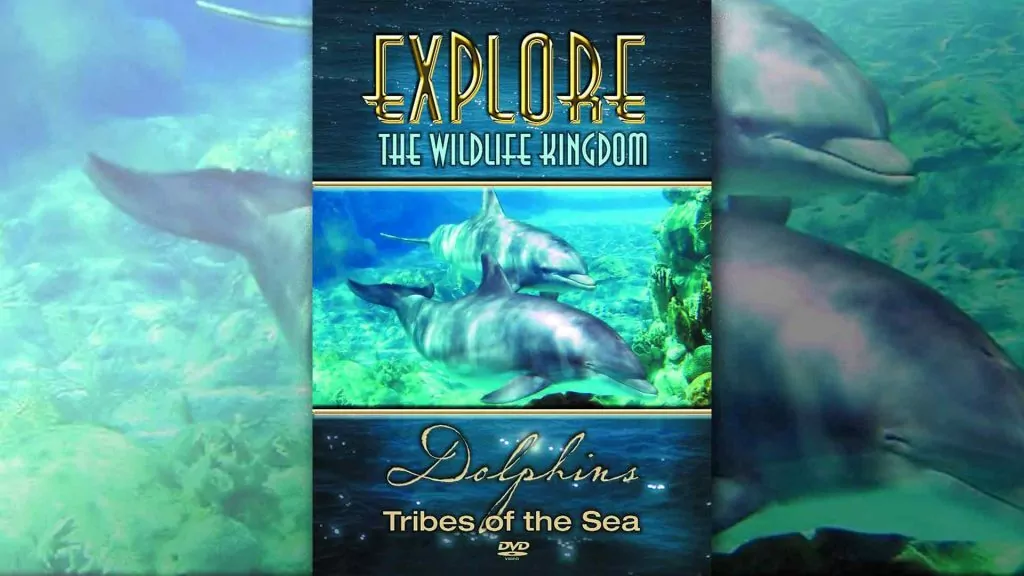
Documentary 2006 / 41 minutes RATING: 7/10 Did you know dolphins can use their echolocation – their own version of sonar – to tell what's inside a sealed wooden box? They use this echolocation to not just find fish, but they might even use it to stun them! The footage here is wonderful, diving down deep with these speedy swimmers. We also get close to them in the research pool where we get to learn how researchers are able to communicate back and forth using sign language. It comes out clearly, these are brilliant animals! One oddity is that while the film's producers are Christians, this is not a Christian presentation. God is never named and the closest thing to a religious reference comes at the end when we are invited to join them again next time as they "journey into the kingdom of creation, a place where nature tells its own story and reveals to us wildlife's incredible design." But if the documentary is sadly shy about naming the Creator and Designer, it is also thankfully free of any inserted evolutionary assumptions. Even as one amazing ability after another is shared, there's no nod to millions of years or random chance as an explanation for how dolphins got so clever. It's got none of that. So, what we do have here is loads of wonder, no evolutionary foolishness, but also no glory given to the Creator. As to the last missing element, viewers can bring that. This is a wonderful introduction to these astonishing swimmers, and you and your family won't be able to not praise their Creator! If you like it, you'll be interested to know there are other episodes in this Explore the Wild Kingdom series that can also be watched for free. I haven't had a chance to watch them yet myself, but share them here: Cougar: Ghost of the Rockies (50 min) Wildebeest: The great African migration (50 min) Lions: Kings of Africa (49 min) Golden River: Secrets of the Amazon (49 min) The hidden world of Africa (49 min) And you can watch Dolphins: Tribes of the Sea for free below. ...

Red heart icon with + sign.
Book Reviews, Graphic novels

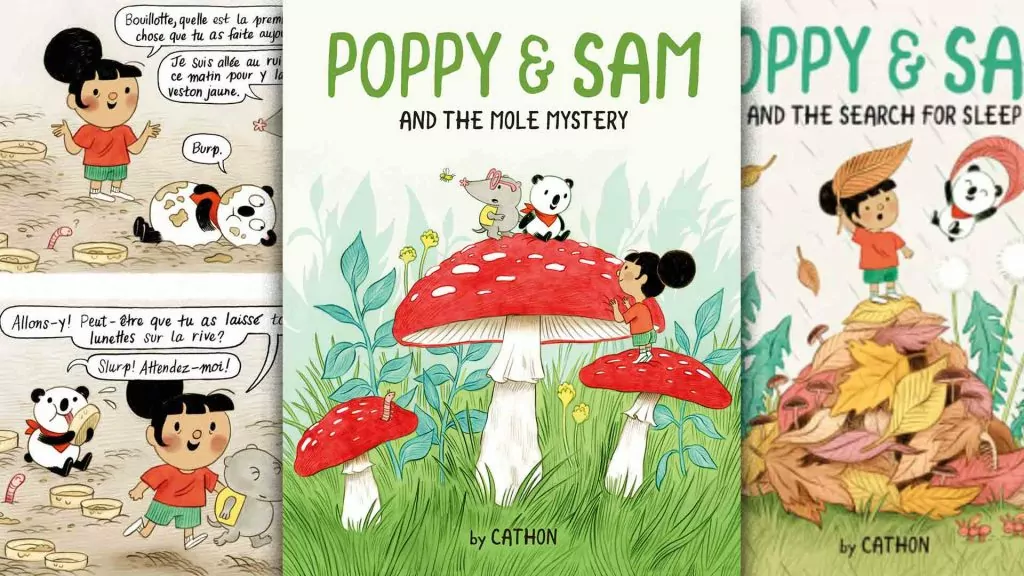
Poppy & Sam and the mole mystery (3 books)

by Cathon 2019 / 42 pages Rating: GOOD/Great/Gift A little girl Poppy and her talking panda friend Sam are either very tiny, or they live in a land of giant people-sized mushrooms and strawberries. Whatever the answer, this is a charming book, with the twosome setting out to find their friend mole’s lost glasses. Along the way they discover all sorts of other lost treasures, start a “lost and found” and provide a happy ending for mole and the many others who now have what they were missing. It is a kind, whimsical, story. There have been three sequels so far. In Poppy & Sam and the search for sleep (2020, 42 pages) little Poppy and her panda friend settle down to hibernate for the winter. But she can’t fall asleep, and so goes off to gather advice from the animals all around on how they get to sleep. It’d make for a fun bedtime read. Poppy & Sam and the hunt for jam (2023. 44 pages) sees Sam wake up early from hibernation with an urge for some rosehip jam. But the ingredients are still hiding under the snow, so this is going to be more difficult than he first thought. Still, with a little help from some friends, including a full size bear – why is the bear the right size, and panda Sam the size of a mouse? I don't get it, but it's fun – a yummy result is had. Only caution: Sam use one mildly problematic word, wondering  "where did that darn pot get to." Another sequel, Poppy & Sam and the leaf thief is a bit too peculiar for me – the twosome are trying to track down which animal is eating leaves from their friend, Basil, a basil plant. It didn't strike my wife as quite as odd, since Basil was actually happy to give away his leaves to any who asked, rather than just took. But I am still stuck thinking friends really shouldn’t eat friends....
Red heart icon with + sign.
Family, Movie Reviews

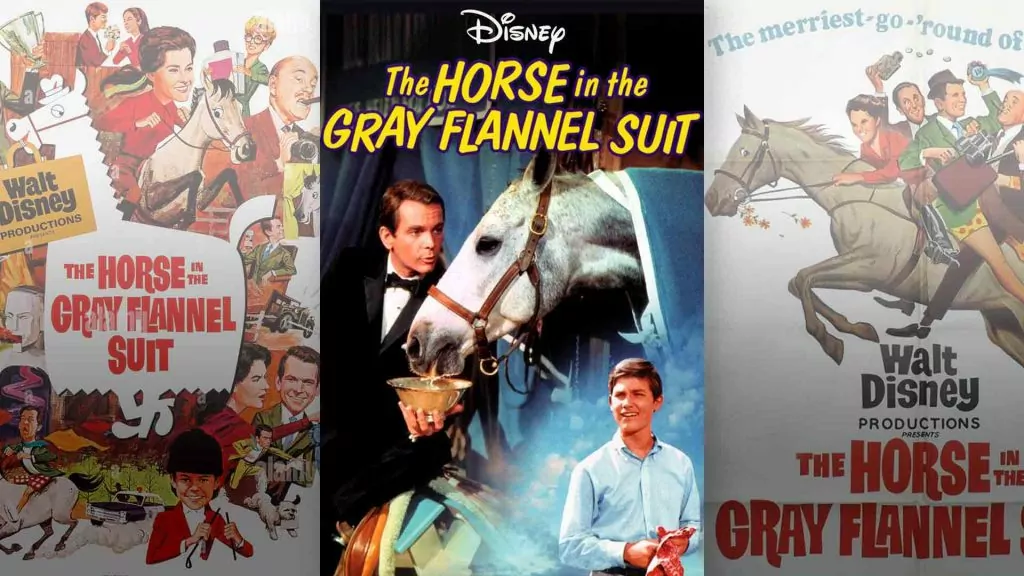
The Horse in the Gray Flannel Suit

Family / Romance 113 minutes / 1968 Rating: 7/10 Horses, humor, and a little romance will make this one a favorite among the preteen girls in your family. Frederick Bolton is a single dad (no mention is made of mom, and it's probably most logical to assume she died some years back) and an advertising executive, and trying to do his best to juggle his responsibilities. So when his daughter Helen asks him for a horse so she can stand a better chance in the horse jumping competitions, and his client wants an inventive way to promote their product, he hits on quite the creative solution. His daughter will get her horse, and they'll name it Aspercel, after his client's product, a remedy for upset stomachs. There is one hitch, though: to make the client happy, Aspercel will have to make regular appearances in the winner's circle, so as to get the publicity they're after. That's the crisis the movie pivots around. Helen is quite talented, and with a little help from her riding instructor, she's got just what it takes to win. But when she finds out that her dad's job depends on her winning, she can't handle that pressure. And, fortunately, her dad doesn't want her to have to deal with it either, even if it does cost him his job. This could have been a dumb movie if dear old dad hadn't stepped up... because it did take him a bit of time to do so. But a loving, if occasionally clueless, father he is indeed. But how is everything going to turn out all right in the end? Well, I won't give it all away, but I will share that the riding instructor, Miss Suzie Clemens, is both willing and able to ride to the rescue! Cautions One odd moment in the film occurs near the end, when Suzie gratefully plants a big kiss on one man, right before she becomes engaged to another. We're not the only ones confused, but the confusion lasts only for a few moments, and perhaps we have to write it off as different cultural habits? Conclusion If you're wondering about the odd title, it doesn't come from anything in the film itself. The horse never wears a gray suit or anything else gray either (though I guess he's kind of a speckled gray himself). The title is borrowed from a movie of 12 years earlier, The Man in the Gray Flannel Suit. Why they borrowed it, I don't know, as the two films are completely unrelated, and intended for different target audiences too. Some critics faulted The Horse in the Gray Flannel Suit for predictability, and it is guilty as charged. But for a family film, that's not such a bad thing – the kids will know where it's going and enjoy the ride. There is also fodder here for parents to discuss how competitive is too competitive, and how sports can't be allowed to take over our lives. So, overall, a nice night's entertainment. While the DVD is readily available (maybe at your local public library) there doesn't seem to be a trailer available online....
Red heart icon with + sign.
Science - Creation/Evolution

Masters of disguise!

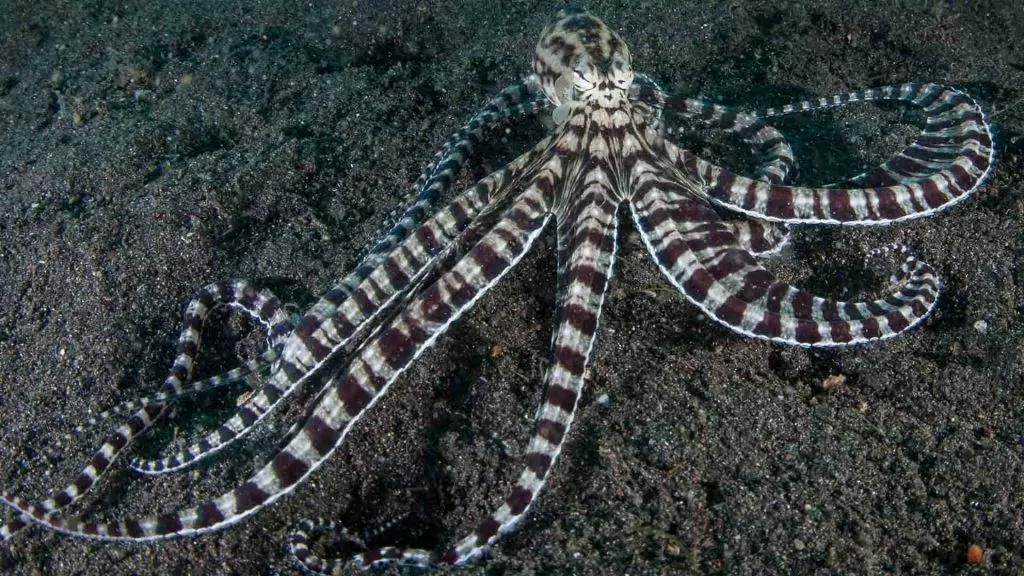
“Poppa! Have you seen the Mimic octopus?” My oldest granddaughter’s question was lit with excitement. I had been mentioning a presentation I was working on featuring animals with incredible design features, highlighting that some of them were incredibly difficult for evolutionists even to begin to explain. When I mentioned squid and octopus camouflage, her question above popped out. My response of “I don’t think so” initiated a frantic scramble for a nearby phone and a hasty search on YouTube. What I watched for the next minute and forty-nine seconds1 left me with my mouth agape and led eventually to a salt-water aquarium in my home with one of those very creatures inhabiting it. (It’s amazing what homeschoolers learn about!) Like a second skin Even the “average” octopus species is truly incredible, capable of rapid color changes a chameleon could only dream of. Like a pixelated video screen, flashes of light can erupt from their skin surface, sometimes pulsating and other times creating waves of shadowy patterns that make them almost impossible to spot along the ocean floor among its corals and sea plants. They are capable of texture changes to their skin that are downright eerie, which means not only can they simulate the color of objects in their surroundings but also the shape of them to an extent. Rather than describing these creatures’ sophistication and complexity as simply a reflection of the brilliance and glory of their Creator, some naturalists have attempted to explain some of their intricacies as being alien in origin. So “advanced” are these creatures’ abilities (and yet so early do they appear in the evolutionary timeline, supposedly 296 million years ago2), some evolutionary scientists have seriously suggested they perhaps had biological input from alien lifeforms at some point in their “evolution”!3 The mimic octopus’s most impressive copying act is its take on the flounder. It even undulates across the ocean floor just like the founder does. Why do you act that way? But as amazing as “regular” octopi are, the mimic octopus is in a class by itself: it’s the first living thing ever observed to impersonate the shape and behavior of other aquatic species along with color and texture changes. Discovered in 1998 off the coast of the island of Sulawesi (Indonesia), it’s been spotted now as far as the Great Barrier Reef in Australia, so may be more widespread than originally thought.4 Many of the creatures it imitates are venomous, so it fools predators into thinking they are encountering a dangerous adversary rather than a sly cephalopod. The exact number of creatures it’s able to mimic is unknown, but watching video of one hide its body and six legs in a hole, change the color of its two exposed arms to the distinctive black and light stripes of the banded sea snake, and then waving them in opposite directions to impersonate a striped serpent is unnerving to say the least! Known “avatars” the mimic imitates include flatfish, crabs, jellyfish, mantis shrimp, stingrays, lionfish, and sand anemones. The uncanny thing about these octopi is that they seem to be able to make accurate and intelligent decisions as to what creature they should imitate depending on the environment they are in or the predators they encounter. For example, because damselfish are hunted by banded sea snakes, mimics often adopt their “snakelike” form, color, and behavior when they encounter damselfish to frighten them away. When traveling across a seabed with little cover, mimics may transform their tentacles to look like the poisonous barbed fins of a lionfish and imitate its pulsing, distinct movement so as to ward off predators. The mimic octopus will burrow down, leaving just two of its tentacles visible, to do a decent impression of the banded snake eel, on the right.  The quick-change artist When considering this creature’s day-to-day activity, you quickly realize it has several sophisticated abilities that depend on accessing and activating tremendous amounts of coded, genetic information. Sensor array: Obviously, the mimic must be capable of monitoring and analyzing its current environment constantly. Response analysis: It must also have the ability to determine an appropriate response(s) needed in different environments or when encountering specific predators it interacts with. (I.e., if A, then B; if X, then Y, etc.). Catalog of aliases: Once a specific creature to mimic has been decided upon, it must then access other detailed “files” for all of the abilities, features, and behaviors of the different creatures it can possibly mimic. Immediate response: The mimic’s systems must then correctly activate commands to alter its shape, color, texture, and movement, which of course requires a body that has the capability to expand or contract, become smooth or rough, rigid or soft, multi-textured, multi-colored and/or precisely patterned almost instantaneously. The pic on the left doesn’t capture the mimic's best lionfish imitation but gives a feel for how it can masquerade as the poison-tipped predator on the right.  Meet “Morph” I named my own mimic, procured from a local pet store, Morph. Morph lived for eight months, but he exhibited spectacular behavior and executed many brilliant performances during that time, with nightly “light shows” being commonplace. Although very shy for the first three days I had him, he became more comfortable, and I was able to hand-feed him shrimp for his supper eventually. Because octopus aquariums are typically a one-species environment (either the octopus eats whatever else is in there or they get eaten by what is), he only “mimicked” once, as there was nothing in the tank to react to. Upon entering my tank for the very first time, Morph impersonated a jellyfish, slowly pulsed down, and then switched to his regular form once he had cover. This made sense, because upon entry he was at the top of the tank with nowhere to hide and didn't know if there were predators in that environment. Note that his mimicry involved imitating another creature not immediately present in his environment (rather than simply blending into the background), which leads to the question, how did he “know” what to do? Mimic octopi are only thought to live nine months (the longest-living octopus live for a maximum of five years), so scientists don’t believe they are simply observing and copying other creatures’ behavior; they are born with it. Which means all of that programming is already present and passed on to each subsequent generation. But how could that have come about? Masterful design Consider this: If a person today were to create and program a mechanism that could perform half the functions this creature does, they would likely receive all of the accolades the scientific community could possibly bestow upon a human being, and probably hail them as the most brilliant scientist on the planet. Their creation would be highly esteemed as an incredible example of intelligent design. However, despite the obvious evidence of design in nature, naturalists seem bound to evolutionary interpretations. One evolutionary blogger from Nature.com tried explaining the mimic this way: "In this species we see the evolutionary 'perfect storm' in which a species with flexibility in their skin and body shape is consistently exposed to a predator-rich environment that contains toxic or venomous species such as soles, lionfish and banded sea snakes. This combination provides both the selective pressures and the opportunity to these otherwise vulnerable animals to evolve into the world's greatest masters of disguise!"5 But that isn’t a real explanation of anything. It’s like saying because evolution is true, evolution happened. But design requires a designer, and programming requires a programmer. Natural selection or genetic mutation are simply not sufficient explanations for what we see in creatures like the mimic octopus. And despite evolutionists concocting many “just so” stories to attempt to explain how so many precisely coordinated and irreducibly complex mechanisms could have arisen in creatures without a designer, for those with eyes to see, the conclusion is obvious. "But ask the beasts, and they will teach you; the birds of the heavens, and they will tell you; or the bushes of the earth, and they will teach you; and the fish of the sea will declare to you. Who among all these does not know that the hand of the Lord has done this?" (Job 12:7-9) The master designer, the God of the Bible, created these along with all of the other magnificent sea creatures on day five of creation. As much as evolutionists try to mimic God’s creative power through the story of evolution, creation declares its Creator, even in an insignificant octopus! Be sure to check out the 3-minute video below. Footnotes 1 Most intelligent Mimic Octopus in the world, https://www.youtube.com/watch?v=t-LTWFnGmeg 2 Rachel Nuwer, “Ten Curious Facts About Octopuses,” Smithsonian Magazine, October 31, 2013, https://www.smithsonianmag.com/science-nature/ten-curious-facts-about-octopuses-7625828. 3 E. Steele, et al., “Cause of Cambrian Explosion—Terrestrial or cosmic?” Progress in Biophysics and Molecular Biology136 (2018):3–23, doi:10.1016/j.pbiomolbio.2018.03.004. 4 “The Mimic Octopus,” National Geographic, www.nationalgeographic.com/animals/invertebrates/m/mimic-octopus. 5 Sarah Jane Alger, “The Mimic Octopus: Master of Disguise,” October 28, 2013, https://www.nature.com/scitable/blog/accumulating-glitches/the_mimic_octopus_master_of. Picture credits from top to bottom: VelvetFish iStockPhoto; VelvetFish iStockPhoto.com; FtLaud Shutterstock.com; Stephan Kerkhofs, MariusLtu, Jenhung Huang, and Vitalii Kalutskyi, all iStockPhoto.com This article was written by Calvin Smith , is published with permission, and originally appeared at https://answersingenesis.org/blogs/calvin-smith/2020/09/07/masters-disguise....
Red heart icon with + sign.
Documentary, Movie Reviews, Watch for free

The Riot and the Dance: the TV series

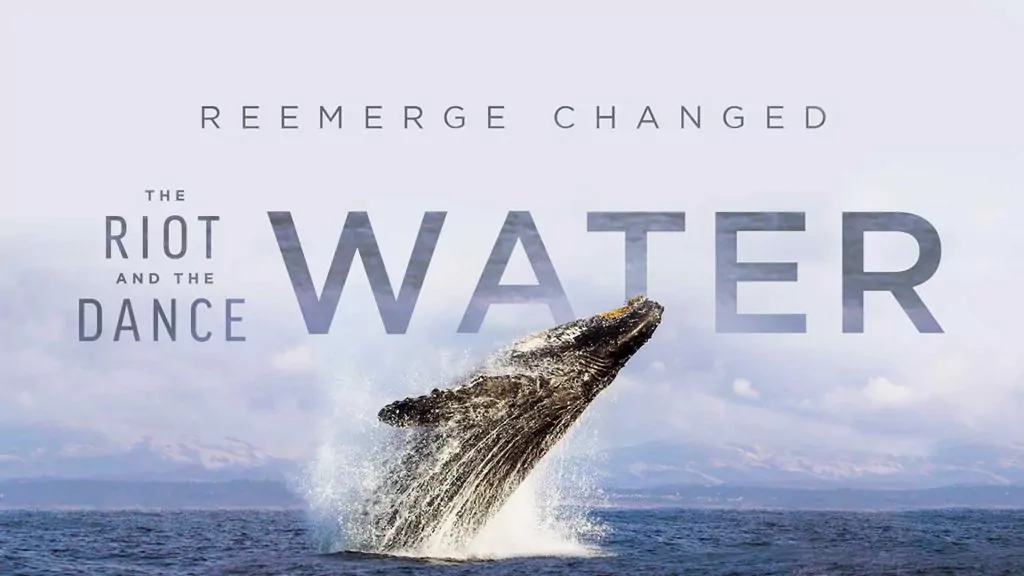
TV series 2022 / 30 minutes RATING: 9/10 The folks who brought you the documentaries Riot and the Dance: Earth and Riot and the Dance: Water are now hard at work creating a TV series and you can watch the pilot episode for free now. This is God's creation accompanied by a classical/rap soundtrack, and viewed through the eyes of a poet and an adventurer. The narrator, Dr. Gordon Wilson, shares that while he teaches a marine biology class, he "needed to go back to school for this film - scuba school!" Why? "I don't want to just sit back and narrate over some pretty picture. I wanted to get as close as I can to as many divinely crafted underwater miracles as possible." First up is an encounter with a round-eyed, chubby-looking, hard-shelled critter. Dr. Wilson can't help but gush: "I love turtles, their eyes, their beaks, their scales like tiles on a fancy floor. What hilarious cartoon characters they are, and what a fantastic cartoonist God is." Next up is a dip down into shark-infested waters, and with no cage to protect him or his crew. Isn't that crazy? Wilson had this reply: "Many, many people have asked why we got in that water with sharks, especially without a cage. The thing is they're amazing. They have an extra sense - electroreceptors that detect even very small disturbances in the water. We saw them respond to a single leaf that landed on the surface of the water.... We need to stop being so distracted at how frightened you're supposed to be, open your eyes and look intently and see their amazing design!" This is creation depicted in a very unique light. Many a Christian nature film will focus more on rebutting evolution than celebrating creation. Or they'll go in the other direction, and celebrate the creation but fail to mention the Creator. Riot and the Dance gets it right on both counts, with nary a mention of evolution, but all sorts of admiration expressed for the God Almighty who can make these marvels. But in addition to the wonder and the intricate dance we see performed throughout all of God's creation, there is also the riotous nature of our fallen world. So it is that we have deadly sharks. And also a giant water-bug that can liquify the insides of a frog many times its size and drink it like an "amphibian-flavored Capri Sun - a frog-shaped juice box." Afterward, we get to briefly gape at a breaching humpback whale, and then swim up close with sea cows. These are quick but amazing clips. And then we're done. This is only a half-hour show, but the first of what they hope will be many. And I do too. You can watch this pilot episode below for free, and if you like it you may want to rent their first feature film: Riot and the Dance: Earth. Their second, Riot and the Dance: Water, can be watched for free here. ...
Red heart icon with + sign.
Documentary, Movie Reviews, Watch for free

Life's Story: the one that hasn't been told

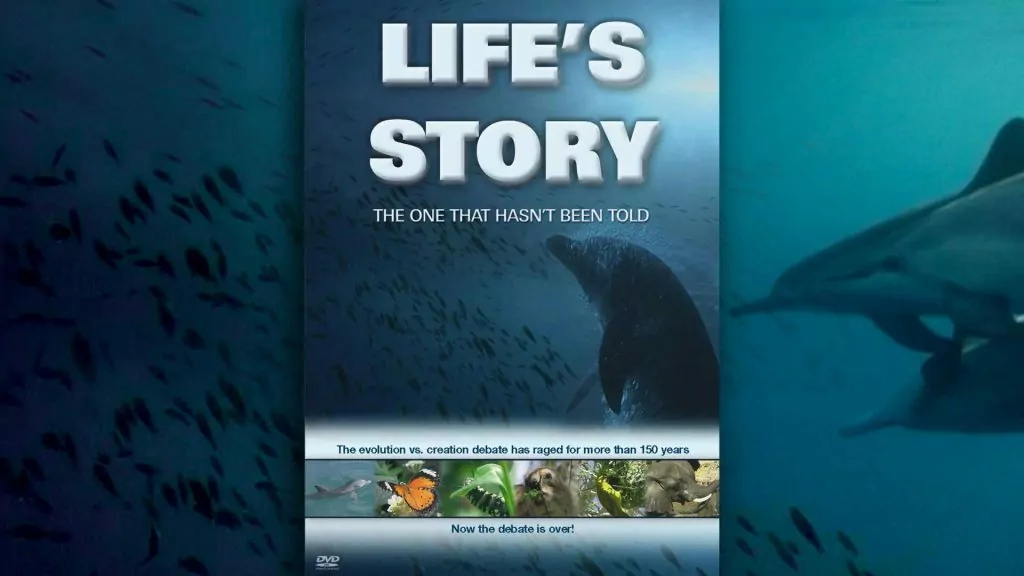
Documentary 2004 / 58 minutes Rating: 7/10 This is a gorgeous investigation of how Creation evidences its Creator. Life's Story was filmed in more than ten countries and it takes us under the ocean waters too. We're introduced to lions, parrotfish, dolphins, giraffes and so many more critters, exploring the genius apparent not only in their bodies, but in their instincts, and even in their relationship with other animals. So, for example, we learn how the parrotfish feeds on the algae that grow on coral formations – this fish needs the coral to serve as its shelter and food source. But the coral also needs the parrotfish to clear away the algae, which otherwise might grow unchecked, and choke off the coral. This symbiosis – two creatures needing each other in order to survive – is a testament to God's intertwined design. It's also a problem for evolutionists to explain, because if each needs the other, then which evolved first, the coral or the parrotfish? God's genius is showcased with one illustration after another, even delving into the creative ways different animal babies are born. Did you know a giraffe baby is born with its mother still standing up, and the afterbirth functioning as a kind of elastic cord to slow the baby's 6-foot descent to the ground? How cool is that? And there's loads of knowledge bombs like that spread throughout. Caution At one point early on the narrator declares the "debate over the origins of life has raged for 150 years, but now, finally, the debate is over." Though he states it quietly, and his British accent adds some gravitas to it, this is hyperbolic. Evolutionists still exist, so the debate continues, even if it really shouldn't (Rom. 1:20). Other overstatements like this mean that as fun as this could be to watch with your family (while pointing out the hyperbole to the kids), it is not the film you'd show your college classmate who's skeptical about the case against evolution. They'd be better off watching Evolution's Achilles' Heels and Dismantled instead. Conclusion A handful of overstatements are what demote this down to being a good, not great, documentary. In its favor it has impressive footage – we're getting close enough to count the lion's teeth, and diving down deep into an underwater world we'd otherwise never see. Viewers will also love all the insights into the intricacies of these critters which are sprinkled liberally throughout. The narrator's calm voice is at times almost sleep-inducing, but the stunning visuals will wake you back up. And if you enjoy this one, be sure to check out the sequel: Life Story 2: the reason for the journey. Another mark in its favor? You can watch it for free below. ...

Red heart icon with + sign.
Science - General

Canada’s beautiful beaver

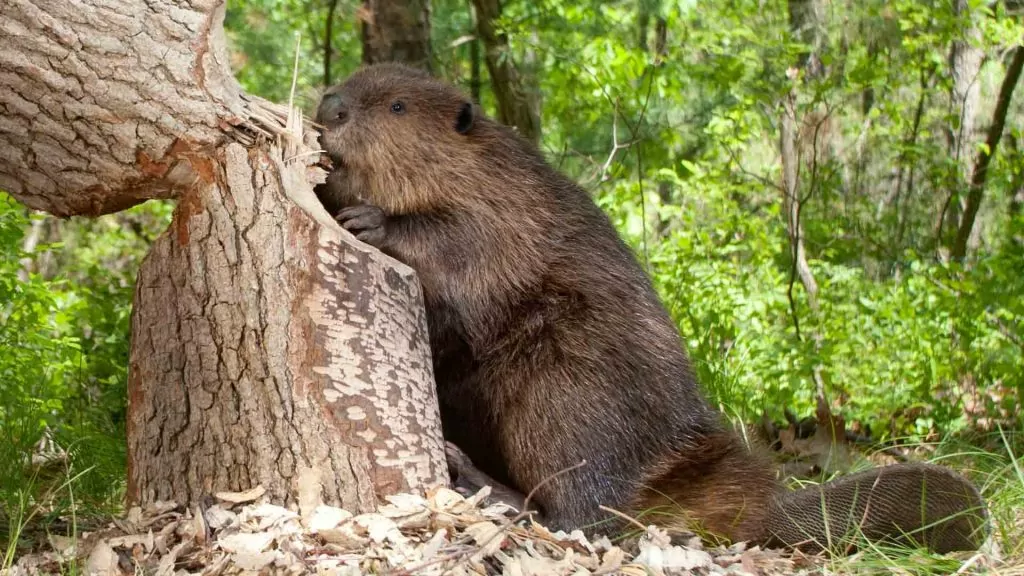
An internationally recognized rodent has become our northern nation’s emblem, but more importantly, the curious nature of this creature highlights the creativity of its Creator. ***** Most Canadians are rightly proud of the beaver, their iconic national emblem.  Indeed, the beaver is a remarkable animal with exceptional talents! Its lifestyle is made possible not only through the wonderful design of its body, but also through in-built skills. The fact is that beavers are the only animals anywhere which can change the landscape to suit their own needs and desires. Bigger and biggest dam The skill of beavers at dam building is legendary wherever they live. Prior to 2010, a beaver dam in Montana (USA) was the largest such structure known. It was 652 meters long, 4.3 meters tall and 7 meters thick at its largest extent. For our imperial friends, that’s 2,140 feet long, 14 feet high and 23 feet wide! However, the Montana beavers’ claim to fame ended when scientists looking for evidence of climate change, scanned satellite images of Canada’s far north lands. These scientists were not looking for beaver dams. Such a thing had never been visible from space. But now they observed a beaver dam in Wood Buffalo National Park in Alberta. First visible (in retrospect) in a Landsat 7 image from 1990, in a 2004 image, the beaver dam appeared to be 850 meters or 2,790 feet long. Jean Thie, a remote sensing specialist, first noted the artifact in a satellite image taken in July 2004, but he did not make his identification until 2007. Eventually, in 2009, Parks Canada was informed of the situation. Thus, it was not until 2010 that Parks Canada released a statement to the world. The terrain is so boggy that nobody can access the site, but aerial reconnaissance has confirmed its existence. The dam must be about 35 years old, built and maintained by generations of beavers. To avoid being tasty treats... Beavers are engineers and builders. With only their teeth and front paws, they change landscapes so that a safe home can be built and enough food harvested and stored for winter. The lodges/homes are large and conspicuous, often about 5 meters in diameter and 2 meters high. Animals as large and tasty as beavers would surely be a popular meal for predators if all the hunter had to do was wait by the lodge until the beaver came home. Obviously, hidden entrances are essential to survival. So what the beavers do is to locate the lodge in the center of a body of water. Then the entrances are hidden underwater, well shielded from the view of predators like wolves. Since the beavers are active throughout the year, they must be able to come and go from their lodge even in winter. Since most small bodies of water freeze at that time, the beavers need to find ponds and streams deep enough so that some liquid water remains below the ice. Since such deep locations are hard to find, the beavers instead change shallow bodies of water into deeper locations. This is where the amazing dam-building skills of the beaver are called into play. First of all, the beavers must select a suitable location for their dam. It is the sound of trickling water that stimulates the beaver to plug the flow. The point that the beavers typically choose is where the noise of moving water is the greatest and the flow rate is fastest. Beavers are not committed to any one style of dam. They build whatever it takes to block the flow of water. A sluggish flow of water calls for a very wide dam, as we see in Wood Buffalo National Park. When the current is strong, however, the dam is built with a convex curve in the upstream direction so that it best resists the pressure of the water. The beavers instinctively know how to compensate for stress and strains of the water pushing against the structure. These animals even build outlet sluices for disposal of overflow water. The construction, after all, must not flood the lodge during times of higher-than-normal rainfall. The beavers always make the right engineering choices. Born landscapers The beaver are certainly unique in their water management capabilities. These animals do not learn their building skills from their elders. They just know them. In Europe, beavers were hounded almost to extinction and for generations had no opportunities to use their talents, but now, once again they are displaying their full architectural expertise. In parts of the American West such as Washington, Oregon and Utah, beavers are increasingly being deployed as effective, low cost agents to restore watersheds. Beaver dams and ponds restore complexity to the landscape, slowing the flow of water and sediment and restoring fish habitat. Besides brainpower, each beaver needs the physical ability to actually build dams. These large animals, distinctly rotund in shape, weigh between 16 and 32 kilograms as adults (or 35 to 70 pounds). They look awkward on land but quite the opposite in water. Their fully webbed hind feet, transparent membranes that protect their eyes and special valves in the nostrils and ears all facilitate underwater activities. The oxygen holding capacity of their red blood cells also must be impressive since they are able to spend as much as 15 minutes submerged. So don’t hold your breath waiting for a diving beaver to re-appear! The beavers’ front paws are small and delicate, without webs. They function almost like hands. They are able to carry objects such as sticks, stones or mud in their hands and they manipulate these into place in the course of their building activities. Tremendous teeth and quite the pair of lips The beaver begins his dam by laying sticks and rocks in the streambed at the desired location. Lots of timber is required for this project. Here, too, the beaver is appropriately equipped for his task. His front teeth are hardened with a dark orange enamel (not pretty, but effective). The teeth grow continuously and the outer tips grind against each other. This keeps the cutting edges chisel-sharp. With these tools, beaver can easily fell trees 30 centimeters or even twice that (1 or two feet) in diameter. The trees are used in building operations, and as sources of twigs, bark and leaves for food. Another interesting feature of beaver mouths is the fact that their lips can be closed behind their front teeth. Thus, while submerged, they can chew without choking on sawdust or water. This gives a whole new meaning to the expression “My lips are sealed”! So, people pursue their agendas and beavers fell trees and flood the landscape. We may find beaver activities expensive and annoying at times. On other occasions, we greatly appreciate their work. Wherever they are, we must admit they are beautiful animals. Canada’s national emblem is characterized by skill, initiative and lots of energy. It’s fun to watch them in action. We do not always realize that God confers on some animals amazing behavior patterns which enable them to follow unique lifestyles. Such is the beaver. All peoples, near or far from Canada, who appreciate wonderful design, will surely see the hand of God in the creation of Castor canadensis. Dr. Margaret Helder is involved in headSTART.create.ab.ca an online tool that defines scientific terms from a creationist perspective, highlighting the 100+ most important ones like convergence, Junk DNA, Horizontal Gene Transfer, and the Framework Hypothesis. It's designed for high school students but useful for their parents too, so be sure to check it out! And also be sure to check out this 10-minute clip on beaver lodge creation. ...

Red heart icon with + sign.
Documentary, Movie Reviews

Living Waters

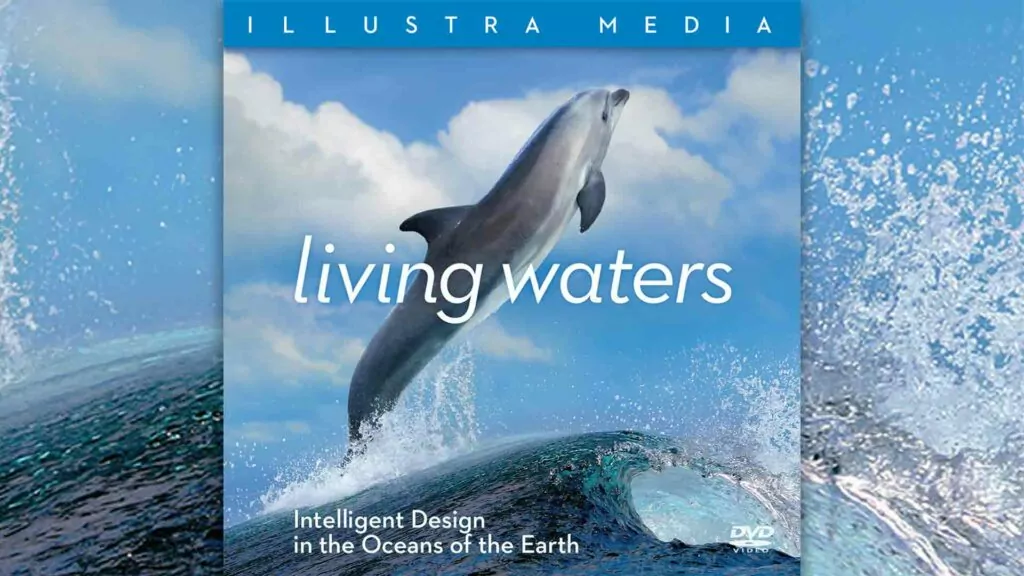
Documentary 69 minutes / 2015 Rating 8/10 This is one part nature documentary and one part evolutionary takedown. Illustra Media understands that a great way to expose evolution is to take a close in-depth look at some of the creatures that God has made. In Darwin’s day, scientists didn’t have the ability to look inside the cell, and only had a glimmering of how incredibly complex even the simplest living creatures are. Now we know so much more – it turns out that even the simplest cell in our body has astonishingly complex and coordinated inner workings. Some have compared the complexity of a cell to the complexity of an entire city! The more we learn, the more apparent it is that evolution can’t be so. In previous films, Illustra Media took a close look at butterflies (Metamorphosis) and birds (Flight). This time they have turned their attention to four maritime creatures: dolphins, sea turtles, Pacific salmon, and humpback whales. Time doesn’t allow a full detailing of just how awe-inspiring this investigation is. But I’ll give you a small sampling of what the documentary shares about the complexity of dolphins. These creatures can distinguish between a ping-pong ball and a golf ball via echolocation. This is a form of sonar, and better than anything man has ever constructed. The dolphin’s sonar system can spot fish up to six inches under the sand and can find a BB at the bottom of a swimming pool. Dolphins also have a complex air return system that allows them to make the high-frequency sounds they need for echolocation by blowing air past two sets of “phonic lips” and then recouping that air and redirecting it back to their lungs. This air return system allows the dolphin to reuse this air and to echolocate for more than ten minutes without needing to surface for air. This is only scratching the surface of the dolphin’s complexity but this is already enough to expose the impossibility of evolution. The dolphin is able to: make the sonic sound focus and direct it receive it and, finally, have the ability to interpret and understand the signal they are getting back All four of these elements are needed or else the system won’t work at all. So how could evolution – random mutation and natural selection – be responsible? The idea that all four elements evolved to be at the very same time is beyond fantastic. So too is the idea that they would evolve one after another and be selected for, despite having no function (despite having no evolutionary advantage) until all four are finally developed and the whole system is up and running. Evolution simply can’t account for systems such as this, which are so obviously and clearly designed. Living Waters is a remarkable documentary with wonderful visuals of all the creatures discussed. My preschool children weren’t able to follow the discussion, but the close-up videos and computer animations kept their attention. Meanwhile, their mom and I were stunned by the sheer brilliance and creativity of God! I should mention that while mention is made of an Intelligent Designer, He is never specifically named as the God of the Bible. That is disappointing, but every Christian watching this will most certainly give God glory. I can’t recommend it enough – this is an amazing look at some seemingly simple but incredibly complex creatures. ...

Red heart icon with + sign.
Book Reviews, Children’s picture books, Graphic novels

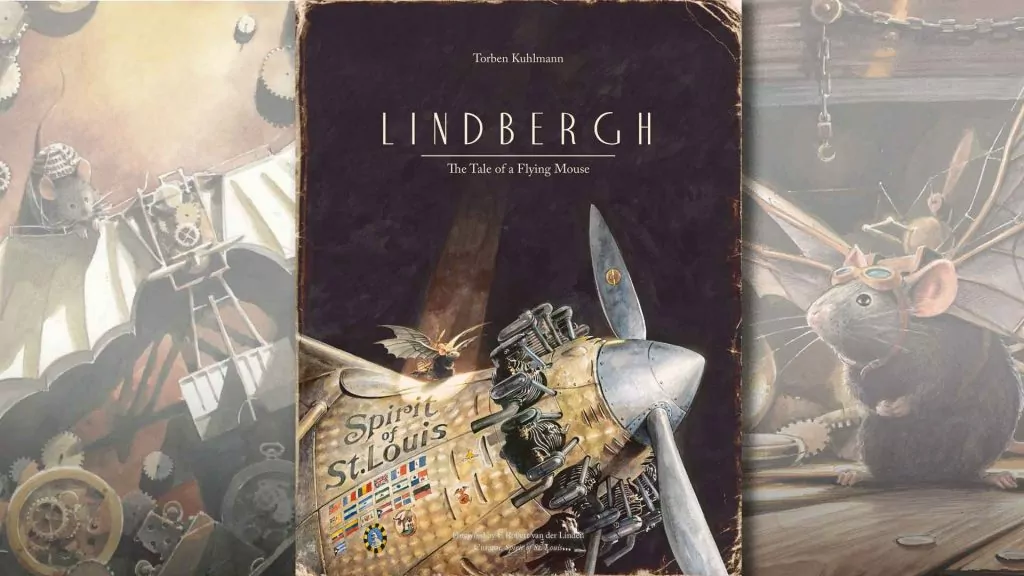
Lindbergh: The Tale of a Flying Mouse (2 books)

by Torben Kuhlmann 96 pages / 2014 Rating: Good/GREAT/Give How did man first learn to fly? It seems we had a little help. This is the story of a little mouse who made the very first transatlantic flight, back when Charles Lindbergh was but a lad. As our story begins we learn what first motivated this mouse to seek the skies. In the late 1800s, another invention was becoming quite popular – the mousetrap! – which had this furry inventor seeking somewhere safer to live. Where could he go? Why not America, a place that welcomed immigrants of all sorts (whether man or mouse)? That was a good destination, but when he tried boarding a boat, he barely escaped the harbor cats. They were guarding the docks, and there was no getting past them. It was there, however, as the little mouse was hiding in the shadows, that he was "struck" by inspiration: "Suddenly wings flapped against his face! Ghostly creatures flew through the dark. They looked like mice, with tiny eyes and huge ears. But they flew with powerful black wings. The little mouse carefully studied the strange flying relatives, then scurried home..." Why not try flying to America using wings like bats! In the many pages that follow we see the mouse draft plans, secure supplies, evade owls, fail, try again, fail once more, and then finally make his way into the skies. What makes the book so special is the enormous, gorgeous, detailed pictures. I want to make the case that this should be shelved in the graphic novel section of the library, even though it isn't what most would think of as a graphic novel. There are no word bubbles, but there are whole sections where the story is told entirely by sequential pictures. It might be accurately called a picture book, but that makes it seem like it's for little children (what older kids read picture books?). This is not a children's story. That's in small part because it has a grim bit here and there – one mouse is depicted in a newspaper picture as clearly dead, caught in a mousetrap, which would be an unexpected jolt to readers in the lowest grades. It might also be too tense with the owls determined not simply to frustrate his flight, but to eat our little inventor. The bigger reason this is older fare is simply the length and depth of the story. The mouse draws schematics that deserve to be closely examined – there are echoes here of Leonardo da Vinci. And he is playing a cat and mouse game on a few levels, not simply with cats, but owls, and people too. So, yes, this visual feast belongs best in the graphic novel section where boys in Grades 4 and up will discover it and love it! Caution The only caution, other than age appropriateness due to the aforementioned grim bits, would concern not this book, but a sequel in the author's "Mouse Adventures" series. In the next book, Armstrong (2016), another mouse takes things even further, developing the first ever rocket to the moon so he can prove that it is not made of green cheese. It's another inventive story, and the only nit I have to pick comes afterward, in an appendix of sorts. There we're told that Galileo Galilei "contradicted the Church's view at the time and his work was banned while he found himself accused of heresy." This is true, but without context, it contributes to the popular idea of Science as the ultimate authority, especially over and above what the Church teaches from the Bible. What this overlooks is that the Church's problem here was its reliance on faulty science in the first place – Aristotilean science – rather than the Bible. Most kids aren't likely to even ingest this section of the book. But this particular lie is a pernicious one, used as a universal solvent to undermine clear biblical teachings on origins, sexuality and gender. While it's only a small mention of a potent lie, it is also delivered to a young audience, which is why I'd give this one a skip for a school library. I'd also skip on Einstein (2020), not because of specific problems, but because there were parts of this picture book/graphic novel that as an adult, I didn't even understand. I think this one was too ambitious, considering the target audience. Conclusion That said, this story is the very pinnacle of creative genius. It will teach children at least a little about what it took to first developed powered flight, providing as fun and wonderfully illustrated an introduction to the topic as you'll find. For more, take a look at the book's trailer below. And if your child enjoys this one, they'll likely also love the third book, Edison: the Mystery of the Missing Mouse Treasure (2018) in which a mouse invents underwater travel to recover the illuminating invention his ancestor created. ...

Red heart icon with + sign.
Science - General

Half duck, half beaver: the astonishing platypus

In recent years a strange assortment of animals, some familiar and some obscure, have enjoyed a brief moment of scientific attention. In each case, the occasion for this special fame was the publication of the genome – the complete DNA sequence - of that organism. In May 2008, the genome of Australia’s platypus was published. This creature is justly famous anyway, but the genome studies have helped focus attention on why this is so. Not a hoax When British naturalists first saw a pelt of a platypus, they were sure it was a hoax. With its thick fur, webbed front feet and duck bill-like snout, it certainly did not resemble any other animal known at the time. Further study showed however that the animal is perfectly genuine. Eventually, naturalists discovered that this animal lays eggs, but yet it suckles its young with genuine mother’s milk. It seemed as if this creature was a strange jumble of bird, reptile and mammalian (feeds milk to young) characteristics. More careful study however reveals that this organism is actually a beautifully designed entity. The duckbilled platypus remains a highly unusual creature. Not only its appearance, but many aspects of its biology are unique. These small animals (up to 60 cm long) spend most of their time underwater. Indeed they are able to find food only when submerged. Amazingly, however, they swim blind, deaf and without the normal opportunity to detect odors since flaps cover their eyes, ears and nose while they are submerged. Recent research however has revealed that they have some unique abilities to compensate for lack of sight, hearing and smell. Once the genome data has been collected, there is nothing obvious to show what stretches of DNA contain genes of interest. The number of nucleotides in the platypus genome is 2.3 billion, quite close to the 3 billion contained in the human genome. The number of protein-coding genes thus far identified in platypus is also similar to the number in humans: 18,600 for platypus compared to about 25,000 for humans. Faced with endless arrangements of nucleotides, how do scientists “read” the information contained therein? What scientists did was to start slowly in their early genome studies with attempts to identify sections coding for certain basic genes. Gradually they built up a computerized repertoire of DNA coding which identifies important genes in at least one organism. Then when they wish to study a different organism, they use huge computers to look for similar stretches of DNA in the new organism. Fancy mathematics allows the computer to decide whether similar sequences are close enough to represent the same gene or not. Since the genomes of many organisms have now been documented, scientists now have a large collection of nucleotide sequences that code for important genes.  The interesting thing then is to compare how the new organism resembles other creatures and ways in which it differs. Does it have similar genes or different ones? This analysis certainly reveals interesting things about the platypus. Gender and reproduction Genome analysis shows that gender determination in platypus is unique among milk-producing organisms. Rather than X and Y chromosomes such as we normally see in milk producers, gender in platypus is determined by chains of tiny chromosomes. Females have five pairs of tiny X chromosomes, while males have 5 pairs of X chromosomes plus five tiny Y chromosomes. The really interesting thing is that the genetic information on the X chromosomes is nothing like that in other milk-producing creatures. The information, in fact, is faintly similar to the Z chromosome which determines gender in birds. Scientists are totally astonished by this feature of the platypus genome. Unlike other milk producers, platypus and echidnas have just one opening at the rear end of the body. Other milk producers have an opening from the digestive system plus a combined one for urine and reproduction. Platypus and echidnas have one combined opening for everything called the cloaca (like birds and reptiles). But platypus has a unique way of producing young, not at all like birds or reptiles. The female keeps the fertilized eggs inside her body for 21 days. Meanwhile, she seals herself into a small chamber lined with vegetation at the end of an 8-meter long tunnel dug into the bank of a lake or stream. There she lays 1 or 2 tiny sticky, leathery eggs. These she incubates until they hatch in about 11 days. Initially only about the size of jelly beans and lacking developed organs and an immune system, the young suckle milk through pores on their mother’s abdomen. After 4 months, the young become independent. The eggs, it is well known, divide in a manner similar to birds and reptiles and as a result, contain a yolk. However recent genome research reveals that the milk is very similar in composition to that of other mammals. Underwater navigation Recent research has revealed how the platypus is able to find food despite the fact that its ears, nose and eyes are closed underwater. Obviously the creature needs special hardware and talents designed for navigation. Thus it was that in 1985 German scientist Henning Scheich discovered some highly unusual properties of the platypus. This animal reacts to weak electrical fields in water. What this scientist did was bury a small charged battery under a brick in the water. In addition, he placed a similar, but dead battery under another brick. The platypus dislodged the brick sitting on top of the charged battery, but it ignored the other brick/battery site. Later, the platypus avoided a mesh screen placed in front of a charged battery, but it collided with a screen placed in front of a dead battery. Further studies have amply confirmed that platypus have electroreceptors in their bills. As sensitive as a star-nosed mole Since the late 1980s, scientists have discovered that there are two kinds of electroreceptor and one type of touch receptor in the platypus snout. At the front edges of the bill, there are tiny pores containing a membranous receptor. Moreover, over the main surface of the bill there are oblique stripe-like arrays of pores which are mucous-filled. The mucous serves to enhance transmission of a signal to the nerve at the bottom of the pit. The bill of the platypus has 40,000 electroreceptors, while in comparison the 2 species of its closest cousin, the echidna, boast only 2000 and 400 respectively. Mapping of sensors was conducted on anesthetized animals. Electrical sensors were attached to the exposed cortex of the brain, and electrical and mechanical stimuli were applied to the bill. The resulting signals in the cortex were duly noted as were the locations in the bill where the sensitive pores were located. The push-rod mechanical (touch) receptors in the bill are remarkable in their own right. Inside the pore is a compacted column of skin which can rotate about its base or move up and down. These very sensitive touch receptors are similar to the highly unusual touch receptors in the nose of the star-nosed mole. The organ of touch in the snout of the star-nosed mole is so sensitive, that the information obtained from it is almost as detailed as vision. This animal also spends most of its time foraging for food in the water. Until recently, scientists knew of no other creatures with as sensitive a sense of touch. Now it appears that the mechanoreceptors in the bill of platypus are of even more sophisticated design. There is yet another interesting feature of these sensory pores on the bill of the platypus – each is surrounded by petal-like skin flaps which open when the animal is underwater. When the animal emerges from the water, however, tiny sphincters around each pore close the flaps so that the sensors will not dry out. The food which the platypus seeks are small animals living near or in the bottom sediments of lakes, ponds, or rivers. These animals favor some larvae of insects, worms, small crustaceans and other invertebrates. Apparently, these small creatures generate weak electrical fields as they move or simply maintain the processes of life in their bodies. With its electroreceptor capabilities, it seems that platypus can detect the field generated by a freshwater shrimp that is 10 centimeters away. Scientists suspect that the platypus knows how far away an electrical source is, whether it is moving, and in what direction it is proceeding. More and more talents The remarkable thing is that these sensory talents of platypus are so unique. As far as electrical sensing of the environment is concerned, some fish also exhibit this ability. However, in the case of fish, the sensors are all over the body and they are not nearly so sensitive. But platypus has more talents yet! One might have imagined that platypus would not need much in the way of a sense of smell since their noses are closed under water. This conclusion is partly right and partly wrong. As far as genes for normal smell (chemical receptors) are concerned, the genome project shows that platypus has a reduced number of receptor types (only about half of what most mammals exhibit). However, there are chemical receptors called vomeronasal receptors which may be located in the mouth or the nose and surprise, surprise, platypus has the largest variety of vomeronasal type 1 receptors known. At 950 different variations on the vomeronasal type 1 receptor (V1R) the platypus has 50% more than the mouse. Compare this to the chicken, which has no such receptors. Nor, for that matter, do people. The platypus thus has very special electrical, touch and chemical (taste) receptors. The article on the platypus genome published in Nature (May 8/08) discusses the large number of genes which code for the special chemical receptors (V1R). But the article makes no mention of genes for electrical and touch receptors. Obviously, there must be quite a number of genes in the platypus coding for components of these sophisticated sensors. However, the sequence (order) of nucleotides does not come with labels identifying which sections code for what. Scientists need an already established standard order of nucleotides coding for such genes from another, not too different creature. Since these talents are highly unusual, however, no comparison with a similar gene in a similar creature can as yet be made. Thus we don’t hear about how many genes code for electrosensory abilities and for extremely sensitive touch. Defense: immunity and venom Besides food and reproduction, an animal in nature needs to defend itself against larger animals and against microbes. The newly hatched young have only partially developed organs. They have no spleen, no thymus and no killer T and B cells which provide acquired immunity. They do, however, exhibit a very unusual number of natural killer receptor genes. A natural killer is a precisely shaped molecule which is able to recognize other types of molecules characteristically produced by disease-causing organisms but not by the host organism itself. This capacity to stop a large number of common disease agents in their tracks is programmed into the genes of platypus and most other organisms as well. However, since the platypus young are so small and vulnerable, it makes sense that these animals are provided with an unusually large variety of natural killer-type molecules (coded for on appropriate genes). The platypus thus has 214 genes for different variations on the natural killer theme compared to only 45 for rat, 9 for opossum and 15 for humans. In addition, platypus is unusual among mammals in that the male is able to deliver a venom potent enough to kill a dog. There are only a few mammals which are venomous, but all of the others transmit the venom by means of a bite. The platypus, on the other hand, has spurs on its hind legs which deliver the venom. That venom is a cocktail of at least 19 different substances which exert various nasty effects on the victim. God’s creativity and intricate design Secular scientists have long declared platypus to be a strange blend of reptilian, bird and mammal (milk producer) characteristics. Such people consider that the genome study has further confirmed this view. They are wrong. What that study has shown is that this animal is not a jumble of features from a broad assortment of organisms, but rather a wonderfully integrated collection of unusual anatomy and attributes. Certain features may remind us of birds and reptiles, but the similarities are merely superficial. The platypus truly is unique in its navigational abilities and in all the other features. Obviously, this unusual creature was designed to pursue its unique but effective lifestyle and designed to delight us in yet another aspect of God’s amazing creation. So give three cheers for a weird but wonderful inhabitant of Australia!! This first appeared in the September 2008 issue under the title "Awesome Aussie: the platypus looks fascinating from the outside, but a look at its inside – its DNA – is just as intriguing." Dr. Margaret Helder is the President of the Creation Science Association of Alberta and the author of "No Christian Silence on Science." For more on the platypus, check out the great video below. ...

Red heart icon with + sign.
Book Reviews, Children’s picture books

Finding Winnie

by Lindsay Mattick 56 pages / 2015 Rating: Good/GREAT/Give It turns out that Winnie the Pooh, a teddy bear who had fantastic and entirely fanciful adventures, was named after a real bear whose adventures were quite something too, and of the genuine sort. Just as Winnie the Pooh starts with a father telling his son a story, so too Finding Winnie begins with a parent telling her child a bedtime tale. In this case, the storyteller is the great-granddaughter of the man who gave the first Winnie his name. Harry Colebourn was a vet living in Winnipeg. When the First World War began Harry had to go, so he boarded a train with other soldiers and headed east. At a stop on the way, he met a man with a baby bear, and ended up buying the little beast. To make a long story shorter, this bear - named Winnie after Harry's hometown – ended up in the London Zoo where a boy named Christopher Robin, and his father A.A Milne came across him and were utterly entranced. It is a wonderful story, but what makes it remarkable is the charming way it's told. This is brilliant, and a homage of sort to A.A. Milne's stories. It's true, so there is quite a difference between his Winnie tales and this author's, but the same gentle humor, the same whimsy, that same charm, is there throughout. This will be a treat for fans of Winnie the Pooh no matter what age. Both my daughters and I were entranced! Winnie by Sally M. Walker 40 pages / 2015 Rating: GOOD/Great/Give The same year a second picture book came out about the bear behind the bear that was also very good, very fun, and different enough that after reading Finding Winnie it is still an enjoyable read as well. Compared to most any other picture book Winnie is remarkable - really among the best of the best - but it does lack a little of the Milne-like charm of Finding Winnie, and so ranks second among these two books....

Red heart icon with + sign.
Family, Movie Reviews

The Incredible Journey

Family 1963 / 80 minutes Rating: 8/10 What do Elsa and Anna, Tom Sawyer and Huck Finn, Pollyanna, and even Huey, Duey and Louie all have in common? If you said they'd all been featured in Disney films, you'd be right, but that's not the answer I was looking for. They all lack, and what many a children's story protagonist lacks is, parental supervision. Dead or otherwise departed parents are pretty common in children's fiction and films, and it isn't as nefarious as it might seem. Parents need to be out of the picture because otherwise the story would end before it even got going. How could Peter, Lucy, Edmund, and Susan have explored the wardrobe if they'd been back in London with mom and pop? Parents still home when the Cat in the Hat stops by? He'd never make it past the front door. And Jack and Jill would never have tumbled if their mom had been there to tell them: "You're not old enough to climb the cliff face– it's dangerous! How many times do I have to tell you to use the path on the other side of the hill?" In The Incredible Journey the parents are once again missing, but this time there is a twist: the Hunters aren't so much parents, as owners, and their "children" are two dogs and a cat. While the Hunters are heading to Oxford, where dad is going to teach for a semester, family friend John Longridge has volunteered to take care of their pets back at his own cabin, some 200 miles away. But then he leaves too, heading out on a long hunting trip, and entrusting the animals' care to his housekeeper Mrs. Oakes. Then, when the note he leaves her falls into the fireplace and gets burned up, she thinks he has the animals. The result: when the trio head out on their own, no one is missing them. Luath, a yellow Labrador, is the leader of the group. He wants to go back to their family, and convinces the other two, Siamese cat Tao, and Bodger, an English bull terrier, to start off with him. While Luath knows the right direction, he doesn't realize that home is more than 200 miles, and a mountain range, away. That's the set-up for their incredible journey. On the way, they have to contend with hunger, whitewater, bears, a lynx, and, unfortunately for Luath, a porcupine! Cautions The big caution here would concern the tension. At one point it seems like the cat has been swept away by the river to her death, and the two dogs are left mourning. The only way my kids could get past that was with the reassurance that the dogs were wrong and the cat would actually be okay. Conclusion There's a 1993 remake, where the animals are voiced by big-name celebrities. I like this version better, where a narrator explains what's going on in the different animals' minds. It's a more realistic approach, almost akin to a nature documentary, where we're observing something that could really have happened. Despite what you might read elsewhere, this didn't happen – it is not based on a true story. There's been some confusion on that point because the author of the book that inspired the film said the pets were based on her own – they are based on true pets – but her pets never went on any such journey. What makes this such a wonderful film is the loyalty the animals have for one another. Bodger is old, and a drag on the group, but that only means that he gets to set the pace – Tao and Luath would never think of leaving him behind. Our whole family, from 8 on up really enjoyed it. The appeal for the kids is the pets – our girls love pretty much any story with dogs or cats in it – while the appeal for the adults was the uniqueness of it. This is an old-school Disney film, so it was easy to predict that everything would turn out fine in the end, but these animals took us on quite the journey with twists and turns that weren't so easy to predict. And that sure was fun! ...

1 2