Transparent heart icon with white outline and + sign.

Life's busy, read it when you're ready!

Create a free account to save articles for later, keep track of past articles you’ve read, and receive exclusive access to all RP resources.

White magnifying glass.

Search thousands of RP articles

Helping you think, speak, and act in Christ.

Open envelope icon with @ symbol

Get Articles Delivered!

Helping you think, speak, and act in Christ. delivered direct to your Inbox!


Most Recent


The Rest


Red heart icon with + sign.
Politics

Alberta separatism: is it wrong to go?

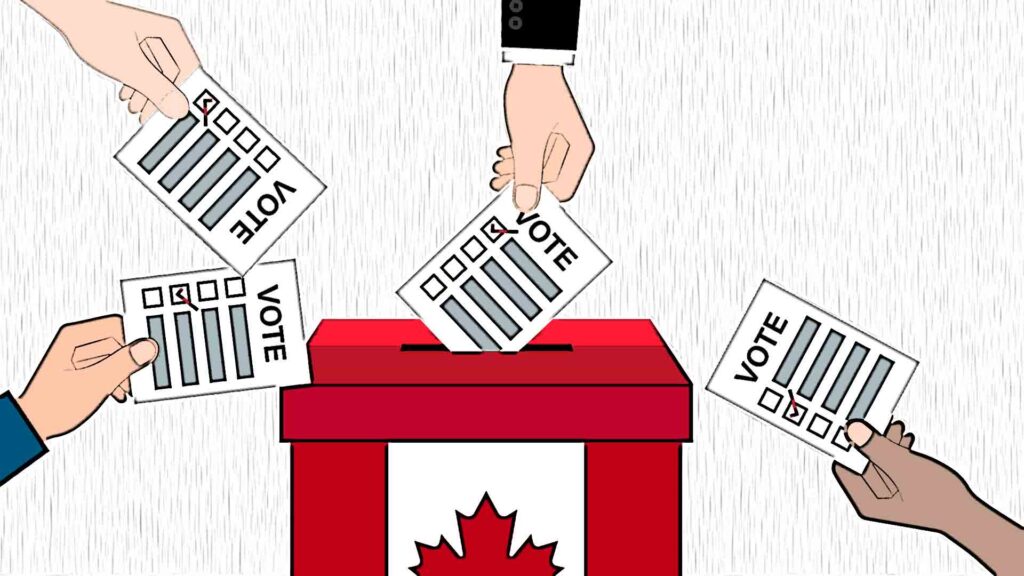
I have deep roots in Alberta, having lived there for the first 30+ years of my life. I was also heavily involved in politics through a half dozen different campaigns, and during those years I thought long and hard about what a better Alberta might look like. I have since been separated from my home province by mileage and decades. While I am still a very interested observer, the distance allows me to act as more of an impartial observer than I would have been able to be two decades ago. I’m going to try here, to make a limited point – that it would be okay for Alberta to go. Not that it should go, but just that going is an option on the table that Christians can consider. Even as I think the referendum is well worth talking about, I don’t think it has any chance of success. A June 5 Ipsos poll had only 19% of Albertans interested in starting the process, and only 18% who actually wanted to go. Angus Reid had support as high as 35% for starting the process, but that was back in May, and their guesstimate was the highest of all the pollsters. So, I’m not writing to sway voters one way or the other. The reason I wanted to write is because some of the issues brought up are universal – they apply not just for Albertans trying to figure out how to vote, but whenever Christians are making any decision. Kevin DeYoung tackled decision-making in his excellent book Just Do Something, so, inspired by him, here are a handful of questions to help shape a Christian’s decision-making process. Q.1 HAS GOD LEFT THE DECISION UP TO ME? Another way to phrase this question would be, is this a wrong/right matter? If it is, then we know what to do – we need to do whatever it is that God commands. Screwing up the courage to do so might be hard, but if we know it is a moral matter then we already know what we should do. God’s will be done. However, as Kevin DeYoung notes in Just Do Something, a lot of our decisions aren’t so simple, precisely because they aren’t about wrong or right. God leaves some pretty big decisions up to us: what kind of job we’ll pursue, where we’ll live, who we will marry, whether we should partner up to start a company. Big stuff. Huge stuff! We can and should look to God for guidance, and talk to our parents and the other wise people He’s gifted us. We can come to Him in prayer and ask Him to make our motivations pure. We can look to His word for wisdom. But then it is up to us; He gives us a decision to make. Take marriage as an example. You can look over every page of the Bible, and you just aren’t going to find the name of the person God has in mind for you. He’s left it to you, to figure out who you have in mind for you. Now, you can’t marry an unbeliever because He’s said we should not be unequally yoked (2 Cor. 6:14). He also offers guidance on the kind of man or woman you should be impressed by. But, if a young man, Timmy, has a couple of those kind of ladies sitting in the pews nearby him each Sunday, then it will be up to him to make a choice. And up to whoever Timmy asks to make her own. Now let’s direct the question above to the separation referendum: is this a matter of wrong and right? The possible answers to the question can go a few different ways: 1. Yes it is, which is why we have to vote against 2. Yes it is, so we have to vote for separation 3. No it is not, so God has left the decision up to us. So which is it? Before trying to answer that, let’s clear away one distraction. That something can be done for the wrong reasons is not proof that it is wrong. Mankind has the sad ability to make just about anything immoral if we try. So, as noted, Timmy could have a couple of wonderful godly young women to consider – either could be a good God-honoring choice. But if he asks out Helen only because she has a cool car he’d like to drive, his selfishness and disregard for her heart would turn a legitimate action into a sinful one. That doesn’t change the fact that Helen is a great girl. So, for our purposes, that people could have bad motivations for voting for (or against) separation is not what we’re trying to figure out. It is no surprise that it could be done sinfully because anything can be done sinfully. But what we’re trying to figure out is whether seeking to leave Canada is sinful all by itself, or whether it’s something God leaves for us to decide. To that end let’s ask a couple of clarifying questions. A) Is there something about leaving that is wrong? Some Christians have invoked Romans 13 to argue that because God calls us to be in submission to our authorities it would be wrong for Alberta to remove itself from being under the authority of the federal government. It’s a good idea to go to Scripture, but let’s dig a little deeper and consider what sort of submission God speaks of here. Under a dictatorship, as Paul and most of the world lived under when this was written, they had no means of changing their leaders. But in a democracy, we do. So, while we know God has placed the Liberals in charge of Canada, we don’t think it would be wrong for us to try, via democratic means, to remove ourselves from being under their authority the next time an election is called. We’d likely thank God for such a result. So, how then, is it so very different for Alberta, via democratic means, to seek to replace this authority over them? Can we characterize such a vote as rebellion against, or disrespect for God’s appointed authorities? No, because, after all, this is simply following the process via the means those authorities laid out. This is an important point – what submission involves – that often gets confused, such that some Christians will characterize taking the government to court as disrespectful, because, again, didn’t God put them in authority over us? But Paul used the courts (Acts 25), and could do so while writing Romans 13, because those courts and that process were a part of the very authority he was in submission to. And what we have in the separation referendum is another government-given process that we can access in submission. B) Would it be wrong not to go? Or in other words, should Christians feel obligated to vote for the referendum? While I think there are reasons that could be offered for leaving, that’s not the same thing as saying Christians must choose to go. To go back to Timmy and his marriage prospects, that there are reasons for him to ask out Susan doesn’t mean he has to. There are, after all, other possibilities to consider, including Helen. So would it actually be wrong to stay? I think that would be a very tough case to make but let’s for the sake of argument, make a hypothetical case where it wouldn’t be so tough. Let’s imagine that the federal government was evil – it was murdering a quarter of its citizens before they were even born, and was now going after the elderly and disabled too. We won’t find that hard to imagine, because that is what’s happening right now. Now let’s imagine Alberta was ruled by wise godly Christians who sought to honor God, and were desperately trying to stop the federal government from pushing abortion and euthanasia in their province but they just couldn’t so long as the province was still under the federal thumb. In those circumstances would it be wrong to stay? Under those circumstances, I think we might well conclude it would be wrong, based on just how many unborn and elderly and disabled lives could be saved if Alberta left. But those aren’t the circumstances we have, are they? Even Alberta at its best is far from godly. Danielle Smith has no qualms about abortion, and euthanasia is paid for by provincial coffers with no protest. Even where the province is out of step with the rest of our Liberal country, it is only a half-step, with the premier’s stance against transgenderism a good example. Yes, she defended kids from this mutilation, but at the very same time she was recruiting doctors from Quebec to better enable confused Albertan adults to mutilate themselves. So this is not some black and white choice between an evil and a godly government. And as such, I don’t think there is a clear case to be made that Alberta must go either. Which would mean God is leaving the decision to us. Q.2 HOW IMPORTANT IS THIS? We make a million decisions every day, and not all of them deserve the same amount of attention. So we need to treat things proportionately. If you are going to buy a new car, that deserves more of your time and maybe prayerful consideration than if you’re buying a coffee. Though if you’re buying a coffee every day, that could warrant some consideration too, because that’s now become a bigger budgetary matter. But not everything is big. If you’re trying to decide between toast and cereal this morning, it’s not worth much brain space. Don’t take forever deciding – that’d be wasting the time that God has entrusted to your care. So, we do need to treat big things as big, but also treat small things as small. And I’d make the case that for the vast majority of us, the separation referendum shouldn’t be a big thing. Why? First, there’s every reason to think the separation vote is going to lose in a landslide. So, give it enough time to go cast your vote, but there are a lot of matters likely to actually happen that are, therefore, more deserving of your attention. Second, even if separation were to happen, would it solve any of our most pressing political problems? No. If it were only the Alberta government in power, God’s people would still need to be just as busy standing up for the unborn, the elderly, and the disabled. So, this isn’t nothing; but it isn’t the big way forward that will save Alberta either. We can give it more brain space and passion than our toast vs. cereal dilemma, but for both practical and prioritization reasons, should it get all that much more? Q.3 ARE MY MOTIVATIONS PURE? As noted, we can do the right thing for the wrong reasons. That’s why Kevin DeYoung suggests (again, in his excellent book Just Do Something) that when we’re making the very decisions that God has left up to us – what job we’ll take, whether we’re going to move, whether we should buy that gaming system – a good prayer we can bring to Him is to ask that He make our motivations pure. So, it’s important that Christians don’t vote for separation with a middle finger in the air aimed at Ottawa. But in our call to love our neighbors as ourselves, someone might vote for separation thinking of what a helpful example a free Alberta could be to the rest of Canada, showing what could be done with a different approach. One Albertan might vote for separation thinking that if only we stop those equalization payments, Albertans, and more specifically him, will now be able to live a life of leisure, rolling in all those extra billions. But another voter might well want separation to end those equalization payments so that the federal government will stop incentivizing people to live where jobs are hard to come by. They could vote out of concern for their neighboring Canadians who are getting harmed by this government program. So, the same act – the same decision – could be done in submission or defiance of God, based on our own motivations. Let’s pray, then, that God be honored in all that we do. Q.4 IN MY ESTIMATION, IS IT WISE? So where do we land when a matter isn’t wrong or right, when we have given it its due consideration, and after we’ve questioned our own motivations? Then we arrive at the point where we have to decide for ourselves whether it is the wise thing to do. Wisdom can be sought in consultation. Ask your parents. Read relevant articles. Debate things with your friends. But it’ll be up to you. CONCLUSION I’m not going to make a case for separation or against, but I hope I’ve made a good case for Christian liberty. And in doing so, I hope I’ve also made the case for charity towards your brothers and sisters who are voting the opposite way you are. We do need to vote to God’s glory. But what I’m arguing here is that in this referendum, that will be done more through the motivation and manner in which we vote, than in what direction we cast our ballot. Honoring God is more than submitting to His will, but certainly not less. When He has expressed His will, then we need to submit no matter what it might cost to follow Him. But we can be bold too, when He leaves the decision-making up to us, knowing that our Heavenly Father will be pleased with whatever we might decide, just so long as we are trying to please Him....

Red heart icon with + sign.
Drama, Movie Reviews

Mr. Smith Goes to Washington

Comedy / Drama 1939 / 130 min Rating: 9/10 Imagine if a director made a movie lauding Martin Luther's Reformation, and then had the chutzpah to arrange for its debut showing to be at the Vatican in front of an audience of the pope and his cardinals. Now you've got an idea of what Frank Capra dared, when he got a packed audience of 4,000 government leaders, including senators, Supreme Court justices, and White House officials, to come out to the movie premiere of his Mr. Smith Goes to Washington.  The film asks, what would happen if a decent man somehow ended up in Washington as a US senator? The answer it gives is, the corrupt, cowardly entrenched powers would try to tear him to shreds. It all begins when the young Jefferson Smith – played by Jimmy Stewart – is appointed to serve out the term of a deceased senator. He's been picked for his naiveté – political lobbyist and behind-the-scenes powerbroker Jim Taylor, and the politicians Taylor has bought, think Jefferson will be too inexperienced, and too blinded by his patriotism and trusting nature, to recognize, let alone expose, their backroom dealings. And to keep Jefferson too busy to even begin to uncover their graft, they've got a pretty girl to turn his head, and Jefferson's own secretary in on it, set to misdirect him so long as she gets a good appointment out of it. But what Jefferson might lack in a sense of discerning skepticism, he makes up for in his dogged determination to do right for the state that sent him here. He gets his very first bill proposed in record time, and it just happens to run right up against the latest project of Taylor and his gang. That won't do, so Taylor decides to destroy Jefferson, and sets him up as the fall guy for the very corruption Taylor was actually guilty of. Taylor doesn't just own politicians, he's got control of the papers too, and he uses this one-two punch to blacken Smith's name. While much has changed in the 85 years since this film was made, one-sided media remains. It isn't often as overt as the infamous 2020 video below shows – with one newscaster after another mouthing the exact same script – but we've seen the media decide for us what we're allowed and not allowed to talk about. Just consider the transgender discussion, or COVID, or the value of the unborn – only one side is allowed. Thankfully, like Smith in this film, there are ways to get around and past the gatekeepers. So when the press joins in on the assault of a good man, the people who know Jefferson best help him get his message out. So why should everyone see this film at least once? 1. Because, like Jefferson Smith, we are called to fight for lost causes with all of our might As Smith put it: "I guess this is just another lost cause, Mr. Paine. All you people don't know about lost causes. Mr. Paine does. He said once they were the only causes worth fighting for. And he fought for them for the only reason any man ever fights for them. Because of just one plain, simple rule: Love thy neighbor. In this world full of hatred a man who knows that one rule has a great trust. You know that rule, Mr. Paine. I loved you for it, just as my father did. You know that you fight harder for the lost causes. You even die for them." There is no earthly means by which we're ever going to win the abortion battle. But do we still need to speak up for the unborn? Of course we do. And, humanly speaking, are we ever going to convince Canada to turn around and end euthanasia? No, we are not. And yet God can be glorified in the speaking of His truth. His is no earthly power, and He can do things no human can, so who knows but that He might work a miracle through us, fighting for a "lost cause." 2. Because we mustn't mix up our first and second priorities Smith's hero is a senator who came to Washington just as committed and courageous as Smith himself. But over the decades, that senator, Senator Paine, compromised. He compromised because he thought he needed power to fulfill his goals. But while power can be a valuable servant, it is a lousy master. It can help you achieve goals, but when it becomes your primary goal, then you'll compromise anything and everything else to keep it. And then what goals are you actually going to accomplish? Christians, and politicians among them, regularly censor ourselves, refusing to bring up God in the public square, even when His truth is what everyone most needs to hear. Consider the transgender debate, where no one understands Who determines our gender. How many Canadians have ever heard the worth of the unborn explained in biblical terms? Why do we keep quiet? Because we think it is the only way to be heard – we presume the secular world won't be interested in an explicitly Christian message. But then, in an effort to be heard – in making getting heard our first priority – we compromise our message, and never even deliver the clear, God-given, God-glorifying, unshakeable truth. Cautions At the time this film was made, the population as a whole would have said they loved God, family, and country, but some of them might have gotten confused about the order. That seems a very American problem, even today, where the country is revered as almost akin to Christ – the last, best hope for the world. There's more than a touch of that error here, with Jefferson's patriotic zeal taking on a religious feel. He believes in America. Thankfully, we aren't forced to agree with Jefferson 100% or not at all – we can appreciate his heroism, honesty, and will to fight, and appreciate his repeated references to Scripture too, even as we topple "country" from atop the pedestal he's placed it. The only other cautions would be a prolonged scene where two key characters are drunk, but I don't think anyone will imagine the film is encouraging this behavior. As to language, I think I heard a "damn," "jackass," and one kid say "gosh." Conclusion This is a classic film, nominated for 11 Oscars for the acting, writing, directing, score, and more. Director Frank Capra and his star Jimmy Stewart later teamed up for It's a Wonderful Life, and maybe that can be the hook you use to get folks watching this one. And here's a trick you can use to improve the experience. At 2 hours and 10 minutes, this is just a long story, and few of us are used to that anymore. Part of the length is because Jimmy Stewart is a bit of a slow talker, so if your DVD player or streaming service is capable of it, play this at 1.25 times speed. That'll make it a more manageable 1 hour and 40 minutes. And the thing is, no one will even notice you sped it up – Stewart will just sound like he's talking at a normal rate. Add in an intermission for snacks and ice cream, and everyone will make it through to the absolute smasher of an ending. Folks who make it to the end are going to cry and clap, guaranteed! For quite the intriguing modern trailer, click here. For the original trailer, see here. And if you want to learn more about the chutzpah of the director debuting his film to a packed house of senators, check out the video below. ...

Red heart icon with + sign.
Politics

Why I’m grateful for the notwithstanding clause

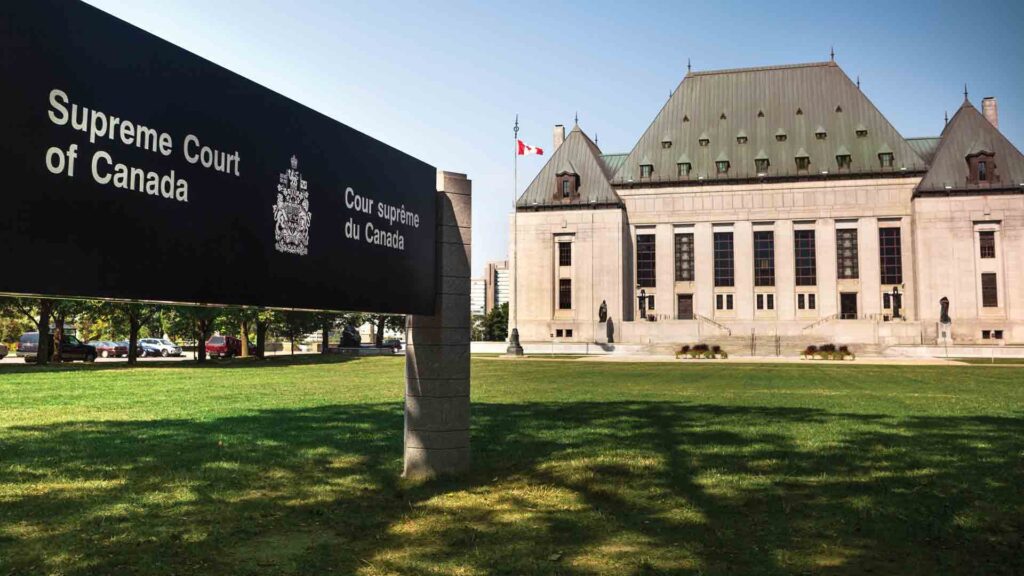
Legislatures make laws, the executive enforces them, judges interpret and apply them in specific cases. Three branches, checks and balances – that’s Civics 101. As Calvinists, we get why we need checks and balances. We know that voters, lawmakers, bureaucrats, police, judges, juries – everyone – is fallen. So we don’t want to entrust one sinner or one group of sinners with too much power. And we want to hold people with power accountable. It’s this Calvinistic insight into human nature that contributed to strong checks and balances emerging in the UK and the US. But who checks whom and how, exactly? That’s where things get interesting. Canada currently awaits a ruling from our Supreme Court on whether the legislature or the judiciary has the final say in disputes over Charter rights and freedoms. More specifically, the Court is reviewing the Quebec government’s use of the notwithstanding clause (section 33 of the Charter) to shield its secularism law (Bill 21) from being declared unconstitutional and unenforceable by the judiciary. The federal government has intervened in the Quebec case to argue that the Supreme Court should impose certain limits on the use of the notwithstanding clause – limits that do not appear anywhere in the text of the Charter. Various other interveners insist that the clause is dangerous and contrary to the spirit of the Canadian constitution. What is the notwithstanding clause? Prior to 1982, Canada had no constitutional bill of rights, unlike the US, which adopted its Bill of Rights in 1791. Today, Britain and several other Commonwealth countries continue to go without such a constitutional bill of rights, which would authorize judges to strike down legislation. Britain, therefore, is said to maintain legislative or Parliamentary supremacy on rights questions, while the US is said to have judicial supremacy. Canada has a kind of hybrid model. Ordinarily, a judge in Canada can strike down a statute if, in the judge’s opinion, the statute violates Canada’s Charter of Rights and Freedoms. However, section 33 of the Charter says that a legislature may declare that a law will operate “notwithstanding” certain parts of the Charter, which include the fundamental freedoms listed in section 2, and the legal rights in sections 7-15. Any invocation of the notwithstanding clause expires in five years, though a legislature may re-invoke it limitless times. This five-year-expiry rule ensures voters can have a say, since the constitution requires an election within 5 years of the last election. Judges’ role in lawmaking Returning to the basic notion that legislatures make laws and judges interpret them – well, that’s not the whole story. 1. Judges have been setting precedents of centuries In the nearly 1000-year-old common law tradition, much of the law is judge-made. Their rulings set a precedent that other judges then follow, and it’s these precedents that make up what’s called common law. But common law is subject to statute. Legislatures might choose to codify the existing common law, or they could pass a law that deliberately modifies or overturns it. But the key is, any legislation they pass prevails over common law precedents whenever there is a tension between the two. The maxim that legislatures make law and judges interpret and apply it may lack nuance, but it highlights the supremacy of statute law over common law. 2. Judges interpret the laws Where we have a statute, there is still an important role for judicial interpretation and precedent, since legislators cannot conceive of and cover every possible situation. But for centuries under the common law tradition, judges have recognized that while they have an inherent civic authority to resolve civil disputes, they are also duty-bound to apply any statute that applies to the case before them. 3. Judges can overturn laws when they find a conflict with the Charter When it comes to the Charter, however, it gets a little odd, because there’s always another law involved. Judges recognize that they should not apply the Charter in the abstract. Rather, as with other laws, judges apply the Charter in particular cases with particular facts. But the Charter is normally used to argue that the other law in question in a given case must not be applied. If applying the law – say, a law forbidding noise above a certain decibel level in a park – would violate the Charter in a particular case (e.g. a group gathers in the park and shouts a political slogan), then judges may declare the law itself to be void. The Charter has massively expanded judges’ lawmaking role in Canada. Most Charter rights are stated broadly and abstractly. Consequently, although a judge is supposed to rely on the facts of a particular case and not make rulings about the constitutionality of statutes in the abstract, judges still end up deciding major policy questions via their Charter rulings. Here, the basic principles underlying the differentiation between the legislative and judicial roles are in tension. Judges end up deciding what the law on a given matter will be for the country, or province, or town, based on the evidence and legal arguments presented to them in a particular case. Legislatures vs. courts The legal process is supposed to discover the truth and reach a just outcome in individual cases. The legislative process ideally channels the wisdom and experience of the broader community and persons from various walks of life into formulating generally applicable rules that reflect what society considers just and good. As John Finnis explains, while courts are fundamentally backward-looking (resolving particular, concrete disputes between parties based on pre-existing rules) legislatures are fundamentally forward-looking – deciding what ground rules should govern society in the future. Legislatures are sometimes referred to as majoritarian bodies, in two senses. First, bills become law by majority vote among legislators. Second, legislators are elected, so presumably legislation reflects majority views in society. The fear, then, is that legislators may not care about the rights and interests of minorities. The latter point may be more or less true depending on how elected members conceive of their role. Do they decide their vote based on public opinion polling? Or do they, in line with Edmund Burke and Abraham Kuyper, see themselves as elected to exercise personal judgment, bring their personal knowledge and experience to bear, and seek to enact just laws for all citizens? Legislatures need not be merely majoritarian bodies codifying shifting popular opinion into law. At their best, they are representative and deliberative bodies endeavoring to enact just laws for everyone in society. Meanwhile, we tend to overlook the fact that the judiciary, too, is majoritarian in the former sense – in appellate courts, cases are decided by a majority vote of justices on the bench. Of course, judges in Canada are appointed, not elected. When a judge fulfills his role of carefully deciphering the facts, and faithfully interpreting and applying the law to the facts, he should not be worried about whether his ruling will be popular. Legal training and expertise are most applicable to applying pre-existing laws to specific events that occurred in the past. But what if a judge is not deciding whether Person A violated Law X, but whether Law X (e.g. a law restricting abortion or euthanasia) should even be law? Should the latter be shielded from electoral and legislative accountability (short of amending the constitution)? Of course, a constitutional bill of rights only gives judges final say over laws that affect the rights listed therein. But since such rights tend to be broadly worded (e.g. freedom of expression, liberty, security of the person), and judges often take considerable liberties in interpreting them, the result is that a small group of unelected people – judges, especially on apex courts, who often serve for decades – can decide major political issues for a province or nation. A prominent justification proffered for giving judges the final say on rights matters is that these are matters of principle and courts are better forums for resolving them on principle rather than politics – which supposedly has more to do with negotiating the distribution of material benefits in society. But this is mere question begging. Rights are matters of principle, sure, but so are questions about the just and proper limits on rights, the duties that correspond to rights, the just distribution of benefits in society, and so on. Really, these are all political questions. They all raise competing moral views and involve judgments about how we ought to live together as a community. Against judicial supremacy There’s an instrumental or consequentialist case to be made – in terms of better or worse policy outcomes – against judicial supremacy, to be sure. Canada’s judges invalidated Canada’s abortion restrictions and euthanasia ban, for example. They also struck down various laws that were premised on spouses being opposite-sex, paving the way for same-sex marriage. The same is true in the US, except on euthanasia. A principled, biblical case against judicial supremacy is somewhat more difficult, and necessarily fairly nuanced. I think Christians can make decent principled arguments in defence of the American system over the British or the Canadian system. But allow me to attempt a more principled case against judicial supremacy and explain why I’m grateful for the notwithstanding clause. The biblical truth that all persons are image bearers of God is the fundamental basis for the equality of all citizens. And while the imago dei admits of distinct, unequal offices (e.g. parent, elder, magistrate), one political implication of imago dei is that each person is God's representative on earth, and together we exercise dominion. We are equal before God, and we all bear some (albeit not equal, depending on our office) responsibility for our political community and the rules that will govern it. Representative legislatures, arguably, best reflect this Christian anthropology as it applies in the political sphere. A nation’s citizens share a common civic responsibility to respect and preserve public justice, the common good, and each other’s individual rights. The body politic, as David Koyzis explains, is by its nature not a private concern, but a community of citizens and their government called by God to do justice. Therefore, it seems appropriate that citizens should bear political responsibility within that community. “Liberty lies in the hearts of men and women,” the famous Justice Learned Hand observed. “When it dies there, no constitution, no law, no court can save it. While it lies there it needs no constitution, no law, no court to save it.” By assigning “rights questions” to unelected judges to finally resolve, legislators and citizens effectively wash our hands of this responsibility. Does a person have a “right” to abort a baby, euthanize a patient, or “marry” a person of the same sex? Does a pre-born baby have a right to life? Should people be free to publicly proclaim the gospel? And so on. A system of judicial supremacy obscures if not reduces the responsibility we have as citizens for preserving others’ rights and the common good. “Isn’t it awful that Barry Neufeld was censored so severely by the Human Rights Tribunal?” you might say. “Yeah, let’s hope he wins in court,” your friend might reply. I hope that too, of course. But do we realize, as citizens, that we are responsible for the law that applies in such cases? A constitutional model – in which legislatures remain ultimately responsible for deciding whether we will be a society that will permit abortion, prostitution, euthanasia, and easy access to online pornography – makes our responsibility as Christian citizens more clear. Also, a system in which judges play a predominant law-making role privileges legal rhetoric and “rights talk” while displacing or marginalizing moral and theological language and perspectives. This accelerates secularization and makes the prophetic task of the Church in politics more difficult, as there is more translating to do. Outstanding opportunity? Functionally, outside of Quebec, Canada has had a system of judicial supremacy since 1982. Cracks have started to show recently in some provinces, as Ontario, Alberta, and Saskatchewan have all used the notwithstanding clause in the last three years. Alberta and Saskatchewan have used it to protect parental authority. Alberta has also used it to preserve its law against medically transitioning minors. Federally, it has never been used, though Conservative Party leader Pierre Poilievre has, notably, endorsed its use. I think this represents an opportunity for us as Reformed Christians. While biblical truth is generally ignored in Canadian society, it is systemically ignored in our highly secularized legal system. Canada’s courts are a uniquely challenging forum to make biblical arguments – in fact, if arguments are explicitly biblical, a judge will likely reject them outright. The notwithstanding clause could offer Christians opportunities to advance more just laws by persuading their fellow citizens instead. “Who will guard the guardians?” has been a classic question in politics throughout the ages. Reformed political thought, Koyzis explains, posits various checks, including those built into government itself, such as separation of powers, recurrent elections, limited jurisdiction of government agencies and ministers, federalism, and so on. But within such a system, some body must bear primary responsibility for resolving great public problems. It is best, I believe, for that body to be a representative and deliberative one, one for which each and every citizen bears some responsibility. The Charter has greatly obscured the sense of citizens’ responsibility to preserve fundamental rights and freedoms. The notwithstanding clause offers an opportunity to recover it....

Red heart icon with + sign.
Economics, People we should know

Friedrich Hayek (1899-1992) showed us that free enterprise is necessary for freedom

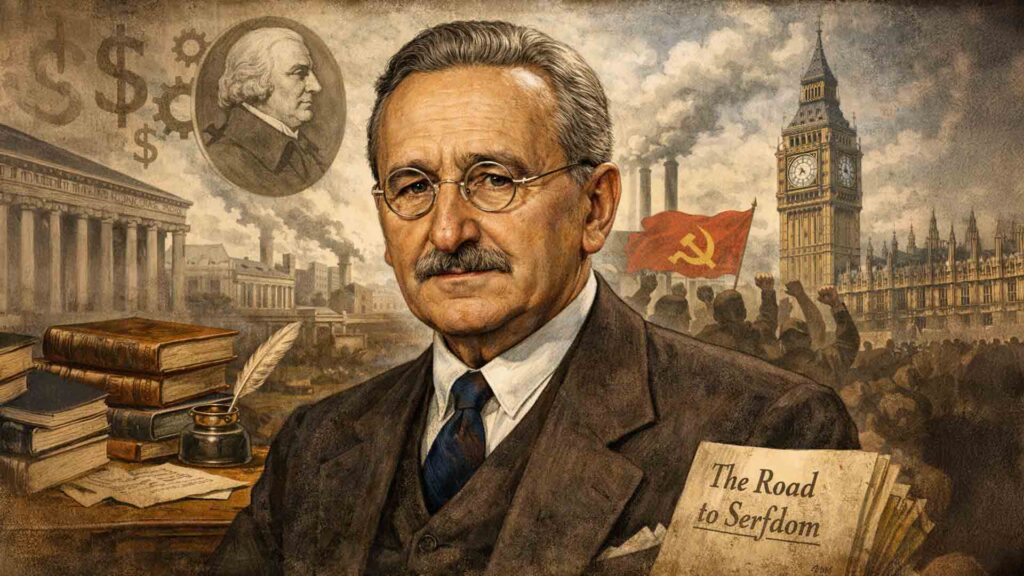
One of the greatest social theorists of the twentieth century was a libertarian – some would say conservative – economist named Friedrich Hayek (1899-1992). Hayek spent his life arguing that free enterprise is not only necessary for economic prosperity, but also essential to maintain political liberty. For much of his career, he faced overwhelming opposition to these views, but he did eventually gain some mainstream acceptance, winning the 1974 Nobel Prize in Economic Sciences. Hayek’s life and legacy An important book about Hayek has recently been published, written by Dr. Eamonn Butler of the Adam Smith Institute in London, England. It’s called Friedrich Hayek: The ideas and influence of the libertarian economist (2012), and it summarizes Hayek’s life and key insights. Hayek was born in 1899 in Vienna, earned a doctorate in law from the University of Vienna in 1921, and a doctorate in political science from the same university in 1923. At the University of Vienna Hayek became a close associate of Ludwig von Mises, the leading figure in the “Austrian School” of economics, which emphasizes the importance of the free market. Hayek and Mises then set up an economic think tank and Hayek undertook economic research. His research demonstrated that bad government policy was the cause of the “boom and bust” cycle of many countries’ economies, and he predicted that the USA was about to experience such a bust. Shortly thereafter, in 1929, his prediction came true, with the Wall Street Crash and the beginning of the Great Depression. In 1931 Hayek took up a position teaching economics at the prestigious London School of Economics in England. He became a naturalized British citizen in 1938 after Hitler took over Austria. The Road to Serfdom In April 1945 Readers' Digest released an abridged version of Hayek's Road to Serfdom. While the original is 250+ pages, this version is just 60. It can be read for free online here. There is also an 18-page cartoon summary that was meant to create interest in the longer book. You can find the comic at Mises.org/books/TRTS where you can also download the original, both of them also free to download. Because of World War Two, Hayek began to focus more on political science. He was afraid that totalitarian ideas were going to sweep the world, not just in the more vicious forms of Nazism or Communism, but even in the softer form of socialism. He believed that the moderately socialistic direction of the Western countries in the mid-twentieth century would ultimately lead to authoritarian government. To articulate this view, in 1944 he wrote a book called The Road to Serfdom, which was very controversial and quickly sold out its first print run. Butler notes that this book was: read by the young Margaret Thatcher, who later said she found it "the most powerful critique of socialist planning and the socialist state." It made Hayek’s name in America, too, where tens of thousands of copies were sold, and Reader’s Digest distributed another 600,000 copies of its own condensed version. Due to this publicity, Hayek gave lectures across the USA and became a visiting professor at Stanford University. In order to help spread libertarian ideas, in 1947 Hayek assembled 39 British, European and American scholars who supported individual freedom to found an organization that would promote the intellectual case for the free society. Because this meeting was held at the Swiss resort of Mont Pelerin, it was called the Mont Pelerin Society. This increasingly important organization still exists today to pursue the same goal. Shortly after World War Two, a former Royal Air Force fighter pilot named Antony Fisher went to Hayek to get advice on how to promote free enterprise in the face of popular socialist assumptions. Hayek convinced Fisher that the best thing would be to found a think tank that would generate intellectual arguments for freedom. A few years later, in 1955, Fisher set up the Institute of Economic Affairs (IEA), the first of several free market think tanks that would become very influential by the late 1970s and 1980s. Fisher would later play a role in the creation of Canada’s Fraser Institute, as well as like-minded think tanks in other parts of the world. Rise to prominence In 1950 Hayek became a professor at the University of Chicago. While there he wrote one of his most famous books, The Constitution of Liberty, articulating the foundations and principles of a free society. In 1962 he moved back to Europe to be a professor at the University of Freiburg in West Germany. As mentioned previously, he won the Nobel Prize in Economic Sciences in 1974. And over the course of the 1970s he wrote a three-volume set called Law, Legislation and Liberty, once again expressing the intellectual case for the free society, as opposed to socialism. Besides the Nobel Prize, Hayek also received other honors. Butler points out that in 1984, Queen Elizabeth II made him a Companion of Honour (he described it as "the happiest day of my life"), and in 1991 he was awarded the Presidential Medal of Freedom by George H. W. Bush. Hayek died in 1992, after seeing his ideas receive acclaim in many academic circles, as well as influencing the policies of some English-speaking democracies (especially Margaret Thatcher’s Britain) and some newly-liberated Eastern European countries. Freedom versus socialism Among Hayek’s many insights, two are of most significance for Christians. First, he argued that modern societies are much too complex to be centrally planned by government (i.e. socialism doesn’t work). Secondly, he argued that attempts to engineer societies to conform to some concept of “social justice” inevitably lead to authoritarian government (i.e. socialism leads to tyranny). Many people believe that if human societies were completely planned and run by governments, they would be much more efficient and fair. In Western societies today there are so many different kinds of products, of so many different shapes and sizes, that the situation is virtually chaotic. So if the government could decide what is produced, all of the products could be standardized, leading to economic efficiency. As well, there is a considerable amount of inequality in society, because some people benefit much more than others in a free market system. Through central planning, the government could equalize incomes, and thus enhance social justice. 1. Too complex for central planning But Hayek points out that societies are much too complex for any human organization to be able to centrally plan successfully. Societies are spontaneous orders, with millions of people every day making economic decisions of various kinds. How could a government possibly be able to aggregate and apply all of the information that would be necessary to anticipate these economic decisions every day? It’s simply impossible. Any attempt to do so would lead to all kinds of economic problems (think, for example, of the old Soviet Union). Consider one particular example of this problem, namely, the determination of salaries in a centrally planned economy. Should a nurse get paid more than a mathematics professor? Should a butcher get paid more than a coal miner? There are thousands of different occupations, and the central planning authority would have to determine each of their salaries relative to each other. How could they possibly know what was right? Hayek correctly argued that the free market takes care of this efficiently without central planning. People pay us for the goods and services we produce because they value those products. So market rewards do depend, in a very real sense, on the value that we deliver to other members of our society. They also reflect the scarcity and skill of the producers, the numbers of customers who want the service and the urgency or importance that buyers attach to it Therefore a person’s salary reflects a number of economic factors, not the political calculation of a bureaucrat. If there are too many people pursuing a particular occupation, their salaries will go down. If there is a shortage of people in a particular occupation, their salaries will go up. In a free market society, economic information is communicated through prices. Prices are signals that indicate “to everyone where their product is most highly valued, and prompting them to steer their efforts and expertise in those directions.” Say, for example, that there is a shortage of tin. Because there is not enough of it, its price will rise. Due to the price increase, companies that use tin will use less of it or find a substitute for it. The extra demand for the substitute will in turn bid up its price, and prompt those using the substitute to seek yet other materials to substitute for that; and so it goes on. The entire market order adjusts to the shortage of tin, even though hardly anyone knows what caused it. The overall point is that free markets automatically adjust to changing conditions. It’s part of the nature of the free market to process all kinds of information and respond to it spontaneously. Central planners could never hope to know all of this information and to be able to respond to changes in the economy so rapidly and effectively. Besides the fact that socialism doesn’t work, its tendency is to lead inevitably to authoritarian government. A central planning government must determine how labor, land and other productive resources are used in the economy. It has to coordinate all these different factors so that they work towards the completion of the government’s plan. In such a situation, everyone would have to do what the authorities have determined is necessary for the achievement of the government’s objectives. Individuals must expect to be uprooted and deployed at the direction of the authorities, since personal life now counts for nothing compared to the good of the collective – a good that is defined by those same authorities. Butler summarizes the point this way: “When governments believe they can ‘run the country’ just as they might run a factory, our lives and property become a mere input at their disposal.” 2. Inequality can be a good thing A centrally planned economy can redistribute resources between people and therefore lead to a situation of greater material equality. However, the loss of freedom necessary for such an endeavor is quite high. As well, the economic benefits of inequality are lost. In the economic sphere, inequality is not always a bad thing. Yes, you read that right: inequality is not necessarily a bad thing. Butler describes Hayek’s insights on the economic importance of inequality this way: Inequality is not just the outcome of the market process: it drives the market process. The high gains made by successful producers act as a magnet, pulling people and resources to where the greatest value can be captured, and away from less productive and less valuable uses. So people and resources are attracted to where they will make the greatest possible contribution to future incomes. And this is a continuous, dynamic, growing process. The inequality that so many people resent is, in fact, the very attraction that steers effort and resources to their most productive applications, pulling up incomes at every level. Hayek argued that the government should have a minimal role in society. Mostly it should be concerned with national defense and enforcing the rules (laws) that protect people from each other. It would also provide public goods such as roads, land registries, organized responses to natural disasters, and other things that governments can do best. He also saw the need for government “to support needy groups such as people with disabilities, those incapable of work, orphans or the elderly.” Needless to say, the government can fulfill these tasks without becoming socialistic. Conclusion Hayek was not a Christian scholar and he was not trying to promote a Christian perspective. Nevertheless, his scholarship dovetails well with Biblical Christianity because he believed in the need for a private property-based economic system. The Bible establishes private property as an essential institution and assumes a private property-based economy. In this respect Hayek’s intellectual work supports an economic system much like what the Bible demands. There are few twentieth century thinkers that were as important and influential as Friedrich Hayek. Whereas so many academics think that mankind is smart enough to re-engineer societies through governmental power, Hayek was humble enough to concede that human beings are very limited in their knowledge and that their efforts to re-engineer any society are bound to be detrimental. While not everything in his thinking can be embraced by Christians, his overall perspective on economics and society provides a powerful intellectual antidote to the socialistic fallacies that are still common in North American colleges and universities today. Hayek and his ideas are featured below in a couple of epic rap battles vs. his economics arch nemesis, John Maynard Keynes. ...

Red heart icon with + sign.
Politics

5 ways God’s providence should impact how we approach politics

This is an edited version of a devotional given at an ARPA Canada “God and Government Conference,” May 4, 2019, in Aldergrove, BC. ***** God is in control. It’s a simple enough truth, but if we understood it, really understood it, I think it would change the way we approach politics. So I want to look now at government through the lens of God's providence. God's providence means that He governs and upholds his creation, all of it, from little rocks to whole galaxies, and plants and animals too. His providence also encompasses the flow of history and the decisions of individual human hearts. In short, God’s providence means that God rules, and that because He rules nothing comes about by chance. Nothing happens apart from God's will. Nothing surprises God or ever presents God with an unsolvable problem. Nothing is ever beyond his control. At some level, everything happens because God wants it to happen in fulfillment of his good and perfect plan. That means when a nation is blessed with good government, we know this is by the will of God. Good governments don't arise by chance. They don't come from nowhere. Instead, they come to us a gift of God's goodness and mercy. They are from the hand of the Lord. At the same time, when a nation endures a period of poor government or when the Christian Church endures oppression at the hands of government, this, too, is from the hand of God. Also in such times, God is in charge. In all the adversity experienced by the Church, the Lord is still advancing his own good purpose to eventually unite all things under one Head, even Jesus Christ (Eph. 1:10). So let’s consider now how working with the doctrine of God's providence will have some blessed effects for those engaged as Christians in the work of politics. 1. Reflecting on God's providence would lighten our mood! When governments do foolish things or act in ways that diminish our freedom and make life more difficult for us, that can be very discouraging. However, when we remember that God is sovereign over everything and that even Satan can do nothing apart from the will of Christ, we get a different feeling about difficult political realities. The world is not spiraling out of control; God is still in control! What's happening is part of his plan and his plan involves working out everything for the glory of his Name and for the good of those who trust him. 2. God's providence should increase our patience. God's providence is connected to God's ultimate purpose and we know that this is a long-term project; our Father in heaven is playing the long-game. Knowing this enables us to continue in hope even as the going gets rough. 3. God's providence should increase our hope for change. We read in Proverbs 21 that the: "king's heart is a stream of water in the hand of the LORD; He turns it wherever He wills." The imagery here probably comes from agricultural practices of the ancient world. In parts of the ancient world, there was the practice of digging canals and smaller waterways that could be controlled by a series of large valves. If a farmer wanted to channel water to a particular part of his land, he would simply close one valve and open another. It wasn't difficult to do and the effects were quite dramatic. Just as easily as a farmer redirects water in a channel, so easily God redirects the heart of a king; He turns it wherever He wills. Even when the king imagines that he is acting with complete autonomy and sovereign power, it's actually God who is directing his decisions. Notice that God's sovereignty extends not just to the actions of the king but to his heart, that is, to his inner self, the place of his thoughts, desires and wishes. For God to influence a ruler in this deeply personal matter is not difficult. For this reason, even in the most trying of times, we can expect positive change. Even when the trajectory doesn't look good, God can make things happen. Walls can come down quickly. Closed doors can be opened when we no longer really expected it. Events can happen that totally change the political landscape – and we didn't see them coming! 4. God's providence should increase our courage I would say that this is true because knowing God's providence decreases the feelings of intimidation which we may experience. When government and the media seem large, overwhelming, and irresistible, we are not afraid. I'm reminded of what Jesus said to Pontius Pilate: "You would have no authority over me at all unless it had been given you from above" (John 19:11). The fear of the LORD who rules the world in his providence takes away the fear of people. Fear paralyzes us but living confidently in the light of God's all-encompassing providence motivates us and encourages us to speak and act according to our convictions. 5. God’s providence encourages us to engage in politics Saying this may seem counter-intuitive. Wouldn’t the confession that God sovereignly turns the hearts of kings wherever He wills make Christians passive? Wouldn't the doctrine of providence encourage us to simply wait for God's next move? I would say that the opposite is true. The more we reflect on God's sovereignty, the more we think about his providential control over the world, the more we will be motivated toward political engagement. God's work of providence encourages us to work in our sphere and responsibility. After all, in his providence, God uses the work of human beings. He uses our prayers, words and our political witness to accomplish his work of providence. Yes, of course, God can and frequently does act directly upon his world but in many cases, God works indirectly and through the actions of people. Ephesians 1 says that God has a plan for the fullness of time, to unite all things in Christ, things in heaven and things on earth.  By God’s providence, this plan is coming to fulfillment.  However, this fulfillment involves human prayer, human actions, words and witness. The fulfillment of God's plan involves each one of us working with our own gifts and opportunities for the glory of God. Imagine that you didn't know there was a plan. Imagine that you didn't believe God was firmly in control. Imagine that you didn't know that in the end God wins and his Kingdom is established in righteousness forever. Imagine that life was a crapshoot so that you just didn't know where it would end. Would that motivate you to action? I don't think so. But when you know that God wins and that everything is somehow part of the pathway to final victory, then you can feel a surge of energy. Something good is coming. God's victory is coming and you can be part of the process. This article was originally published in the May/June 2019 issue of the magazine. Rev. Schouten is a pastor for the Aldergrove Canadian Reformed Church....

Red heart icon with + sign.
Politics

Canada’s law was based on God’s Word

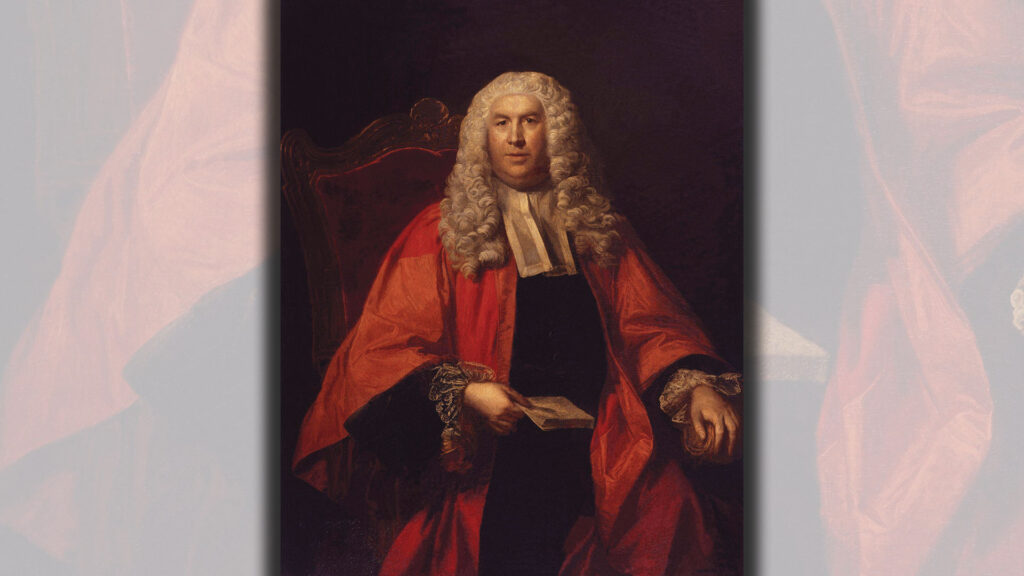
Blackstone, Britain, the Bible and the legal heritage of the English-speaking countries ***** Canada’s law was largely based on God’s law. That’s a claim many would dispute – they don’t want to give God credit for the freedoms, and legal protections we enjoy in our country. But disputing the facts doesn’t change them. Canada’s political and legal institution can largely be traced back to Britain – our “mother country” – and when the British laid down the foundations of their own legal system, they were an officially Christian country (with Anglicanism in England and Presbyterianism in Scotland) that had set out to build their laws and legal system on a biblical foundation. It is this Christian legal and political foundation that Britain transferred to Canada. Documenting Scriptural influence During the eighteenth century an English legal scholar, Sir William Blackstone (1723-1780), wrote a multi-volume set of books called the Commentaries on the Laws of England. This was no ordinary set of legal books. Blackstone’s Commentaries were quickly accepted as the authoritative account of English law and philosophy of law. This is noteworthy because in the Commentaries Blackstone was very explicit about the influence of the Bible upon the law of his time. Robert Stacey, a professor of government at Regent University in Virginia, has written about the significance of Blackstone in his book, Sir William Blackstone & the Common Law. In our day it often seems that the law works against Christianity, so Christians need to be reminded that our current legal situation is a deviation from our country’s history. In this book Stacey briefly traces the development of common law in England and how Blackstone deeply influenced the American colonies and the early American republic. 800s - King Alfred’s “Dooms” A key figure in the initial development of common law was King Alfred the Great of England. He formulated a body of law known as “Alfred’s Dooms” in the ninth century that relied on the Ten Commandments as well as other aspects of the Mosaic Law and the New Testament. Stacey writes that the Dooms were “steeped in Christian principles of right and wrong” and they “became the starting point for English law to come.” 1200s – Magna Carta In 1215 some prominent English citizens forced King John to sign the Magna Carta which placed significant limits on the monarch’s power and recognized certain rights and liberties for English subjects. The idea that monarchs are not above the law, but are under it just as their subjects are, was a central theme that reflected Biblical ideals. 1600s – King and country are not above God During the seventeenth century, Edward Coke, a major judicial and political figure in England at that time, led the fight against Charles I, a king who claimed illegitimate powers for himself. According to Stacey, Coke “resisted both Crown and Parliament whenever either attempted to operate outside its common law boundaries or act in violation of God’s law.” He also wrote a multi-volume Institutes of the Laws of England which was the standard work on English law until Blackstone’s Commentaries in the latter part of the eighteenth century. Anyway, the overall point that Stacey is trying to make by surveying the history of English law is that “the common law emanates from a distinctly Christian worldview.” More precisely, “the common law traces its origin to two sources, Holy Scripture and the natural law.” It’s important not to be confused by the term “natural law” in this context – today that term is often used to describe foundational law that finds its origin in Nature rather than God. But Blackstone did not see it as a rival authority to the Bible. Rather, in using that term he is “acknowledging the common law’s roots in Scripture and God’s created order, as applied to the circumstances of England by many past generations of great Englishmen, exercising a providentially granted wisdom that was perhaps less common in Blackstone’s own, more humanistic age.” Or to put it another way, Blackstone was using the term “natural law” for what the Apostle Paul describes in Romans 2:14-15 as the law that is written on our hearts. 1700s – Christian legal heritage challenged Already in the eighteenth century, English law was being challenged by Enlightenment-inspired secularists. Blackstone defended the earlier Christian heritage of the law. In contrast to the man-centered concepts of law, “Perhaps the most foundational principle for the whole of common law is the axiom that the source of all good and just law is outside of man. Man does not act on his own to produce justice, but acts justly only when he conforms to external standards of justice, in short, the law of God.” Blackstone was very influential in his own day as well as during much of the nineteenth century. His Commentaries appeared in the late 1760s and sold thousands of copies in England and America. According to Stacey: “His intellectual and practical impact on American political philosophy, governing institutions, and legal system being more profound than it was even in England, Blackstone’s Commentaries may be justly counted among the foundational canon of America.” “According to some estimates, the Commentaries were the most widely read work in revolutionary America after the Bible.” Blackstone’s Commentaries remained the standard for American legal education until the second half of the nineteenth century when secular theories of law began to dominate the field. The United States and Britain were not the only countries where law was powerfully affected by Blackstone: “Blackstone’s influence was also felt in such far-flung corners as Canada, Australia, New Zealand . . .” and certain other countries. The fact that Blackstone helped to shape the law and legal education in the English-speaking countries is not just historical trivia. His influential perspective on law both reflected and helped to develop the Christian foundation of law in these countries. “Blackstone effectively advocated a God-centered legal system at a time when many leading culture-shapers sought to impose a man-centered system.” Christian influence waning Looking at Blackstone’s Commentaries reveals the degree to which the common law of England – and therefore also the USA, Canada, Australia, and New Zealand – was rooted in a Christian worldview. This Christian influence on the law has been progressively discarded over the last few decades, but it was there for hundreds of years previously. It’s not a coincidence that these countries are becoming less hospitable to Christians as the Christian foundation of law is being lost. Law is always rooted in a particular philosophical perspective, and if that perspective isn’t shaped by Christianity, it will be shaped by a different worldview. Modern law in the developed English-speaking countries is increasingly shaped by secular humanism which is inherently hostile to Christianity. It is a very different perspective on law than the original perspective Canada inherited from its “mother country.” This first appeared in the April 2011 issue....

Red heart icon with + sign.
Politics

Introducing ARPA Academy

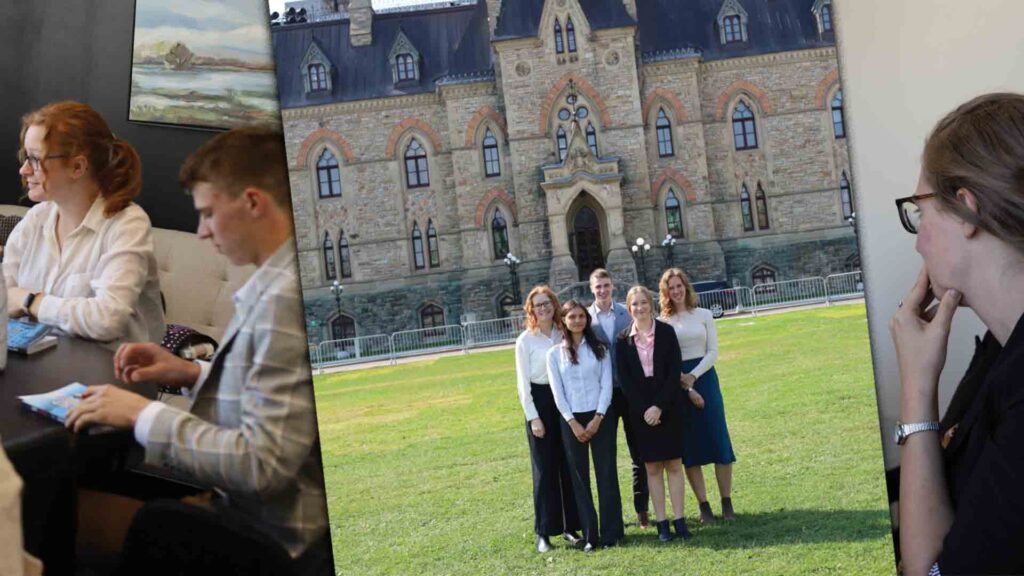
A one-month program in Ottawa to sharpen and shape you! ***** RP’s Nov/Dec 2024 issue – the “Get Educated, Not Schooled” edition – described all sorts of opportunities for young people to consider for after they’d graduated from high school. The possibilities discussed ranged from attending university to entering trade school to starting a family. Now ARPA is pleased to offer a new opportunity this coming summer: ARPA Academy! Abraham Kuyper famously said, “There is not a square inch in the whole domain of our human existence over which Christ, who is Sovereign over all, does not cry: Mine!” As Reformed Christians, we believe in the sovereignty of God and His providential rule over all things. What does that actually mean for Canadian law and politics? ARPA Academy seeks to help answer this very question. The 5 Ws ARPA Academy will be a one-month program in Ottawa to prepare young people aged 18-25 for faithful political engagement. Not only will the program be offered at no cost to participants, ARPA will also offer a small stipend to help cover expenses for the month. While participants will be responsible for finding their own housing, ARPA staff will suggest options and assist where necessary. Throughout the month of August, participants will explore biblical and Reformed worldview foundations for political action, learn about Canada’s constitutional history and legal system, study current policy issues, and develop key skills through readings, assignments, interactive sessions, and direct grassroots action. ARPA Academy will address questions such as “What does the Lordship of Christ over the political square look like in a society that largely does not recognize or understand His rule?” and “How does that apply to the wide variety of law and public policy issues?” The focus of ARPA Academy is on education and worldview training, but it also aims to prepare participants to be involved in politics in the future. While in Ottawa, participants will meet with political staff, lawyers, and non-profit leaders to learn about different careers. If a participant wants to pursue a hands-on internship, work on Parliament Hill, or get involved with a local non-profit organization after ARPA Academy is completed, ARPA staff can help make connections to pursue these goals. Some participants may go on to work full time in law, politics, or advocacy. Others may decide to pursue very different lines of work. In either case, participants will deepen their Christian worldview and be better equipped to be engaged and active Christian citizens. Lucas, one of last year’s ARPA interns, had this to say about his time deepening his understanding of politics from a Reformed worldview: “My experience at ARPA gave me a broad understanding of Canadian politics and the functioning of our political system. It also sharpened my worldview, enabling me to think critically about issues from a Christian perspective. This has allowed me to become a more effective citizen and has enabled me to take political action in my community.” Benefits to consider I’m excited about the ARPA Academy because in my own life it’s opportunities like this that helped me immensely. I spent a semester in Ottawa while in university, and that confirmed for me that I wanted to work in political advocacy for the long term. There were three other key components I learned from my own opportunities that I want to share, because they are also a focus for ARPA Academy. First, my time in Ottawa helped me better understand the nature of politics and political advocacy at a worldview and practical level, including a hopefulness because of God’s sovereignty over all things. Second, I had the opportunity to meet and learn from many devout Christians working on and around Parliament Hill, who were seeking to apply their Christian faith to politics for the good of their neighbors and their country. Finally, it allowed me to see what kinds of career options existed in the political and non-profit world and where I could fit into that kind of work. Whether you’re just out of high school, finished university, doing a trades apprenticeship, or between jobs, this is worth considering. This one-month program is an opportunity for Christian youth to engage with Reformed Christian thought and apply it to the world around them. Applications for ARPA Academy will open in December 2025. Check out our webpage for more information about the program and how to apply. If you have any questions, or would like to be added to an email list for updates, contact [email protected]....

Red heart icon with + sign.
Pro-life - Abortion

Judges vs. justice: a history of abortion in Canadian courts

In 1988 Canada’s Supreme Court’s gave their Morgentaler decision which struck down all restrictions on abortion in the country. Shortly afterwards the Supreme Court again dealt with abortion in the Borowski and Daigle cases. Together, these three cases have been called the “abortion trilogy” and a close look at these cases shows how Canada’s top judges can take a large amount of the credit for us being one of just three countries in the world with no protection for the unborn. 1. The Morgentaler decision In 1983 abortionist Henry Morgentaler was charged with operating an illegal abortion clinic in Toronto. At that time, the law only allowed abortions to be performed in accredited hospitals with special abortion committees that had to approve each abortion. Morgentaler and his supporters considered this to be too restrictive. His case went all the way to the top and on January 28, 1988, the Supreme Court ruled that Canada’s abortion law violated section 7 of the Charter. The majority of judges argued that the abortion law violated the procedural fairness required by the Charter of Rights. While this was a major victory for Morgentaler, there was a sense in which that decision was not a complete defeat for the pro-life cause because it gave Parliament the option to pass better abortion legislation. (though Parliament hasn’t touched the issue since). In his 1992 book Morgentaler vs. Borowski, University of Calgary political scientist Ted Morton relates some little known information that shines some light on the Supreme Court’s thinking. Morton notes that when Gwen Landolt, a lawyer and leader of the pro-family group REAL Women of Canada, read the Supreme Court’s decision she noticed something startling. Four of the judges who struck down the law referred to a document known as the Powell Report in their decision. Dr. Marion Powell had been commissioned by the Ontario government to survey the availability of abortion services in Ontario. Dr. Powell was a “pro-choice” activist, and her report was released on January 27, 1987, three months after Morgentaler’s case had been heard by the Supreme Court. Landolt reviewed the Morgentaler docket in the Supreme Court archives and confirmed that the Powell Report had not been mentioned in court when the case was argued – obviously because the report did not yet exist at that time. In other words, the Supreme Court, in striking down Canada’s abortion law, had relied heavily on a document that had not been submitted as evidence, and which had been produced by an abortion rights activist. Landolt shared this information with Laura McArthur, the president of the Toronto Right to Life Association. McArthur then lodged an official complaint with the Canadian Judicial Council, arguing that the Court had deprived Morgentaler’s opponents of the right to challenge the Powell Report when the case was argued. Considering that Dr. Powell was a pro-abortion activist, the impartiality of her report was certainly questionable. The Council replied that the issue raised by McArthur was outside of its mandate to consider, and also that the Supreme Court occasionally relies on materials which have not been introduced as evidence. This is known as “judicial notice.” However, as Prof. Morton notes, “To justify the Court’s use of the Powell Report as an exercise of judicial notice was to stretch the concept beyond its normal scope.” 2. The Borowski decision While Henry Morgentaler had been fighting in the courts to strike down restrictions on abortion, a prominent Manitoba pro-life activist (and former provincial cabinet minister) Joe Borowski had been fighting in the courts to have abortion prohibited in Canada. That is, he was challenging the same law Morgentaler was challenging, except from the opposite point of view: Borowski said Canada’s abortion law violated the Charter because it allowed abortions to be performed. He argued that unborn children were protected by the Charter’s declaration that “everyone has the right to life.” After considerable effort and expense, Borowski’s case reached the Supreme Court in October 1988. A few months later the Court ruled that it would not address Borowski’s arguments because his case had become moot. The law he was challenging had been struck down in the Morgentaler decision, so the Court did not need to address issues related to legislation that was no longer operative. All of Borowski’s efforts were thwarted by this declaration that his case had become moot. Years of work and expense came to nothing. Now the pro-life movement had lost two cases at the Supreme Court, but there was one more yet to come. 3. The Daigle decision On July 7, 1989, Jean-Guy Tremblay obtained a court injunction in Quebec to prevent his former girlfriend, Chantal Daigle, from aborting the child they had conceived together. The Quebec Superior Court upheld the injunction 10 days later. Then on July 26 the Quebec Court of Appeal also upheld the injunction. In a decision that shocked the country, that court ruled that an unborn child was a “distinct human entity” that “has a right to life and protection by those who conceive it.” The Quebec Court of Appeal decision was immediately appealed to the Supreme Court of Canada. The Supreme Court judges were called back from their summer vacations to hold an emergency session on August 8. As Ted Morton and fellow University of Calgary political scientist Rainer Knopff write in their 1992 book Charter Politics, “Never before in the Court’s history had a case moved from trial to the highest court in the land with such speed!” Canada was in the midst of a full-fledged crisis. How dare a court in this country declare that unborn children had a right to life! During the Supreme Court proceedings, Daigle’s lawyer announced that she had gone to the US and had an abortion there, making the case moot. The injunction preventing her from getting an abortion no longer had any practical effect. The Chief Justice then asked the opposing lawyers if they wished to continue the proceedings. Tremblay’s lawyer said no, but Daigle’s lawyer said yes. The Court therefore decided to continue, and within two hours they had struck down the (moot) injunction against Daigle, once again handing the pro-abortion side a complete victory. That wasn’t all, however. The Court decided to do more than decide Daigle’s case, which concerned Quebec’s civil law. The Court went well beyond the questions of that case by also addressing the rights of the fetus under common law, which applies in the other nine provinces. This was to prevent a similar case from later arising in one of the common law jurisdictions. The Supreme Court had previously taken the position that it wanted to avoid unnecessary judicial pronouncements. Morton and Knopff point out that in this case the Court violated its own maxim twice: When the justices learned that Chantal Daigle had had her abortion, why did they persist in ruling on the issues involved rather than declaring the case moot – which it clearly was? Similarly, why did the Court expand the scope of its ruling to include the common law when this was not necessary for a Quebec appeal? They note that, “for many this aspect of the Daigle decision encourages the suspicion that the Supreme Court is less than neutral on the abortion issue.” Morton and Knopff indicate that there are other questions as well. When Borowski’s case became moot, the Supreme Court refused to proceed with it. When Daigle’s case became moot, the Court proceeded anyway. “Why under these circumstances, sceptics wonder, did the Court persist in deciding the issue of fetal rights? Why did it treat Borowski and Daigle so differently?” As mentioned, Daigle’s case was rushed to the Supreme Court level unlike any previous case. Perhaps this can be justified because of the medical issues involved. It could be seen to be an emergency situation. As a result of the lack of time, there was much less legal preparation and input than usual for a major court case. When Daigle had her abortion, however, the emergency was over. There was no need to rush into a decision without proper study and thoughtful consideration. This was serious stuff, after all, because it concerned the supreme law of the land. Morton and Knopff quote another constitutional expert as saying that it was a bad idea to rush ahead with the Daigle case and produce a major court ruling “in a hothouse, emergency atmosphere. This opinion will be with us for centuries.” And yet this important decision had been reached with considerably less preparation and argumentation than would normally occur. The Canadian people (most notably those in the womb) were not well served. Operation Rescue Besides the Daigle controversy, there was other activity on the abortion front in Canada during 1989. After the Morgentaler decision, many Canadian pro-lifers became increasingly frustrated about the lack of restrictions on abortion. Some joined Operation Rescue and engaged in civil disobedience directed primarily against Everywoman’s Health Clinic in Vancouver and two abortion clinics in Toronto. Operation Rescue was a group founded in the US to promote nonviolent resistance as a pro-life tactic. Operation Rescue activists would use their bodies to block access to the entrance of abortuaries. Pregnant women were thereby prevented from entering and getting abortions. The police were always called in to break up the blockades. Court injunctions were imposed against these protests, but activists would often ignore the injunctions. Many were thus thrown in jail and fined. The courts in BC were particularly harsh in dealing with protestors who participated in Operation Rescue. But while the mainstream media strongly approved of Daigle’s actions and her Supreme Court decision, it disapproved of the Operation Rescue missions. Writing at the time, Ted Byfield of Alberta Report pointed out the hypocrisy of the situation: It’s true that, in aborting the child, she defied a court injunction. In Vancouver, that is a dreadful thing to do, as the judges so gravely aver every time they slam the abortuary rescuers into jail for doing it. receives no such admonition. She has been through enough, the judges decide. So we see how law is administered in Canada. If you defy an injunction in opposing abortion, you are a wretched criminal and must go to jail. If you defy an injunction in having an abortion, you are a national hero, and warmly commended. Conclusion Ted Byfield’s comment puts the matter clearly. Canada’s courts had become politicized. When they were presented with an abortion-related case, the outcome always favored the pro-abortion side. The courts reasoned one way in one case, and the opposite way in another case, in order to arrive at their desired decision. Their legal reasoning was steered in particular directions to achieve their political goals. The courts will not change until Canadian society has been changed. This is why the efforts of pro-life groups are so important. Neither the politicians nor the courts will respond favorably to pro-life arguments until there’s a broader reception of the pro-life message. It isn’t going to start at the top – grassroots activity is essential to accomplishing this goal. We all need to talk to our neighbors. This article first appeared in the April 2015 issue....

Red heart icon with + sign.
Politics

What if everything was about God?

It struck me, just recently, that I’ve been regularly promising to praise God’s Name “among the nations.” This pledge, to talk about God outside of church, out in the world, with non-Christians, comes up again and again in the songs we sing each service (Ps. 18, 57, 108, etc.). And, just recently, God gave me an opportunity to talk about Him with more than a hundred thousand people, sharing His views on a local political issue. God made it happen This year our public library system asked voters to approve a roughly 66% increase in taxpayer funding. The way things work here, an official “voters’ guide” is sent out to everyone, and it includes both the reasons for and against every proposed levy. Who writes up those reasons? Whoever volunteers first. So, I recruited my wife Janice, and the two of us, along with one other gentleman from the area, became the three-person “Against Committee.” Why was I against more money for the library? It’s because our solidly Christian town has a very unchristian library. The local branch is run by people who put on big Pride Month displays, even in the children’s section. This Spring, I bumped into a neighbor by the picture books section, and as we were chatting, she started sifting through the shelves, looking for treasures. But what she kept discovering was one disgusting picture book after another. They were about sexual development, or pushed gender-confusion and other LGBT themes, and were intended for kids barely old enough to read. Neither of us knew what to do with her growing stack. I ended up checking them all out, not because I wanted them, but because, with no late fees being collected anymore, I could at least keep these out of circulation for a good long while. That’s all I was thinking at the time. But I still had those books on my desk when this voters’ guide opportunity popped up. Turns out, God had provided me just the ammunition I’d need for my write-up. What kind of win? While I wanted to focus on how the library was opposing God and what He’s said about gender and sex, the third person on our Against Committee wanted a focus on the money. Making it about the money could broaden the appeal to anyone in the county who cared about their pocketbook. Surely that was a bigger group than just the concerned Christians! Asking for a two-thirds increase is significant, so he had a point. It’s also a familiar point. When it comes to politics, Christians tend to bring forward fiscal issues, or other generally conservative points, rather than anything explicitly Christian. In this case, if more people care about money than God, isn’t the winning strategy obvious? The thing is, not all wins are wins. In 279 BC, King Pyrrhus of Epirus defeated the Romans at the Battle of Asculum, but at a devastating cost to his own army. Ever since then the term Pyrrhic victory has been used to describe a win that leaves the victor weaker than before. In Christians’ engagement with the world, we will, for the sake of some perceived short-term victory, overlook the long-term consequences that come with excluding God from the public square. We wonder why our culture is turning from God, but if, for strategic reasons, God’s own people won’t profess His Name in politics, who are we expecting will? Every square inch The world is the LORD’s, and consequently, the Devil is always and forever trying to get us to overlook, downplay, or deny that. In this library skirmish, the real issue wasn’t how much, but rather Who the library was opposing. So, what kind of win would it be if we had to shut up about our LORD to get it? If the Devil could choose to make us focus on either money or God, wouldn’t he choose money every time? The devil’s win is getting Christians to self-censor their praise and rob God of the glory that is His due. Thankfully, while the third member of our committee wanted money mentioned, he was happy to keep God central. After some back and forth, this is what we sent out to 140,000 eligible voters: Argument Against In the opening chapters of Genesis we learn that God made us male and female (Gen. 1:27) and sex is intended for marriage (Gen. 2:24). Our library system actively opposes these truths, and wants more money to do so. They oppose God in their teen section where Beyond Magenta shares an account of oral sex with a six-year-old. Despite this being brought to the library’s attention, they didn’t pull the book. That opposition is apparent even in the picture book section. Your preschooler can pull My Princess Boy off the shelf and ask you whether boys should wear dresses too. Being You: A First Conversation About Gender will teach them that “it’s okay to wonder: Am I a girl? Am I a boy? Am I both? Am I neither?” And Everybody is a Rainbow depicts naked genitalia. A $600,000 home currently pays about $155 a year to this system – the library wants to up that almost $100, to $252. We have increasing food, electricity, housing, and gas costs – that’s what we need our money for. We most certainly don’t need to give more money to a library that’s opposing God-given truths and sowing confusion, even among the littlest. The voters’ guide only allowed us 200 words, but the debate was also being had in the local paper. The paper published an article arguing for the increase, touting the library as somewhere safe to go. I got 300 words, in a letter to the editor, to share how God knows best what is best for us, and a library pushing transsexual confusion on little kids isn’t safe at all. Three kinds of objections Objections came in three sorts. Folks noted that, if it was about the money, borrowing from a library can save you a lot of money. That was a decent point, and it underscores the danger of what could have happened if we’d made this minor point our major one – we would have wasted all our energy on a matter that doesn’t matter. Another objection was along the lines of “Don’t force your God or your views on me.” But this objection applies better to their position than to ours. Christians don’t want to be forced to pay even more money to support views our Lord opposes. Meanwhile, the library and its supporters want to force us to cough up cash for their agenda. The irony was heavy. The third objection was over the definition of words like “safety,” “love,” and “gender,” and whose definition we were going to go with, the Left’s or God’s. A real win The vote went against us, and now we’ll have to hand over even more money to a library that’s shown it hates God. In the past that kind of result might have gotten me frustrated. This time I’m just grateful. God gave me an opportunity to praise His Name in public, and He made it easy for me. He put the committee sign-up sheet in front of my face, and so pre-arranged things to get my neighbor to track down the obscene picture books I could cite as horrible examples. Then He got a couple hundred words about Him sent out by a State that hates Him to over one hundred thousand voters who don’t normally hear about Him. It was a political campaign with the focus on God. Because everything is about God. And He is amazing....

Red heart icon with + sign.
News

Can you track all the ways you’re taxed?

Each year the Fraser Institute observes a “Tax Freedom Day” – this year it happened on June 8 – that tracks Canadians’ total tax burden when you add up all the municipal, provincial, and federal tax burdens. Across the country, the average Canadian spent up until June 8 earning money to cover their taxes, and it was only June 9 going forward that what they earned was what they could keep. So Canadians need to work nearly half the year just to pay our taxes. The average Canadian family with two or more individuals (i.e., this isn’t tracking individuals living on their own) is said to earn $158,533 a year, and pay $68,266 in taxes, or 43% of their income. This Tax Freedom Day differs from province to province, depending on their tax burden. In Manitoba, it arrives May 17 (37.5% of their income), the very earliest date in Canada, with the latest occurring in Quebec, on June 21 (47%). Do those figures strike you as higher than expected? They did to me, so I dug a bit deeper. The biggest tax we’re all hit with is income tax, but it is far from the only one. The government taxes us all sorts of niggling ways, which has the result of hiding from us the cumulative total. Just consider all the different ways you get taxed when you earn a dollar. The amounts below are based on the Fraser Institute’s purported $158,533 average family income. Payroll taxes: $16,199 – Before you even get your cheque, both you and your employer will have to contribute to the Canada Pension Plan, Employment Insurance, and some provincial Health Taxes. Income taxes: $23,100 – The federal and provincial governments each have their own income tax on the money you take home. Sales taxes: $10,091 – When you spend any of your remaining income, both the federal government, and all provinces except Alberta (and the territories) will charge you a sales tax. Capital gains tax: $6,656 – If you invest your money hoping to make it grow, you’ll be taxed on any gains you make. Property taxes: $2,310 – If you used your money to buy property, then every year you’ll be taxed on that too. Sin taxes: $2,310 – All taxes make things more expensive, but sin taxes are specifically geared to do so, to discourage consumption. They are placed on alcohol, tobacco, and cannabis. Tariffs and fuel could fall under this category too – both are meant to punish consumption – but the Fraser Institute placed them in other categories below. Fuel/vehicle/carbon taxes: $2,267 – There are additional taxes placed on gas, and while the Trudeau carbon tax is now hidden from consumers, it is still applied to industry, which will, of course, have to then pass it on to their consumers. Other miscellaneous taxes: $1,136 – These include import duties (i.e., tariffs), amusement taxes, natural resource fees, etc. and etc. So, that’s how it all adds up. And, to make matters worse, the Fraser Institute figure doesn’t even include what we should call the hidden inflation tax. Over the last 4 years, prices in Canada have risen, cumulatively around 17.5%. If our average Canadian family spent what income remained, that rise in inflation would amount to another $13,000 worth of impact from this “tax” – their $90,267 of remaining income would now have only $77,000 worth of purchasing power, compared to just four years previous. But to a fiscally profligate government that’s piled up a huge debt, inflation can be attractive. It not only deflates the value of the dollar, but deflates the value of the country’s debt too, easing the pressure on the government to curtail their spending. In other words, inflation really is a tax, raising revenue of a sort for the government, at the expense of citizens. And we’re still not done tallying yet, because our governments are planning on spending more than they even collect, which, if that additional sum had to be paid now, would require another $5,500 from our average Canadian. Instead, our federal and provincial governments are borrowing it to a cumulative projected deficit of $84.9 billion in 2025, saddling future generations with repayment, making this a tax on our children. Why so many different and even hidden taxes? Well, if everyone knew just how much we’re paying, would we stand for it? The more important point might simply be the enormous amount. God says that where our treasure is, there our hearts will be also (Matt. 6:21), and the amount of treasure we’re investing in our government – half of everything that families make – shows where Canadians’ hearts are turning. We’ve made a god out of government, and that needs to stop (Ex. 20:3). So next election, when the politicians come knocking, we need to demand less from them. And we need to explain why they don’t need nearly so much money, because, after all, God has called on other levels of government, including the Church, families, and even self-government, to fill so many of the roles that our political leaders have tried to take over....

Red heart icon with + sign.
News, Pro-life - Euthanasia

MP says: No MAiD for the mentally ill

BILL C-218 PROPOSES TO SCRAP EXPANSION OF EUTHANASIA FOR MENTAL ILLNESS ***** MP Tamara Jansen has introduced a new bill that would repeal the expansion of euthanasia to those with mental illness. Four years into the conversation about euthanasia for mental illness, we can be incredibly happy that there is another proposal to eliminate one of the most egregious parts of Canada’s euthanasia regime. History of the planned expansion of euthanasia for those with a mental illness Euthanasia for those with a mental illness was first raised in Bill C-7 in 2021, which originally set a date of March 17, 2023 when euthanasia for those with mental illness would be legalized. After a report by a committee of the Quebec legislature recommended against euthanasia for mental illness and an expert panel report on euthanasia for mental illness noted significant risks, the government passed Bill C-39, which delayed the expansion of euthanasia for mental illness until 2024. As that date approached, former Member of Parliament Ed Fast introduced Bill C-314, An Act to amend the Criminal Code (medical assistance in dying). If passed, that bill would have repealed the expansion of euthanasia to those with mental illness as the only condition causing their request. Although that bill received unanimous support from the Conservative, NDP, and Green Party, along with 8 Liberals, it failed to pass by a vote of 150-167. As ARPA noted at the time, such a close vote, especially on a social issue dealing with a matter of life and death for those with mental illness, sends a message that Canadians have serious reservations about expanding MAiD further. If only nine more MPs had voted in favour instead of against, the bill would have passed 2nd reading and advanced to committee for further study. In response to the close defeat of the bill and in light of concerns raised by nearly every provincial government that they weren’t prepared, the government decided shortly after to delay the expansion of euthanasia for mental illness for a second time, this time until 2027. In the wake of the vote, the Conservatives – who had unanimously voted in favor of entirely repealing the expansion – were riding high in the polls, were expected to form government, and promised to repeal the expansion of MAiD to those with a mental illness. But Trudeau’s resignation and Carney’s ascension led to a different outcome in the recent election. With no Conservative government in charge of things and no commitment from the Liberals to revisit the issue, MP Tamara Jansen used her opportunity to introduce a private member’s bill on the issue. Her Bill C-218 is identical to the previous one introduced by MP Ed Fast and intends to permanently eliminate – rather than just delay – the expansion of euthanasia for the mentally ill. The tragedy of euthanasia for mental illness Every case of euthanasia is a murder. And every case of euthanasia in our health care system is fundamentally at odds with the central premise of health care of doing no harm. But extending MAiD to those with a mental illness is particularly tragic. Simple logic dictates that MAiD isn’t appropriate for people with mental illness. People who have a mental illness are not able to give fully informed consent to MAiD. By definition, their reasoning isn’t entirely sound, and so they should not be put in a position where they could choose to end their life. We should be providing suicide prevention – not assisted suicide – for those who are suicidal because of a mental illness. As a nation, we have poured resources into suicide prevention across the country, particularly for people with mental illness. Canada has a suicide crisis hotline to help people escape suicidal ideation. We should continue support suicide prevention rather than encouraging suicide assistance through MAiD. Indeed, offering suicide assistance undermines suicide prevention efforts. As a country, we raise awareness around mental illness and encourage people to seek help or treatment. For example, Bell Let’s Talk Day is all about reducing the stigma around mental illness and getting people the mental health care that they need. MAiD for mental illness entirely undercuts these efforts. Rather than encouraging people to access mental health care, legalizing MAiD for mental illness encourages people to end their lives instead. To really drive home the tragedy of euthanasia for mental illness, consider this story that we shared with young people at ARPA Canada’s “God & Government” conference a few months ago: It’s February, and as you’ve experienced it is cold, and snowy. Just behind Parliament Hill the wind howls across the Alexandra Bridge. It’s just after dinner time, and a man originally on his way home from the corner store is now standing on one of the struts that hold the bridge in place. Emergency vehicles have begun swarming around, the bridge has been cordoned off, and traffic is being redirected to the Portage Bridge further up river. A camera crew from Ottawa CTV station, craving a good story, hover just off the bridge, attempting to see what the commotion is all about. Paramedics prepare warming blankets and pull out supplies. Police officers and other personnel chat to each other through earpieces. They’re waiting for someone. A moment later, an officer jumps out of a police car that pulls up just a few feet away from where the man clings to the buttress of the bridge. “What’s your name, son?” the officer hollers over the whistle of the wind. “Can we talk about this right now?” “I just don’t think I can do it anymore,” the man shouts back. “I’m done with everything. My depression is simply too much to bear. I don’t have any desire to live anymore.” “I see,” the officer shouts back. “Well, if that’s the case…” The officer jogs up to the side of the bridge, snow crunching under his heavy boots until he stands near the railing where the man is just within reach. He hoists himself up onto the railing, reaches over and stretches until he has a hold of the bottom of the man’s heel. With a sudden jerk, he wrenches the man’s right leg high into the air. The man disappears into the darkness below. “We’re good,” the cop chirps into his radio, “it’s what he wanted.” The following morning’s headline in the Ottawa Citizen reads, “Heroic police officer supports a young man’s right to Die with Dignity, in the face of overwhelming and debilitating depression.” Virtually no Canadian wants to live in such a country. And yet, legalizing euthanasia in any form but especially euthanasia for mental illness, functionally puts our health care system in the exact same position. The road before us Bill C-218 again offers Canada the opportunity to step back from the euthanasia ledge and onto firmer ground that respects the value and dignity of very human life. We are grateful that another MP has taken up this issue and is pushing the government to repeal further expansion of euthanasia. The new Parliament after the spring election has a fairly similar makeup in government as when Bill C-314 – the previous proposal to scrap the planned expansion of euthanasia for mental illness – was voted on. Prime Minister Carney has not expressed where he stands on the issue of MAiD. Perhaps he will whip his caucus to defend the previous government’s law, but perhaps he will allow a free vote among his MPs on the issue. The fact that this is still a live issue and that now four separate pieces of legislation have arisen on this topic in just four years is a testament to your continual advocacy! ARPA groups across the country have worked hard to email and meet with your MPs, talk with your neighbors, and deliver nearly 250,000 flyers to spread the message of caring, not killing. This has contributed to the ongoing conversation, but with another bill on the table, we need to get back at it. Take a few minutes to email your own Member of Parliament expressing your support of Bill C-218 and ask them to support it as well. Copy Prime Minister Mark Carney, Minister of Justice Sean Fraser, and Health Minister Marjorie Michel on that email, encouraging the government to support the legislation as well. As Christians, we can continue to advocate for caring, not killing, in all circumstances. And we can continue to put pressure on our elected officials to do the same. Levi Minderhoud is a policy analyst for ARPA Canada (ARPACanada.ca) where this post first appeared. It is reprinted with permission. Picture credit: office of MP Tamara Jansen....

Red heart icon with + sign.
Politics

Man Up: ARPA leaderboards and the call to courageous action

We live in a time of deep confusion about truth, morality, identity, and even the basic purpose of life. Many young people today are unanchored, unsure of what faithfulness looks like in the world around them. As Francis Schaeffer noted, “Modern man has both feet firmly planted in mid-air.” But following Christ is not just about holding the right beliefs in private. It means living those beliefs out boldly, in public, and without compromise. God calls His people to bear witness to the truth in every sphere of life, including the political realm, where laws are made, values are shaped, and the vulnerable are either protected or ignored. Young people are not exempt from this calling. Scripture gives us examples like Daniel in Babylon, David facing Goliath, and Timothy in the early church – young men who stood firm in the face of pressure, hostility, or fear. That same spirit of faithful action is exactly what ARPA’s Leaderboards competition aims to cultivate. Over the past school year, students across Canada have stepped up by writing letters, hosting events, engaging with elected officials, and standing for life and truth in their communities. Their efforts are a reminder that Christian youth can be courageous, creative, and committed to something far greater than themselves. This article highlights what they did and why it matters. In particular, it takes note of a striking feature from this year’s competition: the individual winners at the top of the Leaderboard were all young men. In a culture where male leadership is often dismissed or diminished, that’s worth celebrating. More than that, it invites us to consider what godly leadership actually looks like, and how we can raise up the next generation to embrace it. What is ARPA Leaderboards? All sorts of ways to be active, and earn your ARPA club points. ARPA Leaderboards is a national student competition that turns political action into a hands-on, community-based challenge. It’s designed to encourage Reformed high school and homeschool students to bring a Christian witness into the public square, and not just in theory, but in practice. Throughout the school year, students form ARPA clubs – these are usually based in Christian schools or homeschool co-ops – and then choose real-world political or cultural actions to carry out together. These actions include things like organizing pro-life flag displays, writing letters to MPs or editors, meeting with local representatives, collecting donations for pregnancy care centers, or educating others through public events. Each completed action earns points, and photos and reports are posted on the Leaderboards website. There are prizes both for individual students and for school clubs, but the real reward is learning how to serve Christ with courage and clarity in public life. While Leaderboards encourages competition, its deeper goal is to encourage young people to take initiative and speak with clarity in the public square. By combining teamwork, creativity, and accountability, it helps young people gain confidence and conviction as they speak out on issues of justice, life, and truth. And it makes political engagement less abstract – less something “for us as adults later” – and more of a concrete expression of public obedience to Christ here and now. Immanuel Christian School students singing at an old age home. Highlights from this year From September to May, students across the country took action that was thoughtful, bold, and often outside their comfort zone. What began for many at an ARPA Youth Conference (where they learned about pro-life advocacy, wrote postcards, and distributed flyers), soon turned into a steady stream of public witness in their own communities. One of the most visible efforts was the all-pink flag display in Burlington, Ontario, drawing attention to the injustice of sex-selective abortion. Students from TEACH Home Educators of Brant and Emmanuel Christian High School of Fergus came out to plant flags, engage with passersby, and take down the display afterward. Emmanuel Christian High School went on to host not one but four flag displays throughout the year! Some actions were deeply relational. Several clubs, including Immanuel Christian School of Winnipeg, organized visits to seniors’ homes, singing, encouraging, and reminding elderly residents of their value and dignity in Christ. Others gathered resources for local pregnancy care centers or raised funds through school-wide initiatives. Emmanuel Christian High School students meeting with their local Member of Parliament Some students stepped into more direct engagement with public officials. Emmanuel Christian High School met with both their Member of Parliament and newly elected Member of Provincial Parliament to talk about key issues. Mia Vandermaarel of TEACH Home Educators of Brant wrote letters to the editor that were published in the Toronto Sun, Winnipeg Sun, and Hamilton Spectator, helping shape public conversation from a Christian perspective. Many clubs also came up with entirely original projects. One group from Coaldale Christian School hosted a student-led apologetics night, where students taught their parents the basics of pro-life argumentation… and even cooked dinner for them! Another group, involved in ARPA’s Let Kids Be campaign, set up a roadside sign warning about the harms of gender transition for minors. When the sign was vandalized, students from Ebenezer Canadian Reformed School returned late at night to repair and re-install it. Not every action was large-scale, but each one mattered. Students wrote pro-life messages with sidewalk chalk for people to see along public pathways. Others knit baby hats (each one representing a life lost to abortion) and sent them to Parliament. Stickers with clear, hopeful pro-life messages appeared on cars, lockers, and backpacks. Taken together, these efforts showed that faithfulness isn’t about age, comfort, or platform. It’s about showing up, speaking out, and putting your beliefs into action – even when no one is watching. The men on the Leaderboard “The world cries for men who are strong: strong in conviction, strong to lead, to stand, to suffer.” – Elisabeth Elliot One of the most striking details from this year’s competition was the individual leaderboard. At the top were three young men: Evan Roth, James Thalen, and Asher Vandermaarel. These weren’t just occasional contributors; they were consistent, committed, and quietly courageous. Evan registered for an ARPA Youth Conference in the fall, participated in the March for Life, visited an old age home, handed out Let Kids Be flyers, and used sidewalk chalk to spread the We Need a Law message. He also wrote postcards to MPs and MLAs, took part in several flag displays, and repeated most of these actions more than once. James and Asher took on similar efforts, showing the same kind of persistence and dedication over the course of the school year. In a time when male leadership is often absent or dismissed, these young men modeled something countercultural: initiative, responsibility, and public conviction rooted in their Christian faith. They didn’t act alone. Like most students in the Leaderboards program, they had guidance from a teacher or club leader, and encouragement from the ARPA staff along the way. But what set them apart was their willingness to take initiative. They followed through, again and again, often going beyond what was expected. They acted faithfully, consistently, and with conviction, because they believed it mattered. This kind of leadership matters. In many of our churches, we’re seeing fewer men entering the ministry and fewer desiring to serve as elders and deacons. And while ARPA’s local adult chapters across the country continue to thrive, many still see greater involvement from women than men. That’s not cause for despair, but it is a reminder of how valuable it is to see young men stepping into public responsibility with clarity and courage. Evan, James, and Asher are reminders that faithfulness doesn’t require a title or a platform. It requires conviction, courage, and the willingness to be counted. A brief biblical case for male leadership in public life Ebenezer Canadian Reformed School students getting the message out with a ”Let Kids Be” sign. The Bible presents a consistent pattern: men are called to take initiative, accept responsibility, and lead with humility and courage – not just in the home and church, but also in the broader public realm. From the beginning, Adam was placed in the garden to “tend and keep it” (Gen. 2:15), a charge that includes cultivation, guardianship, and stewardship. That calling – to bear responsibility for the world God made – echoes throughout redemptive history. Again and again, we see God raising up men to stand in the public square and confront injustice, call rulers to account, and proclaim His truth: Moses stood before Pharaoh, not merely asking for Israel’s release, but declaring the sovereign rule of God over kings: “Thus says the Lord God of Israel: ‘Let My people go’” (Ex. 5:1). Nathan confronted King David after his sin against Uriah and Bathsheba, saying, “You are the man!” (2 Sam. 12:7), a courageous act of public accountability. Elijah boldly rebuked Ahab for Naboth’s murder and Israel’s idolatry (1 Kings 21). Isaiah stood before kings like Ahaz and Hezekiah, urging trust in the Lord rather than foreign alliances (Is. 7; 37–39). Jeremiah warned Zedekiah and the officials of Judah, saying, “O house of David! Thus says the Lord: ‘Execute judgment in the morning…’” (Jer. 21:12), even as he was imprisoned and persecuted for his message. Amos condemned Israel’s ruling class: “They hate the one who rebukes in the gate, and they abhor the one who speaks uprightly” (Amos 5:10), calling out systemic injustice. Micah declared, “Hear now, O heads of Jacob, and you rulers of the house of Israel… who hate good and love evil” (Micah 3:1–2), directly confronting civic corruption. Daniel, serving under pagan kings, boldly interpreted dreams and declared divine judgment: “You have been weighed in the balances, and found wanting” (Dan. 5:27). These men were not grasping for personal gain or prestige. They bore public responsibility because they feared God more than man. Whether they held office or spoke prophetically to those who did, they understood that political power is not evil in itself – it is a tool to be used in submission to God’s authority and for the good of others. They spoke with clarity, even when it cost them dearly. The New Testament carries this same vision of principled courage. Paul exhorts believers: “Watch, stand fast in the faith, be brave, be strong” (1 Cor. 16:13). Though the church is not a political body, it is called to form men who will lead well in every sphere of life, including the public square. This is not a call to control others or seek power for its own sake, but to take initiative with conviction, courage, and a willingness to bear responsibility for the good of others. What we saw this year in the Leaderboards competition was a glimpse of that calling. In a time when many young men are uncertain about their role or place, we saw a few step forward – not perfectly, but faithfully. And that is something to thank God for, and to build on. Speaking truth at the Toronto March for Life. More than politics: preparing for lifelong engagement Leaderboards isn’t just about winning a prize or checking off action items. It’s about planting the seeds of long-term involvement – helping students gain the confidence, skills, and motivation to be engaged Christian citizens well into adulthood. We often hear from ARPA chapter leaders that they wish more men were actively involved. That gap doesn’t close by accident. It closes when young people are shown early that political action is a normal and necessary part of Christian responsibility. Leaderboards helps do exactly that. It gives students a framework for understanding the issues and a place to start acting on them. The hope isn’t just that they participate for a season. It’s that they carry these habits into the rest of their lives by joining ARPA chapters, meeting with elected officials, and encouraging others in their church community to speak up. If we want faithful, engaged adults tomorrow, we need to invest in opportunities for them to participate today. That’s the kind of momentum we want to carry forward – not just into next year’s competition, but into a lifetime of public faithfulness. The work isn’t finished This year’s Leaderboards competition gave us a glimpse of what’s possible when young Christians take action. Some wrote letters. Others planted flags. A few stood in front of MPs or in front of their entire school. And at the top of the individual leaderboard, a handful of young men took initiative, showing maturity, discipline, and a willingness to lead. But this isn’t just about one season or a few standout students. It’s about what comes next. Canada doesn’t just need more political activity. It needs principled, faithful leadership – rooted in truth and directed toward the good of our neighbors. It needs Christians who understand that public responsibility is part of their calling and who are prepared to act accordingly. As André Schutten and Michael Wagner write in the Second Edition of A Christian Citizenship Guide: “When it comes to political action, if not we, dear Christian citizen, then who? Who else would have the courage? Who else would know what to do? Who else would know how to fix the problem? We are a nation lost, without any sense of reality or morality. Canada needs a compass and a guide. The compass exists: it is the Word of God. The guides to read the compass are the faithful members of the church, scattered like leaven (Gal. 5:9) throughout all the institutions and spheres of Canadian culture and society and applying the truth and beauty and goodness of the Word of God in every sphere of life.” Leaderboards will return in September, Lord willing. Until then, we celebrate those who stepped up and we invite others to join them. The competition may end each spring, but our calling as Christians does not. Paul Lawton is ARPA’s Director of Grassroots Action, while Naomi Meerstra is ARPA’s Eastern Grassroots Coordinator. Pictures provided by ARPA Canada....

Red heart icon with + sign.
News, Politics

What if we said what we mean? – political party edition

Another election campaign has come and gone, and one of the bigger disappointments might simply be, did anyone defend anything that really mattered? The Conservatives ran a slogan promising "Canada First – For a Change,” but the changes party leader Pierre Poilievre promised were practical, more than principled. What did he stand for? Change and Canada? The Liberals could have run with that too – Carney, after all, ran on the platform of not being Trudeau. And that seemed change enough for the electors, who gave his party yet another term. But where were the unborn left in this campaign? And what about the many vulnerable elderly or disabled Canadians who, in our culture of death, are now seen as having lives not worth living? Who is going to stand up for them? The mainstream parties weren't going to go there. There's a trend working its way around the web asking, what if companies had to use "brutally honest slogans" that told the truth about their products? What might that look like? Some of the suggestions include: IKEA: Come for the meatballs. Stay cause you can't find your way out. Facebook: Come procrastinate YouTube: Don't let your kids read the comments What if political parties had to do the same and say what they actually meant? If they had to be blunt and truthful, what would their slogans look like? I'd suggest they might look something like this: LIBERALS Vote for us and get the government you deserve Pitching you a bright future, hoping you’ll forget our seedy past Abortion…done! Gay marriage…done! Euthanasia…done! Transgenderism... Swaying Fourth Estate coverage with your tax dollars We listen; We care; We pass out your money everywhere At least we aren’t the scary Conservatives! Proudly aborting the next generation of voters UNDER NEW MANAGEMENT!!! Serving the same old menu. CONSERVATIVES When it comes to moral issues…that’s all we have to say. With Trudeau gone, we'll have to focus on the CBC Christian voters should be seen but not heard Money matters. Unborn children don’t. Still the lesser of two evils! Fiscally? Conservative! Morally? Well... At least we aren't the scary Liberals Christians welcome…at the back of the bus. NEW DEMOCRATS The tenth commandment was only meant for rich people. More government is always the answer. Every child deserves two loving… daycare workers Liberals delivered euthanasia, but we thought of it first! We deny the unborn are people. We won't deny Steve is a girl. When we say “free” we mean your grandkids pay On-call Liberal lapdog We spell “Compassion” M-O-N-E-Y CHRISTIAN HERITAGE PARTY We're not in it to win it. Your vote is your voice; what are you saying with it? As long as "lesser evil" is enough, you'll never get better When you vote pro-choice, you aren’t pro-life Our goal needs to be volume, not victory... but we keep forgetting C'mon! How bad do the Conservatives have to get? If only we got a vote whenever someone said, "I agree with you, but..." Shutting up about God to be winnable is not a good trade The only wasted vote is for something you don't believe in Pictured generated with ChatGPT....

Red heart icon with + sign.
Adult non-fiction, Book Reviews

Canada: Standing on Guard for Thee

by Michael Wagner 2025 / 334 pages Editor's note: this review was of the previous edition, that didn't include the foreword by Jonathon Van Maren, but which is otherwise the same. *** Interested in Canadian politics? Then this is the book for you. The subtitle of Michael Wagner's book – The Past, Present and Future of Canada's Christian Right – says it all.  In this book you'll find a thorough review of rightwing Christian politics in Canada throughout the last century. Beginning in the early 1900’s, Wagner covers all of the major players who helped develop rightwing politics as we know it today. Some of the names are familiar, such as Ernest Manning, Ken Campbell, and Ralph Klein. Others like Robert Thompson, Gwen Landolt and Bob Birch probably aren’t as well known, but played crucial roles nonetheless. Chapter after chapter delves into the roles each of these people had, and provides examples of their struggles and successes as they fought to shine their light in Canada. Wagner also shows how many of the organizations that we have grown familiar with, such as the Christian Heritage Party and even Alberta Report magazine were started in response to political developments brought about by the left, like legalized abortion, gay marriage, and the institution of the Human Rights Tribunals (these tribunals punish for “hate crimes” anyone who dares to condemn the homosexual lifestyle as wrong). The writing style is remarkably easy to read, and is liberally interspersed with quotes from many other writers. While written from a Christian perspective, this volume makes no attempt to sugarcoat anyone or anything. In pro-choice versus pro-life clashes, for example, Wagner documents wrongs done on both sides! All in all this is a very educational read, and gave me an appreciation for the political battle which has been going on for many years. Wagner ends it with a sense of urgency for Christians to stand up for our beliefs and become more and more involved in our political environment....

Red heart icon with + sign.
Politics

Who is Mark Carney?

After winning the leadership of the Liberal Party of Canada, and then leading his party to victory in April’s federal election, Mark Carney has become Canada’s 24th Prime Minister. So, who is he? Mark Carney may well be the most credentialed Prime Minister in Canadian history, despite never having held elected office. His CV includes: Graduate of Harvard (1988) and Oxford (1993) Analyst at Goldman Sachs (1990-2003) Senior associate deputy minister for the Department of Finance (2004-2007) Governor of the Bank of Canada (2008-2013) Governor of the Bank of England (2013-2020) United Nations special envoy for climate action and finance (2020-2025) Special advisor and chair of the Liberal task force on economic growth (2024) Vice chairman at Brookfield Asset Management (2020-2025) Board member of the World Economic Forum (2010-2025) Most Canadians know Mark Carney as “a central banker/climate change guy,” but we want to explore Carney’s political, religious, and moral beliefs that will likely guide him as Prime Minister. Mark Carney’s political beliefs In his 2021 book Value(s), Carney isn’t shy about what he thinks is the duty of the state: “The most fundamental duty of the state is to protect its citizens.” That sounds reasonable, but the question is: protect citizens from what? He elaborates further: “An expansion of state duties has occurred over the centuries. The government’s role as protector now extends well beyond shielding citizens from violence and direct injury to cover areas as varied as promoting financial stability, protecting the environment and maintaining data privacy. Much of this growth has been a response to risk-averse populations that expect ever greater protections from government authorities. Moreover, the duties of governments today reach well beyond their traditional roles as protectors to include the provision of basic services, the promotion of welfare and the fostering of culture.” Compare this with a Reformed view of the duty of the state. With Article 36 of the Belgic Confession, we confess that God “wants the world to be governed by laws and policies so that human lawlessness may be restrained and that everything may be conducted in good order among human beings.” These twin responsibilities can be boiled down to public justice and public order. Although both concepts could be stretched to include all sorts of activities like providing education, welfare, or healthcare, Reformed Christians usually maintain that public justice and public order are relatively narrow responsibilities. A third of Carney’s book is dedicated to discussing the “triple crises of credit, Covid, and climate.” In each of these cases, he frames the government’s responsibility in terms of protection. When it came to the financial crisis of 2008, the government’s job was to protect people from financial instability. In 2020, the government had to protect citizens from a pandemic. Today, the government needs to protect its populace from climate change. Carney uses just these three examples, but there is hardly a hint in the book that he considers there to be many limits to what the state can or should do. That doesn’t necessarily mean that Carney thinks the state needs to be huge or swallow up the other institutions in society. At numerous points in his book, Carney recognizes that businesses and markets are efficient and indispensable in a modern society. He recognizes that markets – not the state – are the engine of the economy. But if businesses and markets are the engine of the economy, Carney believes the state should be the steering wheel, guiding the generative potential of the economy in what it perceives is the right direction. As he puts it, governments must “use regulatory policy to frame the future direction of the economy.” Carney gives this power to the state because only “the state embodies collective ideals such as equality of opportunity, liberty, fairness, regional solidarity and caring for future generations.” In his view, business and other private institutions will always be selfish and self-seeking. Only the state is selfless and altruistic. Religious/moral beliefs Carney is Roman Catholic. In 2015, a British newspaper called The Tablet called Carney the most influential Catholic in Britain. A 2021 Wall Street Journal article noted that Carney “goes to Catholic church at least once a week.” He also sits on the Steering Committee of the Council for Inclusive Capitalism at the Vatican. Although he didn’t write Value(s) from an explicitly Christian perspective, his faith does peek through in his writing. For example, the book begins with a story of his interaction with Pope Francis at the Vatican when various Catholic leaders gathered to discuss the future of the market system. The book ends with quotations from a New Year’s Day service that he attended in 2021. Sandwiched between these stories are occasional references to Scripture, such as Jesus’ warning that “everyone to whom much was given, of him much will be required, and from him to whom they entrusted much, they will demand the more” (Luke 12:48) and “as you wish that others would do to you, do so to them” (Luke 6:31). Carney uses religious worldview language to describe faith or beliefs in markets. He also discusses medieval Catholic canonists like Thomas Aquinas as they attempted to incorporate their faith into their economic thought. Sprinkled throughout the book are words related to Christianity, such as faith, vocation, divine coincidence, meditation, the common good, and the unborn. But perhaps where his faith is most on display is in the overarching theme of his book, in how government, markets, and society must do more than assign economic value (in the sense of worth) to everything but also recognize the importance of values (in the sense of virtues) in building our society. Carney recognizes that the moral foundations of our society are critical and highlights seven principles that he believes public policy needs to take into account: “Dynamism to help create solutions and channel human creativity; Resilience to make it easier to bounce back from shocks while protecting the most vulnerable in society; Sustainability with long-term perspectives that align incentives across generations; Fairness, particularly in markets to sustain their legitimacy; Responsibility so that individuals feel accountable for their actions; Solidarity whereby citizens recognize their obligations to each other and share a sense of community and society; and Humility to recognize the limits of our knowledge, understanding and power so that we act as custodians seeking to improve the common good” (8-9). A Catholic in name only? Having a Catholic as Prime Minister will likely raise the hopes of some Reformed Christians that the federal government might finally take action on social issues. After all, the Catholic Church is opposed to abortion, euthanasia, same-sex marriage, and medical transitioning. Wouldn’t it follow that a Catholic Prime Minister would follow the teachings of his own church? Unfortunately, that isn’t likely. Ten of Canada’s preceding 23 Prime Ministers have all claimed to be Catholic. Yet, their Catholic faith didn’t guide their political decisions. Catholic Pierre Trudeau legalized abortion and homosexuality. Catholic Paul Martin legalized same-sex marriage. Catholic Justin Trudeau legalized euthanasia. With respect to Mark Carney, the Catholic Register concludes that: “his track record betrays a stronger alignment with the mores and allegiances of global markets than with Catholic sensibilities… Carney is undoubtedly a Catholic of a different stripe than the Trudeaus and all the prime ministers who came between… but the wait for a prime minister who will address some of the more glaring divergences of Canadian culture from a culture of life may yet be a long one.” Forward with hope As Mark Carney takes up his task, Canada will be watching. As Christians, let’s also be praying for him during this transition, and for all our leaders that they would have wisdom and strength, and ultimately that they would recognize their place under the God of heaven who gave them their position. This is reprinted with permission from ARPACanada.ca where it was originally published under the title: “Besides being our new Prime Minister, who is Mark Carney?” Photo credit: Shutterstock.com/Harrison Ha...

Red heart icon with + sign.
Economics

Let's not be the squeaky wheel

Fewer people are using VIA Rail, more trains are behind schedule, and the Crown corporation continues to bleed money by the millions: that’s what Canada’s Auditor General found when he took a close look at the passenger service this spring. In 2014 VIA had revenues of $280 million, but spent $597 million in operating costs, plus another $82 million in capital projects (putting down tracks, etc.). That works out to a loss of $399 million, all of it covered by the government. So what did taxpayers get for their money? Well, an economy ticket for a four-day trip from Vancouver to Toronto is roughly $500, but the true cost is $1,100, with the government chipping in the difference of $600.  Even with government subsidies of $55 million for the Vancouver-Toronto route, VIA Rail can’t compete on speed or price. In comparison an economy ticket for a flight on WestJet for the same route can be had for $300 and will take five hours. A bus ticket for a three-day Vancouver-Toronto trip is as little as $250. Government intrusion into the marketplace has left us with a business that is slower, more expensive, and costs hundreds of millions of Canadian tax dollars each year. Why, then, does VIA Rail still exist? Because every time they cut service on unprofitable routes, ticket buyers – those who get the bulk of their ticket price paid for by taxpayers – protest. And these squeaky wheels continue to get greased. What’s the takeaway for us? Let’s not be that sort of squeaky wheel. We can make use of VIA’s service for as long as they exists – we don’t need to feel guilty about taking advantage of their subsidized ticket prices. Why? Because so long as their trains are going to keep running whether profitable or not, our ticket purchases will amount to a small decrease in VIA’s overall losses. However, if VIA proposes cutting a money-losing route – even our favorite route – then we must not squeak! It’s one thing to make use of wasteful government services, and quite another to demand the government continue providing these services. On what biblical basis can we argue that others should be required to subsidize our scenic train trips? This originally appeared in the July/Aug 2016 issue under the title "Government train can't beat WestJet plane... or Greyhound bus."...

Red heart icon with + sign.
News

Canadian economy stank it up under Trudeau

With the Justin Trudeau era (almost) over, it’s time to assess his record. In a January 9 article posted to The Hub, Lakehead University’s Professor of Economics Livio Di Matteo compared current Canadian economic conditions with 2015, when Trudeau was elected as Prime Minister with a majority government. Di Matteo’s conclusion? The Canadian economy is in much worse shape now than a decade ago, especially in six key areas: GDP, job growth, interest and inflation rates, and the federal deficit and debt. Canadian Gross Domestic Product (GDP) per person grew more slowly than other capitalist countries. For comparison purposes the figures that follow are in US dollars. In 2015, Canadians produced about $43,600 per person, compared to $57,000 for the Americans. We were producing approximately 76% of what they were producing, by this economic measure. As of 2023, the World Bank Group has Canada at just above $53,400, or almost $10,000 more than eight years ago. But over those same eight years the US per person GDP has grown to $82,800, an increase for them of about $25,000. So instead of producing 76% of what Americans do, we’re now at about 65% of our largest trading partner’s productivity. On the jobs front, an almost identical percentage of Canadians were unemployed in 2015 and as of November 2024 – just under 7%. However, this statistic conceals that a larger slice of the population is working in the public sector than ever before: 21.1% as of 2023, versus 19.7% in 2015. Interest rates in Canada have increased from very low in 2015, when the Bank of Canada rate hovered just below 1%, to around 3.5% at the end of 2024. Higher interest rates contribute to slow business growth, and an increased cost of living especially for people looking to buy a home. Inflation rates have recently eased from a high of nearly 7% in 2022, to just under 2% in 2024. However, Di Matteo points out that “from 2015 to 2024, the All-Items Consumer Price Index grew by 26 percent.” This Index is another inflation measure based on the rising cost month by month, year by year, of a basket of goods and services. That 26 percent is a far cry from the slow growth of the economy overall. According to the Trudeau government’s own account, they spent $63.1 billion more than they collected in revenue in the fiscal year ending March 31 of 2024. As Professor Di Matteo shares, “over the terms of the Trudeau government, the net federal debt has nearly doubled rising from $701 billion to $1.35 trillion.” Di Matteo reminds readers that when you borrow, you must also repay: the cost of servicing Canada’s national debt is increasing at an alarming rate. “Debt charges are expected to reach $53.7 billion in 2024-2025, or about 10 per cent of federal spending.” Solomon alerts us in Proverbs 14:23 that “in all toil there is profit, but mere talk tends only to poverty.” We pray that future Canadian leaders will be better stewards of the great resources that God has given us. Picture credit: paparazzza / Shutterstock.com...

Red heart icon with + sign.
News

Trudeau resigned and Parliament prorogued – now what?

“I intend to resign as party leader, as prime minister… This country deserves a real choice in the next election and it has become clear to me that if I'm having to fight internal battles, I cannot be the best option in that election.” – Justin Trudeau, Jan. 6, 2025 With those words, Trudeau announced that his time as prime minister will soon come to a close. But his resignation, his announcement that Parliament is prorogued, and uncertainty around upcoming confidence votes in Parliament have sparked all sorts of changes. Some are good. Some are bad. And some are simply opportunities for Reformed Christians to take action. Historical moment Justin Trudeau’s resignation is the eleventh time in 158 years of Canadian history that a prime minister has resigned in office. John Abbott (1892), Robert Borden (1920), and William Lyon Mackenzie King (1948) all resigned because of poor personal health. John A. Macdonald (1873), Mackenzie Bowell (1896), William Lyon Mackenzie King (1926), Lester Pearson (1968), Pierre Trudeau (1984), Brian Mulroney (1993), and Jean Chrétien (2003) all resigned mid-term in the face of political turmoil or scandal. So, a prime minister resigning instead of losing an election is hardly unprecedented. Because of the Prime Minister’s resignation, the Liberal party will select a new leader who will then become Canada’s 24th prime minister. When Parliament reconvenes on March 24, the new prime minister will outline his or her priorities, subject to a confidence motion. What is unprecedented is how short Trudeau’s successor’s time in office could be. To date, Sir Charles Tupper was Canada’s shortest-tenured prime minister, serving only 68 days. Justin Trudeau’s replacement will be selected on March 9 and Parliament returns on March 24. If the Liberal government loses a confidence vote soon after Parliament reconvenes, the new prime minister might also be the prime minister with the shortest term in office. Trudeau’s resignation so close to a potential election is not too dissimilar from Joe Biden’s recent decision to drop out of the presidential race so close to the American presidential election. Effects of prorogation If the Prime Minister had chosen to dissolve Parliament, parliamentary business would have been terminated and a general election would ensue. Prorogation, on the other hand, gives no indication regarding the timeline of the next election. However, the minority Liberal government will need the support of at least one other party following prorogation to be able to govern. The main effect of prorogation is to end the current session of Parliament – there can, at least in theory, be multiple sessions for each elected Parliament, but to this point there had just been one session going on since the 2021 election. But the effect of this prorogation is that bills that have not yet become law are now terminated, committees cannot proceed, and members of parliament are released from their parliamentary duties until the new session. The final effect is that, instead of reconvening on January 27 as planned (and likely facing a non-confidence vote that could force an election), Parliament won’t meet again until March 24. Prorogation of Parliament is a little more common than prime ministerial resignations. I was somewhat surprised that Parliament has been prorogued nine times in my lifetime (versus only one other prime ministerial resignation). But what makes this occasion more unique is its connection to the Prime Minister’s upcoming resignation. Government bills All government bills that have not received Royal Assent are terminated by prorogation, and in some cases, this is excellent news. For example, Bill C-63, the Online Harms Act, was filled with bad policy ideas, particularly around hate speech and hate crime. Such hate speech provisions would be potentially problematic for Christians who seek to speak truth about various controversial issues in our society. Free speech has already been under attack through conversion therapy laws that ban talking about biblical truths on gender and sexuality in some settings, or bubble zone laws that prevent pro-life expression in designated areas. The Online Harms Act would have made Canada’s free speech climate worse. But because Parliament is prorogued, Bill C-63 is now dead. If the government, in a new session, wishes to move forward with this legislation, they will need to start the law-making process all over again and re-introduce it for another first, second, and third reading, all of which take time. Late in 2024, the government also said it would introduce legislation to require pregnancy care centres to publicly disclose that they do not provide or assist with abortions. These organizations could also risk losing charitable status. The House of Commons Finance Committee also recommended that the government strip religious organizations of their charitable status broadly. The government had not yet introduced any bills regarding charitable status, and prorogation means it will be delayed in doing so. In a Parliamentary session that passed laws including conversion therapy bans, increased regulation of what people say online, and universal child care, we can be thankful that laws around hate speech and charitable status have been (at least temporarily) stopped before advancing further. Private members’ bills Unlike government bills, private members’ bills introduced in the House of Commons are not automatically terminated by prorogation. Instead, when Parliament resumes, they are automatically deemed to have passed all stages previously completed. Four bills in particular stand out as ones we would love to see proceed when Parliament resumes. These bills deal with issues of protecting minors from pornography, sexual exploitation, and human trafficking, and protecting political expression. Each of these bills could be reinstated immediately following prorogation. For example, Bill C-270, the Stopping Internet Sexual Exploitation Act, is focused on combatting illegal pornography and would require pornography companies to verify the age and consent of those depicted. The bill has already completed consideration in committee and might be reinstated past that stage. On the flip side, other private members’ bills, focused on allowing advance requests for euthanasia and on banning corporal discipline in Canada, might also be reinstated. Private members’ bills introduced by Senators, however, cannot be automatically carried over into the new session. Only through a special process can these bills be reinstated at their previous stage. Bill S-210, for example, would have required pornography companies to verify the age of potential viewers on their sites. However, the bill had one stage left before receiving Royal Assent and will be terminated in a new session. The bill was introduced over three years ago, and it is difficult to see such an important bill terminated so close to the end of the legislative process. Political uncertainty Of course, if Canada does go to an election shortly after Parliament resumes, none of these bills will advance anyways. It seems unlikely that the government will be able to pass any bills, given the stated intentions of other parties to defeat the government in a non-confidence vote. The Conservatives, Bloc Québécois, and NDP have all said they will vote for a motion of non-confidence against the government at the next possible opportunity and force an election. So, unless the new prime minister can convince one of these political parties to prop up the Liberal minority government, we will likely have a federal election sometime this spring. Looking ahead While political change includes uncertainty about the future, it also allows for new opportunities – opportunities to influence a new prime minister, to communicate with candidates prior to the next election, and to elect MPs who are committed to good policies. A new government also means new priorities and new agendas. Political change creates new avenues to witness to God’s truth and show how that truth also applies in the political arena. Groen van Prinsterer, the 19th-century Dutch historian and statesman, wrote prior to a period of political revival that: “Even in unfavorable circumstances, however, one can witness to the truth; and this continuous witness itself is already a real application and a powerful practice.” And we know that, in whatever political circumstances we find ourselves, Christ is on His throne, sovereign over all that is happening in our nation right now. And as Canadian Christians advocate for biblical principles in public policy, we pray with the Psalmist Moses: “Let the favor of the Lord our God be upon us, and establish the work of our hands upon us; yes, establish the work of our hands!” (Ps. 90:17)...

Red heart icon with + sign.
News

Charitable status of churches and religious charities threatened

While the country’s attention was focused on the conflict within the Liberal Party and the threat of new tariffs from south of the border, the Finance Committee tabled a report in the House of Commons with their recommendations for the next budget. Among 462 recommendations, one called on the government to drop “advancement of religion” as a basis for charitable status. If adopted in the next federal budget, this would threaten over 30,000 charities, making up over 40 percent of all Canadian charities. This includes an estimated 23,000 congregations, as well as many Christian non-profits. Losing charitable status would mean that churches and religious charities wouldn't be able to give charitable tax receipts for donations, or accept donations from foundations and other charities. In a call to action for its members, the Evangelical Fellowship of Canada (EFC) noted that this is also significant because “it indicates that members of the committee, from all the major political parties, supported the idea.” They explained that although the Conservative Party wrote a dissenting opinion on the report, they didn’t specifically mention opposition to this recommendation. In their own letter to the Minister of Finance, the EFC made a passionate case for retaining charitable status based on the advancement of religion. “Religious charities foster vibrant social networks, mobilize outreach, spark local volunteerism, and foster community resiliency,” they explained. “More and more Canadians are grappling with loneliness and social isolation. Polarization and lack of social cohesion are increasing concerns. This is a time to encourage the presence and participation of religious charities, which foster hope, mutual support and belonging, rather than taking steps to destabilize them.” ARPA Canada noted that: “In some ways, the favorable tax treatment of religious organizations is also a recognition of sphere sovereignty. It represents respect and appreciation by the civil government for the mission and work of the church and other institutions, to disciple people in the way of God and to minister to the poor and needy.” The EFC explained that “committee recommendations can function as a trial balloon. If a recommendation seems widely supported, or at least not opposed, it may encourage the government to move ahead with it.” While it looks likely we’re heading for an election, Christians still need to contact their MPs on this now, in case the Liberal government should survive long enough to present a budget this spring. And regardless of whether this recommendation is adopted this spring, it should serve as a wake-up call to Christians that we live in a political climate that has shifted from supportive towards faith-based organizations, to lukewarm, and now even hostile at times. This underscores the importance of churches taking the time to build a relationship of mutual trust and respect with their government officials, regardless of which party they are from....

Red heart icon with + sign.
Politics

Top 10 political wins in recent years

Reformed Christians spend a lot of time discussing and resisting bad policy developments. We have much to lament when it comes to public policy in Canada in the last few decades. But we often forget that we’ve had some wins too. And so, the ARPA Canada staff brainstormed more than two dozen political wins in the last decade or so and voted on which were the best. Each staff member gave 10 points to their top pick, 9 points to their second pick, etc. Here’s the consensus on the top 10 political wins in Canada in recent years. #10. Maternal, Newborn and Child Health Initiative (18 pts) In 2010, Canada played a leadership role in the Maternal, Newborn and Child Health Initiative (MCHN), a joint project among several developed countries to end the preventable deaths of newborns and children in developing countries across the world. Canada committed $6.5 billion to this endeavor. While that program itself is a laudable pro-life policy action, it was a victory in another regard. In almost every possible measure, Canada has succumbed to the sexual revolution, and to the pro-abortion advocates, as evidenced by the fact that we are the only democratic country in the world not to have any laws against abortion whatsoever. There was enormous pressure for the Harper government to include funding for abortion in this program. But they resisted the pressure and excluded funding for abortions in developing countries. #9. Reversal of Alberta’s gay-straight-alliance policy (26 pts) In 2017, Alberta passed Bill 24, An Act to Support Gay Straight Alliances, which required all schools to establish a gay-straight alliance club upon the request of any student. The legislation deleted the requirement that parents had to be notified if their children joined the club. It also required schools to “immediately grant permission” to any activities and events initiated by the club and threatened to revoke the funding and accreditation of independent schools who failed to establish these clubs. Christian schools and Christian parents were rightfully alarmed by this legislation. They fought back. And they won. Just a couple of years later, a new government deleted the worst of Bill 24’s provisions via Bill 8 (2019). #8. National Strategy to Combat Human Trafficking (30 pts) After the landmark Protection of Communities and Exploited Persons Act was passed in 2014 (see #1a), the Canadian government realized that simply having this good law against prostitution wasn’t enough to stop the horrendous crime of human trafficking. Far too many women and girls were being trafficked into sexual slavery in Canada. And so, in 2019, the government created a National Strategy to Combat Human Trafficking that ran from 2019-2024 to provide greater focus on enforcing the existing law and helping trafficked women escape prostitution. The strategy promoted greater cooperation among various federal government departments and even provincial and local police forces. #7. Removal of hate speech offences from Canada’s Human Rights Act (37 pts) Free speech has long been under attack in Canada. Many of the most egregious violations of free speech in our country happened under the hate speech provision of the Canadian Human Rights Act. It was relatively easy to bring a successful hate speech complaint. Many of the complaints brought to the Canadian Human Rights Tribunal ruled against Christian speech and let non-Christian speech off the hook. For example, musicians were found not guilty of hate speech for a song that repeated “kill the Christian,” but Christian ministers and activists were found guilty of hate speech when criticizing homosexuality. Given that this hate speech law broadly violated our society’s guarantee of free speech and was often aimed squarely at Christians, we rejoiced when this section was deleted from Canada’s law in 2013. #6. Improvements to provincial drug policies (39 pts) Tens of thousands of Canadians have died from illicit drug use in the past decade. These tragedies sparked many calls for provinces to change their approach to drug policy. British Columbia went perhaps the furthest, effectively decriminalizing the possession of a wide variety of illicit drugs like cocaine and methamphetamine, handing out “safe supply” of drugs on the street, and even allowing the public consumption of these drugs. But in recent months British Columbia has begun to realize the errors of this approach to drug policy and has changed direction, recriminalizing the use of illicit drugs in public and promising to require those who are unable to escape their addiction to go into treatment programs. Another province, Alberta, has adopted a robust drug recovery program policy in response to this growing crisis. #5. Manitoba’s conscience rights legislation (39 pts) In 2016, right after the legalization of euthanasia across Canada, Manitoba passed legislation to ensure the conscience rights of health professionals not to participate in euthanasia if the practice violates their conscience. This legislation trumps any policy that a medical regulatory body might try to impose on its members. In many other provinces, medical regulatory bodies have policies that require health care professionals to provide an effective referral for euthanasia even if they don’t want to participate in euthanasia themselves. For many Christian doctors and nurses, effective referrals amount to aiding and abetting a suicide so these referrals violate their conscience. Manitoba is the only province that has passed legislation to protect the right of such health care practitioners to follow their conscience in this matter. #4. Saskatchewan Parents’ Bill of Rights (41 pts) Last year, Saskatchewan passed a comprehensive parents’ bill of rights in education, becoming the first province in Canada to do so. Other provinces have some statements and protections of the rights of parents in legislation, but none go as far as the new Saskatchewan bill of rights. Among other things, this legislation guarantees the right of parents to act as the primary decision-maker for their child’s education. This includes requiring that parents be informed on a regular basis of their child’s attendance, behaviors and academic achievement in school, be informed of any sexual education in the classroom, and give consent before a school uses a student’s newly preferred name or pronouns. #3. Delay of expansion of MAiD to mental illness (82 pts) Euthanasia was first legalized in Canada in 2016. Over the last eight years, through a combination of court rulings and new legislation, Canada’s euthanasia regime has become increasingly permissive. It has often seemed like Canada’s euthanasia laws only change in the wrong direction. Thankfully, it is still illegal to euthanize someone who requests MAiD on the basis of a mental illness alone. While the government had planned to legalize this earlier this year, significant pushback led Parliament to delay this expansion until 2027. That might not seem like a huge policy victory. But this delay does protect Canadians with mental illness from euthanasia for four years longer than the original legislation intended. Furthermore, 2027 is after the next federal election and the party currently leading in the polls (the Conservatives) has vowed to entirely cancel this planned expansion. #1b. Alberta’s new gender identity laws (85 pts) Next up, we have the suite of laws newly introduced (but not yet passed at the time of writing) in Alberta to combat gender ideology in the province. Three separate bills aim to: ban medical transitioning for minors under the age of 16 require the consent or notification of parents for their children to learn about gender and sexuality in the classroom or change their gender identity at school limit women’s sports to biological women only While all three bills could be improved in various ways, they are by far the most ambitious steps taken by any Canadian government to reverse the spread of gender ideology. While New Brunswick and Saskatchewan (see #4) took steps in this regard, Alberta has gone further with its changes to the education system and, if these bills pass, will be the only province in the country to significantly limit medical transitioning for minors. #1a. Canada's revised prostitution law (PCEPA) (85 pts) Tied for the top of the list is Canada’s new prostitution law, the Protection of Communities and Exploited Persons Act, commonly known as PCEPA. It was passed in 2014 after the Supreme Court of Canada struck down Canada’s existing prostitution laws. The original prostitution laws criminalized almost every part of prostitution except the actual act itself. So, while prostitution itself was legal, it was illegal to advertise the sale of sex, operate a brothel, or profit from someone else’s prostitution. When the Supreme Court struck down these laws, Parliament seized the opportunity to adopt a very different policy model. Canada’s old laws treated prostitution as a public nuisance to keep out of public view. But PCEPA treats prostitution as a form of sexual exploitation, which better accounts for the ugly realities of prostitution. This new law criminalized both the sale and the purchase of sex, thus publicly condemning prostitution in every circumstance. However, it gave individual immunity to prostitutes to better enable them to seek the help of police and other community services to escape the abusive system of prostitution. PCEPA is both a good and durable law. Originally introduced under the Harper government, the legislation has survived several court challenges. The Trudeau government hasn’t touched the legislation, despite the Liberal party officially favoring the legalization of prostitution. PCEPA is an important piece of legislation that was intentionally designed to help women escape prostitution, enable law enforcement to crack down on pimps, and discourage men from purchasing sex. Note: this list only includes laws passed by the federal Parliament and provincial legislatures, and policies that the Prime Minister or Premier have the power to enact. A top ten court decisions would be an entirely different list!...

Red heart icon with + sign.
Politics

A nation needs a conscience too… but does Canada have one?

When we hear the word “conscience,” we typically think of it in relation to an individual’s sense of ethics – the little voice in the back of our head that tells us when we are doing something wrong. We don’t usually think about a “national conscience.” But doesn’t a nation need to have a sense of right and wrong too? Yes, of course! So Canada, as a nation, needs a conscience… but does it have one? It does have Christian citizens who know the truth about the world, and about right and wrong, through Scripture. And God’s people are called to bear witness to His Truth. Christians then, have a calling to be the voice – the conscience – that holds our nation to account. Seeking well-being Of course, when Christians bear witness to the truth, there will be strong reactions to at least some Christian principles. Think of the preamble to the 2021 Canadian law which banned conversion therapy (helping homosexuals convert to heterosexuality), which referred to the “myth” that heterosexuality or one’s biological gender should be preferred to other expressions of gender or sexuality. Or think about reactions to speech that opposes abortion or homosexuality. Increasingly, such speech is limited because some are deeply disturbed by it. This evidences the need for the conscience to be speaking up. We have a much better idea of what would be good for our society and we seek to promote these ideas despite opposition from some. We read in 1 Timothy 2:1-2: “Therefore I exhort first of all that supplications, prayers, intercessions, and giving of thanks be made for all men, for kings and all who are in authority, that we may lead a quiet and peaceable life in all godliness and reverence.” As we do so, we seek the well-being of the church, but also of those outside the church. Despite opposition at times, an important way of doing this is by being the conscience of the government. The “conscience of the government” Abraham Kuyper explains that God’s Word directly impacts the conscience of the government for those in government who study the Word and learn from it. But it also impacts the conscience of the government indirectly through four areas of society. These are the Church, the press, public opinion, and world opinion.  The Church cares for its members, who are also citizens of a political community, and encourages them not to ignore civil society. The press either reminds king and country of their duty toward God and His will, or it dulls the conscience by suggesting that you can engage in politics apart from Christ. Public opinion and... …world opinion likewise affect what the government and its people think. In his Christian political manifesto, Our Program, Kuyper writes, “Public opinion exerts influence on the conscience of those in government. If a people is serious, its government cannot be light-hearted. A people that seeks after God cannot be governed unless the sovereign allows himself to be governed by God’s Word. The spirit of a nation and the spirit of its government may be distinct, but they are not hermetically sealed from one another. They interpenetrate.” A government cannot act conscientiously if the people within the nation are not doing so. People influence government. Building on this idea, Kuyper explains, “If a government knows that enacting laws according to the demands of God’s Word will meet with reluctance and resistance, it will be tempted to go astray itself and burn incense before the idols of the day. Conversely, if folk songs and folk sayings, days of prayer and national holidays, petitions and elections encourage a people to raise the level of seriousness, ennoble national life, and praise the Almighty – then it will automatically motivate government, if only to satisfy the nation, to inquire again after the ordinances of God.” Bad government policies do not simply come from the government but are pushed by the people as well. Although law and politics can shape people, they also reflect the prevailing beliefs and attitudes of the people. But this also points to the ways that people influence each other. What individuals and communities do can, as Kuyper puts it, is to “encourage a people to raise the level of seriousness” and motivate government to do the same. In Kuyper’s address at the opening of the Free University of Amsterdam, he explains that when the state limits freedom, it is only an accomplice. The main culprits are the citizens who neglect their duty to use and defend their freedoms. So we have to remember that it’s not just the government’s fault when they overstep their authority or when they enact bad policies. It’s the fault of other “spheres of society” as well who fail to act as the government’s conscience. When the conscience is dulled God often gives people what they want in response to sinful requests and attitudes. Samuel told Israel why they would regret asking for a king like other nations, but the Israelites insisted. And God told Samuel (1 Sam 8:7): “Heed the voice of the people in all that they say to you; for they have not rejected you, but they have rejected Me, that I should not reign over them.” Today, God also often gives people what they want. Canadians ask for abortion, euthanasia, gender ideology, and so much more, and suffer the consequences. The government receives its authority from God, and it is thus bound to His ordinances. The truth of the gospel operates as the conscience of the government. While God’s Word does not speak directly and explicitly about many issues that governments face, the government should be working from principles that stem from God’s Word. Where the government’s conscience is dulled, other segments of society must continue to hold the government and the nation to account. A national conscience William Wilberforce is an example we can be inspired by – this Christian’s persistent advocacy for what was right caused him to be known as the conscience of his nation. Wilberforce is known for his work on the abolition of the slave trade and the “reformation of manners,” referring to his efforts to bring the country back to biblical principles as he combatted some of the particularly immoral social issues in his day. Eric Metaxas, in Amazing Grace, writes: “Wilberforce years later came to be thought of as the ‘conscience’ of the nation. A conscience reminds us of what we already know to be right. Wilberforce realized that Britain was a nation that had effectively lost its conscience or grown deaf to it, that claimed in every outward way to be a Christian nation, but that acted upon principles fundamentally at odds with the Christian view of human beings as immortal creatures, creatures created in the image of God.” Does this sound like Canada? Are we not a nation that has lost its conscience or grown deaf to it? We might appear in some ways to honor God as a nation – think of the acknowledgement of the supremacy of God in the Charter of Rights and Freedoms, or the fact that over half of Canadians identify as Christian. But we are a nation that acts on principles at odds with Scripture and devalues creatures created in the image of God. God can work miracles However, change is possible. Metaxas notes that when Wilberforce first became an MP, there were only three devout Christian MPs. Fifty years later, there were nearly two hundred. Wilberforce exemplified what it means to be the conscience of the nation. He spoke up for the vulnerable in his society and called for change, not just in government, but in the hearts of the people of the nation. That speaks to how we too can be the conscience of the nation in Canada today. We begin with prayer, knowing that it is God Who changes our own sinful hearts and the hearts of our neighbors and government. We look to God and seek to be faithful where He has placed us. But we don’t just wait for God to act; we also work. We pray that God will be glorified and that His people will be faithful. And we work for His glory and the good of those around us. We seek to influence government by getting involved, by communicating with our elected representatives, and by voting. We influence our neighbors by living faithfully, sharing the gospel, and informing others about the ways Canada’s conscience has become dull. We do this also within our families, our churches, our workplaces, and any other spheres God has placed us in. Christians are called to be the moral compass of the nation. We have the truth, and we proclaim it to our neighbors and to our governments. That means speaking up for over one hundred thousand children who are aborted every year, for over fifteen thousand Canadians who will be euthanized this year, and for the children who are pressured to change their gender rather than receiving the help they need, among others. Let us pray that the conscience of the nation will be revived and let us continue to seek the peace of the nation where God has placed us. As we pray, let us continue to make every effort to be a faithful conscience of the government. Daniel Zekveld is a Policy Analyst with the Association for Reformed Political Action (ARPA) Canada (ARPACanada.ca)....

1 2 3