Drama/Romance
115 min / 1936
Rating: 8/10
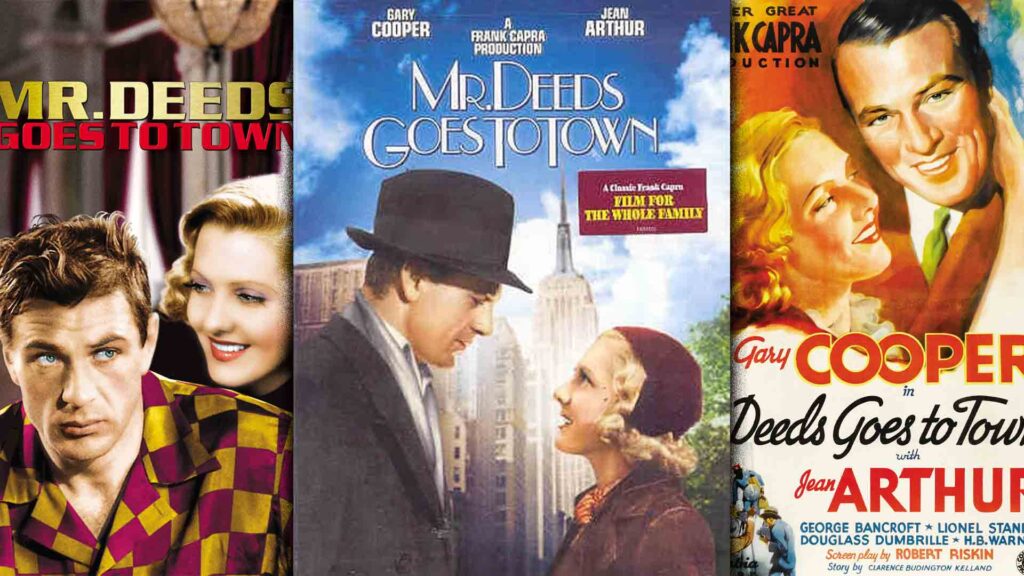
Frank Capra is best known for his 1946 hit It’s a Wonderful Life. But a decade earlier he won an Oscar for directing this story about small-town yokel Longfellow Deeds, who inherits the massive amount of $20 million (think half a billion today) and won’t let it change him.
Mr. Deeds is a salt-of-the-earth sort – he doesn’t drink, won’t smoke, plays a mean tuba, and makes his money writing those endearing greeting card messages – so big money, and getting dragged off to the Big Apple, won’t get him to abandon his small-town values. He’s also not looking for fame, so he has no interest in the reporters trailing after him.
So where’s the conflict in this story? Well, there are some big city lawyers who don’t want Deeds looking too closely at how they’ve managed the fortune he’s inheriting. But the real troublemaker is big city reporter Louise “Babe” Bennett, who isn’t above trickery if it will get her a story. She appeals to Deeds’ decency, pretending to be an impoverished damsel-in-distress who just happens to faint right in front of him. When he comes to her assistance, and falls for her charms, she uses her inside track to get scoop after scoop, without Deeds suspecting she’s actually a journalist.
But she starts coming around as she gets to know Deeds. And by the time he follows through with his plan to give the inheritance away – to one needy person at a time – she’s determined to have his back, even if he isn’t interested in her anymore. He’ll need the help, as the big city men want to use his generosity to proves he’s insane and get him locked up.
Cautions
It’s mentioned in passing that Deeds’ late uncle, who he inherited the money from, was a womanizer who had as many as 20 women in the mansion at once. Deeds also gets into a dust-up, when a table of snobs invites him over just to make fun of him. Deeds also gets into the wrong sort of company, getting invited on a “bender” (think pub crawl) but while he’s happy to go along, it’s apparent he doesn’t know what a bender is, and the next day he regrets accepting the invitation.
That’s about it. But while there’s nothing much to worry about here, the 2002 Adam Sandler remake, Mr. Deeds, packs in some unfortunate additions – a dozen or so potty jokes, a foot fetishist, a pornographer, and at least a few instances of the Lord’s name being taken in vain. This is yet another instance where less is so much more.
Conclusion
This is a great film, still celebrated today for good reason. It’s about a man sticking – with some hiccups – to his morals, even when everyone around is trying to tear him down. And while there are those “hiccups,” they are delicately delivered, talked about rather than shown, making this one gentle enough for the whole family.
But it is black and white. And it is 2 hours long. That means today’s screen-scrolling dopamine-addicts might not have the attention span to enjoy this all-time classic. But for the rest of us, this 90-year-old film still has a lot to love and something important to say. Two thumbs up!