Transparent heart icon with white outline and + sign.

Life's busy, read it when you're ready!

Create a free account to save articles for later, keep track of past articles you’ve read, and receive exclusive access to all RP resources.

White magnifying glass.

Search thousands of RP articles

Helping you think, speak, and act in Christ.

Open envelope icon with @ symbol

Get Articles Delivered!

Helping you think, speak, and act in Christ. delivered direct to your Inbox!

A A
By:

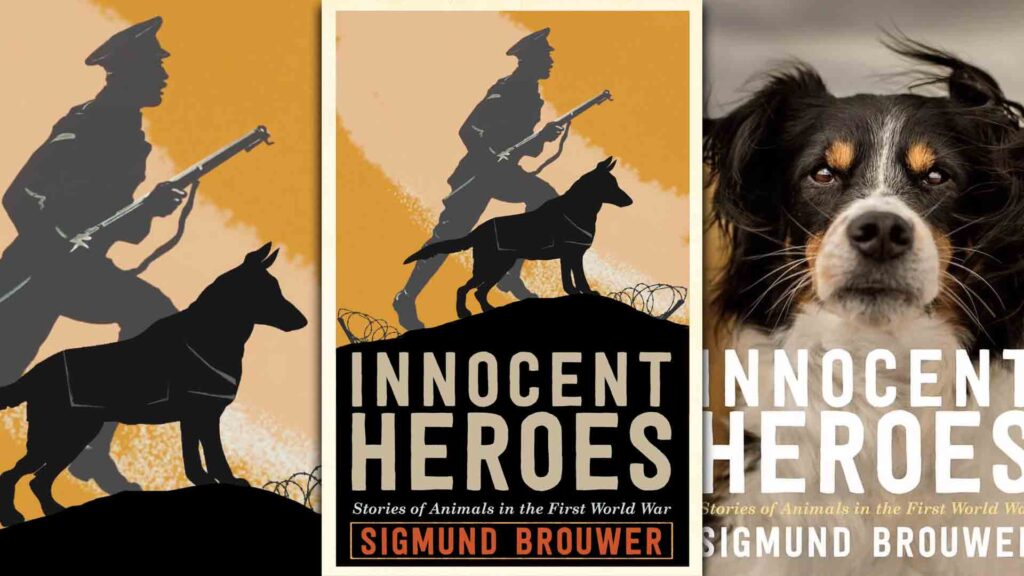
Innocent Heroes: Stories of animals in the First World War

by Sigmund Brouwer
2017 / 186 pages
RATING: Gift

Animals had a way bigger role in WWI than you probably ever realized. Sigmund Brouwer’s fantastic historical novel is all about the true stories of amazing critters – a cat, bird, horse, mule, two dogs, and even a lion – who served right alongside Allied soldiers, and saved their lives.

While these animals’ stories are true, they were “enlisted” in different units from different countries. So the biggest fictional twist here is that Brouwer placed all of these critters in just one Canadian platoon, the Storming Normans.

Each chapter is built around the story of a particular creature but the main characters are three fictional Canadian infantry soldiers. In the trio of Jake, Charlie, and Thomas, the author gives us soldiers who couldn’t have more different backgrounds, with Jake a farm boy, Charlie the city-dwelling millionaire, and Thomas a Cree Indian. With this “odd couple” friendship Brouwer injects his story with humor even in the midst of the horrors of war. It also allows him the opportunity to educate readers as to how Natives were treated on the front lines and back home in Canada during this period. I didn’t realize that Natives needed permission from a government official to leave their reservations. And I didn’t know, either, that many Natives signed up to fight in World War I to make a public, and potentially very costly, statement of their own patriotism.

After the fiction, we get the facts. After each chapter there is a short account of the real animal the chapter was based on. That makes this the very best sort of fictionalized history, using the story to carry the kids along, but then making it clear to them right afterwards what was and wasn’t made up.

Caution

The first time I read this to my kids, they were all 10 and under, and, what with this being a war story, I did need to do some editing on the fly. While Brouwer was clearly trying to make this appropriate for even a pre-teen audience, there’s just no getting around that this is war, and it’s scary. But all I needed to do was skip over a particularly tense line here or there, to tamp down the tension just a bit.

Conclusion

I’ve read this one three times now, since it was first published. The first time was just on my own, and I loved it as an adult. I’ve also passed this along to a bunch of other grown-up folk, and it didn’t matter whether they were 25 or 75, everyone really enjoyed it.

Right after I read it, I knew I had to share it with my kids. I think the youngest might have been as young as 5 or 6 and the oldest 9 or 10. And they loved it too. I read some of it as a bed time story, and that wasn’t the best idea – it was too tense for night time reading. But it worked well reading parts in the car on one of our trips.

Then a couple years back I read parts of it with them again, because they didn’t remember it. And they love it again.

This is a favorite, and one of those books I’m going to make sure all my kids have a copy of before they move out. It’s one of those very rare novels you could give as a birthday present to just about anyone – accessible enough for 10-year-olds, but interesting enough for every age. Simply an amazing book!

Enjoyed this article?

Get the best of RP delivered to your inbox every Saturday for free.


Up Next


Red heart icon with + sign.
Book excerpts, Book Reviews

When C.S. Lewis was an atheist...

An excerpt from Douglas Bond’s novel War in the Wasteland Editor’s note: This excerpt takes place during a prolonged Germany artillery barrage that has the British hunkering deep down in their trenches. Private Nigel Hopkins ends up deep underground with his two of his Company’s junior officers, 2cnd Lieutenant Johnson and 2cnd Lieutenant C.S. Lewis. With nothing to do but wait the two officers restart a conversation they began some days before about the meaning of it all. Lewis, at this point in his life, was an atheist, and, in some ways, a thoughtful one. But in this exchange (in which we come mid-way) Johnson exposes how Lewis’s argument against God is not, as Lewis seemed to suppose, a matter of cold logic, but rather emotion. **** For several moments, listening to the continuing barrage, sitting in total darkness, no one said anything. Lewis broke the silence, his tone sober, brooding, almost simmering: “My mother was a rock, the fortress of our existence. When she died our fortress crumbled.” “I am so terribly sorry,” said Johnson softly. “You were how old?” “Nine. Almost ten.” “Tender age,” said Johnson. “Such a pity. How did you cope?” “I became an atheist.” “Why an atheist?” “Why not? I had prayed – nobody could have prayed more earnestly than I. She died, my praying notwithstanding. God did not answer.” “I am truly sorry for you,” said Johnson. “You need not be,” said Lewis. “It’s just the facts. Facing them is the same as growing up, leaving childish ways behind.” “‘God did not answer,’ you say,” said Johnson, picking his way cautiously, so it seemed to Nigel. ”Ergo, He does not exist? It sounds to me as if you do believe in God, but want Him on a leash, dutifully at your side, a tame lion, coming when you call, doing your bidding.” “Balderdash,” said Lewis. “‘Facing the facts,’ as you call it,” continued Johnson. “I’m rather fond of facts myself. Enlighten me. Did you decide not to believe in God because you had grappled with the evidence and had concluded that no such divine being existed? Or did you – I mean no offense, mind you – did you decide not to believe in such a being because you were angry with Him for not healing your mother? Put simply, was your unbelief in God to spite Him?” “That’s more balderdash. It was –“ Lewis broke off, saved by a rapid staccato of exploding ordinance above them. After another uncomfortable silence, Johnson cleared his throat and began again. “One wonders if it makes rational sense to organize one’s metaphysics around the notion that by simply choosing not to believe in someone that this someone, thereby, no longer exists. If that actually worked, I’d commence not believing in the Kaiser – Poof! Away with him. Poof! Away with the firing their ordinance at us right now. Poof! Away with the whole dashed war.” “All right, all right. Perhaps, strictly speaking,” said Lewis. “Perhaps, I did not become an atheist. I do not know.” “I used to think I was one,” said Johnson, striking a match. “But at the end of the day, Jack, atheism is too simple, wholly inadequate to explain the complexities of life, a boy’s philosophy. That’s what it is.” Lewis, mesmerized by the flickering match light, sat brooding, seeming not to hear him. “Perhaps I had become something worse.” As he proceeded his voice was a strained monotone, each word coming like a lash. “Perhaps it was then that I began to think of God, if He exists at all, as malevolent, a cosmic sadist, inflicting pain on his creatures for sport. Or an eternal vivisector, toying with his human rats merely for curiosity or amusement.” It was pitch dark again. Listening to the exploding artillery rounds above them, no one said anything for several minutes. Nigel concluded that, furious as it yet was, clearly the main force of the bombardment was winding down. He wondered if one of the German howitzers had jammed, or if the British counterbattery fire had managed to take out some of the enemy’s big guns. It was Lieutenant Lewis who broke the silence. His voice was barely audible in the dark. “I wish I could remember her face.” If you’ve enjoyed this excerpt, be sure to pick up a copy of Douglas Bond’s novel “War in the Wasteland” which can be found at any online retailer. And you may also like "The Resistance," a sequel of sorts, which takes place during World War II....


We Think You May Like