Transparent heart icon with white outline and + sign.

Life's busy, read it when you're ready!

Create a free account to save articles for later, keep track of past articles you’ve read, and receive exclusive access to all RP resources.

White magnifying glass.

Search thousands of RP articles

Helping you think, speak, and act in Christ.

Open envelope icon with @ symbol

Get Articles Delivered!

Helping you think, speak, and act in Christ. delivered direct to your Inbox!

A A
By:

What I like about my dumbphone

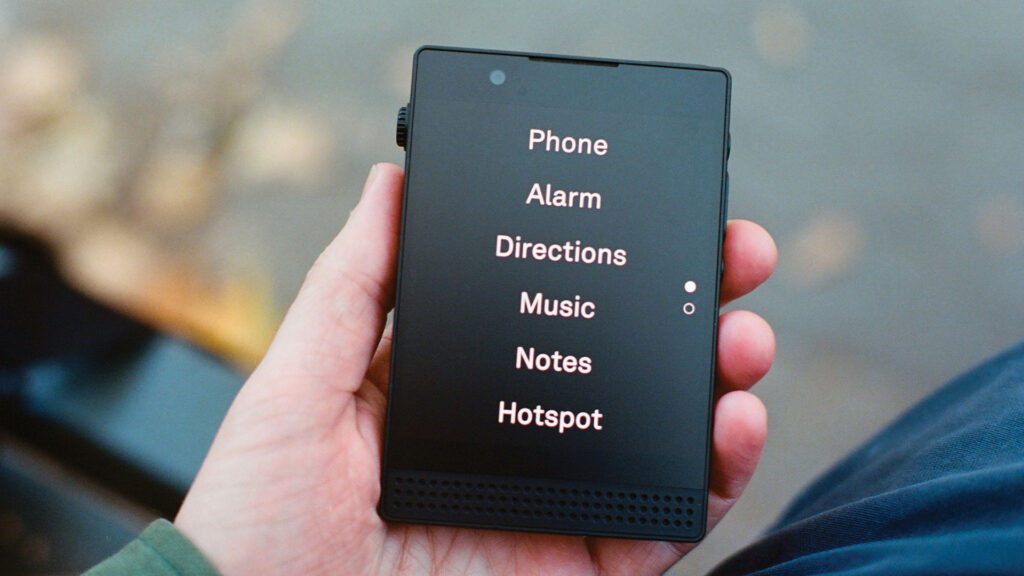
I’ve been using the Light Phone III exclusively for almost a year now and wanted to share a few notes for anyone who might be interested.

First, the LPIII is not a smartphone at all. It truly is “dumb.” It doesn’t have email, a web browser, social media apps, or YouTube. It only has these basics:

  • phone
  • texting
  • maps
  • camera
  • podcasts
  • a calendar
  • music
  • notes
  • calculator
  • an alarm
  • a timer

I purchased the LPIII because it’s truly a dumbphone and doesn’t have any of the distractions that smartphones have.

Second, it works well! Calls and texts are as they should be. The camera isn’t top-of-the-line, but it does a pretty good job. The podcast and music tools work as I’d expect. I load podcasts and music from my laptop on the Light Phone dashboard website. Easy! The Bluetooth works nicely with my earbuds and with my car’s aftermarket Pioneer radio. You can brighten/dim the screen using the little wheel on the side of the phone. There’s even a night mode that minimizes the blue light output. I love that you can use this phone in the sun and still see the screen just fine.

Third, the LPIII is sturdy. It feels solid in my hand. It has a removable battery so I can replace it in the future if need be. Speaking of battery, I get around 2-3 days per charge.

Fourth, there is a learning curve to using the phone. The user interface is not like your smartphone. That’s because it’s not designed to suck you in for hours at a time. Smartphone companies and app developers aim to keep users on the phone as much as possible. The Light Phone team does not have that philosophy at all. They purposely made the phone not addictive. Although the OS was new to me, I did adapt to the interface in just a week or two, and now it’s fine – I have no complaints.

I realize the phone is not cheap ($699 right now – though the older version is half that). However, this phone is worth it to me for these reasons:

  1. my monthly phone bill is half what it used to be. That is a savings of around $250 per year.
  2. I don’t have to upgrade this phone every two or three years because the battery is easily replaceable, and Light will keep updating it as they have with the previous version of the phone.
  3. I don’t have to worry about data mining, creepy spyware, purchasing apps, or expensive subscriptions.
  4. I will never be addicted to this phone, nor will it distract me from being present. It’s hard to explain how wonderful it is not to be tethered to my phone. I often go for hours without touching my phone or thinking about it.

LPIII is not for everyone. Don’t order it if you want a dumbed-down smartphone. There are apps and hacks for that. But if you’re looking for a good full-time dumbphone or a dumbphone for untethering on evenings and weekends, I’d suggest you check out the LPIII. There are other good dumbphones out there – I think several more came out in the last two years – but the LPIII is one of the best ones on the market right now.

*****

Join us for our 2026 screen fast from July 13-22! Sign up here.

Before ordering the Light Phone III at theLightPhone.com be sure to check with your carrier to see if they support it. Canadian plans are $29 to $39 plus tax (though without a long-distance option).

Enjoyed this article?

Get the best of RP delivered to your inbox every Saturday for free.

A A
By:

The challenge of keeping technology in its proper place

I grew up in a home without a TV. But we did have a Commodore 64, a primitive computer (pre-Windows) that we used almost exclusively for games like Test Drive, Pac Man, and Ghost Busters. My smarter and older brothers were quick to figure out that if we added an antenna, the computer monitor could also be used as a TV. Before long, we were watching Hockey Night in Canada on Saturday evenings. And then we were also hooked on some of the shows that came right after the hockey game, like Dr. Quinn, Medicine Woman. We never watched all that much TV but somehow, without any big decisions being made by my parents, the home without a TV had become a home with a TV.

Similarly, I have been intentional about not getting onto social media. I have never signed up for a personal Facebook, Twitter, or Instagram account. But in the past 24 hours I have used Marketplace (a product of Facebook) to search for used bricks, Etsy to purchase plans to build a greenhouse, YouTube to figure out why our toilet isn’t working properly, Church Social to prepare for a care group gathering this weekend, and Spotify to listen to music while driving.  And that doesn’t include the swath of online tools I use for work daily, like Google Suite, Slack, and Zoom. So, in spite of the line I drew to not get onto social media, by using all of these digital tools I’ve somehow signed up anyways.

A paradigm shift

How do we move forward in a world where screens and social media use is hardly an option, especially when they can also be so toxic? Similarly, what are we to think of new technologies like Artificial Intelligence (AI), which creep into our lives, whether we are aware of it or not?

In preparation for this issue of the magazine, which dives into how technology is being used in Reformed schools as well as understanding AI, I went to the most prolific reader I know, RP’s Editor Jon Dykstra, asking him what is the best book I can read on the subject. He pointed me to The Tech-Wise Family, by Andy Crouch.

I wasn’t disappointed.

Crouch brought practical and biblical clarity to these questions and more. But his book did more than that. It gave me a paradigm shift for how I was looking at the whole topic of technology in our lives.

Allowable may not be helpful (1 Cor. 6:12)

If we focus simply on whether something should be allowed, we often miss the point. It may have been possible to keep TV’s out the home before, but it is much more difficult to not allow screens today. Many Reformed churches which once discouraged TV’s now welcome screens in church and at home as gifts from the Lord.

Andy Crouch offers a more helpful approach – putting technology in its proper place so that the things that should be our priorities, like family, friends, and faith, remain priorities.

In a broken and depraved world, we so easily go from owning possessions like a phone, tablet, or gaming console, to being possessed by them. For example, sociologist Jean Twenge has shown that teen mental health has plunged since 2012, the year that a majority of Americans owned smartphones. And many senior readers, if they are honest, will acknowledge that their screen use has long crossed into the territory of becoming an addiction

What does helpful look like?

Putting technology in is proper place requires discernment, something that is more difficult than rules. According to Crouch, technology is in its proper place when:

  1. It helps us bond with the real people we have been given to love.
  2. It starts great conversations.
  3. It helps us take care of the fragile bodies that we inhabit.
  4. It helps us acquire skill and mastery of domains that are the glory of human culture (sports, music, the arts, cooking, writing, accounting, etc.).
  5. It helps us cultivate awe for the created world we are part of and responsible for stewarding.
  6. We use it with intention and care.

On the last point, he adds:

“If there’s one thing I’ve discovered about technology, it’s that it doesn’t stay in its proper place on its own; much like my children’s toys and stuffed creatures and minor treasures, it finds its way underfoot all over the house and all over our lives.”

Take a moment to reflect on the technology use in your home and life. How does it align with the criteria above? Let’s also do this reflecting humbly, recognizing that the ultimate judge is not ourselves (we are very quick to justify what we like) but our God, who calls us to be faithful stewards of our time and gives us a high calling as a prophet, priest, and king (Lord’s Day 12, Heidelberg Catechism).

Tech-Wise changed my thinking

If you or your family struggles with managing technology, I highly recommend you pick up a copy of Crouch’s book, as he shares practical advice about how to prioritize character, shape our spaces with intentionality, structure our time, and apply all of this in the details of life, from our commutes in our vehicles to how we sleep.

This was a paradigm shift for how I was looking at things like social media, including whether media organizations like RP should utilize platforms like Instagram when these mediums cause so many problems for their users. It has made me realize that I was being naïve, and even hypocritical, if I thought we were even able to “flick the switch” on social media. After all, a good case could be made that even apart from our Instagram and Facebook pages, RP’s online presence (complete with a popular app, videos, website, podcasts, and newsletter) could also qualify as social media.

But it has also served to strengthen my appreciation for our board’s decision to prioritize this print magazine and our Real Talk podcast, over social media and video.

Unplugged is different

Since most members of the Canadian NAPARC churches also receive the magazine, we are able to bond, and sharpen each other, about what we find in these pages. For example, my church’s Young Peoples Society picks an article from it at each meeting for their discussions (checking off the first two criteria from Crouch already). This simply isn’t possible if each church member is plugged into their own source of information, oblivious to what others are reading or watching.

A print magazine in particular engages not just our hearts and minds, but also our bodies (we have to pick it up, hold it, gaze at it, flip the pages). Our heart rate slows as we settle into a comfortable position and slowly work through the issue. RP’s team has also been intentional about trying to make the reading experience delightful, with nicely designed pages, space for large pictures, a captivating kids’ section and new sections like the artist profile. Our senses and hearts need to be fed along with our minds.

Our hope is that this magazine, and to varying degrees all of RP’s resources, will strengthen your relationships with your brothers and sisters in Christ, will be used to start great conversations, will help you take care of your bodies and souls, and will develop awe for God’s creation.

But reading this is a small part of your life. So do take more than a moment to consider how the other sources of technology in your home and life measure up to Crouch’s criteria. If you have someone else around you, consider reading Crouch’s criteria about whether technology is in its proper place and ask them for their thoughts, perhaps even about how you are managing technology. And if your device happens to ping while you are enjoying a conversation with them, ignore it!