Transparent heart icon with white outline and + sign.

Life's busy, read it when you're ready!

Create a free account to save articles for later, keep track of past articles you’ve read, and receive exclusive access to all RP resources.

White magnifying glass.

Search thousands of RP articles

Helping you think, speak, and act in Christ.

Open envelope icon with @ symbol

Get Articles Delivered!

Helping you think, speak, and act in Christ. delivered direct to your Inbox!

A A
By:

When the Church stops singing

or, What I learned from the organ bench

*****

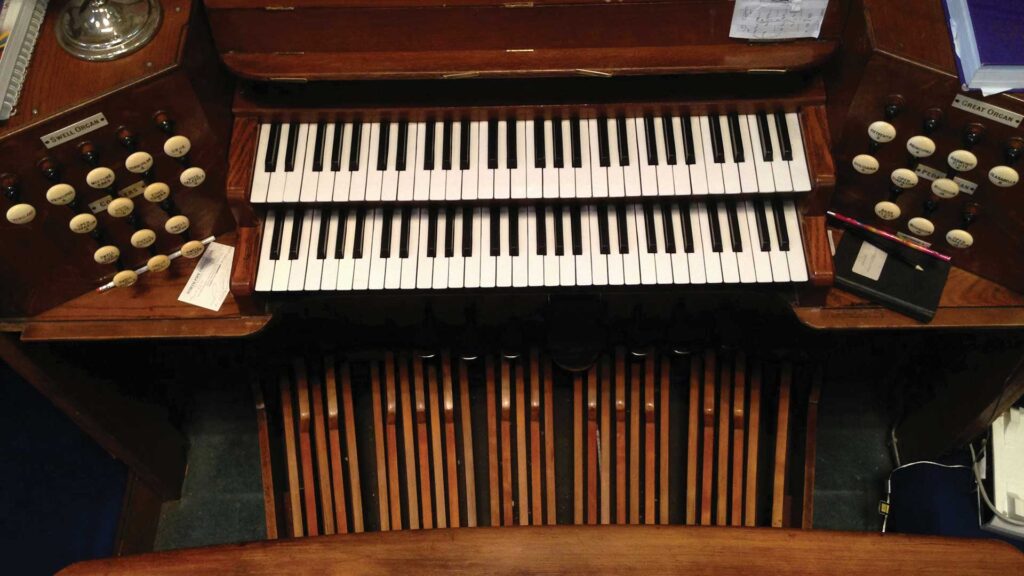
The first time I realized something was wrong with congregational singing, I was sixteen years old, sitting at the pipe organ bench at Tabor Presbyterian Church in Portland. The hymn introduction ended. I lifted my hands for the first verse – and almost no one sang. A few scattered voices appeared, hesitant and thin. The melody was there, printed clearly in the hymnal, but the room itself stayed quiet. From the organ bench, with the congregation behind you, silence is impossible to ignore. I remember thinking, Is this normal?

Over the next several years I played organ in several churches around Portland, and that moment kept repeating itself. Some congregations sang with surprising strength. Others barely sang at all. I remember one Sunday playing “A Mighty Fortress Is Our God.” The first verse was hesitant and quiet, but by the final verse the congregation had found its voice and the room suddenly felt alive. The difference between those two moments – the hesitant beginning and the confident ending – revealed something important: congregational singing does not simply happen. It is something churches either cultivate intentionally or gradually lose.

The sound Scripture expects

The New Testament assumes that the gathered Church sings. Paul writes in Colossians:

“Let the word of Christ dwell in you richly, teaching and admonishing one another in all wisdom, singing psalms and hymns and spiritual songs” (Col. 3:16).

Notice what singing does here. It is not merely an emotional expression. Through singing, believers teach and encourage one another. Truth is carried not only through sermons but through the voices of the congregation itself.

Paul makes the same assumption in Ephesians:

“Addressing one another in psalms and hymns and spiritual songs, singing and making melody to the Lord with your heart” (Eph. 5:19).

In both passages, singing is participatory. The church does not merely listen to music; the church sings.

For centuries, Christian worship assumed this. Choirs and musicians might assist, but the central voice in worship was the congregation. Today, that assumption is not always as strong.

When worship music becomes something we watch

One of the things I noticed while playing in different churches was how dramatically congregational participation could change depending on how music was led.

In some congregations the moment the introduction ended, the singing began. The sound filled the sanctuary almost immediately. Even people who did not sing especially well sang confidently because the music supported them.

Other congregations responded very differently. The musicians played beautifully, the sound system was excellent, but the congregation remained hesitant. A few voices scattered here and there, but many people simply listened.

This shift often happens gradually and unintentionally. Churches want music to sound good. Musicians want to serve faithfully. Technology makes it easier than ever to produce polished sound. But the unintended result can be subtle: music becomes something happening at the front of the room rather than something shared by the whole church. From the organ bench, that difference is unmistakable.

The quiet disappearance of church musicians

Another challenge is less visible but just as real: many churches struggle to find musicians. When I first began playing as a teenager, many congregations still had longtime pianists or organists who had served for decades. These musicians often trained younger players and gradually passed on their role. That pattern is becoming less common. More than once a pastor quietly asked me if I knew anyone who could play because their longtime pianist had retired and no one was ready to replace her. Sometimes churches relied on a single volunteer carrying the entire responsibility for music week after week.

This shortage changes the dynamic of worship in ways many people never notice. When musical leadership becomes fragile, congregational singing often weakens as well. Leading congregational singing requires a particular kind of musician – someone who understands that their role is not performance but support.

What the organ bench teaches

From the organ bench, you quickly learn that congregations sing best when they feel supported. If the accompaniment is steady and confident, people join in. If the tempo drifts or the melody becomes difficult to follow, the congregation hesitates.

Some Sundays the congregation would surprise me. A hymn I expected to struggle suddenly filled the room, especially on the final verse when people realized the organ was carrying them. When that happens, the room changes. People sing more boldly. The sound grows stronger with each verse.

The organ historically served this role well because its sustained sound naturally supports voices. But the deeper principle is not about instruments. Congregations sing best when the music invites participation rather than replacing it.

Why this matters

It might be tempting to treat this as a small issue. There are certainly larger challenges facing the Church today. But Scripture treats the gathered worship of God’s people as something deeply significant. When a congregation sings together, the Word of Christ dwells richly among them (Col. 3:16). The truths of the gospel are not only preached but sung. Believers encourage one another through shared confession of faith.

Children hear their parents sing. Older members who can no longer serve in visible ways still contribute their voices. Corporate singing reminds us that worship is not about personal preference. No one in the room loves every song equally. Yet everyone participates. In that sense, congregational singing becomes a small picture of the unity of the Church itself.

Recovering the sound of the Church

The encouraging news is that strong congregational singing is not complicated to cultivate. Churches that sing well usually share a few simple habits. They choose songs ordinary people can sing. They train musicians to support the congregation rather than showcase themselves. They encourage participation openly rather than assuming it will happen automatically.

In several churches I played in, the problem was not that people refused to sing. The problem was that no one had intentionally thought about how to help them sing. Once that question was asked, the difference could be remarkable.

Listening again

One of the strange privileges of sitting at an organ bench is that you learn to listen carefully to the room behind you. When a congregation really sings, you feel it through the bench and pedals as much as you hear it. The sound moves through the room like a single voice made up of many imperfect ones. It is not polished. Some voices drift off pitch. Some enter late. Yet the sound carries a unity no performance can create. It is the sound of the church speaking together. And once you have heard it clearly, you begin to notice when it starts to fade.

The question facing many churches today is not simply what style of music they prefer. The question is whether the congregation itself is still expected to sing.

Felix Lilly is a musician in Portland, Oregon who has served as a pipe organist in several local churches. He writes about church life, music, and Christian discipleship.

Enjoyed this article?

Get the best of RP delivered to your inbox every Saturday for free.


Up Next


Red heart icon with + sign.
Music

Some thoughts on Christian music in worship

So there is some great music out there, and as Reformed Christians, we can rejoice in that fact. But if the issue of music in general can be a contentious one, the issue of the music we use in our worship services can be a cause for even more controversy. If we can acknowledge that there is Christian music from outside of our own tradition that brings glory to God, does this mean that we can or should use this music in our worship services? I’m a missionary in the Canadian Reformed Churches. In Prince George, B.C., where I am working to spread the gospel and plant a church, we meet every Sunday morning for worship. And our worship service is pretty much the same as the worship service you would experience in every other Canadian Reformed Church. We sing from our denomination's Book of Praise, and the songs we sing are primarily the Psalms. We’ve chosen to do this very deliberately, not because it is simply something that’s required of us. And we’ve made this decision for several reasons. Why Psalms? First of all, our focus on Psalm-singing is in line with the principles of the Protestant Reformation. During the time of the Reformation, the Reformers placed a heavy emphasis on the participation of the congregation in the worship service. No longer was participation to be limited to the priest, who alone could drink the wine of communion, and to the choir, which sang while the congregation listened. Now the entire congregation was invited to participate, both in the Lord’s Supper, and in the singing. It was a revolutionary step – no longer was the congregation an audience, or a group of spectators. Now they were integral to the worship service itself, and that participation was not only beneficial for the worshippers, it also glorified the God who was being worshipped. Participants no spectators So that’s the first important principle; the congregation should be more than mere spectators – they should be active participants. That means that “worship teams,” or “praise bands” do not have a place in our worship services. There are times and places for musical performances, for audiences to sit back and enjoy music performed by skilled artists. But our gathering for corporate worship is neither the appropriate time or place for such a performance. Our worship is corporate– we worship as a body, and we should all participate, not simply observe. Because of this principle, the Reformers developed songbooks to be used in worship. John Calvin promoted the development of a Psalter to be used in worship, and he encouraged skilled men to write music and set the words of the Psalms to that music, for congregational singing. That music had to be singable – it had to be suitable for singing in unison, and it couldn’t be so complex that it would take a trained choir to sing it. And so, what we now have as the Genevan Psalter was developed. This was truly a “people’s Psalter.” No longer was music reserved for the professionals; now musically unschooled laymen could sing together, and the Reformed Christians did just that, in the worship services, at home, and in public gatherings. A rooted tradition So our use of the Genevan melodies is not something that we do merely out of custom; there are some very important principles at play here. Our use of the Genevan melodies is a part of our tradition, but that tradition is not meaningless. We sing these melodies in unity with the catholic (universal) church – the church of all times, as well as of all places. By maintaining this tradition, we are expressing in our practice the reality that true catholicity isn’t just geographical, but that it’s also historical. And we avoid what some have called “the tyranny of the present.” By upholding what has become an ancient tradition, we avoid the pitfalls that can afflict the Church when she attempts to be culturally relevant (and all to often fails). We maintain that tradition in the face of changing tastes and trends; instead of being shaped by the trends of the world, we need to continue to work to shape those trends ourselves. Instead of giving in to the pressures of our culture, including the pressures that influence our understanding and enjoyment of music, we should continue to train ourselves, to develop excellence in the musical tradition that the Reformed church has been blessed with for centuries. We may find some of the tunes hard to sing, but this is most often because of their unfamiliarity, not because of any difficulty inherent to the tunes (which were accessible centuries ago to people who were all but illiterate). If we find the tunes challenging, we should practice them. We should train our ear to understand them, and in doing so, we will find that we grow to love them! This is true with all music that lies outside of the realm of “popular music” – in order to grow to love classical music, or great jazz, your taste has to develop, and mature. That takes time, patience, and learning. But the rewards are great; in refusing to limit ourselves to the simplistic world of pop music (which does have its place), we allow ourselves to grow. Maturity is what Christians seek – a life of growth and development. This should be as true for our musical tastes as it is in every other area of life. After all, as a boy I may have loved to read the Hardy Boys; but when I grew in understanding, I left them behind, and moved on to better things. The process of development in reading and comprehension is challenging, but it’s necessary. The same holds true for music. What about the words? So that’s the musical aspect of the songs we sing on Sundays. But what about the lyrics? This is where our Psalm-singing becomes so very important, especially when we compare the lyrics of the Psalms to those of popular Christian music. The words of the Psalms are deep; they’re profound; they’re God-centred; they express every aspect of the Christian life and experience. They aren’t just meant to make us feel good – they’re meant to challenge us, to encourage us, to admonish us. They express joy, happiness, confession of sins, expressions of anguish, and even despair. The lyrics of the Psalms are words that are sung in unity with believers everywhere, in unity with God’s people throughout history, and in unity with our Lord Jesus Christ. They relate to us in our own experiences, but they do much more; they keep us actively aware of our unity with the universal Church, our unity with our spiritual ancestors. We sing about the Exodus, about the crossing of the Red Sea, about the wandering in the wilderness, about the rebellion of the Israelites, about God’s forgiveness of that rebellion. We sing about God’s amazing work in creation, but also about His amazing work of redemption and salvation. And when we sing the Psalms, we sing the very words that our Lord Himself had on His lips during His life on earth – think of Psalm 22, for example. They may not have catchy choruses. It may take work to memorize them. They may force us to sing about places like Teman and Mt. Paran, and the Baca Valley, places that are very distant from us, historically and geographically. But they force us to realize that our generation is not the only generation that ever existed. They encourage us to see our true place, in the covenant community, as yet another generation that God has guided in the true faith. Once again, a true appreciation of the message of the Psalms takes training and education; but anything worth doing is going to take effort. And that effort will pay off in the end; singing the Psalms will lead us to develop an increased appreciation for our God, for His Word and works, for His justice and righteousness, for His wrath and anger against sin, as well as for His mercy and grace, which He has poured out upon His people. A lifetime's worth of praise Music is important, and our God, in His love for us, has given us music as a great blessing. The songs we sing, and the way that we sing them, and the songs that we listen to, shape our understanding of our God and our relationship with Him. If we insist on remaining like children in our appreciation and understanding of the music we use, we are deliberately limiting ourselves, and cutting ourselves off from a wonderful opportunity. God Himself has given us an opportunity to grow, to be enriched, to thrive as His people, by giving us the beauty and majesty of music. And in giving us, in His Spirit-inspired Word, 150 perfect songs, He has provided us with more than enough content for a lifetime’s worth of praise. An old saying tells us, “Familiarity breeds contempt.” We become so familiar with something that we no longer appreciate the beauty and importance of the thing that we’ve been given. I think that when it comes to the music we use in our corporate worship, this phrase is often very applicable. In each generation, we need to come to an appreciation of the precious heritage that we’ve been entrusted with – the heritage of a musical form and content that is rich, beautiful, upbuilding, and lasting. It may take work to develop a deep, lasting appreciation for that music; but in the end, every bit of that work will be worth it. So let’s not be afraid to put in the effort. And having done that, we can know that God will give us, as He has already given us, a rich reward. This was first published to the Reformed Outfitters (RO) website in 2012 and reposted here when RO became a part of RP in 2022....


We Think You May Like