“Many men are like unto sausages: Whatever you stuff them with, that they will bear in them.” – Russian writer Leo Tolstoy (1828-1910).
“Start children off on the way they should go, and even when they are old, they will not turn from it.” – Proverbs 22:6
****
There was a man.
But first there was a child. This particular child was born on New Year’s Day in 1484 in the small village of Wildhaus. He lived in a cottage whose roof was weighed down with stones to protect it from gusty winds traveling down from surrounding mountains. Wildhaus lay in a valley and was located in the Swiss canton of St. Gallen. This canton was one of the eight cantons, or territorial divisions, in Switzerland, and was noted for its textile production. Respected for their amazing output of stunning embroidery, many women of the village were expert needleworkers. It is easy to imagine that the child saw his mother embroider intricate and beautiful patterns on cloth and that his eyes were fascinated by the detailed stitching and designs that flourished under her hands.
But the strange truth was that when the child stood in the doorway of his home in Wildhaus, his father instructed him in embroidery as well – embroidery, not worked at by his mother, but fashioned and created by the Lord God. There were mountains decorated with glaciers, embellished with gorges, fashioned with meadows and flowers, and flowing with streams and rivulets.
“Look,” said the father, “look and see what God has made.”
And the child was shown incredible illustrations of the majesty of God. And a wonderful awe for the Creator was planted in the heart of the child.
Quite the family
The child’s father was the bailiff, the magistrate, of the parish of Wildhaus. He was an upright man and had the respect of everyone in his community. As well as being the bailiff, the father’s calling was that of a shepherd. The child saw his father leave in the spring, together with two older brothers, as they drove a flock of sheep up the mountains to the high pastures. He watched them climb until they disappeared from his sight.
When summer began to decline and lengthening nights began, the child anticipated their return and daily watched for them to come back home to the cottage. He knew that a time of village companionship would begin – a time when neighbors would gather together in one another’s homes and fill the evenings with stories and songs. Perhaps they would speak of the Pied Piper, who in the year of the child’s birth, it was said, had carried away 130 children who were never seen again. It was speculated that this piper was the devil. Or perhaps the villagers who were gathered together, spoke of the Inquisition in faraway Spain and shuddered at the tortures being inflicted on those who disagreed with the church. It is also possible that they spoke of long-ago heroes who had defended the Swiss mountains from enemies. And everyone, including the child, would feel patriotism surge through them.
The child also had a grandmother. She was a pious woman. At times the child would sit on her knee, and she would tell him stories about heroes of a different kind. Into his small ears, she recited tales of saints in church history – and she told him about heroes in the Bible, heroes who had climbed hills in Judah and who had defended their homeland. She spoke of Jesus, born in a cradle in a stall in Bethlehem; she narrated the story of Calvary; and she took him to the Resurrection. Having no Bible, she could only recount what she had learned from priests but the first seeds of truth were imbedded in the heart of the child.
From one school to the next
The child had a name. He was baptized Ulrich. Of the eight sons his mother bore his father, he stood out in ability to learn. His parents recognized this as a special gift and sent him to board with his uncle, Bartholomew who lived in nearby Wesen. An earnest and honest priest, Bartholomew sent his nephew to the village school.
Soon, however, the child had learned all there was to know in the Wesen village school. Consequently, his father and his uncle arranged for Ulrich to go to a school in Basel. He was now ten years of age.
Again, it soon became apparent that the boy outshone his classmates and from Basel he was transferred to a school in Bern when he was twelve years of age. In Bern, Ulrich excelled in debating, poetry, philosophy and music. Indeed, he was so talented in all the subjects he was taught, that the Dominicans of Bern asked him to join their order, young as he was.
However, Ulrich’s father and uncle, who had been salted with Reformation ideas, were averse to this. Aware of the child’s potential, they determined they would educate him for the church, but under the tutelage of those acquainted with the new ideas. Consequently, they enrolled Ulrich in the University of Vienna.
From Vienna, Ulrich went back to Basel from whose university he graduated in 1506 with a Master of Arts. He was now twenty-two years of age and obtained the position of parish priest in the village of Glarus. Started on the right path, time would prove that he would not diverge from it.
Ulrich’s last name was Zwingli. It is said of him that at no time did he use the title “Master of Arts,” but was quick to say: “One is our Master, even Christ.”
67 Articles
History records many things about Ulrich Zwingli. Even as Luther wrote ninety-five theses, Zwingli penned sixty-seven. Even as he had seen his earthly father guide sheep up to highland pasture, so he wanted to lead the Swiss people up to the mountain of God, up to the truth of the heavenly Father. Some of Zwingli’s theses read:
- The sum and substance of the Gospel is that our Lord Christ Jesus, the true son of God, has made known to us the will of His heavenly Father, and has with His sinlessness released us from death and reconciled us to God.
- Hence Christ is the only way to salvation for all who ever were, are and shall be.
- He who seeks or shows another way errs, and, indeed, he is a murderer of souls and a thief.
- The true holy scriptures know nothing of purgatory after this life.
- Christ is the only mediator between God and ourselves.
When the position of leut-priest (preacher and pastor) in the Great Minster (monastery church) in Zurich became vacant in the latter part of 1518, Zwingli became its spiritual guide. Seven years later, in 1525, Zurich’s great council adopted many of his suggestions. The Latin mass was replaced by a simple communion service; a German-language Bible was introduced; the clergy were allowed to marry; the church’s land property was secularized and its jurisdiction heavily restricted; and images were destroyed or withdrawn from the churches.
Grace where God allows
Mandatory fasting became Ulrich’s first public controversy.
The dispute began on the first Sunday of Lent, which meant it was the onset of forty days of mandatory penitential fasting before Easter. During these forty days only one meal a day was allowed in the evening – meat, eggs, and butter were strictly forbidden. It so happened that, on this initial Sunday, a few months after Ulrich’s thirty-eighth birthday, some citizens of Zurich prepared to meet together.
In Grabengasse, in a home just a hop, skip, and jump away from Zurich’s city walls, these men knocked on the door of Christoph Froschauer. It was late afternoon, the time folks prepared to eat, and the sun was setting. Christoph Froschauer was a printer and a man of some note in Zurich. He was in charge of all the printing for the city government. Christoph himself answered the door, heartily welcomed the men and ushered them into his parlor. They all sat down. It was a varied group of men in that parlor. Two of them were priests, and one of these was Ulrich Zwingli. Reclining next to the priests was Hans, a tailor, Laurenz, a weaver, Niklaus, a shoemaker, two unnamed printing employees, and Heinrich, a baker. They had these matters in common: they were all tradesmen, they all loved the reforming ideas which Ulrich was preaching, and all were willing to be part of the change they were about to stir up.
As the men were talking amongst themselves, Elise, Christoph’s wife, walked in with serving platters. The platters held sausages. Crispy and golden, juicy and flavorful, they smelled and looked good. They tickled the appetite. Everyone (with the exception of Ulrich, who tacitly approved of the events by being present), ate the meat with great relish. Celebrating Christian freedom in the matter of eating and drinking, the men enjoyed their fellowship and then, bidding one another farewell, returned to their homes. Subsequently, after the news of their meal leaked out, all, with the exception of Ulrich, were jailed. As the men sat behind bars, Ulrich took to the pulpit and preached. He exegeted New Testament passages that pertained to fasting, to keeping traditions, and to abstaining from certain foods. He argued that although fasting served a valuable purpose, especially as an act of personal or corporate piety, there was no biblical basis for making fasting obligatory for all Christians.
Some of his words were: “…abstinence from meat and drink is an old custom, which, however, later by the wickedness of some of the clergy, came to be viewed as a command.” He summarized by saying, “…if you will fast, do so; if you do not wish to eat meat, eat it not; but leave Christians a free choice in the matter.”
The consequence was that the Bishop of Constance sent a delegation to investigate the matter. The Zurich Council called for a debate between Zwingli and a representative of the bishop. In that debate the representative could not refute Zwingli’s scriptural defense and both the Council and the people of Zurich cheered. All sided with Zwingli. Consequently, the child who was now a man, was free to continue his preaching.
One year after the gathering in Grabengasse, all mandatory fasting was officially abolished in Zurich. The Council followed, not only Zwingli’s lead in “sola scriptura” as opposed to tradition instituted by men, but also began abolishing other traditions of the Catholic church.
Zwingli lived and preached in Zurich until his death in 1531. He was killed in battle during the Second War of Kappel – a battle fought between Catholic and Protestant forces. He was 47 years old. After the Second War of Kappel, Swiss cantons were given the freedom to choose Catholicism or Protestantism and an uneasy peace rested between them. Zwingli believed that a united Protestant Switzerland would represent God’s true will for the Church on earth and that Catholics who refused to recognize this were not only standing against Zwingli and his teachings but against God himself.
Not the same church
Today there is a Swiss Reformed Church. It was begun in 1920. In 2024 it had a total membership of approximately 1.78 million with 982 congregations in various cantons. It allows the ordination of women and has embraced inclusivity by permitting blessings for same-sex civil unions.
The rather sad 2000 census in Wildhaus recorded that in Zwingli’s birthplace 468 people were Catholic, while 572 belonged to the Swiss Reformed Church. Of the rest of the population, there were 17 individuals who belonged to the Orthodox Church, and there were 17 individuals who belonged to another Christian church. There were 49 who were Islamic. There were 3 individuals who belonged to another church (not listed on the census), 88 belonged to no church, were agnostic or atheist, and 46 individuals did not answer the question.
Done for the Lord
We might automatically surmise that Zwingli would be disappointed in the modern day apparent disintegration of his life’s work. Add to this, he did not live to see the amazing results that followed soon after his passing.
Yet this Swiss child, who became a man, knew a wonderful surety. He was a child of God. Through the Holy Spirit, he had stood up for Truth; he had faithfully exegeted God’s Word; and he had daily turned to his Father. He had used the time allotted to him well and, consequently, was given contentment. Hebrews 6:10 echoes his reason for living and his hope for the future:
“God is not unjust; He will not forget your work and the love you have shown Him as you have helped His people and continue to help them.”
Zwingli’s life and his death encourage us to work, to work in these days which often seem rather hopeless in results. They point us to 1 Corinthians 15:58:
“Therefore, my beloved brothers, be steadfast and immovable. Always excel in the work of the Lord, because you know that your labor in the Lord is not in vain.”
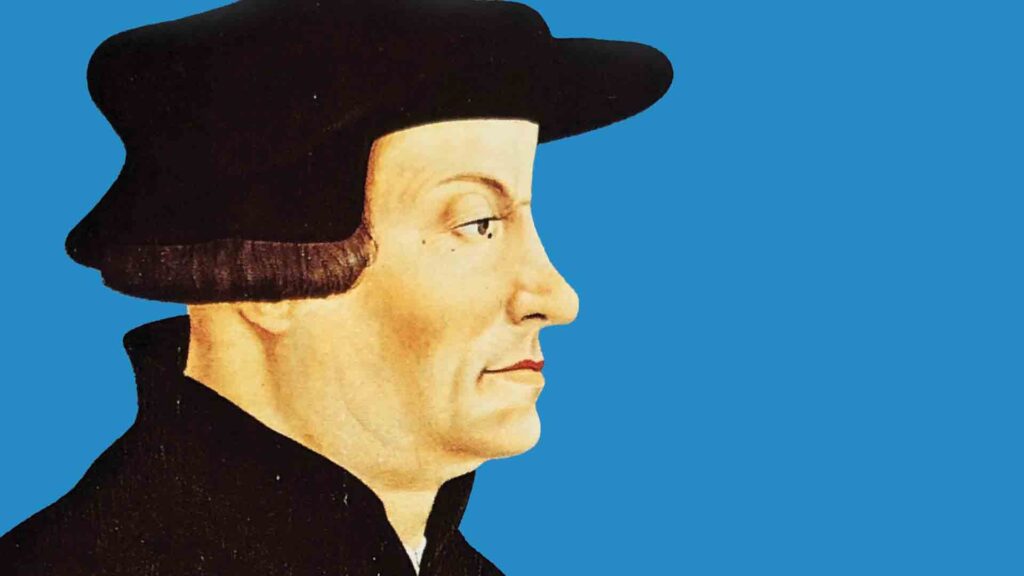
Christine Farenhorst has written for Reformed Perspective going back 35 years. Her most recent book is “Upheld: A widow’s story of love, grief, & the constancy of God.” The picture of Zwingli is adapted from a painting by Hans Asper in 1549.