Transparent heart icon with white outline and + sign.

Life's busy, read it when you're ready!

Create a free account to save articles for later, keep track of past articles you’ve read, and receive exclusive access to all RP resources.

White magnifying glass.

Search thousands of RP articles

Helping you think, speak, and act in Christ.

Open envelope icon with @ symbol

Get Articles Delivered!

Helping you think, speak, and act in Christ. delivered direct to your Inbox!


Most Recent


The Rest


Red heart icon with + sign.
Economics

On why freer trade is best

The following is based on Real Talk’s episode #126, “Mere Economics and the Issue of Tariffs,” with host Lucas Holtvlüwer talking to economics professor and author Dr. Caleb Fuller about the only four ways that people can get the things they need. **** We might not be medical experts, or have a law degree, but we all know a lawyer, and a nurse or two. But how many of us know an economist? Not too many, and I think that's why economics can seem an intimidating field. But it doesn't have to be complicated. When it comes to how we can best get the things that we want and need for ourselves and our families, Dr. Fuller boiled things down: “…there's only actually four possible ways for me to get what I want. And these four ways are logically exhaustive.” What he means by "logically exhaustive" is that these four are it – there are no other possibilities. So what are these four ways? And more importantly, why should we know? To answer the second question first, this is vital information because only one of the four ways will actually work for a society. So it is key we pick the right way. 1. Getting gifts One way we could get the food, clothing, and shelter we need is to simply receive it from someone else. That’s what we do for our kids, after all. But there is a problem, as Dr. Fuller explains: “I could rely on gifts from someone else. But if you think about that for a couple seconds, you realize that if everyone was doing this – if you kind of systematized that way of getting what you want – the world would be incredibly poor. It also pushes the question back a step. You know, where did the gift-giver get what he's giving?” 2. Stealing what we want and need A second option is chosen by some, but we’d all starve if everyone did the same. “You could steal from others. Ethical problems aside, if you universalize that means of getting what you want, you also live in a world ‘nasty, brutish, and short,’ to quote Thomas Hobbes. And, also, just like the first option pushes the question back, where did the person who's being stolen from…get the goods in question?” 3. Making it all ourselves So, that leaves us only two more possibilities. We can either make everything we need ourselves, or, instead, use our particular skills to make something others want, and trade with them for what we want. So, our options are make or trade, and one of the reasons President Trump instituted his tariffs is he wanted less trade with other countries, and more of the making done in the US. Dr. Fuller highlights the problem with this approach. “Let's think about make for a second. There's a great book called The Toaster Project by a guy named Thomas Thwaites. Thwaites chronicles his attempt to build a very simple toaster from scratch, that is, without cooperating with anyone else. So he's not going to engage in buying, he's not going to engage in exchange, he's just going to make, okay? “And it takes him about nine months. He does cheat a little bit along the way. And after this nine months of full-time work on this toaster, he plugs the toaster in, and five seconds later it shorts out. “There's a small fire that melts it down. After nine months of work, that was the consequence. And that is a little vignette of what our lives would be if we systematized or universalized this third means of getting what we want – just making everything that I want to consume.” 4. Specializing/trading And as Fuller shares, that “brings us to this fourth option, of specialization.” Few of us will be any better at making toasters than Thwaites was, but we might have other skills we can offer. One person might be a great nurse, another a very good farmer, and a third might be a skilled high school teacher. We all have our specialties, and it doesn’t take a lot of imagination to recognize how much worse off we’d be if we didn’t specialize. Then the nurse would have to build her home, the farmer would have to teach his kids high school physics, and the teacher would have to fix his son’s broken leg. Specialization helps us do and make more. Dr. Fuller specializes as an economics professor producing lectures and books that others value, and he trades those away for money and then uses that money to buy what he wants. “That's why I say that the ability to exchange is not optional if you want to observe ‘mass flourishing,’ to use economist Ed Phelps’ term. And so that's why economists are so obsessed with specialization…” Conclusion Of these four ways of getting what we need, God’s commandment against stealing rules out the second. His call to be fruitful (Gen. 1:28 and in the Parable of the Talents, Matt. 25:14-30) eliminates the first as an option – we can’t just live off of our parents, even if they were willing. A fruitful life would also address the third option. It doesn’t make sense for us to try to do everything ourselves. If everyone did, we’d all be not simply poor, but quite likely dead. What’s true for individuals is true in large part for countries too. The US is currently trying to use tariffs on foreign goods to drive companies to produce in-country more of the goods that Americans consume. But even the US can’t be better than everyone at producing everything. So, for example, in a June 3rd House Appropriations meeting, Rep. Madeleine Dean questioned Commerce Secretary Howard Lutnick about the tariff being imposed on bananas. The US grows less than a tenth of one percent of the bananas that Americans eat. The other 99.9% are imported. And, as Secretary Lutnick noted, the tariff is “generally 10%.” Lutnick defended the tariff, arguing that, as trade deals are made, the tariffs will eventually be eliminated. But he also argued that “if you build in America and produce your product in America, there will be no tariff.” To which Rep. Dean pointed out, “You can’t build bananas in America.” Free trade remains best, and not simply for banana lovers. ...

Red heart icon with + sign.
News

Saturday Selections – May 4, 2024

Did ancient cultures believe in a third gender? This is an interesting question, in as far as, what point would it prove if they did? Does our culture now believe that because something is traditional, is is right? If so, I have some other traditions to tell you about! Why you should go to sleep early tonight There are physical, emotional, and spiritual reasons too, for why you should be early to bed. Can a Christian be a lawyer? (15 min read / 25 min listen) The short answer is, yes, of course. The longer answer is, yes, but the job does come with some real challenges. Two celebrities talking about how disobeying God hurts Recently Joe Rogan and Oliver Anthony were chatting about how disobeying God's will for sex really messes people up. Anthony is a self-professed baby Christian, and Rogan is no Christian at all, so they aren't talking about this from a biblical perspective. They've just come to the realization that porn usage doesn't work. Theirs was a practical, pragmatic case, but an observant one. Sin really is stupid, and some people learn that the hard way. Others don't have to suffer through the pain that running into the brickwall of reality will cause you, and instead trust God's Wisdom as He's revealed it to us in His Word. What's the difference between venting and lamenting? One is sinful, the other godly, yet they share a lot of similarities. A moral case for capitalism If you have an economic system that respects property rights (i.e. the 8th Commandment), and doesn't covet what the wealthy have (10th Commandment), and doesn't look to the government as savior (Commandment #1), then what sort of economic system would you have? Well, it wouldn't be socialism, communism, or crony capitalism. What you'd be left with is the free market, aka, capitalism. And you'd be left with it, not because it has raised more people out of poverty than any other economic system, but because it is the system God proscribes. The prosperity that results is simply a blessing that comes with obeying our Heavenly Father. This gentleman below makes a different moral case for capitalism (and gets a few things wrong, going back 12,000 years, on a planet that's only been around for about half that) but brings in one more wrinkle that I did not... but which has a biblical parallel. He speaks of capitalism being the result of a society that has moved from "status to contract." In kingdoms and empires it is about who you know – if you are a friend of the emperor, you will prosper, but if he doesn't like you, you're in trouble. But when rules were elevated above the ruler, when even the king could be held accountable to the law, then we had a society built on agreements – contracts – rather than status. Though this gent doesn't describe it as such, that development has Christian roots. Christians understand that the most powerful king has always been accountable to God and His law. ...

Red heart icon with + sign.
Documentary, Movie Reviews, Watch for free

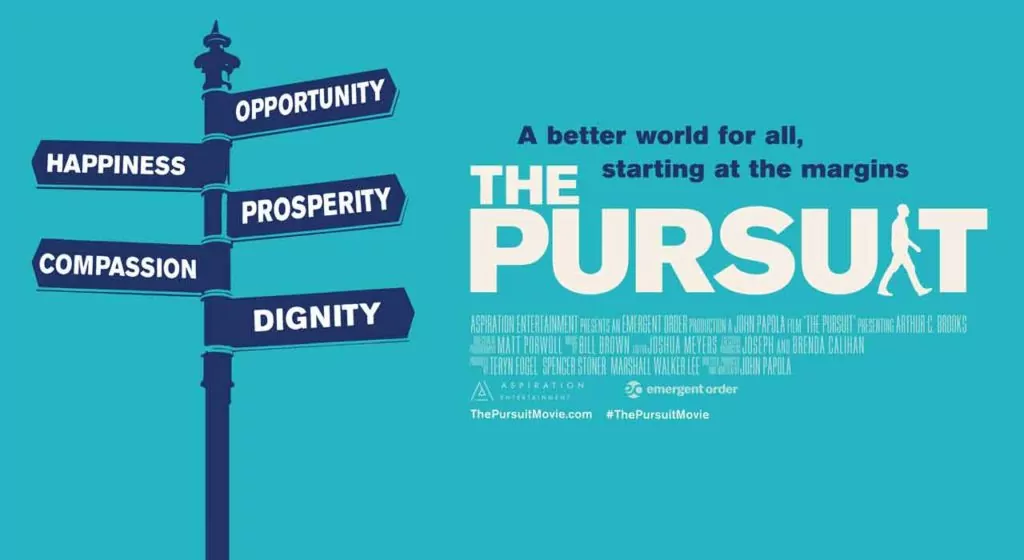
The Pursuit

Documentary 77 minutes / 2019 RATING: 7/10 "From 1970 until today the percentage of people living at starvation's door has decreased by 80%. Two billion people have been pulled out of starvation-level poverty. What did that!?! What did that? That was my vision quest, to figure out what did that." – Arthur Brooks The Pursuit is the story of one man's search for the best way to lift the world's poorest out of their poverty. And what the former French-horn player and current globe-trotting economics professor Arthur Brooks discovered is that it's the free market that did this, that lifted literally billions out of extreme poverty. Brooks makes an interesting guide for this journey. In passing he identifies himself as a Catholic only to, moments later, start sharing Buddhist wisdom. He takes us to the words of the Apostle Paul, but soon after takes us to the home of the Dalai Lama. So why would a Buddhist/Catholic former French horn player make a good guide for Christians interested in learning about economics, and the benefits of the free market? It's because, as much as he might differ from us in big ways and small, his case for free trade is built on principles that line right up with Scripture. He doesn't quote it, but his foundation is the Second Greatest Commandment (Matt. 22:36-40) – Brooks is clearly motivated by a love for his neighbor. That same command is often used as a justification for socialism – if we care for our neighbor, why wouldn't we use the State's taxing power to help the poor? But Brooks responds with a very practical, Prov. 27:14 type, counter-argument: good intentions are not enough. He does that by taking us to a coal mining town in America, where the mine has been shut down, to show that however well-intentioned the socialist government programs might be, they don't help in the long run. He also takes us to the slums of India to visit some of the world's poorest. The desperately poor still remain, but Hindol Sengupta, editor-at-large for Fortune India, estimates that if not for market reforms initiated in India three decades ago, 300 million more Indians would still be impoverished. Socialism didn't help – this improvement came about by allowing people the freedom to make choices, sell their own labor and goods, and make the most of whatever (even if they were limited) opportunities that might come their way. This came about via capitalism's free markets and free enterprise, not socialism's compulsion and restriction. So Brook's argument is simple then: if we believe good results are more important than good intentions, we should support the economic system that actually helps the poor. And that's capitalism. ONE CAUTION I'd highly recommend The Pursuit, but it does require a little discernment on Christians' part. We need to remember that despite Brooks quoting Scripture – sometimes quite insightfully – his is not a strictly biblical perspective. So, for example, he makes this good point in citing 1 Tim 6:10: " putting yourself always ahead of other people. I often reflect on the verse in the New Testament that's most often misquoted: 'Money is the root of all evil.' "That's a misquote of the Apostle Paul. Here's the real Scripture: 'For the love of money is the root of all evil.' This really illuminates the problem of materialism. It's not the  existence of material things. It's not the abundance around us. That's great! The problem is, not the money, it's the love of money. It's not the stuff. The stuff isn't the problem. It is the attachment to the stuff." This is an important point, but it goes askew when Brooks immediately pairs it with the Buddhist philosophy of detachment. Buddhists are right that money makes for a lousy idol and can't possibly satisfy us, but the answer isn't simply detachment. The proper corrective to false worship isn't merely to stop it; we need to start worshipping the one true God. This is where the film falls short. It is excellent in highlighting problems with socialism, and envy, and covetousness, and hard-heartedness. And The Pursuit even directs us to an economic system that will help many materially. But when it comes to what matters most – Whom do you serve? – Brooks is stuck on the Second Greatest Commandment and doesn't bring us to the First: to love the Lord our God with all our heart, soul, and mind (Matthew 22:35-40). CONCLUSION At a time when 4 in 10 Americans believe socialism is a good thing, and many Christians think it the compassionate approach, there is a need for a film like this, that makes the very practical case against socialism that it isn't actually caring because it doesn't actually work. That message and a charming host make The Pursuit both an important film and a pleasure to watch. And here's a bonus: the film can now be watched for free, below. ...

Red heart icon with + sign.
Adult non-fiction, Book Reviews, Economics

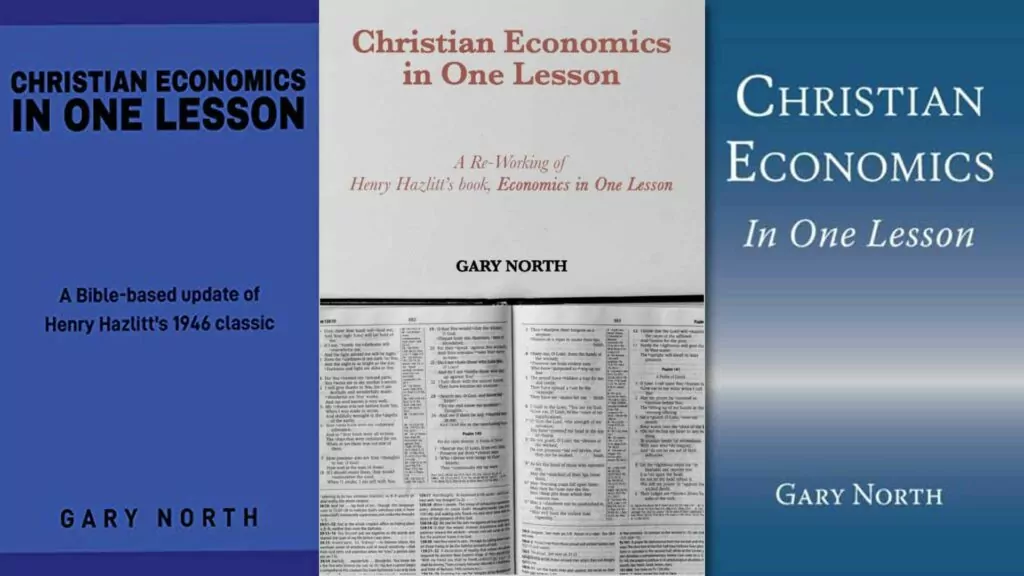
Christian Economics in One Lesson

by Gary North 2015 / 268 pages Henry Hazlitt’s Economics in One Lesson is what its title suggests, just one economic lesson explained in the first chapter – that we focus on the obvious impact of a government program, and don’t consider what otherwise might have happened with those dollars. It’s the seen vs. the unseen. That one lesson is then repeatedly applied to different situations in the 24 chapters that follow. In chapter 4, it is applied to public work projects: when the government builds a new sports stadium we can see the job created by its construction. What’s unseen is all the jobs that might have been created by businesses if they hadn’t had to pay the taxes to build that stadium. Overall, Hazlitt is making a general argument for less government and more economic freedom, but is making it on the basis of practicality: that a free market approach will make us all, overall, more prosperous (download the book for free). Effectiveness is the fruit, not the goal In his Christian Economics in One Lesson, Gary North makes his argument for free market economics on a very different basis: obedience. He also thinks the free market is the most effective way of making us all richer, but he sees that, not as a goal, but as a side effect – the fruit – of being obedient to God’s commands do not covet, and do not to steal. As his title suggests, he is riffing off of Hazlitt, and his chapters are a reworking of each of Hazlitt's. Economics is sometimes treated as a being simply about the math, about some sort of neutral accounting, pitting the different economic systems against each other to find out which creates the greatest benefit for society. Both socialists and capitalists could even agree that economics is about dealing with the problem of scarcity – there is only so much to go around, so how do we make the most of it? But North is arguing that economics is really a matter of ethics, and applying God's guidance on money, work, property, and covetousness to the real world. Then the better way is the way that obeys God’s commands. Now, like Hazlitt, North thinks the best system is the free market, and not the sort of so-called capitalism that involves getting government contracts and special favors. None of that crony "capitalism." This is, instead, a free market where people make exchanges voluntarily, and consequently, both sides benefit. No temptation to tweak But even as Hazlitt and North both hold to the free market system, it is significant that they got there very different ways. Hazlitt got there because the free market works – it is the most prosperous of all systems, doing more to raise people out of poverty than any other economic system before it. North arrives there because the free market is what results when we are obedient to God, respecting our neighbor's property and pushing back against our own covetousness. So, both support the free market. But for those like Hazlitt who arrived there for practical reasons, there will always be the temptation to tweak, and in doing so, to succumb to socialism. If capitalism works best, who's to say if capitalism plus just a smidge of socialism might not be better? Maybe just 5%? Or 10? How can we know unless we try? But there isn't the same temptation to tinker for Christians who choose the free market for its alignment with God's Word. We won't want to be 5% or 10% less obedient. And it is worth noting it is no coincidence that the economic system that most aligns with God's Word is also the one that best raises people out of poverty. That's simply God's love – He knows what is best for us, and when we obey, especially when we do so on a societal level, it goes better for us. Conclusion North's insight – that economics is about ethics, not efficiency; it is about obedience, and not prosperity – is a brilliant one, and worth the reinforcement that comes in the repeated applications that follow. If this isn’t the most important book I read last year, it is certainly in contention… and it can be downloaded for free here....

Red heart icon with + sign.
Book Reviews, Children’s picture books, Economics

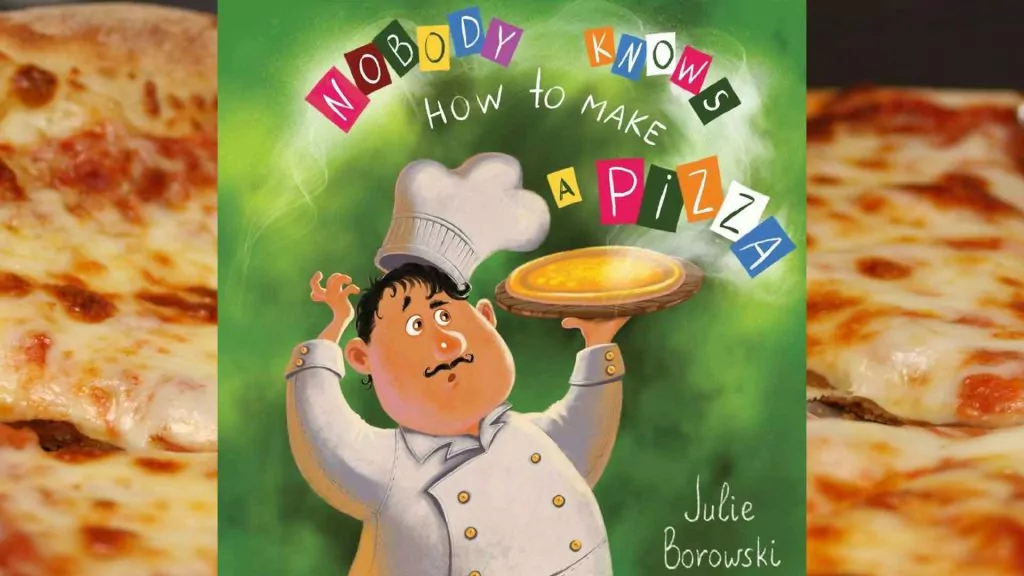
Nobody knows how to make a pizza

by Julie Borowski 2019 / 30 pages Rating: Good/GREAT/Give The picture book's title makes a claim that my daughter just couldn't believe: "Come on Dad, you know how to make a pizza!" But do I really? Sure, I know how to combine a pizza crust with cheese and tomato sauce. I'm even very good at it. But the point this slim volume is trying to make is that there is a lot more to it. That flour I use started as grain that somebody had to grow, and I certainly don't know how to do that. That farmer who does, brings in his crop using  a wheat harvester, which he isn't able to make himself. He'll ship off his grain, perhaps via a train, which neither of us could ever manufacture. We also don't know how to turn wheat into flour, and the folks that do, don't know how to make the semi-trucks that ship their flour to grocery stores around the country. Making even the simple pizza crust requires a lot of different people all working together, with not one of them knowing how to get all the needed steps done. That's why the pizza narrator's claim – that "there's not a single person on Earth who knows how to make me" – isn't as outrageous as it first seem, And that doesn't even get into the tomato sauce and cheese! You might be wondering, okay, but so what? The point of this little book (and the 1958 essay, I, Pencil, which inspired it) is to expose the arrogance of any big government's central planners. Whether it's full-blown communists who want to plan everything, or a democracy where the elected leadership "merely" direct large chunks of the economy (gov't spending in Canada accounts for 45% of GDP, and their impact is extended further still via regulations), we have governments of all sorts all around the world that think they know how best to run things from the top down. However, if planning the production of a single cheese pizza is beyond the capabilities of any one man, or even a team of the very smartest people on earth, then why would we think the government could ever know enough to competently make the innumerable management decisions they make, from what minimum wage everyone should be paid, to how children should be educated in K-12 (and what they should learn), which companies should be bailed out or subsidized, or even how much milk should be produced? Of course, if no one knows how to make a pizza, that prompts an obvious question: how is it that countless cheese pizzas are made every day? Instead of someone at the top planning it all out, this miracle occurs without much planning at all. The author of this picture book makes more of a libertarian presentation than a Christian one, so I'm using the term "miracle" here for a wonder she doesn't really attempt to explain. But Christians do have an explanation. Now, we might take for granted what the free market can produce – cheaper computers, innovations like the smartphone, innumerable kinds of bagel – to the point it seems too ordinary to call all of that a miracle. But the free market is a miracle nonetheless, completely beyond anybody's ability to plan and create, making it all the easier to see God's fingerprints. His commandment "Do not steal" creates property rights, which is the basis for one person trading what they own to another for something they want more. If you can't steal from others, then the only way to provide for yourself and your family is by producing something other people will value. You get money from them to meet your needs by making something that meets theirs. So God's law is the basis for free trade and it is unplanned, unorganized free trade that has miraculously proven to be the most effective way of raising people out of poverty. The government still has a role here - to prevent theft, enforce contract laws, and generally ensure that property rights are respected – but not in picking the winners and losers. While that's deeper than this picture book goes, what Julie Borowski does highlight is the result: all sorts of strangers cooperating with one another, each looking out for their own interests, but together creating something that none of them could make on their own – innumerable voluntary exchanges and, eventually, violà a pizza! As noted, this book has a libertarian flavoring to it, and because libertarians can often be libertines on moral issues, their values can be at odds with what God knows is best. However, in this case the libertarian impulse for small government syncs up well with the Christian emphasis on humility and Man's fallibility – we have a hard enough time trying to plan out our own lives, so it's arrogant indeed for bureaucrats and politicians to think they can plan out everyone else's lives for them. Better then, to limit (though certainly not eliminate) the government and what it does, so as to leave people the responsibility and allow them the freedom to manage their own lives. This would be read to best effect with a parent along for the ride. Otherwise I could see kids enjoying it, even as they entirely miss the overall small government argument being made. You can watch the author read her book below. ...

Red heart icon with + sign.
News

Saturday Selections – April 30, 2022

Meet one of Canada's anti-abortion influencers (6 min) Though this profile is by a decidedly left-wing outlet, it still can't help highlight how impactful pro-life warrior Laura Klassen, and her friends, have been on behalf of the unborn. Klassen's own videos, with her satiric takes on pro-choice "logic," can be seen here, here, here, here, and here, and you can also check out her BC-based pro-life group Choice42. It's wrong to play the pronoun game It's not harmless to offer up your "preferred pronouns" and Christians mustn't have any part of it. Why Disney has gone woke (10-min read) Why would a company that's built around family viewing decide to double down on an LGBT agenda so many families oppose? It's because Disney's new "customer base isn't kids. It's messed up adults." Walt's original "business model depended on a healthy national family" but today's "shareholders are not going to bet on a growth segment in the American nuclear family that doesn’t exist. Betting on dysfunctional adults with sizable disposable incomes makes a whole lot more sense." That's why "60% of Disneyland visitors were adults with no children." No-fault divorce ignores data... and children The UK is bringing in no-fault divorce with the argument that it will "remove unnecessary conflict from the process by ending the blame game — helping spare children from the harmful effects this can have.” But, as John Stonestreet explains: "This, 'the kids will be fine' line, is not just nonsense: it’s dangerous nonsense. It flies in the face of everything we know about the impact of divorce on the most vulnerable among us." The unlikely rise of Vladimir Putin (10-minute read) How did Putin rise to power? Thinkr offers book summaries – 10-minute reads with key insights from various bestsellers – and this time they've summed up Masha Gessen's The Man Without A Face, her biography about this infamous world leader. Does the free market help the poor than any other economic system? "As Christians understand, material wealth is not the be-all and end-all of human existence, however: Only market societies have generated wealth sufficient to meet the basic human needs of entire populations. Only market societies have generated sufficient wealth to generate widespread and organized assistance for those unable to care for themselves. Only market societies have generated sufficient wealth to promote other important human objectives, including nutrition and health, environmental protection, and even human happiness." Your cell has a DNA detangler! (5 min) Ever tried to detangle your daughter's hair? God has packed a tiny machine in each of your cells that does the same job for your DNA. This is so unbelievably cool! ...

Red heart icon with + sign.
News

Saturday Selections - January 16, 2021

Sea shanties go viral (7 min) If you have boys who think singing is girly, there's a new viral trend of men singing manly. For more on this sea shanties trend, and the Nathan Evans performance that started things off, click on the link above. 50 countries where it’s most dangerous to follow Jesus Every day, 13 Christians are killed, 12 unjustly arrested or imprisoned, and 5 are abducted - so reports the 2021 World Watch List. Our politics are cracking under the weight of a thinning civil society "...agitators, after making their violent intentions clear on social media, successfully incited Trump supporters to mob the Capitol. Still, even the most-crafty agitator can only agitate a crowd that is agitate-able." This flower can "hear" bees Bees' buzzing can actually trigger a flower to increase its nectar output, and the flower's petals function as a type of "ear" to amplify the buzzing. Alternatives to Google Google makes its money by selling users' information. And it gathers that information a lot of different ways! Here's alternative services that can provide some of the same features. Annecdotally, it seems like MeWe is becoming an alternative to Facebook, at least for some Canadian Reformed folk. Is Capitalism all about greed? (5 min) This video is fantastic, even if it doesn't get to the root of the issue. Capitalism stands on property rights, which we find in the Bible as well, when God forbids us from stealing (Ex. 20:15). In contrast, socialism presents it as right, and even just, for me to look over my back fence and covet my rich neighbor's goods (Ex. 20:17). While capitalism has this spiritual benefit (that it can be practiced in a way that aligns with God's Law), this video highlights its material benefit. To give one more perspective, a quote from Walter E. Williams (1936-2020): "Prior to capitalism, the way people amassed great wealth was by looting, plundering, and enslaving their fellow man. Capitalism made it possible to become wealthy by serving your fellow man." ...

Red heart icon with + sign.
Economics

Two tales of trade: how free trade creates wealth

As Christians we know that man is prone to all sorts of evil, but we often forget that man is also prone to all sorts of stupidity. Much damage is done by well meaning people who embrace a bad cause – they aren’t trying to do evil, just the opposite in fact, but evil is done because these “good” people are acting out of their ignorance. In Economics this well-meant ignorance often causes serious harm. One telling example involves child labor. We abhor child labor, especially when the alternative is sending these same kids to school instead. But some years back, when a compassionate campaign against child labor moved Nike and Reebok to close plants in Pakistan and lay off 50,000 child workers in Bangladesh, these children didn’t go to school instead. The reason they were working in the first place was because they needed the very basics of life, so when they were laid off, thousands of them turned to prostitution, crime or simply starved to death1. Compassion, coupled with ignorance, forced these children from a barely tolerable situation to one that was much, much worse. Youth are even more susceptible to doing the wrong thing for the right reasons. Enthusiasm combined with inexperience results in an ardent teen who just wants to “Do something!” and off they go, in exactly the wrong direction. Christian youth might be even more inclined to this, since they know that “the love of money is the root of all kinds of evil” (1 Tim. 6:10). That seems to leave them prone to a specific type of economic error – some are deeply suspicious of the rich and their own rich First World countries, convinced that when a rich country trades with a poor country, if the rich get a good deal, it must have been at the expense of the poor. This in turn leaves them leery of free trade. The truth is, it is not through trade, but through the lack of it that rich countries victimize the poor. Now, if there was only a fixed amount of wealth to go around, then any country that got more wealth could only have done so by taking wealth away from someone else. But wealth can be created – there can be more to go around. And trade is one important way to create more wealth. Create wealth via trade? How can that be done? Let me demonstrate by way of a couple of illustrations. How trade creates wealth One day, in his economics class, a university professor was trying to explain to his students the benefits of trade. After lecturing on the subject for an entire week he found his students were still unconvinced. Thinking about it over the weekend he had a flash of insight and headed down to the local dollar store where he bought a range of small inexpensive toys. He bought 20 different toys in all, ranging from a whoopee cushion to a bag of marbles. When the students entered their Economics 101 classroom that Monday they were each given one of the small toys. Most of the students thought their presents were kind of neat, all except for the girl who received the whoopee cushion. She wasn’t quite sure why, but she was offended. The professor then began the class by asking each student to rate their present on a scale of 0-5 with a 5 meaning they really liked it. The twenty students gave their presents a combined rating of 38. The whoopee cushion girl rated hers a zero. Then the professor allowed the students five minutes to trade their presents...but only with students immediately to the right or left of them. The unhappy whoopee cushion girl managed a trade with a frat boy to her right, for a pack of giant playing cards. She was much happier with the cards, and the frat boy was strangely ecstatic with his new possession. Five minutes later the students were asked to rate their presents again, and the combined rating improved to 56. The frat boy gave his whoopee cushion a five. Finally the professor allowed the students to trade with anyone in the room. Once again the overall score went up – the combined rating after this exchange was boosted to 72. From round one to three, no new products were created, and yet people rated their toy higher each round. To put it another way, after making trades they felt what they were left with was worth more than what they originally had. They were getting wealthier. And the freer the trade, the more students were able to obtain what they really wanted, by doing just as the whoopee girl did, offering in exchange something they didn't value as highly. With the trading completed, the professor was overjoyed – his students finally understood how trade could create wealth! He let out a contented sigh and dropped down into his chair…which then produced another, decidedly more rude, sound. The frat boy loved free trade. ****** When I first published this illustration in the Canadian Student Review some students responded by insisting that while trade might benefit First World countries, that didn't mean it was good for everyone. They argued it didn't help the poorest countries since they have absolutely nothing of value to offer in trade. This objection simply isn't true. Whether it is natural resources, or simply cheap labor (even cheap child labor), every country has something to offer. It is true that wars, and corrupt governments, may make it impossible for citizens of a particular country to engage in trade. But that doesn't underscore a shortcoming with free trade, but instead highlights the devastating impacts of wars and corruption. So, as a response, I ended up writing a second story to illustrate how free trade would help even when some countries have much less to offer than others. How trade helps even poor countries It was a regular lunch hour in Mrs. Embargo’s grade 6 classroom and the kids were trading their snacks behind the teacher’s back. One of the kids, Ulysses Sam Austin (USA for short) always had at least a hundred Oreo cookies. He had so many he didn’t value them like he once did when his mom only packed five or ten in his lunch. Canada’s mom (some kids have names like Dallas and Dakota, so why not Canada?) always stuck an entire banana bread loaf in his lunch. The other kids weren’t quite so well off, and had a variety of snacks ranging from a handful of chips to a couple of carrot sticks. The carrot stick kid desperately wanted some banana bread because his mom didn’t have an oven so she couldn’t make it. It took a bit of bartering but eventually he managed to trade one of his carrot sticks for a small slice. It wasn’t a lot, but it was more than he could have gotten any other way. USA was getting quite sick of Oreos and was practically giving them away. It wasn’t that he was softhearted – some even accused him of being the class bully – but he had a surplus of cookies, and they weren’t very useful to him. He traded ten of them to the carrot stick boy for his last carrot. The next day Mrs. Embargo decided to crack down, “You children are going to have to eat what your parents packed in your lunch!” That made all the children very sad: USA because he was now stuck with only Oreos, Canada because he had nothing orange to eat, and especially the carrot stick kid, because Mrs. Embargo’s protectionist stance prevented him from trading for the banana bread he loved so dearly. ****** The truth is, it is not through trade, but through restrictions on trade that rich countries victimize the poor. In this illustration, without trade the poor carrot stick kid/country would never have gotten a slice of banana bread, as he was completely incapable of manufacturing it at home. In the real world, poor countries in Africa can produce some agricultural goods at a lower cost than we can in the West, yet instead of allowing them to compete with us, we may well slap a tariffs on their goods, in addition to spending billions on subsidizing our farmers. As columnist Elizabeth Nickson puts it, “these barriers dramatically reduce what poor countries can earn from farming, which is what most of their people do." She went on to note that, back in 2004, it was "estimated that protecting our markets from African produce costs these countries $100 billion US a year, or twice what they receive in aid.”2 Free, fair trade is a win-win prospect for both sides – the poorer nations wouldn’t trade at all if they didn’t think they were getting a benefit. And if we as Christians want to help the developing world in a substantial manner – far in excess of any material good we can do through our charitable giving – one of the most compassionate things we can do is tell our government to reduce tariffs and agricultural subsidies that, while helping our own farmers, do so at the expense of the poor. End notes 1 “Green power, black death” by Elizabeth Nickson, National Post Jan. 9, 2004 2 “Green power, black death” This article was first published in Feb. 2004 in Reformed Perspective magazine...

Red heart icon with + sign.
Documentary, Economics, Movie Reviews

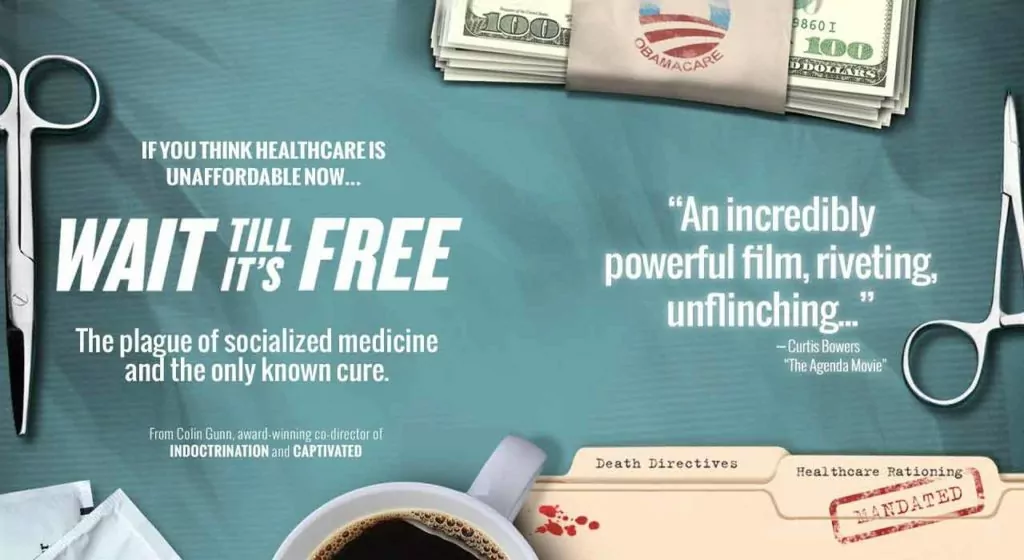
Wait till it's free

Documentary 2014 / 82 minutes Rating: 9/10 Why would Canadians be interested in watching a Scotsman take a look at the American healthcare system? Because this examination, of how capitalism and socialism impact healthcare costs, is very relevant for us too. The film’s director and producer, Colin Gunn, is Presbyterian and consequently a capitalist. If that seems an abrupt connection, then consider that we Reformed folks know that the heart of man is wicked. So we are well aware that if an economic system needs men to be angels, laboring for no personal benefit, then that is an unworkable economic system. So we know better than to be socialists. But for some reason, we don’t seem to think that holds true for healthcare. This comes out most strongly when Canadians, even the Reformed ones, start talking about healthcare with their American cousins. Then we seem to be quite proud of the socialistic nature of our healthcare system, which “costs us nothing, and is free for everyone.” But, of course, that isn’t really so. It certainly isn’t free – the costs are simply not seen, paid out in taxes, so that Canadians have very little idea of how much their healthcare really does cost. And that everyone is covered doesn’t distinguish it all that much from American healthcare, where everyone can get emergency care, and where more and more of the population is covered by the government-run Medicare. As Gunn points out, the American system is almost as socialistic as the Canadian. Gunn’s main argument is that a good dose of capitalism would be good for what ails the American system. His most telling observation was that in the American system no one knows what the costs will be beforehand. There is no public pricing chart, and so no way of comparing what one hospital might charge versus another. And without an awareness of how much things might costs, there is only a pretense of competition. You won't have innovation if you don't have competition so if we want to reform healthcare, this might be the first place we need to start: make all the prices public! I highly recommend this documentary – it is a brilliant argument by a Christian filmmaker who has perfected his craft. The content is superb: Gunn has assembled an impressive cast of experts from around the world to make his case. And the presentation is even better: there are fun little animated bits, and great narration, and a wonderful story arc – this is packaged up nicely, and tied up at the end with a bow. Who should see this? Anyone who thinks socialism is the answer to our healthcare needs. You can watch the trailer below, and rent the full film by clicking on the "$4.95" link in the trailer below. The Wait Till It's Free YouTube site has a lot of extras that are also worth checking out. ...
Red heart icon with + sign.
Economics

The rich keep getting richer… and they're not the only ones

Capitalism helps everyone. That might be hard to believe right now, with the worldwide economy in the doldrums, and with many fingering capitalism as the culprit. But before we jump on the anti-capitalist bandwagon, and before we ask the government to take over larger areas of the economy, it would be a good idea to look back and get a proper understanding of the good capitalism has done. The fact is, capitalism is responsible for lifting billions of people out of poverty and creating improved standards of living that previous generations couldn’t have dreamed of. Swedish scholar Johan Norberg has written a brief overview of this phenomenon in The Wealth of Generations: Capitalism and the Belief in the Future. Marx got it half right It’s likely that Karl Marx, the originator of Marxism, developed the sharpest anti-capitalist theory. According to Norberg, Marx believed “that capitalism would make the rich richer and the poor poorer.” If someone was making money in a free market situation, it must be at the expense of someone else. That is, somebody was losing money if another was gaining money. Thus over time the upper class would accumulate more wealth at the expense of the middle class and lower class. The middle class would be pushed into the lower class, and the original lower class would basically starve. Marx made this prediction during the Industrial Revolution of the nineteenth century. Despite its undeserved bad reputation, the Industrial Revolution resulted in a dramatic rise in living standards. “When Marx died in 1883, the average Englishman was three times richer than he was when Marx was born, in 1818.” Since that time capitalism has continued to raise living standards to the point that “the poor in Western societies today live longer, with better access to goods and technologies, and with bigger opportunities than the kings in Marx’s days.” Lenin got it all wrong Marx’s original theory was obviously a failure; standards of living rose rapidly for all classes due to capitalism. So Marx’s disciple, and Russian revolutionary, Vladimir Lenin had to rework the theory to explain how workers in Western countries were doing so well economically. Lenin argued that the capitalist class of the Western countries looted the poor, undeveloped countries, and gave a portion of the loot to the workers in their own countries. The rich countries were made richer because the poor countries were made poorer. Quite simply, the rich countries took the wealth of the poor countries. But like Marx’s theory, Lenin’s theory contradicts the facts. As Norberg explains, the problem with Lenin’s view is: “all continents became wealthier, albeit at different speeds. Sure, the average Western European or American is 19 times richer than in 1820, but a Latin American is 9 times richer, an Asian 6 times richer, and an African about 3 times richer. So from whom was the wealth stolen?” Capitalism benefits every class, every sector of society, and not just one special group or certain exploitive nations. In fact, Norberg describes the success of capitalism in alleviating poverty in the last three decades or so as “the greatest untold story ever.” As Norberg writes, the proportion in absolute poverty in developing countries has been reduced from: “40 to 21% since 1981. Almost 400 million people have left poverty – the biggest poverty reduction in mankind’s history. In the last 30 years chronic hunger has been halved, and so has the extent of child labor. Since 1950 illiteracy has been reduced from 70 to 23% and infant mortality has been reduced by two-thirds.” This has occurred during a period where many countries around the world have shifted away from socialism and socialistic policies towards capitalism and free market policies. Using creativity to create wealth It’s common to think of creative people as being writers, painters, musicians, and others in the fine arts. But some of the most creative people in the world are entrepreneurs. These are people who use their creative abilities to provide products and services in new and innovative ways. By doing so they create new jobs for countless people and generate wealth where previously none existed. Capitalism allows the greatest freedom and opportunities to people whose creative talents are in the economic sphere. This is a key reason (perhaps the key reason) for the success of capitalism. A thriving economy requires entrepreneurs but socialism stifles and punishes entrepreneurs. Generally speaking, socialists consider businessmen to be the exploiters of workers, therefore these “exploiters” must be heavily regulated and controlled. Capitalism, on the other hand, unleashes the creative powers of entrepreneurial businessmen, and thus becomes a driving force for generating new wealth and economic development. As economic history clearly demonstrates, capitalism is the only system that leads to prosperity. Yes, the rich do get richer under capitalism but so do the poor! Dr. Michael Wagner is the author many books, and is a regular contributor to Reformed Perspective. This article first appeared in the January 2009 issue under the title "The rich keep getting richer...and that's a good thing!"...