Transparent heart icon with white outline and + sign.

Life's busy, read it when you're ready!

Create a free account to save articles for later, keep track of past articles you’ve read, and receive exclusive access to all RP resources.

White magnifying glass.

Search thousands of RP articles

Helping you think, speak, and act in Christ.

Open envelope icon with @ symbol

Get Articles Delivered!

Helping you think, speak, and act in Christ. delivered direct to your Inbox!

Assorted

Am I lazy or just relaxing?

What does Proverbs say?

*****

After a long and hard day at work or school, the last thing someone might want to do is more work. So, some don’t. Instead, maybe we’ll sit around on our phone, scrolling social media, catching up on the latest news. Then, when the weekend rolls around, doing house chores can be the last thing on our minds. So, some don’t. Instead, we’ve sat on the couch and binge-watched our favorite TV series to waste the day away. Taking a break isn’t a problem, but how much is too much? Relaxation can be good, but laziness isn’t.

What exactly does the Bible say about laziness and how can we fight against it? And how do we determine whether we are being lazy or just relaxing?

Laziness means excuses

While the dictionary defines laziness as “the unwillingness to work or use energy,” the Bible has a more applicable explanation. Solomon, in Proverbs 26:13-15, pictures it in this way:

13 A sluggard says, “There’s a lion in the road,
a fierce lion roaming the streets!”
14 As a door turns on its hinges,
so a sluggard turns on his bed.
15 A sluggard buries his hand in the dish;
he is too lazy to bring it back to his mouth.

In Warning Against Laziness, Alistair Begg says of verse 14:

“He can turn to his left, or he can turn to his right, but that’s about it. He absolutely loves it. He makes movement but no progress. Where you found him at seven in the morning you can find him later at eleven in the morning, and perhaps at three in the afternoon.”

And what of the lion? The sluggard is happy making excuses for reasons not to leave his house. He becomes a procrastinator. As Begg notes:

“And the longer they go on filling their mind with that kind of thing, they have imaginary reasons for their inactivity, and these imaginary reasons finally convince them of the fact that they can rationalize the fact that they don’t get up. Of course, the real danger is not the imaginary lion in the street. The real danger is the roaring lion, the devil, who loves to come and lull people into indolence and defeat.”

The more excuses we come up with for avoiding tasks, the more we begin to think it isn’t a problem.

A strong temptation

Throughout the book of Proverbs laziness arises repeatedly. If God repeats a warning, we know that it matters for our spiritual lives and that it’s a tough temptation to overcome.

Proverbs 24:30-34 gives us an image of how detrimental laziness is for our souls. We are given a description of the vineyard of a sluggard and as expected, it is overgrown with weeds, full of thorns, and the walls are in ruins. It is a testimony to his laziness. When challenged with the work and upkeep of his vineyard, this is someone who’d prefer “a little more sleep, a little more slumber.” He or she would rather have 5 more minutes of sleep than do the tasks God has asked of them.

Laziness affects more than just vineyards. A few chapters earlier, in Prov. 21:25, we read that “The cravings of the sluggard will be the death of him because his hands refuse to work.” Laziness keeps the heart empty and provides opportunity for the devil to enter an open door. Laziness occurs when we do nothing productive for the soul and the mind.

The truth of the matter is that we were made to work. Even in the Garden of Eden, Adam was given work to do, to tend the garden and name the animals (Gen. 2:15-20). We work to glorify God, and God has so created us that when we live out our purpose, it is good for us to work too.

When we fail to obey the command to work hard, we are more susceptible to other temptations as well. We need to be working hard, whether that is in the home caring for our children, providing an income for our family, or doing our best in school so that we aren’t easily tempted.

We need to be aware of laziness as a sin. It isn’t a joke because sin, left unchecked, separates us from God. It effects the wholeness of our lives, and it needs to be dealt with.

Those hours spent on Instagram or Tik Tok are times that you could be enjoying communion with others, doing the tasks God’s set out for you, spending time with Him in His Word, and more. The point is that if you don’t discipline yourself to be diligent in your work, studies, in practicing hospitality, and in the reading of the Bible, as well as prayer, you will become lazy. Laziness is the default; it’s the result of not trying.

Remember the Parable of the Talents, with the servant who buried his talent – the master took it from him and gave the talent away to someone who would actually do something with it (Matt. 25:14-30). God is not happy with the bare minimum from us.

We need to make the most of every opportunity lest laziness hinder us from serving God wholeheartedly.

Fight laziness with productivity

What can we do to assure ourselves to not fall into this temptation? We can ask ourselves one simple question: Have I been productive today?

If you can list off a number of things, then a break might be just the thing. If you ask this same question to your parents, or your spouse – “Have I done anything productive today?” – you’ll likely get an honest answer. Another good starting question could be “what does productivity look like in your home?” Learn from others what it means to be productive. Each individual has their own happy medium so there is nothing wrong with asking around.

And if you are struggling with laziness here are some other tips that have helped me:

1) Pray – Ask God to show you when you aren’t putting in a good effort
2) Read what Scripture says about laziness and work
3) Listen to (or read) Alistair Begg’s “Warning Against Laziness”
4) Go for a walk when you can – keep yourself in shape
5) Call a friend whom you haven’t talked to in a while – put effort into your relationships

Fight laziness by resting

On the other hand, burning out isn’t godly either. Just because God calls us to work hard doesn’t mean we should work to a point of pure exhaustion at the end of the day. How can we ever thank Him if we’re too busy to see what He is doing?

Jesus reminds us to rest, “And He said unto them, ‘come away by yourself to a desolate place and rest awhile’” (Mark 6:31). He says rest awhile. He tells his apostles that even the most active servants of Christ cannot always be upon the stretch of business and work. They too need some time to recharge.

Christ understands how weary our lives are. He went through it every day during His ministry. We can turn to Him knowing He’s experienced exhaustion too. So He provides those free afternoons or evenings when there’s no homework taking over. He gives us the weekend for a change of pace from our daily work, and to go out with friends. He has even set aside a day every week where we can step away from our obligations and come praise Him in His house with fellow believers.

We have an obligation to serve Him wholeheartedly and always, but this doesn’t mean working 6 days a week for every waking hour. It’s just that having a break doesn’t have to mean pulling out your phone to doomscroll. It might be as simple as taking a moment to consider every blessing that God has given, and express gratitude for them. It means being present with your family, teaching them the ways of their Maker and training them up in His word.

When you feel deflated, read Psalm 23. God leads us to the still waters, not the raging sea. He restores our souls and gives us quietness of mind.

How do I know it’s rest?

The difference between rest and laziness might come down to its purpose. Laziness is an avoidance – avoiding the laundry piling up, the lawn that needs mowing, the taxes that need doing, the kids that need engagement, whatever it might be. Rest is about restoration, to make yourself ready again to do the work God has prepared for you.

Rest will feel good, it will be enjoyable, and it’s God-given. When I find myself being lazy, I notice that it stinks. I feel sluggish. A sluggard man does not enjoy being lazy. In contrast, a busy man enjoys a day of rest. He is satisfied because he has completed the task to which God called him.

Keep this in mind as you go about each day. Serve the Lord wholeheartedly with your hands and with your rest. We must be good stewards with the time we’ve been given glorifying God in our work.

Laziness is serious; it is incredibly dangerous – the Bible has nothing good to say about the fate of the sluggard. So, when that snooze button is tempting you, think through who God is calling you to be, and how much more important obedience to Him is, than 5 more minutes of sleep. And because we aren’t alone in this race, we can be an encouragement to one another, reprimanding each other gently to stop putting off things until tomorrow. The difference between laziness and rest matters!

God has saved us. He sent his Son to die for us, and we have only a limited time here on Earth to express our gratitude towards Him. So let’s repent from the opportunities we’ve wasted, and ask Him to help us take up “the good works which God prepared in advance for us to do” (Eph. 2:10).

Red heart icon with + sign.
Assorted

“It’s only a dollar!” – on bingos and raffles

Some churches hold bingos and sell raffle tickets, so can gambling really be wrong? ***** “I think we should have a bingo night to raise money for our community.” “All you spend is $1.00 on a ticket and you could win $1,000,000!” “Our organization is having a raffle to raise money for the handicapped; will you buy a ticket for only $1.00? You might win a 10 speed bicycle!” “I just won $2,000 in the lottery – isn’t that great?” Often we have friends and neighbors and perhaps even relatives who participate in the lottery, raffles, or other types of games of chance. And among secular and some professing Christian groups, games of chance are popular fundraisers because they are a fairly easy way to raise a large amount of money fast. I once came under quick attack in a neighbors’ meeting for refusing to participate in a raffle. “What do you mean it’s against your Christian principles? St. Whoever’s church at the corner has bingo every week, and raffles twice a year to raise money. How could it be wrong?” It was too difficult on a moment’s notice in a suddenly hostile group to formulate and express my reasons. I finally stated that I was not going to defend myself there in front of an entire group; however I would be willing to explain to them individually at another time just why I was against all forms of gambling. Happily, one Baptist neighbor spoke her agreement with me and the issue ended. It is sometimes difficult to give a quick answer because there are no specific Bible verses which state, “you shall not gamble.” Is it “only a dollar” and therefore unimportant whether we participate? Or are there principles from God’s Word which regulate even this small purchase? Does it become acceptable when the recipient is a worthwhile cause? Furthermore, how do we react to a friend or relative’s big winnings? Though the odds are ridiculously high, you might know a winner from time to time. Should someone feel so generous as to spread his/her newfound wealth in our direction, what should be our reply? (The questions only get harder, for instance: what if a relative won a large sum of money – what about accepting a Christmas gift of a new car?) I spoke with our minister, the Rev. Kenneth A. Kok, concerning how to express an answer to the basic question, “What’s wrong with gambling?” He provided three answers: 1. It encourages a “something for nothing” mentality Throughout the Bible, we clearly find that God expects us to work to provide for our material needs: “By the sweat of your face you shall eat bread…” (Gen. 3:19) “He who tills his land will have plenty of bread, but he who pursues vain things lacks sense. The wicked desire the booty of evil men, but the root of the righteous yields fruit.” (Prov. 12:11,12) “He who tends the fig tree will eat its fruit; and he who cares for his master will be honored.” (Prov. 27:18) “…give her the product of her hands, and let her works praise her in the gates.” (Prov. 31:13-31) Why would we want to get something for relatively nothing? Aren’t we thankful to God for all He has given us? Doesn’t He provide us with all that we need? And as LD 42, Q 111 of the Heidelberg Catechism states in regards to the commandment “You shall not steal,” here we also learn, “In addition God forbids all greed…” Perhaps we are tantalized with the thought of what we would do if we could only have $1,000, or maybe $5,000, or better make it $10,000, or what if we got a million? With the character Tevye, from “Fiddler On The Roof”, we inwardly pray: Lord, who made the lion and the lamb You decreed I should be what I am But would it spoil some vast, eternal plan If I were a wealthy man? Does this reflect the same sentiment expressed by Paul in Philippians 4:11-13: “Not that I speak from want; for I have learned to be content in whatever circumstances I am. I know how to get along with humble means, and I also know how to live in prosperity; in any and every circumstance I have learned the secret of being filled and going hungry, both of having abundance and suffering need. I can do all things through Him who strengthens me.” It is one thing to work hard and have God bless your endeavor. It is another to look for an easy break. 2. It encourages poor stewardship Gambling often encourages the people with the least amount of money to be irresponsible with what they have. Much money is wasted on chances and this money could be put to better use – saved, spent well, or given to a worthy cause. As Heidelberg Catechism question 111 goes on to say, “…God forbids all greed and all abuse or squandering of His gifts.” Numerous references are listed there. By participating in even a small way, we promote an activity which may be weakening the financial status and even the family life of others. Only one or a few win, at everyone else’s expense. Is this loving our brother as we love ourselves? As Question 112 further states, “I must promote my neighbor’s good wherever I can and may, deal with him as I would like others to deal with me, and work faithfully so that I may be able to give to those in need.” Even if the “chances” benefit a worthy cause, we still have the question from point 1 regarding our attitude. In this case, if we want to help, we should simply donate the money and not take the raffle ticket. 3. It encourages seeing money as one’s savior People begin, with the larger gambling items, to see money as their savior. Their hope is placed upon money, rather than God. This is evident in the long, long lines which form as the state lottery “pot” soars to $24 million or more. People call friends in other states requesting the purchase of these tickets for them, just for that chance – that possibility of being one of the ones to win. Conversations at the office turn to: “What will you do with it if you win?” Smiles and sighs. “Pay off all my debts.” “Buy a fabulous house.” “Quit working here.” “Take a trip to Hawaii.” Or perhaps even “Make a large donation to the school/church/hospital.” It seems, in those few moments of dreaming, as though our main problems in life, i.e., financial ones, would be solved. We do not believe the various accounts we’ve read or heard about money causing new problems. But the point here is this: “My God shall supply all your needs, according to His riches in glory” (Phil. 4:19). We must behave as children of God, children who present our needs and desires to Him, who work diligently for them as far as possible, who trust Him to provide, and who accept with thanksgiving, not as a young child asking after Christmas, “Is that ALL I get?” “But realize this, that in the last days difficult times will come. For men will be lovers of self, lovers of money, boastful, arrogant… ungrateful, unholy, unloving… without self-control… reckless, conceited, lovers of pleasure rather than lovers of God; holding to a form of godliness, although they have denied its power; and avoid such men as these” (II Tim. 3:1-5). The next time we are faced with the temptation to “get rich(er) quick,” to spend “only a dollar” with the mostly false promise that we might gain much more, let us ask ourselves, “Why am I doing this? Does this reflect a godly, thankful attitude? Am I looking for a different savior?” God’s Word answers the whole question the best: “Now there is great gain in godliness with contentment, for we brought nothing into the world, and we cannot take anything out of the world. But if we have food and clothing, with these we will be content. But those who desire to be rich fall into temptation, into a snare, into many senseless and harmful desires that plunge people into ruin and destruction. For the love of money is a root of all kinds of evils. It is through this craving that some have wandered away from the faith and pierced themselves with many pangs. But as for you, O man of God, flee these things. Pursue righteousness, godliness, faith, love, steadfastness, gentleness. Fight the good fight of the faith. Take hold of the eternal life to which you were called and about which you made the good confession in the presence of many witnesses.” (I Tim 6:6-12). This article was originally published in RP's March 2006 issue....

Red heart icon with + sign.
Assorted

If businesses tithed

Christians are familiar with the Biblical principle of tithing, and support many kingdom causes as a matter of course. They apply the principles of Galatians 6:10 with their talents, time and treasure: “So then, as we have opportunity, let us do good to everyone, and especially to those who are of the household of faith.” Followers of Jesus Christ are known for their enthusiastic support of their local church, Christian education, organizations helping the homeless and poor nearby and in other parts of the globe. We are giving, and we can see God blessing those gifts. So, what might the Lord do if Christians who own their own businesses or are shareholders in a venture with others, found ways to apply these same principles in their business operations? Retained earnings Often in the first years of establishing a company, funds can be tight, and any profits that are made need to be invested back in the business to pay down debt, or to purchase new equipment, or to hire more staff. (These profits that are not pulled out of the venture, but are used by the company are often called “retained earnings.”) Sometimes, a new firm can operate for years without paying out profits to its owners, but meanwhile, the company is growing, owns more assets than when it was starting up, and itself is now worth far more than it was when it was just an idea percolating in the minds of its founders. When Christian owners or shareholders are rewarded with a dividend payout from the business, it’s relatively easy for them to make an individual decision about giving back to the Lord from these earnings, just as they would decide when receiving a regular paycheque. All these good gifts that we receive are really the Lord’s, and for us to “give back” from our first fruits should be a given. In Proverbs 3:9-10, Solomon reminds us to: “Honor the Lord with your wealth, and with the first fruits of all your produce; then your barns will be filled with plenty, and your vats will be bursting with wine.” But what about the wealth that has been building up inside the venture, the “retained earnings” referenced above? In Luke 12:16-21, the Lord Jesus warns against covetousness and greed with the story of the rich fool: “The land of a rich man produced plentifully, and he thought to himself, ‘What shall I do, for I have nowhere to store my crops?’ And he said, ‘I will do this: I will tear down my barns and build larger ones, and there I will store all my grain and my goods. And I will say to my soul, “Soul, you have ample goods laid up for many years; relax, eat, drink, be merry.”’ But God said to him, ‘Fool! This night your soul is required of you, and the things that you have prepared, whose will they be?’ So is the one who lays up treasure for himself and is not rich toward God.” Stewards, not owners The rich man’s declaration of what he will do with “my grain and my goods” tells us how he thought of what he owned – it was all his, and not the Lord’s. That’s a point that the Lord Jesus makes again and again – not to think of the possessions God has entrusted to me as mine. All of it is the Lord’s, and all of it is only lent to us here on earth, to use wisely, and give back to Him (Luke 12:42-48, Matt. 25:14-30, etc.). And leading into this passage, He also warns us against thinking that one's life consists “in the abundance of the things he possesses” (Luke 12:15). Although it’s not an exact analogy, the retained earnings inside our companies can function like the grain and goods in the rich fool’s barn – our company’s growth can be a temptation to measure ourselves by what we have built – so we need to be very careful how we view them. So, how can we resist that pull? Firstly, we should consider all of it the Lord’s, to be used for His kingdom and His glory. This does not mean we can’t invest in new equipment, or purchase additional property for our companies, or keep a prudent amount of funds available for potential emergencies. All of these are good business practices. But we should have in the forefront the idea that all of this is the Lord’s: just like the servants entrusted with the master’s property in Matthew 25, we will also be asked to give an account by our Master for how we managed what He lent to us. Secondly, just as we financially support kingdom causes by giving from our paychecks and dividends, our companies could do the same with their retained earnings and with other resources they have built up. I was exposed to this idea of “corporate tithing” years ago by other Christian business owners. At their annual shareholders’ meeting, where they reviewed the past year’s performance, the shareholders were given an update on how much, and to whom the company had donated in the past twelve months, with the expectation that it would add up to a tenth of the retained earnings from the previous year. This built-in accountability helped the company’s management be intentional about their charitable giving, because there was a specific expectation around a measurable quantity – ten percent of last year’s retained earnings is a clear expectation, and one that can be easily communicated and measured. So how about it, business owners? Could a principle like this be adopted in your business? Can you encourage the company you work for to consider more than nominal support of causes that promote the Kingdom of God? May we be encouraged also by Paul who writes in 2 Cor. 9:6-7: “Whoever sows sparingly will also reap sparingly, and whoever sows generously will also reap generously. Each of you should give what you have decided in your heart to give, not reluctantly or under compulsion, for God loves a cheerful giver.” Just imagine Business tithing brings with it all sorts of opportunities and possibilities. Imagine a business tithed from their profit of $100,000: they could cover the cost of a part-time special needs assistant at their local Christian school. If they tithed from $1M, they could provide the means for a church or non-profit to hire a full-time employee, or do a renovation, or fund a medical clinic in the third world for a year. Imagine doing this consecutively over 10 or even 40 years? It really adds up. It could cover the cost of an entire orphanage etc. Another way businesses can tithe, beyond money, is by hiring people who are otherwise not likely to get a job, or a great job. It might be people with special needs, or who are in a place in life where they really need help/grace. Employment is so meaningful. But if we are only thinking about the bottom line, we won't be keen to take them on. While this editorial focused primarily on the financial portion of a company’s giving back, there are many other ways that businesses can contribute to their community with their employees’ and owners’ time and abilities. If you have suggestions for good practices that encourage good stewardship in these areas, we’d be delighted to learn more! Send us your thoughts. Marty VanDriel is the chief executive officer of two small businesses in Washington State, voluntary treasurer for three non-profit organizations, and assistant editor of Reformed Perspective....

Red heart icon with + sign.
Assorted

Write down your story

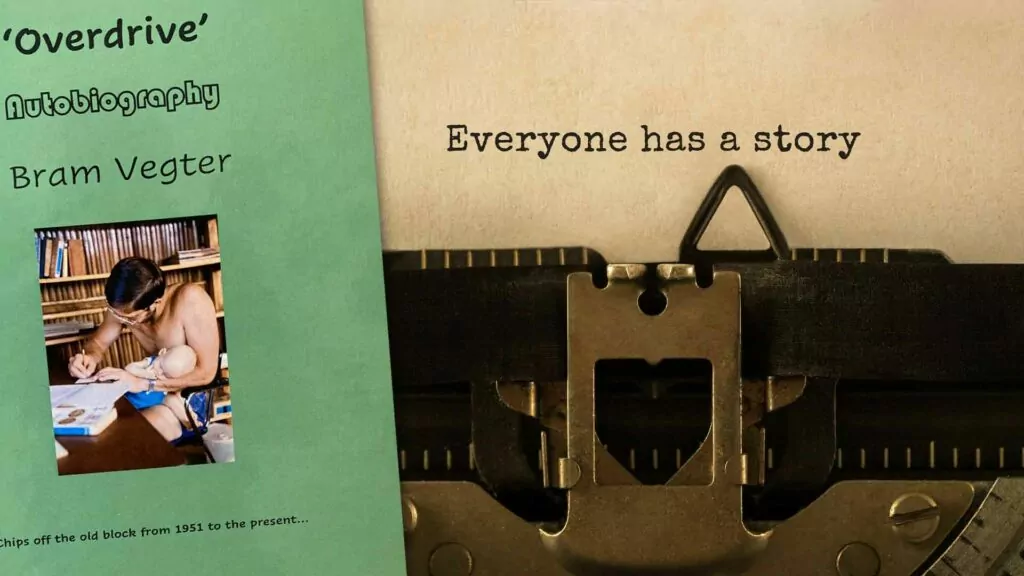
Sharing your history is sharing His story ...things that we have heard and known, that our fathers have told us. We will not hide them from their children, but tell to the coming generation the glorious deeds of the LORD, and His might, and the wonders that He has done. – Psalm 78:3-4. ***** There are half a dozen people in my group of older friends who have written their autobiography, or who are working on completing their life story in print. When someone commented “you should write some of those stories down” they responded! And that they did has benefits for both themselves and their children. How so? Writing might seem an artform slowly losing ground in a world of emoticons and AI-written essays. Fortunately, for some people, writing is still a joy to do, and an even greater pleasure to read again later. Young people who keep a daily journal can attest to this (except perhaps on their wedding day, when someone roasts them with readings from their journal pages). Words are like pictures in that they tend to bring back memories; good and bad. We can enjoy our own writing. And others’ words can place you in the shoes of someone dear to you. Imagine reading a story that your grandpa or grandma wrote many years ago. It helps you to understand who they are, and how they lived their life in those days, and perhaps even why they are the way they are. Writing history 37 years of Bram Vegter’s extended family’s chronicles, bound in some 15 volumes, there for children and grandchildren to enjoy Writing your family history doesn’t need to be a solitary effort. My Dutch family members started publishing our own chronicles in 1987 and kept it going (monthly, and later bi-monthly) until 2024. It was kept “in-house” which enabled us to write freely and openly, and we did. These 37 years of chronicles, which are bound in some 15 volumes (!), are wonderful to browse through and relive all the weddings, birth announcements, vacations, highlights and low points in the lives of my family members. These many years also cover the time when computers and phones were introduced, and you can imagine how things changed because of these and other incoming electronic devices. You can see the changes as you turn the pages, from the old typewriter font to a variety of new typefaces we could select from, and from photocopies to email. The printing press invented anew! Now the grandchildren browse through the pages and are elated when they find the page where their birth was being announced with joy! “Look Mom – this is when I was born!” And Mom looks at a relieved and tired face in a bed… with a tiny newborn on her tummy. Your story If you don’t have a family chronicle, you can take up the quill yourself. It takes just one to start. And the writing you do for your autobiography is your story. How and where it began. Someone who is reading your story sixty years later lives in quite a different era. To read about your younger years and how things were then, will partly explain who you are now! Your story can be so fascinating and encouraging for others who may not have lived close to you, or perhaps even lived in a different country. Different times, different settings, even a different church maybe. You may tell how it was when you were growing up, and these are beautiful word pictures for your descendants. “The times, they are a-changing” Bob Dylan sang years ago, and he wasn’t wrong. This is what makes a time capsule, in the form of an autobiography, so interesting. Some Vegter Dutch relations showing off their just-received copy of Bram’s own autobiography, Overdrive. And there is much to write about: your family, your siblings, your friends, your church activities, your school, your neighborhood, what it was like growing up there. And then of course, what you did after your studies: where you worked, or where you traveled to, what kind of things held your interest. And for those who got married, how did you meet your better half? Explain to readers yet to be born how that went, and what has the “I do” meant to you before your spouse, and before God? We often say so little about that, and these can be fascinating, fun and encouraging stories. Especially for a new generation growing up in a time when marriage is becoming less common. Then you probably want to write a bit about what you have done in life, how you have filled your time with work, perhaps some volunteer work and hobbies. Many of these move to the background as you get older, but they were once front and center in your life! They kept you occupied, and (grand)children want to read about them. What made you tick? His story! Ultimately, whatever you write will be His story, as God has put together your life. In the beginning, when you were just getting started, it was perhaps a bit of a puzzle; maybe you had trouble seeing where He had you heading, and how all the pieces would fit in. Often later in life you recognize God’s hand more and more, and you begin to see how His plans for you came together… though when the picture of your life will be complete, only God knows. It is so beautiful to pass on to (grand)children what you have gone through, how you trusted God in uncertain times, and how God often gave more than He promised you. His goodness, His grace, and His faithfulness are often more fully understood later in life, so your story can encourage younger people still figuring it out. It is also good to relate some of the foolish things you did when you were young, and how God forgives the sins of our youth (Ps. 25:7). Often, when people become older, they tend to reminisce and look back on their life. They may regret some of the things they did when they were young. Be honest about that (without sharing all the details) and tell your children you were once (and still are) far from perfect. Then rejoice together in God’s love and forgiveness! In these days, it has also become much easier to share information with each other. Many families now share a WhatsApp account to regularly keep in touch with each other. This is beautiful, but it misses the rich spiritual heritage of the past. There is still nothing like really writing to help you reflect and remember. I want to end with the first Bible verse I ever wrote on a card to a friend. It is from Proverbs 3:6 and it says: “In all your ways acknowledge Him, and He will make straight your paths.” God was there, also in my early teens. May we acknowledge Him, even to our children’s children! So, start your Word doc today, 8.5x11 will be just fine. Write your story down – for your family....

Red heart icon with + sign.
Assorted

The peculiar blessings of Covid

God used even this evil for good ***** In the early spring of 2020, Christian pastors from across Alberta sat on a telephone townhall with Alberta Premier Jason Kenney and Chief Medical Officer Deena Hinshaw. On the call – which had been scheduled to offer Alberta’s religious leaders an opportunity to ask questions about Covid-related regulations – pastors shared opinions, asked for medical advice, and requested clarification on the government’s early pandemic guidelines. Uncertainty about the future of the pandemic and its effect on in-person worship dominated the conversation. In the months following the townhall, as pandemic restrictions became more hotly contested and closely enforced, pastors and other church members reckoned with deep theological questions about the nature of human embodiment, the importance of in-person worship, and the efficacy of the Lord’s Supper. In addition to such practical theological questions, Canadian Christians – like their non-Christian neighbors – faced a litany of disappointments and devastation over the course of the pandemic era. These included cancelled weddings, cancelled funerals, the death of loved ones from Covid, the death of loved ones from suicide, frayed family relationships, and crushing financial hardships. As a result, many Christians – and most non-Christians – now view the pandemic as a long international nightmare which must never be repeated, and which would best be forgotten. This response to the human devastation of the Covid pandemic is natural. And in many ways it might even be healthy: a desire to constantly relitigate past events at the expense of tackling present problems serves no good purpose. However, underneath the severe difficulties of the Covid-era are surprising proofs of God’s covenant-keeping faithfulness – proofs that should make Christians rejoice in God’s sovereign activity during the Covid pandemic, and should produce hope about God’s activities amid today’s often-grievous cultural developments. Nothing to do but be renewed For some, the hated pandemic restrictions became the means through which God saved their soul. Allison, a young government employee from Alberta, spent much of the pandemic in the United Kingdom, unable to return home. As a result, she stayed at the house of a kind friend who invited her to watch livestreamed worship services. Convicted of her sin and curious about the God proclaimed in the sermons, Allison’s atheistic thinking began to fall apart. Renewed by the Spirit, she embraced the gospel. Today, she is a member of a local church in Calgary, having rejected the godless ideology of atheism and instead now embracing the whole counsel of the God who purchased her with His blood. Jared, a young data scientist from Hong Kong, was unable to find work at the height of the pandemic. Forced to change plans, he moved to Canada to pursue his education and career in a new country, eventually taking a job in Calgary. With no immediate social connections in his new city, Jared started consuming hours of YouTube content and the site’s algorithm eventually led him to Christian apologetics. Intrigued by arguments defending Christianity, he was learning as much about the Christian faith as he could, and soon turned to Christ for salvation. He now faithfully serves his local church where he is beginning to teach theology classes to fellow church members. As Covid spread throughout the world in March of 2020, God carefully laid the foundation for Allison and Jared’s conversion. Long before patient zero, God had chosen vessels of mercy to be converted during the pandemic and ordered the decade’s darkest circumstances to bring His chosen sons and daughters into the marvelous light of His grace. Public education exposed A second proof of God’s covenant-keeping faithfulness during the pandemic is the dramatic expansion of Christian school and homeschool participation in Canada. As school buildings closed, and mom and dad began to pay closer attention to the public school content that was now being streamed into their homes, parents didn’t always like what they were hearing. Some then responded by homeschooling their children, or by placing them in faithful Christian schools. As a result, both homeschooling and Christian school registration rates skyrocketed in the immediate aftermath of the pandemic. Jeff Park, the Executive Director of the Alberta Parents Union, commented that, during the Covid pandemic, parents, “…saw hostility to their values, and less competence than they had always assumed. Public trust in public schools took a big hit, especially for people of faith.” According to Park, “God meant for good – to wake up the sleeping giant of Christian parents and save their children from godless indoctrination.” God is using the previous difficulties of school closures to help Christian parents think more deeply about their children’s education. And He is causing many to ask deep questions about the kind of education that will most benefit the souls of their children. Conclusion The Lord grieves the death, division, and persecution of His people. However, He is never surprised by such occurrences. As Christians braced for the unknowns of a viral pandemic in early 2020, God had already prepared for the salvation of men and women who previously cursed His name. As congregations bitterly disputed about distancing requirements, God applied His pruning to strengthen the unity of His church. As governments made school closure decisions, God established the steps of Christian families. In 2020 – despite the fears of many of His people – the God of Abraham, Isaac, and Jacob did not falter in His promises to the church He’d bought with His own blood. He used a virus to build and strengthen His chosen assembly, against whom the gates of Hell have not prevailed. And if God’s faithfulness did not falter through some of the most dramatic world events of the modern era, should we not also have joyful confidence that He will use every other sin and disaster that besets Canadian society for the good of those who love Him? None of this lightens the tragedy of death, the pain of unhealed division, or the grievousness of sin. It does, however, offer a small glimpse into the eternal perspective. As we approach today’s news – war in Ukraine, war in Israel, a society in rapid moral decline, skyrocketing inflation – we must not do so as those without hope. Instead, we do so with the expectation of eternal joy and with a lasting confidence in the wisdom of an Almighty King who will one day split the sky and prove forever that what man meant for evil, God meant for good....

Red heart icon with + sign.
Assorted

More time to pray

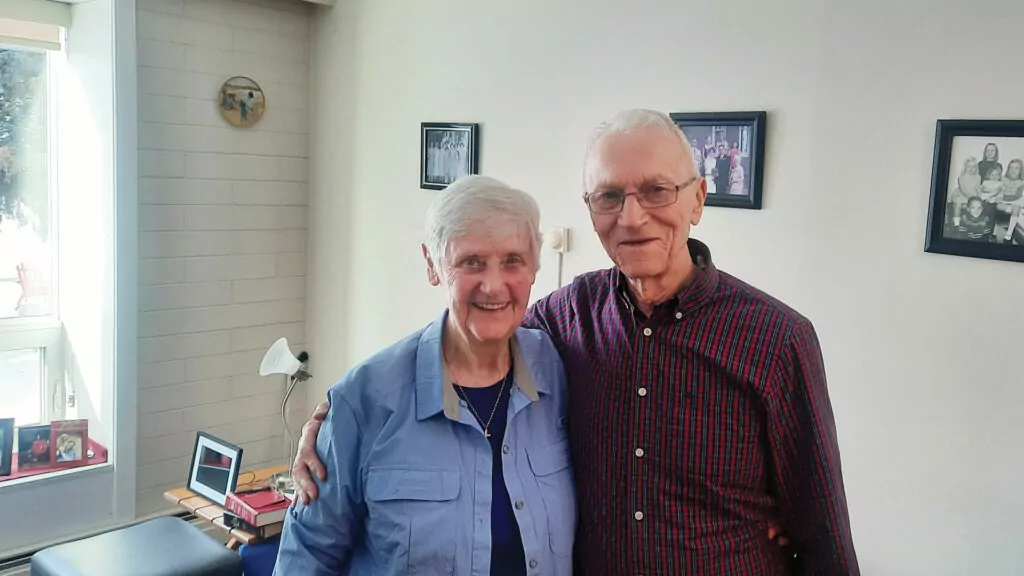
Martin and Christina Veenstra on retirement in your nineties ***** Little did Christina Veenstra know, more than six decades ago, that meeting her future husband, Martin Veenstra, at Reformed Bible Institute would help her preparations for retirement. I recently had the opportunity to interview Christina and Martin, and as she explained, prayer was a part of her life then, and is all the more so now, in her nineties. “I went to Reformed Bible Institute (RBI). I wanted to go into nursing, then, but I didn’t know enough English yet, after three years, so they advised me to take . So I went to RBI and that’s where I met Martin. He was in his first year, and I was in my last year, and for me, it was love at first sight. But he had other plans, and he had other girlfriends, but I prayed for three years. When I was in nurses’ training, I prayed for three years that the Lord would give me Martin. “I was a C student in nursing at RBI, but I always passed everything. But then I did not pass my state boards for nursing, because it was multiple choice, and I still was having some problems with dealing with English, so my mind went blank. So I became a graduate nurse. And after I graduated, I think it was either the same week, or the week after, I got a letter from Martin that we would correspond. Then I knew that’s what the Lord meant me to be, that the husband I prayed for would become my husband.” While we do not always get the spouse that we desire, even when we pray for them, in the grace of God, Christina’s three years of prayer brought her two great spiritual benefits: a partner to pray and serve with, and practice in persistent prayer, which she carries on now in her retirement years. Partners in prayer and service God did see fit to grant Christina the husband who, sixty-three years later, continues to join her in prayer for the people they care most about. Martin: “Now that we’re retired, and we’re both 90, I think that our service is more here , because I don’t drive anymore either. But we do get a ride to church every Sunday. So we talk to people here, the people here who don’t know the Lord. We hope that we can help to mold them, and talk to them at hymn sing.” Christina: “We have a hymn sing every Monday evening. Martin plays the organ, and I more or less lead it. We have 50, sometimes 60 people come, and some of them are not from the church. So we are so happy about that. I pray the Lord that I can sing until the day I die.” Practice for persistent prayer Three years of earnest prayer for a very specific thing is good practice for the life of prayer that is now the focus of Martin and Christina’s retirement. Me: “What do you see right now as your role in your own family?” Martin: “Prayer, and more prayer, and then some more prayer, because we have some grandchildren or great-grandchildren that don’t walk with the Lord. They all love us, and we love them too, but they need the Lord.” Christina: “That’s why I pray every morning for the whole family, every one of them, in the morning.” Me: “What do you think is your greatest challenge in life right now?” Martin: “The greatest challenge is prayer, and just, to live daily for the Lord. And hopefully that somehow, in time, rubs off on our children, that they say, ‘We love the Lord.’” Christina: “The Lord can change the heart. As long as we are alive, we’ll pray for them until the very end. The Lord can change their hearts and lives.” “Living the dream” Of course, a life of prayer is not what our culture sees as ideal “golden years.” Back on May 20, 2000, John Piper told a crowd of 40,000 college students to aim for more than just comfort in their retirement: “I tell you what a tragedy is. I’ll read to you from Reader’s Digest what a tragedy is: ‘Bob and Penny took early retirement from their jobs in the Northeast five years ago when he was 59 and she was 51. Now they live in Punta Gorda, Fla., where they cruise on their 30-foot trawler, play softball and collect shells.’ “That’s a tragedy. And people today are spending billions of dollars to persuade you to embrace that tragic dream. And I get forty minutes to plead with you: don’t buy it. With all my heart I plead with you: don’t buy that dream. The American Dream: a nice house, a nice car, a nice job, a nice family, a nice retirement, collecting shells as the last chapter, before you stand before the Creator of the universe to give an account of what you did: ‘Here it is Lord – my shell collection! And I’ve got a nice swing, and look at my boat!’ “Don’t waste your life; don’t waste it.” Is that “Freedom 55” attitude still around? It seems to be harder to achieve now, but many of those who have the money still want it. Recently, as I was waiting in line at A&W beside an older gentleman, he said that it was good that “we” retired people (I guess I look retired) had plenty of time to kill. So I asked him what a typical day was like for him. He told me that he spent six months every year in Arizona, playing softball and tennis. Living the dream? A counter-cultural daily life Martin and Christina have certainly not bought into that “American dream.” Me: “In what ways are you staying close to the Lord?” Martin: “I love to read Scripture. One thing we learned at Bible school; we fell in love with our Bibles. We love our Bibles; we want to read it more, and I should read more, and now I have the time, so I can. There’s some wonderful things in there that we can know, and remember, and put into practice.” Christina: “I do it in the morning. I’m an early bird. I’m up at five, and Martin gets up at seven, so I have my devotions in the morning.” Martin: “So I read more at night.” Me: “Do you have any things that you share, Bible readings that you share?” Christina: “More or less all day long. If he finds something, then he will tell me, and if I find something in my Bible reading….” Me: “Do you have a list of people that you pray for?” Martin: “Mostly family. We pray for people when we hear about the need, but it changes all the time…” Christina: “And people from the church…” Greatest joy in life So, what is retirement like without the 30-foot boat, the shell collection, or even a driver’s license? For Martin and Christina, it is, even with all the problems of aging, a time of joy: Me: “What is your greatest joy in life now?” Martin: “You raise a wonderful subject. Yesterday we heard about Levi, who is a tax collector who came to know the Lord. He could instantly know the Lord. I think the greatest joy is that we can serve the Lord, and we know that we are His. He made a covenant with us: ‘I am your God, and you are my people,’ and we take that to heart, and believe that, and we rejoice in that. I do think that sometimes there may not be joy enough in this place. We need to dwell on that more. The joy of the Lord is our strength.” Christina: “What is your only comfort in life and death? That I belong with body and soul to my Lord Jesus Christ.” Martin: “I think He strengthens us daily for the walk that we have with Him, and if we want to live with Him, we get reminded of that daily. He wants us, daily, to read the Scriptures, how He loves and cares for us each day….” While Christina needs a walker for her daily walk, because of peripheral neuropathy – ”The outlying nerves don’t like getting old, so they let me know” – she also finds joy in the Scriptures, and the opportunities she has to serve others less formally. Christina: “Over the years, the Bible means more and more to you – how much the Lord means to you. It’s just wonderful. I love this age. You have all the time in the world to be of help, or to read the Bible. When I see somebody that looks a little bit sad, I do encourage them, as much as I can.” Martin: “You want to encourage people as much as you can. When people live in a community, it gets very lonely for people, especially when their spouse dies. So when somebody says, ‘Hi, how are you today?’ – sometimes that’s all it takes.” Christina: “We love it here. We do believe that God put us here….” Unlike Bob and Penny from John Piper’s illustration, who have cause to tremble at their eventual meeting with their Creator, Martin and Christina are not wasting their lives. They are, instead, living in genuine hope in the time that God continues to give them on this earth, as the final Bible passages we discussed show. Me: “Is there a specific Bible passage that lifts you up at this time in your life?” Martin: “Philippians 1: ‘For me to live is Christ; to die is gain.’” Christina: “‘The LORD is my light and my salvation; whom shall I fear? The LORD is the strength of my life.’ (Ps. 27).” Martin: “Or 103 would be a good one: ‘Bless the LORD and forget not all his benefits.’” Christina: “He is in communion all the time.” Interview responses have been lightly edited for brevity and clarity....

Red heart icon with + sign.
Assorted

On the Truth, and the cost of lies

"Remember: one lie does not cost you one truth but the Truth" - Hebbel **** It seems that truth is bendable - it has become elastic during the last decades. People can twist and turn it any which way they want, especially if they have a good lawyer. "Guilty or not guilty?" "Not guilty." "Have you ever been to prison?" "No, this is this is the first time I’ve been caught stealing.’ Surely truth is a question which has plagued mankind for centuries. The question of what, exactly, truth is, has been particularly in the headlines during the last year. There are those times in which we do not speak the truth in order to shield others from something. The Bible records incidents in which people did not speak the truth and two incidents immediately come to mind: the first deals with the protection of the small Jewish babies by the Hebrew midwives (Ex. 1:15-21). The second recounts the hiding of the Jewish spies sent to search out the land for the Israelites (Joshua 2). Incidents such as these remain relevant to the present times. We have only to think of the Second World War during which time many Christians hid Jewish refugees. **** My husband and I had such an incident in our lives as well. It had not nearly the magnitude of life and death to it, but it does illustrate the fact that things are not always black and white. A few years after my husband’s graduation from the Ontario Veterinary College, we had our third child. An aunt of my husband’s, Tante Til, had come over from Holland to help me out for a week or two. She was cheerful, lively and a bastion of cleanliness. We enjoyed having her around. Tante Til had a wonderful sense of humor but she also had a passion for sterilizing whatever came within her reach. Perhaps this was because she mistrusted my husband’s close daily contact with stables and their inhabitants and distrustfully eyed the mud caked to his large rubber boots. Tante Til was “proper” and would never dream of letting a soup bowl function as a cat dish or using her handkerchief to wipe away a cobweb. Tante Til was not extremely fond of animals and the kitten, dubbed “Little Grape” by our two girls, had to stay out of her way. The litter box was vies (dirty), and my husband was delegated the task of cleaning it while I was in the hospital. He gladly did so. We had, I am ashamed to say, acquired the habit of cleaning out the litter box with something I had never found much use for – a silver salad fork – somehow failing to inform Tante Til of this rather disreputable habit. The fork lay in a secluded corner on the kitchen counter. It was a dirty black because I hated cleaning silverware, finding it a useless chore when it would only get dirty again. Besides that, we had lots of stainless steel. One of my first nights home from the hospital, Tante Til cooked us a special dinner - mashed potatoes, vegetables, pork chops, applesauce and salad. It looked and smelled delicious. As we sat down and bibs were tied around the girls’ necks, Tante Til shone with goodwill. "Nou, eet maar lekker, jongens! (Eat hearty, guys!)" We prayed and then began to put the food on our plates. It never hit us until my husband began scooping some lettuce onto his plate. He suddenly realized that he was holding the silver salad litter fork. Only the fork was not holding cat litter but green salad. His second scoop, therefore, hung in mid-air. He caught my eye and I grinned at him. He didn’t grin back. "Good salad, isn’t it, sweetheart?" I said wickedly. "Dank je (Thank you)," Tante Til beamed. "Zal ik jou ook wat geven? (Shall I give you some too?)" "No, thank you," I answered virtuously, "it might give the baby gas." My husband ate around the salad on his plate as Tante Til explained in detail how she had cleaned the fork she had found on the counter and wasn’t it nice and shiny now? "Je moet je zilver wat vaker poetsen hoor, kind (You should polish your silver a little more often, dear.)" She gave me a sidelong glance but smiled tolerantly for wasn’t I a young mother with a great deal to learn? I cannot recall whether or not my husband ate the salad on his plate, but I do know that we never told Tante Til what the salad fork had actually been used for. "I speak truth, not so much as I would, but as much as I dare," said Montaigne. **** Most incidences in daily life, however, call for plain, unadulterated truth - truth you should never shy away from. A number of years ago, during a snow-infested January day, I noticed a car slide to a stop behind a snowbank in front of our house. Our driveway was engorged with snow and I watched to see if the driver of the car would wade her way into it or head for our neighbor’s house. She turned into our driveway. It was a slow process, getting to our door, but it gave me time to put the kettle on, arrange some cookies on a plate and finally, wipe a few hands and noses while giving instructions on good behavior. When I looked through the window again, the woman was only about three quarters way up the driveway. I walked to the door, opened it and smiled a welcome. The woman was small and carried a briefcase. I did not know her. She smiled back and her funny, black hat tilted in the wind. "Why don’t you step in for a minute?" I said, fully confident that this tiny lady was lost and in need of directions and a hot cup of tea to warm her up. "Bad weather." The short, terse statement was carried by a strong voice, albeit a strong voice with a quaver. I nodded, agreeing wholeheartedly. She pulled off her gray, leather gloves and began opening her briefcase in the kitchen. A watchtower tract fell on the ground. I bent simultaneously with her and we almost bumped heads. She reached the pamphlet first and picking it up, held it out towards me. "No, thank you." My words came automatically. The pamphlet quivered. The hand that held it was blue-veined and old. "It’s free," she said, mistaking my refusal to take it with fear of having to pay for it. I shook my head. "I know." She put the tract back into her briefcase. The kettle was boiling and I turned to unplug it. Her voice followed me to the counter. "The world has many problems." My oldest son toddled into the kitchen and smiled at her. I walked past him and said, "It’s a good thing that Jesus Christ came into the world." She nodded, her little hat nodding with her. "Jesus was a good man." I both agreed and disagreed. "He was a good man," I said, "a perfect man, yes, but He was and is also God." She smiled and answered, "How could He be both at the same time?" Shaking her head, she laughed at what appeared to be a foolish and impossible notion. And when I persisted in speaking of the Triune God, she gave up and put her gloves back on while two of my children fingered her briefcase. With her gloved hands she pulled the small, black hat firmer onto her wet, gray hair and then opened the door. The wind blew swirls of snow into the foyer as she stepped back outside. I watched her go, the snow filling in her plodding steps almost as soon as she lifted her feet. And a few minutes later there was no trace to show that she had been by. Pascal said, "Contradiction is not a sign of falsity, nor the lack of contradiction a sign of truth." **** Providentially not only the liars are in the news. The January 30, 1999 issue of World magazine records that a man by the name of Daniel Crocker confessed to murder. Daniel Crocker, who at that time was thirty-eight years old, was sentenced to twenty to sixty years in prison. He will be eligible for parole in ten years. The unusual aspect of Mr. Crocker’s case is that he was living free and easy, with a wife and two children in Chantilly, Virginia. He had committed the murder twenty years previously, smothering a nineteen-year-old girl with a pillow following an attempt to rape her. However, his Christian conscience, following his conversion later in life, would not let him alone. Compelled by the Holy Spirit, he confessed his murder and was consequently tried and convicted. Mr. Crocker and his wife, Nicolette, reportedly were able to pray together twice before the sentencing. Mrs. Crocker said that their two children, Isaac, 6 and Analiese, 9, who were not at the trial, "know what Daddy’s doing is right." Mr. Crocker apologized tearfully to his family "for embarrassing and shaming them" and to the relatives of Tracy Fresquez, his victim. Mr. Crocker submitted, at this point in his life, to the Truth. And that Truth, even though he is a murderer, will set him free. **** According to the NIV Exhaustive concordance, the word truth is used 224 times in the Bible. One of the phrases recurring throughout Jesus’ ministry reads, "I tell you the truth." When the truth of the Bible is compromised, there is no sweet, roundabout way to avoid conflict. Emerson aptly said, "God offers to every mind its choice between truth and repose. Take which you please - you can never have both." Although in this phrase the word choice smacks a bit of arminianism, the fact remains that you cannot have both truth and repose. A lot of people today, however, are convinced that you can have both, never realizing that they have thereby lost their hold on Truth. Although they might agree with Mark Twain’s quote, "Truth is the most valuable thing we have", they subconsciously go one step further with him when he adds, "Let us economize on it." But there is no way to economize on the Truth of creation; there is no way to economize on the Truth of headship; there is no way to economize on the Truth of God’s judgment on homosexuality; and there is no way to economize on the Truth of being servants of one another in love and compassion. Because to economize on one principle does not cost merely one truth but the Truth. And only if you believe this Truth in your heart and confess this Truth with your mouth, shall you be saved. This is an abridged version of an article - "Remember: one lie does not cost you one truth but the Truth" - that first appeared in the June 1999 edition of Reformed Perspective....

Red heart icon with + sign.
Assorted

Why write?

You might not make a lot of money writing, but you can have an impact ***** It’s been said that all that is needed to become a writer is the strong desire to say something. Writing is simply taking your thoughts and research and organizing them on paper, or in your computer, or on your blog, to prove a point or tell a story. It may soothe someone’s soul, clear up a dispute, record family history, challenge someone to live a more godly life, or simply brighten a person’s day with humor or appreciation. This issue marks the 20th anniversary of my first article in Reformed Perspective, and over the years I’ve had people ask me how they could get started in writing. Sometimes what they mean is, “How can I make money off of writing?” and the short answer is, that probably isn’t a good motivation to write… at least not for most of us. I heard at a Christian writers' conference that with most books you might only make about a dollar off each one, so unless someone famous promotes your book, you won’t earn much. Magazines pay a bit, and if you can get into one with a larger circulation, it will pay more. Newspapers may take articles on a volunteer basis, or give you $25 (for the 6 hours you spent on it!). But getting paid is only one reason for honing your writing ability. In her book The Hidden Art of Homemaking, Edith Schaeffer shared that she thought there was all sorts of “art found in the ordinary areas of everyday life.” “Each person has, I believe, some talent which is unfulfilled in some hidden area of his being – a talent which could be expressed and developed.” Schaeffer pointed out that the ability to write ought to be used to express our creativity and/or to bless others, and not just considered as a way to possibly earn money. She gave many examples of how one might use writing in daily life, such as letters of appreciation, explanation or persuasion; poems, anecdotes, adventure, humor, family history, or stories given as a gift. Writing also helps the writers themselves organize their thoughts and process their feelings – as one best-selling author put it, “I write to find out what I think.” This is true of journaling and of writing fiction, as it can aid you in processing your own thoughts and emotions through your characters. So how did I get started? Let me outline how it has progressed for me. Writing just for fun I discovered in grade school that I enjoyed writing. In 5th grade I wrote 50 stories in 6 weeks to earn an A, and a funny poem in 6th grade that was well-received by my classmates. In high school I found essays very easy to write. However, when I got to college, my previous attempts were deemed "average" and I was challenged to improve. My professor said, "Somebody has to write the books and tracts and magazine articles – why not you?" I kept that advice in mind over the years. When I taught English Grammar and Composition for 5 years, I honed my abilities while seeking to inspire my students as I had been inspired. My interest in writing didn't stop when I got married and had 6 kids. I found opportunities to write for various company and club newsletters for free. I wrote occasional poems for family members, and composed songs for my children. I wrote Sunday School lessons for little children. I also wrote a letter to the sellers of a house we dearly wanted to purchase – and that letter caused us to win the bid! I wrote three articles for free for our local newspaper, which turned out to be good listable experience on my résumé since the articles were posted online. I also attended Christian writers' conferences. These seminars provided advice, encouragement, and connections with seasoned writers and publishers. One thing led to another We cannot know what we might do that will lead us to something else. As far as paid writing goes, here is how my journey has progressed: In 2005, with high hopes, I sent an article to Reformed Perspective. After improvements, my first and second articles were published. Then I was on a roll, tackling numerous topics for my own column, entitled "Soup and Buns." An article about those earlier Sunday School lessons that I had written with a friend, led to an Orthodox Presbyterian Church in California hiring me to write a 2-year curriculum entitled “Bible Overview for Young Children” with matching topics for ages 2-6 and 6-9. Copies have been sold to churches, families, and Ladies' Bible Study groups and given to missionaries. In 2009, I published a book, a collection of Reformed Perspective articles, entitled Soup and Buns: Nourishment from God's Word for Your Daily Struggles. From 2010 to 2013 I began writing SEO (Search Engine Optimization) paragraphs for clients' websites. Each paragraph of 350-500 words paid from $3 to $9 each. I found the opportunities through Upwork.com and wrote about everything from credit cards to chicken recipes. After a month using Upwork.com, I bid on three requests for community newsletter articles in small towns about an hour away. Note: those freebie newspaper articles I wrote a few years back were the proof to this new company that I knew how to write. They got me the job! One thing led to another, and soon I was invited to apply for a full-time position as their Publication Manager. I have continued to write for Reformed Perspective, and occasionally for Una Sancta (a Free Reformed Churches of Australia publication) and New Horizons (the OPC denominational magazine). I have a new book entitled Life and Breath and Everything which contains over 50 articles first published between 2010 and 2024. Encouragement The best writing teacher I ever encountered assigned numerous projects to her 7th graders, and graded them only on content. She wanted them to express, explain, or exult, not be exasperated! Each student then chose their favorite 3 projects and cleaned up all the grammar and punctuation in them for their final grade. If you had a teacher that frightened you away from writing by marking you down for each misplaced comma and word on every project, don't think that you cannot write. Write. Express yourself! If someone else is going to see it, fix it up before you deliver it. Very rarely is a first draft perfect. Conclusion In Ecclesiastes 9:10, we read, "Whatever your hand finds to do, do it with all your might." Schaeffer's book applies this to writing, but also to other forms of creativity, such as sketching, painting, cooking, gardening, or music. We all have God-given skills that can be used in our daily lives. The important thing is to start doing it, and then see where one thing might lead to another. Sharon's new book “Life and Breath and Everything” is available on Amazon.com and Amazon.ca. Her first book “Soup and Buns” and her “Bible Overview for Young Children” are available by contacting her at [email protected]....

Red heart icon with + sign.
Assorted

A New Atheist loves that old time Religion

In 2007, four now fairly famous atheists – Christopher Hitchens, Daniel Dennett, Sam Harris, and Richard Dawkins – met to discuss their views. They filmed the discussion, titled it “The Four Horseman,” and when it went viral, they became known as the “Four Horseman of New Atheism.” The name of their group was ironic, since they certainly had no interest in the book of Revelation, in which four horsemen bring God’s judgment on the rebellious world; however, it was also fitting, since the Four Horsemen of Revelation are destructive, as are the New Atheists. Even they seemed to understand the destructive nature of their godless stance. Daniel Dennett saw Darwinism’s Dangerous Idea (the title of his 1995 book) as “a universal acid" that would eat through whatever it came into contact with. The despair of our current culture supports that, though in a way that Dennett did not intend. Cultural Christian? Of these “horsemen” the most famous today is Richard Dawkins, who is best known for his book The God Delusion. His prominence is partly because he is one of only two still living: Christopher Hitchens died in 2011, and Daniel Dennett died just this past April. But Dawkins’ fame is also because he has repeatedly made news for embracing aspects of the very Christianity he’s made his name attacking. And God has allowed Dawkins to live long enough to see some of the impact of his own form of atheistic evangelism, so that the lead horseman could begin to understand the destructiveness of his godless stance. This past year, in an interview with journalist Rachel Johnson, Dawkins declared that he “was slightly horrified to hear that Ramadan was being promoted instead” of Easter, because: “ culturally a Christian country. I call myself a cultural Christian. I’m not a believer.” Dawkins noted that “there is a distinction between being a believing Christian and being a cultural Christian.” But as British evangelist Glen Scrivener noted, Dawkins has maintained his “cultural” Christianity for quite a while now. Dawkins offered to read a chapter of the King James Bible for the Bible Society during the 400-year anniversary of the publication of the KJV back in 2011. Dawkins wasn’t paying tribute to the truth of God’s Word – he was only expressing a “historical interest” in the KJV, equating it to a similar appreciation for Richard Wagner and the Greek gods, since all three give us a better understanding of English literature. He also said that “it is important that religion should not be allowed to hijack this cultural resource.” Scrivener also noted that in 2018, Dawkins tweeted a picture of himself with the following caption: “Listening to the lovely bells of Winchester, one of our great mediaeval cathedrals. So much nicer than the aggressive-sounding ‘Allahu Akhbar.’ Or is that just my cultural upbringing speaking?” Dawkins was more pointed in his 2024 interview with Rachel Johnson. He said: “I love hymns and Christmas carols. I sort of feel at home in the Christian ethos. I feel that we are a Christian country in that sense,” And later in the interview he added: “Christianity is a fundamentally decent religion.” Comparing the treatment of women and homosexuals in both religions, Dawkins admitted that Christianity’s treatment of all people, whatever their sex or sin, is fundamentally more decent than that of Islam. But he still cannot, or will not, acknowledge why it is more decent. And that why is rooted in Christianity's working out of the truth of Genesis 1: that all people are created in the image of God. There is no fruit without the root Glenn Scrivener makes a great point about Dawkins’ inconsistent positions: he said that Dawkins is like the birds pecking at the seeds of the gospel in Jesus’ Parable of the Sower (Matt. 13:1-8). You can see such pecking in his Easter conversation with Rachel Johnson. He kept pecking at her own limited faith, asking, repeatedly, whether she herself believed in the virgin birth or the resurrection of Jesus Christ (she could only reply that she’d like to believe it). Scrivener says that Dawkins wants the fruits of Christianity without the root that brought it into being. He makes a connection to a later parable in the same chapter: the Parable of the Mustard Seed where a giant tree grew out of a small seed (Matt. 13:31-32), and suggests that Dawkins is one of the birds that is allowed to perch in the branches, enjoying the earthly fruits of God’s kingdom, even while he saws at the root of the tree. Every knee shall bow (Phil. 2:10) So what is the good news in Dawkins’ claims of cultural Christianity, even as he continues to deny the objective truth of Christianity? Let’s go back to the first Horseman we looked at: Daniel Dennett, who saw evolution – Darwin’s dangerous idea – as the acid that would transform everything it came into contact with. Dawkins has been admitting the terrible truth of Dennett’s boast. Evolution’s attack on the root of Christianity has left the West vulnerable to false gods, like Allah and trans ideology – two things that horrify Dawkins. Dawkins’ confused, but stubborn and hostile, attitude toward Christ shows the truth of Galatians 6:7-8: “Do not be deceived: God is not mocked, for whatever one sows, that will he also reap. For the one who sows to his own flesh will from the flesh reap corruption, but the one who sows to the Spirit will from the Spirit reap eternal life.” And some people have, unexpectedly, been brought by the Spirit to begin sowing to the Spirit. For instance, Ayaan Hirsi Ali, who first embraced atheism in her rejection of her Muslim upbringing, has seen, like Dawkins, how the New Atheism helped open up the West to destructive gods, and how atheism had nothing to counter them. She has been brought to acknowledge both the fruit and the root of Christianity – Christ himself – and in a conversation with Dawkins, opened him up to at least admit that the existence of God is “a dramatic important idea.” The good news is that the lead horseman has to acknowledge that what he and his friends have been sowing – the wind – is reaping the whirlwind. Even better, that whirlwind is preparing some to be blown over by the wind of the Spirit that Jesus tells Nicodemus about (John 3:8). In that way, willingly or unwillingly, they already have to fulfill the truth of Philippians 2:10, and bend the knee before the King....

Red heart icon with + sign.
Assorted

RP’s guide to “adulting” – our top articles to help you gain the skills to feel grown up

Young people nowadays feel more anxious and overwhelmed about the future than ever. There are several reasons for this– a relentless onslaught of bad news in the media, the rising cost of living and the overcomplexity of our modern world, and our safety culture that restricts children from practicing independence when young. It’s telling that “adulting” has become a verb, that we feel a need to describe the actions adults take as a skill young people struggle to learn. In the past, young people had a more defined roadmap, and the community surrounding them guided them as they began to take their first steps into the big world. Young people today still can use that guidance from our elders who have navigated this before! That’s why we created this list of articles we have published in the past that offers guidance on different areas of life that young people face. Just click on each title to go to the linked article. Use this guide as a bit of a “roadmap” of options. SHOULD YOU GO TO POSTSECONDARY? We did a whole issue on this topic that’s also worth checking out. I’m graduating – Now what? – Graduating from high school can be a big crossroads – from that point on, your path isn’t so clear. You need to make a choice about the next steps, and here's some advice on how to decide what to do next once you've graduated high school. Thriving at a non-Christian university? – There are many choices of universities, but if you're thinking of attending a secular university, here's some advice! What about a Christian university? – Christian universities aren’t always perfect, but there are some benefits! If you're considering a Christian university, this article has advice for that. Podcasts to get you educated, not schooled – Formal schooling is not the only option for getting educated. Here are some options to learn even if you decide not to go to college or university. Learning can be lifelong, and is not limited to university! CHOOSING A CAREER Having trouble choosing a career? No one can tell you what you should do for work, of course, but it can help to get some insight into what a particular career is like. Your own path in a career will be different, but it’s still helpful to hear from the inside about what others have found. Here are some of the careers we’ve covered in the past, and what it’s like to be a Reformed Christian in these fields. Teacher: Paul Bartels: from carpenter to high school shop teacher Journalist: 87 – The Need for Redeeming Canadian Journalism – Alexandra Ellison (Real Talk Podcast) Comedian: Comedy as a calling Artist: Reformed Perspective has a series of interviews with artists to check out Illustrator: Stephanie Vanderpol has a zoologist in the house Book Publisher/Seller: Albert van der Heide’s passion for print Lawyer: Albertos Polizogopoulos: lawyer for the Lord Entrepreneur: What does a Reformed entrepreneur look like? Homemaker: “Homemaking is the ultimate career” – C.S. Lewis (sort of) MARRIAGE Marriage rates are declining worldwide, and yet many young people desire that loving, secure, lifelong partner in life. It’s just not that easy to find a good match! Here are some articles we’ve published to guide you along the way. How to get married younger – The trend is to get married later in life. But getting married is a worthy aspiration. If you want to get married younger, here’s some advice on how to do it. How I married your grandmother: dating advice for a young man – Sometimes it’s helpful to hear how someone else “did it,” so here’s a personal reflection on exactly how one young man found his wife. Obstacles and roadblocks to having children – Many of us desire to have children, but it’s not always as simple as wanting to have them. First, of course, you have to find someone to get married to. But even then, challenges and obstacles can come up. Here’s some encouragement that children really can be a blessing. BUYING A HOME Home ownership is one of the major things that feels out of reach for young people. It's harder than it used to be, but here are some tips on different ways to reach this goal. Home ownership for Christians: how it happened in the past, and how it might now Tiny home contentment FINANCES A common question is, why didn’t I learn more about finances in school? This is a gigantic topic that is important to learn about! However, a lot of advice depends on your situation and your goals. That said, we’ve covered some general financial topics before, and we encourage you to keep learning about this area. Frugalship: 37 ways to save a buck – on being frugal On investing, with Wade Van Bostelen …but I have a couch – on hospitality FINDING MEANING IN LIFE As Christians, we know the meaning of life, but there can be a difference between knowing in our head and feeling it in our hearts. A big part of growing up is figuring out what’s the “point” of everything we do, and how we as individuals fit into the big picture. Here are some links on finding that meaning and putting it into practice. How to live your best life: knowing, and participating in, the greatest (true) story C.S. Lewis on real happiness and real Christianity CONCLUSION No one can give you a complete roadmap for exactly what you should do with your life, but hopefully the perspectives offered in these articles help you through making decisions. Growing up can look daunting at times, but shouldering the responsibility of living well, and learning to use the gifts God has given you, is a worthwhile and fulfilling journey to take....

Red heart icon with + sign.
Assorted

Lost and found: God’s guiding hand in seeking and finding a missing girl

Just before going to bed on a Thursday evening in mid-September, Michelle Dykstra read a Facebook post by a mother whose six-year-old daughter had gone missing. Earlier that evening, around 6 pm, Oaklynn Schweder had disappeared from her home on the Skin Tyee Reserve, an isolated community in northwest BC. Her mother, Gail Skin, shared the devastating news on social media as the RCMP called in a canine team to help find her. “I felt for her, because she is only six” recalled Michelle, a mother of three who lives just outside of Houston, BC. “I couldn’t sleep very much that night.” Not only is Oaklynn young, she is on the autism spectrum and is non-verbal. To make it even more challenging for searchers, she would sometimes hide in unusual places or up in trees. Adding to the urgency, nighttime temperatures around Oaklynn’s home dip below zero, and the surrounding wilderness teems with wildlife, including bears and wolves. Oaklynn was still missing the next morning, and the updates kept coming back negative. Search and Rescue teams throughout British Columbia joined in, along with the Canadian Rangers and the BC Wildfire Service. In addition to specially trained dogs, the RCMP deployed thermal-imaging drones to try to spot Oaklynn’s heat signature in among the trees. As more help was brought in, media outlets from across the country picked up the story of the missing Indigenous girl. Heart for the lost Unable to stop thinking and praying about Oaklynn, that evening Michelle talked to her husband Tim about whether they could help. They had never been involved in a search before, but they lived just a couple of hours away and felt a strong pull to do something for Oaklynn. “I really did feel like it was definitely put on my heart” Michelle reflected. Saturday wasn’t possible because Tim and their son Owen had to work all day, but they decided that if she was still missing Sunday, and if the search and rescue teams were open to volunteers, they would go out to help (even though they don’t normally miss church). In spite of a team that grew to 600 searchers carefully sweeping the area, by Sunday morning Oaklynn was still missing. The searchers were professionally coordinated, using GPS plotting to ensure every part of the land was covered. By this time, hopes of finding Oaklynn alive were diminishing. Michelle was restless and eager to start searching. They filled a vehicle with Tim, Michelle, their children Owen and Morgan, along with Tim’s sister Mandy Jaswal and her two sons Mica and Carson. Providential frustrations In spite of their eagerness to help, they were frustrated by one snag after another. A forgotten coat resulted in a short delay, which resulted in a missed bus ride, which in turn resulted in a missed ferry across Francois Lake. By the time they got to the search area, they missed the team that headed into the bush and had to wait to be called. They spent the next three and a half hours eating bannock, drinking coffee, visiting, and helping out with things like hauling groceries to the search teams. And then a search coordinator passed their group over, as he was concerned that they weren’t experienced enough for the bush. It was afternoon when they were finally called to search, and they were put under the lead of Glen Franz, a search and rescue volunteer from their home town. Two volunteer firefighters also joined their group. In their designated search area, they were to walk 5 meters apart from each other back and forth, to cover a grid over the land. Only ten minutes in, they hit another snag. The search leader was having trouble finding his location on the map and realized that they had started in the wrong place on their quadrant. By this time, they decided to keep searching from where they were, in the hope of going back later in the day to get the area they missed. The problems didn’t stop there. The devices that the search and rescue team was relying on to chart their progress had almost run out of battery. And there were strong winds gusting, with trees falling regularly. It wasn’t until later that day that they began to see that all of these worries and frustrations were actually the means by which God was guiding them exactly to where they needed to be at just the right time. Calming the wind Although dogs, GPS devices, helicopters, drones, and about 1,400 searchers were all devoted to the singular goal of finding Oaklynn, Michelle turned to another “tactic” – going to God. “I remember walking through the bush just praying, ‘Bring her out! Just show her to anybody. We've got hundreds of people out here. If she's hiding, just bring her out.’” As they walked, they saw bear signs everywhere. Tim shared that some searchers even had to climb into bear dens to look for Oaklynn. Although they at first felt they might turn around a corner and just find her, after hours of searching it sunk in to Mandy that: “the only way that a kid is going to be out here, especially since she is only wearing socks and a t-shirt…is if an animal dragged her over here…. Your brain just goes somewhere else to try and prevent you from the pain of thinking of that.” At 6 pm the organizers informed the searchers that it was time to call it a day and head back to the base. They were only half done their search area when it was shared that their GPS search devices were almost out of battery. They were given the option to end their search. Mandy reminded the group that they still needed to go back to the corner where they were supposed to have started. She insisted that they search there so it wasn’t missed. The group agreed, but they also discovered it was the most challenging land in their area, with a steep gully and a lot of trees blown over that weren’t easy to cross. Recent rain made it all very slippery. “We all went up to the top of that gully,” Michelle said, “just so that we could all get together and then leave.” Given that it wasn’t dark yet, the group wondered if Oaklynn had been located. “The thought came to my mind that maybe they had found a body,” said Michelle. They later learned that the search was called because of the strong winds and the danger that falling trees posed to the searchers. Michelle carrying Oaklynn out of the forest, with the team assisting Then, for just two or three seconds, everything got quiet – the static on the radio stopped, and the wind fell silent. As Mandy explained, “All of a sudden were like, ‘Did you hear that? We heard something, Mom, it sounded like a kid!’” The others listened too, hoping it wasn't just an animal. When they heard the noise again they all started calling Oaklynn’s name. That’s when they heard a response coming from the bottom of the gully. They all heard it. None of the adults remember climbing down the gully, even though it had just been a major chore to climb through it. They said it felt like they were transported there. “I just kept hearing ‘I see her, I see her,’ and I couldn't see her till the last second,” recalled Michelle. “So I just kept running. I could not see her until I got around this bunch of trees, and then all of a sudden there was that log, and she was standing behind it, and then she sees me, so she took a couple steps, and I'm full on running, and I just grabbed her and then sat down on the log. It was like, what just happened? What happened?” While Michelle held the little girl, the others rubbed her feet to warm her up, checked her for injuries, got her some warm clothes, and gave her something to drink. They were amazed to find that, other than looking dehydrated, being covered in berries and grime, and smelling like urine, she looked to be completely unharmed. Tim described the occasion as joy all around. Michelle kept saying “thank you Lord!” Their team leader used his radio to report “subject found,” to the disbelief of those at base camp. And then Michelle proceeded to singlehandedly pack Oaklynn through the forest, with the rest of the team holding back branches and helping her over trees. They were so close to the base camp that they could even hear the cheer of the crowd when they were told that Oaklynn had been found and was okay. Just twenty minutes later and they were back to where her mother and father were anxiously waiting. The mom’s reunion with Oaklynn was caught on video and has been viewed on Facebook over 3 million times, in addition to the TV reports that used the footage around the world. But what wasn’t captured was Michelle and the team that God providentially used to find Oaklynn. Recognizing Providence As Tim, Michelle, Mandy, and their children recounted the day’s events, they kept coming back to the same conclusion: God was orchestrating every detail, even the mistakes and frustrations, to allow for the joyful reunion of Oaklynn and her loved ones. If they had started searching where they were supposed, to, they likely wouldn’t have found her because she was moving steadily and wasn’t even in their search area when they actually found her. They also thank God for the young ears of their children, who were the first to hear Oaklynn, even though she couldn’t speak and even though she was more than 100 meters away. Likewise, they praise God for calming the wind and radios so that they could hear her voice. “So all these little glitches, all these little things, all the little breaks, all the perfect timing up to the point of the wind stopping. Like, Who stops the wind?” asked Mandy. “It's obvious, right?” Confessing Providence The previous Saturday, when Michelle was still at home folding laundry and thinking about Oaklynn, she recalled how so many Christians athletes who competed in the Summer Olympics used their platform to give glory to God. “I was thinking, if there’s any chance, I would make sure I would glorify God, right? Because you’ve got to do that.” The day after Oaklynn was found they were invited to a feast organized by the local Indigenous band to thank the many people involved in the search. There was singing, drumming, and speeches, including a mix of traditional native spirituality and Christianity. “The person at the mic asked ‘Does anybody else want to say anything?’” recalled Michelle. “And everybody else is quiet. And then all of a sudden, I'm like, ‘Wait, no, I do. I have to say something.’” Although she is fearful of public speaking, she took the opportunity to share with everyone that it was God who orchestrated all of this. She recalled how she had prayed while searching, and how God directed everything to work together so that Oaklynn was found. Her testimony was shared on Facebook live, and part of it was quoted in their local newspaper. Rejoicing and weeping In Matthew 18, Jesus shares a story of a man with a hundred sheep, one of which goes astray. When he finds it “he rejoices over it more than over the ninety-nine that never went astray.” The searchers shared how vehicles were honking on the ferry ride as they returned from the search, and how they received numerous texts and messages of joy over the news that Oaklynn had been found. Although their children slept well that night, Michelle and Mandy shared how they both had a hard time sleeping, and experienced their share of tears in the days following. By Wednesday, Michelle was back to doing laundry. “I find the sweater that I was wearing, and I pick it up, and it was just this strong smell of pee, like urine, and I just start crying like crazy. I completely broke down.” Later, she went “to bring laundry from the washer to the dryer, and I find the sweater again, and it doesn't smell like pee, and I'm crying again, and it's just a complete mess.” The group admitted they had a hard time in the following days, feeling like a piece of them was missing, since they put their heart out for Oaklynn and now she is back with her parents and doesn’t even know who they are. In many ways, that is exactly what love is. Photos by Mica and Mandy Jaswal....

Red heart icon with + sign.
Assorted

The quickening

"The great mass of this bleary-eyed world can see nothing of the ineffable glories of Immanuel. He stands before them without form or comeliness, a root out of dry ground, rejected by the vain and despised by the proud. Only where the Spirit has touched the eye with eye-salve, quickened the heart with divine life, and educated the soul to a heavenly taste, only there is He understood.” – Charles Spurgeon **** Solving vexations, conundrums, predicaments, heartaches, questions, challenges, dilemmas, mysteries and, in short, anything, is hopeless and impossible unless there is a hunger and a thirst within a spirit for righteousness. This hunger and thirst is not fathered by the human heart. This hunger and thirst is created by God. **** The bird feeder area was literally teeming with birds. It had been a long, hard winter and food was difficult to find; the feeding station provided an oasis. Tiffany stood by the windowed patio door and smiled at the little bodies strutting about while pecking at the seed. Sparrows, nuthatches, juncos, and robins mingled freely on the lawn. What pretty individual names they bore. Adam had chosen well. Of course, he had not spoken English. Probably the many different species of birds had been given individual names over time. She smiled to herself and considered that although her generic name was Woman, because she had been taken out of Man, her personal and unique name was Tiffany. Her mother had not really given her a reason as to why she had been named Tiffany. "I don't know, child," she had said, "I think I just liked the sound of Tiffany. Or maybe I read it somewhere. I just don't know." Several sparrows burst out into chirping. Were they alarmed by some hawk flying over? She searched out the sky, pressing her nose against the window pane. Or were the little birds perhaps arguing about why their name was sparrow and not flitterwing? There had been various times in her own life, times during which she had pondered the significance of her name, stages of discussing with her parents as to why they had not named her Johanna, after her paternal grandmother, or Helen, after her maternal grandmother. It had a curious dictionary meaning – the name Tiffany. It meant sheer fabric. Eventually, when she was a teenager, rapidly approaching adulthood, she was reconciled to the rationale that her father held out to her. “It doesn't really matter, does it, Tiffany? When people hear your name, they should automatically think of what you do, of what you stand for, and how you speak. After all, your name ought to signify the reputation you give it. So be careful about what you say and do. That's what it comes down to.” Tiffany smiled at her reflection before moving back from the window. She remembered Dad's words very clearly. And she also remembered Psalm 139. “For You formed my inward parts; You knitted me together in my mother's womb. I praise You, for I am fearfully and wonderfully made. Wonderful are Your works; my soul knows it very well. My frame was not hidden from You, when I was being made in secret, intricately woven in the depths of the earth.” Surely a fabric, a sheer fabric, such as her name denoted, was precious to think on as being woven together by God. It was an intimate thought, between God and herself, and it was a thought that made her feel special and whole. **** She and Evan had been careful when they had named their children. Their oldest, a boy, had been baptized John, meaning “God is gracious;” the second, Noah, had “rest and repose” affixed to his person. They had frequently spoken to both boys about the meaning of their names. Both John and Noah had been fascinated. Their names had cultivated their identities. Like a gift that could be unwrapped over and again, the truth was that the bestowal of a good name was better than giving a child riches. Their third child, a daughter, had been a wee, tiny thing when she was born. A total surprise, born a good seven years after Noah, this baby had been considered an added sweetness by Evan and herself. She was an extra joy, which was why the name they had chosen for her was Joy. She was now married and had a family of her own. Tiffany sighed. Time went by fast, inexplicably fast. Leaving her place by the window, Tiffany walked through the dining room to the kitchen. The counter was still cluttered with washed breakfast dishes which she had not, as yet, put away. Absently, she took her place in front of the sink, picked up a dish rag and began wiping a spot that needed no cleaning at all. Painfully aware of what made her so reflective and philosophical, she fought the desire to put on her coat, to escape outside and take the car for a long drive out into the country. If she did that, she would not have to wait for the doctor's phone call; if she did that, she would not have to hear the results of her recent lab tests. Even as she doggedly continued to wipe the counter, she fought a rising compulsion to leave. There was no appetite in her at all to digest the knowledge that the doctor might impart. A terrible dread encompassed her that after his phone call this morning nothing would ever be the same again. A fly landed on the counter and she swatted at it with her dish rag. In the middle of her third swat, the phone rang. Startled, Tiffany froze for a moment. She waited for the fourth ring before she finally walked back through the open kitchen door to the diningroom. The phone, large and black, stood on the table. Hesitantly, she picked up the receiver. "Hello." "Hi, Mom." "Joy?" "Yup, it's me. Your one and only daughter. How are you, Mom?" Tiffany's left hand fiddled with the telephone cord. Then she took a deep breath before she answered, "Oh, I'm fine, sweetheart." There was no need, no need at all, she thought, to worry this child, or the others, when there was really nothing to tell. Not yet, anyway. "Listen, Mom, Rob and I thought we might drive up for a visit this weekend, maybe from Friday night until Monday morning. That is, if a visit suits you and Dad." Joy's voice still sounded just like it had when she was a little girl. "Sure, honey. That's fine. We'll look forward to that. I'll have Dad take the playpen out of the shed and the crib's still up in the spare bedroom." "Thanks, Mom. I was hoping it would work out. For some reason, I've missed seeing you guys so much the last few days. Also, and I admit it freely, I really, really want to see how the addition to the house is coming along. Rob and I are so excited about it! But I have to go now. This is a middle-of-the-day call and Rob always tells me to wait until the evening when the rates are lower. But I just had this sudden impulse to call and ask you if we could come and I just wanted to hear your voice." "OK, honey and I'm happy to hear your voice too." Tiffany smiled at the telephone cord which she was crumpling in her left hand. Joy was impetuous, as impetuous as she had been when she was six and had asked the mailman over for supper because she supposed that he looked lonely. "Bye, Mom. See you soon. Suppertime Friday?" "That'll be fine, Joy. Bye, honey." "Bye, Mom. I love you." "I love you too, sweetheart." Tiffany hung up the receiver slowly, and drifted back to the glass patio door. They had begun construction for an addition to the house. She viewed the cluttered backyard with some misgiving. Evan and she had talked about putting on the addition for weeks before finally coming to the decision that it was the right thing to do. However, Noah... She turned abruptly and slowly meandered back to the table, remembering that Joy and Rob might not be the only ones visiting this weekend. Noah and Amy had mentioned that they might drop by on Sunday afternoon. Noah did not approve of the addition. Noah did not approve of Joy any longer either. The remembrance of it fell on her like a shadow and a hard knot gathered in the pit of her stomach. Should she call back and ask Joy to wait – to come another weekend? The phone rang again. This time her hand was on the receiver before it finished its first ring. Somehow she had expected to hear Joy's voice again, but this time it was the doctor. "Tiffany?" "Yes. Dr. Brewster?" Her voice was hoarse. Dr. Brewster wasted no time. "Tiffany, I'm sorry, but the results of your lab tests were not good." "Cancer?" She barely had the breath to push the word out. Behind her, in the kitchen, Toby, the dog, moved about in his woven, wooden basket. The creaks interrupted the doctor's reply. "Yes, but I don't want you to panic." His voice was impersonal, calm and professional. "If you have to have cancer," he went on calmly, "the uterus is not such a bad place to have it in the beginning stages. And that's what I think the lab results show – that you are in the beginning stages of uterine cancer." "So what do I do?" Tiffany felt helpless, hopeless, and tremendously lonely all at the same time. She had not even told Evan about this doctor's appointment. It had, after all, only been a routine appointment, an ordinary appointment. However, Dr. Brewster's insistence on lab work after her last physical had made her nervous, had put a barbed wire fence around the appointment. It had seemed to her that telling Evan would unnecessarily emphasize the possibility that something might be wrong. And she had not wanted to consider that possibility. "Well, Tiffany," Dr. Brewster's voice bruised her ear, "I would suggest a hysterectomy as soon as possible to be your best option. How quickly would you be able to arrange to check into the hospital? The earliest possible arrangement I would be able to make for you would be next week Tuesday or Wednesday. Is that too fast for you and Evan to come to grips with the idea?" "No, that would be fine." What was she saying? What was happening here? Just a few moments ago she had been watching sparrows, and chatting with Joy. "Good." Dr. Brewster's voice was competent, almost chipper as he went on. "Well, keep your chin up. I'll go ahead and book you in for next Wednesday. Just count on the fact that you'll probably have to check into the hospital on Tuesday evening." Tiffany swallowed. There was a lump in her throat and words would not come. "I know this is difficult to take in, Tiffany," Dr. Brewster's voice suddenly became more sympathetic, "it's all rather sudden, isn't it? So, if you have any questions, don't hesitate to call me back. My nurse will call and confirm all these things and will also let you know this week what you may or may not eat prior to checking in." "All right." Tiffany's whisper was barely audible. "Bye, Tiffany." "Goodbye." Woodenly leaning her left hand on the diningroom table, Tiffany's right hand still clutched the receiver. Laboriously she placed the phone back on the hook. She had always loved the Romans 8:28 text. The recitation of it came easily. And we know that for those who love God all things – all things – work together for good, for those who are called according to his purpose. It rolled off her tongue smoothly, effortlessly. She had always accepted it as totally true, absolutely true – for everyone else. But now she had to apply it to herself. Now she had to say and believe that cancer would work for her good. Now she had to acknowledge that cancer would surely build a closer relationship with the Lord. But she was quite satisfied with the relationship she had with Him presently. "Oh, Lord!" she moaned, and again, "Oh, Lord! Slowly inching over, she sat down on one of the leather-backed table chairs. Then she slumped forward, dropping her hands at her sides, shivering as she did so. Feeling the hard wood on her face underneath the tablecloth was not exactly the most comfortable position. But the tablecloth had belonged to her Mom and right now she longed for her Mom and for her Dad and for Evan. She sobbed, first softly but then the whimpers spilled over into great wails of such an anguished nature that the dog got up from his basket in the kitchen and trotted over. Sitting down at her side, he began licking her left hand, whining as he did so. Eventually, Tiffany stopped keening. She was totally depleted, weary in both body and soul. It came to her that Janice Edgar had died of uterine cancer. Janice had been a strong Christian, often testifying in front of the church, often speaking at women's groups, that God's grace sustained her. Would she be able to do that too? Janice Edgar had been dead for almost fifteen years now. Sitting up in slow motion, Tiffany reached for the hanky in her skirt pocket. Blowing her nose and wiping her face, she contemplated the shades of red in the tablecloth. Mom had also died of cancer, of breast cancer, seven years ago. Mom was in heaven now and so was Dad. “What is your only comfort in life and death?” Tiffany could see her father, grey hair unruly and ruffled, teaching catechism to a room full of teenagers. He had boomed out the answer himself. “That I, with body and soul, both in life and death, am not my own, but belong to my faithful Savior Jesus Christ." And his fist had hit the table at the word “belong.” All the catechism students had jumped, herself included. Tiffany blew her nose again, and her thoughts shifted back to Joy. Joy was a teller of tales and Joy was coming home this weekend. How often, Tiffany recalled, had she not been glad at that six-word phrase, Joy is coming home this weekend. After graduating from a journalism program and accepting a job at a newspaper, Joy had left home. Regularly sent overseas on assignments, the child had a drive to speak the truth and had an amazing ability to weave words together. She was a stitcher of stories. Joy was a writer, a writer like her Dad had been. Tiffany shook her head sluggishly. Writing was an ability she herself did not possess. No, as a matter of fact, stuttering came easily and her heartrate accelerated considerably whenever she was called upon to say something. She continued gazing down at the tablecloth. How often had they not, the five of them, Evan, John, Noah, Joy and herself, sat around this table? How often would it still happen? **** Joy and husband Rob, and their children Lacy and baby Evan, lived about two hours north. Rob was a graphic arts designer and worked from home. After her marriage, although still writing articles, Joy had opted not to be sent on assignment any longer. She was a full-time mom and loved it. Five years ago, before she was married, Joy had been on assignment in Pakistan. Gone for about ten months, she had returned with a baby. That baby was Lacy. "The name Lacy is like Tiffany, Mom," Joy had smilingly told her, "they are both a fabric. Lacy though, like her name, is frail – very frail. But she is named for you and you'll have to pray that she will acquire strength." Lacy had been frail. She had been the tiniest nursling Tiffany had ever seen and she and Evan had loved her instantly. They had been sitting by this table when Joy had come home with the baby the first time. "Where…" Evan had carefully begun, but Joy had stopped him. "I can't tell you much, Dad. Just a little. But I'll tell you what I can." Evan, who had started to speak again, stopped and nodded. And Joy had commenced. "Thousands of children go missing or are abandoned each year in Pakistan. Neonaticide is common. This is the act of a parent murdering their own child during the first twenty-four hours of life. Some babies are found ...." Joy stopped for a moment, swallowing before she resumed her narrative. "... some are found in piles of rubbish, some in garbage cans...." And then it had almost been as if Joy began reciting a lesson. Her voice had turned neutral, monotone. She had gone on, repeating herself. "Many girl babies are found in garbage dumps. There is a strong preference, you see, for boys in Pakistan. One day a four-year-old girl was found in my street. Her throat was slit." Quiet for a moment, she eventually continued, continued wearily. "I found Lacy in a trash bin next to a toilet. I only noticed her because some of the garbage was moving and then there was this tiny cry." Tiffany had found herself reaching for Joy's hand. "Mom and Dad," Joy resumed, "I loved this child the moment I saw her moving underneath the garbage. In a flash I could see myself, covered with the filth of sin. And I felt God reaching out to take me away from garbage, to remove filth from me. So, I reached down for Lacy and she became mine." "How?" Evan asked again. But Joy had gone no further than to say that the child now had her name, was properly registered with the authorities, and that she was listed as the child's legal mother. And Lacy was a Down Syndrome child. **** Tiffany’s focus returned back to the present. She could see that a woodpecker had landed on the birdfeeder. Birds were Noah's passion and he had built the feeder when he was twelve years old. "I want to live here forever, Mom." She smiled. Noah loved coziness, delighted in family games, and he had always maintained that he would take care of her forever. Noah had become a teacher, and had married Amy a few years later. He loved children, very much appreciated imparting knowledge, and taught grade ten. He had bombarded Joy with questions about Lacy. Joy, however, remained close-mouthed and had steadfastly told him no more than she had told her parents. "That information is between myself and God, Noah." He had seemed satisfied with that answer, as was his brother, John. As a matter of fact, Noah had related Joy's story to his students. He'd even had Joy, Lacy in tow, visit his class. Retelling the story, she emphasized the need for the Gospel in Pakistan. Later he told his mom and dad that the students had listened, wide-eyed and very impressed. Ten months after coming home from Pakistan, Joy had come home with someone else. "Mom, Dad, Noah, Amy, John, I'd like you to meet Rob Khan." Almost ten years older than Joy, Rob was an immigrant from Pakistan. Crippled in one leg, Rob had initially seemed shy. Lacy, a determined little pipsqueak, was just beginning to pull herself up to stand when he first visited and she chose to do it by his chair. It set him at ease, and even as everyone applauded Lacy's effort, he relaxed – relaxed enough to be able to tell everyone that he was employed by the same newspaper as Joy, but that he had not really known her until she had been sent on assignment to Pakistan. "It was during this time that I also was in Pakistan, visiting my father. He was seriously ill and we met at the hospital. Joy was pursuing an article and while I was sitting in a waiting room, she asked if she could interview me. I agreed and we laughed pretty hard when we found out we were both working for the same newspaper. During the year that followed, it became very apparent to everyone that Rob and Joy were attracted to one another. Tiffany and Evan had been thankful that Joy had met a prospective, godly husband. That surely was the Lord's work. Rob proved to be a gentle man, one who loved God as both Creator and Redeemer, and one who took his responsibilities as a Christian seriously. There appeared no reason why the couple should not marry. And so they did when Lacy was just beginning to walk on her own. She was then twenty-two months old and there was no doubt that Rob loved the child as much as Joy did. His income, although not high, seemed secure. While his walking impairment did not affect his work as a graphic artist, it was this physical disability which to some degree worried Evan and Tiffany. It was for this reason that they prayerfully decided in the ensuing year, the year little Evan Jr. was born, to put an addition onto their bungalow – an addition which would easily accommodate a small family. It was their hope that, at some point in the future, they themselves would live in the addition, and that Joy and Rob would take up residence in their single-story, four-bedroom home. Not in a hurry, they had worked out the financial details with the young couple and, presently, everything would stay as it had always been. As soon as construction work was completed, they would sit down to reassess. On the surface, both John and Noah approved of Rob. That is to say, there had been no problem until the matter of the addition cropped up. To Evan's and Tiffany's great astonishment, Noah became reserved and uncommunicative during this time. He refused to be included in the plans for the addition and vetoed the idea of sitting down with everyone for a family meeting. When finally confronted by his father, he suddenly flared up in anger. "How do you know Rob's not actually Lacy's biological father," was his first sentence, "and that Joy was not an unwed mother who was looking for a decent way out." When Evan, astonished at both the outburst and the words, had remained silent, just staring at his son, Noah bristled on: "And it's not as if the pair of them don't have an income, Dad, as if they can't manage on their own. They earn a decent salary." "But, son," Evan responded, "Rob's lameness puts him at a bit of a disadvantage with regard to, well, for example, snow clearing and such things. So your mother and I, as we are now middle-aged, thought ...." "You're giving them everything, Dad ...." Noah stopped and Evan immediately and painfully recognized that both money and jealousy were controlling Noah's words and emotions. "Son," he tried again, "your mother and I have talked about this long and hard. It was, after all, our decision to make. And we did discuss with you that we were thinking of adding an addition. You voiced no objection at that time. Add to this that Mom and I would like to stay in this home until we die, and you have a rationale as to why we came to this decision." When Noah did not respond, Evan went on. "You can also certainly understand that Joy could use help, especially with Lacy. Your mother would happily provide that help. And Rob and I, between the two of us, will be able to manage the garden and enjoy the benefits of country life. That is not to say that you and Amy ...." He got no further. "Yes, what about us, Dad? Did you ever think about us?" Evan sighed and repeated his words. "Initially, son, your mother and I came to the conclusion that this was a good thing in the eyes of God. Secondly, it was primarily our decision to make. We prayed about it constantly and, after much consideration, felt assured that this was God's will." "Well, it's certainly not my will." The words lay between them. They were only six words but they were as lengthy as the Sinai Desert. Evan sighed again. "Why not, Noah?" "Think about the money you're spending on Rob and Joy, Dad. Isn't that part of the family inheritance? Isn't that ours?" "Noah, they will be paying their own way. They will purchase their own part of this residence. That will be worked out between us." "They're using you and Mom. They have a handicapped child, a baby and a crippled leg between them – and they're using these things to evoke your sympathy." When Evan passed Noah's words on to Tiffany later, she felt sick at heart. A week after this incident, Evan spoke with John about the issue. His oldest son's response had been hesitant, conflicted. "You are free to do as you like, Mom and Dad," he had countered, "I know that Joy can use the help, but honestly, I don't want to become embroiled in a family argument." "But there is no argument," Evan said, "unless you allow for an argument." John had just shaken his head and changed the subject. **** Tiffany moved her head back and forth as she recalled the conversation, even as she ran her right hand aimlessly along the tablecloth, trying to focus on something else. Her eyes concentrated on the feeder. The hairy woodpecker was still there, larger than life. The red patch on his head stood out in sharp contrast to his black and white feathers. Perhaps he was from Trinidad or Tobago. Their flag was black, white and red. Now that thought, Evan would say, is a silly thought. And truly, it was. The dog wandered over and sniffed her left hand. "Do you have to go out?" He sat down next to her and looked up, brown eyes sympathetic and loyal. "All right, Toby, I'll let you out. Just don't chase all the birds away." There were some things which a person could easily chase away, she mulled, as she followed the dog to the kitchen door which led to the backyard, but there were other things which refused to disappear. And there was this one thought which now haunted her – that this hostility in the family was worse pain than the knowledge that she had cancer. **** She told Evan about the doctor's phone call as they were lying in bed that night. She whispered the news under the protective cover of the dark. He held her tightly, very tightly, and she could feel that his cheeks were wet with tears. "It's all right," he whispered through the dimness of the bedroom, "It's all right. God will lead us through this, Tiffany." She gradually fell asleep in his arms, spent with emotion and weary with thinking. **** "What about Sunday?" she asked Evan at breakfast before he left for work. "Should I call Joy and Rob and tell them not to come? But next weekend," and she swallowed painfully, running her spoon along the edge of her dish, "I'll probably be in the hospital and I won't be able to see the grandchildren." Evan didn't answer and she continued. "Or should I call Noah and Amy and tell them not to come?" "Don't call anyone," he advised, "Just let them all come." "But they won't get on." Evan smiled at her. "No, they won't." She wanted him to say more and when he did not say anything else, she went on. "If they don't get on, Evan, it will be difficult." She stopped, perplexed. Looking at her crestfallen face, Evan took pity. "Oh, Tiffany, you know that I understand with all my heart how you are feeling. I feel it too. But presently we won't be able to solve this. Perhaps there will be a breakthrough. Perhaps Noah will gradually be able to accept the situation and support it as he ought to have from the beginning." Tiffany nodded. Evan was right. He came over and kissed her cheek, adding a postscript. "We cannot change him, but we can pray for him. Remember, sweetheart, we have done nothing wrong. As a matter of fact, what we are doing is very right." **** She performed her housework mechanically that day. She dusted what was not dusty, and often stopped to stare vacantly into either the front or the back yard. Her thoughts alternated between the cancer and Noah. To have one's uterus taken out, one's womb, was an incomprehensible thought. The word hysterectomy was easy enough to say, even though it was a big word, but its inference, its significance and essence, was unambiguously difficult. She cringed at its somber implication as it shouted: "You will lose your femininity. You will no longer be able to have children." Now, it wasn't as if she and Evan would have any more children. After all, she was in her late forties and the time of bearing children was past. But the whole concept of losing part of her femaleness was abhorrent to her. And what if one thing led to another? Aunt Catherine had died of cervical cancer. After Aunt Catherine's hysterectomy, her bladder had been removed. There had been tubes in her sides and it had seemed a downward trajectory after that. The large intestine had to be operated on next and then the exit to her lower abdomen was relocated. Not that it was carved in stone, she told herself stoically as she vacuumed the stairs, that this would happen to her. And if it did, well then, that would be something which God wanted her to go through. All things work together. All things work together.... The vacuum cleaner droned the words – words to which she must cling. Nevertheless, as the vacuum cleaner suctioned dirt, she shivered. She hummed quietly through the hoover's discordance. When there was a lot of noise, you could sing and no one knew that you were off-key. Walking back up the stairs, she pulled the plug and then pulled the machine back into the hall closet. After she shut the closet door, she walked over to the piano. What music, what words could comfort now? The Psalter was open and she sat down on the piano bench and played softly, singing the familiar words. They caused tears to trickle down her cheeks. "Praise to the Lord, Who o'er all things so wondrously reigneth, Shelters thee under His wings, yea, so gently sustaineth! Hast thou not seen How thy desires e'er have been Granted in what He ordaineth?" Wiping her cheeks, she re-asked herself the question. Had God ordained the cancer? And she answered herself. Yes, He had. And, she knew as well that this was for her good. Swinging her legs around, she got up from the bench. Evan had said that it might be wise to call the minister. He had offered to do it himself, but she had said that she could manage. Let's see. Could she say it? She cleared her throat. "I have cancer." The words emerged dull and lusterless. "I have cancer." She spoke louder this time. But her heart had begun to thud. Then she said, "Tiffany has cancer." This came out easier. It sounded as if she was speaking about someone else. The clock ticked in the background and through the ticking she tried again. She whispered, "I am Tiffany." And then she sat down and wept. **** The minister was very kind. She did begin to cry as she told him and he patiently waited until she was calm and coherent. "Shall I come and visit?" he asked, but she replied that this was not necessary. But then, all of a sudden, without deliberation, she poured out her heart about Noah, about the intense grief she and Evan were feeling because their son's heart seemed to be turned away from God and towards himself. "Dear heavenly Father," the minister prayed with her, "Touch Noah's heart ...." "Thank you," Tiffany enunciated with difficulty, "but this Sunday ...?" "I know," he answered, "but these things often take time – possibly years and years." "I might not," she responded, "be there after years and years." But even as she said this, she felt it was unfair towards him and her spirit recalled the words, "Granted in what He ordaineth." **** It was Wednesday and Wednesday was her regular day for shopping. Not that it was a hard and fast rule, but she felt a need to go out. The phone rang as she was putting on her coat. She ran up the stairs to answer. It was Evan. "Tiffany, are you all right? I've been thinking about you all morning and just want to say that I love you so much." She smiled. "Hey, I'm just fine. A little teary-eyed every now and then, but I think I'll manage. How about you?" "Oh, I'm fine too." He stopped talking and there was quiet. "Well, I'll call you again later. I just wanted to hear your voice for a minute." "Evan, actually I'm just leaving for some shopping, so if you don't get an answer when you call again, don't worry. I'll give you a call when I get back in." "OK, sweetheart." She hung up the phone slowly and retraced her steps to the front door. **** There was no shopping. On a whim, Tiffany drove to a local conservation area. Here it was that she and Evan often came at dusk to just sit a while, not necessarily speaking. The park was built on a bluff and from it you could look out over a valley lush with maples. Half the view was sky. She sat in the car and stared into the horizon. A memory came and she vividly recalled a time that she, Evan, John, and Noah had camped in Algonquin Park. The boys had been three and five. Joy had not yet been born. She and Evan had slept in one tent and the children right next to them in another. In the middle of the night, they had heard growling. Belly-crawling over the canvas floor towards the tent flap, an unnerving spectacle had met their eyes. The open flap had revealed a mother bear with two cubs. All three animals were nosing around in the little trailer housing their bikes and their food. The trailer stood about ten feet from their tents. Her heart had begun to thump so loud that the ground beneath her shook. "Are you scared, Evan?" "Yes." Two-year-old Noah had unzipped himself out of his sleeping bag about half an hour before, yelling, "Bear! Bear!" at the top of his lungs. They had soothed him, tucked him back into his bedroll, assuring him that there was no bear. Comforted, he had fallen asleep again as quickly as he had woken up. If reawakened, he might have come running out, provoking that mother bear. Their soft prayer for safety had been salted with fear. There really had been nothing they could do except pray. Evan and she had watched the mother bear with her cubs until she lumbered off with them at dawn. God had protected them that night. It felt a bit like that right now. It felt like she was lying flat on her stomach, watching the world around her through a tent flap. The cancer was nosing through her life and she was afraid of its presence. And Noah, next to her in his tent, might be swallowed up by... by what? "By his unnecessary greed and jealousy." She whispered the words towards the sky. **** Later, she reached into the glove compartment of the car for the small Bible Evan had given her on their twenty-fifth anniversary. Inscribed on the flyleaf were the words: “On your forty-seventh birthday. May God's words be a lamp unto your feet. You are my sweetheart. Love, Evan.” She held the small leather volume between her hands. Both words of life and words of death were contained within its cover. She did not read but just kept the book on her lap. The almost-teenager Joy abruptly appeared in her memory. She had been tucking the girl in for the night. "Mom, does the Lord's Supper bread taste good?" "It's a symbol of Jesus' body, Joy." "Oh, Mom," Joy was indignant, "I know that. That's not what I meant. I meant, does it taste good in your heart?" "Yes, it does, Joy. It tastes very good in my heart." "What do you suppose, Mom, we'll eat at the wedding supper of the Lamb? I suppose," she added softly, "that it doesn't really matter. What really matters is that you've been invited." The girl smiled at Tiffany before she continued. "What do you suppose the invitation looks like, Mom?" Again she went on without waiting to hear what Tiffany would answer. "I know what it looks like, Mom. It looks like this." She took the Bible off the nightstand next to her bed. "Can you imagine the price of the postage, Mom? Can you imagine what you would have to pay to send out invitations like this?" She grinned and sat down cross-legged on her bed. "But that's not really true is it, Mom. The real price was not postage stamps. It was a lot more expensive. It was Jesus dying on the cross." "Yes, Joy." **** It was late afternoon when she drove the car back into the driveway again. She turned the car off, opened the door and stepped out. It was almost at the same time as Eleanor Trask, her neighbor, walked by on the sidewalk. "Hi, Tiffany." "Hi, Eleanor." "Tiffany, I need to speak with you a moment." Eleanor approached at a rather quick clip, and there was something in her demeanor which made Tiffany uneasy. Eleanor was a sweet neighbor, a widow in her sixties, and someone she trusted. Before she had quite reached her, Eleanor's words spilled out. "The doctor has been trying to reach you all afternoon, Tiffany. He knew you were my neighbor and asked that, should I see you, I pass on that you come to his office as soon as possible. Even if it's late, he said, you were to go directly to his office." Tiffany blanched. "Did he say why?" "No, dear, he didn't. Is anything wrong, Tiffany? Can I help you with anything?" "Thank you, Eleanor, but no. I'll talk with you some other time. I'll just go in now and phone Evan before I leave." "All right, dear. But are you sure? You look pale. I could make you a cup of tea before you go." Tiffany smiled. "No, thank you. Really, I'm fine." With that she turned, not trusting herself for fear of weeping, trembling, and blubbering on Eleanor's shoulder like a child. Inside, she sat on the stairs for a few moments, praying. "Please, Lord, help me, for Jesus' sake." Then she got up and phoned Evan. He had been, he informed her, trying to call her and was about to call her again. When she told him about Dr. Brewster's phone call via Eleanor, he immediately said he would meet her at the clinic. "Oh, and sweetheart," he added, but then said, "Never mind, I'll tell you when I see you." It was barely twenty minutes later that they checked in at the nurse's desk. Even though it was late afternoon, several people were still sitting in the waiting room. "I don't have an appointment," Tiffany explained, "but Dr. Brewster seems to have called me and ...." She did not have to say more. The nurse smiled up at her. "Yes, I know. Please have a seat. I'll let you know as soon as he can see you." **** "Tiffany," Evan began in an undertone, "there's something I have to tell you. Right after you phoned, I called both John and Noah. I told them what Dr. Brewster had said in his first phone call, and that you had received another phone call from him because... well, I don't really know why, but..." "Oh, Evan, we were going to wait to tell them until the weekend." "I know, sweetheart. But when you told me Dr. Brewster had phoned again, I thought it was better to let the boys know sooner. I think I would have wanted to know if my mother..." Evan's voice had become rather unsteady. He stopped talking and she reached out her hand. He took it, cradling it within his two much larger hands even as he kept talking. "I love you, my sweetheart, and I wish it were myself who..." "Oh, don't, Evan." They had not noticed that the nurse had left her place behind the counter and was standing in front of them. "You may go in now. The doctor is waiting for you." Unsteadily, Tiffany rose even as Evan's arm supported her back. **** Dr. Brewster, a tall, middle-aged man, stood up from behind his desk as they entered. "So glad you received my message and came, Tiffany. Good to see you too, Evan. Please, please sit down." Tiffany had difficulty catching her breath and she leaned on Dr. Brewster's large bureau before she took her place on one of the black, chrome-edged chairs stationed in front of it. Both she and Evan sat down gingerly, as if by relaxing on the chairs too comfortably, tragedy might strike them unaware. Tiffany's breathing was shallow. She couldn't bring herself to speak. Dr. Brewster smiled at her, but her face was a mask – a hard mask that would break should she move even one muscle. "Tiffany, Evan, I don't quite know how to tell you this. There's been a mistake." Tiffany reached for Evan's hand. Her eyes were riveted on Dr. Brewster's mouth. He had a tiny gap between his front teeth and she noted that the bristles of his moustache quivered as his voice orated on. "I have no idea how it happened. I suppose living in a computer-age, we're all subject to mistakes because of machines." Evan interrupted. "Tell us, Dr. Brewster, what you're driving at. Can't you see that this is tremendously difficult for us." "Yes, of course." He half-stood up and then, thinking the better of it, sat down again. "Well, you see, the tests that I spoke to you about earlier this week on the telephone, Tiffany, those tests were not yours. They belonged to someone else." It was quiet for a long minute. Then Evan cleared his throat. "Are we to understand that you are telling us that Tiffany does not need a hysterectomy – that she does not have uterine cancer?" His voice had a sharp edge. "That is correct." Dr. Brewster answered quickly, almost nervously. He stroked the mustache above his full lips and went on. "I am, as I am sure you are, tremendously relieved. Please accept my apologies for the trauma you must have gone through." It was quiet again – a quiet in which all sounds seemed beautiful to Tiffany. Suddenly she relaxed against the back of the chrome chair. "But my tests, Dr. Brewster, what do my tests actually show?" Tiffany's voice was slightly higher than it usually was. "Well," leaning back in his chair as well, and adopting a more commanding presence, Dr. Brewster's voice resumed a professional tone, "your tests were absolutely healthy. They were normal. There is nothing for you to worry about." "How…" Evan began, and then stopped. "Why…" he started again, but pressure from Tiffany's hand deterred him from continuing. She stood up. Both her legs and her voice were a bit unstable. "Will you need to see me again, Dr. Brewster?" He stood also, as did Evan. "Not until next year, Tiffany." "Thank you." She moved towards the door, pulling Evan with her. "We are walking through a miracle," she whispered, "We really are walking through a miracle, Evan. It's like I'm the daughter of Jairus." Faltering through the office, unmindful of the waiting patients, Tiffany began to weep and stumbled. Evan put his arm around her. "It's all right, sweetheart," he whispered, "I love you." They made it down the clinic hallway, and Evan pushed the door to the parking lot wide open. "I think I'll drive you home," he said, "and tomorrow you can drive back here with me and I'll take the car to work." She nodded, unable to speak. Her throat was dry. Evan held her hand and directed her towards the car. It was beautiful outside. The birds sang what she felt in her hearts in that moment. The nearby maples on the edge of the parking lot, were alive with notes of praise. She noted with delight a grey squirrel scampering up one of the trees. The air was pure and she inhaled deeply to taste it. "Taste and see that the Lord is good." Indeed, He was. "Evan, let's ...." She stopped short for there in the car parked next to Evan's car, she could see Noah. He was staring at them and her whole wall of thankfulness came tumbling down. "Evan!" "Yes, I see him." Even as they spoke, Noah opened the door of his car and came out. "Mom! Dad!" She loved Noah. She loved him so much that she ached. "Oh, Evan!" “It's all right, Tiffany! It's all right!" “Can I come and sit in your car?" Noah's voice was strangely sober, and Evan nodded, simultaneously answering, "Of course, you can, son." As they took their places in the front seat, Noah edged into the back seat. He began speaking as soon as Evan closed his door. "Mom, I know you must be wondering why I'm here, although I think that Dad might have explained to you about how he called and told me..." He stopped here, touching the back of her shoulder before he went on. "It doesn't matter what the doctor said, Mom. I love you. It will be OK. I know it will and I've been praying for you the whole time while you were in the office. We'll deal with it together as a family should." Tiffany felt a sob rising in her chest, a sob that she suppressed. "I know what you must think of me," Noah went on, "and I want to tell you something – a story actually – a devotional read by one of my students this morning. I was very much moved by that devotional. I'd like you to hear it before you tell me about the doctor. Would that be all right? Would you listen to it, Mom and Dad?" Again it was Evan who answered. "Sure, son." The trees, tall and majestic, surrounded the parking lot. Tiffany gloried in their beauty, even as she strained her ears to mind the words Noah was beginning to share. The grey squirrel ran up a nearby tree and took his place on a low-hanging branch, chattering up a storm. "There was a man," Noah began, "a preacher. He was a good preacher, always saying the right things, preaching excellent sermons on how one's life should be transformed by the Holy Spirit, and how we must study and act on what God's Word tells us. One day, a stranger attended one of the preacher's services. The sermon was particularly personal that Sunday and the man felt something stir within him, something he had never felt before. As a matter of fact, he felt so guilty with regard to the unwholesome way of life he had been living, that he followed the preacher after the church service with the intention of asking him questions. "Now there were other people as well who wanted to speak with the preacher after the service. So, the man who had just been shamed for his way of life by means of the sermon, was not able to reach the pastor's side because the pastor was literally surrounded by these other folk. So he lingered at the tail end of the group. But even though he was not directly among them, he did pick up their coarse language and their crude jokes which were being told. And he noticed with bewilderment that the minister laughed as loud and as long as the others in the group. "After some fifteen minutes or so of walking, the group entered a home, probably the home of one of the men in the group. Everyone was invited in and beer was served. The man went in also and the joking and unhealthy manner of speaking continued in the home. The minister was in the thick of it but he said nothing to halt the vulgarities of his companions. After some time of observing this unrestrained behavior, the man left. "It was at least twenty years later, that this preacher was called out to visit a dying man. He readily acquiesced and was led to the bedside of someone he did not know. And this dying man, after fixing him with a long stare, began to speak. "'I suppose,' his lips muttered, 'that you do not recognize me.' "'No,' the pastor replied, "indeed, I do not.' "'I heard you preach once,' the man went on, 'a long time ago.' "'Praise God,' the preacher said, 'I'm thankful for that.' "'Perhaps you ought not be thankful,' the dying man answered, 'even though I admit that at that time I was initially thankful for what you said.' "'What do you mean?' "'When I heard you preach, I was living a sinful life – a very immoral and wicked life. But your words, the words you preached on the pulpit, made sense and I was sorely shamed. So I followed you after church, wanting to speak with you privately so that you might help me understand what it was I ought to do to make amends.' "'Yes?' "'You were walking with a group of men. Their joking and rudeness amazed me. But what amazed me more was the fact that you participated. Even when I walked into the house you entered with these disgusting companions, you did not correct them. So after some time, I left. Once outside, I stamped my foot upon the ground and vowed that if such was a changed life, I didn't have to do much to change. I might as well keep enjoying what I had, up to that point in my life, delighted in.' Even as the man spoke, a death rattle in his throat, the minister paled. Shocked and chastened, he could find no words to speak. And then the man died." Tiffany and Evan had been totally quiet throughout Noah's telling of the story. When it finally appeared done, Evan cleared his throat. But Noah was not done. "You need not say anything just yet, Dad," he carefully went on, "You see, I came to understand during that devotion that the preacher in the story resembles me. I often tell the kids in my class how important it is to share, how important it is to show the love of God not just in words but in deeds. And I came to understand that I myself have been hypocritical." Noah's voice was breaking, even as he went on. "Oh, Dad and Mom, I am so sorry!" A bird alit on a tree branch overhanging the car and began to sing. And Tiffany knew that this last miracle was greater, much greater than the first. Pictures are by Havilah Farenhorst....

1 2 3 4 5 6 7