Transparent heart icon with white outline and + sign.

Life's busy, read it when you're ready!

Create a free account to save articles for later, keep track of past articles you’ve read, and receive exclusive access to all RP resources.

White magnifying glass.

Search thousands of RP articles

Equipping Christians to think, speak, and act

Open envelope icon with @ symbol

Get Articles Delivered!

Equipping Christians to think, speak, and act delivered direct to your Inbox!


Assorted

Life in bloom: The gift of flowers

“Consider the lilies, how they grow: they neither toil nor spin, yet I tell you, even Solomon in all his glory was not arrayed like one of these.” - Luke 12:27

When God created the first humans, He placed them in a garden. So it’s natural enough that, since then, people have not only cultivated plants for practical reasons (food, medicine, clothing), but have delighted in the beauty of plants and flowers. Our love of flowers seems to be built into our DNA. In a sense, a garden is our natural habitat.

I was reading an article recently about all the ways flowers are good for us (which include lowering stress, improving mood, and boosting memory and concentration). The article quoted from a 2005 Rutgers University study that investigated why exactly humans have the seemingly innate positive relationship with flowers that they do – which is, after all, hard to explain from an evolutionary perspective. I was struck by how the researchers (with their evolutionary assumptions) seemed baffled as they summarized their findings:

“For more than 5000 years, people have cultivated flowers although there is no known reward for this costly behavior.... There is little existing theory in any discipline that explains the findings. We suggest that cultivated flowers are rewarding because they have evolved to rapidly induce positive emotions in humans...”

But what baffles evolutionists simply delights Christians, teaching us about our Creator. Surely our love for flowers points us to a God who made the world more extravagantly beautiful than it had to be, a God Who takes pleasure in His creation and invites His image-bearers to do the same. Surely flowers are one of His good gifts to humanity – a gift with many different facets.

Flowers are good for us

Flowers do more than bring us passing joy; their impact can go much deeper, offering benefits in a variety of ways.

Mental, emotional, and physical benefits
As the Rutgers study, among others, found, flowers are good for people – mentally, emotionally, and even physically. The positive response of humans to flowers seems to be universal, crossing age and gender lines, and going beyond cultural associations with flowers (for example, the idea of flowers as gifts representing affection or gratitude). As the Rutgers study summarized it,

“The presence of flowers triggers happy emotions, heightens feelings of life satisfaction and affects social behavior in a positive manner far beyond what is normally believed.”

Exposure to nature in general, and to flowers in particular, can contribute to many health benefits. Even the simple presence of a vase of flowers has been shown to reduce stress and increase wellbeing in studies of college-age women, male office workers, and hospital patients. Other research in multiple settings has shown that the activity of flower arranging can lower blood pressure and heart rate, and decrease stress, in participants (including the elderly and those struggling with mental health issues).

Theresa Brouwer and Christine VanEerde, sisters who own a flower shop in Fergus, Ontario (and who happen to be my cousins), wouldn’t be surprised by the results of these studies. “Being in the floral industry can be quite therapeutic,” they told me. “We get to be creative and expressive using God’s creation. To be busy with one’s hands, creating floral designs, is a great way to spend one’s day.”

The sisters agreed that flowers generally bring a lot of joy to their customers as well. “People typically leave the shop with flowers in hand and a smile on their face. Flowers tend to bring joy all around – whether it be the joy of giving them, or receiving them. To be able to assist others in ‘making their day’ is quite rewarding."

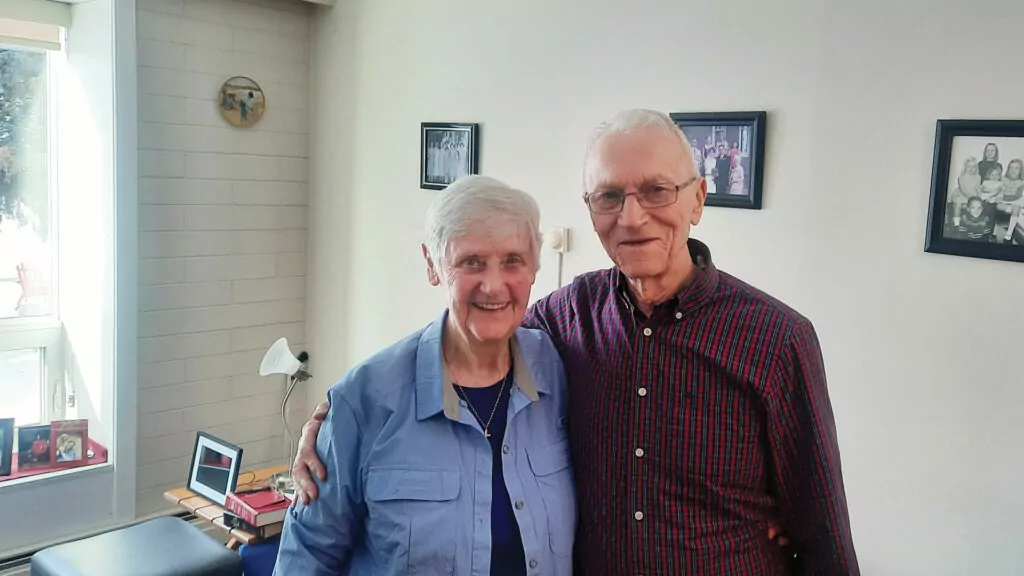
John and Margaret Helder at Muttart Conservatory, where John served as director for many years.

Horticultural therapy
John Helder is a horticulturalist with many years' experiences working as both the long-serving director of Edmonton’s Muttart Conservatory and greenhouses, and as the city’s Principal of Horticulture. He and his wife, Margaret, a botanist, appreciate flowers both personally and professionally. Their beautifully planted front and back yards bring smiles to the faces of many passersby; and John has seen first-hand the far-reaching benefits of flowers in his work.

“At Muttart , opportunity is provided for people to be exposed to and enjoy the beauty of plants of God’s creation. Many people come to relax and to be spiritually or emotionally refreshed in such a beautiful, calm setting.”

His work with the city of Edmonton also involved working with plants for social improvement.

“As Edmonton’s Principal of Horticulture, I worked with community beautification, school plantings, community gardens. Some projects were with various social agencies whose clients were helped through their volunteering in horticulture (planting and caring for floral beds) and using their activities for horticultural therapy.”

“Horticultural therapy” was a new term for me, and I was fascinated to learn more about it. This type of therapy is generally designed for people with physical limitations, mental illness, or other particular challenges. Working with plants can stimulate, engage, and bring joy and satisfaction, as well as give opportunities for beneficial socialization.

John described his work in helping establish community gardens and community planters in several low-income, troubled areas of the city. Over time he witnessed both personal and social growth for those who participated. Residents began to take pride in their neighborhood, interact more, and even support each other more (in one case by developing a cooperative babysitting service) as they built relationships and trust while working together. Community gardening was a catalyst with many ripple effects, providing “a non-threatening environment start to interact, socialize and counter their loneliness and grow as people.”

John also told me about a member of his church who lives at a seniors’ home which started making planters available for residents’ use. “A number of people now gather at the planters and chat, interact and enjoy the growing or just observing and enjoying each other’s company.”

Horticultural therapy can be a structured, formal activity; but everyone can benefit from growing or simply appreciating natural beauty. “In my mind, gardening, working with plants and soil, is enjoyable, and people should be exposed to horticulture from an early age to learn to appreciate flowers, plants, nature and beauty,” John concluded. He added,

“This also goes for music, the arts, literature, culinary arts, and in whatever other ways we can stimulate our senses and our talents, enjoy life and God’s gifts, and through our interests serve and share with others. As per Philippians 4:8: ‘Whatever is true, whatever is honorable, whatever is just, whatever is pure, whatever is lovely, whatever is commendable, if there is any excellence, if there is anything worthy of praise, think about these things.’”

Flowers teach us

Like all of the “book” of creation, flowers teach us about their wise and creative Designer. And we can learn other things from them as well.

Lessons from God’s Word
In the Bible, flowers are sometimes used as a metaphor to remind us of the brevity of life. As David soberingly put it, “As for man, his days are like grass; he flourishes like a flower of the field; for the wind passes over it, and it is gone, and its place knows it no more” (Ps. 103:15,16). Flowers remind us to “number our days, that we may get a heart of wisdom,” as Moses expressed it (Ps. 90:12).

Flower imagery in the Bible also gives us a vivid picture of the blessings God will pour out on His people: “I will be like the dew to Israel; he shall blossom like the lily; he shall take root like the trees of Lebanon; his shoots shall spread out.... they shall blossom like the vine” (Hosea 14:5-7). In Isaiah 58, when God promises restoration to His repentant people, He tells them, “you shall be like a watered garden” (Is. 58:11).
In Isaiah 35:1, the result of the coming of the Messiah is described as the bursting into bloom of a dry and lifeless land: “The wilderness and the dry land shall be glad; the desert shall rejoice and blossom like the crocus; it shall blossom abundantly and rejoice with joy and singing.”

These types of word pictures sink into our minds and hearts in a way that more dry, abstract teaching may not.

“Working and walking in my garden... reminds me of God’s goodness, blessings, and grace,” says Gina.

Learning experientially
Working with flowers can also teach us lessons, and help us experience truths, that we wouldn’t as easily learn in a less tangible way.

For myself, my (very small-scale) flower-growing is always a hopeful but also a humbling endeavor. So many variables are outside my control, and the final results are usually not quite what I’d pictured. When I do end up with vases full of vibrant flowers, I know I can’t really take any credit. The flowers from my garden – like so many of the good things in my life – truly are a gift.

Gina is one of the women in my church who enjoys growing and sharing flowers on a somewhat larger scale. She shared how working in her garden is a powerful reminder that she has a choice every day whether to focus on all the weeds – the difficulties and discouragements of life – or on the flowers, the beautiful blessings in the middle of the messiness.

“Working and walking in my garden full of flowers reminds me of God’s goodness, blessings, and grace,” Gina told me. “Just like life, my garden is chaotic, often a mess full of weeds. I can’t control the weeds or stop them from coming – they keep popping up – but in the midst of this messy garden I can see little patches of beautiful flowers growing.

“I will need to deal with the weeds and mess on a daily basis. Sometimes it can be discouraging or overwhelming to keep going. So it’s the flowers in front of me I choose to focus on – like beautiful rays of sunshine of God’s grace and goodness.”

Theresa and Christina, co-owners of Grand Floral, love helping their customers “say it with flowers.”

Flowers communicate & express

“Say it with flowers” is the slogan of Grand Floral (the Fergus, Ontario flower shop), and it captures this key communicative aspect of flowers. As co-owners Theresa and Christine explain:

“There are so many things you can express to others by giving flowers…. Gratitude, love, thankfulness and celebration to what may already be a joyous occasion. Expressions of sympathy or simply ‘thinking of you’ to lift someone’s spirits on a difficult day.

“Being able to help our customers convey this message to others is often a joyful task – either in meeting their needs or supporting them through any of these occasions. It is often through the difficult times (grief, loss) that we have the opportunity to provide a word of encouragement and support.”

Expressing joy and gratitude
Flowers have meanings, or can evoke emotions, which make them a beautiful way to express things like joy and thankfulness – also in the context of worship. Both the Old Testament tabernacle and temple included floral designs, and flowers can add a note of joy and vibrancy in our own churches as well.

My church has enjoyed beautiful bouquets and arrangements at the front for many years. Mrs. Lenie Noort provided these for well over a decade. “Going to church should be a joyful thing,” she told me, explaining that it’s natural to express that joy with the beauty of flowers. “I loved using the flowers God created to make His house beautiful.”

Kim sees her flower arrangements as a way to express and share gratitude and thanksgiving.

Several years ago, Kim Kieneker took over providing flowers for our church. Kim, who comes from a family of flower growers and arrangers, loves all things green and colorful; she’s always had a perennial garden as well as a vegetable garden, and enjoys growing as well as foraging for beautiful flowers and plants, and then using them in creative ways. “I love the soil,” she told me. “I enjoy beautiful and created things, I enjoy creating with them.”

As she described how she goes about putting together arrangements for the church, and her thoughts during the process, the words “thanks” and “thankfulness” came up often. Kim sees her work as a beautiful way to express, share, and inspire gratitude and thanksgiving in the congregation, giving glory to God for His bounty and blessings. “God gives us so much natural beauty around us,” she commented; “it’d be shame not to give a thank offering of it to Him.”

Kim often subtly integrates meaning into her arrangements. She likes researching the meanings of particular flowers, and also thinking about the church season and significant occasions or celebrations in the congregation. She finds it interesting how different people often see different things in her arrangements, and she loves giving people something to reflect on.

For example, in her arrangement for Good Friday last year, she made use of palms (looking back to Palm Sunday), thorns (representing the crown of thorns, “but pulled apart to recognize that Jesus no longer wears the crown of thorns”), white lilies (which are often association with Christ’s resurrection), and yellow forsythia (which evoke hope, joy, anticipation, and the coming of spring and new life). Even if we don’t consciously make all these connections, we as members of the congregation often experience an emotional response and are given something to ponder.

More simply, some Sundays Kim just enjoys providing “seasonal bouquets from nature” – many of which she gives away to church members at the end of the day. She loves foraging for plants and flowers, wherever she happens to be – “I always keep a pair of rubber boots and a pruner in my vehicle” – and delights in creating from what she finds.

Kim is drawn to asymmetrical designs and interesting shapes, finding beauty in the natural “quirkiness” of nature, rather than aiming for stiff, static perfection in her arrangements. Often the results are a bit unexpected or whimsical; I loved the flowers arranged inside a pumpkin last fall, and the blueberries peeking out of a bouquet early last summer when they were in season.

“Sometimes it’s hard to find a way to use your talents and passions in a special way to serve in the church,” Kim commented. In her case, providing weekly flowers has been a beautiful and rewarding way for her to do just that.

Flowers connect us

Finally, flowers can connect us – with our roots, our families, and with our neighbors – sometimes in wonderful and unexpected ways,

Connecting the generations
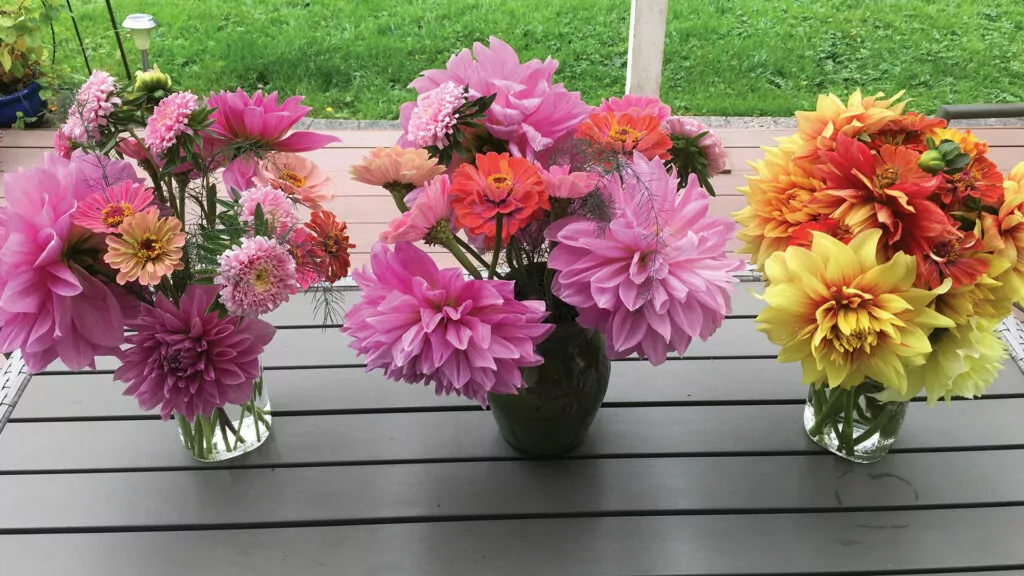
My parents grew (and still grow) big, beautiful dahlias, while my father-in-law introduced me to colorful, sturdy zinnias. Both flowers have become standbys for me, and I enjoy how they remind me of people I love. And, although I’m several generations away from the Netherlands, I have a soft spot for tulips and like seeing these bright little reminders of generations of flower lovers before me.

Similar experiences were shared by many people I talked to. As Theresa Brouwer remembered,

“My Oma always had windows full of plants, and took such good care of her gardens. I spent a lot of time there and must’ve picked up on her love for ‘everything nice.’”

Her sister Christine VanEerde felt the same way. Even before working with flowers at Grand Floral, she always had a love for them; “Often you could find fresh cuts on my table after a grocery run.”

Mrs. Lenie Noort also reminisced about her flower-growing family when we talked. She says she inherited her love of flowers from her mother: “After the house was cleaned up, then the flowers went on the table. A table without flowers was nothing.”

Gina has also found flowers to be a wonderful way to connect the generations. Her young granddaughters enjoy working in her garden with her, and Gina has especially loved helping them pick and prepare flowers as gifts for other family members. Gina described the rewarding feeling of

“seeing the joy in whole being when she picked, arranged, and wrapped up a bouquet to give to her great-grandmother. I realize I am passing on the joy of giving. The anticipation of thoughtful giving by choosing the flowers from the garden, arranging them into a bouquet, wrapping them up and seeing the smile of the person receiving your hand-picked gift – it’s worth more than words can describe.”

Henk and his daughter Shelley planting dozens of their yearly baskets together.

In Henk and Ginny Vanderhorst’s family, planting baskets together in spring has been an all-day father-daughter tradition for twenty-five years now (although, with one of the two daughters having moved away from Langley, BC, where her parents and older sister still live, the tradition has changed over the years). The sons of the family don’t participate, and Ginny understands that, although she is politely welcome to bring coffee, it’s “dad and daughter” time.

Preparations begin several weeks ahead of time, as the three visit favorite nurseries and select a variety of plants and flowers, which they’ll later share and exchange with each other. Back at the parental home on the designated planting day, the three use the back of Henk’s truck as their work surface, putting together countless planters and baskets – enough for all their homes, and often a few to give away.

The running joke is that, while shopping for their plants, they “didn’t go over budget” – mainly because they didn’t have one.

Some things are priceless.

The Helders’ frame-worthy front yard, which features a diversity of ground cover, flowers, and shrubs, gets a lot of attention.

Connecting with our neighbors
The beauty of flowers and plants can also connect us to neighbors and even strangers around us. John and Margaret Helder have found that their beautifully planted (and unfenced) property has become a draw for acquaintances and passersby alike.

At first, this “sharing” of their yard and garden was unintentional; “we never thought of fencing our yard because I (a cheap Dutchman) thought a fence to be an unnecessary expenditure,” John told me with a smile. As well, the couple liked having an open play area for their children (and a small collection of outdoor pet rabbits, pigeons, and a chicken), connected to the municipal grassed walkway and treed berm behind their property.

“As the grassway became more popular for residents, our menagerie became a popular destination for the neighborhood: little children with parents, as well as school and child-care groups,” John explained. Over time, as their yard matured and the Helders made various changes and additions, including adding an experimental rain garden, “people continued to stop by.” A number of years ago, as part of a more dramatic makeover, they replaced all the grass in their front yard with “a wild diversity of ground cover, flowers and shrubs.” Especially in the spring, when all the front bulbs were blossoming, “we got a lot of attention,” John told me.

Eventually the Helders started “sharing” their property in more deliberate, organized ways: “Along with the general public, school and summer camp groups stop by and learn about plants, composting, our rain garden, etc. We have invited specific groups to our garden as well” – including sending out an impromptu invitation to their congregation for a “yard open house” this past summer.

“Many people enjoy our property and chat with us about our garden,” John concluded. “The conversations lead to a wide diversity of topics well beyond flowers and plants.”

Connecting in Covid
A unique example of connecting with the community through flowers took place in southern Ontario in the spring of 2020, during the first of the Covid lockdowns.

During the “Covid spring” of 2020, the Ravensbergens’ full greenhouses (shown here this past February) called for creative solutions.

Many wholesale florists, including P. Ravensbergen & Sons in Smithville, Ontario, found themselves with greenhouses full of flowering plants – hydrangeas, begonias, chrysanthemums – that were no longer needed by many of their regular buyers.

Although Ravensbergen was already regularly donating surplus flowers to charitable organizations such as the Grimsby Benevolent Fund, Habitat for Humanity and others (as they still do today), the sheer volume of “extra” plants called for creative solutions.

Staff searched for new and creative ways to sell and donate the plants.

“We sold some from trucks by the side of the road,” said general manager William Ravensbergen, “and donated some to seniors’ homes and senior living neighborhoods in the area.” Help was received from a local business that wished to help scale up the distribution from the immediate West Lincoln area to create a larger impact. This involved reaching out to many local Reformed churches with an offer to sponsor flower distributions in the churches’ communities, if groups such as home mission and outreach committees were interested in organizing these activities.

The response was positive – both from many churches, and from neighbors who eventually received the cheerful blooms, along with messages of support and encouragement, during that difficult and isolating spring season. Countless plants were delivered door to door or, to avoid physical contact, left on porches, and the gesture clearly made an impact. “We received literally hundreds of thank-you cards from those who got flowers,” William told me.

I spoke to one young woman who had been part of the “flower drop” around Dunnville, Ontario. She described how her young people’s group knocked on doors around town, delivering the flowers along with encouraging notes and invitations to their church’s live-streamed services. She remembers it as a very positive experience; “you never got tired of seeing people’s reactions to the flowers.”

One older woman broke down and cried when she received her flowers, explaining that she hadn’t had contact with anyone for days. The young woman who had brought them was struck by the older woman’s utter loneliness, and decided to maintain contact. The two of them continue to visit regularly to this day. Although the older woman has hesitated to accept her new friend’s invitation to church, she says she sees God’s hand in making their paths cross. Another friendly church family has recently moved in down the street, and the woman has also expressed that she now feels so much less lonely – surrounded by caring community.

And sometimes during a visit the older woman will smile and say, “It all started with flowers, eh?”

“O LORD, how manifold are your works! In wisdom have you made them all...” – Ps. 104:24

Red heart icon with + sign.
Assorted

On the Truth, and the cost of lies

"Remember: one lie does not cost you one truth but the Truth" - Hebbel **** It seems that truth is bendable - it has become elastic during the last decades. People can twist and turn it any which way they want, especially if they have a good lawyer. "Guilty or not guilty?" "Not guilty." "Have you ever been to prison?" "No, this is this is the first time I’ve been caught stealing.’ Surely truth is a question which has plagued mankind for centuries. The question of what, exactly, truth is, has been particularly in the headlines during the last year. There are those times in which we do not speak the truth in order to shield others from something. The Bible records incidents in which people did not speak the truth and two incidents immediately come to mind: the first deals with the protection of the small Jewish babies by the Hebrew midwives (Ex. 1:15-21). The second recounts the hiding of the Jewish spies sent to search out the land for the Israelites (Joshua 2). Incidents such as these remain relevant to the present times. We have only to think of the Second World War during which time many Christians hid Jewish refugees. **** My husband and I had such an incident in our lives as well. It had not nearly the magnitude of life and death to it, but it does illustrate the fact that things are not always black and white. A few years after my husband’s graduation from the Ontario Veterinary College, we had our third child. An aunt of my husband’s, Tante Til, had come over from Holland to help me out for a week or two. She was cheerful, lively and a bastion of cleanliness. We enjoyed having her around. Tante Til had a wonderful sense of humor but she also had a passion for sterilizing whatever came within her reach. Perhaps this was because she mistrusted my husband’s close daily contact with stables and their inhabitants and distrustfully eyed the mud caked to his large rubber boots. Tante Til was “proper” and would never dream of letting a soup bowl function as a cat dish or using her handkerchief to wipe away a cobweb. Tante Til was not extremely fond of animals and the kitten, dubbed “Little Grape” by our two girls, had to stay out of her way. The litter box was vies (dirty), and my husband was delegated the task of cleaning it while I was in the hospital. He gladly did so. We had, I am ashamed to say, acquired the habit of cleaning out the litter box with something I had never found much use for – a silver salad fork – somehow failing to inform Tante Til of this rather disreputable habit. The fork lay in a secluded corner on the kitchen counter. It was a dirty black because I hated cleaning silverware, finding it a useless chore when it would only get dirty again. Besides that, we had lots of stainless steel. One of my first nights home from the hospital, Tante Til cooked us a special dinner - mashed potatoes, vegetables, pork chops, applesauce and salad. It looked and smelled delicious. As we sat down and bibs were tied around the girls’ necks, Tante Til shone with goodwill. "Nou, eet maar lekker, jongens! (Eat hearty, guys!)" We prayed and then began to put the food on our plates. It never hit us until my husband began scooping some lettuce onto his plate. He suddenly realized that he was holding the silver salad litter fork. Only the fork was not holding cat litter but green salad. His second scoop, therefore, hung in mid-air. He caught my eye and I grinned at him. He didn’t grin back. "Good salad, isn’t it, sweetheart?" I said wickedly. "Dank je (Thank you)," Tante Til beamed. "Zal ik jou ook wat geven? (Shall I give you some too?)" "No, thank you," I answered virtuously, "it might give the baby gas." My husband ate around the salad on his plate as Tante Til explained in detail how she had cleaned the fork she had found on the counter and wasn’t it nice and shiny now? "Je moet je zilver wat vaker poetsen hoor, kind (You should polish your silver a little more often, dear.)" She gave me a sidelong glance but smiled tolerantly for wasn’t I a young mother with a great deal to learn? I cannot recall whether or not my husband ate the salad on his plate, but I do know that we never told Tante Til what the salad fork had actually been used for. "I speak truth, not so much as I would, but as much as I dare," said Montaigne. **** Most incidences in daily life, however, call for plain, unadulterated truth - truth you should never shy away from. A number of years ago, during a snow-infested January day, I noticed a car slide to a stop behind a snowbank in front of our house. Our driveway was engorged with snow and I watched to see if the driver of the car would wade her way into it or head for our neighbor’s house. She turned into our driveway. It was a slow process, getting to our door, but it gave me time to put the kettle on, arrange some cookies on a plate and finally, wipe a few hands and noses while giving instructions on good behavior. When I looked through the window again, the woman was only about three quarters way up the driveway. I walked to the door, opened it and smiled a welcome. The woman was small and carried a briefcase. I did not know her. She smiled back and her funny, black hat tilted in the wind. "Why don’t you step in for a minute?" I said, fully confident that this tiny lady was lost and in need of directions and a hot cup of tea to warm her up. "Bad weather." The short, terse statement was carried by a strong voice, albeit a strong voice with a quaver. I nodded, agreeing wholeheartedly. She pulled off her gray, leather gloves and began opening her briefcase in the kitchen. A watchtower tract fell on the ground. I bent simultaneously with her and we almost bumped heads. She reached the pamphlet first and picking it up, held it out towards me. "No, thank you." My words came automatically. The pamphlet quivered. The hand that held it was blue-veined and old. "It’s free," she said, mistaking my refusal to take it with fear of having to pay for it. I shook my head. "I know." She put the tract back into her briefcase. The kettle was boiling and I turned to unplug it. Her voice followed me to the counter. "The world has many problems." My oldest son toddled into the kitchen and smiled at her. I walked past him and said, "It’s a good thing that Jesus Christ came into the world." She nodded, her little hat nodding with her. "Jesus was a good man." I both agreed and disagreed. "He was a good man," I said, "a perfect man, yes, but He was and is also God." She smiled and answered, "How could He be both at the same time?" Shaking her head, she laughed at what appeared to be a foolish and impossible notion. And when I persisted in speaking of the Triune God, she gave up and put her gloves back on while two of my children fingered her briefcase. With her gloved hands she pulled the small, black hat firmer onto her wet, gray hair and then opened the door. The wind blew swirls of snow into the foyer as she stepped back outside. I watched her go, the snow filling in her plodding steps almost as soon as she lifted her feet. And a few minutes later there was no trace to show that she had been by. Pascal said, "Contradiction is not a sign of falsity, nor the lack of contradiction a sign of truth." **** Providentially not only the liars are in the news. The January 30, 1999 issue of World magazine records that a man by the name of Daniel Crocker confessed to murder. Daniel Crocker, who at that time was thirty-eight years old, was sentenced to twenty to sixty years in prison. He will be eligible for parole in ten years. The unusual aspect of Mr. Crocker’s case is that he was living free and easy, with a wife and two children in Chantilly, Virginia. He had committed the murder twenty years previously, smothering a nineteen-year-old girl with a pillow following an attempt to rape her. However, his Christian conscience, following his conversion later in life, would not let him alone. Compelled by the Holy Spirit, he confessed his murder and was consequently tried and convicted. Mr. Crocker and his wife, Nicolette, reportedly were able to pray together twice before the sentencing. Mrs. Crocker said that their two children, Isaac, 6 and Analiese, 9, who were not at the trial, "know what Daddy’s doing is right." Mr. Crocker apologized tearfully to his family "for embarrassing and shaming them" and to the relatives of Tracy Fresquez, his victim. Mr. Crocker submitted, at this point in his life, to the Truth. And that Truth, even though he is a murderer, will set him free. **** According to the NIV Exhaustive concordance, the word truth is used 224 times in the Bible. One of the phrases recurring throughout Jesus’ ministry reads, "I tell you the truth." When the truth of the Bible is compromised, there is no sweet, roundabout way to avoid conflict. Emerson aptly said, "God offers to every mind its choice between truth and repose. Take which you please - you can never have both." Although in this phrase the word choice smacks a bit of arminianism, the fact remains that you cannot have both truth and repose. A lot of people today, however, are convinced that you can have both, never realizing that they have thereby lost their hold on Truth. Although they might agree with Mark Twain’s quote, "Truth is the most valuable thing we have", they subconsciously go one step further with him when he adds, "Let us economize on it." But there is no way to economize on the Truth of creation; there is no way to economize on the Truth of headship; there is no way to economize on the Truth of God’s judgment on homosexuality; and there is no way to economize on the Truth of being servants of one another in love and compassion. Because to economize on one principle does not cost merely one truth but the Truth. And only if you believe this Truth in your heart and confess this Truth with your mouth, shall you be saved. This is an abridged version of an article - "Remember: one lie does not cost you one truth but the Truth" - that first appeared in the June 1999 edition of Reformed Perspective....

Red heart icon with + sign.
Assorted

Why write?

You might not make a lot of money writing, but you can have an impact ***** It’s been said that all that is needed to become a writer is the strong desire to say something. Writing is simply taking your thoughts and research and organizing them on paper, or in your computer, or on your blog, to prove a point or tell a story. It may soothe someone’s soul, clear up a dispute, record family history, challenge someone to live a more godly life, or simply brighten a person’s day with humor or appreciation. This issue marks the 20th anniversary of my first article in Reformed Perspective, and over the years I’ve had people ask me how they could get started in writing. Sometimes what they mean is, “How can I make money off of writing?” and the short answer is, that probably isn’t a good motivation to write… at least not for most of us. I heard at a Christian writers' conference that with most books you might only make about a dollar off each one, so unless someone famous promotes your book, you won’t earn much. Magazines pay a bit, and if you can get into one with a larger circulation, it will pay more. Newspapers may take articles on a volunteer basis, or give you $25 (for the 6 hours you spent on it!). But getting paid is only one reason for honing your writing ability. In her book The Hidden Art of Homemaking, Edith Schaeffer shared that she thought there was all sorts of “art found in the ordinary areas of everyday life.” “Each person has, I believe, some talent which is unfulfilled in some hidden area of his being – a talent which could be expressed and developed.” Schaeffer pointed out that the ability to write ought to be used to express our creativity and/or to bless others, and not just considered as a way to possibly earn money. She gave many examples of how one might use writing in daily life, such as letters of appreciation, explanation or persuasion; poems, anecdotes, adventure, humor, family history, or stories given as a gift. Writing also helps the writers themselves organize their thoughts and process their feelings – as one best-selling author put it, “I write to find out what I think.” This is true of journaling and of writing fiction, as it can aid you in processing your own thoughts and emotions through your characters. So how did I get started? Let me outline how it has progressed for me. Writing just for fun I discovered in grade school that I enjoyed writing. In 5th grade I wrote 50 stories in 6 weeks to earn an A, and a funny poem in 6th grade that was well-received by my classmates. In high school I found essays very easy to write. However, when I got to college, my previous attempts were deemed "average" and I was challenged to improve. My professor said, "Somebody has to write the books and tracts and magazine articles – why not you?" I kept that advice in mind over the years. When I taught English Grammar and Composition for 5 years, I honed my abilities while seeking to inspire my students as I had been inspired. My interest in writing didn't stop when I got married and had 6 kids. I found opportunities to write for various company and club newsletters for free. I wrote occasional poems for family members, and composed songs for my children. I wrote Sunday School lessons for little children. I also wrote a letter to the sellers of a house we dearly wanted to purchase – and that letter caused us to win the bid! I wrote three articles for free for our local newspaper, which turned out to be good listable experience on my résumé since the articles were posted online. I also attended Christian writers' conferences. These seminars provided advice, encouragement, and connections with seasoned writers and publishers. One thing led to another We cannot know what we might do that will lead us to something else. As far as paid writing goes, here is how my journey has progressed: In 2005, with high hopes, I sent an article to Reformed Perspective. After improvements, my first and second articles were published. Then I was on a roll, tackling numerous topics for my own column, entitled "Soup and Buns." An article about those earlier Sunday School lessons that I had written with a friend, led to an Orthodox Presbyterian Church in California hiring me to write a 2-year curriculum entitled “Bible Overview for Young Children” with matching topics for ages 2-6 and 6-9. Copies have been sold to churches, families, and Ladies' Bible Study groups and given to missionaries. In 2009, I published a book, a collection of Reformed Perspective articles, entitled Soup and Buns: Nourishment from God's Word for Your Daily Struggles. From 2010 to 2013 I began writing SEO (Search Engine Optimization) paragraphs for clients' websites. Each paragraph of 350-500 words paid from $3 to $9 each. I found the opportunities through Upwork.com and wrote about everything from credit cards to chicken recipes. After a month using Upwork.com, I bid on three requests for community newsletter articles in small towns about an hour away. Note: those freebie newspaper articles I wrote a few years back were the proof to this new company that I knew how to write. They got me the job! One thing led to another, and soon I was invited to apply for a full-time position as their Publication Manager. I have continued to write for Reformed Perspective, and occasionally for Una Sancta (a Free Reformed Churches of Australia publication) and New Horizons (the OPC denominational magazine). I have a new book entitled Life and Breath and Everything which contains over 50 articles first published between 2010 and 2024. Encouragement The best writing teacher I ever encountered assigned numerous projects to her 7th graders, and graded them only on content. She wanted them to express, explain, or exult, not be exasperated! Each student then chose their favorite 3 projects and cleaned up all the grammar and punctuation in them for their final grade. If you had a teacher that frightened you away from writing by marking you down for each misplaced comma and word on every project, don't think that you cannot write. Write. Express yourself! If someone else is going to see it, fix it up before you deliver it. Very rarely is a first draft perfect. Conclusion In Ecclesiastes 9:10, we read, "Whatever your hand finds to do, do it with all your might." Schaeffer's book applies this to writing, but also to other forms of creativity, such as sketching, painting, cooking, gardening, or music. We all have God-given skills that can be used in our daily lives. The important thing is to start doing it, and then see where one thing might lead to another. Sharon's new book “Life and Breath and Everything” is available on Amazon.com and Amazon.ca. Her first book “Soup and Buns” and her “Bible Overview for Young Children” are available by contacting her at [email protected]....

Red heart icon with + sign.
Assorted

How to be happier

Keep long lists, and short accounts ***** As I pad down the hallway to my home office, sometimes I’ll look down and remember that the laminate planking I’m walking on was laid down with the help of friends. I’m not the best with a hammer or saw, so while I did some of the sweating, my friends brought the skill. I was so very thankful at the time, and now whenever I remember it’s a warm feeling still. As of late I’ve been remembering these friends more often because of a curious book. It’s about a guy who set out to personally thank every person involved in getting him his morning brew. There’s the barista, of course, but a farmer had to grow the beans, and then there’s all the people in between – it turns out there are an astonishing number of people involved in a simple cup of coffee. Who picks the blend? How many are involved in the actual roasting? Someone had to design the lid (there’s quite some engineering to it), and then there’s the coffee cup sleeve – there wasn’t always a sleeve – and when we remember that coffee is about 1 percent beans and 99 percent water, then there’s a whole municipal water department to thank too. And who makes the pipes that carry the water? We haven’t even gotten into the boats and trucks involved and all the crews who man and make them. A long list to be thankful for This guy wanted to personally thank everyone involved but quickly realized that might amount to millions. So he narrowed it down to the one thousand most directly involved. G.K. Chesterton said that, “When it comes to life the critical thing is whether you take things for granted or take them with gratitude,” and this book was an eye-opener for just how many blessings I’ve been taking for granted. If thousands – millions – are involved in making a cup of coffee, how many could I thank for everything I find even on my short journey from bed to shower each morning? How many designers, engineers, miners, and factory workers were involved in making the Kindle that wakes us up each morning? And what about our bedding, the bedroom carpet, bathroom tiles and that long-shower necessity, our tankless water heater? I normally clomp past it all, but I could choose to start each day just looking around in amazement. As Chesterton reminds us, “gratitude is happiness doubled by wonder.” The author of this book is a sometimes-blasphemous atheist (which is why I’m not sharing his name - I don’t want to promote him) but even as an atheist he recognizes that his disposition to grumpy ingratitude isn’t good… for him. “…gratitude is the single-best predictor of well-being and good relationships, beating out twenty-four other impressive traits such as hope, love, and creativity. As the Benedictine monk David Steindl-Rast says, ‘Happiness does not lead to gratitude. Gratitude leads to happiness.’” But why is thankfulness next to joyfulness? He doesn’t seem to know, but we do. God created us to glorify Him and then gave us innumerable reasons to do just that. And because He loves us, He so fashioned mankind that when we do what we were made to do, it is good for us. And He’s so gracious that even when we do a half measure, thanking the people around us, but forgetting the God Who made us, it is good for us still. Sometimes we need a Jordan Peterson or Elon Musk – someone outside the Church – to remind us of what we have, and what unbelievers don’t. I was struck by that here, when this author shared, “…I’ll occasionally start a meal by thanking a handful of people who helped get our food to the plate. I’ll say, ‘Thank you to the farmer who grew the carrots, to the truck driver who hauled them, to the cashier at Gristedes grocery story who rang me up.’” This fellow is “praying” to people he knows will never hear him because he feels such a need to express gratitude. To quote Chesterton again, “The worst moment for an atheist is when he is really thankful and has no one to thank.” When I look around the dinner table at the food that’s there once again, and the family gathered around, and when I really stop to think of all I’ve been given here, my heart can’t help but swell, but now there’s another blessing I can bring to my giving, loving Father – I can thank God that I can thank God! Keeping short accounts But if Christians have so much to be thankful for, why aren’t we more joyful? Why am I too often grumpy, sullen, and short to the people God has gifted me? Part of it is that we take so much for granted. We easily forget what we have, so there’s something to keeping a thankful journal. Around Thanksgiving each year my wife gets some notecards and encourages us each day to draw something we’re grateful for, and then we put the cards up on the hallway wall. It’s quite the display by month’s end. But even more of it is taking for granted the biggest gift we’ve been given: forgiveness. In his booklet How to Maintain Joy in Your Life, Jim Wilson shares how, upon his conversion, he experienced joy liked he’d never had chasing after the world’s substitutes. But as this Navy midshipman set out on his Christian journey, he found that joy diminishing. And it continued diminishing for the next three years. Sitting in the stateroom of an American destroyer stationed in the Sea of Japan, he was struck that for the 3 years since his conversion he hadn’t really been confessing his sins. Oh, sure, he’d confessed some sins, but there were many he hadn’t taken to God for all sorts of reasons. When he confessed his sins, God forgave him, and once again he started feeling that same joy. Guilt is a weight. But, thanks to Jesus, it’s one we don’t have to carry. Guilt is also God’s way of getting our attention. As it says in Hebrews 12:11: “No discipline seems pleasant at the time, but painful. Later on, however, it produces a harvest of righteousness and peace for those who have been trained by it.” Jim Wilson was trained by that discipline, but like the rest of us, he was a slow learner. “I would again disobey, get disciplined, and lose my joy. This time, instead of not confessing, I would confess after a while… ten hours, a week, 2 weeks.” Eventually he realized that he didn’t have to wait to confess his sins – he could “keep short accounts.” Then, instead of a series of ups when he was forgiven, and downs when he wouldn’t go to God (or at least not yet), he started to experience ongoing joy. “Sometimes I went for a while before confessing, but generally I would confess right away or within a couple of hours. I’m not saying I have not sinned in those years…. But I have a low tolerance for discipline. I do not like it. As long as I am unrepentant, the discipline stays on me, the hand of the Lord is heavy. I can remove the discipline of the Lord by repenting now.” For those of us who’d prefer to stay miserable, he concludes his booklet with a list of what you can do instead of confessing your sin. You can justify, excuse, or hide it. You can blame someone else, procrastinate, or stand on pride. A favorite for many is “generalization,” where you readily admit “mistakes were made” without really getting into the dirt of what you did. But tricking yourself doesn’t trick God, and you can’t enjoy Him if you are hiding from Him. Conclusion If you want to be happier, it isn’t complicated. Open your eyes wide, and see the world as it really is. There are troubles, but then there is God, and He continues to bless us beyond any measuring. And the biggest of those blessings is that we can know for certain – we can count on Him – that when we come to our Father with our sins, He will always and forever forgive. That’s got me a little verklempt but I can assure you, they are happy tears....

Red heart icon with + sign.
Assorted

How to look forward to the future

Hopefulness is a skill we can learn, because… God ***** Doomerism: despair and apathy caused by a disbelief that anything can get better; most often used with regard to global warming, lack of positive social change, and the risk of AI takeover. – as defined by Wiktionary I am shocked at how much optimism has died just in my own lifetime. I didn’t even realize the cultural atmosphere in my childhood was particularly optimistic – it was just “normal” to me. But compared to the current atmosphere, with the oppressive worries of natural disasters, new diseases, social tension, authoritarian governments, and renewed nuclear threats, the previous decades take on a rosy hue. Why do so many people, especially young people, feel an impending sense of doom? It’s less about our current circumstances, and more about the loss of hope for the future. We might be all right at the moment, the feeling seems to be, but we’re just hanging in there. Who knows how long we’ll be able to hang in there for? You might argue that this is worldly thinking. Climate change, authoritarianism, social issues are all things “the world” is concerned about. But I can relate to feeling like my actions and decisions are pointless, my life is going nowhere, and that the future looks bleak. I have had times in my life where I felt paralyzed, like anything I did would likely lead to doom. It turns out that being hopeful takes a lot of effort sometimes. And when the world around us persistently sends messages about how bleak everything is, about how young people are worse off than their parents’ generation, and how disaster looms on the horizon, it feels even harder to go against the flow. But as Christians, shouldn’t we know how to hope? Yet Christian discussions can also be full of how the world is getting worse. Christians are worried about what will happen to their families and their churches. And so, hopefulness becomes a hard skill for us to learn. How do you learn to have hope for the future? Here are a few perspectives that have helped me along the way. 1. Don’t miss the big story by obsessing on the details One helpful way I’ve found to think about the future is to remind myself that I already know the ending, and that ending is a happy one. The day-to-day right now might look like it inevitably leads to doom and gloom, but I know that’s not the big picture. I just need to zoom out enough to see the whole big story, and see that I’m just in a small part in the middle of it. I’m muddled down in the details, but a detail isn’t the whole story. And the best way to remind myself of the big story is to read the Word of God. That’s where we hear the end of the story and are reminded about who’s writing it. Ok, ok, you might be thinking, that's the big picture, but I still feel hopeless about my life. I might know in the end everything will turn out all right, but I still don’t feel capable of doing anything right now. I still feel like the current circumstances make whatever I do seem pointless. It’s true, it can be hard to connect what we believe to how we feel. Sometimes we know something, but we still feel anxious or paralyzed. But this means that it’s worthwhile examining what story our feelings are buying into, if we feel that way. We might not realize the degree that we’re accepting other people’s narratives about our lives. 2. No, the pessimists don’t know it all You might be sitting at home, doomscrolling on your phone, and some talking head on TikTok pops up bringing all these facts together: while wages in Canada have increased by 74.3% since 2003, housing prices have increased by 227%. Add to that the information that Canada’s population has also increased during this time, and that housing starts have struggled to keep up with the demand. Your heart sinks. You weren’t thinking about when you’d be able to afford a house before that moment, but now you’re convinced you never will. What’s the point of going to work tomorrow? And that’s just one example. It doesn’t take much time online to find theories about why Gen Z, or millennials, or whatever generation is doomed – why they will never get married, or afford a house, or be able to have children, or ever retire. These theories all seem so airtight, based on facts and statistics laid out in a logical fashion, with each piece of data leading to the next. But life is not so airtight. These theories are not prophecies about your life. Perhaps some of the stats and data might be useful for bureaucrats trying to understand social conditions, but when they become reasons for you to give up on life, they’ve left the realm of usefulness. We’re often skeptical of mainstream media narratives about politics and the environment, but somehow this kind of data can sneak into our brains. Sometimes it starts off being comforting, because it explains why we’re not quite where we want to be in life yet. It’s not us, it’s just our circumstances. But an inescapable path of doom unfolding beneath your feet doesn’t help you in the long run; it paralyzes you. What will help? Stop listening to these voices. No one theory can take into account all the information available – each tends to cherry-pick facts that fit. Online influencers and writers and videos tend to emphasize the negative narratives because that’s what gets clicks. And no theory can predict the unexpected event that changes everything and throws all accepted theories into chaos (sometimes known as a black swan event). The world is not predictable, and events that don’t fit the theories do happen (and disprove the theories). So why base your life on one of those theories? 3. Learn from history as it actually was When my grandma was a young woman in the Netherlands, World War II started and all the young men left town to join the army. She didn’t think it was likely she would get married. Then she met my grandpa, who was a resistance fighter. After the war, they wanted to get married, but so many houses had been bombed in the Netherlands that there was nowhere for them to live. We can look back on the past with nostalgia – “in the 1950s you could support a family on one income!” But we don’t remember all the times that a future didn’t look possible for them back then, all the times when, logistically, there was just no one around to get married to, or statistically there were zero homes for newly married couples to live in, or that the “better life” looked a lot harder than the old life. Maybe life doesn’t give us “optimal conditions.” Sometimes “doing something” really looks like doing the impossible. My grandma just kept taking the next step, even if circumstances didn’t look great. After all, nothing is impossible with God. So don’t base your life on disheartening statistics. Instead, why not base your life on the Word of God? 4. Trust God with the future God loves you, and He didn’t design your life as a kind of trap you can’t escape. But He also doesn’t reveal our life paths to us before they happen. He calls us to trust in Him as we walk in His ways: “Your word is a lamp to my feet and a light to my path” (Ps. 119:105). In other words, God hasn’t shone a spotlight on your destination, but He does light your feet as you take each step. You are part of a big story, but your part might not include our society’s preferred narrative of buying a home to fund your retirement, or finding the one career where you can make a meaningful impact. Or, who knows, maybe that will be part of your story one day. But the fundamental thing to hold onto is that you are a part of the story God is telling, and this means your life has meaning. What does knowing this do for us? It means we don’t have to be paralyzed. It also means we don’t have to see what will happen to us before it happen, even though we think predicting our future will make us feel better. We don’t need to add up all the facts together to predict our future and come to a negative conclusion (“there’s more women than men in the average church I attend, therefore the likelihood of me finding a husband is less than...”). God doesn’t work according to statistics. God doesn’t stop working out His plan because forecasters say most millennials won’t be able to afford a house. He will do whatever His will is for your life. The question is, are you open to that? 5. Trust Him one step at a time Can you keep taking the next step God lays in front of your feet, and the next step, and the next step, without always knowing where it will go? Can you find the courage to try things that are a little scary for you, if He calls you to them? Sometimes moving forward in life feels like plunging into the unknown, into something that could go terribly wrong (because any momentous choice in life could go terribly wrong) but with the willingness to try and see what God will do with your life. It’s easy to say, just do something, but doing something come with risk. We can take actions that make us suffer, we can make wrong decisions, we can do the wrong thing. That’s what scares us, and makes us paralyzed. The reality of risk feeds our paralysis. But to begin to exercise our faith and trust in our God Who is bigger than us, we do have to step out and learn to leave what’s out of our control up to Him. The Bible is full of examples of people stepping out in faith and leaving the future up to God. There is Abraham, who "went out, not knowing where he was going... to live in the land of promise, as in a foreign land” (Heb. 11:8-9). People did not live their lives by theories or statistics: “By faith Sarah herself received power to conceive, even when she was past the age, since she considered him faithful who had promised” (Heb. 11:11-12). And in the face of our fear of the future we can still act: “In the morning sow your seed, and at evening withhold not your hand, for you do not know which will prosper, this or that, or whether both alike will be good” (Eccl. 11:6). We’re urged in the Parable of the Ten Talents, and in Proverbs, to do the work in front of us. But we’re also urged to leave the results up to God. “Unless the Lord builds the house, those who build it labor in vain. Unless the Lord watches over the city, the watchman stays awake in vain. It is in vain that you rise up early and go late to rest, eating the bread of anxious toil; for He gives to his beloved sleep” (Ps. 127:1-2). So let go of what you can’t control. God isn’t calling you to navigate what’s out of your hands. And then do your part. Take steps in what areas you can do something. This is the only place to start. Conclusion Hopefulness isn’t a journey we can travel on our own. We can’t always formulate or speak the positive story to ourselves, and others can come alongside us to tell us their own stories of God’s work in their lives. If you’re feeling hopeless, reach out and talk to someone you trust. But at the same time, lean into God and His Word. He can contradict and counteract the negative narratives from culture that surround us every day. He can give us hope when the world claims it is dark. And we know His promises to us never fail....

Red heart icon with + sign.
Assorted

Lost and found: God’s guiding hand in seeking and finding a missing girl

Just before going to bed on a Thursday evening in mid-September, Michelle Dykstra read a Facebook post by a mother whose six-year-old daughter had gone missing. Earlier that evening, around 6 pm, Oaklynn Schweder had disappeared from her home on the Skin Tyee Reserve, an isolated community in northwest BC. Her mother, Gail Skin, shared the devastating news on social media as the RCMP called in a canine team to help find her. “I felt for her, because she is only six” recalled Michelle, a mother of three who lives just outside of Houston, BC. “I couldn’t sleep very much that night.” Not only is Oaklynn young, she is on the autism spectrum and is non-verbal. To make it even more challenging for searchers, she would sometimes hide in unusual places or up in trees. Adding to the urgency, nighttime temperatures around Oaklynn’s home dip below zero, and the surrounding wilderness teems with wildlife, including bears and wolves. Oaklynn was still missing the next morning, and the updates kept coming back negative. Search and Rescue teams throughout British Columbia joined in, along with the Canadian Rangers and the BC Wildfire Service. In addition to specially trained dogs, the RCMP deployed thermal-imaging drones to try to spot Oaklynn’s heat signature in among the trees. As more help was brought in, media outlets from across the country picked up the story of the missing Indigenous girl. Heart for the lost Unable to stop thinking and praying about Oaklynn, that evening Michelle talked to her husband Tim about whether they could help. They had never been involved in a search before, but they lived just a couple of hours away and felt a strong pull to do something for Oaklynn. “I really did feel like it was definitely put on my heart” Michelle reflected. Saturday wasn’t possible because Tim and their son Owen had to work all day, but they decided that if she was still missing Sunday, and if the search and rescue teams were open to volunteers, they would go out to help (even though they don’t normally miss church). In spite of a team that grew to 600 searchers carefully sweeping the area, by Sunday morning Oaklynn was still missing. The searchers were professionally coordinated, using GPS plotting to ensure every part of the land was covered. By this time, hopes of finding Oaklynn alive were diminishing. Michelle was restless and eager to start searching. They filled a vehicle with Tim, Michelle, their children Owen and Morgan, along with Tim’s sister Mandy Jaswal and her two sons Mica and Carson. Providential frustrations In spite of their eagerness to help, they were frustrated by one snag after another. A forgotten coat resulted in a short delay, which resulted in a missed bus ride, which in turn resulted in a missed ferry across Francois Lake. By the time they got to the search area, they missed the team that headed into the bush and had to wait to be called. They spent the next three and a half hours eating bannock, drinking coffee, visiting, and helping out with things like hauling groceries to the search teams. And then a search coordinator passed their group over, as he was concerned that they weren’t experienced enough for the bush. It was afternoon when they were finally called to search, and they were put under the lead of Glen Franz, a search and rescue volunteer from their home town. Two volunteer firefighters also joined their group. In their designated search area, they were to walk 5 meters apart from each other back and forth, to cover a grid over the land. Only ten minutes in, they hit another snag. The search leader was having trouble finding his location on the map and realized that they had started in the wrong place on their quadrant. By this time, they decided to keep searching from where they were, in the hope of going back later in the day to get the area they missed. The problems didn’t stop there. The devices that the search and rescue team was relying on to chart their progress had almost run out of battery. And there were strong winds gusting, with trees falling regularly. It wasn’t until later that day that they began to see that all of these worries and frustrations were actually the means by which God was guiding them exactly to where they needed to be at just the right time. Calming the wind Although dogs, GPS devices, helicopters, drones, and about 1,400 searchers were all devoted to the singular goal of finding Oaklynn, Michelle turned to another “tactic” – going to God. “I remember walking through the bush just praying, ‘Bring her out! Just show her to anybody. We've got hundreds of people out here. If she's hiding, just bring her out.’” As they walked, they saw bear signs everywhere. Tim shared that some searchers even had to climb into bear dens to look for Oaklynn. Although they at first felt they might turn around a corner and just find her, after hours of searching it sunk in to Mandy that: “the only way that a kid is going to be out here, especially since she is only wearing socks and a t-shirt…is if an animal dragged her over here…. Your brain just goes somewhere else to try and prevent you from the pain of thinking of that.” At 6 pm the organizers informed the searchers that it was time to call it a day and head back to the base. They were only half done their search area when it was shared that their GPS search devices were almost out of battery. They were given the option to end their search. Mandy reminded the group that they still needed to go back to the corner where they were supposed to have started. She insisted that they search there so it wasn’t missed. The group agreed, but they also discovered it was the most challenging land in their area, with a steep gully and a lot of trees blown over that weren’t easy to cross. Recent rain made it all very slippery. “We all went up to the top of that gully,” Michelle said, “just so that we could all get together and then leave.” Given that it wasn’t dark yet, the group wondered if Oaklynn had been located. “The thought came to my mind that maybe they had found a body,” said Michelle. They later learned that the search was called because of the strong winds and the danger that falling trees posed to the searchers. Michelle carrying Oaklynn out of the forest, with the team assisting Then, for just two or three seconds, everything got quiet – the static on the radio stopped, and the wind fell silent. As Mandy explained, “All of a sudden were like, ‘Did you hear that? We heard something, Mom, it sounded like a kid!’” The others listened too, hoping it wasn't just an animal. When they heard the noise again they all started calling Oaklynn’s name. That’s when they heard a response coming from the bottom of the gully. They all heard it. None of the adults remember climbing down the gully, even though it had just been a major chore to climb through it. They said it felt like they were transported there. “I just kept hearing ‘I see her, I see her,’ and I couldn't see her till the last second,” recalled Michelle. “So I just kept running. I could not see her until I got around this bunch of trees, and then all of a sudden there was that log, and she was standing behind it, and then she sees me, so she took a couple steps, and I'm full on running, and I just grabbed her and then sat down on the log. It was like, what just happened? What happened?” While Michelle held the little girl, the others rubbed her feet to warm her up, checked her for injuries, got her some warm clothes, and gave her something to drink. They were amazed to find that, other than looking dehydrated, being covered in berries and grime, and smelling like urine, she looked to be completely unharmed. Tim described the occasion as joy all around. Michelle kept saying “thank you Lord!” Their team leader used his radio to report “subject found,” to the disbelief of those at base camp. And then Michelle proceeded to singlehandedly pack Oaklynn through the forest, with the rest of the team holding back branches and helping her over trees. They were so close to the base camp that they could even hear the cheer of the crowd when they were told that Oaklynn had been found and was okay. Just twenty minutes later and they were back to where her mother and father were anxiously waiting. The mom’s reunion with Oaklynn was caught on video and has been viewed on Facebook over 3 million times, in addition to the TV reports that used the footage around the world. But what wasn’t captured was Michelle and the team that God providentially used to find Oaklynn. Recognizing Providence As Tim, Michelle, Mandy, and their children recounted the day’s events, they kept coming back to the same conclusion: God was orchestrating every detail, even the mistakes and frustrations, to allow for the joyful reunion of Oaklynn and her loved ones. If they had started searching where they were supposed, to, they likely wouldn’t have found her because she was moving steadily and wasn’t even in their search area when they actually found her. They also thank God for the young ears of their children, who were the first to hear Oaklynn, even though she couldn’t speak and even though she was more than 100 meters away. Likewise, they praise God for calming the wind and radios so that they could hear her voice. “So all these little glitches, all these little things, all the little breaks, all the perfect timing up to the point of the wind stopping. Like, Who stops the wind?” asked Mandy. “It's obvious, right?” Confessing Providence The previous Saturday, when Michelle was still at home folding laundry and thinking about Oaklynn, she recalled how so many Christians athletes who competed in the Summer Olympics used their platform to give glory to God. “I was thinking, if there’s any chance, I would make sure I would glorify God, right? Because you’ve got to do that.” The day after Oaklynn was found they were invited to a feast organized by the local Indigenous band to thank the many people involved in the search. There was singing, drumming, and speeches, including a mix of traditional native spirituality and Christianity. “The person at the mic asked ‘Does anybody else want to say anything?’” recalled Michelle. “And everybody else is quiet. And then all of a sudden, I'm like, ‘Wait, no, I do. I have to say something.’” Although she is fearful of public speaking, she took the opportunity to share with everyone that it was God who orchestrated all of this. She recalled how she had prayed while searching, and how God directed everything to work together so that Oaklynn was found. Her testimony was shared on Facebook live, and part of it was quoted in their local newspaper. Rejoicing and weeping In Matthew 18, Jesus shares a story of a man with a hundred sheep, one of which goes astray. When he finds it “he rejoices over it more than over the ninety-nine that never went astray.” The searchers shared how vehicles were honking on the ferry ride as they returned from the search, and how they received numerous texts and messages of joy over the news that Oaklynn had been found. Although their children slept well that night, Michelle and Mandy shared how they both had a hard time sleeping, and experienced their share of tears in the days following. By Wednesday, Michelle was back to doing laundry. “I find the sweater that I was wearing, and I pick it up, and it was just this strong smell of pee, like urine, and I just start crying like crazy. I completely broke down.” Later, she went “to bring laundry from the washer to the dryer, and I find the sweater again, and it doesn't smell like pee, and I'm crying again, and it's just a complete mess.” The group admitted they had a hard time in the following days, feeling like a piece of them was missing, since they put their heart out for Oaklynn and now she is back with her parents and doesn’t even know who they are. In many ways, that is exactly what love is. Photos by Mica and Mandy Jaswal....

Red heart icon with + sign.
Assorted

The quickening

"The great mass of this bleary-eyed world can see nothing of the ineffable glories of Immanuel. He stands before them without form or comeliness, a root out of dry ground, rejected by the vain and despised by the proud. Only where the Spirit has touched the eye with eye-salve, quickened the heart with divine life, and educated the soul to a heavenly taste, only there is He understood.” – Charles Spurgeon **** Solving vexations, conundrums, predicaments, heartaches, questions, challenges, dilemmas, mysteries and, in short, anything, is hopeless and impossible unless there is a hunger and a thirst within a spirit for righteousness. This hunger and thirst is not fathered by the human heart. This hunger and thirst is created by God. **** The bird feeder area was literally teeming with birds. It had been a long, hard winter and food was difficult to find; the feeding station provided an oasis. Tiffany stood by the windowed patio door and smiled at the little bodies strutting about while pecking at the seed. Sparrows, nuthatches, juncos, and robins mingled freely on the lawn. What pretty individual names they bore. Adam had chosen well. Of course, he had not spoken English. Probably the many different species of birds had been given individual names over time. She smiled to herself and considered that although her generic name was Woman, because she had been taken out of Man, her personal and unique name was Tiffany. Her mother had not really given her a reason as to why she had been named Tiffany. "I don't know, child," she had said, "I think I just liked the sound of Tiffany. Or maybe I read it somewhere. I just don't know." Several sparrows burst out into chirping. Were they alarmed by some hawk flying over? She searched out the sky, pressing her nose against the window pane. Or were the little birds perhaps arguing about why their name was sparrow and not flitterwing? There had been various times in her own life, times during which she had pondered the significance of her name, stages of discussing with her parents as to why they had not named her Johanna, after her paternal grandmother, or Helen, after her maternal grandmother. It had a curious dictionary meaning – the name Tiffany. It meant sheer fabric. Eventually, when she was a teenager, rapidly approaching adulthood, she was reconciled to the rationale that her father held out to her. “It doesn't really matter, does it, Tiffany? When people hear your name, they should automatically think of what you do, of what you stand for, and how you speak. After all, your name ought to signify the reputation you give it. So be careful about what you say and do. That's what it comes down to.” Tiffany smiled at her reflection before moving back from the window. She remembered Dad's words very clearly. And she also remembered Psalm 139. “For You formed my inward parts; You knitted me together in my mother's womb. I praise You, for I am fearfully and wonderfully made. Wonderful are Your works; my soul knows it very well. My frame was not hidden from You, when I was being made in secret, intricately woven in the depths of the earth.” Surely a fabric, a sheer fabric, such as her name denoted, was precious to think on as being woven together by God. It was an intimate thought, between God and herself, and it was a thought that made her feel special and whole. **** She and Evan had been careful when they had named their children. Their oldest, a boy, had been baptized John, meaning “God is gracious;” the second, Noah, had “rest and repose” affixed to his person. They had frequently spoken to both boys about the meaning of their names. Both John and Noah had been fascinated. Their names had cultivated their identities. Like a gift that could be unwrapped over and again, the truth was that the bestowal of a good name was better than giving a child riches. Their third child, a daughter, had been a wee, tiny thing when she was born. A total surprise, born a good seven years after Noah, this baby had been considered an added sweetness by Evan and herself. She was an extra joy, which was why the name they had chosen for her was Joy. She was now married and had a family of her own. Tiffany sighed. Time went by fast, inexplicably fast. Leaving her place by the window, Tiffany walked through the dining room to the kitchen. The counter was still cluttered with washed breakfast dishes which she had not, as yet, put away. Absently, she took her place in front of the sink, picked up a dish rag and began wiping a spot that needed no cleaning at all. Painfully aware of what made her so reflective and philosophical, she fought the desire to put on her coat, to escape outside and take the car for a long drive out into the country. If she did that, she would not have to wait for the doctor's phone call; if she did that, she would not have to hear the results of her recent lab tests. Even as she doggedly continued to wipe the counter, she fought a rising compulsion to leave. There was no appetite in her at all to digest the knowledge that the doctor might impart. A terrible dread encompassed her that after his phone call this morning nothing would ever be the same again. A fly landed on the counter and she swatted at it with her dish rag. In the middle of her third swat, the phone rang. Startled, Tiffany froze for a moment. She waited for the fourth ring before she finally walked back through the open kitchen door to the diningroom. The phone, large and black, stood on the table. Hesitantly, she picked up the receiver. "Hello." "Hi, Mom." "Joy?" "Yup, it's me. Your one and only daughter. How are you, Mom?" Tiffany's left hand fiddled with the telephone cord. Then she took a deep breath before she answered, "Oh, I'm fine, sweetheart." There was no need, no need at all, she thought, to worry this child, or the others, when there was really nothing to tell. Not yet, anyway. "Listen, Mom, Rob and I thought we might drive up for a visit this weekend, maybe from Friday night until Monday morning. That is, if a visit suits you and Dad." Joy's voice still sounded just like it had when she was a little girl. "Sure, honey. That's fine. We'll look forward to that. I'll have Dad take the playpen out of the shed and the crib's still up in the spare bedroom." "Thanks, Mom. I was hoping it would work out. For some reason, I've missed seeing you guys so much the last few days. Also, and I admit it freely, I really, really want to see how the addition to the house is coming along. Rob and I are so excited about it! But I have to go now. This is a middle-of-the-day call and Rob always tells me to wait until the evening when the rates are lower. But I just had this sudden impulse to call and ask you if we could come and I just wanted to hear your voice." "OK, honey and I'm happy to hear your voice too." Tiffany smiled at the telephone cord which she was crumpling in her left hand. Joy was impetuous, as impetuous as she had been when she was six and had asked the mailman over for supper because she supposed that he looked lonely. "Bye, Mom. See you soon. Suppertime Friday?" "That'll be fine, Joy. Bye, honey." "Bye, Mom. I love you." "I love you too, sweetheart." Tiffany hung up the receiver slowly, and drifted back to the glass patio door. They had begun construction for an addition to the house. She viewed the cluttered backyard with some misgiving. Evan and she had talked about putting on the addition for weeks before finally coming to the decision that it was the right thing to do. However, Noah... She turned abruptly and slowly meandered back to the table, remembering that Joy and Rob might not be the only ones visiting this weekend. Noah and Amy had mentioned that they might drop by on Sunday afternoon. Noah did not approve of the addition. Noah did not approve of Joy any longer either. The remembrance of it fell on her like a shadow and a hard knot gathered in the pit of her stomach. Should she call back and ask Joy to wait – to come another weekend? The phone rang again. This time her hand was on the receiver before it finished its first ring. Somehow she had expected to hear Joy's voice again, but this time it was the doctor. "Tiffany?" "Yes. Dr. Brewster?" Her voice was hoarse. Dr. Brewster wasted no time. "Tiffany, I'm sorry, but the results of your lab tests were not good." "Cancer?" She barely had the breath to push the word out. Behind her, in the kitchen, Toby, the dog, moved about in his woven, wooden basket. The creaks interrupted the doctor's reply. "Yes, but I don't want you to panic." His voice was impersonal, calm and professional. "If you have to have cancer," he went on calmly, "the uterus is not such a bad place to have it in the beginning stages. And that's what I think the lab results show – that you are in the beginning stages of uterine cancer." "So what do I do?" Tiffany felt helpless, hopeless, and tremendously lonely all at the same time. She had not even told Evan about this doctor's appointment. It had, after all, only been a routine appointment, an ordinary appointment. However, Dr. Brewster's insistence on lab work after her last physical had made her nervous, had put a barbed wire fence around the appointment. It had seemed to her that telling Evan would unnecessarily emphasize the possibility that something might be wrong. And she had not wanted to consider that possibility. "Well, Tiffany," Dr. Brewster's voice bruised her ear, "I would suggest a hysterectomy as soon as possible to be your best option. How quickly would you be able to arrange to check into the hospital? The earliest possible arrangement I would be able to make for you would be next week Tuesday or Wednesday. Is that too fast for you and Evan to come to grips with the idea?" "No, that would be fine." What was she saying? What was happening here? Just a few moments ago she had been watching sparrows, and chatting with Joy. "Good." Dr. Brewster's voice was competent, almost chipper as he went on. "Well, keep your chin up. I'll go ahead and book you in for next Wednesday. Just count on the fact that you'll probably have to check into the hospital on Tuesday evening." Tiffany swallowed. There was a lump in her throat and words would not come. "I know this is difficult to take in, Tiffany," Dr. Brewster's voice suddenly became more sympathetic, "it's all rather sudden, isn't it? So, if you have any questions, don't hesitate to call me back. My nurse will call and confirm all these things and will also let you know this week what you may or may not eat prior to checking in." "All right." Tiffany's whisper was barely audible. "Bye, Tiffany." "Goodbye." Woodenly leaning her left hand on the diningroom table, Tiffany's right hand still clutched the receiver. Laboriously she placed the phone back on the hook. She had always loved the Romans 8:28 text. The recitation of it came easily. And we know that for those who love God all things – all things – work together for good, for those who are called according to his purpose. It rolled off her tongue smoothly, effortlessly. She had always accepted it as totally true, absolutely true – for everyone else. But now she had to apply it to herself. Now she had to say and believe that cancer would work for her good. Now she had to acknowledge that cancer would surely build a closer relationship with the Lord. But she was quite satisfied with the relationship she had with Him presently. "Oh, Lord!" she moaned, and again, "Oh, Lord! Slowly inching over, she sat down on one of the leather-backed table chairs. Then she slumped forward, dropping her hands at her sides, shivering as she did so. Feeling the hard wood on her face underneath the tablecloth was not exactly the most comfortable position. But the tablecloth had belonged to her Mom and right now she longed for her Mom and for her Dad and for Evan. She sobbed, first softly but then the whimpers spilled over into great wails of such an anguished nature that the dog got up from his basket in the kitchen and trotted over. Sitting down at her side, he began licking her left hand, whining as he did so. Eventually, Tiffany stopped keening. She was totally depleted, weary in both body and soul. It came to her that Janice Edgar had died of uterine cancer. Janice had been a strong Christian, often testifying in front of the church, often speaking at women's groups, that God's grace sustained her. Would she be able to do that too? Janice Edgar had been dead for almost fifteen years now. Sitting up in slow motion, Tiffany reached for the hanky in her skirt pocket. Blowing her nose and wiping her face, she contemplated the shades of red in the tablecloth. Mom had also died of cancer, of breast cancer, seven years ago. Mom was in heaven now and so was Dad. “What is your only comfort in life and death?” Tiffany could see her father, grey hair unruly and ruffled, teaching catechism to a room full of teenagers. He had boomed out the answer himself. “That I, with body and soul, both in life and death, am not my own, but belong to my faithful Savior Jesus Christ." And his fist had hit the table at the word “belong.” All the catechism students had jumped, herself included. Tiffany blew her nose again, and her thoughts shifted back to Joy. Joy was a teller of tales and Joy was coming home this weekend. How often, Tiffany recalled, had she not been glad at that six-word phrase, Joy is coming home this weekend. After graduating from a journalism program and accepting a job at a newspaper, Joy had left home. Regularly sent overseas on assignments, the child had a drive to speak the truth and had an amazing ability to weave words together. She was a stitcher of stories. Joy was a writer, a writer like her Dad had been. Tiffany shook her head sluggishly. Writing was an ability she herself did not possess. No, as a matter of fact, stuttering came easily and her heartrate accelerated considerably whenever she was called upon to say something. She continued gazing down at the tablecloth. How often had they not, the five of them, Evan, John, Noah, Joy and herself, sat around this table? How often would it still happen? **** Joy and husband Rob, and their children Lacy and baby Evan, lived about two hours north. Rob was a graphic arts designer and worked from home. After her marriage, although still writing articles, Joy had opted not to be sent on assignment any longer. She was a full-time mom and loved it. Five years ago, before she was married, Joy had been on assignment in Pakistan. Gone for about ten months, she had returned with a baby. That baby was Lacy. "The name Lacy is like Tiffany, Mom," Joy had smilingly told her, "they are both a fabric. Lacy though, like her name, is frail – very frail. But she is named for you and you'll have to pray that she will acquire strength." Lacy had been frail. She had been the tiniest nursling Tiffany had ever seen and she and Evan had loved her instantly. They had been sitting by this table when Joy had come home with the baby the first time. "Where…" Evan had carefully begun, but Joy had stopped him. "I can't tell you much, Dad. Just a little. But I'll tell you what I can." Evan, who had started to speak again, stopped and nodded. And Joy had commenced. "Thousands of children go missing or are abandoned each year in Pakistan. Neonaticide is common. This is the act of a parent murdering their own child during the first twenty-four hours of life. Some babies are found ...." Joy stopped for a moment, swallowing before she resumed her narrative. "... some are found in piles of rubbish, some in garbage cans...." And then it had almost been as if Joy began reciting a lesson. Her voice had turned neutral, monotone. She had gone on, repeating herself. "Many girl babies are found in garbage dumps. There is a strong preference, you see, for boys in Pakistan. One day a four-year-old girl was found in my street. Her throat was slit." Quiet for a moment, she eventually continued, continued wearily. "I found Lacy in a trash bin next to a toilet. I only noticed her because some of the garbage was moving and then there was this tiny cry." Tiffany had found herself reaching for Joy's hand. "Mom and Dad," Joy resumed, "I loved this child the moment I saw her moving underneath the garbage. In a flash I could see myself, covered with the filth of sin. And I felt God reaching out to take me away from garbage, to remove filth from me. So, I reached down for Lacy and she became mine." "How?" Evan asked again. But Joy had gone no further than to say that the child now had her name, was properly registered with the authorities, and that she was listed as the child's legal mother. And Lacy was a Down Syndrome child. **** Tiffany’s focus returned back to the present. She could see that a woodpecker had landed on the birdfeeder. Birds were Noah's passion and he had built the feeder when he was twelve years old. "I want to live here forever, Mom." She smiled. Noah loved coziness, delighted in family games, and he had always maintained that he would take care of her forever. Noah had become a teacher, and had married Amy a few years later. He loved children, very much appreciated imparting knowledge, and taught grade ten. He had bombarded Joy with questions about Lacy. Joy, however, remained close-mouthed and had steadfastly told him no more than she had told her parents. "That information is between myself and God, Noah." He had seemed satisfied with that answer, as was his brother, John. As a matter of fact, Noah had related Joy's story to his students. He'd even had Joy, Lacy in tow, visit his class. Retelling the story, she emphasized the need for the Gospel in Pakistan. Later he told his mom and dad that the students had listened, wide-eyed and very impressed. Ten months after coming home from Pakistan, Joy had come home with someone else. "Mom, Dad, Noah, Amy, John, I'd like you to meet Rob Khan." Almost ten years older than Joy, Rob was an immigrant from Pakistan. Crippled in one leg, Rob had initially seemed shy. Lacy, a determined little pipsqueak, was just beginning to pull herself up to stand when he first visited and she chose to do it by his chair. It set him at ease, and even as everyone applauded Lacy's effort, he relaxed – relaxed enough to be able to tell everyone that he was employed by the same newspaper as Joy, but that he had not really known her until she had been sent on assignment to Pakistan. "It was during this time that I also was in Pakistan, visiting my father. He was seriously ill and we met at the hospital. Joy was pursuing an article and while I was sitting in a waiting room, she asked if she could interview me. I agreed and we laughed pretty hard when we found out we were both working for the same newspaper. During the year that followed, it became very apparent to everyone that Rob and Joy were attracted to one another. Tiffany and Evan had been thankful that Joy had met a prospective, godly husband. That surely was the Lord's work. Rob proved to be a gentle man, one who loved God as both Creator and Redeemer, and one who took his responsibilities as a Christian seriously. There appeared no reason why the couple should not marry. And so they did when Lacy was just beginning to walk on her own. She was then twenty-two months old and there was no doubt that Rob loved the child as much as Joy did. His income, although not high, seemed secure. While his walking impairment did not affect his work as a graphic artist, it was this physical disability which to some degree worried Evan and Tiffany. It was for this reason that they prayerfully decided in the ensuing year, the year little Evan Jr. was born, to put an addition onto their bungalow – an addition which would easily accommodate a small family. It was their hope that, at some point in the future, they themselves would live in the addition, and that Joy and Rob would take up residence in their single-story, four-bedroom home. Not in a hurry, they had worked out the financial details with the young couple and, presently, everything would stay as it had always been. As soon as construction work was completed, they would sit down to reassess. On the surface, both John and Noah approved of Rob. That is to say, there had been no problem until the matter of the addition cropped up. To Evan's and Tiffany's great astonishment, Noah became reserved and uncommunicative during this time. He refused to be included in the plans for the addition and vetoed the idea of sitting down with everyone for a family meeting. When finally confronted by his father, he suddenly flared up in anger. "How do you know Rob's not actually Lacy's biological father," was his first sentence, "and that Joy was not an unwed mother who was looking for a decent way out." When Evan, astonished at both the outburst and the words, had remained silent, just staring at his son, Noah bristled on: "And it's not as if the pair of them don't have an income, Dad, as if they can't manage on their own. They earn a decent salary." "But, son," Evan responded, "Rob's lameness puts him at a bit of a disadvantage with regard to, well, for example, snow clearing and such things. So your mother and I, as we are now middle-aged, thought ...." "You're giving them everything, Dad ...." Noah stopped and Evan immediately and painfully recognized that both money and jealousy were controlling Noah's words and emotions. "Son," he tried again, "your mother and I have talked about this long and hard. It was, after all, our decision to make. And we did discuss with you that we were thinking of adding an addition. You voiced no objection at that time. Add to this that Mom and I would like to stay in this home until we die, and you have a rationale as to why we came to this decision." When Noah did not respond, Evan went on. "You can also certainly understand that Joy could use help, especially with Lacy. Your mother would happily provide that help. And Rob and I, between the two of us, will be able to manage the garden and enjoy the benefits of country life. That is not to say that you and Amy ...." He got no further. "Yes, what about us, Dad? Did you ever think about us?" Evan sighed and repeated his words. "Initially, son, your mother and I came to the conclusion that this was a good thing in the eyes of God. Secondly, it was primarily our decision to make. We prayed about it constantly and, after much consideration, felt assured that this was God's will." "Well, it's certainly not my will." The words lay between them. They were only six words but they were as lengthy as the Sinai Desert. Evan sighed again. "Why not, Noah?" "Think about the money you're spending on Rob and Joy, Dad. Isn't that part of the family inheritance? Isn't that ours?" "Noah, they will be paying their own way. They will purchase their own part of this residence. That will be worked out between us." "They're using you and Mom. They have a handicapped child, a baby and a crippled leg between them – and they're using these things to evoke your sympathy." When Evan passed Noah's words on to Tiffany later, she felt sick at heart. A week after this incident, Evan spoke with John about the issue. His oldest son's response had been hesitant, conflicted. "You are free to do as you like, Mom and Dad," he had countered, "I know that Joy can use the help, but honestly, I don't want to become embroiled in a family argument." "But there is no argument," Evan said, "unless you allow for an argument." John had just shaken his head and changed the subject. **** Tiffany moved her head back and forth as she recalled the conversation, even as she ran her right hand aimlessly along the tablecloth, trying to focus on something else. Her eyes concentrated on the feeder. The hairy woodpecker was still there, larger than life. The red patch on his head stood out in sharp contrast to his black and white feathers. Perhaps he was from Trinidad or Tobago. Their flag was black, white and red. Now that thought, Evan would say, is a silly thought. And truly, it was. The dog wandered over and sniffed her left hand. "Do you have to go out?" He sat down next to her and looked up, brown eyes sympathetic and loyal. "All right, Toby, I'll let you out. Just don't chase all the birds away." There were some things which a person could easily chase away, she mulled, as she followed the dog to the kitchen door which led to the backyard, but there were other things which refused to disappear. And there was this one thought which now haunted her – that this hostility in the family was worse pain than the knowledge that she had cancer. **** She told Evan about the doctor's phone call as they were lying in bed that night. She whispered the news under the protective cover of the dark. He held her tightly, very tightly, and she could feel that his cheeks were wet with tears. "It's all right," he whispered through the dimness of the bedroom, "It's all right. God will lead us through this, Tiffany." She gradually fell asleep in his arms, spent with emotion and weary with thinking. **** "What about Sunday?" she asked Evan at breakfast before he left for work. "Should I call Joy and Rob and tell them not to come? But next weekend," and she swallowed painfully, running her spoon along the edge of her dish, "I'll probably be in the hospital and I won't be able to see the grandchildren." Evan didn't answer and she continued. "Or should I call Noah and Amy and tell them not to come?" "Don't call anyone," he advised, "Just let them all come." "But they won't get on." Evan smiled at her. "No, they won't." She wanted him to say more and when he did not say anything else, she went on. "If they don't get on, Evan, it will be difficult." She stopped, perplexed. Looking at her crestfallen face, Evan took pity. "Oh, Tiffany, you know that I understand with all my heart how you are feeling. I feel it too. But presently we won't be able to solve this. Perhaps there will be a breakthrough. Perhaps Noah will gradually be able to accept the situation and support it as he ought to have from the beginning." Tiffany nodded. Evan was right. He came over and kissed her cheek, adding a postscript. "We cannot change him, but we can pray for him. Remember, sweetheart, we have done nothing wrong. As a matter of fact, what we are doing is very right." **** She performed her housework mechanically that day. She dusted what was not dusty, and often stopped to stare vacantly into either the front or the back yard. Her thoughts alternated between the cancer and Noah. To have one's uterus taken out, one's womb, was an incomprehensible thought. The word hysterectomy was easy enough to say, even though it was a big word, but its inference, its significance and essence, was unambiguously difficult. She cringed at its somber implication as it shouted: "You will lose your femininity. You will no longer be able to have children." Now, it wasn't as if she and Evan would have any more children. After all, she was in her late forties and the time of bearing children was past. But the whole concept of losing part of her femaleness was abhorrent to her. And what if one thing led to another? Aunt Catherine had died of cervical cancer. After Aunt Catherine's hysterectomy, her bladder had been removed. There had been tubes in her sides and it had seemed a downward trajectory after that. The large intestine had to be operated on next and then the exit to her lower abdomen was relocated. Not that it was carved in stone, she told herself stoically as she vacuumed the stairs, that this would happen to her. And if it did, well then, that would be something which God wanted her to go through. All things work together. All things work together.... The vacuum cleaner droned the words – words to which she must cling. Nevertheless, as the vacuum cleaner suctioned dirt, she shivered. She hummed quietly through the hoover's discordance. When there was a lot of noise, you could sing and no one knew that you were off-key. Walking back up the stairs, she pulled the plug and then pulled the machine back into the hall closet. After she shut the closet door, she walked over to the piano. What music, what words could comfort now? The Psalter was open and she sat down on the piano bench and played softly, singing the familiar words. They caused tears to trickle down her cheeks. "Praise to the Lord, Who o'er all things so wondrously reigneth, Shelters thee under His wings, yea, so gently sustaineth! Hast thou not seen How thy desires e'er have been Granted in what He ordaineth?" Wiping her cheeks, she re-asked herself the question. Had God ordained the cancer? And she answered herself. Yes, He had. And, she knew as well that this was for her good. Swinging her legs around, she got up from the bench. Evan had said that it might be wise to call the minister. He had offered to do it himself, but she had said that she could manage. Let's see. Could she say it? She cleared her throat. "I have cancer." The words emerged dull and lusterless. "I have cancer." She spoke louder this time. But her heart had begun to thud. Then she said, "Tiffany has cancer." This came out easier. It sounded as if she was speaking about someone else. The clock ticked in the background and through the ticking she tried again. She whispered, "I am Tiffany." And then she sat down and wept. **** The minister was very kind. She did begin to cry as she told him and he patiently waited until she was calm and coherent. "Shall I come and visit?" he asked, but she replied that this was not necessary. But then, all of a sudden, without deliberation, she poured out her heart about Noah, about the intense grief she and Evan were feeling because their son's heart seemed to be turned away from God and towards himself. "Dear heavenly Father," the minister prayed with her, "Touch Noah's heart ...." "Thank you," Tiffany enunciated with difficulty, "but this Sunday ...?" "I know," he answered, "but these things often take time – possibly years and years." "I might not," she responded, "be there after years and years." But even as she said this, she felt it was unfair towards him and her spirit recalled the words, "Granted in what He ordaineth." **** It was Wednesday and Wednesday was her regular day for shopping. Not that it was a hard and fast rule, but she felt a need to go out. The phone rang as she was putting on her coat. She ran up the stairs to answer. It was Evan. "Tiffany, are you all right? I've been thinking about you all morning and just want to say that I love you so much." She smiled. "Hey, I'm just fine. A little teary-eyed every now and then, but I think I'll manage. How about you?" "Oh, I'm fine too." He stopped talking and there was quiet. "Well, I'll call you again later. I just wanted to hear your voice for a minute." "Evan, actually I'm just leaving for some shopping, so if you don't get an answer when you call again, don't worry. I'll give you a call when I get back in." "OK, sweetheart." She hung up the phone slowly and retraced her steps to the front door. **** There was no shopping. On a whim, Tiffany drove to a local conservation area. Here it was that she and Evan often came at dusk to just sit a while, not necessarily speaking. The park was built on a bluff and from it you could look out over a valley lush with maples. Half the view was sky. She sat in the car and stared into the horizon. A memory came and she vividly recalled a time that she, Evan, John, and Noah had camped in Algonquin Park. The boys had been three and five. Joy had not yet been born. She and Evan had slept in one tent and the children right next to them in another. In the middle of the night, they had heard growling. Belly-crawling over the canvas floor towards the tent flap, an unnerving spectacle had met their eyes. The open flap had revealed a mother bear with two cubs. All three animals were nosing around in the little trailer housing their bikes and their food. The trailer stood about ten feet from their tents. Her heart had begun to thump so loud that the ground beneath her shook. "Are you scared, Evan?" "Yes." Two-year-old Noah had unzipped himself out of his sleeping bag about half an hour before, yelling, "Bear! Bear!" at the top of his lungs. They had soothed him, tucked him back into his bedroll, assuring him that there was no bear. Comforted, he had fallen asleep again as quickly as he had woken up. If reawakened, he might have come running out, provoking that mother bear. Their soft prayer for safety had been salted with fear. There really had been nothing they could do except pray. Evan and she had watched the mother bear with her cubs until she lumbered off with them at dawn. God had protected them that night. It felt a bit like that right now. It felt like she was lying flat on her stomach, watching the world around her through a tent flap. The cancer was nosing through her life and she was afraid of its presence. And Noah, next to her in his tent, might be swallowed up by... by what? "By his unnecessary greed and jealousy." She whispered the words towards the sky. **** Later, she reached into the glove compartment of the car for the small Bible Evan had given her on their twenty-fifth anniversary. Inscribed on the flyleaf were the words: “On your forty-seventh birthday. May God's words be a lamp unto your feet. You are my sweetheart. Love, Evan.” She held the small leather volume between her hands. Both words of life and words of death were contained within its cover. She did not read but just kept the book on her lap. The almost-teenager Joy abruptly appeared in her memory. She had been tucking the girl in for the night. "Mom, does the Lord's Supper bread taste good?" "It's a symbol of Jesus' body, Joy." "Oh, Mom," Joy was indignant, "I know that. That's not what I meant. I meant, does it taste good in your heart?" "Yes, it does, Joy. It tastes very good in my heart." "What do you suppose, Mom, we'll eat at the wedding supper of the Lamb? I suppose," she added softly, "that it doesn't really matter. What really matters is that you've been invited." The girl smiled at Tiffany before she continued. "What do you suppose the invitation looks like, Mom?" Again she went on without waiting to hear what Tiffany would answer. "I know what it looks like, Mom. It looks like this." She took the Bible off the nightstand next to her bed. "Can you imagine the price of the postage, Mom? Can you imagine what you would have to pay to send out invitations like this?" She grinned and sat down cross-legged on her bed. "But that's not really true is it, Mom. The real price was not postage stamps. It was a lot more expensive. It was Jesus dying on the cross." "Yes, Joy." **** It was late afternoon when she drove the car back into the driveway again. She turned the car off, opened the door and stepped out. It was almost at the same time as Eleanor Trask, her neighbor, walked by on the sidewalk. "Hi, Tiffany." "Hi, Eleanor." "Tiffany, I need to speak with you a moment." Eleanor approached at a rather quick clip, and there was something in her demeanor which made Tiffany uneasy. Eleanor was a sweet neighbor, a widow in her sixties, and someone she trusted. Before she had quite reached her, Eleanor's words spilled out. "The doctor has been trying to reach you all afternoon, Tiffany. He knew you were my neighbor and asked that, should I see you, I pass on that you come to his office as soon as possible. Even if it's late, he said, you were to go directly to his office." Tiffany blanched. "Did he say why?" "No, dear, he didn't. Is anything wrong, Tiffany? Can I help you with anything?" "Thank you, Eleanor, but no. I'll talk with you some other time. I'll just go in now and phone Evan before I leave." "All right, dear. But are you sure? You look pale. I could make you a cup of tea before you go." Tiffany smiled. "No, thank you. Really, I'm fine." With that she turned, not trusting herself for fear of weeping, trembling, and blubbering on Eleanor's shoulder like a child. Inside, she sat on the stairs for a few moments, praying. "Please, Lord, help me, for Jesus' sake." Then she got up and phoned Evan. He had been, he informed her, trying to call her and was about to call her again. When she told him about Dr. Brewster's phone call via Eleanor, he immediately said he would meet her at the clinic. "Oh, and sweetheart," he added, but then said, "Never mind, I'll tell you when I see you." It was barely twenty minutes later that they checked in at the nurse's desk. Even though it was late afternoon, several people were still sitting in the waiting room. "I don't have an appointment," Tiffany explained, "but Dr. Brewster seems to have called me and ...." She did not have to say more. The nurse smiled up at her. "Yes, I know. Please have a seat. I'll let you know as soon as he can see you." **** "Tiffany," Evan began in an undertone, "there's something I have to tell you. Right after you phoned, I called both John and Noah. I told them what Dr. Brewster had said in his first phone call, and that you had received another phone call from him because... well, I don't really know why, but..." "Oh, Evan, we were going to wait to tell them until the weekend." "I know, sweetheart. But when you told me Dr. Brewster had phoned again, I thought it was better to let the boys know sooner. I think I would have wanted to know if my mother..." Evan's voice had become rather unsteady. He stopped talking and she reached out her hand. He took it, cradling it within his two much larger hands even as he kept talking. "I love you, my sweetheart, and I wish it were myself who..." "Oh, don't, Evan." They had not noticed that the nurse had left her place behind the counter and was standing in front of them. "You may go in now. The doctor is waiting for you." Unsteadily, Tiffany rose even as Evan's arm supported her back. **** Dr. Brewster, a tall, middle-aged man, stood up from behind his desk as they entered. "So glad you received my message and came, Tiffany. Good to see you too, Evan. Please, please sit down." Tiffany had difficulty catching her breath and she leaned on Dr. Brewster's large bureau before she took her place on one of the black, chrome-edged chairs stationed in front of it. Both she and Evan sat down gingerly, as if by relaxing on the chairs too comfortably, tragedy might strike them unaware. Tiffany's breathing was shallow. She couldn't bring herself to speak. Dr. Brewster smiled at her, but her face was a mask – a hard mask that would break should she move even one muscle. "Tiffany, Evan, I don't quite know how to tell you this. There's been a mistake." Tiffany reached for Evan's hand. Her eyes were riveted on Dr. Brewster's mouth. He had a tiny gap between his front teeth and she noted that the bristles of his moustache quivered as his voice orated on. "I have no idea how it happened. I suppose living in a computer-age, we're all subject to mistakes because of machines." Evan interrupted. "Tell us, Dr. Brewster, what you're driving at. Can't you see that this is tremendously difficult for us." "Yes, of course." He half-stood up and then, thinking the better of it, sat down again. "Well, you see, the tests that I spoke to you about earlier this week on the telephone, Tiffany, those tests were not yours. They belonged to someone else." It was quiet for a long minute. Then Evan cleared his throat. "Are we to understand that you are telling us that Tiffany does not need a hysterectomy – that she does not have uterine cancer?" His voice had a sharp edge. "That is correct." Dr. Brewster answered quickly, almost nervously. He stroked the mustache above his full lips and went on. "I am, as I am sure you are, tremendously relieved. Please accept my apologies for the trauma you must have gone through." It was quiet again – a quiet in which all sounds seemed beautiful to Tiffany. Suddenly she relaxed against the back of the chrome chair. "But my tests, Dr. Brewster, what do my tests actually show?" Tiffany's voice was slightly higher than it usually was. "Well," leaning back in his chair as well, and adopting a more commanding presence, Dr. Brewster's voice resumed a professional tone, "your tests were absolutely healthy. They were normal. There is nothing for you to worry about." "How…" Evan began, and then stopped. "Why…" he started again, but pressure from Tiffany's hand deterred him from continuing. She stood up. Both her legs and her voice were a bit unstable. "Will you need to see me again, Dr. Brewster?" He stood also, as did Evan. "Not until next year, Tiffany." "Thank you." She moved towards the door, pulling Evan with her. "We are walking through a miracle," she whispered, "We really are walking through a miracle, Evan. It's like I'm the daughter of Jairus." Faltering through the office, unmindful of the waiting patients, Tiffany began to weep and stumbled. Evan put his arm around her. "It's all right, sweetheart," he whispered, "I love you." They made it down the clinic hallway, and Evan pushed the door to the parking lot wide open. "I think I'll drive you home," he said, "and tomorrow you can drive back here with me and I'll take the car to work." She nodded, unable to speak. Her throat was dry. Evan held her hand and directed her towards the car. It was beautiful outside. The birds sang what she felt in her hearts in that moment. The nearby maples on the edge of the parking lot, were alive with notes of praise. She noted with delight a grey squirrel scampering up one of the trees. The air was pure and she inhaled deeply to taste it. "Taste and see that the Lord is good." Indeed, He was. "Evan, let's ...." She stopped short for there in the car parked next to Evan's car, she could see Noah. He was staring at them and her whole wall of thankfulness came tumbling down. "Evan!" "Yes, I see him." Even as they spoke, Noah opened the door of his car and came out. "Mom! Dad!" She loved Noah. She loved him so much that she ached. "Oh, Evan!" “It's all right, Tiffany! It's all right!" “Can I come and sit in your car?" Noah's voice was strangely sober, and Evan nodded, simultaneously answering, "Of course, you can, son." As they took their places in the front seat, Noah edged into the back seat. He began speaking as soon as Evan closed his door. "Mom, I know you must be wondering why I'm here, although I think that Dad might have explained to you about how he called and told me..." He stopped here, touching the back of her shoulder before he went on. "It doesn't matter what the doctor said, Mom. I love you. It will be OK. I know it will and I've been praying for you the whole time while you were in the office. We'll deal with it together as a family should." Tiffany felt a sob rising in her chest, a sob that she suppressed. "I know what you must think of me," Noah went on, "and I want to tell you something – a story actually – a devotional read by one of my students this morning. I was very much moved by that devotional. I'd like you to hear it before you tell me about the doctor. Would that be all right? Would you listen to it, Mom and Dad?" Again it was Evan who answered. "Sure, son." The trees, tall and majestic, surrounded the parking lot. Tiffany gloried in their beauty, even as she strained her ears to mind the words Noah was beginning to share. The grey squirrel ran up a nearby tree and took his place on a low-hanging branch, chattering up a storm. "There was a man," Noah began, "a preacher. He was a good preacher, always saying the right things, preaching excellent sermons on how one's life should be transformed by the Holy Spirit, and how we must study and act on what God's Word tells us. One day, a stranger attended one of the preacher's services. The sermon was particularly personal that Sunday and the man felt something stir within him, something he had never felt before. As a matter of fact, he felt so guilty with regard to the unwholesome way of life he had been living, that he followed the preacher after the church service with the intention of asking him questions. "Now there were other people as well who wanted to speak with the preacher after the service. So, the man who had just been shamed for his way of life by means of the sermon, was not able to reach the pastor's side because the pastor was literally surrounded by these other folk. So he lingered at the tail end of the group. But even though he was not directly among them, he did pick up their coarse language and their crude jokes which were being told. And he noticed with bewilderment that the minister laughed as loud and as long as the others in the group. "After some fifteen minutes or so of walking, the group entered a home, probably the home of one of the men in the group. Everyone was invited in and beer was served. The man went in also and the joking and unhealthy manner of speaking continued in the home. The minister was in the thick of it but he said nothing to halt the vulgarities of his companions. After some time of observing this unrestrained behavior, the man left. "It was at least twenty years later, that this preacher was called out to visit a dying man. He readily acquiesced and was led to the bedside of someone he did not know. And this dying man, after fixing him with a long stare, began to speak. "'I suppose,' his lips muttered, 'that you do not recognize me.' "'No,' the pastor replied, "indeed, I do not.' "'I heard you preach once,' the man went on, 'a long time ago.' "'Praise God,' the preacher said, 'I'm thankful for that.' "'Perhaps you ought not be thankful,' the dying man answered, 'even though I admit that at that time I was initially thankful for what you said.' "'What do you mean?' "'When I heard you preach, I was living a sinful life – a very immoral and wicked life. But your words, the words you preached on the pulpit, made sense and I was sorely shamed. So I followed you after church, wanting to speak with you privately so that you might help me understand what it was I ought to do to make amends.' "'Yes?' "'You were walking with a group of men. Their joking and rudeness amazed me. But what amazed me more was the fact that you participated. Even when I walked into the house you entered with these disgusting companions, you did not correct them. So after some time, I left. Once outside, I stamped my foot upon the ground and vowed that if such was a changed life, I didn't have to do much to change. I might as well keep enjoying what I had, up to that point in my life, delighted in.' Even as the man spoke, a death rattle in his throat, the minister paled. Shocked and chastened, he could find no words to speak. And then the man died." Tiffany and Evan had been totally quiet throughout Noah's telling of the story. When it finally appeared done, Evan cleared his throat. But Noah was not done. "You need not say anything just yet, Dad," he carefully went on, "You see, I came to understand during that devotion that the preacher in the story resembles me. I often tell the kids in my class how important it is to share, how important it is to show the love of God not just in words but in deeds. And I came to understand that I myself have been hypocritical." Noah's voice was breaking, even as he went on. "Oh, Dad and Mom, I am so sorry!" A bird alit on a tree branch overhanging the car and began to sing. And Tiffany knew that this last miracle was greater, much greater than the first. Pictures are by Havilah Farenhorst....

Red heart icon with + sign.
Assorted

The Colson Center: a sibling we look up to

Growing up as the second youngest in a family of ten, I learned a lot about life from my older siblings. Once grown, most of us continue to lean on our siblings in Christ as we navigate what it means to run a business, parent children, or serve in a church. We’ll get in trouble quickly if we think we can figure things out all on our own. That’s why, through the years, we have introduced our readers to some of RP’s “siblings” – organizations and individuals that we have learned a great deal from and aspire towards. If you appreciate what we are doing, you will probably like them too. I have already shared about WORLD Media Group, which covers the news from a solid Christian perspective via a magazine, video program for kids, podcasts, and more. RP is taking steps in that direction (with more journalism). But we don’t want to give up something that has always been core to our identity – worldview training. And the organization that best models this to us is the good folks at the Colson Center, a Christian organization which exists to “equip Christians to live with clarity, confidence, and courage in this cultural moment.” The organization is named after Charles Colson, whose books Kingdoms in Conflict (now retitled as God & Government) and Loving God have been very influential to both RP’s Editor Jon Dykstra and myself. Colson had served alongside President Nixon, before being thrown into prison for his role in the Watergate Scandal. By God’s grace, he repented and became a born-again Christian. God used him in a powerful way, first through creating Prison Fellowship (a ministry in prisons around the world), and then in developing Christian worldview training. He was concerned by the emphasis among evangelicals about “getting saved” without understanding the life of thankfulness we are saved to. The Colson Center trains Christians through many mediums including their daily Breakpoint commentary (on many radio stations), e-newsletters, podcasts, conferences, and intensive courses/programs. Over the past year, my wife Jaclyn and I have been enrolled in the Colson Fellows training program, following a curriculum that requires daily, weekly, and monthly training commitments that average about an hour a day. If you are looking to grow in your biblical worldview, I highly recommend it. Like WORLD, the Colson Center isn’t explicitly Reformed. But a Reformed perspective is very evident in both the underlying principles that guide them, and the teams that lead them. Both organizations seek to be faithful to God’s Word, applying it to the issues of our day, and waging war against Satan’s lies that abound in so many other resources. And they do so with grace, maintaining a positive tone that should always be found among those who hold to the Lordship of Jesus Christ and the sovereignty of God. I heartily encourage you to get plugged in to their short daily Breakpoint newsletter or podcast (available in both formats at no cost). You won’t be disappointed. To give you a taste, we included a Breakpoint article in the magazine on occasion, such as "When 'helping' kids hurts them" and "Is AI just another tool, or something else?" As Jon Dykstra explained in the March/April 2024 issue: Breakpoint has an American focus and is not specifically Reformed (though some writers are), so we differ in some notable respects: they are anti-evolution and RP is specifically 6-day creationist; we'll highlight problems with the Pope both when he is acting Roman Catholic and when he is not, while they stick to the latter. So, as with everything, there is a need to read with discernment. But when it comes to the hottest cultural battles of our day – sexuality, gender, the unborn, and God's sovereignty over "every square inch" of creation – they get it right consistently, and they are timely, often replying to events that happened just the day before. That's why Breakpoint articles have been featured in our online “Saturday selections” column for years now. You can also find more about them at Breakpoint.org and ColsonCenter.org....

Red heart icon with + sign.
Assorted

Gambling as the new norm? Christians still need to say no

Estimates had Americans betting a record $23 billion on Super Bowl LVIII, up more than a third from the $16 billion that was wagered in 2023. Among the betters was one Cardinal Pritchard, who shared that he’d made a wager in an article for the news site Not the Bee. Pritchard didn’t specify how much he bet, so it could have been trivial. What is notable is that he publicized it on a specifically Christian website and in making his admission there, he was acting as if it’s no big thing for Christians to gamble. The irony is that he did so in an article on the enormity of America’s gambling problem – Pritchard reported that an estimated 67.8 million Americans placed a bet on the Super Bowl, for an average of well over $300 a bet! Gambling is a bad bet Big, too, is just how common gambling has become – that works out to almost 1 in 5 Americans. Pritchard actually reported it as 1 in 4, but his math was off. Bad math is, of course, an ailment common to gamblers, who make the repeated mistake of thinking that this time they’ll come out ahead. But in a bit of computation that should be a part of every Christian high school math curriculum, if you engage in any sort of regular gambling the odds are going to get you in the end. Why? Because casinos and online sites take their percentage, so what’s paid out will always be less than what was paid in. Thus one of the reasons Christians shouldn’t gamble is because it’s a bad use of the resources God has given us. It’s worse than what the one servant did in the Parable of the Talents (Matt. 25: 14-30) who buried the money his master entrusted to him, and didn’t even put it in the bank to earn some interest. How much angrier would his master have been if the servant had come back with half a talent, having frittered the rest away in gambling? Or if he’d come back with a debt of several talents? Even when you win gambling is bad news But what if you are an especially good gambler, defying the odds to actually win more than you lose? Would it be okay for a Christian to gamble if he could turn a profit? No, but for a different reason. When you win at gambling it is only because someone else lost. Whatever your gain, it is someone else’s pain. Sometimes investing is likened to gambling, but a key difference is that if I make money on a business investment, it can be as the result of that business doing something to benefit many others. A company like Costco grows in value because it opens more stores that serve more people some good values. Your gain as a Costco stockholder comes at the general populace’s gain too. But in gambling, you only win because someone else has lost. And that’s not loving your neighbor (Matt. 22:35-40). Add to this the number of people who get addicted to gambling and lose everything. And then consider how, in Canada, provincial governments have a big hand in pushing gambling, and thus a big hand in destroying these lives. While I couldn’t dig up the specifics for the Canadian Super Bowl wager numbers, gambling is big business in Canada too, as evidenced by the sheer volume of sports gambling ads on television. A peek at government coffers shows their own heavy dependence on gambling. Alberta, for example, is expecting to take in $1.5 billion in 2023-2024, or, more than $300 per citizen. God’s people need to understand why gambling is wrong so we can steer clear of this entrapment. And in steering clear we can also be a good neighbor to others by “denormalizing” gambling. Just say no, for everyone’s sake....

Red heart icon with + sign.
Assorted

Sparrow blessing

Mao’s “Four Pest Campaign” shows why a nation’s leaders need to be humble about their expertise, and about what they attempt ***** Most mornings I waken to the sound of sparrows chittering and chattering. Approximately twenty to thirty little house sparrows have a sun-up inclination to alight on one of the cedar bushes right next to my window. These sparrows used to reside in my laundry poles – winter and summer. They had their babies there and they slept there. They also poked out their gray, brown heads and white cheeks to assess me as I walked by on my way to the chicken coop every morning. Perhaps they now resent me as I cut down one of the laundry poles last summer. Feeling guilty about cutting down the laundry pole home, I fill the bird feeder with lots of seed. I have named eight of the songsters – Sam, Pete, Al, Rudy, Rembrandt, Ollie, William and Simon – and their daily, simple notes of joy give me pleasure and comfort. A father who loved sparrows My Dad told me that when he was a little boy, he learned to sing Psalm 84, especially verse 3, with great enthusiasm. He sang the Psalm in Dutch and the translated version of verse 3 reads: Even the sparrow finds a home, and the swallow a nest for herself, where she may lay her young, at your altars, O Lord of hosts, my King and my God. My Dad, who was a wonderful story teller, went on to relate that he thought the word altars, which in the Dutch language sounds a lot like lanterns, meant that sparrows would eventually make their homes in the lanterns lining his street. Consequently, dressed in short pants and a blue jacket, he would stand for long periods of time underneath the street lanterns. He would crane his neck and gaze up at these lamps, hoping to see sparrows lay their babies in the lights. It never happened, but he was convinced for a long time that it would happen. The Chairman who hated them In 1893, seventeen years before my Dad's birth, Mao Zedong was born. Growing up to become the first chairman of the Communist Party of China (1935-1976), as well as being the founding father of the People's Republic of China, Mao had absolutely no respect for, or understanding of, the Psalms. Neither did he love the sparrow, that fifth-day creature which God had set in the sky to be a blessing to mankind. In 1958, the year my family immigrated from Holland to Canada, Mao Zedong, Marxist dictator of the world's most populous country, decreed that all the sparrows of China were to be killed. Ostensibly to help China leap forward economically and socially, he began a “Four Pests Campaign” (1958-1962) to eradicate, among other animals, the Eurasian tree sparrow. The Chinese Chairman, an unbelieving little man who did not comprehend that the sparse hairs of his head were numbered by God, did not know what he was doing. His proud slogan was: “Man must conquer Nature.” And, because of his campaign, the vast country and grand country of China, instead of leaping forward, began to leap backwards into famine and death. Matthew 10:29-31 tells us: “Are not two sparrows sold for a penny? And not one of them will fall to the ground apart from your Father. But even the hairs of your head are all numbered. Fear not, therefore; you are of more value than many sparrows.” That is to say, God's people are of more value than the sparrows; that is to say, God works all things out for His people's good. He cares for them. Besides the tiny, chestnut-crowned sparrow, three other animals were targeted in an overall elimination crusade. These three animals were the mosquito, the rat and the fly. Mao's reasoning was: mosquitoes cause malaria; rats cause the plague; and flies are a general nuisance. Sparrows were included at the tail end of the elimination list because they ate both grain and fruit. Chinese poster declaring war against the four pests: mosquitos, flies, rats, & sparrows Government didn’t know best Mao enacted a law in 1959 which made it mandatory for Chinese citizens to participate in the offensive against this common little bird, the sparrow. He had no idea that this little song-bird helped plants to grow. When the sparrow ate from plants, it passed on the seeds in its droppings. Mao didn't have a clue that these small twitterers also served as food for other larger birds and mammals, nor that they helped provide necessary fertilizer with their excrement for the plants on which they fed. Neither did the Chairman know that sparrows ate harmful insects. With the enacting of Mao's law to kill the diminutive sparrows with their kidney-shaped, black ear patches, the Chinese ecosystem and environment took a downward turn. The Chinese people took to arms. They were forced to do so. All over the country people banged pots and pans together to prevent the little birds from settling into their nests. The little “pests” were about twelve centimeters in length and weighed less than an ounce. There were numerous posters declaring war on the birds. Young boys and men fired at the midget flyers with guns and slingshots. Yelling and screaming crowds beat trees with long, wooden poles. As soon as any little creature perched anywhere, worn out by the riots below them, they would be harassed to such a point that they would drop dead from exhaustion. Exhilarated by what they thought was a great leap forward and constantly praised by the authorities for their diligence, people collected dead birds and tied their petite brown bodies together, forming feathery ropes of destruction. One small light in this fowl massacre was the Polish Embassy in Beijing. They refused to engage in the killing of the sparrows. A refuge for the remaining sparrows, the embassy was eventually surrounded by zealous Chinese citizens, who shouted and shrieked continuously. In the long run, the sparrows hiding in this small space also died. The Polish personnel cleared their area of dead sparrows with shovels. Instead of sparrows, locusts Psalm 102:7 reads: “I lie awake, I am like a lonely sparrow on the housetop.” There were many lonely birds after Mao's feather massacre. No census of them was taken prior to their demise. But it is estimated that there were perhaps some six hundred million of them. Hundreds of millions were eliminated through Mao's campaign. The year after the murder of these birds began, insect infestation of field crops increased, the locust being the main predator. The locusts multiplied and ate everything in their path. Grain production collapsed and a famine began. All the places in which sparrows no longer chirped and chipped, had no cereal output. The Great Famine which ensued is not allowed to be spoken of in China. Rather, this desolate time is referred to as the “Three Years of Natural Disaster” or the “Three Years of Difficulties.” Yang Jisheng, (1940-  ), Chinese journalist and author, wrote a book entitled Tombstone: The Great Chinese Famine, 1958-1962. First published in Chinese in 2008 (and translated into English in 2008), it chronicles the Great Famine and the Great Leap Forward. Although he was, for a time, a loyal Communist, the Tiananmen Square massacre destroyed Jisheng's faith in the Party. Mao’s arrogance killed tens of millions The horror stories chronicled by Jisheng are brutal and graphic. He records, among many, many incidents: a teenage orphan killing and eating her four-year-old brother the death of 44 of a village's 45 inhabitants and the consequent insanity of the last remaining resident, a woman in her 60s the torture and beatings and live burials of people who declared realistic harvests, who refused to hand over what little food they had, and who stole scraps or simply angered officials Jisheng wrote regarding his research: “I didn't think it would be so serious and so brutal and so bloody. I didn't know that there were thousands of cases of cannibalism. I didn't know about farmers who were beaten to death. People died in the family and they didn't bury the person because they could still collect their food rations; they kept the bodies in bed and covered them up and the corpses were eaten by mice. People ate corpses and fought for the bodies. In Gansu they killed outsiders; people told me strangers passed through and they killed and ate them. And they ate their own children. Terrible! Too terrible!” Devoting fifteen years to documenting this terrible famine, Jisheng catalogued a three-year catastrophe that is estimated to have taken 36 to 55 million lives across China. At the end of his campaign against the four designated pests, Mao Zedong ordered the vendetta against sparrows ended, replacing it with an operation against bed bugs. Eventually, the People's Republic of China had to import 250,000 sparrows from the then Soviet Union to stop the ecological disruption. After the sparrows had settled back into the country, the locust population was brought under control once more. Over a period of three years, it is estimated that one billion sparrows, 1.5 billion rats, 100 million kilograms of flies and 11 million kilograms of mosquitos were annihilated throughout China. Ecological and economic disaster jeopardized the very fabric of the country. Even as Nebuchadnezzar before him, Mao was deluded into thinking that he owned nature. Mao (in)famously quipped: "Make the high mountain bow its head; make the river yield the way." The truth is that Sinai and Jordan laughed at him and God held him in derision. Where is this mass murderer now? Conclusion In this day and age, when so much misery and terrible economic disaster looms and threatens to undo us, we do well to remember the sparrow blessing, the blessing which Jesus gives to all who acknowledge Him: “But even the hairs of your head are all numbered. Fear not, therefore; you are of more value than many sparrows.So everyone who acknowledges Me before men, I also will acknowledge before My Father Who is in heaven, but whoever denies Me before men, I also will deny before My Father Who is in heaven.” – Matthew 10:30-33...

Red heart icon with + sign.
Assorted

Outward appearance over against the heart

Or do you not know that your body is a temple of the Holy Spirit within you, whom you have from God? You are not your own, for you were bought with a price. So glorify God in your body (I Cor. 6:19-20). When Jehu came to Jezreel, Jezebel heard of it. And she painted her eyes and adorned her head and looked out of the window (2 Kings 9:30). ***** Over the centuries, there have been people who died selflessly for things they held dear – country, love, honor, faith – just to mention a few. Martyrs such as Polycarp, Latimer, and Stephen died for their faith. The American patriot Nathan Hale, who famously cried out prior to his death: "I only regret that I have but one life to lose for my country," died for his homeland. There is also another category of those who died, but by unintentionally putting their lives at risk for love of self, for vanity, and for pride. Good Queen Bess Queen Elizabeth I, who ruled England from 1558 to 1603, became ill with what was first assumed to be a fever. It was not. It was the dreaded smallpox. At the time of this fever, this young daughter of Henry VIII was twenty-nine years old and she had been queen for only four short years. Adored by the British public, she was known to have a good-natured smile and a trim figure. Seen wearing intricate lace collars beneath a smooth, ivory complexion, the youthful monarch considered her looks somewhat of a status symbol. Her fiery red hair was usually dotted with expensive jewels – the jewels representing her chastity. While in bed with the fever, it was feared in the court and in the country that she would die. At the onset of her illness, Elizabeth refused to believe that she had contracted the dreaded disease. A Dr. Burcott was asked to diagnose and when he came up with the word “smallpox,” the word “fool” escaped Elizabeth's lips. A repeat visit from the man, who was quite courageous in returning to her side a second time, having been called a fool the first time, again identified the illness with these words: “Tis the pox,” whereupon Elizabeth, it is said, moaned: “God's pestilence! Which is better? To have the pox in the hand or in the face or in the heart and kill the whole body?” No such angry words came from the lips of Mary Sidney, Elizabeth's lady-in-waiting and friend, a loyal girl who selflessly nursed her sovereign for hours throughout the illness. Mary had caught the disease from her mistress for whom she was caring and, as a result of her devotion, the girl became very disfigured. Mary Sidney's husband, Sir Henry Sidney, wrote of his wife: "When I went to Newhaven I lefte her a full faire Ladye, in myne eye at least the fayerest, and when I retorned I found her as fowle a ladie as the smale pox could make her..." Mary, though scarred, through her sacrificial devotion, was beautiful in the eyes of God. When Elizabeth gazed into her looking-glass after recovering her health, she was devastated to notice that the pox had left some visible scar tissue on her face. Having been celebrated by the populace for her looks, so she thought – the elaborate gowns, her lace kerchiefs and her white skin – she now felt a certain degree of insecurity. Seeking to regain her physical loveliness in the eyes of the public, she hunted about for an answer. She began using Venetian ceruse. Venetian ceruse was a cosmetic used as a skin whitener and it was a lead-based cosmetic. Sometimes mixed with manure for traction or with vinegar to thin out the consistency, it was popular among the rich. Because its main ingredient was lead, however, it was a potential killer. Because of her vanity and insecurity, Elizabeth began covering her facial pockmarks with this heavy, white makeup. She did not know that symptoms of lead poisoning could include abdominal pain, aggressive behavior, constipation, sleep problems, headaches, irritability, loss of appetite, loss of teeth, fatigue and high blood pressure. Some scholars believe that Elizabeth’s eventual death was due to blood poisoning from lead. Having access to the Bible, and having read it, the young queen should have known that security was to be sought in God, not in cosmetics. Although Elizabeth's sad lack of knowledge about the danger of Venetian ceruse is to be decried, it was a far worse matter that Elizabeth put her trust and confidence in her outward appearance. Rouged and poisoned There is another story. A century and a bit after Elizabeth I's reign of forty-five years, in 1733 to be exact, a young girl was born in Cambridgeshire, East England. The girl's name was Maria Gunning and she was the eldest child of six. Her father was from Castle Coote, County Roscommon in Ireland and her mother, Bridget Bourke, was the daughter of Theobald Bourke, 6th Viscount Mayo. The Gunnings were not wealthy. On the contrary, they lived in relative poverty on father Gunning's home of Castle Coote. Considering the fact that there were six children to support, mother Bridget decided to become enterprising. When her two oldest girls were barely teens, she decreed they should take up acting. Maria and Elizabeth were both extraordinarily pretty and acting, although not a respectable occupation, could open the doors to wealthy patronage. Actually, the word “pretty” for the two daughters was mild. They were very beautiful. So, shuttled off by their mother, they traveled down to Dublin and joined the theater. In Dublin, the sisters soon became well-known – well-known for their handsomeness. When they were but in their early teens, they were both present at a ball in Dublin Castle wearing gowns borrowed from their theater group. At this ball, Maria was introduced to the Earl of Harrington, Lord Lieutenant of Ireland. The man was so impressed with the shapely girl, that he granted mother Bridget a pension. With ready money in hand, Bridget immediately took her two daughters to England. Attending parties and dances in Maria's birthplace of Cambridgeshire, the sisters soon became acclaimed personages. Invited to attend the court of St. James, the official royal court of the king of England, they charmed him. Followed by celebrity-seeking crowds wherever they went, their popularity rose to the point where Maria was mobbed one night in Hyde Park. King George II, consequently, gave Maria a guard to protect her and, from then on, she walked in the park with two sergeants of the guard before her and twelve soldiers following her. The girls had achieved fame and notoriety. Within the small space of two years both girls were married – Elizabeth to a duke, and Maria to an earl, thus achieving the rank of Countess. Maria's earl, the 6th Earl of Coventry, took his bride to Paris for a honeymoon. Feeling pressured to preserve the beauty which she felt sure had brought her this far up the social ladder, Maria began using rouge. Rouge was the rage at the French court, and Madame Pompadour, mistress to King Louis XV, had set a fashion of pale white skin with red rouged cheeks. The base ingredient of this makeup, as of Venetian ceruse, was lead. Although her husband did not approve of makeup, even wiping it off her face publicly with his handkerchief, Maria continued to apply thick layers onto her skin. But the end of the matter was this – at the tender age of 27, having borne four children, Maria was diagnosed with consumption. It is reported that she retreated to a darkened bedroom in the weeks prior to her death, refusing to receive any visitors. It is also said that her early death was a “death by vanity,” because lead poisoning from her excessive use of makeup probably contributed to her demise. Maria Gunning, or Countess Maria of Coventry, was the owner of a 7-foot mirror and countless jars of rouge. The mirror caused her mental anguish when she gazed into it prior to her death. The rouge caused her physical discomfort and, in the long run, death. Maria had not the spiritual comfort of being beautiful and secure in the eyes of God. She had existed a decade of being feted and admired by the world. But what is that, compared to an eternity?! Not limited to the past We can travel further down in history. In 1867, there was an advertisement placed in a local newspaper in Montreal. The ad praised Dr. Campbell's safe arsenic complexion wafers, as well as acclaiming Dr. Fould's medicated arsenic complexion soap. Both were touted to be wonderful for removing freckles, blackheads, pimples, vulgar redness, rough yellow or muddy skins and all other disfigurements whether on the face, neck, arms or body. The promotion went on to say that if you desired a transparent and clear complexion free from coarseness or blotches, these medications should be tried, by men as well as women, and could be mailed to your address or bought at your local pharmacist. We know, without a doubt, that taking arsenic is bad. Although arsenic destroys red blood cells, which does lead to pale, desired skin, it will eventually kill you. Today as well, harmful ingredients can hide in lipstick, mascara and rouge – ingredients which can wreak havoc with your body. It is a fact that the chemical lead can poison. It hides in many industrial sources, foods, and spices, as well as in everyday cosmetics. Lead, it is said, makes cosmetic colors pop and helps products resist moisture. Many countries have developed strict controls of lead in cosmetics. Sixty-five countries have even banned it outright. But it is still an ingredient among cosmetics in many low- and middle-income countries. There are other health matters which a Christian might keep in mind as he or she considers their appearance. For the woman, there is a shoe choice to be made every day. Granted, we are not all Imelda Marcos material (Imelda was the wife of the former Philippine dictator, Ferdinand Marcos Sr., and infamously owned 3,000 pairs of shoes), but we do choose our footwear each day. Some women choose very high heels. Wearing stiletto, or any kind of heels, can certainly cause unpleasant side effects – these side effects can include lower back pain, sore calf muscles, protruding veins and constricted blood vessels. All these side effects taken together can sooner or later result in an ugly deformity of the foot called “hammer toe.” Then there is the issue of tight clothing. Wearing close-fitting outfits, often chosen in a desire to be more attractive to the opposite sex, is not only morally unhealthy and not according to Scripture, but also physically unwise. Making a tight garment choice can lead to yeast infections, cause difficulty in breathing and bring on abdominal pain. Tight pants can cause tingling thigh syndrome and “low waist” tight jeans can cause digestive issues and will lead to back pain. It is judicious to wear apparel which keeps circulation flowing. Indeed, it is wise and pleasing in God's eyes to be modest and discreet in dress. Conclusion It is no sin for a woman to want to look pretty. It is no sin to dress attractively and it is no sin to rejoice in the body God has given you. But to depend on physical appearance, to seek security in outward looks, to rely on your exterior for your relationship with others or for your assurance and self-esteem, is not what the Bible teaches. Neither are we to judge others on their outward appearance, but rather we are to evaluate people on their confession of faith and on the fruits of the Spirit they display. We are to be merciful in judgment and we are always to remember that God, and God only, sees the heart. Being beautiful for God can actually cause pain. Living and humbling yourself before others, can cause hurt and hardship. So, indeed, our Lord and Savior found it to be. For it is said of Him in Isaiah 53 that: “He had no form or majesty that we should look at Him, and no beauty that we should desire Him. He was despised and rejected by men, a Man of sorrows and acquainted with grief; and as one from whom men hide their faces He was despised, and we esteemed Him not.” Jesus did not eschew a marred countenance; He did not try to cover His wounds for the sake of resembling a more pleasing impression in the eyes of those beholding Him. In fact, His wounds are what make Him beautiful. We do well to remember throughout our earthly life that Jesus “was pierced for our transgressions; He was crushed for our iniquities; upon Him was the chastisement that brought us peace, and with His wounds we are healed” (Is. 53:5). Knowledge of this and faith in this, gives us beauty of countenance; knowledge of this and faith in this, gives us assurance in life; knowledge of this and faith in this, gives us a reason to live. Have a blessed 2024!...

Red heart icon with + sign.
Assorted

Complaining: our national pastime

Long ago, people were taught not to complain. In addition, being selfless, giving, and kind was applauded as the way that a person should live. I’m not certain when the tide changed, but there is generally an attitude now of “me first” that is promoted, approved, and endorsed. And we Christians even fall prey to this worldly behavior at times. It is so prevalent that we don’t even recognize it for the sin it is. Just a half twist on the truth I remember noticing self-centeredness when it became popular to say, “‘Charity begins at home, so I need to give to myself first.” The original saying, “Charity begins at home,” meant that learning to love others and put others first is an action that needs to be learned within the family unit. Then I noticed that “Love your brother as you love yourself” (Matt. 22:39) started being used in a way that disregarded Ephesians 5:29 which tells us “…no one ever hated his own flesh, but nourishes and cherishes it.” Instead, some people started saying, “See, before we can love anyone else we first have to learn to love ourselves right.” Add to this the magazines that encourage women in particular to look out for themselves first (and even the crazy commercials where family members shout, “Leggo my Eggo” as they grab each other’s breakfast treat) and we have a society that thinks this is the correct way to think. Root of complaining When we place ourselves first, this entitlement can have us thinking that nothing should ever go wrong in our lives. Appliances and cars shouldn’t break down, kids shouldn’t argue, milk shouldn’t be spilled, traffic should never be jammed, and other drivers should never drive “wrong.” Our health should always be perfect, and our boss should give us praise and a raise, and our family and friends should consistently lavish loving attention on us (unless, wait, maybe they are putting themselves first also! Hmmm). But here we are in the real world, where things don’t always go the ideal way that we would prefer. And so we hold a complaint-a-thon: “Let me tell you all the things that I didn’t like in my last few hours (or days, or weeks).” Then we launch into how everything stinks. Often our recounting causes us to monopolize the conversation, believing that it’s interesting to the hearers. Our hearers, often enough, are patiently waiting to give their own account of their sufferings until the entire circle of friends is comparing or one-upping levels of discomfort. It’s quite the popular thing to do. When we complain, we are talking only about our own reactions to the world around us. It’s self-focused and self-centered, and generally expresses a lack of gratitude to and trust in the Sovereign God who brought those circumstances to us. Don’t do it The crux of the matter is that God very clearly commands (not suggests!) us not to complain. The apostle Paul says in Philippians 2:14-15: “Do all things without grumbling or disputing, that you may be blameless and innocent, children of God without blemish in the midst of a crooked and twisted generation, among whom you shine as lights in the world.” The root cause of complaining is a lack of trust in God’s providential care for us. Complaining means that we, His sheep, are essentially saying, “Hey, Shepherd, I don’t like the trial that you sent to me today.” Proverbs 3:5-6 teaches us, “Trust in the Lord with all your heart, and do not lean on your own understanding. In all your ways acknowledge him, and he will make straight your paths.” We will not always understand why we face circumstances that we do not like. But when we pray about them, the Lord will assure us that He has everything under control – His path just looks different than ours did. What we think complaining does for us Dave Stuart Jr., in The Case Against Complaining, suggests that we complain because we think venting is therapeutic and will make us feel better. We might even think that it builds the “fellowship of the offended” because we are all in this together. We need to carefully consider what our deceitful hearts tell us to do, as it may not actually be helpful to us or to others who have to listen to us. There are better, more positive ways to build camaraderie, because “complaining wastes time and warps our heart, making us feel powerless.” Will Bowen has an excellent TED Talk entitled “A World Without Complaining.” In it, he states five reasons why people complain so much: To get attention: complaining seems to help them to feel connected to other people. It’s ego reinforcement. To remove responsibility: complaining may get them out of doing a task that they don’t want to do. To inspire envy (or brag): the purpose of their complaining is to impress other people with their superiority in how much more they have suffered.  To make themselves more powerful: they gain support by complaining to people with similar opinions. To excuse poor performance: people complain instead of taking blame for not completing an assigned task. “It’s not my fault, because someone else….” They complain to avoid accountability. Results of complaining Research from Stanford University has shown that complaining negatively affects your brain and your body! According to Dr. Travis Bradberry, Ph.D. and author of Emotional Intelligence: Complaining actually rewires your brain for negativity, or in other words, what you practice, you perfect: “When you repeat a behavior, your neurons branch out to each other to ease the flow of information… So your neurons grow closer together and the connections between them become more permanent. Scientists like to describe this process as ‘Neurons that fire together, wire together.’ Repeated complaining rewires your brain to make future complaining more likely. Over time, you find it’s easier to be negative than to be positive, regardless of what’s happening.” Complaining becomes an entrenched habit! Complaining shrinks the hippocampus – the area of the brain critical to problem solving and intelligent thought. Keep in mind that the hippocampus is one of the primary brain areas destroyed by Alzheimer’s. Complaining causes your body to release the stress hormone cortisol, which shifts you into fight-or-flight mode. It raises your blood pressure and blood sugar, impairing your immune system and making you more susceptible to depression, digestive problems, sleep issues, physical/mental exhaustion, and heart disease. None of this should be a surprise to Christians. Prov. 17:22 states, “A joyful heart is good medicine, but a crushed spirit dries up the bones.” And what did Paul say are the fruit of the Holy Spirit within us? “But the fruit of the Spirit is love, joy, peace, patience, kindness, goodness, faithfulness, gentleness, self-control; against such things there is no law.” (Gal. 5:22-23) If we go back a couple of verses in Galatians 5, we might place complaining under “the desires of the flesh are against the Spirit.” Perhaps our complaints might stem from enmity, strife, jealousy, fits of anger, rivalries, dissensions, or divisions. The solution to complaining So how do we counter a complaining spirit, especially if that’s become our habit? Develop an attitude of gratitude. Ps. 106 says, “O give thanks unto the LORD, for He is good, for His steadfast love endures forever.” The apostle Paul tells us in Phil. 4:6: “Do not be anxious about anything, but in everything by prayer and supplication with thanksgiving let your requests be made known to God.” You can add to this numerous other verses and Heidelberg Catechism sections as well! When is constructive complaining okay? Not all complaining is wrong, of course. How can we improve if we won’t acknowledge that something isn’t the way it should be, or could be? However, we should only engage in solution-oriented constructive complaining. And this should only be done when you truly have something to complain about. Constructive complaining also means raising the concern with the appropriate person and asking for help with finding a solution. For example, if your son keeps leaving his shoes in the middle of the foyer, what good does it do to complain about it to all your friends? Sit down and work out a solution with your son. Your bank made an error on your account? Go talk to your banker. Feeling achy and tired for the past two days? Talk to your doctor or take the steps you already know will help you (specific exercises, sleep, vitamins, etc.). When there is an offense between Christians, we are to take the complaint directly to the offender (as scary as that may seem – God can give you the courage!). We read in Matt. 18:15-17: “If your brother sins against you, go and tell him his fault, between you and him alone. If he listens to you, you have gained your brother. But if he does not listen, take one or two others along with you, that every charge may be established by the evidence of two or three witnesses.” If there is no resolution, then the complaint can be escalated to take another person or two – possibly an elder – with you to plead your case. Note that this does not include telling everyone else you know about the problem! Good complaints can begin with gratitude When you make an appropriate complaint, start it with something positive first. For instance, if your bank makes an error, say, “I have been happily banking here for 15 years, and wish to continue, but recently there was a problem.” To your son you might say, “Son, I really appreciate that you always hang up your coat and backpack on the hooks. But yesterday I nearly tripped over your shoes that were in the middle of the foyer.” Be specific. Don’t dredge up everything that has ever happened in your experience with a person. If an employee was rude to you, describe specifically what the employee did that was rude. End on a positive note, such as, “I’d like to work this out together.” Please note: if you complain to anyone else, you are likely aiming to get attention, remove responsibility, brag, gain power, or excuse your poor performance. Dealing with other people who complain Dr. Bradberry states: “Since human beings are inherently social, our brains naturally and unconsciously mimic the moods of those around us, particularly people we spend a great deal of time with. This process is called neuronal mirroring, and it’s the basis for our ability to feel empathy…You need to be cautious about spending time with people who complain about everything. Complainers want people to join their pity party so that they can feel better about themselves.” This is likely too rash of a solution, because we must spend time with our family, friends, and brothers and sisters in the Lord. But you can see how it’s easy to fall into the trap of complaining when others are doing it. Instead, be thoughtful and brave! Think about the direction that a conversation is going, and then redirect it to something more positive. Start talking about specifically how God has blessed you lately, or what you heard in the sermon that really helped you. Dr. Bradberry suggests that once you have worked on your own habit of complaining, you can help others to improve their negative focus. That seems more sensible advice, akin to taking the log out of your own eyes before trying to get the speck in someone else’s (Matt. 7:3-5). Then do for them as you would want done for you: listen for the need that is being expressed – perhaps the person complains because he feels unheard. Then don’t try to solve his problem. Instead, offer only a few words of sympathy and some encouragement. You might reframe the situation, share information that might be helpful, ask for solutions, or call it out as what it is: grumbling. Then redirect the conversation, talking about positive things. The apostle Paul tells us to: “Put on then, as God's chosen ones, holy and beloved, compassionate hearts, kindness, humility, meekness, and patience, bearing with one another and, if one has a complaint against another, forgiving each other; as the Lord has forgiven you, so you also must forgive.” (Col. 3:12-13). If someone has a legitimate complaint against us, we must apologize. If we have a complaint against them, we must be ready to forgive. If the complaint is mis-directed to us, we should encourage them to go to the appropriate party and solve the problem, not just gossip about it. Learn to shine If we justify complaining, instead of confessing it as sin, we will reach a point where it is our default setting. It will feel natural to do it. But we are not stuck! We have the Holy Spirit within us, whose power we can call upon when the temptation strikes us – daily – to complain. We can ask for forgiveness and start noticing our complaints or ask our family members to do so (light-heartedly, perhaps). We can ask our omnipotent Lord to help us to stop it so that we will be “the children of God without blemish in the midst of a crooked and twisted generation, among whom you shine as lights in the world.” Sharon L. Bratcher is the author of a collection of 45 RP articles entitled: “Soup and Buns: Nourishment from God’s Word for Your Daily Struggles.” To purchase this book, contact her at [email protected]....

1 2 3 4 5 6 7