Transparent heart icon with white outline and + sign.

Life's busy, read it when you're ready!

Create a free account to save articles for later, keep track of past articles you’ve read, and receive exclusive access to all RP resources.

White magnifying glass.

Search thousands of RP articles

Helping you think, speak, and act in Christ.

Open envelope icon with @ symbol

Get Articles Delivered!

Helping you think, speak, and act in Christ. delivered direct to your Inbox!

A A
By:

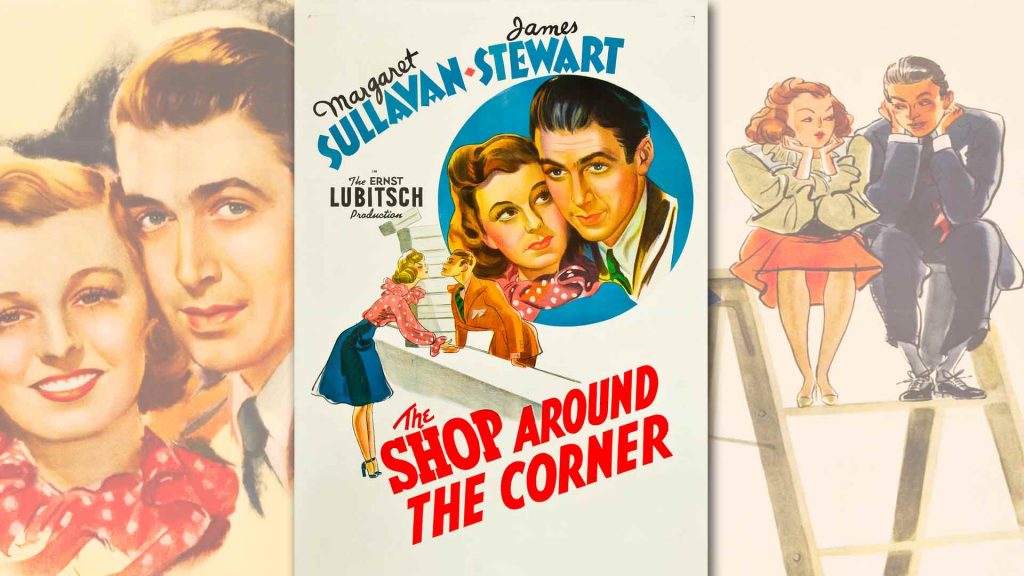
The Shop Around the Corner

Drama/Romance
1940 / 99 minutes
Rating: 9/10

While Jimmy Stewart is best known for his other Christmas movie, It’s a Wonderful Life, this is the one that mom and dad should watch for an in-home date night.

Stewart plays the young Alred Kralik, top salesman at the Matuschek and Company giftshop in Budapest. As top salesman, he serves as confidant and all-around right-hand man to his boss, Hugo Mastuschek. When a young lady, Klara Novak, comes in looking for a job, it is Alfred’s sad duty to inform her that there just aren’t any positions available. But strangely Alfred’s boss, in a fit of independence, decides to override Alfred and hires Klara.

From the start, it’s clear that Alfred and Klara have a little chemistry, but he decides she isn’t the girl for him. Maybe it was how they first met, but whatever the reason, the two of them just can’t get along. And besides, Alfred already has a girlfriend of sorts. He has a heart-to-heart, mind-to-mind connection with his long-time pen pal, and how can mere physical attraction compare to something like that?

It just can’t!

Before he rushes off to marry his pen pal, Alfred decides he should probably meet her once first. And it’s at this first date that he finds out his pen pal looks a lot like the new store clerk…an awful lot like her! Turns out, Shop Around the Corner is a great counter to the Hollywood notion of love at first sight – this is love done write!

Cautions

The one caution here regards a backstory and the reason why Mr. Mastuschek decided to override his top salesman. He suspects Alfred of having an affair with his wife. It turns out that while Mr. Mastuschek is wrong about which salesman it is, he is right about the affair, and that drives him to attempt suicide. Thankfully he is saved by the store’s delivery boy. This mature topic matter means this isn’t one for the whole family, even though it is delicately handled.

Conclusion

Shop Around the Corner has been in Time magazine’s Top 100 Films list, has a 99% rating on Rotten Tomatoes, and was popular enough to spawn two remakes. A musical adaptation, In the Good Old Summertime (1949), was done less than a decade later and stars Judy Garland and Van JohnsonThis time the two letter-writers are working in a music store. Not as good as the original, but it is a solid 7. Van Johnson isn’t as charming as Jimmy Stewart, and near the end even comes off as a bit creepy. That said, it is fun to see how this remake compares and contrasts with the film that inspired it. Another sequel is Tom Hank’s You’ve Got Mail (1998), which was super popular, but which also takes God’s name in vain.

If you enjoy Shop Around the Corner, you may also like a couple more from the same director, Ernst Lubitsch. His To Be Or Not To Be (1942) is about a Shakespeare acting troop surviving World War II. And Ninotchka (1939) is a comedy about a loyal Russian communist who comes to Paris and falls in love with a man who represents everything about the West that she despises. There are some good and educational laughs in that one!

Check out Shop Around the Corner‘s trailer below.

Enjoyed this article?

Get the best of RP delivered to your inbox every Saturday for free.


Up Next


Red heart icon with + sign.
Drama, Movie Reviews

Casablanca

Drama 103 min / 1943 Rating: 10/10 While today if a film won an Oscar that'd be a reason not to see it, when Casablanca won Best Picture back in 1942, it meant something. And today you'll still find film historians touting it as the best picture ever. When Ilsa Lund hears that the Nazis have killed her husband she is inconsolable…until she meets Rick Blaine. They meet in Paris, a city on the brink of an invasion by German forces, and in the midst of this ongoing chaos the two quickly fall in love. But then, mysteriously, Ilsa runs away. She disappears from Paris without a word of explanation, and leaves Rick an embittered man. Three years later they bump into each other again, this time in the free French North African town of Casablanca, but Rick is stunned to find out that Ilsa is there with her very undead husband, Victor Laszlo! In one of the film's most stirring scenes, "La Marseillaise," the French National anthem, is sung in Rick's bar at the behest of Laszlo, a heroic man but, looking at this from Rick's perspective, a competing love interest. But Lazlo is singing to drown out the Nazi soldiers singing "Die Wacht am Rhein," a German national anthem of sorts – they are staking their claim to Casablanca, and Lazlo won't have it. Then Rick gives a nod to the band, and they start playing the French anthem, and everyone joins in. I read up on this, and discovered that among the extras populating the bar background were many actual refugees, who had fled Nazi persecution in Germany and elsewhere, and their tears may well have been real. Cautions The most obvious objection here is that Rick has a romance with a married woman. But at the time both Rick and Ilsa think her husband, Lazlo, is dead so I don't think they can be faulted. When Lazlo reappears, Rick and Ilsa's romance ends. Then, there is a scene in Paris in which Rick is talking with Ilsa in a hotel room, and you can choose to think that is "their" room, or simply presume that Rick has his own room. In other words, you can choose to conclude they acted properly, or choose to think they didn't, but the film doesn't force you to go either way. I choose the latter. I'll also note that a hero in the story, Rick, owns a bar which is also a gambling joint. Not the sort of hero that Christians should usually find admirable. But the point is, Rick doesn't start off all that heroic. He does show some empathy when a a young girl is gambling to hopefully get enough money for her and her husband to flee to America - he fixes the game in her favor. But the point, early on, is that Rick is all about Rick, and it is only the reforming Rick who becomes the hero willing to risk it all for others. Conclusion I am a fan of many World War II films, particularly those that were made at that time. What sets Casablanca apart (and above) the many other very good WWII movies is that it is not a movie about heroes doing heroic things. Rather it is about lonely, broken, and even wretched people in difficult conditions doing the right thing in the end. That might sound rather depressing, but it isn't. These are the sort of folk we can empathize with, so when they pick principle over pragmatism we're right there with them, cheering them on, and hoping that we would do the same. This is one of those rare classics that even today's audience is sure to love. I'd recommend it for 12 to 112, with two thumbs way up! For a very different (but equally enthused) review, check out Harma Mae Smit's thoughts here. ...


We Think You May Like