Transparent heart icon with white outline and + sign.

Life's busy, read it when you're ready!

Create a free account to save articles for later, keep track of past articles you’ve read, and receive exclusive access to all RP resources.

White magnifying glass.

Search thousands of RP articles

Helping you think, speak, and act in Christ.

Open envelope icon with @ symbol

Get Articles Delivered!

Helping you think, speak, and act in Christ. delivered direct to your Inbox!

A A
By:

The Peleg Chronicles

This one sat on my shelf for months because a glance at the back had me dismiss it. The series was touting what it didn’t include: “No Magic – No Evolution – No Humanism.” That is all fine and good – I’m not a big fan of any of those – but when the bragging points are about what it is not, that makes me skeptical (“You’ll love her, trust me. She’s not hideous, not argumentative without reason, and not dumb as a rock”).

But in this case I was very wrong.

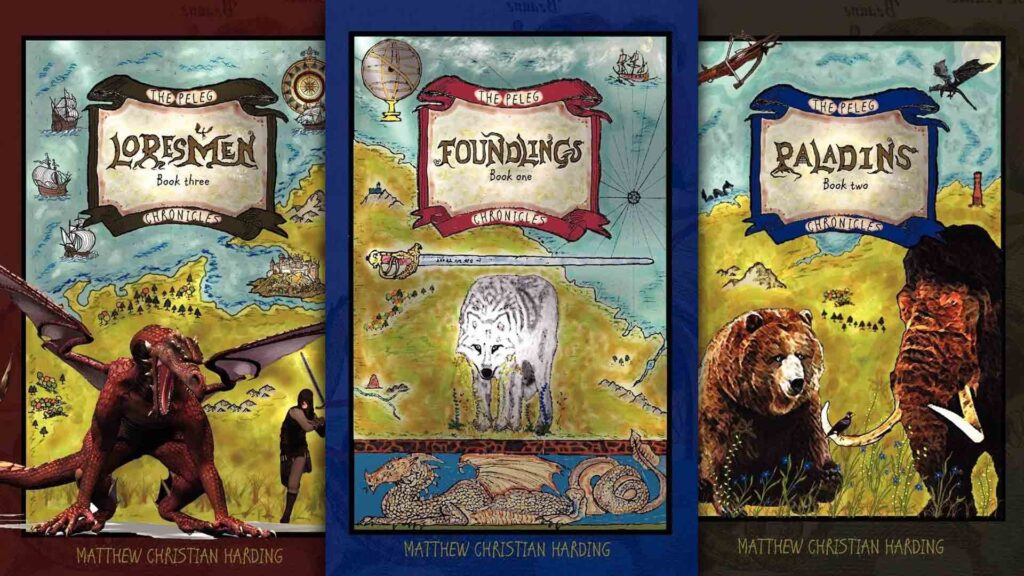
Matthew Christian Harding’s 3-book series, The Peleg Chronicles, was a solid bedtime read for my daughters a few years back, and we all really enjoyed it.

It’s quirky Christian fiction, with a fantasy feel (though there isn’t any magic) set in biblical times. I’m not normally wild about biblical fiction because I don’t want to get confused between what a novelist presents and what the Bible actually says. But Harding has picked a time – the days of Peleg (Gen. 10:25) after the Tower of Babel and before Abraham – when the Bible doesn’t say much, and that eliminates any chance of confusion.

The author depicts a post-Flood world in which the followers of Noah’s God are few, dragons exist but are rare too, and a sect of Dragon Priests is gaining power. In the first book, Foundlings (256 pages, 2009), we’re introduced to Lord McDougal, a hero who is as graceful and deadly in battle as he is awkward around ladies. This is just such a fun flaw, but it’s more than just a foundation for comic gold – McDougal’s social bungling might be what keeps this mightiest-of-all-warriors a humble servant of all in need. Dimwitted giants and a cowardly-lion type warrior add to the comedy.

But what makes this a book worth reading is the Christian depth. I was struck by how deep the dialogue could get – when the going gets tough, different characters struggle with doubt, and the answers offered by the followers of “Noah’s God” aren’t pat or simple. It’s that depth that had me reading chunks to my wife; this is a teen series that could also encourage adults.

Caution

There aren’t any concerns, but I’ll also note a key edit it could have benefited from: when characters praise God, or speak a prophetic word, they do it in King James language. That’s fine for an older guy like me, but I had to “translate” as I read it to my kids. I also wish that cover art was more attractive because we do still judge a book by its cover.

Conclusion

So this will be best suited for teens who have already shown an ability to tackle bigger books that require an attention span. For them, I’d give two thumbs up to Foundlings and its two sequels, Paladins (2010, 272 pages) and Loresmen (2014, 278 pages). And to offer up a taste, the author has made the first book available for free as an ebook on Amazon.com.

This is author Matthew Christian Harding’s first go at fiction, so there are some rougher bits of writing that could have done with just a bit more polish. But when his characters talk to each other about God’s Word (they have but one book at the time – Job), it can be amazing. My favorite scene was two characters, walking through a cave in utter darkness, take turns talking as all Christians really should in tough circumstances, but don’t. It is realistic dialogue in the sense that it is not stilted or false, but astonishing in that, while this is how we should encourage one another, I’ve not run across many authors who present Christians as we should really want to be.

So, lots to love in this one, but because of a few spots of rough writing, I’m going to give this trilogy a rating of: GOOD.

Enjoyed this article?

Get the best of RP delivered to your inbox every Saturday for free.

A A
By:

The Unlikely Intrusion of Adams Klein

by John Greco
2025 / 288 pages
Rating: good/GREAT/gift

Adams Klein is a pretty ordinary 14-year-old, except, maybe for that “s” at the end of his first name…. and that he’s from the future. He’s been sent back 200 years, to our modern day, for his protection. In the future the dictator wants to kill Adams, but now that he’s back in the past, he’s safe, right? Well, so long as he doesn’t get noticed. If he pops up in a newspaper, then the future’s dictator can figure out where he is, and when, and send his killer robots back in time to get him.

So Adams keeps a low profile, hiding in the woods in the middle of the winter. But how long can a boy do that without the loneliness getting to him? Then, when he sees a girl, Emma Bloom, fall through the ice, he springs into action and saves her, and that gets him noticed! Are the killer drone robots on their way? You bet. But saving Emma also got Adams friends: Emma, and a boy named Clay Danvers. Together they’ll take on the Marshall and change the future!

Cautions

There is some violence, but mostly talk of it, rather than anything detailed. But some talk of people getting killed is inevitable in a book about a future really evil tyrant. Maybe the freakiest bit is someone being threatened with having his vocal cords removed and implanted in a drone.

I’ve read the sequel too, and while I don’t want to give many spoilers, but I’ll share one that’s… symptomatic. At one point a robot basically becomes a moral creature – it’s like it now has a soul. If this was a secular book I’d maybe have a problem with that, as the evolution-pushing materialist world says we are just meat computers/robots ourselves, so a sufficiently complex robot should be able to become a conscious moral creature with its own soul of sorts (though maybe materialists would say neither robots nor people have any sort of non-corporeal part of themselves like a soul). My point is, in secular hands a human-like robot would be an attack on the distinctiveness of human-kind (Gen. 1:26-27). But that’s not what’s going on here. It’s just a fun quirky side-character, that’s all. So there are some plot points that in a secular author’s hands might be troublesome but just aren’t here.

I’ll also note – this is a bit of spoiler, so don’t tell your kids – that the evil future “Marshall” is playing with occultic things. He’s trying to get help from “the Ones Out There.” I was a bit worried where it was going at first, but I had no need – it speaks to the spiritual realm, but from a solidly Christian perspective.

Conclusion

Unlikely Intrusion is the first book in the TimeFall Trilogy, and the second, The Bewildering Courage of Emma Bloom, is every bit as good, which has me looking forward to book 3, The Astonishing Destiny of Clay Danvers. I think the series would be best for boys (and some girls too) 10 through 14 who like adventure stories. Lots of action here, and kids with courage. Very creative, and the Christian underpinnings are evident, even if they aren’t explicit.

You can hear the author read Chapter 1 below.