Transparent heart icon with white outline and + sign.

Life's busy, read it when you're ready!

Create a free account to save articles for later, keep track of past articles you’ve read, and receive exclusive access to all RP resources.

White magnifying glass.

Search thousands of RP articles

Helping you think, speak, and act in Christ.

Open envelope icon with @ symbol

Get Articles Delivered!

Helping you think, speak, and act in Christ. delivered direct to your Inbox!

A A
By:

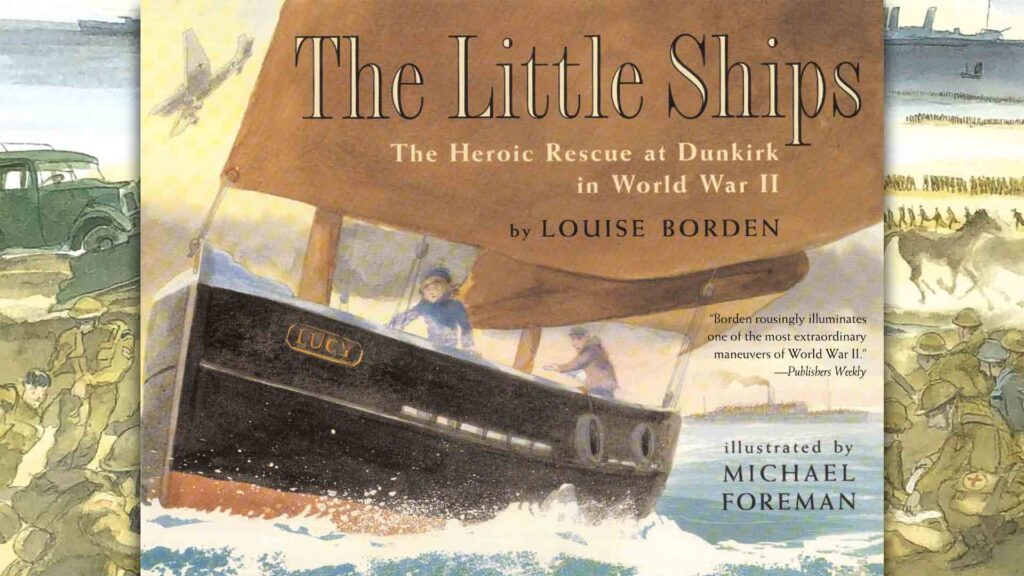
The Little Ships: the Heroic Rescue at Dunkirk in World War II

by Louise Borden
illustrated by Michael Foreman
1997 / 32 pages

In May of 1940, half a million British and French soldiers were trapped in on three sides by German forces. They had their back to the sea, and the Germans seemed intent on pushing them right into it. But then the call went out all over the English coast for ship owners to come bring their boats to save these stranded soldiers. And they came, by the hundreds. In total 861 ships set sail for the shores of France, for the beaches of Dunkirk, including hundreds of small fishing boats and pleasure craft. This is one of the most stirring examples of courage, in a war that was filled with them, because this the most ordinary sort of courage – ordinary courage  these were ordinary men the soldiers’ old neighbors, their fathers and hometown friends heading out into danger simply because they were needed. They brought back more than 300,000 soldiers.

That’s the story this little picture book sets out to tell, and it is quite a story. The author tells it from the perspective of a fisherman’s daughter, who, because she is a seasoned sailor, goes along with her father and their little ship, the Lucy. This is a read-out-loud book, as the author Louise Borden lays out lyrical sentences – this isn’t poetry, but it has a clear cadence and rhythm that springs up from the page.

The illustrations are water colors, which ably captures the mood and the scene, but the pictures themselves are not that eye catching – the colors are all muted. That’s one reason I think this book may have to be read twice to be appreciated: it is a book about quiet courage, and the pictures are quiet too. But the text, read aloud, and the somber tones of  the illustrations have a cumulative impact. It really hits you in the end. But the worry is that children might stop after only a few pages.

So to conclude, this is a great book for a teacher to read out loud to their class. There is a fair amount of text per page, and the intense story line also makes this a book best suited for Grade 2 or older, and while they may not be wild about it at the start, I’m confident they’ll appreciate it, and the courage of these hundreds of ordinary men, by the time they get to the end.

Enjoyed this article?

Get the best of RP delivered to your inbox every Saturday for free.

A A
By:

Shooting at the Stars: The Christmas Truce of 1914

by John Hendrix
40 pages / 2014
Rating: Good/GREAT/Give

I was raised with stories of the Dutch Resistance and the Canadian liberators fighting against the brutal Nazis – war, it seemed, had clear villains and obvious heroes. Later, though, I learned that right and wrong in war can be far more confusing: for example, in recent years we’ve seen US-backed groups fighting other US-backed groups in Syria.

John Hendrix’s Shooting at the Stars: The Christmas Truce of 1914 presents parents with a tool to give our children a more nuanced understanding of war.

In a style that is halfway between realistic and cartoon, the author tells us the events of Dec. 24 and 25, 1914. On the day of Christmas Eve, 1914, all along the frontlines, the shooting slowed, and that night the Germans could be heard singing Stille Nacht, Heilige Nacht – “Silent Night, Holy Night.” Then the next morning, on Christmas Day, in spots up and down the frontlines, German, British, and French troops spontaneously came out of their trenches and celebrated Christmas together.

The next day they returned to killing one another.

Does that make this book sound anti-war? I’d say it is more an underscoring of just how horrible war is. Fighting is sometimes necessary, which is why we are grateful for the courage of the Dutch Resistance and the Allied forces in World War II, who understood that stopping the Nazis was worth risking, and even giving, their lives. We need to remember their sacrifice because it was noble, and selfless, and good.

But if war gives us examples to admire and imitate, there is also much that is foolish, and which we must learn to avoid. To give our children a more complete understanding of war, we need to show them that there are those who, under the guise of patriotism, rush to war even though war should always be a last resort. There are leaders who do not treat their young men’s lives as precious, and World War One is an example of that right up to the last day when 11,000 soldiers died in fighting that occurred after the peace treaty was signed. Commanders who sent their men out on offensives on that last day – some from our side – should be remembered as murderers.

Shooting at the Stars is a gentle way of teaching the ethical complexities of war. It is gentle in that no blood or gore is seen (making this suitable for maybe Grade Three and up). The most war-like illustration occurs on a two-page spread where we see three corpses, as soldiers on both sides work together to bury their dead. What is striking is simply that there were men on both sides who could praise God together one day and fight to the death the next. That is a shocking bit of history. And it needs to be remembered.

Jon Dykstra and his siblings blog on books at ReallyGoodReads.com.