Transparent heart icon with white outline and + sign.

Life's busy, read it when you're ready!

Create a free account to save articles for later, keep track of past articles you’ve read, and receive exclusive access to all RP resources.

White magnifying glass.

Search thousands of RP articles

Helping you think, speak, and act in Christ.

Open envelope icon with @ symbol

Get Articles Delivered!

Helping you think, speak, and act in Christ. delivered direct to your Inbox!


Most Recent


The Rest


Red heart icon with + sign.
Book Reviews, Graphic novels

Nathan Hale's Hazardous Tales (3 books)

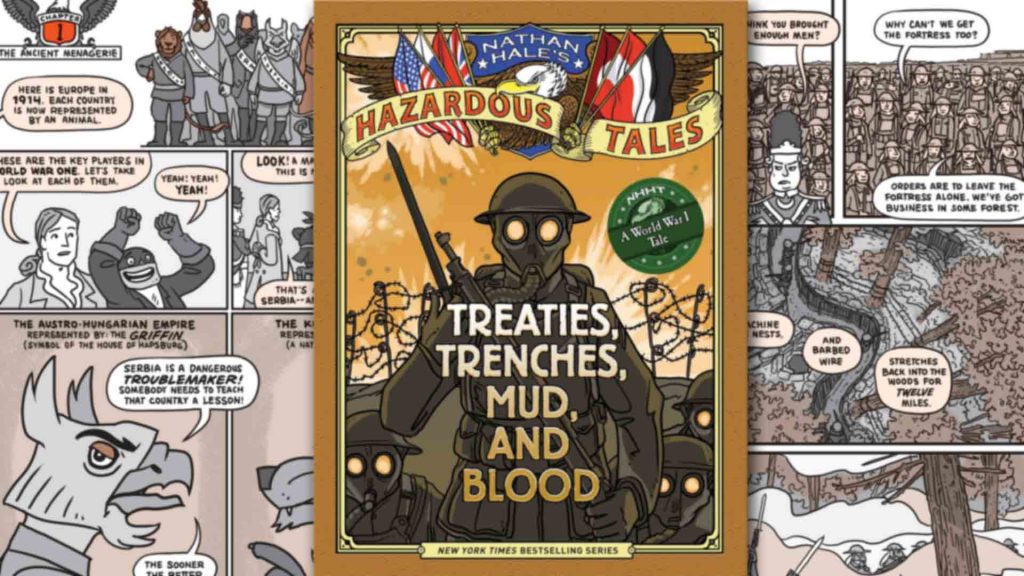
Nathan Hale's Hazardous Tales are a growing series of fast-paced, thoroughly researched, historical graphic novels. The best of these making learning easy, with humor and history intermixed such that kids will not just be eager to read them, but will be happy to reread them again and again. That makes them quite special. But the author does not seem to be a Christian, and that comes out more as the series has progressed. There are 13 books so far, with the second last spending several pages arrogantly belittling God. So, if you are going to introduce your kids to Hazardous Tales, be aware they aren't all alike. I've reviewed only 8 so far, and have recommended just 3. RECOMMENDED (3) I've listed these, not by publication date, but by preference, with my favorite right up top here. Treaties, Trenches, Mud, and Blood 2014 / 128 pages Rating: Good/GREAT/Gift A few decades ago a cartoonist decided to tell the story of the Jewish Holocaust in World War II via an animal metaphor. He made the Jews mice, and the Germans cats, the good folk dogs and the collaborators were pigs. It was a dark story, of course, but the use of the animals made it slightly less gritty, and thus more bearable. In Treaties, Trenches, Mud, and Blood, author Nathan Hale has done something similar for World War I. Each nation is assigned an animal: the Germans are eagles, the English are bulldogs, the Belgians are lions, the Ottomans are otters, the Russians bears and the Americans get stuck being bunnies, because eagle has already been taken. Hale does a good job of laying out the facts, and detailing the slaughter that amounted in the millions, but also lightening things up with doses of humor whenever he can. I knew the basic facts of World War I already, but learned a lot from this overview. Of course a comic, particularly one presented in metaphor form, shouldn't be regarded as an authoritative source, but it does provide a useful overview. Now if I want to find out more, I've now learned enough to know what I might want to read more about. This book is one of in a series of "Nathan Hale's Hazardous Tales" referencing both the author Nathan Hale, and the more famous American spy Nathan Hale who lived 250 years ago, and who appears in this series as the narrator. I hope to review the series at one point, as it has both high and low points. Hale used much more discretion in Treaties, Trenches, Mud, and Blood, though there are a couple cautions to share here too: this is a historic account that details the death of millions, so even though it is in animal/comic form parts of it would be too much for the very young. I'm not talking about gore - there isn't any - but rather the story itself. Also a language advisory: a couple of "good heavens"s pop up, a "holy moley" and in one instances a character says, "ye gods" (page 73). I'd recommend this for children 12 and up, though some kids might be able to handle it as young as 10. Big, bad, Ironclad 2012 / 128 pages Rating: Good/GREAT/Gift About the American civil war, and how the two sides each had, for the first time, ironclad ships (that cannonballs would just bounce right off of) fighting each other. If you only have a passing familiarity with the US civil war you might not know that it wasn't just a land-based battle. One lesser-known aspect, investigated in this graphic novel, is the attempt by the North to use a naval blockade to stop the South from exporting their cotton. To break the blockade the South built a ship with an iron hull, a hull so strong that cannon balls would bounce off of it. When the Merrimack was put out to sea it was every bit as devastating as it's creators had hoped, and was hampered only by an underpowered engine. The North had heard rumors about the Merrimack long before she was completed and had gotten to work on their own ironclad ship. So not too long after the Merrimack set sail, the North's response, the Monitor was completed. This is a fascinating tale, with the whole civil war as a backdrop. While the information is well researched, the book itself is drawn in a very comical style, with one character, Gustavus Fox, actually presented as a uniform-wearing fox. So this is great for someone trying to get a good overview of events – at 128 pages it has the size to give us much more than a glimpse – but it wouldn't be the sort of book that would be cited in the bibliography of any paper. Donner Dinner Party 2013 / 128 pages Rating: GOOD/Good/Gift The general gist of this tale is well known: the Donner party was a caravan of settlers heading to California that took an ill-advised short-cut and to survive the winter had to eat their dead. So this might not seem the sort of story that is well suited for a graphic novel account: too dark and disturbing. There is certainly something to that, but author Nathan Hale does ensure this is, at most, a PG-rated account - there is no gore of any sort, save one panel in which a man is stabbed and that is as muted as a stabbing can be. I enjoyed learning the true (or mostly true - the author fills in the gaps with his imagination) story behind the popular folk tale. But, unlike the previous story on World War I, there is no pressing reason to read this graphic novel. There is no real lesson to be learned (other than, as one survivor put it, "Don't take no cut-offs, and get where you're going as fast as you can") and the story of the Donner party has had no real impact on our culture or our world. So if you don't know much about it, well, you can still get by. But readers will get an idea of just how brave (and perhaps crazy) these first settlers were, to travel for months on end through wilderness and Indian lands and without even really knowing what they were in for. So my overall recommendation would be to get Treaties, Trenches, Mud, and Blood before you get this one. But while there is no pressing reason to get this one, there are no real reasons not to, and it is an interesting slice of American history well and quite delicately told. You can get a copy from Amazon.com by clicking here. NOT RECOMMENDED (5) While a few of the below are not recommended because they include an instance or two of God's Name being abused by a historical figure (such that a librarian with a black marker could perhaps handle things), there's also at least one where author Hale devotes several pages in a row to mocking God. I've listed these here in the order they were published. One Dead Spy 2012 This is the first book in the series, and American spy Nathan Hale's first story is his own – when he first decided to become a soldier, his part in booting the British out of Boston, the story of the supply ship he seized - which coincides with the story of the early part of the American Revolution. That's the real thrust of the book, to give readers a look at how the war started. But at just 128 pages there simply isn't room for the whole story, so this tale ends with the end of Nathan Hale. Or rather, it ends with him on the gallows, telling stories to the Hangman and his British guard. It is the first story, but finds it's place here at the bottom because, unfortunately, the author includes an exact quote from a British General that begins with the general taking God's name in vain (page 57). That wasn't necessary. The Underground Abductor 2015 This would best be described as a biography of Harriet Tubman, an American slave who helped dozens and eventually hundreds of other slaves flee to freedom. She worked with many others, who would shelter the slaves as they went from one stop to the next in their journey from the slave-holding southern states to the freedom found that was to be found in Canada. These escape routes that slaves would take, traveling from safe house to safe house, came to be known as the Underground Railroad...even though very few trains were involved in their transport, and none of it was really underground (though a few secret cellars were involved). This is a fascinating story, but there is some strange mysticism included: Harriet Tubman, after recovering from a severe head injury, would claim to get visions from God. But more troubling is that this book, like One Dead Spy takes the Lord's name in vain. In this book it happens at least a couple times, which is why it, also, is near the bottom of this list. Alamo All-Stars 2016 "Remember that Alamo!" - many of us have heard this rallying cry, but don't know what it is we're supposed to remember. This is the story of the stand that a 200 (or so) Texans took against a Mexican army many times that size in 1836. The Texans took their stand in a makeshift fort at the Alamo mission, and after a 13 day siege the Mexicans wiped the smaller Texan force out, leaving only a few women and slaves alive to spread the story in the hopes it would break down resistance to Mexican rule. It did the opposite - among those killed were the infamous Jim Bowie and famous Davy Crockett, and their deaths helped spark a revolution which saw the Mexicans defeated and Texas declaring its independence (10 years later Texas joined the United States). Hale does another fine job here of teaching history while keeping things very interesting, but in two instances (page 99 and 103) he again depicts God's name being taken in vain, both involving historical quotes. Blades of Freedom 2020 This is a grim history of Haiti presents Christianity as just another religion, akin to Voodoo. It has blood aplenty, and a naked butt. And it also repeatedly takes God's name in vain. Above the Trenches 2023 It's a World War I story about the very first fighter pilots. The story is incredibly complex, such that I don't think most kids will even be able to follow what's going on. God's name is taken in vain in French ("Mon Dieu!"). There's also an few F-word-related jokes about a Dutch plane builder, Anthony Fokker, and the Fokker plane he built. One example: a pilot is called a "Clever Fok –" before getting interrupted by the narrator telling him to "Shut your mouth." Add to that, the prophet Elijah makes an appearance on a half dozen pages because he is, so it is explained, the patron saint of aviators. The 2 Kings 1:1-17 story is told of how Elijah informed Israel's King Ahaziah that he was going to die from the injury he had suffered because he had chosen to consult Baalzebub rather than God. We also get to see how Ahaziah sent a group of 50 soldiers to bring him Elijah, and how God consumed those soldiers in fire.  We see it happen again a second time to the next group of 50 soldiers the king sends. "Crispy critters!" one of the narrators interjects excitedly. Then we see how the third group of 50 was led by a wiser soldier who asked Elijah to spare the lives of his men, which he does, to the disappointment of this same narrator. It's a portion of Scripture that has a context – God's utter holiness, and Ahaziah's incredibly arrogant rebellion – but to anyone new to this story (including many Christians) this is everything from bizarre to monstrous. Patron saint of aviators? That's a weak reason to include a story that readers will not understand at all, so this is just author Nathan Hale taking a shot at God, hoping to get laughs. Give this one a miss....

Red heart icon with + sign.
Animated, Movie Reviews, Remembrance Day

Sgt. Stubby: an unlikely hero

Animated / Family 2018 / 84 minutes Rating: 8/10 I read a review by a parent who arrived at the movie theater with his four-year-old and picked this film based solely on the smiling ever-so-cute doggie he saw on the movie poster. One problem: while this is about a charming, incredibly clever dog named Stubby, it's also about life in the trenches of World War I. And that's not 4-year-old material. Why, oh why, don't more people read movie reviews! But, as we mark the 100th anniversary of the end of the "Great War" this is a movie that many a ten-year-old and up will enjoy and should watch. It's based on the true story of Sgt. Stubby, the most decorated dog in American history. The story begins with the homeless dog attaching himself to a unit readying itself to be shipped overseas. First, he charms his way into the heart of one Private Robert Conroy, the main two-legged character in the film. Then, one by one, from the lowest private to the general in charge, he wins over everyone. Well, not everyone. Some folks just aren't dog people, and Private Elmer Olsen just doesn't understand what's so special about Stubby. When the unit heads overseas, Stubby manages to sneak aboard the ship, and he too is heading to the fight. From this point onward there's one perilous scene after another, but to make it appropriate for (nearly) the whole family, the filmmakers decided to make this an entirely bloodless film. Even as bullets are whizzing, no one gets shot. German bombardments send both soldiers and dirt flying, but the soldiers get dug out and emerge both unbruised and unbloodied. While parents will appreciate the nonexistent blood and gore, by muting the violence and death the film ran the risk of also muting the sacrifice that these soldiers made. But as the film draws to a close there is one death – to a secondary character, Private Olsen – that drives home, even to the younger audiences, what these men risked and what they lost. Without giving it all away, I'll note that the death happens off screen and we don't even see the body. It is the soldier's absence that is noted – while his friends are looking for him after the last big battle, Stubby brings them his helmet. That'll get some kids crying, and even moisten the eye of many an adult. But it is necessary. And it is done with great care and restraint. As you'd expect with an energetic pooch as its star, there is a lot of fun in the film. Kids are sure to enjoy Stubby training along with his fellow soldiers, getting chased by the cook, and winning over the Colonel after Conroy teaches his little buddy how to salute. In another treat, Gérard Depardieu makes an appearance as a large, wise French soldier, who along with Conroy and Stubby is tasked to spy out German positions. These "three musketeers" become fast friends, saving each others' lives. Cautions There are only a couple of concerns, including a little bit of language. The worst of it includes one character saying "What the devil?" and another exclaiming "I'll be darned." There is also just one bit of "naughty" comedy as the drill sergeant lectures his men on how they should imitate the never-complaining, always-ready-to-roll Stubby but he makes this speech just as Stubby decides to lick his nether regions. That gets a laugh out of the sergeant and his men as they are presented with proof-positive that Stubby has some traits that aren't worthy of imitation. The big caution would concern the near constant peril. This is not a film for four-year-olds. But most ten-year-olds will be sure to enjoy it. Conclusion This was such a pleasure to discover. Before this, I couldn't have imagined a war film that would be appropriate for the very young and yet still be a treat for their parents. This would be a great one to watch with the family for Remembrance Day, Memorial Day, or Anzac Day. You can find out more about the film at its website: StubbyMovie.com. ...

Red heart icon with + sign.
Book excerpts, Remembrance Day

Living through World War II

This an excerpt from Gerda Vandenhaak's "Geertje: War Seen through the Eyes of a Child as an Adult" ***** I am lining up for food. I can feel the crackling of the papers my mom put under my jacket against the wind. I have in my hands a round brown enamel little pan with two black handles. The edge is black too and there is a chip broken off the edge. We line up at the soup kitchen. I see no adults. It must be for children only. But I do not see my brother and sister. The soup smells good. It is grayish brown. It makes me feel good inside.... **** I keep looking at my legs. They feel so heavy. I am surprised every time I look at them. They look the same. It seems like I am wading through something heavy. I don't know why I feel this way. I did not find much food today, only a white paper bag with some powder in it. I don't know what it is. I did not even steal it. I just found it on a windowsill. When I walk into the house, mom right away puts her arms around me and says: "What's the matter?" Nothing is the matter. I only have this powder and I hand it to mom. Mom smiles and seems to be happy with it. "Salt," she says, "Real salt, this is great." She pulls me towards her and holds me and then I tell her about the dead people and the three that we knew. Mom cries and I let her. "Are you sure?" she asks. "Yes, I checked," I tell her. Then my mom holds me so tight, it almost hurts, but it also makes me feel good. Mom says it is a good thing that they do not shoot children, so I won't tell her about the twins.... My brother and I are standing outside in the darkness. Our backs are pressed against the wall of our house. I am seven and my brother is five years old. I can feel the roughness of the wall under my left hand. My brother is very brave. He holds my hand very tightly. I am never afraid. My mother said to wait before we start walking, to wait until we could see. And if we were afraid to look up to the stars and God would look after us. We have to get some milk for the baby. Mom only has water for her. We have to go to the second farm. Mom said not to go to the first one. We walk slowly, we do not talk, not even whisper. People are not allowed to be outside after eight. We come to the farm and knock on the back door, it opens and a hand pulls us inside. The door is closed behind us and then a candle is lid. The warmth of the place puts its arms around us. "What do you want, you are only kids," a voice says. We ask for some milk for the baby. The farmer’s wife smiles at us and says, "Yes." I can feel my insides again. The farmer’s wife says we can come again, as she fills the milk container. When we get home, mom hugs us so tight, it almost hu rt again. Mom loves us so much.... **** I did it! All morning I had waited on the side of the road with the other kids. The trucks with the sugar beets would come by. This was the place where the trucks really slowed down, because of the curve. I had jumped on the back of the truck and now had three sugar beets – two I grabbed and one that fell down after me. My arm was scraped and blood trickled down one leg, but I did not feel it at all. I was so overjoyed with the beets I ran all the way home. My brother and I cleaned the beets in the kitchen sink and then we sucked on them. I can still taste and feel the breaking of the beet skin. It felt funny and ribbling. For the next two days we sucked the beets. At night we would climb in mom and dad's bed and huddle together under the blankets. I don't remember what happened after that. But I do know that was the last time I needed to steal food.... **** I sit between them, my mother and her friend. We are taking the horse and buggy to the concentration camp in Amersfoort, to visit dad and the friend’s husband. The buggy belongs to the friend. We have two plates of food wrapped in towels, in the back. They talk softly right above my head. I can hear every word. The steady talking makes me sleepy. I am so hungry and now we are bringing food to the camp. Why? We need food ourselves! Suddenly we are there. I even see my dad. He is wearing pajamas… strange. Mom's friend talks to the guard. The guard shakes his head. Mom starts to cry, so the guard does not look at her again. We go to the fence. The men all look funny, as if they are dead. I have seen dead men, but the men here still walk. They guard starts yelling and the men leave, including my dad. He looks at us, his eyes are very strange. Then he leaves too. We go back home. In the back are two plates of food. Mashed potatoes with red cabbage. Mom says we can share it when we get back home. I want to eat it so badly, but I keep thinking of my dad and I feel bad about wanting the food. I don't want to feel anymore.... **** I am setting the table in the dining room. Mom is singing in the kitchen and that makes all of us happy. She got a whole whack of potato peels and she washed them and washed them. Now they are cooked and she added some red cabbage. Mmm… It smells good and we are getting a meal today. It is my brother’s turn to sit in dad's chair today. As usual, I open my eyes real quick, just for a second, while mom prays. I am sure that when mom prays, God, Jesus and the angels are there in the dining room with us. Again I was not quick enough. We start to eat, then suddenly a siren, shooting and yelling. We all jump up and run to our hiding places under our house. We have three hiding places under our house. I know that, but mom does not know that I know that. I have taken my plate of food with me and go to the farthest corner of the place, my little brother next to me. Other people are coming in and find a place to sit. I hold my plate close to me, my arms protective above it. Someone sees my plate and food and wants to take it away. I start to cry and suddenly there is my mom. She says: "This is still my house and this is my daughter. This is her food and she is going to eat it." My mom sits next to me and I still remember the feel of her arm around me as I was eating then. I just could not stop crying and my sobs fill the room. People are telling me to be quiet, but I just can’t. I eat and I sob and sob. Even when I was quiet my body kept shaking. All night my mother kept her arm around me. My big sister was on the one side and me on the other, my brother next to me. I did not care about all the other people, just about us and my mom. All night long there was yelling and loud noises around us and all night long mom prayed. First out loud with all the people and then softly just with us.... **** Mom woke us up and told us to get ready, quick. "Dad is home,” she said “and we have to flee.” In minutes we are on the road, mom pushing the baby buggy. In the middle of the night we ran. All I remember is the confusion at first: the shooting, yelling again, the piercing scream of some missile and the terrible fear. We wound up in the middle of a skirmish near Nykerk. A soldier came and told dad to go the other way. I remember hiding under a bridge and waking up in the morning in the middle of a field with dad’s arms around the three of us. We started walking again along a path at the bottom of the dike. I remember mom pushing the buggy and in it the baby and a little pan of cooked horsemeat, taken from a dead horse behind our house. I remember dad suddenly having a bicycle. He was walking alongside it, my oldest sister sitting on the crossbar. I remember my brother walking in front of me, step by step. His feet were bleeding and we were walking on all alone in the countryside. Late in the afternoon we rounded a curve in the dike and we saw a farmhouse. I can still see it. It had orange ribbons all over it and a sign that said they were free!! We did it. We somehow had broken through and were free. I really did not know what that meant. They, the farmers, welcomed us and took us in their home. The farmer’s wife set us all at the table and gave us a bowl of hot oatmeal. Then she poured milk over it and brown powder. Brown sugar, she called it. Dad prayed with us. His voice again sounded funny and mom cried. It was the most wonderful meal I had ever tasted. We all sat there and smiled at each other and cried some more. Dad said we were free and the war was over. We would never be hungry again. The next day we reached our destination, Putten.... This first appeared in the October 2004 issue of Reformed Perspective. ...