Transparent heart icon with white outline and + sign.

Life's busy, read it when you're ready!

Create a free account to save articles for later, keep track of past articles you’ve read, and receive exclusive access to all RP resources.

White magnifying glass.

Search thousands of RP articles

Helping you think, speak, and act in Christ.

Open envelope icon with @ symbol

Get Articles Delivered!

Helping you think, speak, and act in Christ. delivered direct to your Inbox!


Red heart icon with + sign.
Book Reviews, Children’s fiction

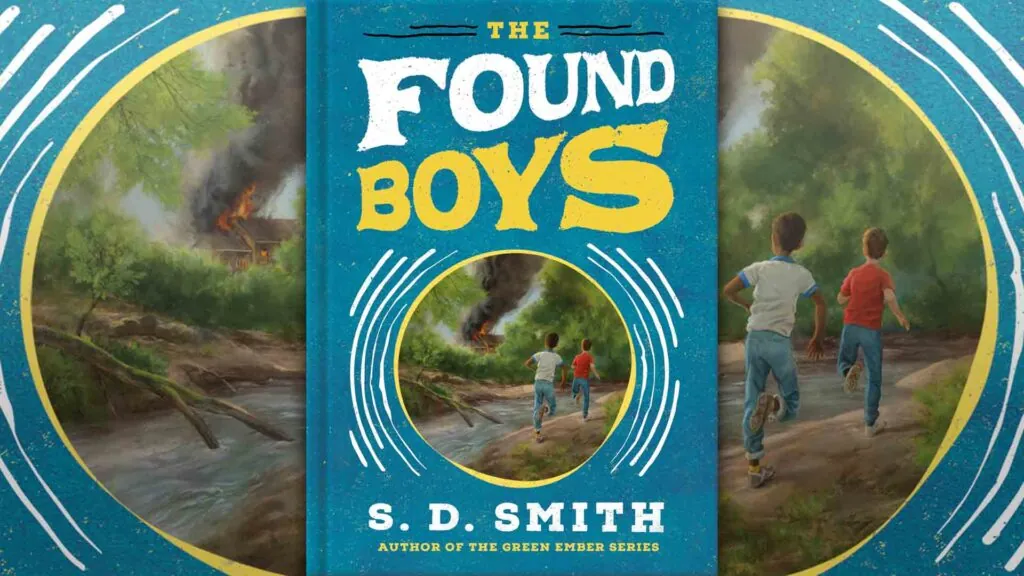
The Found Boys

by S.D. Smith 2024 / 172 pages Rating: Borrow/Buy/GIVE Author S.D. Smith is best known for his rabbits-with-swords Green Ember series, and while this is quite a departure, it is every bit as good. Set in the US south of the 1980s, The Found Boys struck me as Hardy-Boys-meets-the-Ku-Klux-Klan, except they have a black friend, they're all around 12-ish, and everyone goes to church. Friends Tommy and Scott were just hanging out after the service. Their parents never left their Valley Baptist Church early – they sure loved to chat afterwards – so the boys had plenty of time to hit the swings behind the church and then explore the creek behind. And further back yet is an old junkyard, complete with a lost treasure the boys left behind when their exploration was cut short by a couple of junkyard dogs. The boys have made plans to recover their treasure, but the plans always fall short, often because Scott gets a stomach ache at just the wrong time. It ain't just the dogs he's worried about – the junkyard is owned by a wizard! But this time they've got a new friend to help them. Well, he wasn't a friend to start. Tommy and Scott first chased him up a tree. That wasn't all that friendly. But it was because Dooley – that's his name – scared them silly when Tommy and Scott were exploring the nearby graveyard. And, of course, they had to get him back. Dooley is from the black Baptist church on the other side of the creek, and good Christian lads that they all are, peace negotiations were quickly had and a plan was hatched. Together they'll brave the junkyard and get their treasure back from the wizard. I won't give more away, but to say we discover the wizard isn't the magical sort the boys imagine, but the KKK kind. Cautions The cautions here would just be age appropriateness. Racism is a nasty sin, and particularly in the American South – the most shocking section shares how the Klan burned a cross in the black pastor's lawn. Scary stuff for the 10-year-old target audience that this would be best for. Conclusion That said, The Found Boys has the kind of grit kids need to read, and in this classic-in-the-making, we have not just boys having an adventure, but parents stepping in to take the lead. Parental involvement is rare in a children's story, and even here they only come in at about the two-thirds mark. But their appearance is both calming and instructional: author Smith showcases what it looks like when godly men – and their whole congregations – step up. Racism isn't just experienced; it is fought. Yes, there is some grit to this story, and that's what makes it the perfect boy's book. The world had villains, and our boys need to learn what it looks like to stand up and defend what and who God has entrusted to them. I'd recommend it for 10 and up. That said, my girls love this too. The heroes are all boys, but girls seem to be able to get over that a lot better than boys would ever do the reverse....

Red heart icon with + sign.
Book Reviews, Graphic novels, Teen non-fiction

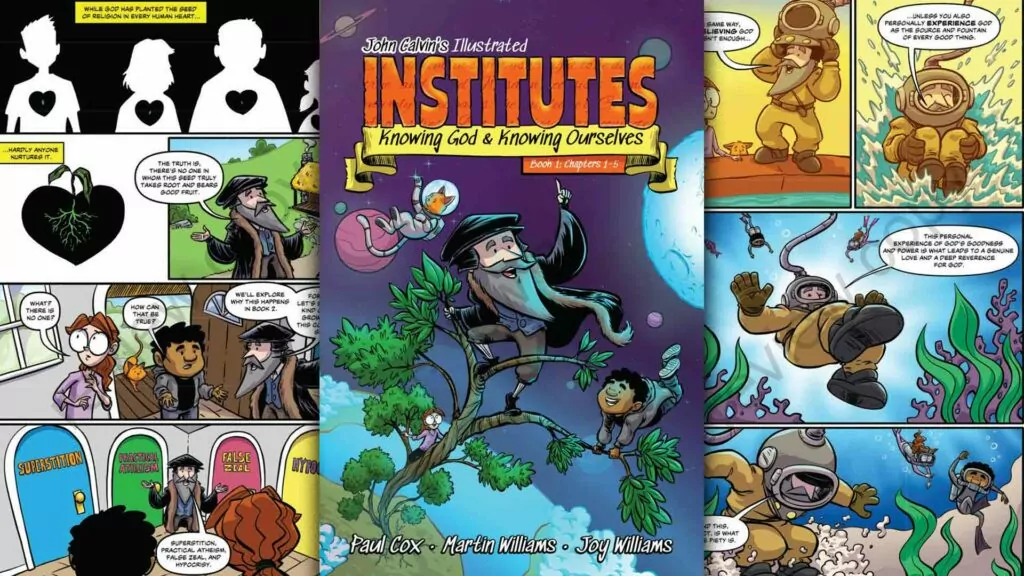
John Calvin's Illustrated Institutes: Knowing God & knowing ourselves

Book 1 - Chapter 1-5 by Martin Williams and Joy Williams illustrated by Paul Cox P&R Publishing 2025 / 82 pages Rating: Borrow/Buy/GIVE Have you always meant to read Calvin's Institutes of the Christian Religion and just never gotten off the starting blocks? You're not alone, and help has arrived! Calvin's weightiest work has been transformed into a much more accessible, but still substantive, comic book. Or, rather, a good start has been had. Husband and wife writers Martin and Joy Williams have teamed up with illustrator Paul Cox, (whose Reftoons comics have been featured in Reformed Perspective) on this ambitious project. In their first book they've covered the Institute's first 5 chapters... which leaves them with 75 more chapters to cover in future editions. Our guide is John Calvin himself, along with three companions: Theo is a boy, Geneva a girl, and the cute cat tagging along is named Luther. There isn't a story, exactly. Theo comes across Calvin (and cat Luther) while studying on his computer. And somehow Calvin steps right out of the computer screen and they start talking about the nature of "true knowledge." To give you a taste of what's discussed, here's Calvin explaining that a true knowledge of God – really knowing God – is more than knowing facts about Him: "Think about this: Satan knows a lot about God and even trembles (James 2:19)... he doesn't love God. That's why fear without love isn't true piety and love without fear isn't true piety either. God's children, however, both fear and love Him at the same time." This is a mighty abridgment of what Calvin says in his original, but it does cut to the heart of it. And each of the five chapters ends with 10 questions to aid in reflection, and with an encouragement to read the original to dive even deeper. A few of the other issues covered include: How we can only really understand ourselves when we know God How a just God can judge people who have never heard of Him Why there are no true atheists but there are so many idols For another taste, here's Calvin speaking to practical atheism - folks who "might admit there's a God, but they strip Him of His majesty by denying His power and providence – like someone trying to block out the sun with their hands as if that could make it disappear. Even worse they outright reject God's just judgment on the wicked." So who is this for? Anyone who's wanted to study the Institutes – because we all know there is gold about our God to be mined there! – but who is understandably intimidated by the 1700+ page original. This is a way to start. And there is gold even here too. The nuggets are smaller, but Calvin loved our Lord, and that comes out even in this abridged form. These Illustrated Institutes really are for everyone... and for some it is going to be the perfect on-ramp to tackling the much bigger version (and for you, we've got recommendations on exactly what version you should get). That said, even as this does a fantastic job of simplifying and illustrating deep truths about God, it still isn't kiddish. The cartoon pictures might give the impression that this is aimed at young teens, and inside of a Bible or catechism class, 12 and up could tackle it. But this is still Calvin – meaty rather than milk – so not a lot of 13-15 year-olds are going to work through this if they aren't being made to. But an older crowd? Oh yeah. For all of the well-meaning Reformed folk out there who've bought a copy of the Institutes but it's lying on the "to be read much later" pile, this will be such a fun way to learn what all the hype is about. It's been almost 500 years since Calvin's first edition of the Institutes was published, and there is a reason it is still being read today. Now we can all find out why! And if you enjoy this effort, you'll be interested to know that Paul Cox has also crafted The Illustrated Westminster Shorter Catechism. The illustrations are Cox's same friendly style, though this is more picture book than comic – there are no characters taking us from one page to the next, and no dialogue – and the Catechism's original 17th-century English has been lightly modernized. This could be a great tool for a family to work through the Catechism's 107 Questions and Answers together....

Red heart icon with + sign.
Adult non-fiction, Book Reviews

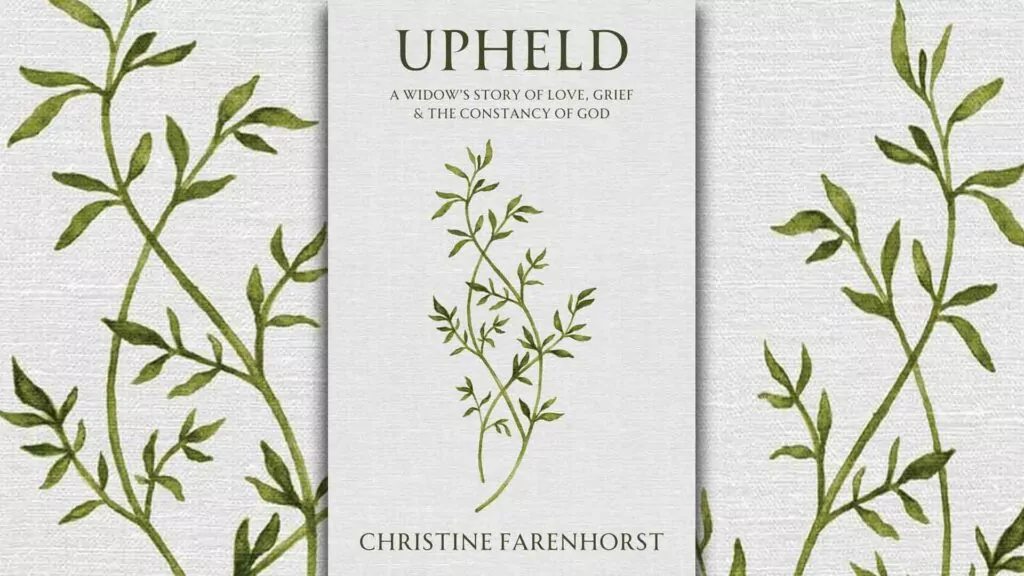
Upheld: A widow’s story of love, grief, & the constancy of God

by Christine Farenhorst 2025 / 252 pages Rating: Borrow/Buy/GIVE Anyone who has ever loved is going to face loss, and what are we to do then? It’s not a thought I like to dwell on. But as I age, and as I attend more funerals of godly men and women, I see whole families who are mourning, not as those without hope (1 Thess. 4:13), but as those assured that Christ’s victory over death is our victory too. But what does that assurance look like in the day to day? Here is an answer. Christine Farenhorst was married to her Anco for almost 53 years, and Upheld is the story of their life, and her loss after Anco died in 2022. Here we have someone wrestling with one of the greatest losses any will face, assuring her beloved readers that yes it’s really true “that in all things God works for the good of those who love him” (Roman 8:26). Or as she puts it: “When we are pushed off a cliff, whether that cliff is war, cancer, a snub by a friend, the death of a mother, being maligned and slandered for standing up for the truth, or suffering a stroke – it is of prime significance to note that God has let this happen so that we can die to ourselves and live for Him. He only works for our good.” That assurance worked itself out throughout Anco and Christine’s married life. She shares story after story of relying on the Lord, and looking for the good He was bringing. So when, for example, the Christian Reformed Church was slowly capitulating to women in office, and to a non-literal understandings of the opening chapters of Genesis, she could be grateful. “Strangely enough, although the Word of God was watered down in many pulpits, this visible bruising of the church became a blessing to our family. It was as if Joseph said to us: ‘Others mean this for evil, but God means this for your good, to bring about that many people should be kept alive .... So do not fear: I will provide for you and your little ones.’ And God did provide for us. The slippery slope exhibited within the church proved to be the tilt that caused our family to climb up and study God’s Word in such a way as we never would have done had there been no issues. Consequently, our children were taught male headship by both Scripture and by Anco’s example; they were grounded in the fact that God hates all sexual sin; and they were spoon-fed on the historicity and infallibility of the Bible.” When you understand that God is always working on you, and through you, then you start to see rightly that what’s in front of you is always another opportunity to glorify your Creator. And throughout their lives together, Anco and Christine had quite some opportunities! In one of my favorite passages Christine shares how, when Anco was still in veterinary school and they were living the life of poor students, they’d be grateful for any lunch or dinner invites. However, one of their invites was from an elderly couple, the Pots, who were “rather impoverished themselves.” So when Mrs. Pot offered her a pastry, Christine was horrified to discover, after a couple of bits, that her piece was full of mold. Should she say something? The elderly woman was quite delighted with her own piece: “Isn’t it good? I’ll bet you haven’t eaten anything like this for a long time!” “Mrs. Pot beamed at me again and a patch of sunlight caught a faded spot of the carpet. I knew she considered both Anco and myself underfed, and had taken great pains to buy something special for us.” And so, Christine ate it all down as quickly as she could, and when asked whether she’d like another piece, she “croaked a trifle hoarsely” that no, she did not, “but it was delicious.” “ appeared very pleased with the comment, and I knew that my statement, strange as it sounded to my stomach, was Gospel truth to my heart.” Sometimes a lie is no lie at all – the cake was both disgusting and also delicious; stomach-churning, and heart-warming all the same. One of the benefits of reading biographies of godly men and women is that they have sometimes, in God’s grace, triumphed over a pitfall we are still getting tripped up by. So their example can show us the way. Today one pitfall the Church has is an eagerness to be respected, or at least tolerated by society. We wanted to be liked. But in the Bible we’re repeatedly told that we will be cursed because we love Jesus (Matt. 10:22, Luke 6:28, Ps. 109:28, etc.). And what does that look like, and how should we act when it happens? “Anco was once asked by someone, someone who disliked him intensely, to come for a meeting in a Tim Horton’s restaurant, so that she could speak with him. A very liberal woman, one who had wreaked havoc within the church community, she had also spread slander about him. He went and was reamed out in such a loud manner by this female, that people in surrounding booths turned their heads to look. It was embarrassing as well as demeaning. Anco listened quietly and let her go on and on. The woman ended the public diatribe by saying: 'You are a narrow-minded bigot. It’s like you’re in a box and you don’t allow anything else in that box.' As she was sounding off this last statement, she drew the picture of a box on the booth table with her right index finger. Anco waited a moment to make sure she was done. Then he took his Bible and placed it in the box.” I could share one passage after another – there is so much to love – but I’ll content myself with just one more, a section I read to my daughters about Christine’s wedding... interrupted. Husband-to-be Anco was already waiting at the front of the church when a late-arriving 5-year-old nephew slipped on the snowy steps outside and knocked himself unconscious. The boy was taken to the basement and Christine’s sister, one of the bridesmaids but also a doctor, went to see if she could help. “My father, about to escort me into the church but anxious about his oldest grandson, also departed. Consequently, no matter that I was resplendent in my wedding finery, I was left alone in the church foyer with the caretaker. He was a man of few words and simply stared at me in mute sympathy.” And so, Anco, best man beside him, stood up front unsure of just what was going on. For the next 15 minutes the organ continued to play as the whispering among the pews increased. Thankfully her nephew turned out to be fine, and the wedding resumed. But oh, what a start! So who would love this book? I don’t know that I would give it to anyone who has recently experienced the loss of a loved one. But it’d be a wonderful book later. And important beforehand. Just how good is it? Well, it ranks at the top of my own rating scale which goes something like this: Didn't like it Enjoyed it Enjoyed it enough to recommend it Loved it so much I had to read sections out loud to my wife and/or kids Loved it so much, I have to put this in folk's hands I’ve bought ten copies and my daughters will be among the first to get a copy. But I wanted plenty more, because I'm sure this will be a much-appreciated present to other family members and friends....

Red heart icon with + sign.
Book Reviews, Children’s fiction

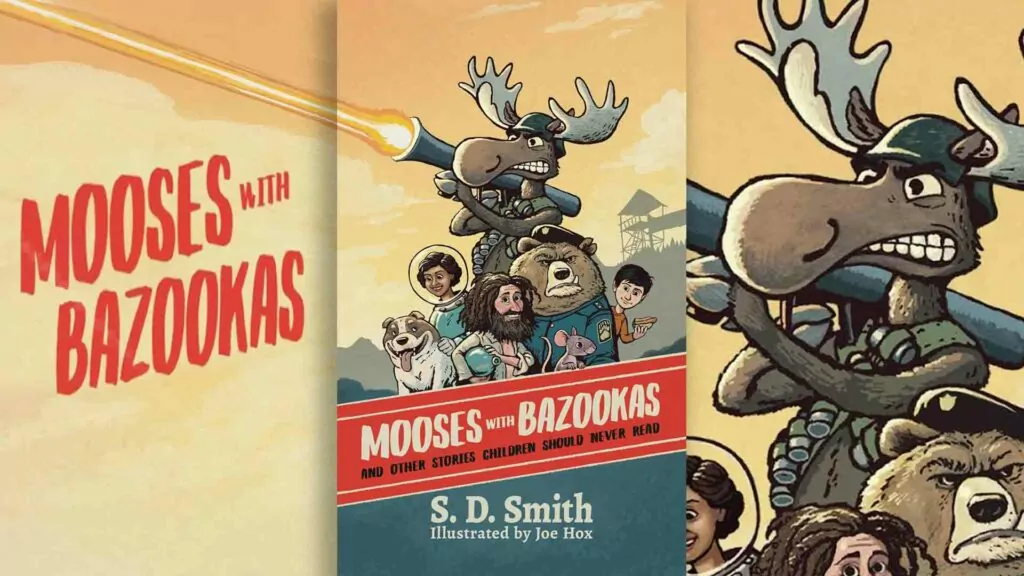
Mooses with Bazookas

by S.D. Smith 2023 / 160 pages Rating: Borrow/Buy/GIVE I liked this book so much that right after I finished it, I read it again, this time to my kids for bedtime. Like C.S. Lewis before him, S.D. Smith is a popular Christian author who had some curious correspondence land in his lap. In Lewis's case, it was serious stuff – he somehow got his hands on notes from a senior devil to a junior devil, instructing him on how best to tempt and devour people. Lewis later published this correspondence as The Screwtape Letters.  Smith got sillier stuff, but how he got his hands on these letters is every bit as mysterious. Eleven "jug notes" from one Wally Warmbottom, author, expert, and solitary shipwrecked resident of the deserted island of Peachpitistan, somehow floated across the ocean to Smith, who lives in the land-locked state of West Virginia. Smith doesn't understand it, but he collected and has now published the notes. As Wally Warmbottom recounts it, his small island is full of peach pits and beach pits, both of which are tripping hazards. It also has a "story cave" with tales preserved there in jugs, written by, well, who knows? The stories didn't interest Wally, but he thought Smith could take a look, so the book includes, in addition to 11 letters from Wally, four of these short stories. What Wally missed, you will most certainly enjoy, as "Binsley Bustbocket burns the buns" and "Rocket and Elsie and Rocket" are a hoot! This is wonderfully stupid throughout, but I think I might have most enjoyed one running gag that pops up in a couple of Wally's letters, and also in the title story. Barry the Moose has been having quite the day: Fort Moosefort has been overrun by flame-thrower-wielding bears, Barry's lucky stick has been burnt to ash, and a bear bullet broke off a favorite bit of his antler. So now he's on the run, and who can this silliest of all creatures turn to when he's in desperate need? Well, Science of course. But when Barry invokes his god, it's always to no effect. "The bears started firing rocket launchers at the cabin. 'Trust in Science!' I screamed..." "I swiveled and saw a pack of wolves rushing at us with fully loaded shotguns. Were they locked as well? I couldn't tell. I didn't know if you could lock one or if you would even want to in a fight, because if it's locked, can you still shoot it? ...'Help me, Science!' I cried as I dove behind a skinny tree." "The wolves had abandoned the chase – or at least the chase of me. Maybe that was bad news for J. J. whathisname or whathisinitials, but for me, no loaded or locked gun would be fired or shot at me for a while. May Science guide you, I thought towards J.D., finally remembering his initials..." It's a joke that will breeze right over the kiddos' heads, but is there for mom and dad to appreciate. So, a silly goofy story, with some political subtext – what more could you want? Maybe the only critique I would have is that, other than this being both hilarious and clean, I wouldn't have had reason to suspect the author was Christian. That said, it might be hard to include God – Who appreciates silly, but is not at all silly – in such a deliberately insubstantial book. I'll rate this as a great one for everyone eight and up, so long as they can appreciate Dad-joke humor. For a good taste of the silly, check out the book trailer below. And if you like this, S.D. Smith has written a less silly but more adventurous series on "rabbits with swords." Check out our review of the first book: The Green Ember. ...

Red heart icon with + sign.
Book lists, Book Reviews, Children’s picture books

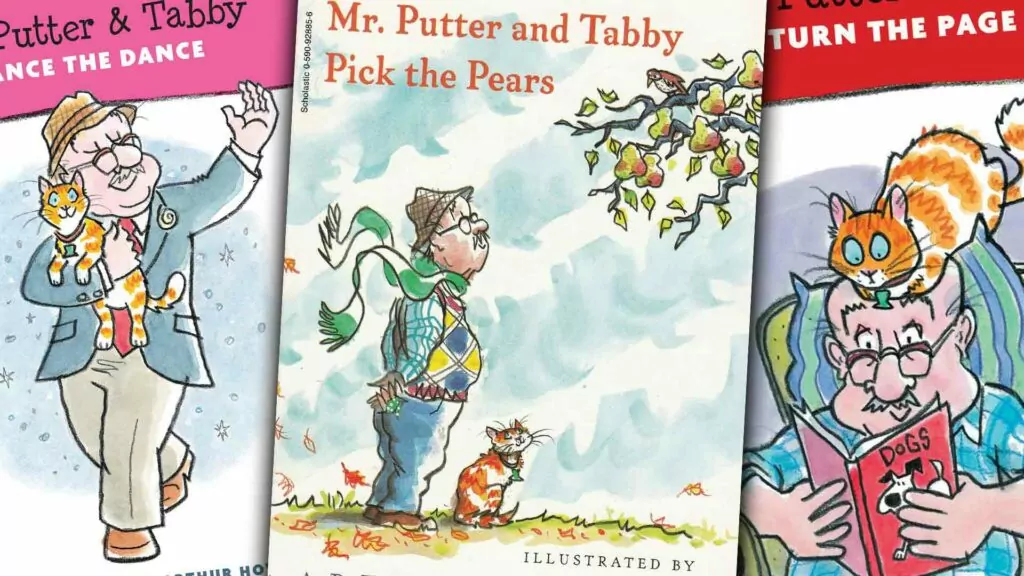
Mr Putter & Tabby: 25 sweet stories

by Cynthia Rylant illustrated by Arthur Howard 44 pages / 1994-2016 Rating: Borrow/Buy/GIVE It's always fun to find a children's book that is interesting enough for parents to read repeatedly without getting too bored. And it is an absolute treasure when you can find an entire series of such books! Cynthia Rylant's Mr. Putter and Tabby books – 25 in all – are exactly that sort. Mr. Putter is an older retired man with an older, quite sedentary cat named Tabby. And next door, they have a wonderful neighbor, Mrs. Teaberry, who has a "good" dog named Zeke. They go on the sort of adventures that older people do – a boat ride, a cooking class, painting the porch – and their two pets help liven things up. These are quiet, sweet stories that will have you and your child smiling throughout. My wife and I enjoyed reading them to our then three-year-old, who was only disappointed with one story, but that was because I told her it was the one "where Mr. Putter and Mrs. Teaberry finally get married." She was very sad to discover I was just joking – this perfect couple hasn't yet become an official couple. We are still hoping, though! I would recommend these for the 3-9 year-old age group. They are great books for parents to read to both pre-school and even elementary-age children because parents and children will enjoy them. And they are very fun books for children who are just learning to read to tackle by themselves. I've included short reviews of all 25 titles. There's no real order to them, except maybe the first two. Those would be best to read in order at the start. I would highly recommend the whole series, with just one caution. Mr. Putter and Tabby Take the Train has this elderly couple flouting a "no pets" rule – not the best example in a book for young children – but that is the exception to a series that's full of charm and warmth. 1. Mr. Putter and Tabby Pour the Tea Mr. Putter has some wonderful English muffins he would love to share, but no one to share them with. And when he goes to the pet store looking for a cat, all he finds are kittens, far too full of energy. But when he visits the animal shelter, Mr. Putter finds a cat who's certainly not overly energetic. Tabby's joints creak, her fur is thinning, and she seems a bit deaf in one ear... just like Mr. Putter! It's a wonderful match! 2. Mr. Putter and Tabby Walk the Dog This marks the first appearance of Mr. Putter's wonderful neighbor Mrs. Teaberry. When she slips on a kiwi (the fruit, not the bird) and twists her ankle, soft-hearted Mr. Putter quickly volunteers to walk Mrs. Teaberry's dog, Zeke. But Zeke is no model dog – for Mr. Putter he is a nightmare! At least until Mr. Putter and Zeke have a man-to-dog talk! 3. Mr. Putter and Tabby Bake the Cake Mrs. Teaberry inexplicably loves fruitcake. Or, at least, Mr. Putter finds it inexplicable. For Christmas, Mr. Putter decides he wants to make her a cake that won't hurt her foot if she drops it. But he has never made a cake before! Another sweet story about this wonderful elderly couple. 4. Mr. Putter and Tabby Pick the Pears Mr. Putter loves Fall because that's when he can pick the juicy pears from his tree and make pear jelly. But this year Mr. Putter's cranky legs aren't cooperating – he can't make it up his ladder to pick them. But that isn't enough to stop this inventive senior. Mr. Putter remembers how, as a kid, he used a slingshot to knock things down. He fashions his sling, takes careful aim at his pear tree, and gives it a go. It turns out, however, that his slingshot is much more powerful than he thought, and Mr. Putter spends the next several hours launching apples high, high, high into the air, until they disappear over his house. Great fun... though it does nothing to get his pears down. And it leaves him without any apples too! Fortunately, Mrs. Teaberry comes to the rescue. 5. Mr. Putter and Tabby Row the Boat On this very hot summer day, Mr. Putter figures out a great way to stay cool. He takes Tabby, and his neighbor Mrs. Teaberry, and her good dog Zeke, out on the lake. And on an island in the middle, they eat their lunch and he and Mrs. Teaberry share "tall tales" from their lives. This is the first book that had me hoping the author would soon write "Mr. Putter & Tabby Pop the Question." 6. Mr. Putter and Tabby Fly the Plane  Mr. Putter may be old, but he still loves toys (even though he knows he isn't supposed to anymore). In this adventure, Mr. Putter and Tabby enjoy flying a radio-controlled toy plane... and give it to someone who enjoys it even more. 7. Mr. Putter and Tabby Take the Train What could be better than going on a train ride? The only problem, it turns out, is that trains don't allow pets. But this rule is bypassed when Mr. Putter backs Zeke into a backpack, and Mrs. Teaberry carries Tabby on the train in a picnic basket. One caution: This focuses on how to cleverly get around rules. So, if I was getting a dozen of this series for my school library, I'd give this one a miss. But I might still take it out of my public library and then, while reading it to my girls, teach them that even such wonderful old folks can misstep now and again. 8. Mr. Putter and Tabby Toot the Horn Mrs. Teaberry decides that since she and Mr. Putter like music so much, they should be in a band. But what sort of band can they be in, since neither knows how to play an instrument? 9. Mr. Putter and Tabby Paint the Porch Mr. Putter's porch is looking a little shabby. But when he gets out the pink paint, a squirrel decides he might want to help. Soon little pink paw prints are everywhere! Fortunately, Mr. Putter has a wonderful neighbor, Mrs. Teaberry, who is happy to help him clean up the mess. 10. Mr. Putter and Tabby Feed the Fish Mr. Putter and Tabby both love visiting the fish store. But when Mr. Putter brings three goldfish home, Tabby starts having troubles – he can't stop watching them! However Mrs. Teaberry is once again able to help. How nice it is for Mr. Putter and Tabby to have such a wonderful neighbor! 11. Mr. Putter and Tabby Catch the Cold "When Mr. Putter was a boy, he had almost liked colds. He always got spoiled." But now that he's old, it's not good to have a cold – there's no one to spoil him! Or is there? Mrs. Teaberry and her good dog Zeke make sure that this is "the best cold Mr. Putter ever caught." 12. Mr. Putter and Tabby Stir the Soup Mr. Putter and Tabby both love soup, but there always seems to be something stopping them from making it: either they don't have the onions, or the beans, or the macaroni. And then, when they finally have all the ingredients, their trusty stove decides not to work. But no worries – Mrs. Teaberry would be happy to let them use her stove. And, of course, Zeke won't be a bother, right? One caution offered: Mr. Putter says "Jiminy!" at one point, which some regard as a mild expletive. 13. Mr. Putter and Tabby Write the Book When a snowstorm keeps him indoors, Mr. Putter decides to become a mystery writer. He soon discovers there is a lot of preparation involved in getting ready to write – snacks don't just fix themselves! When Mr. Putter's writing strays from mysteries and towards the many good things he sees all around him, Mr. Putter is a bit discouraged... until Mrs. Teaberry cheers him up! 14. Mr. Putter and Tabby Make a Wish With a shock, Mr. Putter realizes that today is his birthday, and while he thinks he's too old for cake, candles, and presents, he still wants a celebration. So he calls up Mrs. Teaberry. She is happy to come over... but she first needs to do some chores. While Mr. Putter waits, increasingly impatient, Mrs. Teaberry is preparing a surprise! One caution offered: Mr. Putter says, "Good heavens!" 15. Mr. Putter and Tabby Spin the Yarn Mrs. Teaberry is a very good neighbor and also a cook and a baker who loves to share her culinary creations with Mr. Putter. But Mr. Putter has started to wonder if he's a good neighbor – what does he do for her? So he decides to do something nice by serving tea to Mrs. Teaberry's knitting club. But being a good neighbor turns out to be quite a bit harder than Mr. Putter thought! 16. Mr. Putter and Tabby See the Stars Mrs. Teaberry likes to feed Mr. Putter. And Mr. Putter likes to be fed by Mrs. Teaberry. But one night he so enjoys himself that he doesn't notice just how many of her jelly rolls he has eaten. Later that night he does notice – his grumbling tummy won't let him sleep. So he and Tabby go for a walk in their neighborhood. And who do they meet? Mrs. Teaberry! It seems her good dog Zeke also had too many jelly rolls, and his tummy wouldn't let him sleep either. Mr. Putter and Mrs. Teaberry tell each other "stories in the moonlight. They told secrets. They make each other laugh." This is another sweet, simple story that will have you rooting for Mr. Putter to get down on one arthritic knee. 17. Mr. Putter and Tabby Run the Race With Mrs. Teaberry's encouragement, Mr. Putter enters a seniors' race. And, with the help of Mrs. Teaberry's good dog Zeke, Mr. Putter runs quite a race! 18. Mr. Putter and Tabby Spill the Beans Mrs. Teaberry is very good at coming up with new things for her and Mr. Putter to do. Of course, sometimes these new things don't work out. But they are always an adventure. This time around Mrs. Teaberry wants the two of them to take a cooking class: one hundred ways to cook beans! To Mr. Putter this doesn't sound like it will be much of an adventure. "But he wanted to make Mrs. Teaberry happy." Fortunately, Tabby and Zeke are able to turn this into an adventure after all. 19. Mr. Putter and Tabby Clear the Decks Mr. Putter thinks that Mrs. Teaberry is a genius when she decides they should have an adventure on a sightseeing boat. But as much as Mr. Putter likes the boat, Zeke likes it even more. When he decides he doesn't want to leave, it is up to the boat's captain to talk Mrs. Teaberry's good dog into letting go of the mast. 20. Mr. Putter and Tabby Ring the Bell Mr. Putter gets all nostalgic about school and arranges to visit a first-grade classroom. And Tabby and Zeke arrange to make this a very memorable visit! 21. Mr. Putter and Tabby Dance the Dance Mr. Putter may have two left feet, but Mrs. Teaberry thinks he is a wonder! I wonder when he is going to ask her to marry him! 22. Mr. Putter and Tabby Drop the Ball Mr. Putter decides that, as fun as napping is, they really need to take up a sport. He finds his old baseball glove and calls up Mrs. Teaberry, who knows just the right team to join, where one of the players is 100 years old! No one is very fast... except Zeke. Oh, Zeke, put down the ball! 23. Mr. Putter and Tabby Turn the Page Mr. Putter loves to read out loud, and Tabby loves to listen. When the library invites patrons to come "Read aloud to your pet at Story Time" Mr. Putter decides to go. But he makes a mistake. He tells Mrs. Teaberry. She loves new things, so she wants to do it too. But Zeke in a library? 24. Mr. Putter and Tabby Smell the Roses Mrs. Teaberry's birthday is just around the corner: what can Mr. Putter and Tabby get her? She likes her garden, so Mr. Putter decides to take her to the Conservatory. But can Zeke behave himself in the midst of so many flowers and plants? Well, no, and suddenly the bananas and lemons are flying everywhere. But even after the rambunctious mutt gets them all booted out, that doesn't put a damper on the celebrations. Mrs. Teaberry even manages to make lemonade out of the lemons. 25. Mr. Putter and Tabby Hit the Slopes While this isn't the happy conclusion to the series that we were hoping for – Mr. Tabby and Mrs. Teaberry are still only neighbors – it is another fun episode. This time Mr. Putter is a bit tired of winter and needs a little excitement. He remembers the sledding he used to do as a boy, and just knows his adventurous neighbor is bound to have some toboggans!...

Red heart icon with + sign.
Adult fiction, Book Reviews

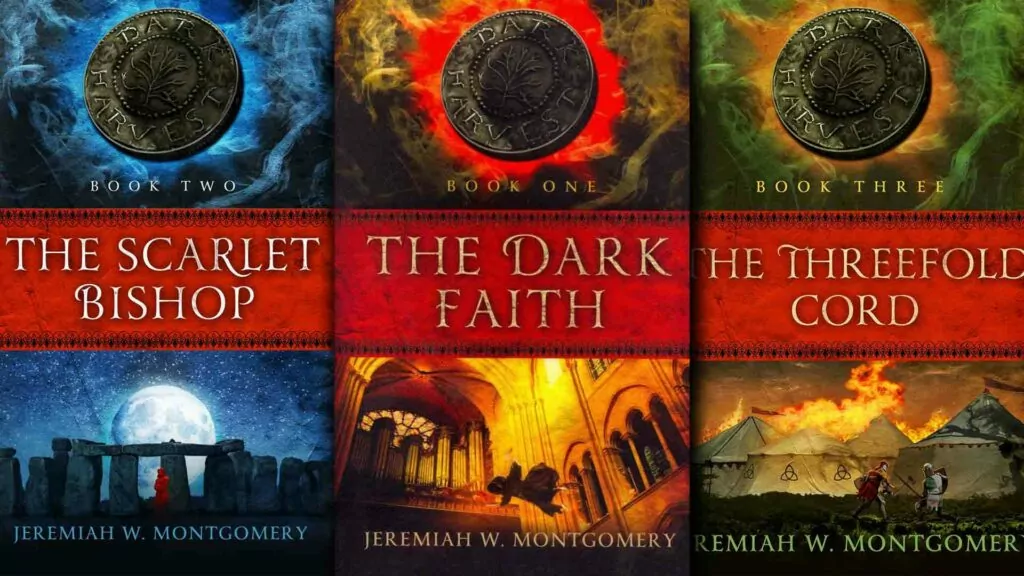
The Dark Harvest Trilogy

The Dark Faith 368 pages / 2012 by Jeremiah W. Montgomery The Scarlet Bishop 304 pages / 2013 by Jeremiah W. Montgomery The Threefold Cord 312 pages / 2014 by Jeremiah W. Montgomery Rating: Borrow/Buy/GIVE ***** I gave The Dark Faith to my oldest daughter, knowing only that it was by an OPC minister. The cover looked a bit dark and ominous, but I figured It's by a Reformed pastor, so how freaky can it be? I hadn't gotten to it yet because, well, I'd also figured It's an epic fantasy novel by a Reformed pastor, so how good could it really be? I was wrong on both counts. This was really good, and quite freaky. My daughter was only a few chapters in when she gave me this update: "Dad, the main girl has just fallen into a well of blood!" "Real blood?" "Yeah, real blood!" "Hmmmm... maybe this isn't a good one to keep reading." "No Dad, it's okay. I can keep reading." An OPC pastor writing about wells of blood? A couple of days later, and another update from my daughter: "They're going to skin this nun alive!" And then, "Oh Dad, there's something even worse!" A story this freaky, that my squeamish daughter still wouldn't put down? I had to start reading it too... and it was so good I didn't stop until I was through all three. The trilogy is set on a Great Britain-like island empire called Aeld Gowan, and the time is very pre-Reformation. The Church here isn't quite the bed of hypocrisy that got Luther going, but it attracts both the devout and the power-hungry eager to use its influence. Our hero is one of the devout, a monk named Morumus, who turned to the Church for another reason: knowledge. When still a boy, Morumus saw his father, Raudron Red-Fist, and all his soldiers, slain by nightmarish creatures whose song rendered the men unable to raise their swords and shields in defense. The boy Morumus was overlooked and escaped. Now, as a grown man, Morumus thinks that whatever it was that attacked his father, they were likely followers of the "Dark Faith" that once ruled the island. And he wants to learn more, to prepare the Church for what might be coming. But in ten years of study so far, he hasn't found much of anything. What his learning has done, however, is make him an expert in languages, and now his archbishop wants him to translate Holy Writ into the language of peoples who might still follow the Dark Faith. His love for the Lord, and his obsession with solving the mystery of his father's murder seem to be converging! This is a complex story, and not one that can be briefly summarized (the appendix of names is a much-needed feature to keep track of the extensive cast). There's just so much here – whether it's palace intrigue, a compromised Church, cunning enemies, or unexpected friends, it's all here, and all wrapped up in an epic fantasy that is very relevant for our own time. Caution The cautions concern the gore, and especially a scene in which a monastery of monks, who were having their evening meal, are found slaughtered, their innards piled up on the plates in front of them (this was the scene my daughter was warning me about). Why did the author include that? I think to show the evil to be evil. And while there is gore, he's not glorying in the gore, as some writers do. That's why my 14-year-old could read it without getting too bothered, though this was a book she wouldn't read at night. It is, however, why this might be better for 16 and up. Conclusion I was struck by just how well-written it is – this would make for a great read-out-loud if only I could find an audience brave enough to hear it. I don't want to overhype it, so I won't make comparisons to Tolkien or C.S. Lewis, but I will say that outside of those two, this is really among the best of the best of Christian fantasy fiction. Epic, excellent, and insightful, telling an old tale that has lessons for our modern age. Two thumbs way up! And if you want to hear another Reformed perspective on the Dark Harvest Trilogy, be sure to check out this review, by OPC member and teen (at the time), Katharine Olinger....

Red heart icon with + sign.
Adult biographies, Book Reviews, Homosexuality

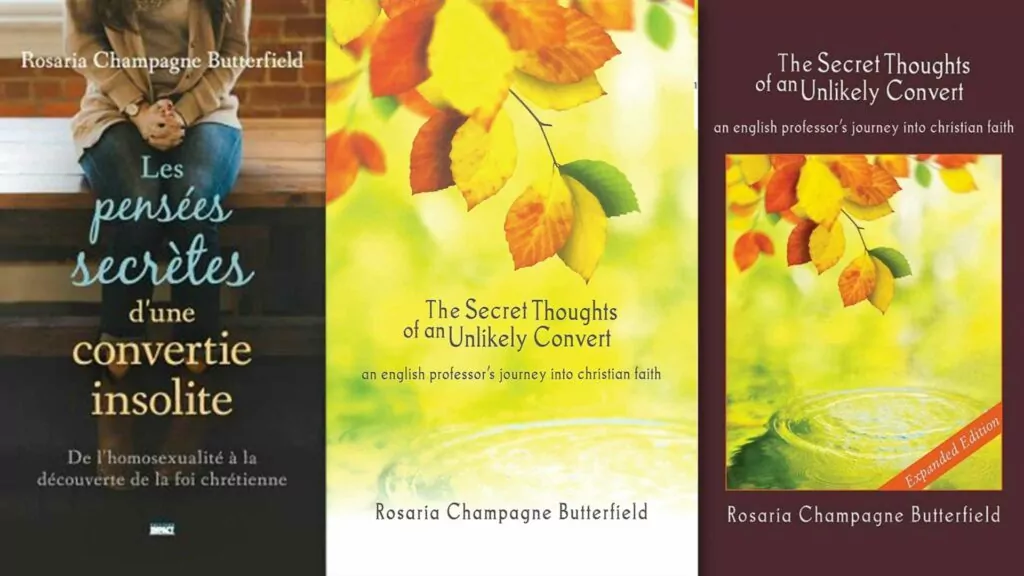
The secret thoughts of an unlikely convert

an english professor's journey into christian faith by Rosaria Champagne Butterfield 2012 / 150 pages Rating: Borrow/Buy/GIVE 13 words: Post-modern, lesbian activist, university English professor becomes Reformed Christian homeschooling pastor's wife. Intrigued yet? There is so much to love and so much to learn from this book. One of the biggest lessons is in how God got the attention of this professor. After she wrote an article in the local paper critiquing Promise Keepers she "received so many letters... I kept empty Xerox paper boxes on both sides of my desk, one for hate mail, and one for fan mail." But one of the letters she received wasn't so easy to categorize. It was from a Reformed pastor, and instead of commending or condemning her, it was "a kind, inquiring letter." The pastor wanted to know "how did you arrive at your interpretation? How do you know you are right? Do you believe in God?" The letter concluded by inviting "me to call its author to discuss these ideas more fully." After a week of repeatedly throwing out the letter and then digging it back out of the recycling that's what she did. As you might expect from an English professor the writing is delightful. She is also no quiet convert, and her pointed questions uncover wonderful Christian truths but also unmask the shallowness and hypocrisy that is such a prevalent part of the Church. One caution: In the course of her conversion the author is confronted with, and takes on so many different theological issues (adoption, homeschooling, the Regulative Principle, etc.) it's likely readers will find some point on which they disagree. But for a discerning adult, that is a minor issue. And to them this book is highly recommended....

Red heart icon with + sign.
Adult biographies, Book Reviews

Unbroken: A World War II story of survival, resilience, and redemption

by Laura Hillenbrand 2010, 497 pages Rating: Borrow/Buy/GIVE One of the least amazing things about Louis Zamperini is that he took up skateboarding in his eighties. But it shows the determination that had him competing as a 5,000-meter runner at the 1936 Berlin Olympics. It also reveals the attitude that led the young Louis to steal a Nazi banner when the Games concluded. These two qualities would be vital to him when, during World War II, his plane crashed and Louis found himself on a tiny raft in the middle of the vast Pacific Ocean. His chances of being found by searchers were remote, but if the small craft continued to drift west there was a chance it might make it to land – islands occupied by brutal Japanese forces. The redemption mentioned in the subtitle is true redemption. Louis starts the story as a thief and a punk. As an airman in World War II he bunks in a cabin plastered with pornography. Many of the Japanese soldiers he meets are sadistic and perverse. So we see evidence of the Fall in this book (described with restraint). But the most amazing thing Louis is able to do is something he knows comes from completely outside his own abilities. God enables Louis to repent and forgive. This ranks in my top three best biographies I’ve read - it is an amazing story told by an equally amazing storyteller. Laura Hillenbrand is half the age of her subject but the level of detail in her research makes it seem like she must have grown up with him, and tailed behind him wherever he went. And at the same time, she never lets the detail overwhelm the story; this is a large book, but a very fast-paced one. One caution: the author quotes at least a couple of her subjects taking God's name in vain. I don't know if the author is Christian, so she might not have understood that this level of detailed recollection was unnecessary and undesirable. As for who should read this book, in addition to recommending this to adults – though it is all done with restraint, there is too much brutality and horror here for teens – interested in World War II, this is also a very good book for anyone wondering how the US could possibly have dropped two nuclear bombs on Japan, targeting and killing over 150,000 civilians (this is the most conservative estimate). While neither the author nor Louis argues explicitly for the morality of dropping the bomb, Louis's experiences make it clear that when it came to Japan, there was little difference between the military and the civilian population – rather than surrender Japan was readying its civilian population to fight on, seemingly to the last man and woman. Reading about Japanese brutality, and their thoughts on the disgrace of surrender, gave me a perspective on the atomic bomb I had never before had. It certainly makes the decision much more understandable. Afterward, I still questioned why they couldn't have first demonstrated the power of the bomb on something other than a city, but, as National Review contributor Victor Davis Hanson explains here, there were only two bombs available, and the Americans were worried that the destruction of just one city would not be enough to induce Japan to surrender. And it seems they were right to worry. Unbroken doesn't end the debate, but it does give insight into the way both the Americans and Japanese were thinking at the time. But that is a long aside - the book is about an amazing man, saved by an awesome God. Highly recommended!...

Red heart icon with + sign.
Book lists, Book Reviews, Children’s picture books, Graphic novels

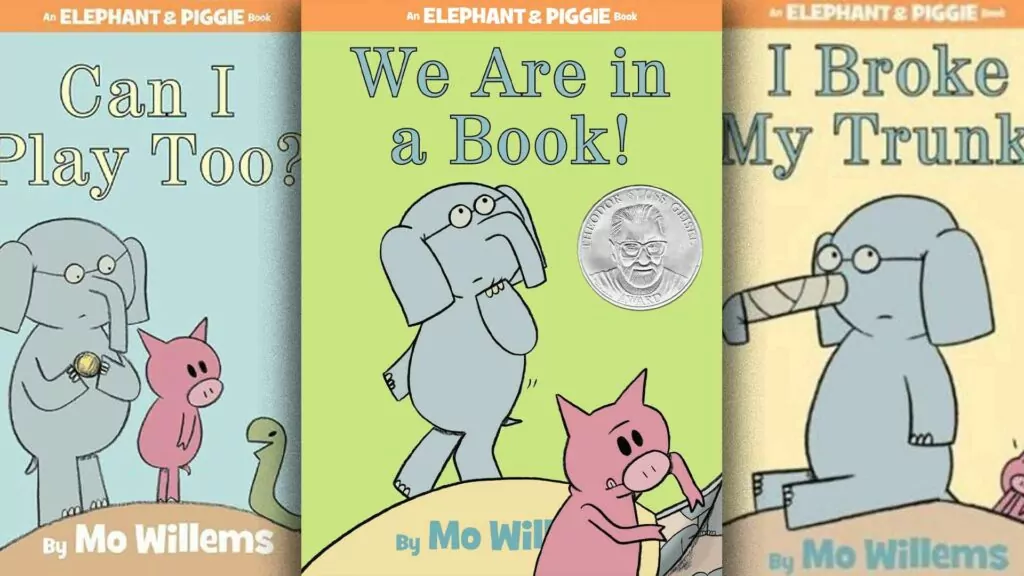
Mo Willems' "Elephant & Piggie" (25 books)

From about three years old and up, my daughters and I have all loved Elephant and Piggie and their whole 25 book series. When I'd bring a new one home from the library often times my littlest would squeal with delight – before having kids I always thought that was just an expression but now I know better. They are great books for preschoolers and also very fun for first graders just learning to read, and even for third and fourth graders to act out. Piggie is the more expressive of the two friends, but Gerald the Elephant can get bouncy and loud too. It's one adventure after another for two very good friends who are thoughtful, fun-loving, curious and most definitely loud (it's no coincidence that nearly every book title is capped off with an exclamation mark!). My daughter loves the stories because the drawings and the characters are just so energized! The plots are simple enough for her to follow, and bring up situations that she understands like dealing with a friend breaking a toy, learning to throw a ball, and cheering up a sad elephant. All of the books are full of silly fun, and most of them teach simple moral lessons without being obvious about it. For example, in Listen to My Trumpet, Piggie's performance is so bad, Elephant doesn't know quite how to tell her. So he praises her for what he can: her trumpet is shiny, and she can play it loud, and she holds it very well. But when Piggie insists on hearing his opinion of her playing, he is honest. Fortunately, it turns out that Piggie wasn't trying to play music, but was instead trying to sound like an elephant, so it all works out in the end. What a great lesson in, and example of, honesty and tactfulness! Another feature I appreciate is that the stories are generally limited to two characters. That makes it a bit simpler to handle giving them different voices. I can go with a high voice for the girl Piggie, and low for Elephant, and that's pretty much the limit of my vocal ability - if a third character shows up they are stuck with my normal voice. And I love that there are 25 of these. When I would eventually get tired of one book (long before my daughter) I could bring home another one from the library, to her squealing delight! They are recommended for 3-9, but nostalgia has even our older kids looking at them now and again. The following are short reviews of each title, by publication date (2007 to when Willems stopped in 2016). These come in durable hardcovers, with each story at 50+ pages, and the whole series has now been collected in 5 "biggie" books for a pretty thrifty price. Today I Will Fly! You may think pigs can't fly, but when Elephant tells Piggie that, it doesn't discourage her in the least. And, with a little help from a friend, she does get off the ground! My Friend is Sad When Elephant is sad Piggie decides to cheer him up by dressing up as a cowboy, then a clown and finally a robot. But he still doesn't cheer up. Why not? Because he is sad that Piggie wasn't there to see them too! One caution: parents may want to note that while friends are a blessing, they are not everything. I Am Invited to a Party! When Piggie is invited to a party, she turns to Elephant to figure out what to wear because "he knows parties!" Good clean silly fun! There Is a Bird On Your Head! Piggie gives the moment-by-moment commentary as first one bird, and then two, land on Elephant's head, build a nest, and have eggs that soon hatch. Complete nonsense, and lots of fun. I Love My New Toy! Piggie has a new toy she really wants to show Elephant. But when she shows it to him, he accidentally breaks it. Piggie does not deal with this very well, even though Elephant is very sorry. But when it turns out the toy isn't really broken after all, Elephant shows Piggie where her priorities should have been: "Friends are more fun than toys." I Will Surprise My Friend! After Piggie and Elephant see two squirrels having fun jumping out and surprising each other they decide to try it too. They agree to meet at the big rock. But when they both arrive on opposite sides of the rock, and thus don't see the other, each begins to wonder what happened to the other. The humor here comes in the contrast: Gerald wonders if Piggie might have fallen off a cliff, or been abducted by a giant bird, or whether she might be fighting a scary, scary monster right now while Piggie wonders if Gerald might have gone for lunch. Funny, but Gerald's wondering made this a bit borderline for my three-year-old, making this the only book in the series I wouldn't read her right before bedtime. Are You Ready to Play Outside? Piggie want to play outside. She really wants to play outside. But then it starts to rain. What's a pig to do? Maybe a change of attitude, and a good friend, can help her have fun no matter what the weather. Watch Me Throw the Ball! Elephant is very good at throwing a ball. Piggie... not so much. But she sure has fun trying! A caution I might add for this one is on boasting. All of it is done in fun, but there sure is a lot of it here! Parents will want to point out that boasting in our strength, if we actually mean it, is disgraceful (Prov. 11.:2). Elephants Cannot Dance! Elephants cannot dance – it even says so in a book! But as Piggie reminds her friend, that doesn't mean you can't try! And while Elephant is not very good at doing most dances, he can do a very good rendition of "the Elephant dance." This is a title that, with some parental guidance, can be used to teach children that while they will not be good at everything, they can still try to improve, and they have their own unique talents and abilities. Pigs Make Me Sneeze! Is Elephant allergic to Piggie? Could his best friend be making him sneeze? Or might there be another reason for why Elephant is sneezing all the time? More silly fun! I Am Going! Piggie is going, and Elephant is having a hard time dealing with it. I was hoping this one could be used to teach my daughter how to deal with the "It's time to go home now" situation, but this title would just exasperate the drama. Elephant just cannot stand being apart from Piggie, and, it seems, he never has to be. Though I love the series, this one isn't all that good. Can I Play Too? Elephant and Piggie are going to play catch, but then Snake asks if he can play too. But Snake does not have arms, so how can he play catch? After a few misadventures Piggie, Elephant and Snake figure out how to play the game so then can include everyone. With a little commentary from mom or dad, this is could be a great way to teach kids about thinking of others, and include others in what they do. We Are in a Book! Piggie and Elephant discover that they are in a book. They then have great fun when they realize they can get the reader to say whatever they want (and they really want the reader to say "Banana"). But when Elephant discovers that, like all books, this one is going to end, he and Piggie figure out a way for the fun to continue - they ask the reader to read the book again! This is an inventive book, but a tad taxing if daddy wanted to read just one more book. I Broke My Trunk! This is a laugh-out-loud story for both parent and child. How did Elephant break his trunk? Did balancing a hippo and rhinoceroses on it have anything to do with it? Nope. Or at least, not directly. This is my favorite in the whole series. Should I Share My Ice Cream? Elephant wants to be a generous soul. But share ice cream? It's so yummy! Elephant spends so much time wrestling back and forth that by the time he finally decides to share, his ice cream has melted! But don't worry – Piggie sees that her friend is sad, so, to cheer him up, she offers to share her ice cream. Happy Pig Day! It's "Oinky Oink Oink!" (that's pig for "Happy Pig Day!") and Elephant feels left out – he doesn't have a snout, or hooves, and he is not pink! But then Piggie explains that "Happy Pig Day!" isn't just for pigs; it is for anyone who loves pigs! So that certainly includes Elephant! Listen to My Trumpet! When Elephant hears Piggie playing her new trumpet he has to figure out a nice way to say she is very, very, very, very, very bad! He does a good job, which makes this a fun and instructive book. Let's Go for a Drive! Elephant wants to go for a drive. And if you are going to go for a drive you need lots of stuff, like maps, sunglasses, umbrellas and luggage to carry it all. Fortunately his friend Piggie has everything they need. Or does she? Lots of fun repetition in this one that your child will catch on to quickly and be able to shout out along with you. A Big Guy Took My Ball! Elephant is incensed at the injustice of it all when Piggie comes to him for help, because "a big guy took my ball!" But then he finds out the big guy is really big – he's a blue whale! Fortunately he's a gentle giant, just looking for a friend. I'm a Frog! When Piggie says he's a frog, a surprised Elephant believes him... only to find out that Piggie is just pretending. When this was written in 2013, there was no transgender angle, but now it could be used to highlight how, just as Piggie was never actually a frog, other sorts of pretending also don't make it so. My New Friend Is So Fun! When Piggie makes a new friend, Elephant gets a more than a little insecure. But Elephant eventually realizes he can make new friends himself and still be best friends with Piggie. Waiting Is Not Easy! Piggie has a surprise for Elephant... but he has to wait for it. A looooooooong time. And Elephant is not so good at waiting. Fortunately, the surprise really is worth the wait. I Will Take a Nap! In one of the more surreal episodes, Elephant takes a nap... and dreams about taking a nap. I Really Like Slop! Piggie's slop does not look good. But she likes it a lot, and wants Gerald to give it a try. Gerald finds the flies a little off-putting, but after some persistent encouragement from Piggie he gives it a tiny try. And lives to tell the tale. Oh, the things we do for our friends! The Thank You Book In their last book, Piggie wants to be sure to thank everyone who's been involved in the series. But he almost forgets one very big thank-you. Thankfully Elephant is there to help....

Red heart icon with + sign.
Adult biographies, Book Reviews

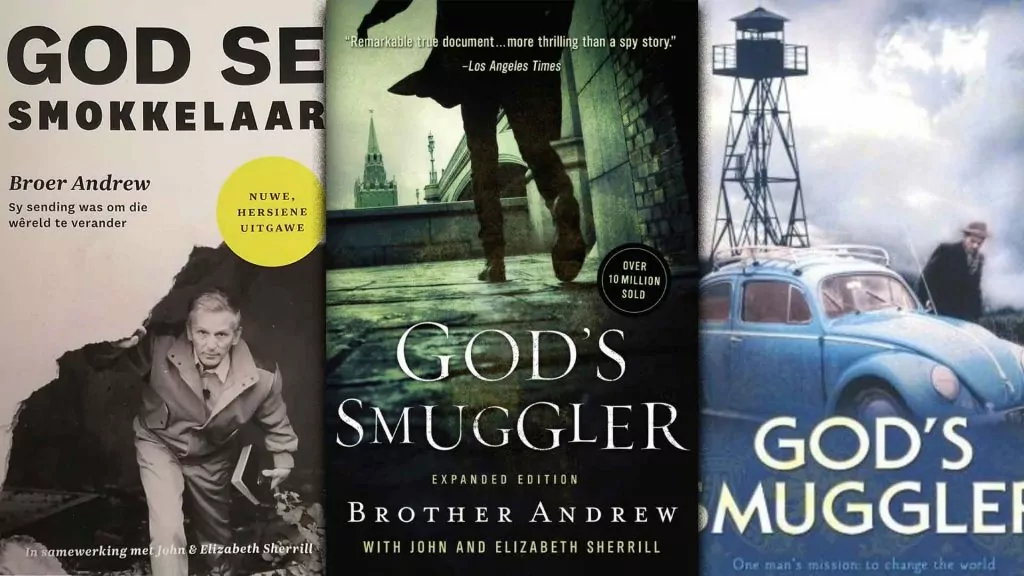
God's Smuggler

by Brother Andrew Autobiography 1967 / 288 pages Rating: Borrow/Buy/GIVE This is an amazing true story about God’s miraculous interventions to get Bibles to his persecuted Church in both Communist countries and Muslim ones. There are miracles all around us, but the rising sun, our pumping hearts, and babies’ wriggling toes do their thing with such regularity as to seem ordinary to us – we take them for granted. Not so the miracles in God’s Smuggler. Here “Brother Andrew” (1928- ) relates one extraordinary answer to prayer after another: a needed cake delivered by an off-duty postman, money of the right sum arriving at just the right time, the instant healing of Andrew’s crippled ankle. Then, in his work smuggling Bibles behind the Iron Curtain, this Dutchman came to rely on the extraordinary becoming regular. Border crossings into Communist countries were always tense, but each time Brother Andrew would ask God to “make seeing eyes blind” and again and again God would do so. The same border guards who had just taken apart the car in front of them would simply wave them through or, if they did inspect their cargo, the guards would completely miss the Bibles crammed in everywhere. It was through these regular miracles that God used Andrew and his coworkers to deliver His Word to millions in the persecuted Church. I'll share one of his miraculous accounts, which I also shared with my children, about Andrew on an early smuggling trip, this time to Yugoslavia. "The roads in Yugoslavia were extraordinarily hard on cars. When we weren't climbing fierce mountain trails, we were fording streams at the bottom of steep valleys. But the worst threat to the little VW was the dust. Dust lay over the unpaved roads like a shroud; it sifted in on us even through the closed windows, and I hated to think what it was doing to the engine. Every morning in our Quiet Time, Nikola and I would include a prayer for the car. 'Lord, we don't have either time or the money for repairs on this car, so will you please keep it running?' "One of the peculiarities of travel in Yugoslavia in 1957 was the friendly road-stoppings that took place. Cars. especially foreign cars, were still such a rarity that when two drivers passed each other, they almost always stopped to exchange a few words about road conditions, weather, gasoline supplies, bridges. One day we were dusting along a mountain road when up ahead we spotted a small truck coming toward us. As it pulled alongside, we also stopped. "'Hello,' said the driver. 'I believe I know who you are. You're the Dutch missionary who is going to preach in Terna tonight.' "'That's right.' "'And this is the Miracle Car?' "'The Miracle Car?' "'I mean the car that you pray for each morning.' I had to laugh. I had mentioned the prayer in a previous meeting; the word had obviously gone on ahead. 'Yes,' I admitted, 'this is the car.' 'Mind if I take a look at her? I'm a mechanic.' "'I'd appreciate it.' I had put gasoline in that engine, and that was literally all since I had crossed the border. The mechanic went around to the rear and lifted the hood over the motor. For a long time he stood there, just staring. "'Brother Andrew,' he said at last, 'I have just become a believer. It is mechanically impossible for this engine to run. Look. The air filter. The carburetor. The sparks. No, I'm sorry. This car cannot run.' "'And yet it's taken us thousands of miles.' The mechanic only shook his head. 'Brother,' he said, 'would you permit me to clean your engine for you and give you a change of oil. It hurts me to see you abuse a miracle.' Gratefully we followed the man to his village a few miles from Terna. We pulled behind him into a little courtyard filled with pigs and geese. That night while we preached he took the engine apart, cleaned it piece by piece, changed the oil, and by the time we were ready to leave the next morning, presented us with a grinning new automobile. God had answered our prayer." Cautions While reading this to my girls, I told my children we shouldn’t understand the many miracles Andrew experienced as evidence that he was always acting wisely and praying as he should – he himself acknowledged that God honored one of of his prayer requests despite how he prayed. There's an instance or two early on that reminded me of the old joke about a man caught up in a flood who had to take refuge on his roof and prayed for God to save him. As he was praying a boy rowed by in a boat and asked if the man wanted to join him but the man replied that he didn't need the boy's help because God would save him. Then a helicopter came, the pilot offering a lift, only to get the same response. Eventually, the waters rose and the man drowned. When he got to heaven the man wanted to know why God didn't save him, and God told him He had, sending a boy in a boat and a pilot in a helicopter. Similarly, Brother Andrew turns down offered help (for a needed cake), only to later receive help of an even more miraculous sort (a cake, unsolicited, arriving in the mail, just in time). I don't think that we have to take all of this prescriptively, as what we also should do – we can get in the boat or helicopter, or take someone up on their offer to bake a cake, and not wait for even more miraculous intervention. But we should most certainly take it descriptively as evidence of God’s great love for his persecuted Church. And, when we understand God's great love for His children, and His great power, then we too may be willing and eager to risk much to show His love to others. Conclusion We can also appreciate how aware Andrew was of his complete reliance on God. We all are, all the time, but when times are good we so often forget. Living his life in danger so much of the time, Brother Andrew wasn’t nearly so forgetful. This would also be a valuable tool to impress on a younger generation that while in their lifetimes it has primarily been the culture that has been the biggest enemy of God’s Church, in many places, and at many times, it has been the government. I would recommend this primarily for adults, because it does take some discernment to think through where Brother Andrew is relying on God in ways that we too should imitate, and where he might be getting close, or even crossing the line, into testing God. For a younger audience, just read it to them and discuss afterward. Then it could be good for as young as 8. This is one of the books I read for RP's 52 in 2022 challenge....
Red heart icon with + sign.
Book Reviews, Children’s picture books

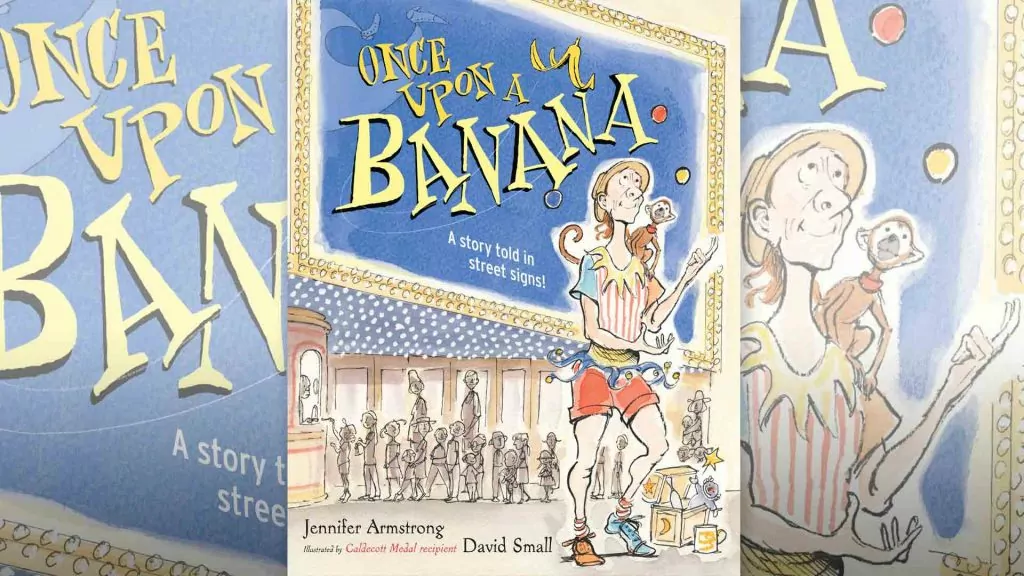
Once upon a banana

by Jennifer Armstrong illustrated by David Small 48 pages / 2013 Rating: Borrow/Buy/GIVE I'd almost forgotten just how wonderful wordless books can be. But then I found this at the library, brought it home, read it once to my three girls, and then, moments later, my youngest, all of three, was off on her own "reading" the book to herself. The fact is, long before kids can read, many really, really want to. Parents might find them, picture book on their lap, either trying to remember how the story goes, or trying to make up something that will fit the pictures. And all the while, just wishing they could read it for themselves. Wordless books are a way to build on this enthusiasm. I did need to go through Once Upon A Banana the first time with them, pointing out things like how banana peels are supposed to be slippery, and how the book was giving us hints as to what was coming, by showing us some characters in full color, and the less important characters only in shades of blue. But they didn't need much to figure it out. The story is one big chase scene, with monkey owner chasing monkey, and then grocer chasing monkey owner, and then some dogs join the chase, and a skateboarding judge, and a mom and her baby in its stroller. Oh, and there's a big garbage truck in the mix too. It's crazy and frantic with lots to look at on every page. After I gave a short "lesson" on how to read this wordless book, my two pre-readers could do it all on their own. That means that, while wordless books aren't going to replace me any time soon, they do reduce the demand just a tad on Dad the book reader. And that freed me up to read something a bit more challenging, and at least a little bit closer to my own level, to my older girls. The only downside to wordless books is that they take hardly any time to read. That means this isn't the best value for a parent - it'd be better to get it out of the library. But this is a good one for a school library. You can get it at Amazon.ca here and Amazon.com here. And for more wordless wonders, see our collection of more than 130 recommends here....
Red heart icon with + sign.
Adult fiction, Book Reviews

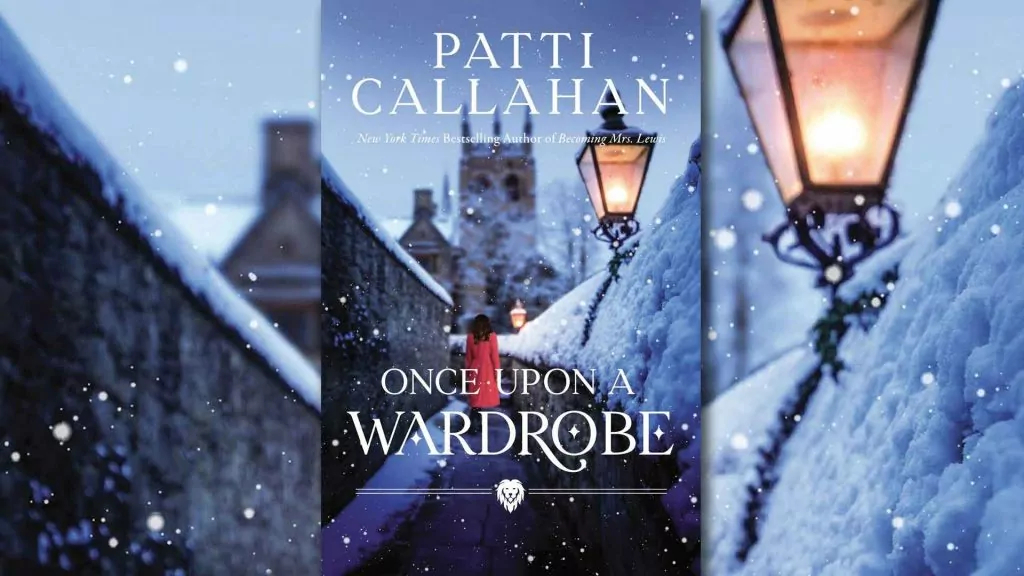
Once Upon a Wardrobe

by Patti Callahan 2021 / 285 pages Rating: Borrow/Buy/GIVE The year is 1950, and an eight-year-old George Henry Devonshire has finished a book, just published, called The Lion, the Witch, and the Wardrobe. And now he wants to know Where does Narnia come from? George is old enough to know Narnia is not real, and yet at eight, he's somehow already wise enough to know that this story is about something very true. So where did it come from? Born with a weak heart, the young George has been confined for most of his life to his own room, and, on better days, to the rest of his house. But his older sister Megs loves him fiercely and comes home every weekend from university, so George is sure she'll help him figure this out. Megs, after all, goes to Oxford, where the creator of Narnia teaches. She should just ask him! It turns out though, that Oxford isn't simply one college, but dozens, and Megs is at an entirely different school than where Lewis teaches. She sometimes sees him walking about, but the quiet girl doesn't want to intrude on the great man with bothersome questions. And yet, for her brother, she promises to try. In the end, Megs doesn't so much manage to introduce herself to Lewis, as Lewis's brother Warnie introduces himself to her... and invites her for tea! What follows is only the first conversation of many. Megs keeps coming back because Lewis and his brother never seem to offer the simple answer that young George is after. Instead of sharing where Narnia came from, the two tell Megs stories about their growing up. Megs isn't into stories the way her brother is – her studies in math and physics don't leave her a lot of time, as she might put it, to waste on fiction – so even as she enjoys her time with the two men, she doesn't understand why they won't give her a more direct answer to relay to young George. Her brother loves the stories she brings home, but he keeps sending her back for more. George is aware, even though his parents and sister have tried to shelter him from the knowledge, that he does not have long to live on this earth. So there's an insistent edge to his questions: he needs to know where such beauty and truth comes from. Patti Callahan has married careful research with simply wonderful prose to create a fictionalized biography of both Lewis and his best-known book. I loved this so much I've given it to my mom and my wife, and I can't really give it higher praise than that. If you're looking for the serious sort of biography that tells you what the subject ate for breakfast on his 43rd birthday, you'll need to look elsewhere. But if you enjoy learning a little something from the fiction you read, or if you've ever wanted to know more about the man who gave us Narnia, you won't find a more charming introduction....
Red heart icon with + sign.
Book Reviews, Teen fiction

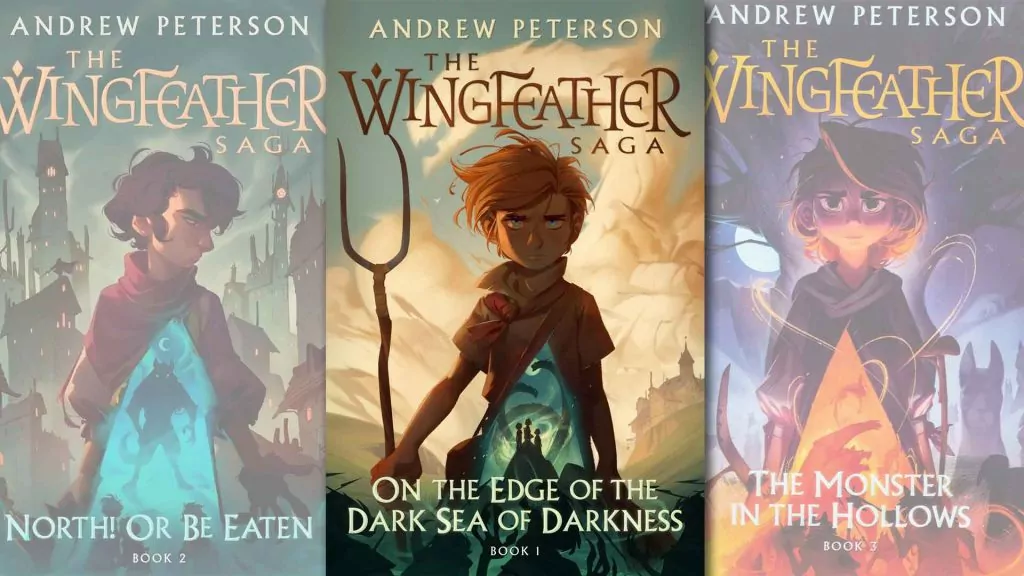
On the Edge of the Dark Sea of Darkness

by Andrew Peterson 284 pages / 2008 Rating: Borrow/Buy/GIVE My wife hasn't read this book, but she enjoyed it too. As I made my way through I couldn't help but read whole chapters to her, or, if she wasn't nearby, the next time she came by I'd update her about all the wackiest bits. And there are a lot of wacky bits. The "Dark Sea of Darkness" in the title gives a clue right off as to Peterson's goofy sense of humor. The subtitle is even better: "Adventure. Peril. Lost Jewels. And the fearsome toothy cows of Skree." While I read the first three chapters to my wife I'll restrain myself here, and pass along only the first few lines of the opening which is titled: "A Brief Introduction to the World of Aerwiar." Peterson wants us to know this takes place on an entirely made-up world so he begins with his own creation story: The old stories tell that when the first person work up on the first morning in the world where this tale takes place, he yawned, stretched, and said to the first thing he saw, "Well, here we are." The man's name was Dwayne, and the first thing he saw was a rock. Next to the rock, though, was a woman named Gladys, who he would learn to get along with very well. In the many ages that followed, that first sentence was taught to children and their children's children and their children's parents' cousins and so on until, quite by accident, all speaking creatures referred to the world around them as Aerwiar. That gives a good taste of the fun that is to follow. The heroes of this epic tale are three siblings: Janner and his little brother Tink, and their littler sister Leeli. The villains are the Fangs of Dang, under the direction of the "nameless evil...whose name was Gnag the Nameless." Our story begins nine years after the Fangs sailed across the Dark Sea of Darkness and conquered the lands of Skree, and it is in a little cottage, in this conquered land, that the family Igiby resides: the three children, their mother, and their grandfather. The Fangs are cruel, bureaucratic, and they look exactly like "...humans except for the greenish scales that covered their bodies and the lizard-like snout and the two long venomous fangs that jutted downward from their snarling mouths." Oh, and they have tails. And worst of all, they think the Igbiy's have the lost Jewels of Anniera! Janner, Tink, and Leeli don't know anything about any jewels, but they're curious sorts, and they are eager to find out all they can. So Peterson is writing not just a fantasy, but also a mystery, and certainly a comedy. And he's managed to slip in a really good chase film too. Caution A word of warning might be due as far as the comedy is concerned. Some of it could be described as juvenile: no potty humor, but Janner does, at one point, discover a candle made of "snot wax." Peterson peppers the book with footnotes and for the candle he has this entry: 1. Snot wax is too repulsive a thing about which to write a proper footnote. Then there are the vile Fangs of Dang. Their name gives a good indicator of the line that Peterson draws: it leaves no doubt that they are a vile bunch, but Peterson isn't going to use vile language. And yes, the Fangs like to eat brown lettuce, maggot-loaves, and anything that wriggles, but this humor is all of a sort that will appeal to boys, gross out their sisters, and leave parents largely untroubled. Conclusion But what mom and dad are sure to love is the prominent place that parents have in Peterson's story. In most teen fiction parents are either dead or dumb; the teen hero is either an orphan or wishes he was. Here we have a well-respected mother and a grandpa who is doing what he can to fill in for the siblings' long-dead father. So when Janner makes a big mistake and doesn't know what to do he is smart enough – and he loves and respects his grandpa enough – to know he should go to the old man for help. This might be where the author's Christian faith most comes to the fore. Andrew Peterson is better known as a Christian songwriter, and while this is not a specifically Christian fantasy, the virtues lauded in this book are of the sort found in Philippians 4:8. These three siblings know they can look to their grandpa for guidance, for love, and to see what sacrificial leadership looks like. So I'd recommend this as a very fun and positive book for fathers to read with their boys 10 and up, or in some cases maybe even a couple of years younger if they can handle battles and lizard-like villains. This is a fun one that will have both dad and son laughing, and turning pages quickly. I'm learning too, that while there are some notable distinctions between "girl books" and "boy books" if a dad really loves a book, his daughter is quite likely to love hearing him read it. So this could be a very good dad/daughter book too, maggot-loaf aside, with little Leeli giving daughters someone to cheer on too. This was so good I was thankful to discover there were three more titles in this wild and wacky Wingfeather Saga series, plus a short stories collection! The series has been republished now, with new covers and extra pictures inside, so be sure to get the newer version. It's also being turned into a TV series, and a sneak peek is available below. ...

Red heart icon with + sign.
Book Reviews, Children’s fiction, Teen fiction

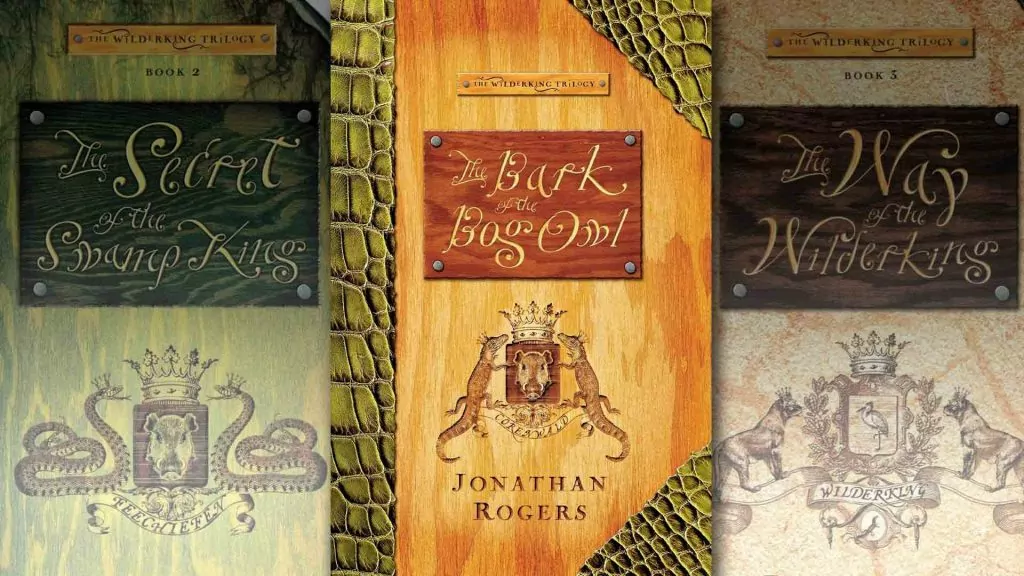
The Bark of the Bog Owl

by Jonathan Rogers 2014 / 248 pages Rating: Borrow/Buy/GIVE Our hero, Aidan Errolson, is a medium-sized twelve-year-old with dreams that are far bigger. When we join his story he's just putting the finishing touches on a letter: My Dearest King – You will be glad to learn that I am still available for any quest, adventure, or dangerous mission for which you might need a champion or knight-errant. I specialize in dragon-slaying but would be happy to fight pirates or invading barbarians if circumstances require. I would even be willing to rescue a fair maiden imprisoned by evil relatives. That would not be my first choice, since I am not of marrying age. Still, in peaceful and prosperous times like these, an adventurer takes whatever work he can find... For Aidan, it's all that peace and prosperity that's the problem. While his father was a great warrior, and his grandparents carved out a settlement on Cornwald's wild eastern frontier, Aiden's only excitement comes from the imagined foes he fights in defense of the flock he's been tasked to tend. However, things quickly take a turn. First, Aidan hears the bark of the Bog Owl, a creature that has never been seen. Then the Bog Owl turns out to be one of the feechiefolk, who are no less the stuff of campfire stories, akin to impish elves, or fierce boogeyman, and like them both, entirely made-up. But this feechie boy is anything but... and he wants to wrestle. Second, Bayard the Truthspeaker makes an unannounced stop at the Errolson farm to see, so he says, the "Wilderking of Corenwald." And Bayard declares that it is none other than little brother Aidan. That's quite the surprise, and quite awkward too, because Corenwald already has a king, and the Errolson family are his most loyal supporters. Now, if you're a bit quicker than me, this last bit might be ringing some bells, reminding you of Samuel's visit to the house of Jesse (1 Sam. 16). This is where my middlest caught on, but I needed several more chapters. I finally figured it out when Aidan fights a giant. With a sling. And five stones. In my defense, this is only very loosely based on David – Aidan has to deal not only with a giant, but cannons too, and there's no feechie folk in the original either. That it is inspired by, but does not pretend to be, the story of David is part of what makes this so intriguing. While there'll be no confusing the two tales, Rogers' account will have you reflecting on what a tough position David was in, the king not yet crowned, loyal to, and yet chosen to replace, the failed king. Requirements I usually list any possible cautions for the book being reviewed, but there are none for Bark so I'll list one requirement instead: this absolutely needs to be read aloud. The feechie folk dialogue, as it is paced and misspelled, will have you speaking with the most delightful accent, without even trying. Jonathan Rogers makes it easy for a dad to sound good. Conclusion I really can't praise this one enough. I started reading it on my own, and had to stop midway and start again with my girls because this was simply too good not to share. The Bark of the Bog Owl has been compared to The Lion, the Witch, and the Wardrobe, not so much for story similarities, but because both are clearly Christian and utterly fantastic fantasy. Bark of the Bog Owl is a book that, if you do read it to your children, you can be sure that one day your grandkids will hear their own parents reading it to them too. The two sequels – The Secret of the Swamp King, and The Way of the Wilderking – complete the story. This is really one epic tale split into three parts, so be sure to buy the set. You can preview the first 2 chapters here. And for a second opinion, read Hannah Abrahmason's take at Reformed Reader....

Red heart icon with + sign.
Book Reviews, Teen fiction

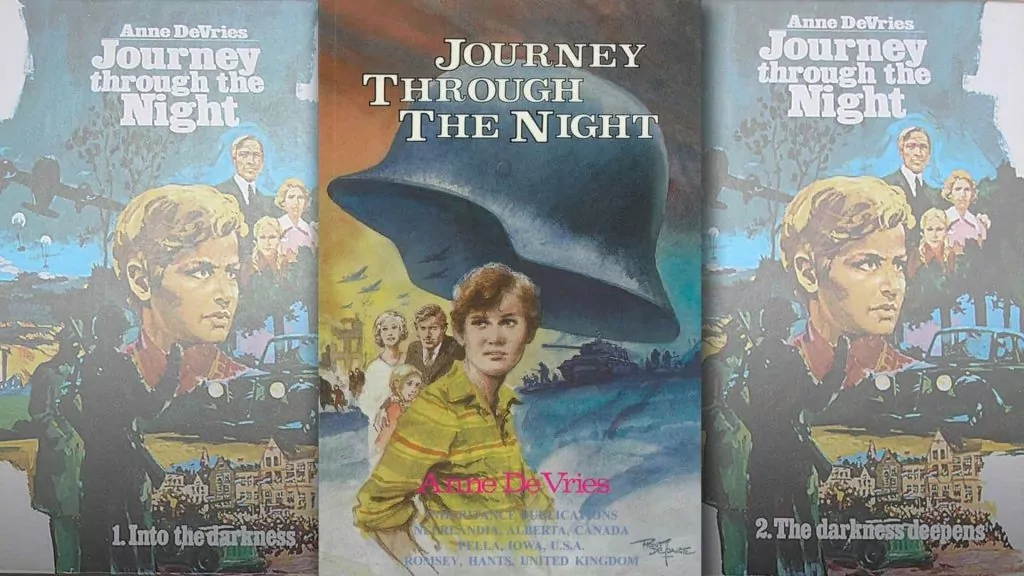
Journey Through the Night

by Anne De Vries 372 pages / 1951 Rating: Borrow/Buy/GIVE Christian writers these days, they just don’t know subtlety. They write miraculous stories where the miraculous occur with a regularity that robs it of all wonder. And instead of pitting the Christian character against worldly temptations, they have the hero wrestling actual demons, or even Satan himself. But back when I was a kid, authors like Piet Prins wrote stories that could have actually happened in the real world. Though no actual demons made an appearance in their books, the demonic presence was felt in a much more powerful way, through the actions of human underlings. In Anne De Vries' Journey Through the Night we meet John De Boer, a Dutch boy soon to become a man... if only he survives the Nazi occupation of the Netherlands. When the Germans first took over, the De Boer family weren't actively trying to resist. However, as German persecution increases, John and his father are compelled by their conscience into helping Jews and others wanted by the authorities. Our heroes enter into their work for the Dutch underground in an almost grudging manner, but they do the work because they know it is what God wants them to do. When I first read this as a child I wondered why they weren’t eager to jump into the work, into the adventure! I read this part of the book quite differently as an adult, wondering whether I would have had the same courage. That is one of the strengths of this book, I think. It tells a story about the bravery of our fathers, and grandfathers, as they fought against an evil that we too might face one day. Of course, it won’t be the Nazis in our case, but it seems likely we will be similarly tested in one way or another. We can draw courage reading about how God was with his people in this war, whether they were caught by the Nazis, or survived until the Liberation. This story is particularly compelling for teenagers since it focuses on the life of sixteen-year-old John, and his adventures among older soldiers and underground members. But I also know a number of adults who have reread this story and enjoyed it immensely, so I would recommend it for anyone 10 years old and up. As C.S. Lewis said, if a children’s book isn’t worth rereading as an adult, it isn’t much of a book at all. Older folks might remember that Journey Through the Night was originally a four-book series. This new version includes all four books in one pretty sturdy soft-covered edition. Kids probably aren’t going to ask for these books themselves so maybe parents and grandparents out there should consider giving this one as a gift. Who knows, maybe you’ll even be asked to read it out loud to your little descendants. Journey Through the Night really is children's fiction at its very best. Editor’s note: you can now find the Journey Through the Night series with some new covers at the Cántaro Institute....

Red heart icon with + sign.
Graphic novels, Teen non-fiction

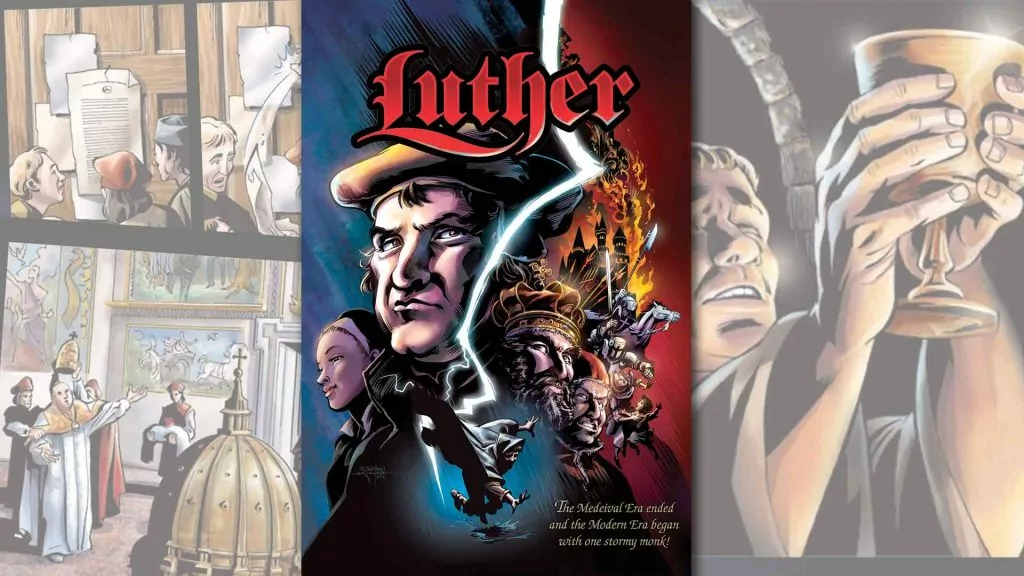
Luther: the graphic novel

by Rich Melheim illustrated by Jonathan Koelsch 2016 / 72 pages Rating: Borrow/Buy/GIVE I’ve reviewed other “comic biographies” and never enjoyed one more. Luther is scripted like a movie, has witty dialogue with actions scene interspersed, and the artwork is of the same quality you would find in Marvel or DC comics – it is fantastic! Educational comics, as a genre, are valuable in that they make learning history a lot less painful. But very few of these educational graphic novels are the sort that a teen would just pick up and start reading. Luther is the exception. I don’t want to over-hype it – a kid who reads nothing but superhero comics will still find this a bit of a stretch – but it really is as good a comic as you will find. Cautions Since this is intended for teens, I’ll note a few cautions. The word “crap” is mentioned three times, “ass” once, and “old fart” once. But when you consider this is a comic about the notoriously potty-mouthed Luther, this is really quite tame. I’ll also note there is a depiction of Christ on the inside back cover of the book that is not part of the story, but rather part of an ad for other comics by the same publisher. Also: the comic treats as fact, the famous conclusion to Martin Luther’s speech at the Diet of Worms where he is said to have declared: “Here I stand. I can do no other. God help me. Amen.” There is some dispute as to whether he ever said these words. Conclusion The comic has several strengths including the overall picture it gives of the happenings going on in the broader world that made it possible for Luther to both spark this Reformation and live into old age and die a natural death. I’ve always wondered why the Emperor didn’t just have him killed. Perhaps it was because, as we learn in this comic, Charles V was busy contending with Turkish expansion and might not have wanted to risk alienating any of his German princes. Another strength is that while this account is sympathetic, it does note one of Luther’s weaknesses: that sometimes Luther’s pen got the best of him and he could write some “terrible and hateful words” denouncing Jews, Calvinists, and Anabaptists alike. Overall this is a comic that teens and adults (who aren’t embarrassed to be seen reading a comic) will certainly enjoy. It is available at Faith Inkubators....

Red heart icon with + sign.
Book Reviews, Children’s picture books

Tikki Tikki Tembo

retold by Arlene Mosel 1968 / 48 pages Rating: Borrow/Buy/GIVE My full first name is Jonathan, but long ago I learned there were benefits to using a shorter form. In basketball, for example, if a teammate was streaking up the sidelines and yelled for a pass, by the time he got out all three syllables of Jon--a--than he wasn't open anymore. But "Jon!" would get my attention, and him the ball, much quicker. Tikki Tikki Tembo is about this same lesson but in a very different setting. We are told that long ago Chinese families would honor their firstborn sons with long names, and give their other sons very short names. Our story takes place in a small mountain village where a mother had two sons. The second was simply called Chang while the first was named Tikki Tikki Tembo-no Sa Rembo-chari Bari Ruchi-pip Peri Pembo. If these two played sports we can be sure who'd be making all the great passes and who wouldn't even make the team (try fitting that name on a jersey!). Of course, they didn't have basketball in ancient China, so their names come into play a different way. This is a charming book so I don't want to give away the ending. Let it suffice to say that as in basketball, so too in aquatic events it is better, and less hazardous, to have a shorter name. The story is wonderful, the illustrations fun, but more than anything else this is such a joy to read out loud: Tikki Tikki Tembo-no Sa Rembo-chari Bari Ruchi-pip Peri Pembo is not only a long name, but a lyrical one, and each time it gets repeated in the story it gets funnier. This is a classic for a reason!...

Red heart icon with + sign.
Book Reviews, Children’s picture books

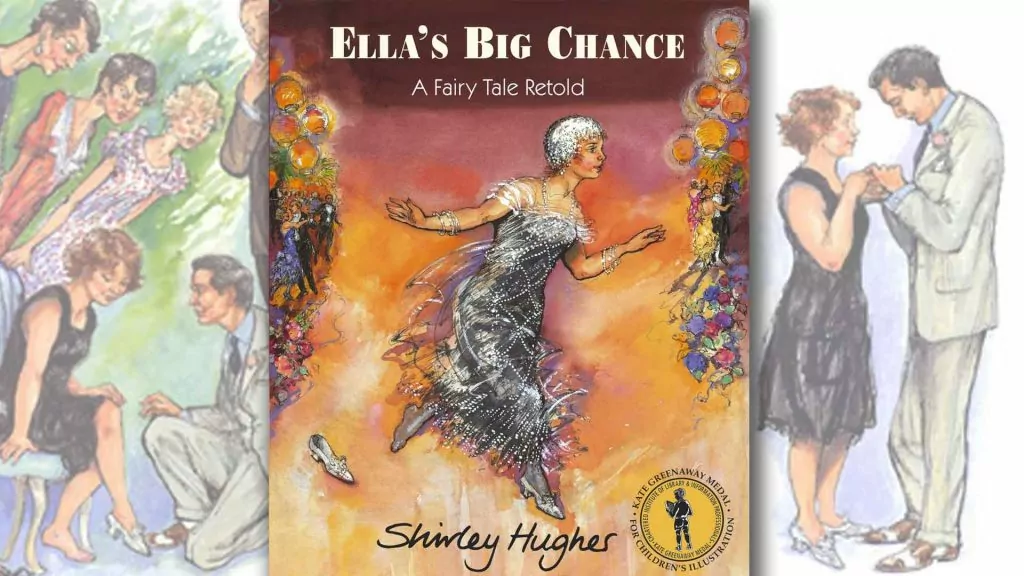
Ella's big chance: a fairy tale retold

by Shirley Hughes 48 pages / 2003 Rating: Borrow/Buy/GIVE This unique spin on the story of Cinderella is so good it improves on the original. Some of that is due to Shirley Hughes' artwork, charming as always. Then there is the setting: this is a "Jazz-Age Cinderella" pushing the story forward to the 1920s. Ella and her father run an elegant dress shop, making the finest of clothes. The evil stepmother, in this case, has some business acumen, turning the small shop into an even bigger success. But the greater the demand, the more work there is to do for poor Ella. The story follows along the familiar course of other Cinderella versions, but with pictures all the more stunning, and a twist at the end in which (SPOILER ALERT!) the love-at-first-sight duke finds his Ella but doesn't get the girl! This is really what sets this version both apart and above all others – none of the nonsense about knowing someone for an evening and then getting married when next you meet again. Nope, Ella ends up with the store's delivery boy, who has always been there for her and wanted to be so evermore. While Hughes' artwork is wonderful, the prose is superb as well. It flows so very naturally that, as I read this out loud to my girls, I felt as if I was one of those professional readers. I sounded good! But that is all to Hughes' credit, and not my own - there is a wonderful flow to each page of text. I will add one caution: there is one use made of the term "good heavens," which some view as a substitute oath and too much like a real blasphemy for their liking. Though I don't agree, I do sympathize and wanted to alert readers to its use. I would give this two very enthusiastic thumbs-up, and recommend it highly to anyone who has three- to ten-year-olds. While this is probably far more a girl than a boy book, I really liked it. I think other dads will enjoy reading it too. And if you're looking for another inventive spin on Cinderella, be sure to check out Jan Brett's Cinders: A Chicken Cinderella....

Red heart icon with + sign.
Adult fiction, Book Reviews

Dawn of Wonder

by Jonathan Renshaw 2015 / 708 pages Rating: Borrow/Buy/GIVE This might, at first glance, seem to be your typical boy-meets-girl, boy-dares-girl-to-jump-off-of-a-thousand-foot-high-bridge-into-the-icy-cold-stream-below-and-girl-shows-him-up-by-actually-doing-it story. And, as many a fantasy tale contains, there are swords, courageous heroes, battles to be fought (and sometimes with large, very toothy creatures), and evil not yet here but lurking ominously. Our hero, Aedan, is not yet thirteen but he has a sharp mind, and he's had a hard life, which makes him wise beyond those few years. So when an officer comes galloping into the village with warnings of slavers on the way, Aedan is the first to suspect the man might not be the ally he seems. But when no one will listen, his foresight isn't enough to save his not-yet-a-girlfriend-but-already-his-best-friend Kalry. In the adventures that follow Aedan is equal parts determined and desperate, willing to do and try whatever it takes to retrieve, or revenge, his lost companion. The book's size is not so typical – the 700-page first-of-the-series would make for a good doorstop. And not just any story would get my nephew recommending this to all his brothers and sisters, and any friend within earshot too. It is atypical too, in that it accomplished what no other book has managed: it made me look forward to running. I only let myself listen to the fantastic audiobook reading when I was out jogging, and at 30 hours long, it got me out the door roughly 60 times. It is Christian, but not obviously so. The author is content to let the deeper tale – the moral of this story – come out gradually. I should add, I don't know the author is Christian but like the best bits of Narnia, or Lord of the Rings, this book is simply too good, and too true, not to be rooted in the Word. The only downside is that Book 2 still seems to be a good ways out. Fortunately, there is a sense of resolution to Book 1 – it's as satisfactory a cliffhanger as a reader could really hope for. So I'll pass on a most enthused two thumbs up, and express my gratitude to my nephew for being insistent that I should read Dawn of Wonder; I can't recall enjoying a fantasy novel more! To give you an idea of the research the author invested in his novel, the video below is of him investigating whether it is possible – as one of his characters did – to make a decent bow in a single day using just a knife. ...

Red heart icon with + sign.
Adult fiction, Book Reviews

Flags out front

A Contrarian's Daydream by Douglas Wilson 196 pages / 2017 Rating: Borrow/Buy/GIVE In Flags out Front, Douglas Wilson has crafted something that is as inspirational as it is fictional. What if a Christian public figure took a stand on principle and, no matter what pressure came, just would not back down? What might happen if, instead of wilting under that pressure, or trying to avoid it, a Christian leader embraced it, and fought back fearlessly? In Flags out Front we get to find out. Tim Collins is a "mild-mannered president of a dwindling southern" Bible college who never meant to cause a fuss. But he arrives on campus one day to find a prankster has swapped a couple of the flags at the campus entrance. Now instead of the American flag flying above all, there is the Christian flag waving from on high, with the Stars and Stripes just below. Collins doesn't know quite what to think. But, upon reflection, he concludes the change is a good one and leaves it. Then the phone calls start coming. He gets calls from conservative, patriotic sorts, wondering why the American flag is not in its central place. He hears from the other side too, from those who'd be happy enough to burn the flag, but don't want to see it waving below a Christian flag. Protests to the right, threats from the left, and Collins quietly stand his ground. He's willing to do it, even if it means standing alone...but alone is one thing he's not going to be. Quiet, meek, Dr. Collins, becomes the rallying point for Christians of all sorts...including some clever college students who know how to make some noise. This is how it should be, and, maybe could be – who knows what God would do with a fearless few? Actually, we already know: it wasn't so long ago that we celebrated the 500th anniversary of the firestorm God started with one monk and his mallet. Flags out Front is a funny, clever, comedic, feel-good novel that most anyone would enjoy, particularly if you want to be inspired as to how Christians can do politics differently. I've foisted this off on a number of friends and family (and read about half of it out loud to my wife) and the response has been enthusiastic all around....

1 2