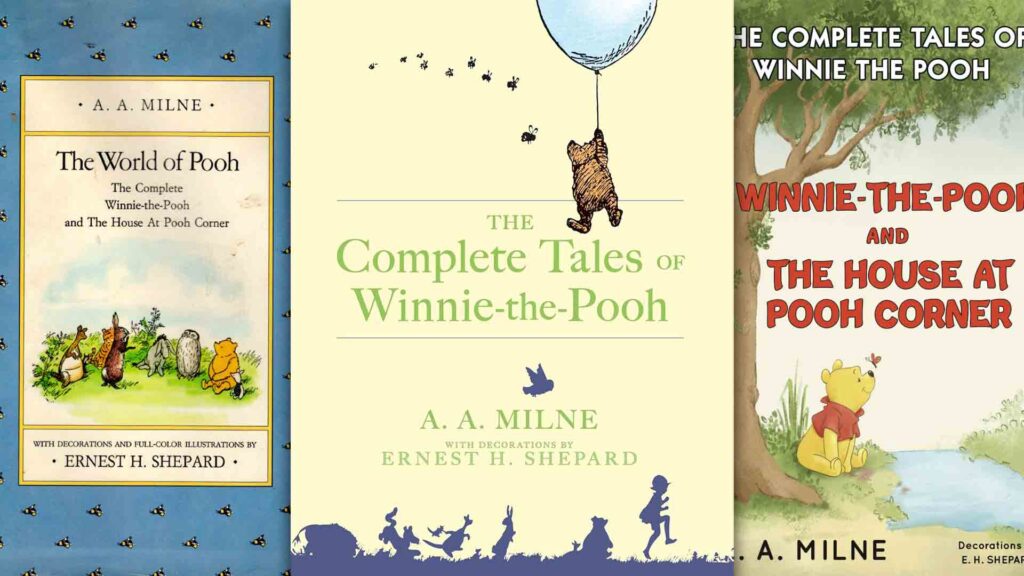
by A. A. Milne
1926-28 / 368 pages
Rating: Good/Great/GIFT
The Complete Tales includes both Winnie-the-Pooh, first published in 1926, and The House at Pooh Corner, in 1928. As I began to read, I quickly entered the fun of the characters, most of whom were based on the stuffed animals of author A. A. Milne’s son Christopher Robin.
Pooh Piglet, Roo, and Tigger, for example, are very much children, with children’s typical egocentric focus on themselves. At the same time, Pooh, though a somewhat gluttonous Bear of Very Little Brain, has the childlike love of the world that prompts him to create and recite plenty of poetry, which he, with childish confidence, is sure that Christopher Robin, will love. Piglet is a typical little kid who is more than a little worried about everything. Both Roo and Tigger are filled with the energy of children that sometimes exhausts the adults in their lives.
Many of the others seem to be more children’s view of adults: Rabbit, all busy and bustling, but not very patient; Kanga, the perfect mother, but just a little fussy; Eeyore, the somewhat depressed (and depressing) donkey.
What binds the two groups together is their love for Christopher Robin, who owns all these (stuffed) creatures.
What makes the characters funny is their general lack of awareness of their own weaknesses, but this can also get somewhat discouraging story after story. I was pleasantly surprised, then, when near the end of the second volume, Milne tells a story that shows how, sometimes, the communion of saints breaks through.
We’ve seen Rabbit in action before, trying to un-bounce Tigger, but now his brusqueness is put to good use when he (finally) tells Eeyore what we’ve been thinking all along – to stop feeling sorry for himself and go out and visit others. Pooh sings a song that does more than just amuse himself; it also pays tribute to Piglet’s earlier heroic actions. Finally, Piglet, when Eeyore mistakenly gives away Piglet’s house to Owl after Owl’s tree falls down, quietly lets Owl keep the house and accepts Pooh’s gracious offer to come and live with him (echoes of Acts 2:45!).
All the creatures, who love the one who owns them, learn to love each other as well. That’s what we should be seeking as well. Our unity in the One who owns us should prompt our love for the others who are owned by Him (at much greater cost than Christopher Robin’s ownership). That love should start as well, for its youngest audience, in the family. The Pooh stories are wonderful read-alouds for parents with their kids, and a wonderful way to start conversations about the difference between being childlike and childish, and how growing up in the communion means being able to deal graciously with others even when they are (as we all sometimes are) being childish.