Transparent heart icon with white outline and + sign.

Life's busy, read it when you're ready!

Create a free account to save articles for later, keep track of past articles you’ve read, and receive exclusive access to all RP resources.

White magnifying glass.

Search thousands of RP articles

Helping you think, speak, and act in Christ.

Open envelope icon with @ symbol

Get Articles Delivered!

Helping you think, speak, and act in Christ. delivered direct to your Inbox!


Most Recent


The Rest


Red heart icon with + sign.
Economics, People we should know

Friedrich Hayek (1899-1992) showed us that free enterprise is necessary for freedom

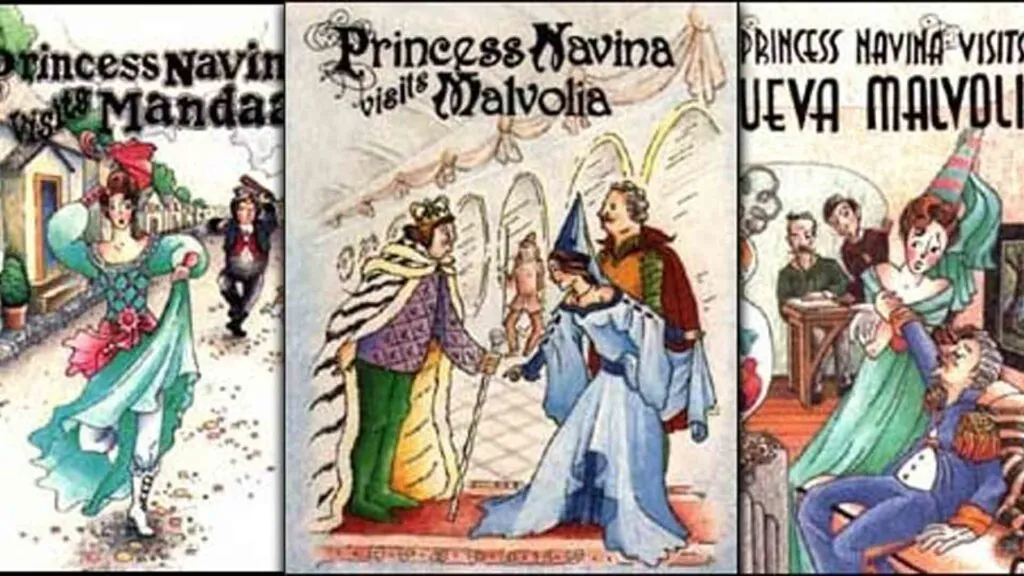
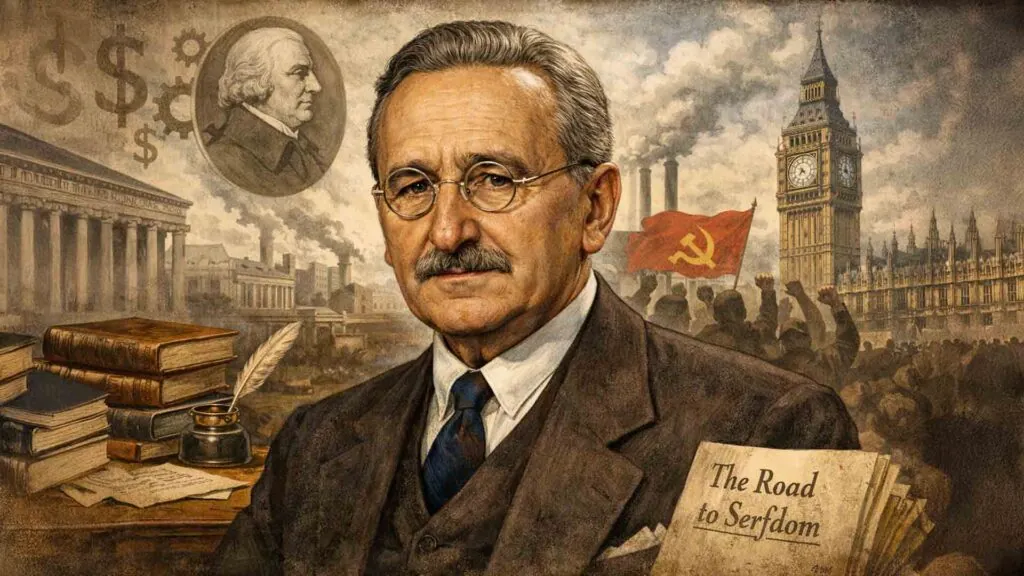
One of the greatest social theorists of the twentieth century was a libertarian – some would say conservative – economist named Friedrich Hayek (1899-1992). Hayek spent his life arguing that free enterprise is not only necessary for economic prosperity, but also essential to maintain political liberty. For much of his career, he faced overwhelming opposition to these views, but he did eventually gain some mainstream acceptance, winning the 1974 Nobel Prize in Economic Sciences. Hayek’s life and legacy An important book about Hayek has recently been published, written by Dr. Eamonn Butler of the Adam Smith Institute in London, England. It’s called Friedrich Hayek: The ideas and influence of the libertarian economist (2012), and it summarizes Hayek’s life and key insights. Hayek was born in 1899 in Vienna, earned a doctorate in law from the University of Vienna in 1921, and a doctorate in political science from the same university in 1923. At the University of Vienna Hayek became a close associate of Ludwig von Mises, the leading figure in the “Austrian School” of economics, which emphasizes the importance of the free market. Hayek and Mises then set up an economic think tank and Hayek undertook economic research. His research demonstrated that bad government policy was the cause of the “boom and bust” cycle of many countries’ economies, and he predicted that the USA was about to experience such a bust. Shortly thereafter, in 1929, his prediction came true, with the Wall Street Crash and the beginning of the Great Depression. In 1931 Hayek took up a position teaching economics at the prestigious London School of Economics in England. He became a naturalized British citizen in 1938 after Hitler took over Austria. The Road to Serfdom In April 1945 Readers' Digest released an abridged version of Hayek's Road to Serfdom. While the original is 250+ pages, this version is just 60. It can be read for free online here. There is also an 18-page cartoon summary that was meant to create interest in the longer book. You can find the comic at Mises.org/books/TRTS where you can also download the original, both of them also free to download. Because of World War Two, Hayek began to focus more on political science. He was afraid that totalitarian ideas were going to sweep the world, not just in the more vicious forms of Nazism or Communism, but even in the softer form of socialism. He believed that the moderately socialistic direction of the Western countries in the mid-twentieth century would ultimately lead to authoritarian government. To articulate this view, in 1944 he wrote a book called The Road to Serfdom, which was very controversial and quickly sold out its first print run. Butler notes that this book was: read by the young Margaret Thatcher, who later said she found it "the most powerful critique of socialist planning and the socialist state." It made Hayek’s name in America, too, where tens of thousands of copies were sold, and Reader’s Digest distributed another 600,000 copies of its own condensed version. Due to this publicity, Hayek gave lectures across the USA and became a visiting professor at Stanford University. In order to help spread libertarian ideas, in 1947 Hayek assembled 39 British, European and American scholars who supported individual freedom to found an organization that would promote the intellectual case for the free society. Because this meeting was held at the Swiss resort of Mont Pelerin, it was called the Mont Pelerin Society. This increasingly important organization still exists today to pursue the same goal. Shortly after World War Two, a former Royal Air Force fighter pilot named Antony Fisher went to Hayek to get advice on how to promote free enterprise in the face of popular socialist assumptions. Hayek convinced Fisher that the best thing would be to found a think tank that would generate intellectual arguments for freedom. A few years later, in 1955, Fisher set up the Institute of Economic Affairs (IEA), the first of several free market think tanks that would become very influential by the late 1970s and 1980s. Fisher would later play a role in the creation of Canada’s Fraser Institute, as well as like-minded think tanks in other parts of the world. Rise to prominence In 1950 Hayek became a professor at the University of Chicago. While there he wrote one of his most famous books, The Constitution of Liberty, articulating the foundations and principles of a free society. In 1962 he moved back to Europe to be a professor at the University of Freiburg in West Germany. As mentioned previously, he won the Nobel Prize in Economic Sciences in 1974. And over the course of the 1970s he wrote a three-volume set called Law, Legislation and Liberty, once again expressing the intellectual case for the free society, as opposed to socialism. Besides the Nobel Prize, Hayek also received other honors. Butler points out that in 1984, Queen Elizabeth II made him a Companion of Honour (he described it as "the happiest day of my life"), and in 1991 he was awarded the Presidential Medal of Freedom by George H. W. Bush. Hayek died in 1992, after seeing his ideas receive acclaim in many academic circles, as well as influencing the policies of some English-speaking democracies (especially Margaret Thatcher’s Britain) and some newly-liberated Eastern European countries. Freedom versus socialism Among Hayek’s many insights, two are of most significance for Christians. First, he argued that modern societies are much too complex to be centrally planned by government (i.e. socialism doesn’t work). Secondly, he argued that attempts to engineer societies to conform to some concept of “social justice” inevitably lead to authoritarian government (i.e. socialism leads to tyranny). Many people believe that if human societies were completely planned and run by governments, they would be much more efficient and fair. In Western societies today there are so many different kinds of products, of so many different shapes and sizes, that the situation is virtually chaotic. So if the government could decide what is produced, all of the products could be standardized, leading to economic efficiency. As well, there is a considerable amount of inequality in society, because some people benefit much more than others in a free market system. Through central planning, the government could equalize incomes, and thus enhance social justice. 1. Too complex for central planning But Hayek points out that societies are much too complex for any human organization to be able to centrally plan successfully. Societies are spontaneous orders, with millions of people every day making economic decisions of various kinds. How could a government possibly be able to aggregate and apply all of the information that would be necessary to anticipate these economic decisions every day? It’s simply impossible. Any attempt to do so would lead to all kinds of economic problems (think, for example, of the old Soviet Union). Consider one particular example of this problem, namely, the determination of salaries in a centrally planned economy. Should a nurse get paid more than a mathematics professor? Should a butcher get paid more than a coal miner? There are thousands of different occupations, and the central planning authority would have to determine each of their salaries relative to each other. How could they possibly know what was right? Hayek correctly argued that the free market takes care of this efficiently without central planning. People pay us for the goods and services we produce because they value those products. So market rewards do depend, in a very real sense, on the value that we deliver to other members of our society. They also reflect the scarcity and skill of the producers, the numbers of customers who want the service and the urgency or importance that buyers attach to it Therefore a person’s salary reflects a number of economic factors, not the political calculation of a bureaucrat. If there are too many people pursuing a particular occupation, their salaries will go down. If there is a shortage of people in a particular occupation, their salaries will go up. In a free market society, economic information is communicated through prices. Prices are signals that indicate “to everyone where their product is most highly valued, and prompting them to steer their efforts and expertise in those directions.” Say, for example, that there is a shortage of tin. Because there is not enough of it, its price will rise. Due to the price increase, companies that use tin will use less of it or find a substitute for it. The extra demand for the substitute will in turn bid up its price, and prompt those using the substitute to seek yet other materials to substitute for that; and so it goes on. The entire market order adjusts to the shortage of tin, even though hardly anyone knows what caused it. The overall point is that free markets automatically adjust to changing conditions. It’s part of the nature of the free market to process all kinds of information and respond to it spontaneously. Central planners could never hope to know all of this information and to be able to respond to changes in the economy so rapidly and effectively. Besides the fact that socialism doesn’t work, its tendency is to lead inevitably to authoritarian government. A central planning government must determine how labor, land and other productive resources are used in the economy. It has to coordinate all these different factors so that they work towards the completion of the government’s plan. In such a situation, everyone would have to do what the authorities have determined is necessary for the achievement of the government’s objectives. Individuals must expect to be uprooted and deployed at the direction of the authorities, since personal life now counts for nothing compared to the good of the collective – a good that is defined by those same authorities. Butler summarizes the point this way: “When governments believe they can ‘run the country’ just as they might run a factory, our lives and property become a mere input at their disposal.” 2. Inequality can be a good thing A centrally planned economy can redistribute resources between people and therefore lead to a situation of greater material equality. However, the loss of freedom necessary for such an endeavor is quite high. As well, the economic benefits of inequality are lost. In the economic sphere, inequality is not always a bad thing. Yes, you read that right: inequality is not necessarily a bad thing. Butler describes Hayek’s insights on the economic importance of inequality this way: Inequality is not just the outcome of the market process: it drives the market process. The high gains made by successful producers act as a magnet, pulling people and resources to where the greatest value can be captured, and away from less productive and less valuable uses. So people and resources are attracted to where they will make the greatest possible contribution to future incomes. And this is a continuous, dynamic, growing process. The inequality that so many people resent is, in fact, the very attraction that steers effort and resources to their most productive applications, pulling up incomes at every level. Hayek argued that the government should have a minimal role in society. Mostly it should be concerned with national defense and enforcing the rules (laws) that protect people from each other. It would also provide public goods such as roads, land registries, organized responses to natural disasters, and other things that governments can do best. He also saw the need for government “to support needy groups such as people with disabilities, those incapable of work, orphans or the elderly.” Needless to say, the government can fulfill these tasks without becoming socialistic. Conclusion Hayek was not a Christian scholar and he was not trying to promote a Christian perspective. Nevertheless, his scholarship dovetails well with Biblical Christianity because he believed in the need for a private property-based economic system. The Bible establishes private property as an essential institution and assumes a private property-based economy. In this respect Hayek’s intellectual work supports an economic system much like what the Bible demands. There are few twentieth century thinkers that were as important and influential as Friedrich Hayek. Whereas so many academics think that mankind is smart enough to re-engineer societies through governmental power, Hayek was humble enough to concede that human beings are very limited in their knowledge and that their efforts to re-engineer any society are bound to be detrimental. While not everything in his thinking can be embraced by Christians, his overall perspective on economics and society provides a powerful intellectual antidote to the socialistic fallacies that are still common in North American colleges and universities today. Hayek and his ideas are featured below in a couple of epic rap battles vs. his economics arch nemesis, John Maynard Keynes. ...

Red heart icon with + sign.
News

Saturday Selections – Mar. 28, 2026

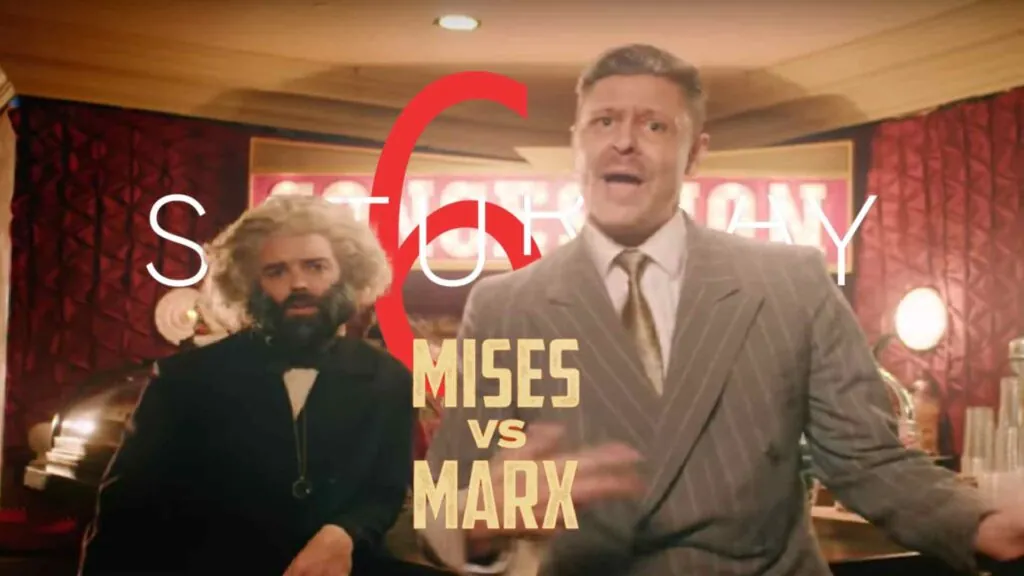
Some good news about euthanasia Scotland has voted against euthanasia after looking at the horror happening in Canada. 1 in 5 Canadian employees works for the government and it's rising And that doesn't include all the time that private sector employees have to spend. Meanwhile the self-employed are dropping. Correlation doesn't prove causation but... Finnish parliamentarian convicted of hate speech for opposing homosexuality ...and the court ordered her book to be banned too. The astonishing "engineering" involved in childbirth (10-minute read)  When a baby is born we think it is fearfully and wonderfully made, and that is certainly so. But we're just starting to learn about all that's going on in mom's body during childbirth... and it's amazing. Some of this was a bit above me, but I enjoyed reading it even just getting the gist. What a gist!  What a Creator! Man most responsible for global population collapse has died Paul Ehrlich passed away this week at the age of 93. He spent his life scaring people into thinking our planet was going to be overpopulated, and millions and billions would consequently starve. He did such an effective job that our world is now in great danger of a demographic collapse, with countries globally no longer having enough babies born to replace the adults who are dying. Ehrlich is another example of how "Science" can be biased, and based on ideology, not reason or facts. Ehrlich was always wrong, but only people grounded in God's Word – where we learn that children are a blessing, not our doom – could have stood up against his hype and hysteria. Oh sure, eventually the research proved him wrong, but that took decades. Decades and decades of abortions, with millions dead. Only Christians, gifted with God's clear Word, could have known better. "Science" belittles the Bible, but the Bible was right and the world was wrong. And now Canada's birthrate is so low we would be shrinking, if not for immigration. This is the legacy of a man who was arrogant enough to go right up against God, took the world with him, and was disastrously wrong. Marx vs. Mises - the epic economic rap battle This is the most informative 8-minute overview of economics you'll ever see. And the most entertaining. There might be some terms and concepts that blow past you, but if so, rewind, and then do some digging. This isn't a Christian presentation, though it lines up well with God's Word... or at least far better than socialism. Marx pitches socialism as all about equality, but it is about class warfare (against the 5th commandment), about fostering envy (10th commandment), about the use of force to take what God has entrusted to others (8th), and ultimately about the arrogance to think central planners can be omniscient (1st commandment), knowing what everyone should be doing. Mises pitches individualism, which is often worshipped as a god too, but it doesn't have to be. We are part of groups – our country, the covenant Church, and our family, to name three, but we are individuals, too, and God has entrusted us individually with our own skills and resources, and tasked us, as individuals, to make the most of them (Matthew 25:14–30). And if we do not steal what others have, or covet it, then what results? The free market with its free exchanges. Adam Smith spoke of an "invisible hand" making things work as if by magic, getting fruits and milk and medicine to market without a central planner. As Christians we can recognize Whose hand that is – when we do economics the way God prescribes, the reason it works so well is just evidence of His love for us. ...

Red heart icon with + sign.
Economics - Home Finances

A business tithe on sales?

Not a requirement, but what an opportunity! ***** Every sale has a story and an opportunity behind it. • Someone trusted you and chose your product or service. • And as believers, we know something deeper still is happening, that every sale is God’s providence, His care being displayed to us. So how should a believer respond to God’s providence? The answer is simple: gratitude – biblical gratitude. And one way to express that gratitude is through a business tithe. Now Scripture does not say, “businesses must tithe.” Even in the Old Testament the tithe requirement was on individuals, not business entities. The tithe command is not directly repeated in the New Testament, so it might well be part of the ceremonial law that is no longer binding. Yet the absence of a tithe requirement does not mean the absence of direction. We are still to give, and joyously! The Bible consistently shifts the focus from obligation to intention, reminding believers that giving is not meant to be done “reluctantly or under compulsion” but as a deliberate act of faith (2 Cor. 9:7). Stewards, not owners What does that look like in practice? It starts with moving from gratitude, being thankful for the sale, to recognizing the opportunity it presents and converting it into stewardship. The dominant biblical framework for money is stewardship. Like the servants given money to invest in the Parable of the Talents (Matt. 25:14-30), a business owner is entrusted with capital, people, and opportunity, none of which ultimately belong to them. Giving from business increase, therefore, is not about meeting a quota but acknowledging God’s ownership over what has been entrusted. Scripture also teaches us to give of our first fruits to honor God as our first priority: “Honor the Lord with your wealth, with the first fruits of all your produce” (Prov. 3:9). For business owners, this must be expressed wisely and often in a calculated, budgeted way. Sometimes planning is thought to be too deliberate, and consequently not joyous enough – that maybe there is a lack of faith to not give as you feel led in the moment. But planning generosity is not a lack of faith; it is intentional worship that balances faithfulness with responsibility to employees, customers, and the long-term health of the business. Tithing on the sale So what does it look like to convert our gratitude into stewardship? I will offer up some details on one approach I like very much. It involves creating a business model with tithing built right into it at the very beginning. More specifically, it involves tithing the sale as it comes in, rather than waiting to year’s end to see what profit is left over. I think this better reflects a heart posture of faith, gratitude, and honor. The full sale represents the true increase God provides, while profit is simply what remains after human calculations and expenses. By giving first from the sale as it comes in, we acknowledge that everything – costs, opportunities, and provision – comes from Him. Tithing on the sale is an act of trust that declares God, and not our profit margins, is our Source. It’s a way of putting God first, not with what’s left. In essence, what this approach says is, “Lord, this business belongs to You.” Not at the end of the year, not when the numbers feel safe, but from day one, from the moment the business begins until it is sold or transferred to the next generation. Working it out – understanding net margin To show how this might work out practically, let’s start with considering the concept of “net margin.” Net margin is what a business keeps after all expenses, such as payroll, supplies, and services. It’s calculated with this formula: "Net Margin (%)" = "Net Profit" / "Revenue" ×100 For example, if a company earns $100,000 in sales and, after expenses, has $10,000 left, its net margin is 10%. This means the business keeps 10 cents of every dollar earned. You can figure out your net margin for the last year, or, if you’re accounting is very tight, you can figure out your net margin for the last quarter. Then, instead of tithing from profit at year’s end, you give 10% of the net margin – essentially a percentage of total sales – throughout the year. For instance, if your business has a net margin of 20%, you would give 2% of sales; if your net margin is 15%, you give 1.5%. The key is that giving isn’t from profit or leftovers; it’s from the sales God provides in real time. Again, it’s about honoring the Lord with our first fruits. Giving of our leftovers doesn’t require faith, but giving from our first fruits does. And when we give first, it will reshape everything we do and think: how we spend, how we grow, and how we lead. The question shifts from, “What can we afford to give?” to “What has God already entrusted to us?” How this works in practice Let’s make it practical. Imagine if, last year, your sales were $1.2 million, and your business operated at a 10% net margin. Then, if you were committed to giving 1% of sales, that equals $12,000 for the year. Breaking it down monthly, with sales averaging $100,000 per month, 1% is $1,000 per month. Then each month, you’d distribute $500 to the kingdom and save $500 for future needs. Why save half? God brings needs throughout the year. Saving allows us to respond immediately when a family is in crisis, support a ministry mid-year, or meet any need He places in front of us. At year-end, the remaining balance is distributed in full. This approach removes stress, eliminates debate, and keeps guilt out of the process. Tithing this way doesn’t limit growth, it refines it. Generosity keeps us grateful, and gratitude keeps us disciplined. Sometimes business owners get caught up trying to forecast God’s provision, as if we must predict exactly what He will provide or when. The reason we save half each month isn’t about forecasting God – it’s about being faithful and wise stewards of what He has already entrusted to us, ready to respond when needs arise. The heart of the matter The heart of this isn’t about rules or earning God’s favor, or working this out the exact same way my company has to plan its giving – it’s about recognition. Who provides your work? Who owns your business? And ultimately, who are you really working for? When every sale is seen as a gift from God, we naturally don’t want to waste it. We steward it, honor Him with it, and He multiplies it. When provision is treated casually and we give only from leftovers, our spending can follow the same pattern: extra lunches, convenience purchases, upgrading vehicles too soon, or not seeking efficiency. Committing to a business tithe recenters our hearts, reminding us that everything comes from God and should be managed with gratitude and intentionality. Personally, I believe that a 1% tithe on sales naturally encourages efficiency, which can grow a net 10% margin to 11% or 12% over time. Jesus rarely spoke in percentages but frequently addressed trust. Giving is meant to loosen money’s grip as a source of security and control. While no verse says, “Business owners must tithe,” Scripture consistently calls believers to honor God through stewardship, generosity, justice, and trust. When giving flows from these principles, it fulfills the heart of biblical teaching, even without a mandated number. Tithing that makes things possible Let me conclude with two pictures for your mind’s eye. The first is a man, let’s call him Bob. Bob comes to your shop every other day to vacuum up the sawdust. He lives in a supported residential home for adults with limitations. From a purely business perspective, Bob isn’t your most efficient choice; an assistant would get it done quicker and cheaper. But Bob doesn’t come just to vacuum; he comes to work, to contribute. God uses Bob to remind us that people are people, that He made them all, and He provides for them too. The second picture is a widowed woman in your community whose back fence had been knocked over in a windstorm. She couldn’t afford repairs. Because your generosity was pre-decided through the 1% tithe on your sales, you didn’t hesitate. You showed up, served her, and took care of her, a tithe of service. You may never know all the prayers she had been lifting, but God always provides. When planned, these acts of generosity can be part of your 1% of sales, Spirit-led, and used to meet needs where God places them. Neither of these moments will show up on financial statements, but both exist because God entrusted us to honor Him with our first fruits, not leftovers. Final encouragement When we tie giving to sales, generosity becomes automatic. Every sale becomes an opportunity to steward God’s provision, giving every dollar purpose and making every business decision an act of worship. Churches and charities benefit from steady month-to-month funding, and there’s no stress at year-end. Cash flow remains consistent, and we can respond immediately when needs arise – whether it’s someone like Bob or a widow in your community. Stewardship brings joy, as we see God’s kingdom at work through what He provides. When we give first and consistently, God multiplies the impact far beyond what we can measure. That is the power of a business tithe: thankfulness in action. The challenge is clear – push your company to grow from 1% to 2%, 3%, or even 4%, and watch how God multiplies faithful generosity. “‘Bring the whole tithe into the storehouse, that there may be food in my house. Test me in this,’ says the Lord Almighty, ‘and see if I will not throw open the floodgates of heaven and pour out so much blessing that there will not be room enough to store it.’ ” – Mal. 3:10...

Red heart icon with + sign.
News

Saturday Selections – Jan. 31, 2026

Reformed and Dangerous's Christ is King A little harder rocking than some of us might be used to, but the fire in the music is a match for the power of the words... Is Bluey's dad too good?  A New York Times article offered up that critique, and the folks at Breakpoint ministries had this insightful response. An unexplored mission field: seniors' homes? I'm really hoping this link works (it is behind a paywall but says I can share it). This is a story of a lady suffering from dementia who is bringing the gospel to other dementia sufferers. Sex on the silver screen – outsourcing depravity Tim Challies asks, are we outsourcing our sexual depravity, getting actors to do for our entertainment what we would never do ourselves? Free will vs. determinism Atheist Sam Harris has famously argued that because we are just meat machines, all our actions are determined, so we should be more compassionate to criminals because what they did isn't really their fault – their "output" is just a result of all their inputs, with no choice on their part. He denies we have any free will, but, ironically, wants us to choose to be nice to criminals. His campaign highlights his own disbelief in his notion. Calvinists deny free will too, but mean something very different by it. We know that Man is sinful in all he does, and cannot choose God apart from God's own intervention. But we also know that when we choose to steal, lie, or cheat, we are responsible – we are making these choices for evil. So, we make choices, even as God is sovereign. Do we get that totally? Nope, but God tells us it is so (Rom. 8:7-8, Eph. 2:8-9), and each of us know it is true personally in how we experience both that slavery to sin, and know yet that it is still me, myself, and I responsible for my sins. The free market's "double thank-you" Sports can help teach kids a lot of real-life lessons – how hard work pays off, the importance of being a team player, etc. – but there's one big difference between life and games. In the arena there can be only one champion but in life both sides can win. Socialists deny it, pitting the poor against the rich, and fostering envy over what our wealthier neighbors have (violating the 10th Commandment). But the rich only get rich by being helpful. Unless he stole his money, a businessman can only get rich via free, voluntary transactions. And those exchanges will only happen when both sides agree that they are better off for it. Kid offers to mow your lawn for $20? He's only going to make the offer if he thinks it's worth it for him, and you'll only agree if you think it benefits you. Both are better off. You are both "richer" for it. When the government manages things, it may force people to do what they wouldn't otherwise want to do. We're taking your money to build this library (and stock it with obscene books). We're going to build a hockey arena so we're hiking your taxes. That's win/lose – one side wins by making others lose. And the government can even pull off lose/lose situations where everyone is worse off. So we want to combat the Left's envy by remembering the rich only got that way by thousands and millions of voluntary transactions in which not only did they benefit, but the other side was made richer too! Instead of envying them, we should be saying "thank-you" right back to them!      ...


Red heart icon with + sign.

Adult non-fiction, Book Reviews

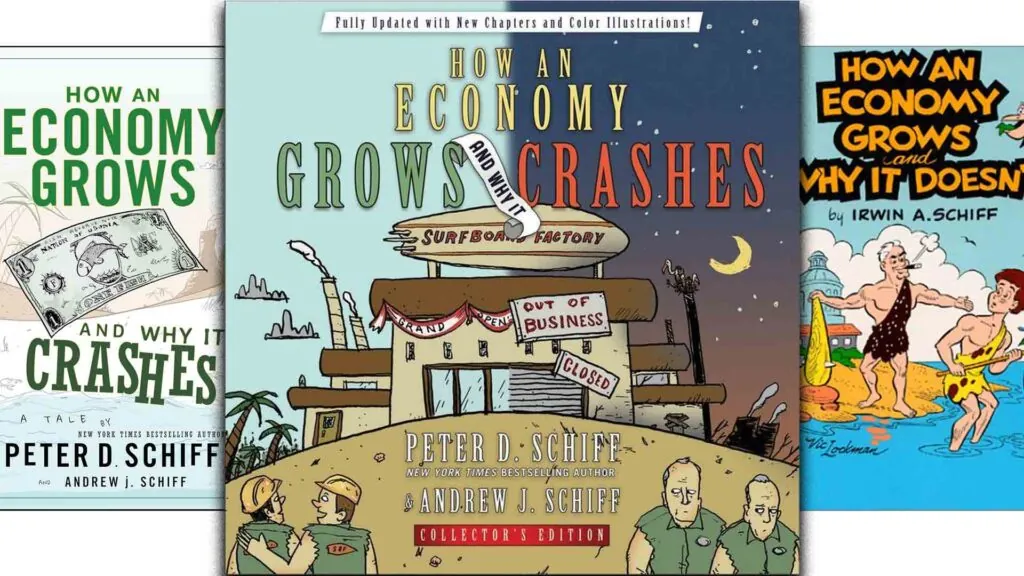
How an Economy Grows and Why It Crashes

by Peter Schiff and Andrew Schiff 2014 / 304 pages Economics affects everyone but few people care to learn much about it. All the numbers and graphs make it seem complex and quite boring. Of course some subjects are so important that even if they were boring we’d just have to soldier on and learn them anyway. And you could certainly make that case for economics – every citizen has to get a handle on the basics of economics so we can properly evaluate government policies and get a handle on where the economy may be heading. However, Peter Schiff and Andrew Schiff have done us a service by making it possible to learn economics without being bored to sleep. Peter Schiff is an investment manager who was also an economic adviser to Congressman Ron Paul's 2008 presidential campaign. Andrew, Peter’s brother, is the communications director for Peter’s investment firm. In 2014 they released a Collector's Edition of their book How an Economy Grows and Why It Crashes that is part fiction, part comic book, and educationally entertaining throughout. . A fish story Their book is written in the form of a story, with some cartoon illustrations thrown in, which makes this a lot easier to digest and follow than, say, a university economics textbook. The story begins as follows: Three men, Able, Baker, and Charlie, live on an island and survive by catching fish with their bare hands. They just barely subsist from day to day, catching only enough for their next meal. Then Able gets the idea of making a simple net to catch fish, but to make it, he has to invest a day’s worth of time. Instead of going fishing, he spends the day crafting the net. This investment is not only costly – he has to go a day without food – it is also risky: he doesn’t know if his net will work. But Able is an entrepreneur, so he takes the risk, and makes the investment. And work it does. The net enables him to dramatically increase the amount of fish he catches, and therefore improves his lifestyle. The net is “capital” he created that increased his productivity. He subsequently catches more fish than he can consume, and this situation initiates improvements on the island. The lesson, as the Schiffs write, is that “spare production is the lifeblood of a healthy economy.” Because he has surplus fish, Able lends them to Baker and Charlie. Those two fellows can then take time off from catching fish with their hands to make nets for themselves. That is, they too create capital to improve production. With the extra fish they can now catch, they pay Able back with interest, and all three of the men are better off than before. Even though they had to pay interest, Baker and Charlie increased their own standard of living. Able’s motivation in loaning the fish was to earn a profit. But the loan he provided benefited the other two men as well as himself. As the Schiffs explain, The pursuit of profit drives innovation, business formation, and economic growth. It’s the force that raises everyone’s living standard. A big profit just means that a business is good at satisfying customers. Those who earn it should be celebrated not vilified. Increasing productivity The story continues from this point with the three men able to spend less time fishing, and more time developing other tools and implements (capital) for improving their lives. For example, they make more nets to build larger fish-catching devices. The new capital they create increases productivity even further. The Schiffs strongly emphasize the importance of increasing productivity as the key to a successful economy. It benefits everyone. Besides using their story to show how, they also add a real-life example: the industrial revolution of the nineteenth century. They write that the …vastly increased productivity of the industrial revolution made it possible for working-class people to afford all kinds of goods, like upholstered furniture, tailored clothing, plumbing, and wheeled transportation, that were previously available only to the rich. Eventually Able, Baker and Charlie begin trading with people on other islands. Immigrants come to their island, a government is formed, and the economy becomes more complex. Their island society becomes known as Usonia. It’s an easy story to follow with lessons on basic economics interwoven with the story’s events. Paper currency Fish function in this story not only as food but also as currency. Everyone eats fish and they are easy to exchange for other items. Once a government is created for Usonia, it issues paper currency backed by fish. Each “Fish Reserve Note” could be redeemed for actual fish at a central bank. Using paper money was much easier than carrying actual fish, so it became the common currency. Over time, though, the government produces larger and larger amounts of paper currency without maintaining enough fish to redeem the notes. Eventually the government declares that the Fish Reserve Notes could not be redeemed for actual fish after all. The value of the currency then becomes based on the citizens’ confidence in the government. This is much like the situation with money in the world today. The currencies of modern nations are no longer based on particular sources of value (like gold) but on confidence in the nations’ governments. The Canadian and US dollars were at one time backed by gold (that is, a dollar represented a specific amount of gold), but that is no longer the case. Now they are just paper. The Schiffs point out that this kind of paper money is commonly called “fiat” money. The word “fiat” comes from Latin and literally means “let it be done.” The word applies because paper money does not have any intrinsic worth, but rather derives its value from government decree. Right now the worldwide economy based on fiat money seems to be working. But the Schiffs do not think it will last. They do not consider fiat money to be real money because it has no inherent value, the way gold and other precious metals do. In their view, we are in a “through the looking glass” world where, for the past 40 years, no country issues real money. This is the biggest monetary experiment ever conducted. No one knows how or when it will end. But rest assured, it will. Government debt The government of Usonia, like actual governments today, increases spending beyond its means and finances its operations through increased taxes, borrowing money, and also printing more paper money. These activities are harmful to the economy in the long run. The Schiffs state that Taxes and borrowing merely divert private-sector spending or investment to government. Printed money has the same effect. Newly created money spent into circulation by the government depresses the purchasing power of money held by the public. In the United States, President Barack Obama has pursued a policy of high government expenditures financed by borrowing and printing money. The US government debt is so large, in fact, that the Schiffs do not believe it can ever be paid. They paint a rather unnerving picture: Ultimately the U.S. government will have only two options: default (tell our creditors that we can’t pay, and negotiate a settlement) or inflate (print money to pay off maturing debt). Either option will lead to painful consequences. They believe that the value of the US dollar will drop steeply because so much is currently being printed. However, its status as the official “reserve currency” of the world keeps its value artificially propped up. Being the international reserve currency means that the dollar is accepted as the exchange currency for any international transaction. This means that everyone, not just the United States and its trading partners, needs dollars to conduct trade. So even if no one actually buys things that are made in this country, dollars are always in demand. No other country has this monetary good fortune. In their view, if the US dollar was to lose reserve status, its value would drop severely, wiping out much of the wealth Americans currently possess. Its present value only remains high because of its wide acceptance around the world. Conclusion Economics may not be inherently exciting to many people but it affects everyone. The basics are understandable if they are presented properly, and the Schiff brothers do a great job in their book. They provide a simple basis for understanding the kinds of measures that help an economy grow as well as those that stifle growth. Some policies (such as printing more money) provide a temporary illusion of prosperity followed by a financial downturn. Politicians campaigning for re-election love policies that provide an illusion of prosperity. They often make decisions that will benefit themselves in the short run but actually harm the economy in the long run. The Schiffs emphasize work, saving, thrift, and innovation as keys to economic success. To a large degree the virtues that lead to prosperity are also Biblical virtues. Therefore, even though the book is not specifically Christian, it reflects much that is compatible with Biblical Christianity. This was originally published in the May 2015 issue under the title “Economics for Everyone.”...

Red heart icon with + sign.
News

Saturday Selections – Nov. 15, 2025

Women don't belong in combat (5 min) That world won't acknowledge that it is Who made us, and in Whose Image we are made (Gen. 9:6), that makes us valuable. So, instead, the world evaluates people on the basis of what a person might have, or how they look, or what they can do. All of these other evaluations cause troubles, especially the last. An abilities-based assessment is what's behind both dehumanizing the unborn, because they can't yet do many of the things the already born can do, and dehumanizing the elderly and disabled because they can't do what the young and more able-bodied can. Valuing people on the basis of what they can do is also what's been behind the push for women in combat roles. If you are what you can do, then we would be forced to conclude that women aren't the equal of men if there is anything men can do that women can't. So, in rejecting God, the world also has to reject the reality that men are stronger and make more capable soldiers. The world puts on blinders, because the only alternatives are equally unattractive to them: either to believe that men are better than women, or to believe that our worth is found in God and not in ourselves or anything we can do. Another problem with the minimum wage It's said a person will judge himself by his intent – "It doesn't matter how it went, after all, I meant well" – and judge others by their actions... or, in other words, by whether it actually went well. The minimum wage is an example, implemented in the name of helping the poor, and therefore judged by its implementers to be a success, no matter what results. But with the newly elected New York mayor having campaigned on a push for a $30 minimum wage, it doesn't take much imagination to see the harm that could result, with all sorts of businesses closing because they can't afford to pay those wages. Then, instead of the poorest getting paid more, you have the poorest getting fired. Now a new study finds that the harm the minimum wage causes hurts blacks more. This is a US study, and the racial aspect doesn't translate directly to Canada. But the fact that the minimum wage hurts the most vulnerable certainly does. The woke mob doesn't forgive, but God does Malcolm Gladwell became one of the first big names to admit peer pressure cowed him into saying guys in dresses should be able to compete against women. His admission – both to being cowed, and owning up to it now – are remarkable in a culture in which forgiveness is in low supply. A whole list of reasons to consider marrying younger Tim Challies with a bunch of benefits that come with marrying younger. On marital nakedness What the world cheapens, God's people can enjoy as He intended. Nick Fuentes: a name your kids may know (15 min). Nick Fuentes is big in the US, and probably leaking across the border, so if your kids don't know about him yet, they may soon. Whether or not you've heard of him, there's a reason to watch this video – Fuentes' rise is an object lesson in how taking a strong stand against what's wrong can be both attractive and still really, really evil. Too many think we can find the the truth simply by pushing back against the lies of the Left. But that forgets that there is another side of the horse to fall off of. So, for example, feminists who say motherhood is slavery are calling good evil, but when Fuentes hits back at feminists by degrading women, he's just turning his followers in a different evil direction. So Truth isn't found by rejecting error but by turning towards Christ. While Fuentes says he is Christian, he wears his "faith" like an outfit, to be put on or taken off whenever it suits. Maybe we can use this video with our kids to show how being loud while professing "Lord, Lord" (Matt. 7:21-23) can be a very different thing than being bold in our submission to the LORD (Matt. 10:32-33). The one concern I'll offer with the video below, is that it includes, near the end, depictions of Christ as He has been portrayed by actors through the years, including some quite bloody, graphic portrayals.. I'd have loved if they'd steered clear of visually depicting Jesus (my concern is the 2nd Commandment), but share this anyways because of the insight offered. ...

Red heart icon with + sign.
Adult fiction, Book Reviews

Time will run back

by Henry Hazlitt 368 pages / 1951 Rating: Good/GREAT/Gift As novels go, this is intriguing. As economics textbooks go it is downright amazing. Like 1984... In Time Will Run Back author Henry Hazlitt envisions a future in which the communists won and have been in power for more than 100 years. As Henry Hazlitt himself acknowledges, his novel bears some similarities to 1984 (published two years earlier) since both take place in a dystopian future in which the government manages every aspect of citizens' lives. But Hazlitt didn't read 1984 until after he had finished the first draft of his own book, so no plagiarism was involved. Instead, as Hazlitt puts it, authors like Orwell, Aldous Huxley (and his Brave New World) and himself were: plagiarizing from the actual nightmare created by Lenin, Hitler and Stalin....All the writers had done was to add a few logical extensions not yet generally foreseen. In Hazlitt's envisioned future the government has not only taken over the capitalist West, but they've wiped away any memory of capitalism, even editing Karl Marx's books so that no one could deduce from them what sort of economic system it was that Marx was writing against. Into this setting Hazlitt places the ultimate outsider. The world dictator's son, Peter Uldanov, has grown up far away from his father, isolated on a Bahama island. When his mother and father split, he agreed to let her take Peter, so long as she agreed not to teach Peter anything about history, politics or economics. So when the world dictator calls his now adult son to Moscow and informs Peter that he is to succeed his father as dictator, father first has to bring son up to speed in these three key areas. Peter's education takes up the first third of the book, though there is some palace-intrigue as well: the second-ranking member of the ruling Politburo is eager to see Peter dead, but doesn't want to be caught doing the deed. ...and Screwtape Letters This first third bears more than a passing resemblance to C.S. Lewis' The Screwtape Letters, with Peter's teacher filling the role of the elder Screwtape explaining to his younger devilish charge why they do things the way they do them. For example, at one point Politburo member Adams and Orlov, the editor of the world's state-approved and only remaining newspaper, explain to Peter how what is carried in the paper has nothing to do with the truth, but instead has to do with what is useful for the masses to hear. It turns out "what is useful" can be hard to determine. "It is for the Politburo to decide, for example, whether we shall say that the production record is very bad, in order to exhort and sting everyone to greater output; or whether we shall say that it is very good, in order to show how well the regime is doing and to emphasize the blessing of living under it." "These decisions are sometimes very difficult," Adams put in. "We often find that a zigzag course is best. For example, if goods are shoddy and fall apart, or if too many size nine shoes are made and not enough size eight, or if people cannot get enough to eat, there may be grumbling and complaints – or silent dissatisfaction. We must make sure that this unrest does not turn against the regime itself." "Therefore," said Orlov, "we must lead the complaints. We must ourselves pick scapegoats to denounce and punish." In the middle third of the novel Peter takes on the role of the ultimate benevolent dictator. He wants to help his citizens, so he tries desperately to figure out ways to make socialism work. He has the help of his country's greatest minds, and near absolute power, so he is in the best sort of situation to make it work. But try as he might, they can't make it work. The biggest trouble Peter keeps running into is trying to figure out the value of what they are making. They have no money (since no one buys anything, but is instead given what they need) so they can't use price to calculate how valuable one product might be compared to another. And if they can't calculate value, then they also can't determine if the country is producing more overall this year vs. the last. Sheer tonnage is one proposed measure – that could use that to compare how much grain they grew from one year to the next. But even this falls short, because grain can come in different qualities. How then should they evaluate things if one year more grain is produced but of a lower quality, and in another year there is less but of a higher quality? Which was the better year? After ruling out tonnage as a helpful means of measuring output, one alternative after another is proposed only to have the shortcomings of each then exposed. The alert reader will see where this is leading: what this socialistic  economy lacks are markets in which the value of a product is assessed by consumers as a whole. In the final third of the book Peter gets more desperate and more radical in his efforts to make real improvements and give citizens real freedom, and he ends up discovering some economic principles that really help: open competition, property ownership, and the rigorous prosecution of cheats and swindlers. To help his citizens he is forced to invent capitalism! Conclusion Though the book is most obviously about communism, the warning Hazlitt offers here - that freedom and prosperity cannot co-exist with an economic system that prioritizes equality of distribution – is directly applicable to communism's democratic twin, socialism. This book sat on my shelf unread for many years because I didn't believe a world-renown economist could also be a credible novelist. I was wrong. There is a conversation here and there that gets bogged down by the economic lesson Hazlitt is trying to teach, but overall this is not just readable, but engaging and entertaining, able to stand up to comparisons with 1984 and Brave New World, which themselves are not read for their wonderful prose, but rather for their insightful investigations of human nature in the face of tyranny. So this is a readable, intriguing and important novel with a few slow bits. And as an economics textbook, there is none better – Hazlitt makes a strong and compelling case for the free market. The e-book can be had for free here. Note to Teachers: How Time Will Run Back is better than 1984 and Brave New World Though 1984 and Brave New World are important books, they both have sexual content (Brave New World more so) that can make them problematic to discuss even in the high school setting. Sex is also discussed in Time Will Run Back but in a way that parents and teachers may find more palatable: brief mention is made of how the government manages even citizens' sex lives, mandating that no one can pair up for longer than a month, lest they form familial bonds that compete with the bonds they should have to the state. But this is sex at is most boring - nothing titilating here. I believe you'll find find Hazlitt's offering a worthy substitution for either of these other two - just as engaging, as insightful, as thought provoking, and without the sexual content....

Red heart icon with + sign.
News

Can you track all the ways you’re taxed?

Each year the Fraser Institute observes a “Tax Freedom Day” – this year it happened on June 8 – that tracks Canadians’ total tax burden when you add up all the municipal, provincial, and federal tax burdens. Across the country, the average Canadian spent up until June 8 earning money to cover their taxes, and it was only June 9 going forward that what they earned was what they could keep. So Canadians need to work nearly half the year just to pay our taxes. The average Canadian family with two or more individuals (i.e., this isn’t tracking individuals living on their own) is said to earn $158,533 a year, and pay $68,266 in taxes, or 43% of their income. This Tax Freedom Day differs from province to province, depending on their tax burden. In Manitoba, it arrives May 17 (37.5% of their income), the very earliest date in Canada, with the latest occurring in Quebec, on June 21 (47%). Do those figures strike you as higher than expected? They did to me, so I dug a bit deeper. The biggest tax we’re all hit with is income tax, but it is far from the only one. The government taxes us all sorts of niggling ways, which has the result of hiding from us the cumulative total. Just consider all the different ways you get taxed when you earn a dollar. The amounts below are based on the Fraser Institute’s purported $158,533 average family income. Payroll taxes: $16,199 – Before you even get your cheque, both you and your employer will have to contribute to the Canada Pension Plan, Employment Insurance, and some provincial Health Taxes. Income taxes: $23,100 – The federal and provincial governments each have their own income tax on the money you take home. Sales taxes: $10,091 – When you spend any of your remaining income, both the federal government, and all provinces except Alberta (and the territories) will charge you a sales tax. Capital gains tax: $6,656 – If you invest your money hoping to make it grow, you’ll be taxed on any gains you make. Property taxes: $2,310 – If you used your money to buy property, then every year you’ll be taxed on that too. Sin taxes: $2,310 – All taxes make things more expensive, but sin taxes are specifically geared to do so, to discourage consumption. They are placed on alcohol, tobacco, and cannabis. Tariffs and fuel could fall under this category too – both are meant to punish consumption – but the Fraser Institute placed them in other categories below. Fuel/vehicle/carbon taxes: $2,267 – There are additional taxes placed on gas, and while the Trudeau carbon tax is now hidden from consumers, it is still applied to industry, which will, of course, have to then pass it on to their consumers. Other miscellaneous taxes: $1,136 – These include import duties (i.e., tariffs), amusement taxes, natural resource fees, etc. and etc. So, that’s how it all adds up. And, to make matters worse, the Fraser Institute figure doesn’t even include what we should call the hidden inflation tax. Over the last 4 years, prices in Canada have risen, cumulatively around 17.5%. If our average Canadian family spent what income remained, that rise in inflation would amount to another $13,000 worth of impact from this “tax” – their $90,267 of remaining income would now have only $77,000 worth of purchasing power, compared to just four years previous. But to a fiscally profligate government that’s piled up a huge debt, inflation can be attractive. It not only deflates the value of the dollar, but deflates the value of the country’s debt too, easing the pressure on the government to curtail their spending. In other words, inflation really is a tax, raising revenue of a sort for the government, at the expense of citizens. And we’re still not done tallying yet, because our governments are planning on spending more than they even collect, which, if that additional sum had to be paid now, would require another $5,500 from our average Canadian. Instead, our federal and provincial governments are borrowing it to a cumulative projected deficit of $84.9 billion in 2025, saddling future generations with repayment, making this a tax on our children. Why so many different and even hidden taxes? Well, if everyone knew just how much we’re paying, would we stand for it? The more important point might simply be the enormous amount. God says that where our treasure is, there our hearts will be also (Matt. 6:21), and the amount of treasure we’re investing in our government – half of everything that families make – shows where Canadians’ hearts are turning. We’ve made a god out of government, and that needs to stop (Ex. 20:3). So next election, when the politicians come knocking, we need to demand less from them. And we need to explain why they don’t need nearly so much money, because, after all, God has called on other levels of government, including the Church, families, and even self-government, to fill so many of the roles that our political leaders have tried to take over....

Red heart icon with + sign.
Economics

On why freer trade is best

The following is based on Real Talk’s episode #126, “Mere Economics and the Issue of Tariffs,” with host Lucas Holtvlüwer talking to economics professor and author Dr. Caleb Fuller about the only four ways that people can get the things they need. **** We might not be medical experts, or have a law degree, but we all know a lawyer, and a nurse or two. But how many of us know an economist? Not too many, and I think that's why economics can seem an intimidating field. But it doesn't have to be complicated. When it comes to how we can best get the things that we want and need for ourselves and our families, Dr. Fuller boiled things down: “…there's only actually four possible ways for me to get what I want. And these four ways are logically exhaustive.” What he means by "logically exhaustive" is that these four are it – there are no other possibilities. So what are these four ways? And more importantly, why should we know? To answer the second question first, this is vital information because only one of the four ways will actually work for a society. So it is key we pick the right way. 1. Getting gifts One way we could get the food, clothing, and shelter we need is to simply receive it from someone else. That’s what we do for our kids, after all. But there is a problem, as Dr. Fuller explains: “I could rely on gifts from someone else. But if you think about that for a couple seconds, you realize that if everyone was doing this – if you kind of systematized that way of getting what you want – the world would be incredibly poor. It also pushes the question back a step. You know, where did the gift-giver get what he's giving?” 2. Stealing what we want and need A second option is chosen by some, but we’d all starve if everyone did the same. “You could steal from others. Ethical problems aside, if you universalize that means of getting what you want, you also live in a world ‘nasty, brutish, and short,’ to quote Thomas Hobbes. And, also, just like the first option pushes the question back, where did the person who's being stolen from…get the goods in question?” 3. Making it all ourselves So, that leaves us only two more possibilities. We can either make everything we need ourselves, or, instead, use our particular skills to make something others want, and trade with them for what we want. So, our options are make or trade, and one of the reasons President Trump instituted his tariffs is he wanted less trade with other countries, and more of the making done in the US. Dr. Fuller highlights the problem with this approach. “Let's think about make for a second. There's a great book called The Toaster Project by a guy named Thomas Thwaites. Thwaites chronicles his attempt to build a very simple toaster from scratch, that is, without cooperating with anyone else. So he's not going to engage in buying, he's not going to engage in exchange, he's just going to make, okay? “And it takes him about nine months. He does cheat a little bit along the way. And after this nine months of full-time work on this toaster, he plugs the toaster in, and five seconds later it shorts out. “There's a small fire that melts it down. After nine months of work, that was the consequence. And that is a little vignette of what our lives would be if we systematized or universalized this third means of getting what we want – just making everything that I want to consume.” 4. Specializing/trading And as Fuller shares, that “brings us to this fourth option, of specialization.” Few of us will be any better at making toasters than Thwaites was, but we might have other skills we can offer. One person might be a great nurse, another a very good farmer, and a third might be a skilled high school teacher. We all have our specialties, and it doesn’t take a lot of imagination to recognize how much worse off we’d be if we didn’t specialize. Then the nurse would have to build her home, the farmer would have to teach his kids high school physics, and the teacher would have to fix his son’s broken leg. Specialization helps us do and make more. Dr. Fuller specializes as an economics professor producing lectures and books that others value, and he trades those away for money and then uses that money to buy what he wants. “That's why I say that the ability to exchange is not optional if you want to observe ‘mass flourishing,’ to use economist Ed Phelps’ term. And so that's why economists are so obsessed with specialization…” Conclusion Of these four ways of getting what we need, God’s commandment against stealing rules out the second. His call to be fruitful (Gen. 1:28 and in the Parable of the Talents, Matt. 25:14-30) eliminates the first as an option – we can’t just live off of our parents, even if they were willing. A fruitful life would also address the third option. It doesn’t make sense for us to try to do everything ourselves. If everyone did, we’d all be not simply poor, but quite likely dead. What’s true for individuals is true in large part for countries too. The US is currently trying to use tariffs on foreign goods to drive companies to produce in-country more of the goods that Americans consume. But even the US can’t be better than everyone at producing everything. So, for example, in a June 3rd House Appropriations meeting, Rep. Madeleine Dean questioned Commerce Secretary Howard Lutnick about the tariff being imposed on bananas. The US grows less than a tenth of one percent of the bananas that Americans eat. The other 99.9% are imported. And, as Secretary Lutnick noted, the tariff is “generally 10%.” Lutnick defended the tariff, arguing that, as trade deals are made, the tariffs will eventually be eliminated. But he also argued that “if you build in America and produce your product in America, there will be no tariff.” To which Rep. Dean pointed out, “You can’t build bananas in America.” Free trade remains best, and not simply for banana lovers. ...

Red heart icon with + sign.
News

Saturday Selections – May 17, 2025

Micah Tyler's "Praise The Lord" It ain't always easy following God, but His goodness is certain. The daily battleground we often ignore in our therapy culture "In his book on spiritual depression, the late Welsh minister, Martyn Lloyd-Jones, wrote: 'Have you realized that most of your unhappiness in life is due to the fact that you are listening to yourself instead of talking to yourself?... The main art in the matter of spiritual living is to know how to handle yourself. You have to take yourself in hand, you have to address yourself, preach to yourself, question yourself.'” Common logical fallacies Tackle one a night with your family to become familiar with the bad arguments that the world, and sometimes even fellow Christians, are using. Forewarned is forearmed! IVF and the rise of intentionally single mothers IVF has enabled both same-sex couples and single women to have children without a father, creating and celebrating a situation that would otherwise have been decried as abandonment. And we should never forget what IVF has done to the millions of babies who have been abandoned to cold storage and the millions more that have been aborted in the selection process. 5 red flags to watch for in YA Christian romance fiction It's the books your girls will want to read. But how Christian is it? And how much of it is too much? "Comparative advantage" – economics Christians need to know (4 min) What's this principle of "comparative advantage" and why is it so important to understand in the middle of our tariff wars? As Jacob Clifford highlights, trade allows people and countries to make what they are best at – just as different people have different skills, different countries also have some kind of advantage in their skills, location, or resources that will equip them to produce some products better than other countries can. When we do what we are best at, then we can trade with others for what they are best at producing. This makes everyone more productive and wealthier than if we all tried to make everything for ourselves. Just consider how productive you'd be if you had to do everything yourself, including cutting down and shaping the boards to make your home, manufacturing your fridge, growing your food, building your car, and more. You would likely starve while you were still at the shaping boards stage. Thankfully, you can trade your labor (in whatever role you have) for all these things. So being able to trade freely makes you wealthier. And being able to trade makes our neighbors wealthier, too. Trade enriches everyone! So if we are to love our neighbors (Mark 12:31), then we'll want what's best for them, including in a material sense. That's why we won't want to put unnecessary restrictions on trade... because it hurts both ourselves and our neighbors. ...

Red heart icon with + sign.
Economics

Let's not be the squeaky wheel

Fewer people are using VIA Rail, more trains are behind schedule, and the Crown corporation continues to bleed money by the millions: that’s what Canada’s Auditor General found when he took a close look at the passenger service this spring. In 2014 VIA had revenues of $280 million, but spent $597 million in operating costs, plus another $82 million in capital projects (putting down tracks, etc.). That works out to a loss of $399 million, all of it covered by the government. So what did taxpayers get for their money? Well, an economy ticket for a four-day trip from Vancouver to Toronto is roughly $500, but the true cost is $1,100, with the government chipping in the difference of $600.  Even with government subsidies of $55 million for the Vancouver-Toronto route, VIA Rail can’t compete on speed or price. In comparison an economy ticket for a flight on WestJet for the same route can be had for $300 and will take five hours. A bus ticket for a three-day Vancouver-Toronto trip is as little as $250. Government intrusion into the marketplace has left us with a business that is slower, more expensive, and costs hundreds of millions of Canadian tax dollars each year. Why, then, does VIA Rail still exist? Because every time they cut service on unprofitable routes, ticket buyers – those who get the bulk of their ticket price paid for by taxpayers – protest. And these squeaky wheels continue to get greased. What’s the takeaway for us? Let’s not be that sort of squeaky wheel. We can make use of VIA’s service for as long as they exists – we don’t need to feel guilty about taking advantage of their subsidized ticket prices. Why? Because so long as their trains are going to keep running whether profitable or not, our ticket purchases will amount to a small decrease in VIA’s overall losses. However, if VIA proposes cutting a money-losing route – even our favorite route – then we must not squeak! It’s one thing to make use of wasteful government services, and quite another to demand the government continue providing these services. On what biblical basis can we argue that others should be required to subsidize our scenic train trips? This originally appeared in the July/Aug 2016 issue under the title "Government train can't beat WestJet plane... or Greyhound bus."...

Red heart icon with + sign.
News

Saturday Selections – April 5, 2025

Click on the titles to go to the linked articles. Broken Window Fallacy explains what government gets wrong Politicians can always point to the results of their spending. But what we don't see is what would have happened with that same money if they hadn't taken it from businesses and families and individuals in the first place. The jobs we would have created are unseen, because those jobs didn't happen – the government didn't let them happen. So any time a government brags about creating jobs, it's akin to a company bragging about its revenue while refusing to account for its costs (Prov. 18:17). Beast Games: family fun or mammon worship? A bit of a late warning, but if you haven't already checked it out, here's why you shouldn't bother. How murderous are you when even the UN says, "Whoah now, that's enough"? Canada has murdered its millions – nearly 100,000 unborn babies a year for decades now – and that's nothing compared to what the United Nations (UN) is responsible for due to their own promotion of abortion worldwide. But when it comes to euthanasia, even the UN is shocked at what Canada has been up to, in looking to expand it to the mentally ill too. Trump goes 0 for 3 on trade knowledge The Fraser Institute with one way Trump's tariff rhetoric contradicts itself, and a couple ways that his tariffs will hurt not just Canada, but the US too. The government is handing out more money to the media ...but why aren't we hearing about it? Maybe it's because we know that typically he who pays the piper calls the tune – this is media being bought and paid for. That's why The Hub is donating the $22,000 they've received so far to charity. (And no, Reformed Perspective wasn't sent any of this cash.) Defending the unborn as Christians (10 min) What does it look like to defend the unborn as an unabashed, God-glorifying Christian? It means starting with God, and then stacking the science, the logic, the biological reality, all atop that firm foundation of our Lord. Jeff Durbin shows us how it is done. ...

Red heart icon with + sign.
News

Tariffs as a dressing down: if it is about drugs we should listen

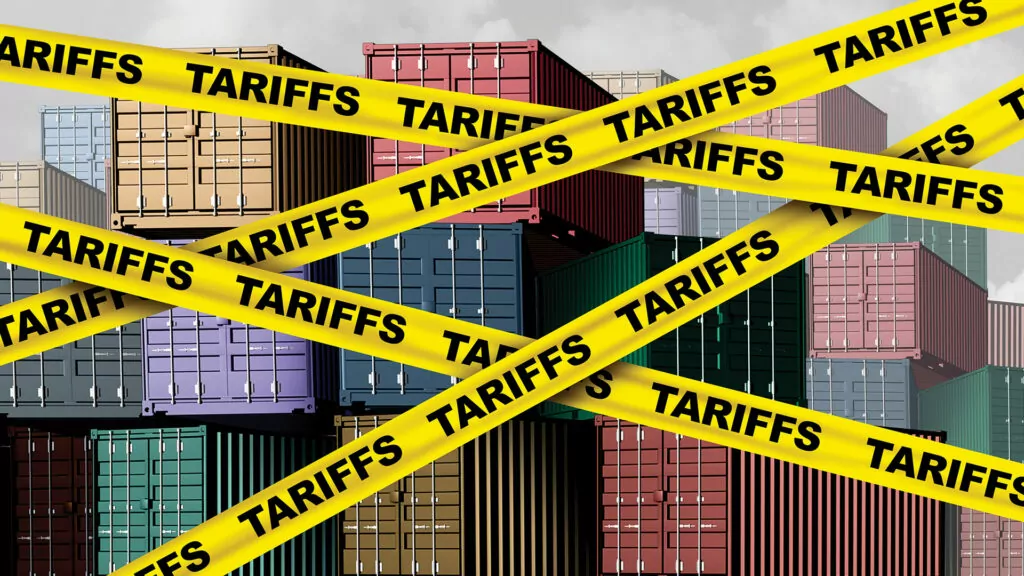
With a lot of bluster and bravado, President Trump has made good on campaign promises to impose trade tariffs limiting other countries’ access to the prized American market, especially if these trading partners are reluctant to go along with concessions and demands from the new U.S. administration. Canada has experienced the uncertainty of these tariff threats, causing unsettlement for businesses on both sides of the border, and raising ill feelings among Canadians towards their southern neighbor. Economists almost unanimously agree that tariffs are ultimately harmful for the overall market: certain domestic industries can benefit from these financial penalties on their international competition, but the resulting prices will hurt domestic companies that use these imports to make their goods. And eventually the consumers who pay for finished goods will see these new increased costs included in the price they pay. Christian economist David Bahnsen recently wrote that Trump’s key economic officials agree that tariffs are harmful: “I believe Treasury Secretary Scott Bessent is essentially a free trader who knows in his heart and mind that tariffs are a cost on the U.S. economy paid by U.S. importers, and ultimately, consumers. I believe NEC chair Kevin Hassett knows this. I believe CEA chair Stephen Miran knows this.” If tariffs cause economic harm all around, why is the U.S. President insisting that he will impose them? It all seems to be based on extracting action, not promises, from trading partners that the U.S. has deemed to not be living up to their commitments. U.S. officials allege that Canada is too lax on border security, allowing aliens to enter the U.S. from Canada: “ is not confined to the southern border – encounters at the northern border with Canada are rising as well.” Trump’s team has stated that Canada is not doing enough to capture smugglers bringing fentanyl into the U.S. “There is… a growing presence of Mexican cartels operating fentanyl and nitazene synthesis labs in Canada,” stated a White House fact sheet. I spoke recently off the record with several U.S. border patrol employees in Washington State who indicated that fentanyl coming into the U.S. from Canada is indeed becoming a bigger problem. The Trudeau government responded to the tariff threats by promising to beef up border security and appointing a fentanyl czar, resulting in a delay, but not cancellation of the tariffs. At the time of this writing, the tariffs are still scheduled to come into effect in the beginning of March. Canadians as a whole have been offended by this aggressive talk from our normally friendly neighbor to the south: the U.S. anthem was booed at sporting events, and some consumers have threatened boycotts of American-made products. How should Christians view these developments? It is good to recognize that every government has the duty to protect its citizens and defend its borders: while Canadians may not agree with President Trump’s assessment of dangers coming from “up north,” we should recognize that as chief executive of his country, he has the right to ask for increased cooperation in fulfilling this essential task of protecting his country’s citizens. In Luke 14, the Lord Jesus illustrates negotiation between sovereigns in this way: “…What king, going out to encounter another king in war, will not first sit down and deliberate whether he is able with ten thousand to meet him who comes against him with twenty thousand. And if not, while the other is yet a great way off, he sends a delegation and asks for terms of peace.” While citizens might not appreciate the heavy-handedness of demands brought by a nation we consider our friend and ally, our government should respond positively to reasonable requests, especially if they are intended to increase law and order, and stop criminal behavior that is harmful on both sides of the 49th parallel....

Red heart icon with + sign.
Economics

Tariffs are terrible economics: why Canada shouldn’t hit back

Free trade – free of barriers and restrictions – has, traditionally, been pretty exclusive to the Right side of the political spectrum. But now, with President Trump implementing tariffs on steel and threatening tariffs on Canada and Mexico, we’re even hearing the Left talk about the harms that tariffs could cause. And not just to Canada and Mexico, but to American consumers too. As the far-left stalwart Alexandria Ocasio-Cortez (aka AOC) noted on X, “Remember: *WE* pay the tariffs….Trump is all about making inflation WORSE for working class Americans, not better.” But what is she talking about when she says Americans pay the tariffs it charges? Think of it this way. Imagine two towns located right next to each other – Town A and Town B – and each has a car mechanic. These mechanics are full-service: they go right to your house to do the repairs. The only difference between the two is that the car mechanic in Town A – let’s call him Arnold – is way cheaper, so not only do all the folks in Town A use Arnold, so do most of the folks in Town B. That, understandably, makes the mechanic in town B – we’ll him Bill – quite unhappy, as it really hurts his business. So Bill demands that his town put in a tariff of sorts. He wants a 25% surcharge on any “out of town” car mechanics. He argues that this surcharge will be incredibly beneficial – applying it to Arnold for the work he does in Town B will help fund Town B’s government. It will also help protect Town B’s homegrown car repair businesses – Bill’s – by making his prices seem more competitive. And, Bill notes, if he gets more business, the government will benefit from the taxes he’ll pay. Bill pitches his tariff/surcharge as a win/win all the way around. But Bill is forgetting someone – several someones, in fact. The surcharge will make Arnold’s prices higher. Any Town B clients who do continue to use him will now be paying 25% more. And any clients he loses to Bill will be impacted too, having to pay Bill’s higher prices for their car repairs, taking a bigger chunk out of their household budget than ever before. In other words, Bill is staying in business at the expense of the car repair consumers in his own town. That’s not win/win at all – that’s a win for Bill, at the cost of everyone else in town. This is what AOC meant when she said that Americans will pay the tariffs they charge. Canada rightly fears American tariffs on the energy and goods they produce. Those tariffs could hurt our producers badly. But hitting back at American tariffs with our own tariffs on US goods is only going to compound the pain. It might benefit some of our producers – whoever makes the goods that compete with imported American goods – but that benefit will come at the expense of Canadian consumers overall by making them pay more. Just like Town B’s car repair “tariff” hurt Town B’s citizens. Is there an explicitly biblical perspective to be brought here? Well, what about Leviticus 19:15? “Do not pervert justice; do not show partiality to the poor or favoritism to the great, but judge your neighbor fairly.” God equates justice and impartiality, which prompts a question: should a government take actions that benefit some of its citizens – some producers – at the expense of other citizens, the consumers and producers who use those goods? Isn’t that partiality? God also speaks to this in His Golden Rule (Matt. 7:12). “Do unto others as you would like done unto you,” applied to the economic realm would mean that car mechanic Bill wouldn’t argue for his surcharge because he wouldn’t want that same surcharge applied to everything he buys. If Town A has cheap car parts, or groceries, or gasoline, he’d love to be able to benefit. The fact is, tariffs always hurt consumers, so no matter what the US does, let’s not let tariffs beget more tariffs. Instead of putting up trade barriers, there are actually interprovincial trade barriers that we could greatly benefit from taking down, as Pierre Poilievre has been highlighting recently. In  the video below Remy highlights one of the ills caused by tariffs – fewer choices and higher costs. ...

Red heart icon with + sign.
Adult non-fiction, Book Reviews, Economics

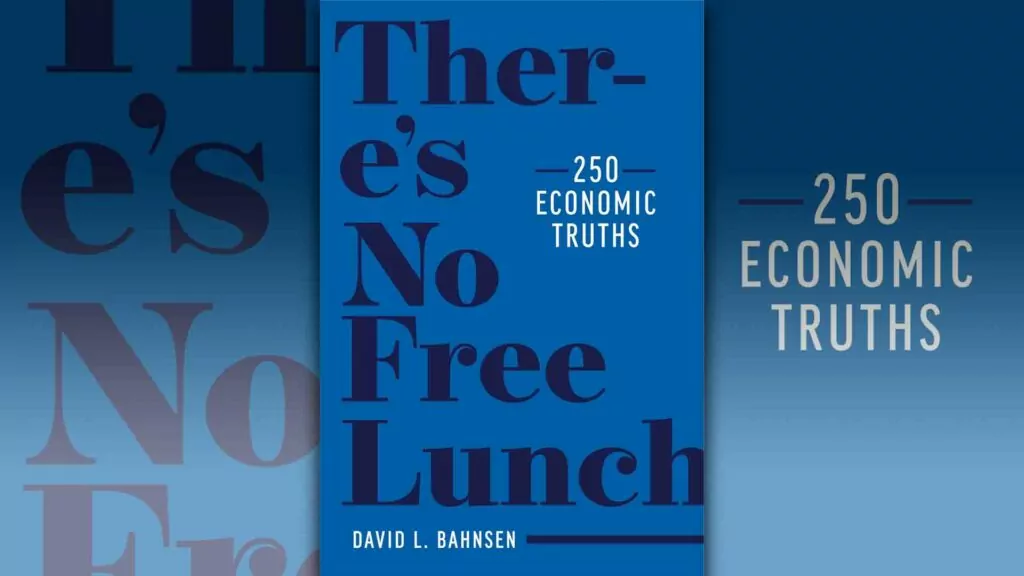
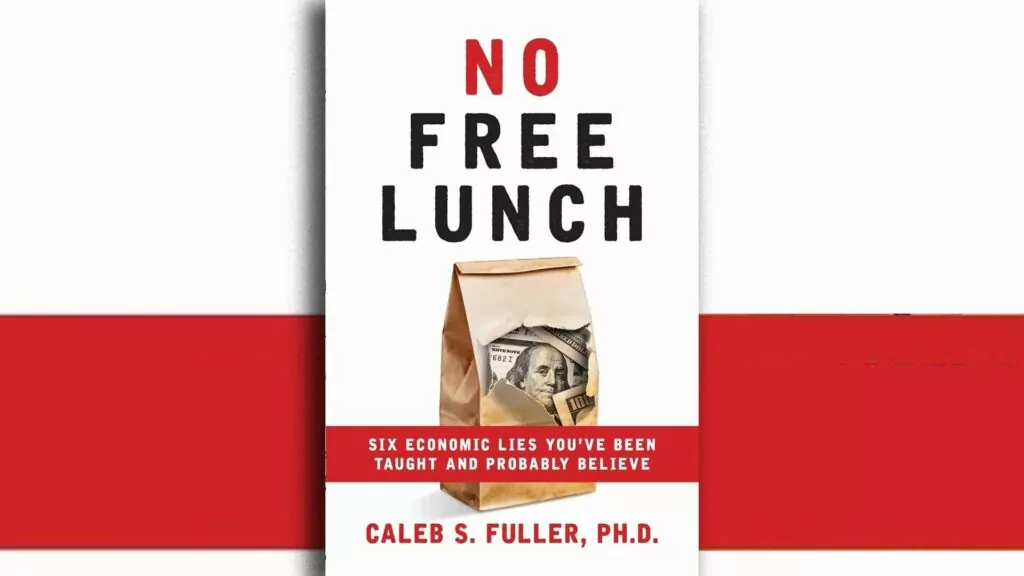
No Free Lunch: Six economic lies you’ve been taught and probably believe

by Caleb Fuller 20021 / 138 pages Every now and again I’ll hand out a book to any nephews or nieces willing to give it a go. And with Caleb Fuller’s No Free Lunch, I’ve found the next book I’m going to pitch to them. While Fuller addresses six lies, there is one truth he’s trying to present: that every opportunity you pursue, comes at a cost. What cost? The time and money you put into it – and here’s the important part – which can’t then be spent on other opportunities. This “opportunity cost” could be known as the “you-can’t-have-your-cake-and-eat-it-too principle” or, as the book title puts it, “there’s no free lunch.” So, then, when a government jobs program funds summer work for students, what we see is all the students getting jobs. But what we don’t see is the opportunity cost to this program – we don’t see all the other jobs that companies might have started on their own – and maybe full-time even – had the government not taxed them to fund their summer jobs program. Fuller shows how much damage is done by the well-meaning, but economically ignorant, and highlights how there is on many issues a consensus among economists on both the Left and Right, that politicians on the Left will simply defy. My only disappointment with this punchy book is that this Christian professor never makes plain why the Left fails, and the free market works. He never mentions how the foundation for the free market – private property rights – is simply obedience to God’s command, “Do not steal” (Ex. 20:15). In fact, God is not mentioned in the whole book. For a more explicitly Christian economics book sharing this same great name, check out David Bahnsen's No Free Lunch....

Red heart icon with + sign.
News

Canadian economy stank it up under Trudeau

With the Justin Trudeau era (almost) over, it’s time to assess his record. In a January 9 article posted to The Hub, Lakehead University’s Professor of Economics Livio Di Matteo compared current Canadian economic conditions with 2015, when Trudeau was elected as Prime Minister with a majority government. Di Matteo’s conclusion? The Canadian economy is in much worse shape now than a decade ago, especially in six key areas: GDP, job growth, interest and inflation rates, and the federal deficit and debt. Canadian Gross Domestic Product (GDP) per person grew more slowly than other capitalist countries. For comparison purposes the figures that follow are in US dollars. In 2015, Canadians produced about $43,600 per person, compared to $57,000 for the Americans. We were producing approximately 76% of what they were producing, by this economic measure. As of 2023, the World Bank Group has Canada at just above $53,400, or almost $10,000 more than eight years ago. But over those same eight years the US per person GDP has grown to $82,800, an increase for them of about $25,000. So instead of producing 76% of what Americans do, we’re now at about 65% of our largest trading partner’s productivity. On the jobs front, an almost identical percentage of Canadians were unemployed in 2015 and as of November 2024 – just under 7%. However, this statistic conceals that a larger slice of the population is working in the public sector than ever before: 21.1% as of 2023, versus 19.7% in 2015. Interest rates in Canada have increased from very low in 2015, when the Bank of Canada rate hovered just below 1%, to around 3.5% at the end of 2024. Higher interest rates contribute to slow business growth, and an increased cost of living especially for people looking to buy a home. Inflation rates have recently eased from a high of nearly 7% in 2022, to just under 2% in 2024. However, Di Matteo points out that “from 2015 to 2024, the All-Items Consumer Price Index grew by 26 percent.” This Index is another inflation measure based on the rising cost month by month, year by year, of a basket of goods and services. That 26 percent is a far cry from the slow growth of the economy overall. According to the Trudeau government’s own account, they spent $63.1 billion more than they collected in revenue in the fiscal year ending March 31 of 2024. As Professor Di Matteo shares, “over the terms of the Trudeau government, the net federal debt has nearly doubled rising from $701 billion to $1.35 trillion.” Di Matteo reminds readers that when you borrow, you must also repay: the cost of servicing Canada’s national debt is increasing at an alarming rate. “Debt charges are expected to reach $53.7 billion in 2024-2025, or about 10 per cent of federal spending.” Solomon alerts us in Proverbs 14:23 that “in all toil there is profit, but mere talk tends only to poverty.” We pray that future Canadian leaders will be better stewards of the great resources that God has given us. Picture credit: paparazzza / Shutterstock.com...

Red heart icon with + sign.
Economics - Home Finances

“Honey I blew the budget!”

A FEW THOUGHTS ON GETTING BACK IN THE BLACK AFTER TAKING A PLUNGE IN THE RED “Honey I blew the budget!” Do those words sound familiar to you?  Were you one of many Canadian couples that made a New Year’s resolution to build a budget and live according to it?  And February 14th came along and you blew it?  Or perhaps the budget was blown before you even started because your Christmas spending made the budget a non-event? Or perhaps it is a much less dramatic event that got you off to a bad start: you just can’t seem to stay within the amounts you had agreed on. How to start: prayer Let’s see if a frank discussion of some potential issues can benefit us all.  Before we do that I believe that everyone should begin their budget process with prayer.  Pray that God would grant you the courage you need to be honest with yourself and your spouse as you build the budget. Also pray that God will grant you a sense of satisfaction with the gifts He does grant. Pray that God remove the sense of covetousness from your heart. Pray that God would forgive your sense of entitlement if that is something you struggle with. A sense of entitlement? What do I mean with that last line?  In my business I often hear the following excuse when a couple comes to me and they are having serious difficulty making ends meet. Often it is because one or both of them have what I call “a strong sense of entitlement.”  They say things like, “We deserved that one-week vacation in Mexico because we both worked very hard these past three months.” Or, “I deserve that new dress or new suit, because I have not treated myself to anything new for a long time now.” Or perhaps you blew it on Valentines Day; you dropped in at the flower shop on your way home and purchased a dozen roses for your wife and then, when you got home, you told her, “Honey, I am taking you out for dinner tonight!” So you take her to that very special (read expensive) restaurant downtown.  The dozen roses are $25 and the dinner was $100.  But your entertainment budget for the month was $30. So what do we do now? Well, the temptation now is to reduce your contribution to the church for the month because the church, after all, has lots of other people that can pay. No easy way, but there is a way So, how can we deal with these kinds of blown budgets? Discipline. One word only. Discipline. There is no easy way to deal with this temptation.  Once again, let me urge you to pray.  In John 15 Jesus encourages his disciples to bear good fruit and He also says, “If you remain in me and my words remain in you, ask whatever you wish, and it will be done for you” (verse 7).  You see! Jesus clearly says it.  Of course we need to keep this in its context. Jesus is saying this in light of His other comments regarding the bearing of much fruit.  I take this to mean that there is a relationship between what we are to ask for and bearing fruit. So, pray that God will help you in your struggle with covetousness.  Or ask God to grant you His peace and satisfaction so that you are truly at peace with what He gives you and you don’t just use that Visa credit card that makes it so easy to grab “stuff” that God has not granted you. Looking at the grocery budget But let’s move on, because there may be other ways we can help you with your budget. Let’s take a hard look at your grocery budget. Do you really think $800 per month is what it takes to provide a family of five, two parents and three children, with all that is needed? Perhaps we can find a way to do this for $500. This is not always the most fun part of running a household but perhaps you can make it a little more enjoyable. First, it’s vitally important that you plan a menu for every day of the week. If you know that Monday you are going to have chicken and rice and a vegetable for dinner, then the two weeks before you can keep an eye on the flyers and purchase that chicken when it is on sale at one of the grocery stores.  If you put together a planned menu for the entire month, you have a great weapon that you can use in your battle with the budget.  If pork comes on sale this week and you know that there is pork planned for next Thursday’s dinner, buy it now when it is on sale, and freeze it. Or if your family regularly has oatmeal for breakfast, (I know, oatmeal is old school, but it’s healthy and it’s cheap) then find a store that sells oatmeal in bulk - leave the individual packages on the shelf and buy it in bulk. You will easily save 20 per cent. As I said earlier, grocery shopping is not always the most fun, but what you can also try is to band together with one or two of your friends. I know, for example, that here in Alberta one of the grocery outlets will give you a $25 gift card when you buy $250 dollars of groceries.  So join forces. Go to the store with two or three of you. Make sure you all have a list - impulse buying is dynamite on grocery budgets (it blows them up!). When you go through the check-out, ask the cashier to sub-total at each person’s purchases. That saves you the hassle of having to total it up at home.  And then share the gift card on your next trip. Try to purchase fruits and vegetables that are in season (when possible).  In the summer and fall, find a farmer’s market and buy some extra beans and carrots and freeze them. Don’t improvise In my experience though, it is not the grocery dollars that destroy a budget; it is the impulse buying. It is the idea that I must have a new 40 or 50-inch television, even if that means it goes on a credit card. Or, it is the new stereo for the car or the new cellphone with all the latest technical stuff. Or even just the cellphone plan that we just have to have - the one with unlimited texting! - or the cable plan that has all those sports channels. or the new chesterfield and chair that we just have to have. The unexpected expenditure Some other things that can blow a budget are things like a hot water heater that bursts, or a furnace or a refrigerator that packs it in. Now these truly are valid items that need to be dealt with. But once again, a few tips may be beneficial. Check out the nearest used furniture and appliance outlet or go through the local free “buy and sell” magazine. You may be surprised at how often you can find a very good used furnace or a refrigerator (I have a used hot water heater stored away just in case).  The wealthy in your town or city often will be replacing perfectly good mid-efficiency furnaces for a high-efficiency furnace and often you can buy their used one for as little as $200. Insurance There are some other areas in which we can save money as well.  One of the areas I often look at with my clients is the cost of all their insurance.  Call to a few other brokers and see if the premium you are paying to insure your home really is the best premium available. If you are not in BC or Manitoba, check the rate on your car insurance as well. Another high cost is the cost that many young people pay for life insurance.  The life insurance industry will go to quite some lengths to show you why you need a million dollars of life insurance and a further $200,000 critical illness policy.  But I would suggest that you look at that more carefully.  Also look at the type of life insurance that you have.  Ask the insurance salesman why he might be recommending whole life or universal life insurance when a 20-year-term policy at less than half the price may be all you really need. You won’t live like your parents Another mistake we often make is we compare what we have to what we had when we were still living with our parents.  But remember, our parents have been working for 20 plus years and are often at the top of their pay scale while we are starting at the bottom of the pay scale.  Once again, at risk of sounding repetitious, be satisfied with what God grants you. Greed and covetousness are sins that are spoken of in many places in God’s Word and these are sins that we need to fight against daily. So, if we go back to our initial statement, “I blew the budget,” don’t despair. Ask God to bless your attempt to start the process again. And do not be afraid to start a third or a fourth or even a tenth time.  Living within a budget is a tough thing to do and it does require some determination.  But when it works it works well....

Red heart icon with + sign.
Economics, News

Premier Ford calls on the feds to make EV cars more expensive

Ontario’s premier has asked the federal government to impose a 100% tariff on Chinese electric vehicles, which would make these cars twice as expensive as they would otherwise be. Why would Premier Doug Ford want to so strongly discourage consumers from buying these EVs? Aren’t EVs the way of the future? The premier explained he wants the tariff to protect Ontario jobs. Back in April, he announced he was gifting $2.5 billion of Ontario taxpayers’ money to induce Honda to build four EV manufacturing plants in the province. The federal government added in their own $2.5 billion in tax credits. Combined, this $5 billion would create 1,000 jobs, which works out to a cost of $5 million per job. It’s not surprising then, that the premier wants to protect these positions – they were a very expensive purchase. But why are these Chinese cars so cheap? In an interview with the Toronto Sun’s Brian Lilley, the president of Canada’s Automotive Parts Association, Flavio Volpe, raised the possibility of forced labor – slaves – sometimes being involved. That could be a reason to ban sales altogether, not simply penalize them. Another critique is that the Chinese government is heavily subsiding these vehicles. But The Hub has calculated that overall, the federal, Ontario, and Quebec governments have combined to offer $40 billion in subsidies and tax credits to our own EV industry. Or as Kiernan Green noted: “This represents 15 percent more than the companies themselves have put forward for their investments in Canada’s EV sector.” If subsidization is an unfair business practice, then shouldn’t we should stop it ourselves (Matt. 7:12)? And if it isn’t unfair, why are we complaining? There are other issues involved here: as Flavio Volpe noted, the same federal government that is subsidizing Canadian production is also involved in subsidizing foreign EV production too – the Liberals announced a program this past December that could credit EV manufacturers, both domestic and foreign, with as much as a $20,0000 credit per EV car sold. It is more complicated than that, but the short of it is, the government has gotten itself so muddled up in this market that its right hand is actively working against its left hand. Might that be evidence that it should get both hands, and its nose, out of the business sphere? Taxpayers are shouldering a heavy burden for EV cars. And now, if this tariff goes through, Canadians will be asked to shoulder even more, as less expensive Chinese competitors will be tariffed out of the marketplace. There is a broader lesson here, as this is what tariffs always do, protecting local producers at the expense of local consumers. God calls on the government to administer justice, and one of the first principles of justice is impartiality (Lev. 19:15, James 2:8). What we have happening here is an example of the government picking winners and losers, favoring EV producers over EV purchasers (and all of it done at the expensive of taxpayers). Why the one over the other? What business is it of government to show such favoritism? Picture credit: adapted from a photo by Bruce Reeve/flickr.com and used under a Creative Commons CC BY-SA 2.0 license....

Red heart icon with + sign.
News

Saturday Selections – April 20, 2024

Painting without a license could soon be illegal in Minnesota Government growth is like the slowly rising temperature that eventually boils the frog in the pot alive – so long as the red tape grows only bit by small bit, we don't really protest. Here then, is a cup of cold water (or some sharp scissors if we're going with the tape metaphor) to shake things up and highlight how the government will regulate everything if we give them the chance. Christians should lead the resistance to growing government, since we understand that God didn't entrust our leaders with the responsibility of managing every aspect of citizens' lives. And we know that limited fallible human beings aren't up to the enormity of that task. 3 things a Christian should consider before serving in the military This short piece has an American focus but offers thoughts for Canadians to consider too. Since it was written in 2017, both nations' militaries have taken an ideological turn, so more could be said, which Aaron Renn does here. Today's music really is angrier, more egocentric A new study says it isn't just your imagination, Mom and Dad; song lyrics really are getting more repetitive, "me" and "mine" are popping up more often, and the tone of the lyrics has gotten angrier over the last 40 years. We're all Christian Nationalists now I prefer the term "Christian patriotism" to "Christian Nationalism" due to the latter's many conflicting definitions. But, as Larry Ball suggests, if we run with the definition of Christian Nationalism that the secular media is increasingly using – as Christians who think our rights come, not from the State, but from God Himself – then we are all Christian Nationalists now. What are the reasons disability exists? (10-minute read) AJ was struck with a progressive neurological disability that put him in a wheelchair as a young man. He had questions for God... and he went to Scripture to hear what God had to say. Were the Greek gods real? Douglas Wilson makes things clear with this "yes and no" answer. ...

Red heart icon with + sign.
Book Reviews, Economics, Teen fiction

The Hyperinflation Devastation

by Connor Boyack 400 pages / 2019 Rating: GOOD/Great/Give Remember those “Choose Your Own Adventure” books kids loved back in the 1980s? Readers would be brought to a fork in the road, given two options to choose from and if they chose Option A, they would be told to go to one page, and if they chose Option B then they would be directed to another. Afterward, they would continue on their chosen track with the adventure continuing to branch repeatedly thereafter. In The Hyperinflation Devastation, author Connor Boyack has taken that concept and expanded on it, creating a 400+ page “Choose Your Consequence” adventure to teach teens various lessons about economics. In this, the first book in the series, Emily and Ethan Tuttle, a pair of 15-year-old twins, head out on their own to the small South American country of “Allqukilla.” If 15 strikes you as young to be out without parents, I’m with you. However, these two are a particularly independent pair who have spent the last year planning and saving for this trip. They want to go to Allqukilla to check out the country’s ancient ruins. But is it to be? Right after their plane arrives, they see local news reports warning about an impending earthquake and it’s here that readers face their first choice. Are the Tuttle twins going to have an incredibly short adventure and head back on the very next plane, or are they going to go on to their hotel? Of course, no reader is going to take the cautious route, so onward and forward the adventure continues. While exactly what happens depends on the choices a reader makes, the twins will encounter that earthquake, and then, with power disrupted, they’ll have to deal with roads in bad repair, hyperinflation, a lack of available food and water, and no cell phone service, as the two figure out their way home. The author’s economic outlook is a small government, libertarian one, which comes out in the lessons the twins learn. So, for example, in one story branch, they end up in a small village in the hills that still has power because these villagers have never relied on the government to provide it. In another branch, they encounter some not-so-warm-hearted help – entrepreneurial sorts who will do them good…for a price. The twins sometimes get entirely altruistic help, but the point is, they also get help from people who wouldn’t otherwise be helpful, except that it is in their own self-interest to do so. The lesson here is that the free market is important because it gives people a motive to provide things other people want. While this is intended as an educational story, Boyack doesn’t beat readers over the head with the lessons he’s trying to teach. Only once, in the eight or so different story arcs does a character offer up a prolonged economics lecture. But even then, it isn’t too long. CAUTIONS The one caution I would offer deals not with this book, but with the author. He writes from a generally Judeo-Christian, libertarian perspective. Often times, those two perspectives can match up quite nicely since both Christians and libertarians recognize that the government shouldn’t try to be God. Thus we both believe in some form of smaller, limited government, which sets us apart from the many who call on the government to solve whatever problems they face. But in some of Boyack’s other books, his libertarian perspective comes in conflict with his Judeo-Christian perspective. In The Tuttle Twins Learn About the Law (one of the Tuttle Twins picture books he’s written for younger readers) he teaches readers that governments gain their authority from people, and not God. Based on that assumption the author argues that governments should only be able to do what people are able to do, therefore just as it would be wrong for a person to forcibly take money, so too the same must be true of government. But this simply isn’t true. God has empowered governments to do some things which individuals must not do, and taxation is one of them (Luke 20:25, 1 Peter 2:13-14). The libertarian perspective in Hyperinflation Devastation is more restrained, and thus in keeping with a Christian worldview that understands God as distributing powers and responsibilities not simply to the state, but to parents, and the church, and individuals too. CONCLUSION I would recommend this for any kid from 10 to 15. The adventure is a solid one, and the Choose-Your-Own-Adventure component will grab their attention. Yes, this is an economics lesson, but it is a generally subtle presentation that never gets in the way of the story. That allows most kids, whether they are politically-inclined or not, to enjoy this. But because the economics angle is so very different from what they are reading in other books, it may well spark an interest in learning more about money, inflation, politics, and more. It may interest parents to know there are other titles in this “Choose Your Consequence” series so far, but as I haven’t read them, I can’t recommend them as of yet. There is one mistake in the book, on page 388, where we are directed to Page 335 but should be directed to Page 111. I recommend some of the Tuttle Twin pictures books on my personal blog here....

1 2 3