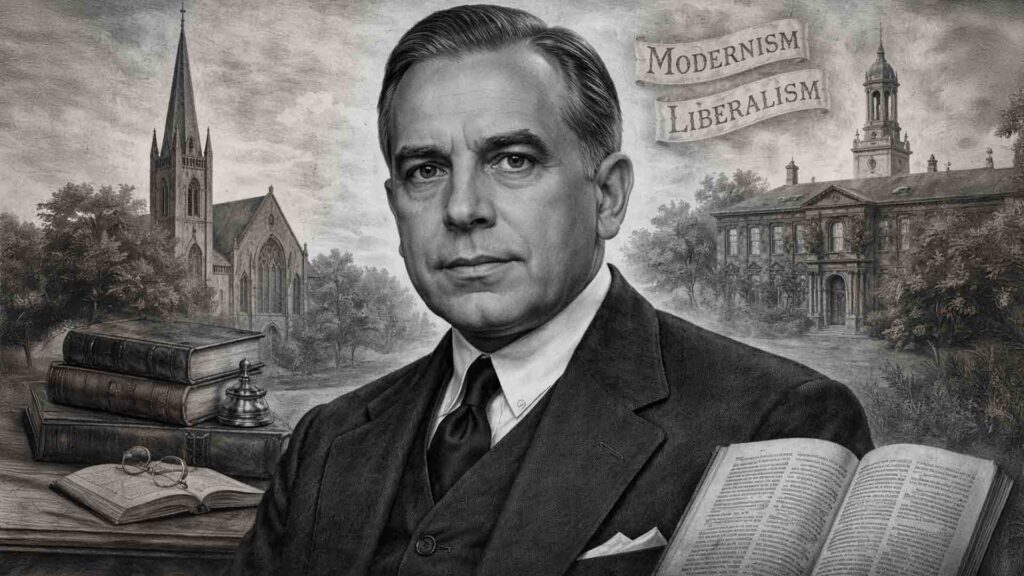
One of the greatest theologians of the twentieth century was an American Presbyterian named John Gresham Machen. More than any other individual in the English-speaking world, Machen led the intellectual defense of Biblical Christianity against the attacks of theological liberalism in the early twentieth century. Machen was among the top-ranked Biblical scholars of his generation, and he was the point man for conservative Protestantism when it looked like believing the Bible was no longer going to be plausible for educated people.
Started OPC & WTS
Among Machen’s achievements was the founding of three notable institutions: Westminster Theological Seminary in Philadelphia, the Independent Board for Presbyterian Foreign Missions, and the Orthodox Presbyterian Church. All three of these institutions continue to exist today.
One of the most recent biographies of Machen is J. Gresham Machen: A Guided Tour of His Life and Thought by Stephen J. Nichols. Nichols recounts Machen’s life and also describes the significance of his books.
Machen was born in Baltimore, Maryland in 1881. His father was a successful lawyer and his mother came from a well-to-do family in Georgia. She was a staunch Presbyterian and raised her son to love the Bible. He did very well at school and ended up attending Johns Hopkins University. Subsequently he decided to do graduate studies at Princeton University while taking some divinity courses at Princeton Theological Seminary (PTS).
It’s important to note the historical significance of PTS. That seminary was the leading conservative Protestant seminary in the English-speaking world from about the mid-1800s until 1929 (when it would be taken over by theological liberals). In the latter part of the nineteenth century and initial part of the twentieth century, the best known of the Princeton theologians was Benjamin Breckenridge Warfield the leading defender of Biblical Christianity in his day. Warfield would have a strong influence over Machen, and the two became friends.
In the lion’s den
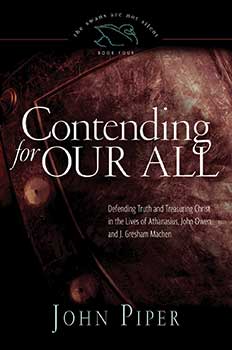
If this short article has whetted your appetite to learn more about J. Gresham Machen, you’ll be interested to know there is a 41-page biography by John Piper available online, for free. Gresham’s biography is packaged with 2 others, about John Owen and Athanasius, in Piper’s Contending For Our All. A free pdf copy of the book can be downloaded here.
During the 1905-1906 academic year, Machen studied in Germany under Wilhelm Herrmann, an influential and articulate theological liberal, who argued, among other things, that it wasn’t even vital whether Jesus really lived. Machen’s conservative views were severely challenged at this time, but ultimately he was able to resist Herrmann’s sinister theological perspective.
After returning to America, Machen became a professor at PTS, teaching the New Testament. He was ordained as a minister in the Presbyterian Church (U.S.A.) or PCUSA in 1914. When the United States finally entered World War One in 1917, Machen volunteered to serve in France with the Young Men’s Christian Association (YMCA), where he would operate a canteen, serving refreshments to French and American soldiers on the front line. Although he didn’t engage in combat himself, he saw the fighting and its effects first hand.
You can’t split a rotten church
During the first two decades of the twentieth century, the insidious tentacles of theological liberalism were rapidly spreading among the Protestant churches of North America, turning people away from belief in the Bible as a supernatural revelation from God. The stage was being set for a showdown between orthodox believers and the adherents of fashionable unbelief.
Machen discussed with B.B. Warfield the possibility of a split in the PCUSA that would separate real Christians from the theological liberals. But as Nichols records, Warfield, seeing the widespread success of liberalism among the leadership of the PCUSA, famously replied, “No, you can’t split rotten wood.”
In 1921 Warfield died, and with him (in the estimate of many people) Old Princeton also died as the stalwart defender of theological conservatism. Soon the pack of liberal wolves (in sheep’s clothing, of course) would seize control of the seminary and place it in the service of unbelief.
On a more positive note, Machen’s first book entitled The Origin of Paul’s Religion was published in 1921. In each of his books Machen would defend historic, orthodox Christian beliefs against the rising tide of liberalism. Theological liberalism, as Nichols helpfully summarizes it, takes “as a starting point the position that the Bible is not a divinely inspired book, but a human one, deriving from a religious community and traced with legend and myth.” Machen had a thorough knowledge of the current scholarship on the apostle Paul and was able to defend genuine Christianity against its challengers.
Christianity and Liberalism
Besides being a theology professor and author, Machen was becoming increasingly popular as a speaker at various Christian events. In the theological battle between conservatism and liberalism, Machen was beginning to take center stage as the conservative champion in the academic field. In 1923, his book New Testament Greek for Beginners (a text for learning Biblical Greek) appeared to wide acclaim. It’s still in use today.
But it was another of his books published in 1923 that would become his most important: Christianity and Liberalism. “With this book,” Nichols writes, “Machen emerged as the singular spokesperson for the rigorous defense of orthodox Christianity in response to the challenge of liberalism.” It became a classic, clearly demonstrating that historic Christianity and theological liberalism are, in fact, two entirely different religions.
Due to his efforts in defense of the truth, Machen received the support and accolades of fellow believers. From some of those on the other side, however, Machen received hate mail. According to Nichols, one liberal sent him a letter addressed to “Prof. of Bigotry” that referred to his “miserable theology” and instructed him to “learn to be a Christian or else get out.”
The fall of Princeton Seminary
As time went on, momentum was clearly on the side of the liberals within the PCUSA, and in 1929 they managed to “reorganize” the governing board of Princeton in such a way as to give control to liberals. Nichols states that with this development, Machen “was left no real choice but to resign.” As a result, with a small band of supporters he founded Westminster Theological Seminary (WTS) in Philadelphia in 1929, with the intent to recreate a seminary in the image of Old Princeton. Among others who left PTS to join with Machen in this endeavor were Cornelius Van Til and John Murray.
Some PTS board members also resigned in order to be on the board of WTS, including Samuel Craig, the founder of Presbyterian and Reformed Publishing Company (or, as it is more commonly known today, P&R Publishing)
In 1930 Machen produced another significant book, The Virgin Birth of Christ. Liberals, of course, denied that Christ had been born of a virgin because they were unwilling to believe the miracles recorded in the Bible. Nichols writes that this book became “the standard scholarly defense of this crucial, orthodox doctrine for decades to come.”
The final battle
A decisive showdown between conservatives and liberals in the PCUSA finally occurred in the mid-1930s. In 1933 the PCUSA (along with six other denominations) released an official report entitled Re-Thinking Missions. It “advocated a paradigm shift in missions premised on the notion that Christianity is not the exclusively true religion.” This was the liberal view: Christianity should accommodate people of other religions rather than proselytize them.
A battle within the PCUSA ensued between conservatives (led by Machen) who believed that Christianity is the one true religion, and the liberals who were religious pluralists. To make a long story short, the liberals won. In response, Machen founded the Independent Board for Presbyterian Foreign Missions (IBPFM) so that conservative Presbyterians could give money to missionaries who believed in evangelizing non-Christians.
Having a missions board that is not under the authority of the church is not the Biblical ideal, of course, but the intent was good. However, the General Assembly of the PCUSA declared the IBFPM to be unconstitutional and proceeded to discipline its supporters. Nichols notes,
On March 29, 1935, making front-page news in The New York Times – “Presbytery to Try Machen as Rebel,” ran the headline—Machen was officially defrocked and stripped of his credentials.
Machen appealed this decision but his appeal was rejected by the General Assembly in 1936.
Then in June 1936, Machen and his supporters founded the Presbyterian Church in America. In 1939 its name was changed to the Orthodox Presbyterian Church (OPC) due to a lawsuit filed by the PCUSA.
Machen had a lot of work on his hands as the leading figure of both WTS and the OPC. He was becoming worn out and exhausted. Then in December 1936 he took a train out to North Dakota to help a struggling congregation there. He caught pneumonia and died on January 1, 1937. His death was a tragic loss for the cause of truth. But he had fought a good fight and left numerous books that would help to strengthen believers in their faith. He also left the institutions he founded that would continue to maintain a testimony against theological liberalism.
Conclusion
Gresham Machen was widely recognized as one of the greatest Christian scholars of his generation. He used his God-given talents, education and social standing to uphold Biblical Christianity in the face of unrelenting attacks from theological liberals who sought to undermine the faith. Machen was the conservative scholar of highest standing in this struggle, and his efforts encouraged many Christians to stand fast for orthodoxy.
Of course, Biblical Christianity would have survived even without Machen, but he demonstrated that genuine Biblical scholarship supported the truth of the Bible. The conflict wasn’t between educated, intelligent liberals and uneducated, ignorant conservatives as some believed. The liberal scholars could not refute Machen’s work. Christians did not need to fear that their religion was being disproven by modern scientific discoveries, as the liberals alleged. In his own way, Machen lifted high the standard of orthodox Christianity, providing a rallying point for those who continued to believe the historic faith. The tide of opinion in his day swirled furiously against Biblical Christianity, but he was a rock against which the waves of unbelief harmlessly broke.