
A first neighborhood
I was far too young to remember staying over at the neighbors’ on the fateful day my sister – vernix-covered and with oh so perfect fingers and toes – entered the world. But I remember the house down to each room and can picture each tree in the expansive backyard – so large it seemed like a vast pasture to a younger me, the kind in which I was accustomed to seeing cows or sheep grazing as I sat through the miles and miles of driving to Ontario and back each August. I remember climbing in the willow and swimming in the infinitely deep pool and drinking Coca-Cola standing on the cold kitchen floor.
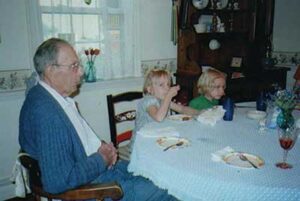
Dinner at the Aunt Barbara’s house
But memories and photographs become jumbled, and I wonder if any of it is really a memory. I can see my parents’ wedding reception in the very same backyard through these photographs – boxes and boxes of them that seem to diminish with each successive cross-country move my parents make – the laughing faces of people ages older now, sweating joyfully in the June sun. Through another set of photographs, I can see my brother as a chubby and moody baby held in my honorary Aunt’s lap on a lawn chair by the pool. Today, the house is inhabited by strangers, just as is the house nearby to it on Coles Boulevard, where at nine months I took my first steps so precociously.
Between these two houses stood another where a happy but fading part of my childhood was lived. There, I remember eating perfect dinners of spaghetti, salad, and jello in the pink dining room. Dinners were followed by joining my mother for a thoughtful examination of Aunt Barbara’s new paintings in the small art studio at the top of the stairway. These neighbors we had a more perfect communion with; Sundays did not separate us. One of these “aunts” was the photographer for our family’s iconic series of baptism photos taken in the graveyard behind our two-hundred-year-old church building. Each Lord’s Day, we inhabited this building twice, listening to long sermons that changed everything each new week. Their handwritten summaries once filled drawers of filing cabinets in the laundry room. Now they spill into the online world in messy virtual piles, filling email inboxes.
Could I be coming home again?
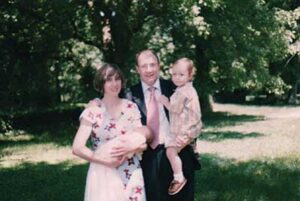
My baptism photo
It’s been nearly fifteen years since I sat in the cold, cushionless pews of the church where my baptism took place. Now I’m far away, driving down another long-forgotten street after having lunch with a long-lost childhood friend. It’s a few weeks before my third semester of university begins. I turn right onto McNabb Street and cross Silver Creek, where years ago my sister and I would catch crawfish at lunchtime. With shock but no surprise, I see in front of number 17 the most enormous wall of sunflowers rising out of a tangle of vines. Gourds, squash, and pumpkins grow with singular abandon between their stalks. The sidewalk is barely passable, and where grass used to grow in the front yard, there are more vines and wildflowers than should be proper in such a small space.
I don’t have to look at the familiar cars in the driveway to be certain that the neighbors from our brief years living at number 19 next door still inhabit the large brick house behind the jungle. I park and walk around the block twice before I work up the courage to knock on their door. I imagine their children, the event of whose births I can vividly recall, who must nearly be teenagers now. I wonder what it would be like if one of them answered the door and I had to explain myself. But no such thing happens, and after lingering on the porch for a few minutes, I walk back to my car and drive away with a feeling of finality I can’t shake the whole way home.
Disconnection and distance
Late on a March night the following year, I call my mother from the top bunk in my rented basement room, exhausted from the impossible combination of relentless on-call work, loads of coursework, and the part-time job I try to fit in between it all. She gives me her usual account of the joys and entertaining politics of teaching first grade, her first time with a classroom of six-year-olds in decades, then pauses and says that she had sad news that morning. Our former neighbor has died after an unfathomable battle with the rapid physical and mental breakdown of Alzheimer’s. This battle was evident in her diminishing presence in the immaculate garden she’d created over her lifetime. We don’t live beside them anymore, but I can almost see the devastation on the face of her husband, the architect who rebuilt their beautiful house with floating walls and stairs to surround his wife’s presence so perfectly.
Later in the year, I’m squatting beside an inflatable pool with dripping sleeves, lost in the wonder of the moment, a few seconds after the clock turns 1:17 a.m. Come Thou Fount of Every Blessing plays in the background, and with irrelevant enthusiasm, I say “Oh, I love this hymn” as I hear it for the first time accompanied by the cries of a brand-new baby still sticky with vernix and warm from the radiant comfort of her mother’s skin.
My visit there the next day is a quiet one – the younger children are still next door with their grandparents, and the new baby is utterly content with the colostrum filling her tiny but growing stomach. I hesitate to undress her and press my cold stethoscope to her steadily rising chest to hear her lungs and heart move in a remarkable synchrony they’ve only known for 34 hours now. From the end of their driveway as I leave, I can see the letterbox next door that bears the same family name as the new baby, the name of her grandparents, and I think about how impossibly distant we tend to put ourselves from our own families.
I look across the blue-green waves of Lake Huron on the following Saturday afternoon. I force myself to take my car down to the lake so I won’t drown in the malaise of indecision and aloneness I so often encounter these days. As I stand on the narrow beach, I can’t even make out the other side of the lake, let alone the thousands of kilometers of fields, trees, mountains, desert, and more lakes beyond that my mind traverses to imagine myself back at the dining room table that’s followed my family to each new home they make.
Losing ourselves and finding a home
In C.S. Lewis’ vision of Hell in The Great Divorce, the reader finds himself in a neighborhood, an uncanny departure from the flames and circles of Dante’s Inferno imagined eight centuries before. But soon the reader of Lewis finds out this is no ordinary neighborhood; rather than every house being crowded, there is hardly a block with more than one occupant. In fact, the more houses empty, think Hell’s inhabitants, the better. C.S. Lewis imagines Hell as a constant movement away from other people, an endless conflict that isolates people again and again and again. When Hell’s inhabitants have the opportunity to visit the glassy, bright, and mysterious world of Heaven, they are disgusted. They long for the darkness of their tomb-like homes back in the false neighborhood to which they’ve been banished.
C.S. Lewis seeks to answer the nagging question: if we keep moving away from one another, where do we end up? In Proverbs 27:10, the wise king tells us, “Better is a neighbor who is near than a brother who is far away.” Solomon is calling us to first love and care for those who are near – both our literal neighbors and those who make up our communities. Nowhere is this better manifested than in the life of Christ, who ministered to the lost sheep of Israel (Matt. 15:24), working amongst those who knew Him despite their reluctance to hear His voice (Luke 4:16-30). For Christ, being rejected by His people – the very Jews He grew up amongst and journeyed alongside to Jerusalem for the Passover as a child – was the moment of His entrance into Hell.
As a result of Christ’s full isolation first from His community and finally from God, we do not have to experience such isolation any longer. Christ’s aloneness was part of the way God chose in His wisdom to restore our communion with Him and with others. When we reject isolation and live in gratefulness for communion and service in the body of Christ, we experience the true joy of fellowship. The story of our salvation mirrors that of Israel’s, the story of journeying as strangers from one foreign land into another and miraculously finding a beautiful home. In Psalm 119:17-21, the Psalmist pictures our lives as a sojourn from the isolation caused by sin towards God’s perfect law of love, a Holy Spirit-directed journey to restored fellowship. This journey is embodied in the context of community, particularly the Church community.
Because we belong body and soul to our Savior and thus to our brothers and sisters in the Church, our identity is tied to others. We were made for people. The idea of belonging and community seems popular in our modern world, but connections between people are often brittle and shallow, rooted in common interest rather than common confession. Common interest alone cannot truly bind people together. Devastating cultural impacts are evident in a world driven by technology, social media, and political causes, all ready to replace dependence on other human beings with self-sufficiency and self-determination. True community, however, means giving up self-ownership and self-interest and becoming grafted into the assembly of the redeemed – a people of God’s choosing.
New life and our responsibility in the communion of the saints
Since our spiritual well-being is dependent on our belonging to a community of believers, our physical well-being must also carry ties to relationships and dependence on others. This is made so clear on the path I currently travel as a third-year midwifery student. Maternity care makes the role of being bound to a community in improving physical health particularly evident.
Both anecdotal and peer-reviewed evidence point to the effectiveness of community-based models of care, where home visiting by midwives and other caregivers is central to improving mental and physical health for mothers and babies.1 These outcomes extend to the rest of the family and can lead to more involvement by fathers in parenting and improved health outcomes for all members of the family.2,3
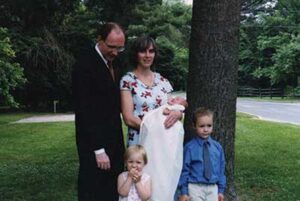
My little sister’s baptism photo
In the communion of the saints, these benefits seem natural and logical, but the support we take for granted, such as meals being provided unconditionally following a birth or tragedy or serious illness, is unheard of amongst the majority of people in Western countries. Our strong understanding of the covenant and its attendant blessings that spill down through generations helps us care for one another in the early days of parenting and be instruments of Christ in the way we care for our children. The absence of such a connection to community is evident in the intergenerational inheritance of poor health and parenting outcomes that so many in the world around us suffer from. Accessing help for the basic needs of life while trying to feed and care for a new human being is no small task. It leaves many in a position of compromise for themselves and their infants that continues down several generations.4 If no community of those physically or spiritually “next door” exists, new families lack the love, care, and support they need to thrive.
Perhaps more important than the tangible benefits (food, childcare, clothing, etc.) of a strong community is the comfort that our neighbors, particularly our fellow church members, can provide through the most challenging circumstances of life. Certain research has shown that there is a positive but finite role for both social support and healthcare provider-initiated intervention in preventing and alleviating serious mental health concerns.5,6 There is clearly a limited extent to which these supports, however important they are, can practically provide a long-term solution to mental health struggles like postpartum depression. Interestingly, research on spiritual health postpartum in North American contexts finds a connection that is widely supported between religious involvement, community support, and positive mental health outcomes.7 Of course, we understand that for all the medical research on the “hormonal” and “psychological” benefits of faith and religious community, it is only by the work of the Holy Spirit, a confounding variable more powerful than any that can be randomized or controlled for, that any true well-being can be conferred. Furthermore, we confess that such benefit comes through the preaching of the Gospel, an act that occurs only in communion with others.
How are we then to live?
It’s a few weeks after I visit Lake Huron when I turn into the icy gravel road where my vast rented farmhouse sits. I’ve inhabited the house for the past six weeks, moving from one room to another each time the loneliness grows to fill the kitchen or attic or drafty front bedroom. Sandy, my little white sticker-covered car, groans in the frozen air, air so cold the small screen on my dashboard flashes a pathetic-looking snowflake and beeps a strangely aggressive warning against venturing outside. It’s only the third week of November, and yet winter, with its confounding grace, has already descended on the countryside in patches – driving from one town to the next out here can mean the difference of half a foot of snow.
Since I left for my postpartum home visits this morning, the road has been ploughed and covered again, and the laneway’s entrance is no longer passable, at least for Sandy, who has been known to flounder in snowbanks much less formidable. For the first time, but without hesitation, I call the neighbor who is kindly renting me the house. I first came into contact with her through the happy confluence of church and clinic connections. “I’m really just being lazy, but if I had a shovel…” I start, but then I find myself in the warmth of her home fifteen minutes later, eating apple pie and talking about birth and the passage of time that to me is still totally beyond comprehension.
Every new home I’ve made in every new place has made it clear to me that life without a neighborhood, life without an embodied community, life without flesh-and-blood people, is no life at all. My hope is to remain always connected to a community that rejects futile individualism and finds itself belonging in a way that defies our lonesome contemporary culture. My hope is also that we as believers pray to belong to the beautiful God who has rescued us from ourselves and to the beautiful people He is making into His holy Bride. In this way, we can echo Christ’s high priestly prayer in John 17 that gives believers the hope that they will never be alone in the world. For we know He will accompany us every day by granting us the Holy Spirit and helping us show love in the most tangible ways to one another through the communion of saints that He is continuously building.
End notes
1 “Postpartum care for parent-infant dyads: A community midwifery model” by Ariana Thompson-Lastad (and associates), published in Birth: Issues in Perinatal Care, April 8, 2024
2 “Midwives’ perceptions and experiences of engaging fathers in perinatal services” by Holly Rominov (and associates), published in Women and Birth: Journal of the Australian College of Midwives, August 2017
3 “The impact of paternity leave and paternal involvement in child care on maternal postpartum depression” by N. Séjourné (and associates), published in the Journal of Reproductive and Infant Psychology, June 29, 2012
4 “Experiences accessing nutritious foods and perceptions of nutritional support needs among pregnant and post‐partum mothers with low income in the United States” by Jessie Benson (and associates), published in Maternal & Child Nutrition, October 2024
5 “Systematic Review of the Literature on Postpartum Care: Effectiveness of Postpartum Support to Improve Maternal Parenting, Mental Health, Quality of Life, and Physical Health” by Elizabeth Shaw (and associates), published in Birth: Issues in Perinatal Care, September 2006
6 “A systematic review of community-based interventions to address perinatal mental health” by Jihye Scroggins (and associates), published in Seminars in Perinatology, October 2024
7 “Social support, religious commitment, and depressive symptoms in pregnant and postpartum women” by Andrea D. Clements (and associates), published in Journal of Reproductive and Infant Psychology, on March 15, 2016
*****
“My name is Madeleine and I am a young believer in my final year of training at McMaster University to become a midwife. In my work over the past couple of years, I’ve come to realize how instrumental community and the support of neighbors are for new mothers in the early days postpartum. In this article, I wanted to use my personal experiences of moving frequently throughout my life and connect these to some writing about the spiritual and physical benefits that our neighbors provide. I hope what I have written can be edifying to readers and give people encouragement in their simple, daily, neighborly acts of love.” – Madeleine