Transparent heart icon with white outline and + sign.

Life's busy, read it when you're ready!

Create a free account to save articles for later, keep track of past articles you’ve read, and receive exclusive access to all RP resources.

White magnifying glass.

Search thousands of RP articles

Helping you think, speak, and act in Christ.

Open envelope icon with @ symbol

Get Articles Delivered!

Helping you think, speak, and act in Christ. delivered direct to your Inbox!

A A
By:

Winnie the Pooh

Animated / Children / Family
63 min, 2011
Rating: 8/10

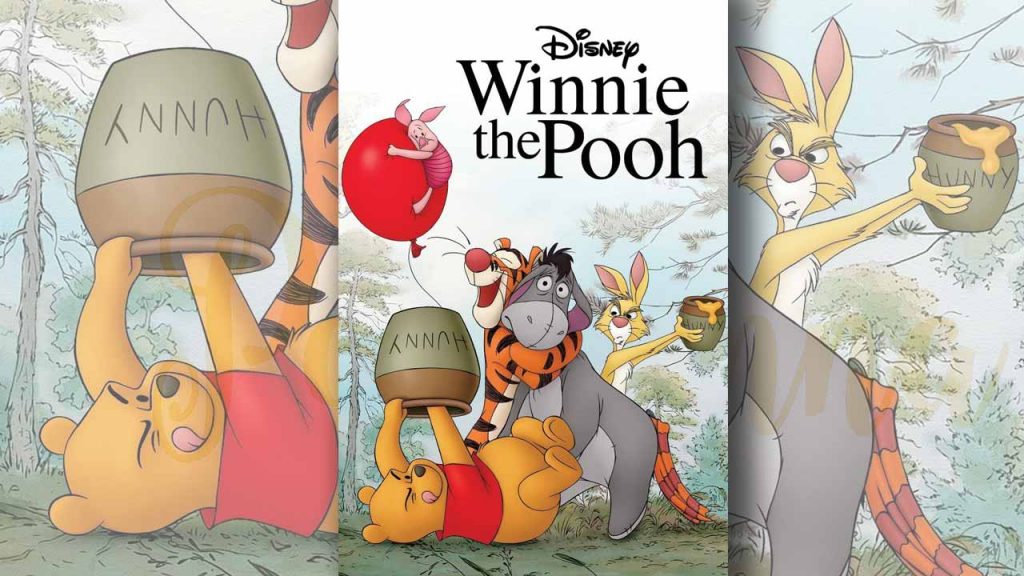
Our favorite silly little bear starts his newest adventure in bed, waking up only at the insistence of the narrator. Winnie-the-Pooh “has a Very Important Thing to Do” today, so he simply must get up!

Just what that important thing is, the narrator does not specify, so Pooh decides his first priority is going to be to take care of his tummy. And that requires some “huny.” When he discovers he is all out, this bear of very little brain comes up with a sensible enough plan – he goes in search of “friends out there with honey to spare.”

Once out of his little house Pooh proceeds to have a series of adventures. The first involves Tigger and a balloon, and the second, a fearsome beast (or as fearsome as a Pooh cartoon can be) named the Backson. The longest adventure of all is a search for Eeyore’s tail… or for some substitute that could serve in that role.

This is a gentle family-friendly gem. Disney has produced a score of Pooh films but this is the first since 1977’s The Many Adventures of Winnie the Pooh to fully capture the charm of the books. Many Adventures remains the best of all the Pooh films, with this a very close second.

Some reviewers were critical about its length, or rather, lack of length. Winnie the Pooh is listed as being an hour long, which is only about half as long as a regular feature film (and when you subtract the credits, it would be more accurate to say this is just over 50 minutes). It’s a legitimate beef. I know I would feel a little put out if I spent ten bucks per head for my family and we were marching out of the theatre before I even finished my popcorn. But on DVD this length is more palatable, especially when its intended audience, and their limited attention spans, are considered.

There are only two cautions to note. The first concerns language. After the film ends, and ten minutes of credits run, there is one final, very short scene in which the word “gosh” is used twice. I’m not a fan of this “substitute expletive” but this is not God’s name, and thus is not taking His name in vain.

The only other caution is about Pooh himself. In this rendition, Pooh is a little more self-absorbed and selfish than usual. As an example, when the group sets out to trap the Backson, Pooh is content to let his little friend Piglet do all the work while he supervises. Pooh’s shallowness (including his obsession with honey) is the central “conflict” in the story, and one that parents should point out to their children – the “hero” of this little story is not being a good friend right here. Of course, Pooh does get his priorities figured out by the end of the film. When faced with the choice of finally getting some honey, or bringing Eeyore his missing tail, Pooh chooses friend over food. The story concludes with Christopher Robin congratulating Pooh for the “Very Important Thing” he did today: “Instead of thinking of your tummy you thought of your friend.”

Enjoyed this article?

Get the best of RP delivered to your inbox every Saturday for free.


Red heart icon with + sign.
Book Reviews, Children’s fiction

The Complete Tales of Winnie-the-Pooh

by A. A. Milne 1926-28 / 368 pages The Complete Tales includes both Winnie-the-Pooh, first published in 1926, and The House at Pooh Corner, in 1928. As I began to read, I quickly entered the fun of the characters, most of whom were based on the stuffed animals of author A. A. Milne's son Christopher Robin. Pooh Piglet, Roo, and Tigger, for example, are very much children, with children's typical egocentric focus on themselves. At the same time, Pooh, though a somewhat gluttonous Bear of Very Little Brain, has the childlike love of the world that prompts him to create and recite plenty of poetry, which he, with childish confidence, is sure that Christopher Robin, will love. Piglet is a typical little kid who is more than a little worried about everything. Both Roo and Tigger are filled with the energy of children that sometimes exhausts the adults in their lives. Many of the others seem to be more children's view of adults: Rabbit, all busy and bustling, but not very patient; Kanga, the perfect mother, but just a little fussy; Eeyore, the somewhat depressed (and depressing) donkey. What binds the two groups together is their love for Christopher Robin, who owns all these (stuffed) creatures. What makes the characters funny is their general lack of awareness of their own weaknesses, but this can also get somewhat discouraging story after story. I was pleasantly surprised, then, when near the end of the second volume, Milne tells a story that shows how, sometimes, the communion of saints breaks through. We've seen Rabbit in action before, trying to un-bounce Tigger, but now his brusqueness is put to good use when he (finally) tells Eeyore what we've been thinking all along – to stop feeling sorry for himself and go out and visit others. Pooh sings a song that does more than just amuse himself; it also pays tribute to Piglet's earlier heroic actions. Finally, Piglet, when Eeyore mistakenly gives away Piglet's house to Owl after Owl's tree falls down, quietly lets Owl keep the house and accepts Pooh's gracious offer to come and live with him (echoes of Acts 2:45!). All the creatures, who love the one who owns them, learn to love each other as well. That's what we should be seeking as well. Our unity in the One who owns us should prompt our love for the others who are owned by Him (at much greater cost than Christopher Robin's ownership). That love should start as well, for its youngest audience, in the family. The Pooh stories are wonderful read-alouds for parents with their kids, and a wonderful way to start conversations about the difference between being childlike and childish, and how growing up in the communion means being able to deal graciously with others even when they are (as we all sometimes are) being childish....