

















Eric Liddell showed how Christians should do sports differently
*****
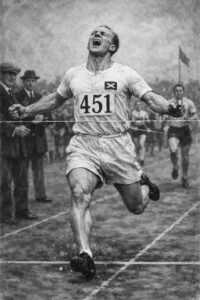 In July 1924, Scottish sprinter Eric Liddell refused to race in the qualifying heat of the Olympic 100-meter competition. A devout Presbyterian, Liddell had been heavily favored to win the event’s gold medal. When schedule-makers placed the qualifying heat on a Sunday, however, Liddell resigned from the competition rather than violate his conscience by competing on the Lord’s Day.
Liddell’s story has been honored for over 100 years through biographies, children’s books, and the blockbuster movie Chariots of Fire. For Christians, Liddell is a model of godly participation in sports, a demonstration that playing and watching sports may bring glory to God when contained by self-control.
Sunday as sports day
The challenges Liddell faced, however, have not disappeared in the modern context. Today, youth sports fill up Sunday morning after Sunday morning in the calendars of many Canadian families, impeding church attendance and implicitly inculcating an alternate-catechism.
Sunday is also the preferred day for many major televised sporting events including the Super Bowl, the Olympic gold medal hockey game, and the World Cup Final – in addition to standard NFL, NHL, MLB, NBA, and CFL broadcasts. A day designed for lasting spiritual benefit has become a feast day for temporary entertainment.
Some benefit
Scripture affirms that bodily training – including involvement in sports – is of some benefit. However, when this temporary benefit hinders growth in holiness, the Christian should lay aside such a hindrance. Of course, Christians must also avoid the trap of gnosticism, the ancient heresy which taught that the material world, including the body, is inherently evil. Against this, the early Church asserted that the incarnation and resurrection of Christ proves the inherent goodness of the body as designed by God – every human being has a body that is designed by God and must be respected rather than ignored.
Paul tells the Corinthians “whether you eat or drink, or whatever you do, do all to the glory of God” (1 Cor. 10:31), giving spiritual worth to the regular care of the body. Participation in sports, then, may glorify God by exemplifying stewardship of the body, and valorizing the self-control which marks high-level athletes. This is affirmed by Paul himself when he tells Timothy that “while bodily training is of some value, godliness is of value in every way, as it holds promise for the present life and also for the life to come” (1 Tim. 4:8).
The “some value” of bodily training may be incurred through direct participation or by watching professional athletes compete at the highest level – giving cause to rejoice in the creative wonder of God. These benefits, however, are only applicable to the heart of a God-worshipper. When our human bodies are offered as sacrifices to self rather than “living sacrifices” to God, the temporary benefit dissipates and instead becomes a hindrance – a distraction from the eternal benefit of holiness.
A rival religion
The temporal must always serve the eternal. If what is temporal, fleeting away, and quickly aging is honored as the ultimate prize of life, then bodily training is of very little value. If, however, the body is disciplined for action in service to God, there is great value in sport.
By contrast, the world often presents sports as a rival religion to Christianity. Fans congregate together, watch repeatedly, spend money, make pilgrimages, and speak constantly of their favorite teams.
This rival religiosity is reflected in the habits of Canadian families. In addition to exorbitant costs, families are often required to travel long distances for extended periods of time for children’s sports. Perhaps more alarmingly, avid sports fans spend countless hours consuming sports-related content on TV, social media, and audio platforms. Increasingly, the cost of lost time is conjoined with the cost of squandered wealth as recently-legalized sports gambling leads to dramatic increases in the number of individuals reporting sports gambling-related addiction and financial crises. There’s plenty of reasons, then, to want to topple this growing idol.
Whose glory?
So how should Christians respond to a sports-obsessed world without becoming modern gnostics?
Here, the example of Eric Liddell is helpful. Eric Liddell invested a significant amount of time into training. He endured pain, studied other athletes, rose early, and traveled far distances to compete. Yet he did so to the glory of God.
When faced with the choice to glorify himself or to present his body as a living sacrifice by keeping God’s law, Liddell did not hesitate – a decision that baffled onlookers. Eric Liddell understood that physical training was of “some value” but, more fundamentally, he understood that godliness is of eternal value. Liddell flourished as a Christian in sport because he did not worship sport. Sport, instead, was for him a means by which he could present his body as a living sacrifice.
In later life, Liddell became a missionary to China, pouring out his life for the sake of lost souls in a foreign nation that knew little of his athletic achievements. Ultimately, Liddell would die in that country, having become sick in a Japanese concentration camp during the Second World War. The youth he served inside the camp reported his last words: “It’s complete surrender.”
Liddell died as he had lived: in obedience to the Master who was able to deliver eternal godliness to his soul, far beyond the “some value” of bodily training. Even as Liddell’s once athletically unmatched body began to fade, his eternal godliness and joy – which his sporting career helped cultivate – became stronger and stronger.
Today, the location of the gold medal sacrificed by Eric Liddell and won by Harold Abrahams is unknown. Liddell, however, is seated with Christ on high – having received the reward of his total surrender. And his body – trained by godliness – will soon be raised to immortality. Though his medals are corroding and will one day be consumed by fire, his eternal reward is everlasting.
With Liddell as an example, Christians should play and watch sports as if it holds some value, all the while remembering that godliness is of eternal value.
Josh Senneker is a Christian political operative from Southern Alberta. He grew up playing Little League baseball and cheering for his two favorite hockey teams: the Calgary Flames and whoever is playing the Edmonton Oilers.