Transparent heart icon with white outline and + sign.

Life's busy, read it when you're ready!

Create a free account to save articles for later, keep track of past articles you’ve read, and receive exclusive access to all RP resources.

White magnifying glass.

Search thousands of RP articles

Helping you think, speak, and act in Christ.

Open envelope icon with @ symbol

Get Articles Delivered!

Helping you think, speak, and act in Christ. delivered direct to your Inbox!

A A
By:

Nearly 60% of violent crime cases now being stayed or withdrawn

“Justice delayed has become justice denied,” concluded a recent report from The Hub about the amount of time it is taking for criminal justice cases to be completed.

Digging into the most recent data available across Canada, the report found that the median amount of time it takes to complete a case – from first appearance to a final decision – has increased 60 percent increase in just eight years. It’s gone from averaging around 4 months – varying from 121 to 124 days – for the 8 years preceding 2016, to now being well over 6 months, or 198 days for 2023/24.

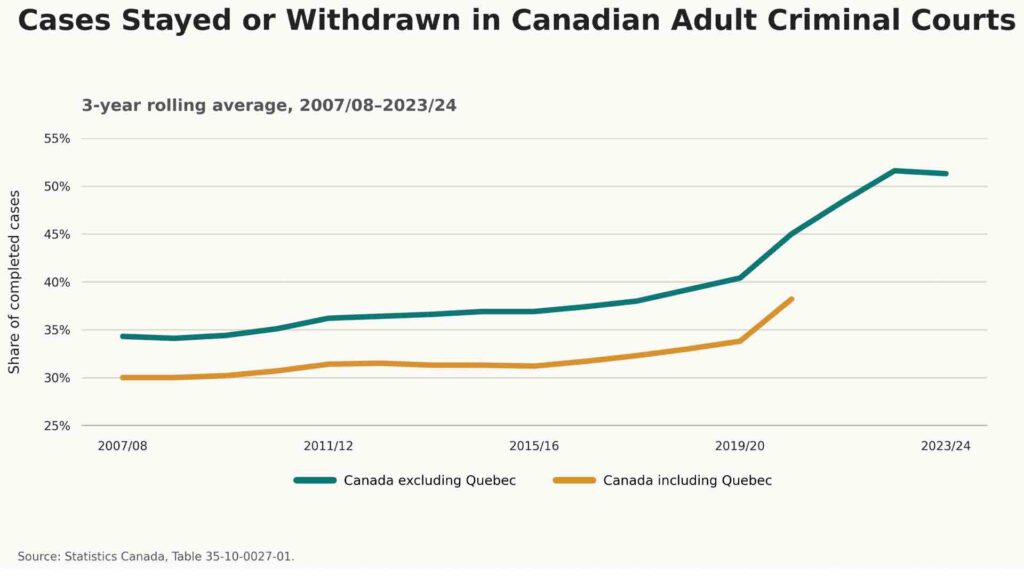
There are many costs to delaying justice with a big one being guilty people set free because they haven’t been offered a trial within the “reasonable time” promised in the Charter of Rights. The same report found that over the same time period, there has been a corresponding increase in the number of cases that have been stayed or withdrawn. That means no finding of guilt or innocence has been reached. As The Hub’s David Snow reports:

“Focusing on Canada outside Quebec [because QC stats aren’t as up to date], the proportion of criminal cases that were stayed or withdrawn increased from just under 35 percent in 2007/08 to 40 percent by 2019/20. The increase accelerated sharply after the pandemic, to the extent that more than 50 percent of criminal cases outside Quebec now end without a determination of guilt or innocence.”

This is particularly the case for violent crimes, where now nearly three in five cases are stayed or withdrawn.

As a result, fewer people are being found guilty, dropping from 63 percent to 46 percent. This isn’t because there are more acquittals. In fact, of the 228,425 adult court cases in 2023/2024:

• 105,371 were found guilty
• 118,265 were stayed or withdrawn
• only 2,442 were acquitted

God, who is perfectly just, calls us to image His justice. “Do not withhold good from those to whom it is due, when it is in your power to act” we are instructed in Proverbs 3:27-28. And as we read in Jeremiah 21:12, it must be done promptly. “Administer justice every morning; rescue from the hand of the oppressor the one who has been robbed.” So the Charter of Rights’ call for trials in a “reasonable time” is good – we don’t want people who’ve never been convicted, languishing in jail for years on end before they even have a trial. Imagine if you are innocent, and you’re made to wait in jail for even “just” 4 months. This needs to be fixed.

Enjoyed this article?

Get the best of RP delivered to your inbox every Saturday for free.

A A
By:

Justice delayed is justice denied: Supreme Court Justice Russell Brown resigns

In the midst of a misconduct investigation, Supreme Court Justice Russell Brown has chosen to resign his post on Canada’s top court.

The investigation was triggered by allegations of inappropriate conduct by Brown after an altercation in Arizona earlier this year. In a social setting, after a speaking engagement there, Brown was accused of making unwanted advances on a couple of women. In a public statement, Brown pointed to the slow misconduct investigation, the strain on him and his family, and the impact on the court’s proceedings, as leading to his decision that it was “for the common good” to resign. Accompanying the statement, Brown also released evidence to affirm his innocence in the matter.

While we aren’t in a position to judge Justice Brown’s guilt or innocence, we can consider the process. Brown was put on leave Feb. 1 and resigned on June 12. In his public statement he noted:

“At this point, it is impossible to know how much longer this delay would continue…. Given the progress so far, it is not unreasonable to think that this process may continue well into 2024.”

In Ecclesiastes 8:11, the Preacher tells us that: “When the sentence for a crime is not quickly carried out, people’s hearts are filled with schemes to do wrong.” The National Post’s Jamie Sarkonak echoed the thought: “The Supreme Court and the Canadian Judicial Council have shown troublemakers exactly what needs to be done to de-bench a judge.”

Canadian news website The Hub shared the reactions of other legal experts including Yuan Yi Zhu, an assistant professor of international relations and international law at Leiden University, who was very critical of the disciplinary process for Canadian judges.

“From Chief Justice Wagner’s decision to place Brown on an immediate leave of absence without official explanation on the basis of a flimsy complaint filed by a man who had assaulted his colleague, to the Canadian Judicial Council’s unbearably sluggish preliminary investigation which took the better part of half a year, to the numerous leaks from well-informed insiders to favoured journalists, the whole process has been designed to be as exhausting and wounding to Justice Brown as possible.

“There can be no better illustration of what American law professor Malcolm Feeley described as ‘the process is the punishment.’ Even if Justice Brown had been fully exonerated at the end of the open-ended process, his reputation would still have suffered, not to mention the fact that he would have been barred from exercising his chosen profession for the duration of the investigation, which could have run into years.”

The justice’s resignation has also shaken the Christian and conservative legal community.

Andre Schutten, Director of Law and Policy for ARPA Canada, told Reformed Perspective that Justice Brown’s resignation “is a major setback for our nation’s legal culture.”  Schutten explained that Justice Brown was “faithful to the law, and respected and guarded the rule of law. He was a constitutionalist and believed ardently that the law must be something more than the ruler’s whims. Where a majority of the Supreme Court pursued their own policy preferences and bent the law to reflect that, Justice Brown was loyal to the constitution, even when such loyalty was not in vogue.”

Schutten is concerned by what this means for the highest court moving forward, saying that it doesn’t bode well for religious freedom in Canada and is “another step toward judicial policy-making that is decidedly progressive.”

Sean Speer, The Hub’s editor-at-large, shared that conservatives sometimes overstate their lack of influence in Canada. However,

“the one area though where conservative despair has been justified is the judiciary. The ‘living tree’ view of the Constitution has been the dominant (even the sole) judicial philosophy at law schools and on the bench for more than a generation.”

The “living tree doctrine” says that the Constitution’s meaning wasn’t determined by those who wrote it, but is created by the judges who read it, that like a tree it should change and grow with the times. Speer went on to explain that there has been a change in recent years, with “a new generation of law students and scholars… capable of challenging the prevailing legal monoculture.” And he pointed to Brown as a key figure in this movement.

“His judicial dissents, including in high-profile cases like References re Greenhouse Gas Pollution Pricing Act and Trinity Western University v. Law Society of Upper Canada, gave this emerging cohort of conservative legal thinkers and practitioners a credible and different way to think about individual rights, the division of powers, and the role of the court…

“His departure from the bench, therefore, represents a regrettable blow to these efforts. That future now feels farther away especially since he’ll predictably be replaced by another ‘living tree’ exponent.

“It’s important however, particularly for the young people involved in the legal movement that Brown came to personify, that it must ultimately be bigger than one person. While his resignation creates a significant void, it cannot bring an end to these efforts. Quite the contrary. It reinforces the need for more Russell Browns.”

Schutten came to a similar conclusion, noting that Brown’s resignation underlines again the importance of Christian engagement in the law. “For too long, Christians abandoned the field to secularists and we shouldn’t be surprised that the result is so few principled judges. The Christian community must recommit to serving their nation also in the courts of law, inspiring, encouraging, and assisting the next generation of Christian leaders to pursue law as a calling while ensuring those Christian lawyers think christianly about the law.”

The resignation paves the way for Trudeau to appoint a sixth judge to the nine-judge bench that already had the National Post’s Tristin Hopper deeming it “the most activist Supreme Court in the world.”

While that’s not an encouraging thought, Christians can remember that one day we will see perfect justice exacted by the Chief Justice of the world’s Supreme Court, before whom every knee will bow.