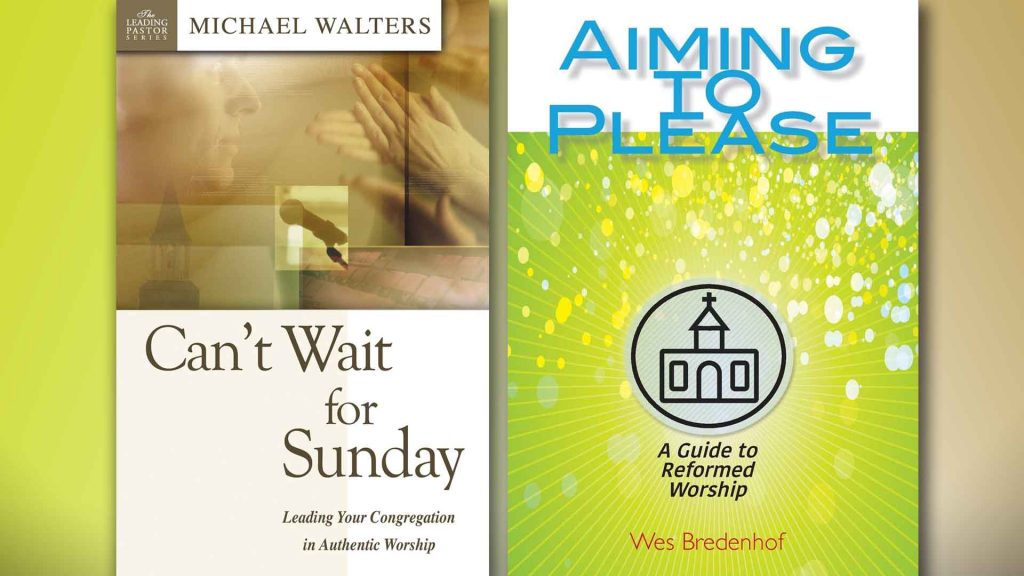
With the restrictions on church attendance easing, many people are saying: “Can’t wait for Sunday.” Did you know that there is also a book with that name by Michael Walters? The back cover has a large heading which says: “A Silver Bullet for the Worship Wars.” After reading Dr. Wes Bredenhof’s book on worship, Aiming to Please, I dove into this one book with its intriguing title.
There is some overlap between it and Aiming to Please, in chapters on liturgy, music, and sacraments. However, there are also new topics in Walter’s Can’t wait for Sunday. For example, Walters comments on the acoustics of the sanctuary. While many (of our) church buildings are optimized for the speaking voice, Walters points out that the sanctuary has multiple functions, including a space for singing and music. Therefore, the room should be acoustically designed for both speaking and singing.
Bredenhof and Walters both look at pulpits, which Walters sees as being replaced by a “lectern” in modern churches. He comments:
“The presence of a pulpit communicates that it is the Word of God, not the communicator, that is most significant in preaching.”
He continues, noting that modern communicators often prefer to have no barrier between themselves and their audience. Yet, pastors would do well to let their congregations know why they use “the sacred desk.”
While Bredenhof comes from a singing tradition with a select number of songs that the congregation knows well, Walters comes from a different practice where the songs are in abundance. The result: “Hymn singing can be a stretch for many worshipers these days.” Having many songs for the congregation to sing means there may be too many to be familiar with them. His advice is: “It is better to know ten or twelve hymns well than thirty perfunctorily.” Perhaps something to keep in mind while the Canadian Reformed churches are considering adding more songs.
Worship often changes, and Worship Wars start because of a lack of knowledge and understanding. It is essential to know why we do what we do. Both of these books would be an aid to any who want to learn.
Frank Ezinga blogs at FrankEzinga.com.