Transparent heart icon with white outline and + sign.

Life's busy, read it when you're ready!

Create a free account to save articles for later, keep track of past articles you’ve read, and receive exclusive access to all RP resources.

White magnifying glass.

Search thousands of RP articles

Helping you think, speak, and act in Christ.

Open envelope icon with @ symbol

Get Articles Delivered!

Helping you think, speak, and act in Christ. delivered direct to your Inbox!

A A
By:

Toy Story 5

Animated
2026 / 102 minutes
Rating: 8/10

Woody and Buzz are back one more time, though for the first time in the Toy Story franchise they aren’t the stars of the show. Instead, Jessie the cowgirl doll, and her faithful horse Bullseye are the heroes, and, also for the first time, the real life people in the story feature prominently. In fact, the little girl Bonnie, who owns Jessie, is the focal point of everything, and so much so that this really could have been called Bonnie’s Story.

But don’t worry, there’s still plenty of Woody to go around, and simply oodles of Buzz.

Bonnie is an imaginative girl who loves playing with her toys, but is looking to make friends. She’s terribly shy, and then, when she gets the courage to wave over at a couple of neighborhood kids – twins living right across the street – they just stare at her for a moment before rushing back inside their house. Hurt, Bonnie heads back inside her own house to ask her parents: “Mom, dad, why won’t anyone be my friend?”

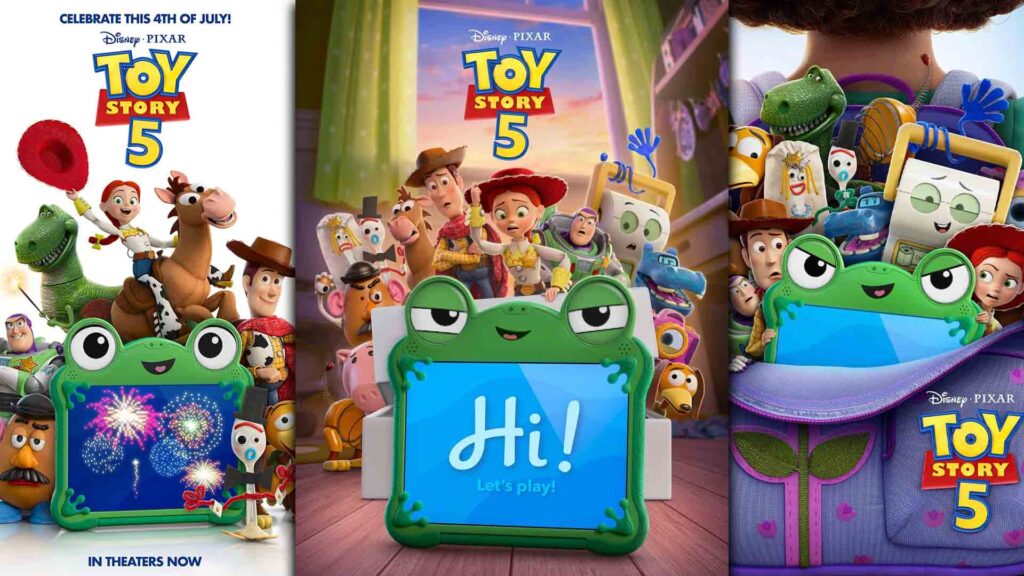
So what do mom and dad do? They decide to gift their eight-year-old a “Lilypad” or Lily as she’s known by the other toys – it’s an iPad-type device loaded with “educational” games. All the other kids have moved on from playing with toys to just tap, tap, tapping on their screens, so Bonnie’s parents figure that’s a good reason to get their little girl one too.

And Bonnie does love her Lily – she seems downright glued to it. And that has Jessie and the rest of the toys less than impressed. How can they get their imaginative little girl back? And how can they help Bonnie make friends?

Lily is definitely the villain of the piece, but she’s no cackling, super baddie. She loves Bonnie too, and with a quick flurry of online friend requests, she manages to secure Bonnie a “friend” in just 15 seconds. But is a screen friend the same thing as an in-real-life one? The toys know it just ain’t so… and eventually Bonnie, her parents, and even Lily will figure it out too.

Caution

While Bonnie is playing she marries two pieces of plastic cutlery done up with pipe cleaner arms and feet – Forky and Knifey – and Jessie is the female officiant. Is this an endorsement of female pastors? Or is this a little girl just playing around? You can evaluate for yourself, but I’ll say the moment lasts all of a few seconds. Maybe more noticeable, there’s also a little role reversal when Jessie and Buzz marry at the end, and Jessie dips Buzz before kissing him.

Pixar is generally very good with language, but there is a potty-training piece of tech called “Smarty Pants” which leads to a few potty-related references. Most were minor but the one that leapt out at me was someone saying that Smarty Pants would “wipe your a…” with the end of the word cut off before it could be completed. I also heard one “jeez” and an “oh my gosh.”

Another caution relates to a strange standalone film called Lightyear that was supposed to be the backstory to the fictional character that Buzz-Lightyear-the-toy was based on. Confused yet? You’re not alone. But the real problem with the film was the LGBT backstory for one of Buzz’s teammates. Tim Allen, the voice of Buzz, didn’t participate, the film bombed at the box office, and it now seems to be forgotten. And deservedly so.

Conclusion

Every movie has a message, moral or worldview that it’s pitching, but sometimes that message is delivered with some artistic subtlety, so it can creep up on you, and resonate all the more deeply in your bones (for good, or for ill, depending on what that moral is). Other times, filmmakers aren’t trying to have their message sneak up – they are trying to bash us over the head with it, lest we miss it. This “sermon as cinema” is common enough in Christian filmmaking – think of the Kendrick brothers’ Facing the Giants, Fireproof, Courageous, Overcomer, and The Forge – but it isn’t exclusive to them. Hollywood will also sermonize, delivering heavy-handed treatments of euthanasia (Million Dollar Baby), environmentalism (Avatar), and abortion (The Cider House Rules).

How much you like or love Toy Story 5 will depend on whether you were looking for a story, or you can really appreciate how this sermon echoes what you’ve been trying to teach your own family about tech.

Story-wise, it is another solid Toy Story outing, and the kids will appreciate Jessie and Bullseye bounding to the rescue, and the 50 different Buzz Lightyears (yes, we get a whole crateful of them here) shouting “To infinity… and beyond!” The four girls I watched this with, aged 11 to 14, gave it an average rating of just under an 8. They really liked it.

But they didn’t love it.

What many parents will love is the moral of the story – that screens are taking over our lives, and our kids’ childhoods, and we need to rein it all in. Lily, and tech in general, are the obvious baddies, but parents should be understood as the bigger villains. What are Bonnie’s mom and dad doing, handing her an iPad and just walking away? I’m not a huge fan of heavy-handed moralizing, but I was annoyed that parental irresponsibility was the only point of this sermon delivered with any delicacy. If there’s ever a time for a cinematic boot-to-the-head, isn’t this it?

Toy Story 5 is enjoyable as entertainment, but what sets it apart is its utility. This is a film parents can use to kick off a talk about how they want their kids to respond to technology’s pull, its temptations, and its possibilities. For some families, that could be a really important but painful discussion, because the limits and behaviors parents might want in place with their kids are, mostly, going to have to be modeled by mom and dad too. It’s going to be impossible to get your kids taking you seriously about screen-time limits if you can’t tear yourself away from your own phone.

That makes Toy Story 5 a must-see for most of us – one to watch and discuss and then put the lessons learned into practice.

Enjoyed this article?

Get the best of RP delivered to your inbox every Saturday for free.

A A
By:

The Toy Story franchise is for adults

Animated / Drama
1995, 1999, 2010, and 2019 / 81, 92, 103, and 100 minutes
Rating: 8/10

Animation is usually for kids. And a story that’s all about toys would seem best suited to children too. That’s why, when I saw the original Toy Story in the theater with a group of my college-age friends, we all thought it was kids’ fare…though the sort that adults could enjoy too.

When I tried watching it with my own kids 25 years later, I came to a different conclusion: that this movie franchise has always been directed first and foremost at adults.

All the evidence is there: a children’s film has children in the main roles, and a film for adults stars adults. What about Toy Story? In the original, there’s Andy, the little boy who owns the toys. He’s a child, but the film isn’t really about him. It turns out Toy Story is populated almost exclusively by adults…or, rather, toys, as voiced by adults.

Woody is front and center, a Western sheriff with a pull string on his back that makes him say “Reach for the sky, pardner!” He and his fellow toys are limp and lifeless when people are around, but spring to life – as every child has always suspected – the moment we leave. Some of the brilliance of Toy Story is in the toy cast’s very different personalities: we’ve got a timid Tyrannosaurus Rex, a wise-cracking Mr. Potato Head, a loyal Slinky-Dink Dog, and a flirtatious Little Bo Peep lamp. Shucks, even the Etch-a-Sketch is quite the character, trying regularly to “outdraw” Sheriff Woody. The biggest personality of them all is the newest arrival. For his birthday, Andy has gotten a Buzz Lightyear – a spaceman action figure – that replaces Woody as his favorite. Woody is jealous, but what really drives him nuts is that Buzz doesn’t even understand that he’s a toy. Buzz thinks he’s landed on an alien planet, and that the other toys are the friendly locals. Woody is normally a pretty stand-up toy, but in a bout of exasperated jealousy, he gives Buzz a shove. He meant to bump Buzz off the bureau, where he’d get stuck (and maybe forgotten for a while) in the gap between the bureau and the wall. But instead, he sends Buzz right out the second-story window into the bushes below. Woody, more concerned with what the other toys will think of him than actual concern for Buzz, tries to rescue the spaceman. But things just go from bad to worse and they end up in the next-door neighbor’s house, in the clutches of Sid, a boy whose parents don’t supervise him like they should. Why is it dangerous to be around Sid? Because he blows up his toys… and now Woody and Buzz may be next!

That’d be quite the problem for a bunch of children to solve. Fortunately, all these toys are, in as far as toys can be, adults. Woody, Buzz, Little Bo Peep, and Mr. Potato Head are voiced by adult actors and have adult personas (as most toys do).

Their problems are also adult problems, as becomes increasingly evident in successive films. In the first, Woody has to teach Buzz his purpose in life: to be there for their owner. In the follow-up, Woody wrestles with what it means to grow old and start to break down. In the third, the gang is wondering what they’re meant to do, now that Andy has grown up. This is ultimate-meaning-of-life material, which is pretty heavy, even if it’s only on a toy scale.

The films also feature events that, if viewed through the eyes of a child, would be downright traumatic. Adults don’t flinch when Sid blows up one of his army men. But for kids, who have watched these toys come to life, this is too close to seeing somebody getting blown up. The second film actually begins with Buzz dying – the evil emperor Zurg has gotten the best of the space ranger, hitting him with an energy beam that disintegrates Buzz’s top half, leaving only his legs still standing, but now smoking. It turns out that this is only Buzz Lightyear the video game character getting blown up, and the toy version is still fine. But kids don’t know that when it happens. Even more adult, in film #3 the whole gang, facing their certain incineration, are forced to come to an acceptance of death (though they are rescued at the last possible moment). Finally, in the franchise’s most recent chapter, a pretty but psychotic doll wants to rip Woody’s voice box right out of his stuffing.

Finally, add in some minor innuendo throughout – when Mr. Potato Head travels down the Barbie aisle in a toy store he has to remind himself “I’m a married spud, I’m a married spud.” It’s tame, and infrequent, but not kid stuff either.

Toy Story is meant for adults.

Cautions

If I was recommending this for children, there would be all sorts of little nits that could be picked. For example, when one toy talks about how much he trusts Woody, Mr. Potato Head takes off his lips and presses them to his butt – adults understand, though my kids missed it. A bunch of alien toys in one of those coin-operated toy dispensers view the claw that comes down as “our master” and speak of it in a worshipful manner. They’re basically a cult, and make for a weird, if fortunately brief, addition.

And for kids, it’d be important to note the overall tension throughout. If you’re watching any of them with children, there could be parts where you’ll need to hit the fast-forward button because it’ll be simply too much for the under-ten crowd. (The scariest moment of all might be in the first film, when we discover that Sid, in addition to blowing up his toys, has spliced a number of different toys together. After Woody and Buzz get trapped in Sid’s bedroom, they get surrounded by his freaky creations, including the creepiest toy you’ll ever see: a mute Mechano spider topped with a shaved doll’s head. We soon learn that these monstrosities are all friendly, but for a while there it’s downright disturbing. I think even adults could get the kreebles in this scene.)

But as far as adults are concerned, the only caution would regard the company behind the franchise. Pixar films spent a couple of decades making films that were artistic, entertaining, and still generally safe – language and sexuality concerns were minimal, and violence was of the cartoonish sort. But the Pixar of the 1990s and early 2000s has now transitioned into a woke company that encourages homosexuality and transsexuality. So the warning is, don’t presume that what Pixar creates next will be generally safe.

Conclusion

Twenty-five years ago Toy Story was groundbreaking: it was the first feature film to be animated entirely by computer. Successive films continued to push animation advancements; however, Toy Story’s success was never about the spectacle. What made Pixar special (before it became woke) was the attention to detail in every aspect of their storytelling. They knew their cinematic history and borrowed from the best that had gone before. So, for example, Buzz and Woody are a classic odd couple, and it doesn’t matter that we all know right from the start that they’re destined to become the best of friends by film’s end – the joy is in the craftsmanship of the journey. Throw in some loyalty and love, daring-do, and more than a little nostalgia and wistfulness, and what’s delivered are films to savor, at least in the moments when the action slows down.

And while these are best appreciated by adults, I’d recommend them for as young as 12. Look below for the trailers for all four films.