Transparent heart icon with white outline and + sign.

Life's busy, read it when you're ready!

Create a free account to save articles for later, keep track of past articles you’ve read, and receive exclusive access to all RP resources.

White magnifying glass.

Search thousands of RP articles

Helping you think, speak, and act in Christ.

Open envelope icon with @ symbol

Get Articles Delivered!

Helping you think, speak, and act in Christ. delivered direct to your Inbox!

A A
By:

Tidbits – June 2026

O Canada!

A Canadian woman and a Saudi woman were arguing about which country was better.

The Canadian said, “Canada has more than its share of problems, but at least here I can freely walk up to Parliament Hill, head to the Prime Minister’s office, and loudly complain, ‘Mark Carney, I don’t like the way you’re running this country.'”

“But I can do that in my country too!” the Saudi woman exclaimed. “I’m free to walk up to the palace, go to the King’s office, and loudly complain, ‘King, I don’t like the way Mark Carney Harper is running Canada!'”

Source: Adapted from a Reagan joke about Russia and the US 

4 of a kind

Grace and Mercy are two words with distinct meanings…but do you know what they are?

Through sheer repetition some Christian words seem to blend into each other and we forget their distinct meanings. But their differences do matter. Below are three short definitions that describe the following four words: Grace, Mercy, Justice and Persecution. 

  1. not getting what you do deserve
  2. getting what you do deserve
  3. getting what you don’t deserve

Test yourself. Do you know what definition applies to each word? The answers follow:

  1. Not getting what you do deserve, is God is merciful when He doesn’t send us to hell. We deserve to go to hell, but fortunately Christians don’t get what we deserve.
  2. Getting what you do deserve, is God’s justice requires that sinful man be punished. Jesus took our deserved punishment on Himself and thus fulfilled God’s requirement for justice.
  3. Getting what you don’t deserve is Persecution. If justice is about getting punished when you do something bad, then persecution is about getting punished when you’ve done nothing, or done something good (like handing out a Bible in China). Persecution is, therefore, getting something bad that you don’t deserve. This definition is a little tricky, however, because it can also be a good thing to get what we don’t deserve. That’s exactly what Grace is! Our salvation and adoption as God’s children is ours entirely out of grace – we have done nothing to merit this reward. It is through grace alone.

Another reason everyone should study economics

A story is told about an old man who was called silly names by the neighborhood kids and he couldn’t get them to stop. Then he hit on an idea. The next day, when the children gathered around him, shouting their taunts, he told them that next week he was going to pay them to insult him – if they came on Tuesday, four days later, he would give them each a dollar to shout their insults at him. They agreed, and the immediate impact was that the children stopped hassling him – it seemed they were saving up their insults. Then, come Tuesday, the man did as he promised, giving each of the little bullies a dollar for shouting insults at him. Then he announced that he’d pay them the next day too, but just 50 cents each.

Wednesday they all gathered again, threw their insults, and were given 50 cents each. Afterwards the man announced that he’d only pay them a penny for their insults tomorrow. “A penny?” the ringleader complained, “that’s not even worth it.” And they never taunted the man again.

Source: adapted from Michael Hodgin’s “1001 More Humorous Illustrations for Public Speaking”

Do you like being corrected? David did.

We’re supposed to love correction. Not throw a fit in response to it, or even stoically accept it. No, we’re supposed to love it. Proverbs 9:8 is just one of the texts where God makes this point:

Don’t reprove a scoffer, lest he hate you.
Reprove a wise man, and he will love you.

God tells us that reproof is, in fact, a sign that He loves us: “whom the Lord loves, He chastens, and scourges every son whom He receives” (Heb. 12:6). This verse makes good sense to any parent – it’s a lot easier to not discipline our kids, to just let it go this time (and the next, and the time after that), but if we love them, then we want to teach them what’s wrong and right, and that will necessarily involve reproof of some sort.

Still, “love correction” is a hard command to follow, so it struck me when I came across King David’s response to the prophet Nathan’s rebuke. As you’ll recall, Nathan came to David after David had committed adultery with Bathsheba, and murdered her husband to cover it up (2 Samuel 11-12). Nathan came with condemnation, and a curse. Though David confessed his guilt, Nathan informed the king that the LORD would kill the child that he had conceived with Bathsheba. And the child did die.

We would all understand it if David didn’t think all that kindly of Nathan after that. But, despite his great sins, David was still a man of God, and he shows this in his response to Nathan’s reproof. In 1 Chronicles 3:5 we read that, of the four sons David had with Bathsheba, one was named Nathan! Here, then, is a man who was reproved, and seems to have loved the messenger who brought him that correction.

Presuppositions

When a little boy asked his grandfather whether he’d been on the ark with Noah, his grandfather had to laugh, and assured the boy that no, he had not been on the ark.

“But grandpa,” the boy asked, “then why didn’t you drown?”

Are we conservatives?

Dave Rubin, Douglas Murray, and the DailyWire’s Spencer Klaven are all self-described “gay conservatives,” and how can that be? It’s because “conservative” is a term that has meaning in comparison. So long as a position can be placed on a spectrum, there will always be liberal and conservative versions. If an anarchist wants to destroy all of Western Civilization, and I want to destroy only half of it, I would be the conservative anarchist. And if a couple of college ethics professors want to euthanize all disabled babies now, and I want to wait a few years, I am the conservative eugenicist in this conversation. In much the same way, conservative and gay go together just fine too.

That’s why God’s people need to understand that if we want to express our loyalties clearly, we need to come out as Christians, not conservatives. Conservative Christians even, but not simply conservatives.

Showing and telling

A half dozen writing tips that highlight what’s to be done, and how not to do it.

  • Don’t use a big word where diminutive verbiage will suffice.
  • Check carefully to see if you any words out.
  • Avoid clichés like the plague.
  • It’s generally a good idea to be specific.
  • Colorful, vivid, descriptive, multi-layered adjectives are overdone.
  • Don’t re-use the same words. Use different words. Other words.

Done before the first down

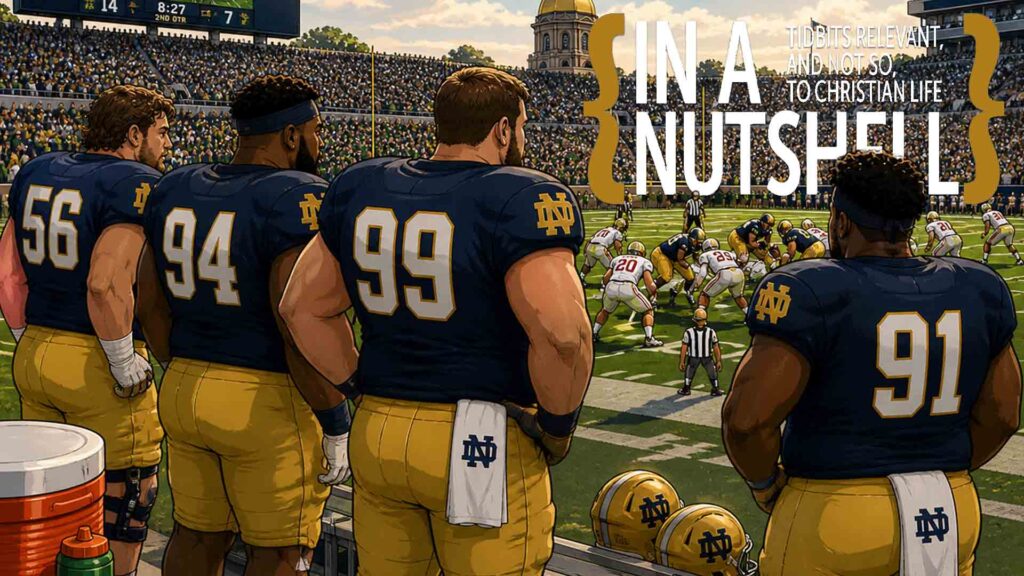
Notre Dame’s famed football coach Knute Rockne wasn’t above employing psychology to give his team an edge. A legend is told of how, when he was about to face the much better University of Southern California (USC) team, he spent the week beforehand scouring the city of South Bend for its largest men. He found a hundred, all 6’5” or taller, and every one of them weighed 300 pounds or more. Then he decked them out in Notre Dame uniforms and the pads and helmets only made them look even bigger.

When it was game time, he marched them out. One after another, these giants ran onto the field, right past the opposing players. The USC coach kept telling his guys, “They can only field 11 men at a time,” but it didn’t matter. None of them played a minute, but the opposition was so intimidated at the sight of them that they dropped passes, committed fumbles, and even ran into each other in their crossing routes. And Notre Dame won the game.

Did it happen? Maybe. But the reason the story is told is because this sort of thing does happen. Think of the men who spied out Israel and got intimidated by the giants of the land before any battle was even fought. Consider today’s battles and how often God’s truth is more loudly defended by non-Christians like Ben Shapiro or Jordan Peterson than by us – we’ve run from the battle and left it up to others, scared of what we might, but haven’t yet, had to face. How often are we beaten before we’ve even begun?

Thankfully, our God is not just mighty – bigger than any giant on the football field sidelines, or standing in front of a Canaanite army – but He is also gracious and forgiving. So let’s fall on our knees, and get ready to put up our fists when God next calls us to fight for His glory.

Source: adapted from Michael Hodgin’s “1001 More Humorous Illustrations for Public Speaking”

That speck in your neighbor’s eye

The faults we spot so easily in others may well be the ones we excuse in ourselves. Of course, there is some artistry in our self-deception – we aren’t going to bluntly say, it is wrong for my kids to be curt and impatient, but I’m allowed to be. No, we’ll say it’s wrong for them, but then relabel our own conduct as something more acceptable or even admirable, as this poetic ditty demonstrates:

Stubbornness we deprecate;
   firmness we condone.
The former is our neighbor’s trait;
   the latter is our own.

Source: Michael Hodgin’s “1001 More Humorous Illustrations for Public Speaking”

Berra-isms

Major league player and coach Yogi Berra had quite the way with words. Here are a few of his most famous “Berra-isms,” with wisdom to be found, if you’re willing to ponder.

  • It ain’t over ‘til it’s over.
  • If you don’t know where you’re going, you might not get there.
  • Ninety percent of the game is half mental.
  • You can observe a lot by watching.
  • When you come to a fork in the road, take it.
  • If you can’t imitate him, don’t copy him.
Enjoyed this article?

Get the best of RP delivered to your inbox every Saturday for free.


Up Next


Red heart icon with + sign.
In a Nutshell

Tidbits – May 2026

On logic Sherlock Holmes and his faithful companion Dr. Watson once went on a camping trip. Some hours after they lay down for the night and went to sleep Holmes awoke and nudged his faithful friend. "Watson, look up at the sky and tell me what you see." Watson replied, "I see millions and millions of stars." "What does that tell you?" Holmes asked. Watson pondered for a minute – accompanying Holmes for years had given him countless opportunities to see the power of careful observations, and, as he was no intellectual slouch himself, he thought now might be a good opportunity to put his own keen observational abilities on display. "Well, Holmes, astronomically speaking it tells me that there are millions of galaxies and potentially billions of planets. Astrologically, I observe that Saturn is in Leo. Horologically, I deduce that the time is approximately a quarter past three. Theologically, I can see that God is all-powerful and that we are small and insignificant. Meteorologically, I suspect that we will have a beautiful day tomorrow. What does it tell you, Holmes?" "It tells me, Watson, that someone has stolen our tent!" Source: Adapted from a joke making its way around the Internet Simply and truly... There once was a man whose parents had given him the highly unusual name of "Amazing" when he was born. They gave him the name in the hopes that he would live up to it and achieve great things. But as far as most people were concerned, Amazing never seemed to do anything to live up to his name. He never even got far from where he was born. He worked in the family business, and had some limited – one might even say quite normal or ordinary – success and married his high school sweetheart. While she thought him quite extraordinary, no one else did, and his name left him as the unfortunate butt of countless jokes. These jokes so bothered him that he told his wife that when he died he didn't even want his name put on his tombstone; maybe then the jokes would stop. Well, when Amazing did finally die, his wife honored his request. But she also wanted to have people finally understand how extraordinary her husband had been. So in place of his name she had this inscription placed on the tombstone: "Here lies a man who was loving and faithful to his wife for 60 years."  And now, whenever people walk by, they point and say, "Well, isn't that Amazing!" Source: A joke passed along by my father-in-law Do you like being corrected? David did. We're supposed to love correction. Not throw a fit in response to it, or even stoically accept it. No, we're supposed to love it. Proverbs 9:8 is just one of the texts where God makes this point: Don’t reprove a scoffer, lest he hate you. Reprove a wise man, and he will love you. God tells us that reproof is, in fact, a sign that He loves us: "whom the Lord loves, he chastens, And scourges every son whom he receives" (Heb. 12:6). This verse makes good sense to any parent – it's a lot easier to not discipline our kids, to just let it go this time (and the next, and the time after that) but if we love them, then we want to teach them what's wrong and right, and that will necessarily involve reproof of some sort. Still, "love correction" is a hard command to follow, so it struck me when I came across King David's response to the prophet Nathan's rebuke. As you'll recall, Nathan came to David after David had committed adultery with Bathsheba, and murdered her husband to cover it up (2 Samuel 11-12). Nathan came with condemnation, and a curse. Though David confessed his guilt, Nathan informed the king that the LORD would kill the child that he had conceived with Bathsheba. And the child did die. We would all understand it if David didn't think all that kindly of Nathan after that. But, despite his great sins, David was still a man of God, and he shows this in his response to Nathan's reproof. In 1 Chronicles 3:5 we read that, of the four sons David had with Bathsheba, one was named Nathan! Here, then, is a man who was reproved, and seems to have loved the messenger who brought him that correction. The next time you’re grumpy… I saw this four-step cheer-yourself-up process on my sister-in-law’s social media feed and had to try it out. And it worked! Whisper “beep boop” to yourself. Repeat randomly over the next couple minutes Pinch your nose and say “sneep snop” Nose pinched, say “boopdedoop” in a really deep voice Nose still pinched, say “bubbles” in the angriest voice you can Give it a go and let me know if you find it effective too (the fourth one really gets me). But why does it work? The world often acts as if emotions control us, but God talks about self-control as being a fruit of the Spirit (Gal. 5:22-23). There’s a sense too, in what God tells us, of emotions being actions we can do. So we might not be called to feel happy, but we are commanded to rejoice always (Phil. 4:4), and rejoicing is something we can express no matter how we might feel. This involves a person trying to actually control their emotions. And because the attempt is something that lines right up with God’s commands, the fruit that results is good. God’s love comes out in His commandments, such that obeying God is good for us. What is the purpose of your home? Some years back Rev. Peter Moelker wrote a head-clearing piece titled "My home, my idol?" in Faith in Focus. He asked Christians to give their head a shake and really think about why we buy, renovate, paint, scrub, tidy, dust, vacuum and have our homes: "Have you ever sat back and asked yourself the question: 'what is my home really for?' What is its purpose? A place to store our stuff? A museum to be shown to select guests? A fast-food restaurant to prepare quick meals for those who hurriedly pass through? What is the purpose of my home? The Bible tells us that our homes are to be places where children are instructed in the Law of the Lord (Deut. 6:7, 11:19), where the righteous experience the Lord’s blessing (Prov. 3:33), where Christians fellowship and worship God together (Acts 2:46), and where others are invited in to enjoy that same blessing of the Lord (Acts 16:15, 18:26, Romans 12:13, 16:23, 1 Peter 4:9, 3 John 1:8)." We might be embarrassed to have guests over when our home isn't pristine and smelling of lemon-scented Mr. Clean, or when we're having some problems with the night's menu. But if we realize the purpose of our home is for it to be used to the glory of God, rather than presented at its best for our own glory we'll have the proper perspective and not sweat such little stuff. Sola Opus Dei "I guess you could say we’ve been saved by works. His.” - Shai Linne, "Active Obedience" from his album Lyrical Theology Part One Why God can't make a square circle Here’s a trick question atheists pose: "If God is all-powerful, can He create a rock so heavy He can't lift it?" If Christians answer yes, then God must not be all-powerful since He can't lift the rock. And if we say no, then it again calls into question God's omnipotence – He must not be all-powerful, because it isn't within His powers to make such a rock. But the question misunderstands what Christians are saying about God when we talk about God's omnipotence. While we claim it is within His power to do anything, we aren't saying it is within His character. There are, in fact, many things God cannot do, because to do them would violate His own character. For example, God is eternal, so He cannot cease to be. He also cannot lie, and cannot abandon His elect. And, for the very same reason – because it would violate His character – He cannot make a rock so big He can't lift it (or make a square circle, or homosexual marriage, etc.). God's character is the very basis for reason and logic, and He will not do anything that would violate the essence of Who He is. Diversity by Rob Slane Up is like down when left is like right Cold may be hot when the day is like night The cat and the dog are the same only when The men are like women and the women like men Celebrate diversity for sure, but recall That small really is small and tall really is tall Calling smiling a frown will not make it a frown Up really is up and down really down Updating a "classic" Have you noticed how grim many nursery rhymes are? Jack goes up a hill to get water and ends up cracking his head, while precariously perched Humpty Dumpty breaks his whole body... irreparably. Years back, I decided I absolutely had to draw the line when I made the mistake of reading "rock-a-bye baby" as a goodnight story to my two-year-old. I quickly made a last-line revision that would be far more conducive to my toddler having a restful – nightmare-free – sleep. This is how my version goes: Rock-a-bye baby, on the treetop, When the wind blows, the cradle will rock, If the bough breaks, the cradle will fall, And Daddy will catch them, cradle and all. On patience “Patience is a quality you admire in the driver behind you, and scorn in the one ahead." “Living would be easier if men showed as much patience at home as they do when they’re fishing.” Source: God’s little instruction book Man vs. beast "...our best moralists tell us to treat other animals well – never dreaming of telling the animals to treat us well!" – C. John Collins explaining how even those who say we came from the animals can't help but acknowledge how distinct we are from them. ...


We Think You May Like