









Transparent heart icon with white outline and + sign.

Life's busy, read it when you're ready!

Create a free account to save articles for later, keep track of past articles you’ve read, and receive exclusive access to all RP resources.

White magnifying glass.

Search thousands of RP articles

Helping you think, speak, and act in Christ.

Open envelope icon with @ symbol

Get Articles Delivered!

Helping you think, speak, and act in Christ. delivered direct to your Inbox!

A A
By:

Tidbits – April 2026

Some is better than none

“There is nothing wrong with starting a hefty book like Calvin’s Institutes and only getting a hundred pages read. Think what the Church today would be like if we all read the first hundred pages of Calvin.” – Ben House

What kind of impact will you have?

Whether it is municipal, provincial, or federal, there always seems to be an election just around the corner and Tim Bloedow’s way to influence these elections is worth considering. Some years ago he passed on a strategy he’d gleaned from one Dr. Glenn Martin. The professor was convinced that every serious Christian should try to influence the vote of at least 100 people. He himself wasn’t satisfied unless he attempted to influence at least 1,000. This was back before social media was much of a thing, so he would write these 1,000 people and tell them how they should vote and why. We’ve got more means now than he did then, so this next election can we have that kind of impact?

A brief rebuttal of post-modernism

“Some of you may believe that you cannot discover Truth. If this is true, you have actually discovered a truth. You might as well continue searching for more.” – Thor Ramsey, A Comedian’s Guide to Theology

How much do our children owe?

Parents try to leave their children with an inheritance, not debt (Prov. 13:22), but Canada continues to debt-finance their federal and provincial government budgets. They spend money they don’t have to pay for promises made to this present generation. But while this generation gets more than they paid for, the next generations will be saddled with paying off the more than $2.3 trillion combined debt of our federal and provincial governments. Individually what we owe differs some, depending on what province we live in, but according to the Fraser Institute, even in Alberta it amounts to $41,000 per person, and it rises to nearly $69,000 per Newfoundlander.

So what’s a billion… or a trillion?

When our debt is in trillions that’s pretty hard to fathom. So let’s start with a smaller number and see if we can wrap our heads around it. Just how much then, is one billion? Well…

• A North American’s average age expectancy is 2-3 billion seconds
• A billion liters would fill 400 Olympic-size swimming pools
• 170 African bull elephants weigh the equivalent of one billion grams
• A bit over one billion minutes ago Jesus walked the Earth

And what’s a trillion? Dr. D. James Kennedy did an interesting bit of calculating in his book The Mortgaging of America. He notes that, “if you had gone into business when Jesus Christ was born – a business that was so unprofitable that… you lost a million dollars a day, seven days a week, it would still take you 700 more years from today to lose a trillion dollars.”

The log in our own eye

When the London Times asked notable personalities across Britain to write on what they thought was wrong with the world, they purportedly got this response from author G.K. Chesterton: “Dear Sirs, I am. Yours truly, G.K. Chesterton.”

Fcat or foitcin?

An email mkanig its way ronud the Ietrnent calims:

It deosn’t mttaer in waht oredr the ltteers in a wrod are. The olny iprmotnant tihng is taht the frist and lsat ltteer be at the rghit pclae. The rset can be a taotl mses and you can sitll raed it woutiht a porbelm.

Tish is bcuseae the huamn mnid deos not raed eervy ltteer by istelf, but the wrod as a wohle. Azamnig, huh?

But is it ture? Yes and no. Lsat lteerts are irtomanpt but wehn the wdros we raed are lses flaimiar or qtiue lhtgney or rbleemse oehetr wdors it bmoeecs duicflift to urnneadtsd eevn wtih frsit and lsat lterets paceld ctlrcroey.

Parental dictionary

If words were defined just for parents:

bathroom: used by the entire family, believed by all except mom to be self-cleaning
feedback: what you get when your baby doesn’t appreciate dinner
grandparents: people who think your children are wonderful even though they’re not sure you’re raising them right
independent: how we want our children to be, as long as they do everything we say
ow: the first word spoken by children with older siblings
puddle: a small body of water that draws other small bodies, wearing dry shoes, into it
show-off: a child more talented than your own
sterilize: done to your first baby’s pacifier by boiling it and your last baby’s pacifier by blowing on it
sweater: garment worn by child when its mother is feeling chilly
top bunk: bed where you should never put a child wearing Superman pajamas

Some choices are wicked

When American abortionist George Tiller was murdered in 2009, pro-life leaders knew that whatever they said in response would be misinterpreted by the media. That left most too cautious to speak out, but it pushed columnist Ann Coulter to do so. In an interview with Fox News anchor Bill O’Reilly she talked about the murder using rhetoric that pro-abortionists use to justify killing the unborn.

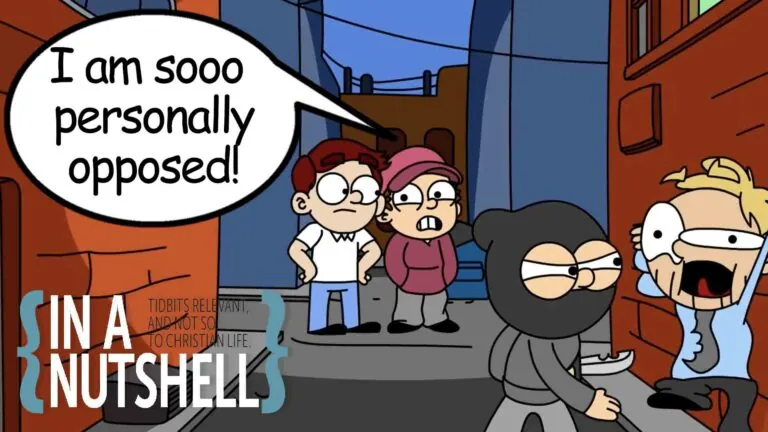
She started by telling O’Reilly that she didn’t like thinking of Tiller’s death as murder, preferring instead to call it “terminating Tiller in the 203rd trimester.” O’Reilly, misunderstanding what Coulter was doing, started to protest, which prompted Coulter to take it further, putting a twist on another well-known bit of abortion rhetoric. “I am personally opposed to shooting abortionists,” she told O’Reilly, “but I don’t want to impose my moral values on others.” Putting her own spin on a best-selling pro-abortion bumper sticker she told viewers, “If you don’t believe in shooting abortionists, then don’t shoot an abortionist.”

When abortionists bring up issues like “privacy,” “choice,” or “imposing morality” on others, they’re trying to evade the only relevant issue in the abortion debate: are the unborn human beings? If they aren’t, then no one should object to abortion; if they are, then everyone should! But instead of arguing this issue, abortionists avoid the debate entirely using slogans that assume what they are trying to prove – that the unborn aren’t human. Coulter exposed this evasion by showing how their slogans make no sense when applied to an acknowledged human being, abortionist George Tiller.

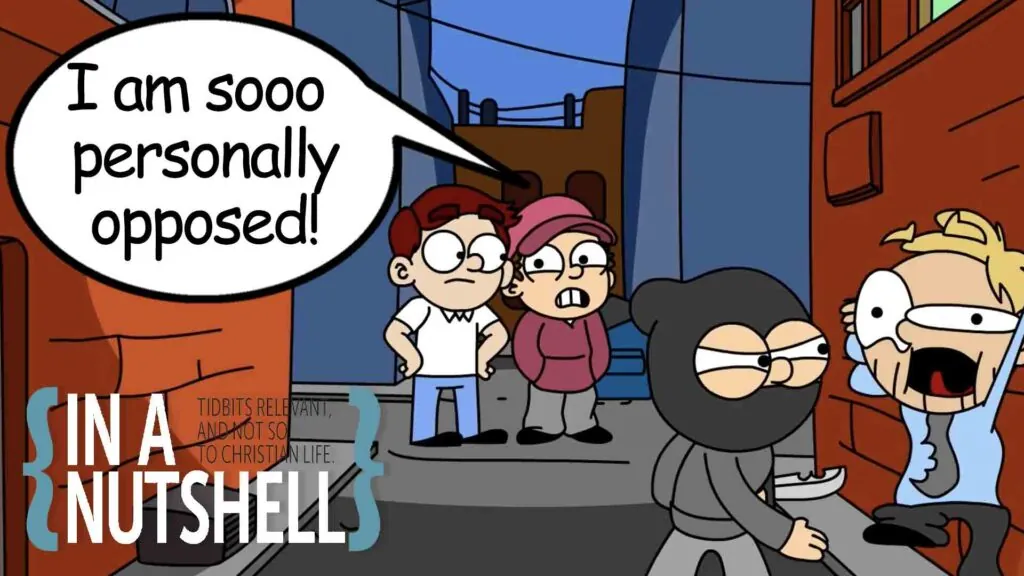
Seamus Coughlin attacks the “personally opposed” evasion in the video below (which is cartoon, so some of the brutal is taken away, but it still should not be watched with kids around).
Enjoyed this article?

Get the best of RP delivered to your inbox every Saturday for free.


Red heart icon with + sign.
In a Nutshell

Tidbits – March 2026

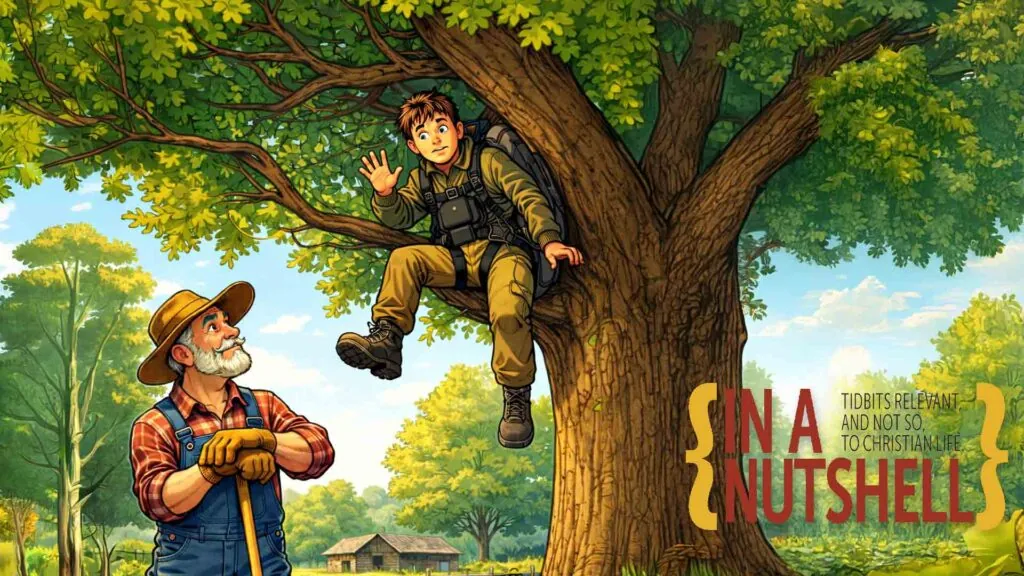
Still true in some places… Johan had left Edmonton to go up northward, near Neerlandia, for a bit of skydiving. Late Sunday evening he was found in a tree by a farmer. “What happened?” asked the farmer. “My parachute didn’t open!” Johan replied. “Of course not,” said the farmer. “Around here most nothing opens on Sunday.” Even if your wife is a ninja…. In his book, This Momentary Marriage, John Piper takes on the task of teaching men what it means to be men. Building on Ephesians 5:21-33 he points out a number of roles males should take on including one he wishes was “too obvious to need illustration,” that of protector. He notes that this role is not given on the basis of ability, but gender alone – this is what real men do: “If there is a sound downstairs during the night and it might be a burglar, you don’t say to her, ‘This is an egalitarian marriage, so it’s your turn to go check it out. I went last time.’ And I mean that – even if your wife has a black belt in karate. After you’ve tried to deter him, she may finish off the burglar with one good kick to the solar plexus. But you’d better be unconscious on the floor, or you’re no man. That’s written on your soul, brother, by God Almighty. Big or little, strong or weak, night or day, you go up against the enemy first. Woe to the husbands – and woe to the nation – that send their women to fight their battles.” Great podcast for the kids If you’re looking for a podcast to play for your kids on a long drive or family trip, you may want to check out Angela O’Dell’s explicitly Christian “Real Cool History for Kids.” These 15-minute-or-so episodes are aimed at kids 6-12, and with more than 150 to choose from mom and dad can pick a topic that will interest them too – O’Dell covers everyone from Queen Elizabeth to Karl Marx and Charlie Kirk to Bonnie and Clyde. Our family has been listening off and on for years now, and have really enjoyed tackling two or three at a time. She is very clear about bringing a biblical worldview to the show (and in her dinosaur episode, she even comes out as a 6-day creationist!) – I don’t know that we’ve ever heard a take we didn’t agree with. Check out “Real Cool History for Kids” at AngelaODell.com or wherever you listen to podcasts. Chesterton and Charlie on Original Sin Chesterton spoke of how some religious sorts were disputing whether Man was even in need of washing – was he actually sinful? How ridiculous, Chesterton argued, for men incapable of even imagining sinlessness in their dreams, to “deny human sin, which they can see in the street.” “Certain new theologians dispute original sin, which is the only part of Christian theology which can really be proved.” Charles Spurgeon made the same point this way: “Any man who declares children to be born perfect was never a father. Your child without evil? You without eyes, you mean!” Pious sounding evasion When evangelist Ray Comfort first heard the St. Francis of Assisi quote, “Preach the Gospel; where necessary, use words” it, rather ironically, left him “upset beyond words.” This quote is used to encourage a type of “lifestyle evangelism” that involves “less talk, and more walk.” Instead of preaching the Word to their unbelieving friends and neighbors, Christians are supposed to just let their light shine by living good lives. There is something to this idea – God tells us we can impact the unbelieving with the way we live our lives (1 Pet. 3:1-2). But that doesn’t negate the need to use the Word (Rom. 10:14). Comfort exposed the empty piety of the St. Francis quote with a story. In a refugee camp thousands of children were on the brink of starving to death even though there was food enough to give them. Why weren’t they being given the food? Because one of the aid workers had held up a sign that said: “Feed the starving children. Where necessary, use food.” Such an approach would be insane, but, Comfort insists, no more so than thinking we can preach the Gospel without using words. Earth thrown in “If you read history you will find that the Christians who did most for the present world were those who thought most of the next. The apostles themselves, who set out on foot to convert the Roman Empire, the great men who built up the Middle Ages, the English evangelicals who abolished the slave trade, all left their mark on earth, precisely because their minds were occupied with Heaven. It is since Christians have largely ceased to think of the other world that they have become so ineffective in this one. Aim at Heaven and you will get earth ‘thrown in.’ Aim at earth and you will get neither.” – C.S. Lewis Are creationists pitting Scripture vs. science? We who hold to a recent (in the last 6,000 years or so), six-day creation are sometimes accused of pitting Scripture versus science. After all, doesn’t mainstream science tell us the universe is billions of years old? Now, if that’s what we’re calling “science” then it is true, us six-day sorts do know we’ve got a problem. But when mainstream scientists hold as their a priori assumption that only naturalistic explanations are valid, they’re the ones picking a fight. After all, Romans 1 and Ps. 19 affirm (as do our own eyes) that all of creation testifies to its supernatural origins. And that’s not the only Scripture vs. secular science conflict. Genesis 1:27 declares “male and female He created them” but the medical and psychological experts won’t stand for such binary bigotry. The Bible says children are a blessing but we’ve got experts lamenting each new addition’s carbon footprint. While God presents life-long monogamy as best, mainstream science says it simply isn’t natural...though homosexuality is. Yes, this is science – of a sort – pitted against Scripture, but the conflict isn’t of our doing. If we are troublemakers it is only because, standing as we are on the firm foundation of God’s Word, we refuse to be moved. As Douglas Wilson put it: “The Bible teaches that Adam produced death. The opposing view has to say that in some manner death produced Adam.” Those are the two sides, and there is no reconciling them. We who follow a God/man who died and rose, can’t avoid a fight with any and all who say dead men don’t rise and the supernatural isn’t. That’s the fight to be had. So let’s rise to it! Reagan’s principal, on parenting Ronald Reagan remembered his high school principal fondly, recounting how he had his priorities in place. And as principal he was standing in loco parentis and so there is a reminder here how parents should prioritize: “I was in the principal’s office once in Dixon High School, and I wasn’t there just to pass the time of day. Well, at one point he said to me, ‘You know, I don’t care what you think of me now. I’m only interested in what you think of me fifteen years from now.’” Can you put that in writing? In a recent issue of Focus on the Family’s magazine, parent Renae Green shared how she was teaching her 11-year-old to stop tattling. “I told my children that I would only accept and review written complaints.” Implementing this new policy has her daughter thinking twice – is her brother’s behavior annoying enough to warrant working through the paperwork? And, most of the time, her answer is, no. Too proud to seem weak Walter Dean Myers is a children’s author I haven’t read, but his own story sticks with me. Money was tight, and his mother was an alcoholic – when he was 14 she stole the money he’d been saving up to buy a typewriter. His janitor dad, not rich by any means, stepped in and bought the typewriter for Walter instead. But that was the last time his dad showed any interest in his son’s writing. Walter went on to write over 100 books, and, as he told his own son in an NPR interview, Walter’s dad “never said anything good about my writing…. And that really, that really hurt, that really bothered me.” Walter tried to get his dad’s attention by turning some of his dad’s own stories into published work. “I would show them to him, and he would never comment on them. So, when I did that, then I said, he hates me. You know, he hates me.” When his dad was dying, Walter brought him the book he’d just published, “And he picked it up and he looked at it, and then he just laid it down.” It was only after his dad died, and Walter looked through his papers, and saw they were all signed with an X, that he realized his dad didn’t know how to read. And that’s why he’d never said anything about his writing. So here was a son too hurt to ask why his dad wouldn’t read his work, but, hitting closer to home, a dad, too proud to let his son see his shortcoming. Parents, we’ve all learned lessons the hard way, and while those might be embarrassing moments, if we want our kids to sidestep some of the troubles we blundered through, we will need to share our weaknesses. There is such a thing as sharing too early, or too much, but, as this sad story shows, we can be tempted to share too little....