Transparent heart icon with white outline and + sign.

Life's busy, read it when you're ready!

Create a free account to save articles for later, keep track of past articles you’ve read, and receive exclusive access to all RP resources.

White magnifying glass.

Search thousands of RP articles

Helping you think, speak, and act in Christ.

Open envelope icon with @ symbol

Get Articles Delivered!

Helping you think, speak, and act in Christ. delivered direct to your Inbox!


Most Recent


The Rest


Red heart icon with + sign.
Apologetics 101

Forewarned is forearmed: Seeing through 5 common logical fallacies

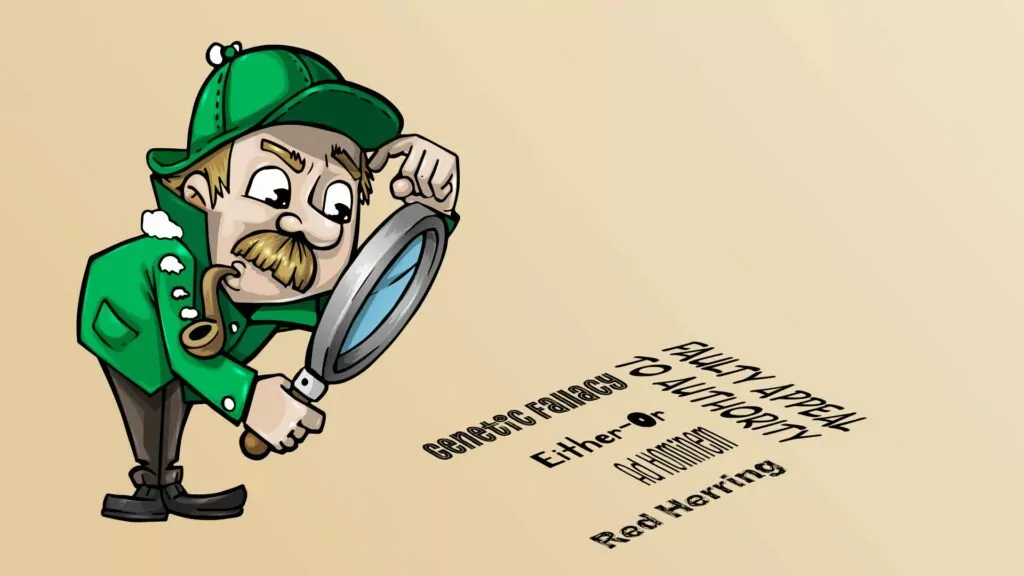
“I have no other but a woman’s reason; I think him so, because I think him so. That’s Shakespeare poking fun at the irrationality of a female character in his comedy The Two Gentlemen of Verona. It’s the lack of logic that makes this a bit funny. But that sort of illogic is found just as often among men. How many times have you heard a man pontificate and yet really say no more than “I feel that is what the Bible teaches. I don’t really know why, but that’s what I believe.” In other words, “I think it’s so, because I think it’s so.” Now when it concerns the Bible, that sort of illogic isn’t even a bit funny! Fun with fallacies Illogical thinking and logical fallacies came with sin. The two illustrations above are both examples of a fallacy called Circular Reasoning. A classic Peanuts cartoon that you might remember had the following dialogue: First Panel Lucy: “You don’t believe me, do you? Well it’s a scientific fact that girls are smarter than boys.” Linus wisely say nothing Second Panel Lucy: “And do you know who discovered it?” Again Linus maintains his detachment and says nothing. Third Panel Lucy: “Woman scientists!” Linus loses the argument and his composure. In this circular argument Lucy asserts girls are smarter than boys because scientists have proven it. We know these scientists are right because they are girls, and girls are smarter! Obviously the comic strip is humorous because of the logical fallacy. So we don’t have to be one hundred per cent logical all the time – we can have some fun with illogic. Nor must we always draw the same conclusion from the same scenario. I married a beautiful woman. Now, forty years later, she has a few grey hairs and maybe even a wrinkle or two. To me she is more beautiful than ever. You may think that’s illogical, but that’s because you don’t see her the way I do. I have a son who is convinced Coca Cola has more flavor than Pepsi, but in a blind taste test he always picks Pepsi as the best. That has never changed his conviction, because, as he puts it, “the Coke sample must have been stale.” I shake my head at his pig-headedness – but his delusion is not of material significance. Nevertheless, logical fallacies came with sin, and it is important to recognize them when they are used to mislead or misrepresent. Ad Hominem In the book The Fallacy Detective readers are taught to recognize various techniques used commonly to mislead or misdirect an argument. One of these has a fancy Latin name, Ad Hominem, which means literally “to the person.” In practice it is a personal attack, questioning the motives or the reputation of the opponent, instead of disproving his position. Already in the Garden of Eden we see this technique used successfully. God told Adam and Eve that if they ate from the tree of the knowledge of good and evil they would surely die. Satan denied this, and claimed that God had a hidden motive to lie to Adam and Eve – Satan attacked God’s character: “You will not surely die. For God knows that when you eat of it your eyes will be opened and you will be like God knowing good evil.” An absolute lie, but in Eve’s eyes God’s credibility has been undermined and she falls for Satan’s whole scenario. In politics we see this technique used so often that the term “smear campaign” has become part of our vocabulary Red Herring Another frequently used tactic is the Red Herring, an irrelevant point brought in to divert the attention from the real problem or matter at hand. A red herring is a dead fish, an over-ripe dead fish, which a trainer uses to test tracking dogs. The dog is to follow the moose trail, or whatever you’re tracking, and not be diverted by the scent of the red herring that has been dragged across the primary trail. Now reflect on the behavior of Moses when the angel of the LORD appeared to him in flames of fire from within a bush. God has for him an assignment that Moses does not want. Does he say so? Oh no! “Who am I that I should go to Pharaoh…?” “What if they do not believe me or listen to me…?” “I have never been eloquent… I am slow of speech.” Finally, after God has armed him with an assortment of signs and miracles to overcome all his so-called objections, Moses reveals the real problem – he just does not want to go: “O LORD, please send someone else to do it.” That’s what it was all about! The objections were just red herrings! As kids we have all use this tactic in its most elementary form. Mom asks “How come your boots have water in them again?” The reply invariably is something like “Oh mom, you ought to see Johnny’s. His boots were filled right to the top.” Genetic Fallacy The Genetic Fallacy is another personal attack fallacy. Yet it does not attack the person, but attacks the argument for where it came from: it condemns the argument because of where it began, how it began, or who began it. For example, a couple of years ago I read an excellent article on biblical headship. It was good solid scriptural material. Yet it was criticized by a few because it had been written by a bachelor. On one occasion Moses too received that sort of criticism. Two Hebrew men were fighting and Moses asked the one in the wrong “Why are you hitting your fellow Hebrew?” The man avoided the question by criticizing the source: “Who made you ruler and judge over us? Are you thinking of killing me as you killed the Egyptian?” A few years ago I listened to author Scott Klusendorf speak eloquently against abortion. Said one woman in the audience: “What do you know about this? You are not a woman.” She found it necessary to attack the person who brought the message because she was unable to undermine the message itself. Faulty Appeal to Authority One fallacy that is of particular importance to us as Christians is the Faulty Appeal to Authority. In our debates and discussions we, as Christians, properly appeal to the authority of the Word of God. Similarly, we use quotes from The Heidelberg Catechism, The Canons of Dort or The Apostles’ Creed, again quite properly because they have an authority derived from their faithfulness to the Scriptures. Likewise, we quote Synod decisions as authoritative because, as stated in Article 31 of the Church Order, “whatever may be agreed upon by a majority vote shall be considered binding (i.e. authoritative), unless it be proved to be in conflict with the Word of God.” All of these are examples of a proper appeal to authority. A faulty appeal to authority, for example, is demonstrated by the Pharisees when they appealed to the traditions of men as authoritative. In Mark 7 we read of one such tradition: goods that could have been used to support needy parents could be withheld from them by pledging the goods to the temple service. Such a pledge did not have to specify a date of fulfillment. Thus the unfaithful son continued to profit from the property withheld from his parents. It was all quite legal according to the tradition of the elders as taught by the Pharisees. Christ warned them that their teachings were a faulty appeal to these traditions as authoritative, because these traditions were in conflict with God’s Word. He said to them “…Moses said, ‘Honor your father and your mother,’ …but you say that if a man says to his father or mother: ‘whatever help you might have received from me is a gift devoted to God’, then you no longer let him do anything for his father or mother. Thus you nullify the word of God by your tradition that you have handed down…” In everyday discussions we have all run into the same difficulty. “We’ve always done it that way” is sometimes the final determination, no matter what the pros or cons of the considerations. More frequently a faulty appeal to authority is an appeal to someone who has no special expertise in the area being discussed. Simply put, if you want to quote someone on the best way to treat an enlarged prostate, quote an urologist, not a young auto young mechanic who has neither studied nor experienced the problem. Yet that sort of thing happens all the time. Movie stars tell us about the benefits of particular toothpaste, hockey players hype the nutrition value of a popular cereal, or bishops are interviewed about military strategy or economic plans. The Either-Or Fallacy In this short essay we only have room to tackle one more bit of illogical thinking – the Either-Or fallacy (in their book, The Fallacy Detective, the authors tackle about two dozen different fallacies). When someone asserts that we must choose between two things, when in fact we have more than two alternatives, he is using this fallacy. You’ve heard or used it, I’m sure: “If I do the chores I won’t be able to finish my homework and the teacher will fail me.” One of the options, failing, is so absurd or unthinkable that we are being manipulated to choose the other option. This fallacy is obvious to any experienced mother. She realizes that there is another possibility: Don’t procrastinate, and you’ll be able to do both. Conclusion So what’s the point of all this? Every day we are faced with questionable logic in our secular newspapers and even in our Christian publications. Often we accept their conclusions intuitively, because our own reasoning skills are very poor. Learning to recognize the most common logical fallacies will enable us to listen and to read more critically and analytically. Forewarned is forearmed! This was originally published in the July/August 2004 issue under the title “Forewarned is forearmed: how to recognize the most common logical fallacies.”...

Red heart icon with + sign.
Book Reviews

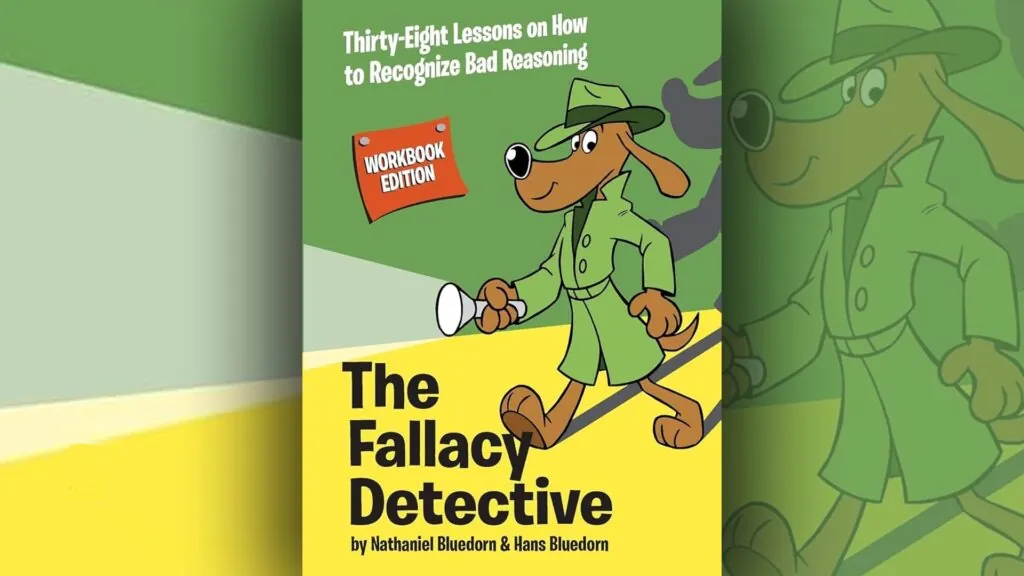
The Fallacy Detective

Thirty-Six Lessons on How to Recognize Bad Reasoning ***** Two young fellows, brothers Nathaniel and Hans Bluedorn wrote this book as a course in logic for the Christian home-schooling adherents. Why? Let them tell you: “We see a need for Christians to strive for a higher standard of reasoning. We believe God wants his people to become aware of their lack of discernment, and logic is an important part of the science of discernment. For instance, many Christians adopt beliefs and practice without properly evaluating the arguments which are used to support them. We need to rediscover the way of the Bereans, who searched the Scriptures daily to see if the apostles’ teachings were true (Acts 17:10-11). “As we grow older, we become more aware of how poor many people’s reasoning is. But we also need to realize how poor our own reasoning is. This is a humbling thought, and with it we embark on a journey towards higher standards of reasoning. We will never be as logical as the Lord Jesus Christ was, but we must work at it. “Besides just learning logic, we also see a need for a truly Christian logic. We want to take logic back from the unbelievers. Our challenge is to define good reasoning in a truly biblical way. Logic was not invented by a pagan philosopher named Aristotle. Logic is the science of thinking the way God thinks (more correctly, the way God wants us to think) – the way Jesus taught us to think…” This book is… This book is for all Christians… It is important that we learn our reasoning skills from a genuinely Christian worldview. This book focuses on practical logic… It teaches you to recognize the everyday fallacies you are confronted with in your work, in the newspaper, in advertisements, in listening to politicians, and also in our discussions with brothers and sisters in Christ. This book is self teaching... It is written in an easy-to-read style that reminds me a bit of the best of the …for Dummies books, but I can assure you, you’ll learn a lot and enjoy it while doing so. Two thumbs way up Supposedly this book was written for children and parents to use together, and there is no doubt that it could be an effective teaching tool that way. But it is much more than that. The first few lessons are easy enough and might lull you into thinking the book is just for children, but as you progress, you’ll enjoy the challenges of recognizing and refuting many more difficult fallacies. So the book is truly for all ages. Most of the lessons deal with a single fallacy, give an example or two, and end with varied exercises that sharpen your thinking processes so that you can solve them as they become progressively more difficult. The fallacies covered include many that are readily recognized by most of us, such as loaded questions, red herrings, weak analogies, and generalizations. But many are new to almost all of us. How many times haven’t you listened to a speech or read a newspaper article and thought to yourself, “there’s something wrong with that scenario, but I just can’t put my finger on it.” Learning to recognize a fallacy is also the beginning of being able to respond to it. In short, I heartily recommend this book on the Christian view of logic. It is suitable for anyone from teens to senior citizens; all that it requires is a desire to learn practical logic skills. It would also be a valuable addition to the curriculum of our Christian schools. “The Fallacy Detective” is available on christianbook.com...

Red heart icon with + sign.
News

Saturday Selections – April 19, 2025

Embrace reality - brought to you by the letter f This is both fantastic – encouraging a farm hand to embrace reality over his feelings – and falls short because Granny points to a changeable dictionary as the final arbitrator of reality, rather than to the author of reality Himself, our God, and His unchanging Word. So God's people need to point to our sure Foundation. Does the 2nd Commandment apply to the King of Kings? Does the 2nd Commandment apply to film portrayals of Christ? This is a pertinent question at a time when there are three bio-films about Christ scheduled for theaters, including the animated The King of Kings for kids, and also the popular streaming series The Chosen, now in its fourth season. Roman Catholics, Mormons, and many an evangelical don't believe the 2nd Commandment applies. But as this article highlights, some Reformers such as Herman Bavinck, Joel Beeke, and John Calvin thought this commandment forbids any representation of any member of the Trinity. Why? Part of it may be practical – how could we ever visually depict the immaterial God the Father, or the Holy Spirit? But Jesus was a man, so isn't that different? Well, another practical consideration is that in extending what was written down into a visual medium, additions will not only have to be made, but made up (because we don't know what they were wearing or looked like, etc.). And as happened with The Chosen, once producers and writers are making additions, they seem to feel free to change what was written down too. Albert Mohler on IVF Mohler notes that the New York Times is asking questions that the world really can't answer. Christians need to ask these same questions, and we do have answers. So, "what do we owe the embryo?" Mohler knows "Christians must now face the question of IVF and embryo ethics head on." Creationist lessons from Australia’s rabbit plague From 24 rabbits 166 years ago, Australia now has a rabbit population of approximately 2oo million! This article is about how creationists... "...are often asked: how could we get so many people in such a short time since the Ark landed (about 4,500 years)? Similarly, how could we have so many land vertebrates today if most came from a pair on the Ark (seven pairs for ‘clean’ animals)? The answer is exponential growth." Australia's News South Wales has passed its own "anti-conversion therapy" law A law that makes it illegal to help someone convert from homosexuality to heterosexuality is now in effect in NSW Australia. The wrongs it is supposed to right are forced conversions, but as Anglican Archbishop Kanishka Raffel has noted, "the initial consultation paper provided no direct evidence of conversion practices in New South Wales." So why this law? Well, if we lived in a rational world then laws would only be proposed when needed – again, as the Archbishop put it, "Good laws must target extraordinary harm not ordinary faith." But the law is here anyway... because the world hates God (John 15:18-19, 1 John 3:13, 2 Tim. 3:12). "...now it’s time for churches to call this out for the massive intrusion it is on liberty of conscience, and its naked attempt to force self-censorship on faith communities at the risk of prosecution. And now is the time for faith-based schools to remind their students and their key stakeholders – government and well-heeled parents – that the gospel is actually all about conversion. Always about conversion." What's not fair about free trade? The key point here would be "we shouldn't make things harder to obtain simply on the grounds that they originate somewhere else." This gentleman has an evolutionary slant – he thinks the reason people instinctively object to free trade is a remnant of our evolutionary programming – but what he attributes to evolution can be better explained by our sinful nature. We are envious and seek our own advantage even if it hurts others, so no wonder then that we'll, for example, push for tariffs that help our industry even if those tariffs make things more expensive for everyone else. ...

Red heart icon with + sign.
News

Saturday Selections – April 5, 2025

Click on the titles to go to the linked articles. Broken Window Fallacy explains what government gets wrong Politicians can always point to the results of their spending. But what we don't see is what would have happened with that same money if they hadn't taken it from businesses and families and individuals in the first place. The jobs we would have created are unseen, because those jobs didn't happen – the government didn't let them happen. So any time a government brags about creating jobs, it's akin to a company bragging about its revenue while refusing to account for its costs (Prov. 18:17). Beast Games: family fun or mammon worship? A bit of a late warning, but if you haven't already checked it out, here's why you shouldn't bother. How murderous are you when even the UN says, "Whoah now, that's enough"? Canada has murdered its millions – nearly 100,000 unborn babies a year for decades now – and that's nothing compared to what the United Nations (UN) is responsible for due to their own promotion of abortion worldwide. But when it comes to euthanasia, even the UN is shocked at what Canada has been up to, in looking to expand it to the mentally ill too. Trump goes 0 for 3 on trade knowledge The Fraser Institute with one way Trump's tariff rhetoric contradicts itself, and a couple ways that his tariffs will hurt not just Canada, but the US too. The government is handing out more money to the media ...but why aren't we hearing about it? Maybe it's because we know that typically he who pays the piper calls the tune – this is media being bought and paid for. That's why The Hub is donating the $22,000 they've received so far to charity. (And no, Reformed Perspective wasn't sent any of this cash.) Defending the unborn as Christians (10 min) What does it look like to defend the unborn as an unabashed, God-glorifying Christian? It means starting with God, and then stacking the science, the logic, the biological reality, all atop that firm foundation of our Lord. Jeff Durbin shows us how it is done. ...