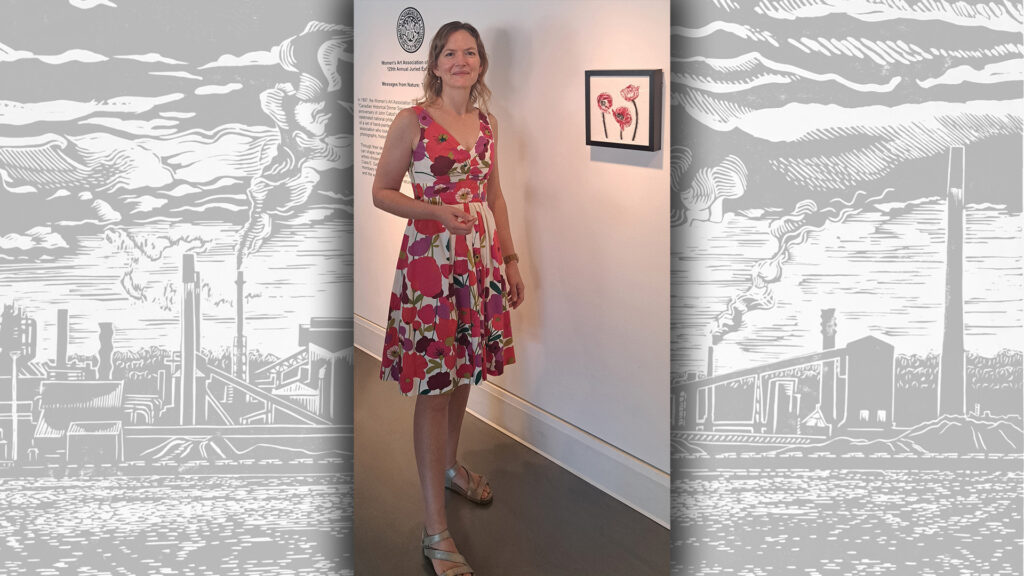
I’ve always thought printmaking was a fascinating form of art – first carving your design into wood or lino, and then pressing that inked design onto paper. It involves thinking about an image in a unique way.
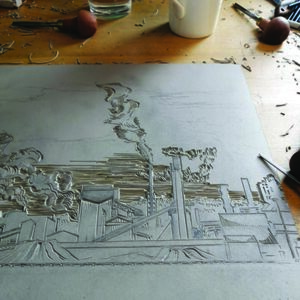
This is what a carved linoblock looks like before ink is applied.
So when I heard about a Reformed printmaker, I was eager to interview Stephanie Sikma for this column. What follows has been edited for length and clarity.
HARMA-MAE SMIT: Lino cuts are a unique form of art. What are the challenges and joys of using this type of technique to create art?
STEPHANIE SIKMA: One of the challenges of being a printmaker is explaining the process to people who are curious but unfamiliar. It’s a multistep process that is very analog. I draw on piece of linoleum (smooth and gray, not like the flooring), carve out all the areas I want to be white, ink up the carved block of linoleum with a roller, and then press a piece of paper onto the block so that the ink transfers onto the paper and I get an image.
The absolute best part is carving a block. When I draw my image out on the linoblock it tends to be a little sketchy and not very detailed. This is partly because I’m impatient to start carving, and also that I like to let the physicality of the carving process guide the mark-making that happens, rather than follow a very prescribed outline. Seeing a block printed for the first time is always a thrill, but after that comes the slog, which is the trial and error that’s necessary to get multiple good prints. It’s a very tricky process. A fellow printmaker once put it this way, “Printmaking is fun because it takes a perfectly simple process like drawing and makes it as complicated and error prone as possible.”
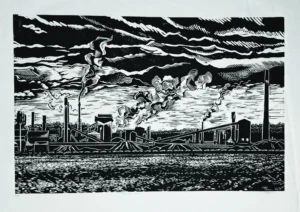
Above and Below
Linocut
12 x 18 inches
The industrial waterfront in Hamilton – a “terrible beauty.”
When I’m carving a block, time vanishes and there’s a wonderful feeling of effortless focus and attention that clears my mind. The scientific suggestion that roughly 25% of your brain’s motor cortex is dedicated solely to the hands makes perfect sense to me. We’re not meant to be using our amazingly designed hands to simply hold a phone and slide along a screen, doomscrolling. There are so many different ways to exercise creativity and make things with our hands but, in our current environment, resisting the role of passive consumer of entertainment requires deep intentionality.
HMS: I love that one of your subjects is urban architecture. How did this theme come about?
SS: Growing up in Hamilton, Ontario, I’ve always been captivated by the sight of the industrial waterfront. I remember as a young child looking out the window as we drove home over the Skyway bridge from visiting my grandparents in Burlington. I would make sure to stay awake long enough to catch sight of the steel mills before falling asleep in the car.
To this day, I find the steel factories possess a fascinating beauty, or to quote W.B. Yeats, a “terrible beauty.” I’m definitely drawn to the contrast between the industrial and the organic. You have these large and elaborate industrial structures that speak loudly of human ingenuity and environmental impact, but the presence of nature (and by extension, God) in the wide-open sky and water of Lake Ontario looms larger.
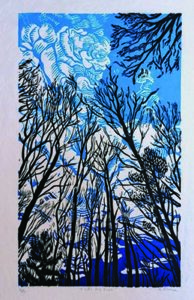
I Lift My Eyes
Linocut
10 x 6 inches
This is a 2 block print. The blue block of the clouds was printed first and then the trees were printed on top of the clouds.
HMS: How does being a Christian inform your work?
SS: My faith informs my artistic practice as it does all areas of my life. I don’t think the moniker of “Christian art” or “Christian artist” is especially helpful; rather it’s perhaps better to think in terms of art made by Christians.
The distinction may seem trifling so allow me to explain. I believe the Lord made me with artistic gifts that I can cultivate, grow, and use with discernment. When I develop my gifts and make art, I do so in the knowledge that I’m fulfilling God’s purpose for me and honoring Him through the stewardship of what He’s given me. Whether or not someone looks at my work and takes from it an explicitly Christian message does not change the fact that my art is an expression of my Christianity. Indeed, art that is heavily didactic can run the risk of missing the artistic qualities that would carry the artist’s message further. An indication of the framework of my faith often comes through in the titles I give my pieces.
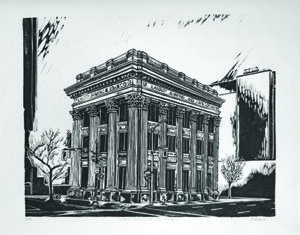
Landed Banking and Loan Company
Linocut
10 x 12.5 inches
This old bank is right across from a bus stop where, as a university student, the artist used to wait for the bus to get home from McMaster. She spent a fair amount of time admiring its neo-classical design. When creating this linocut, she challenged herself to use a two-point perspective.
HMS: What does a typical day look like for you?
SS: During the school year, a typical day sees me headed to work at Guido de Bres Christian High School in Hamilton where I teach two art classes every school day morning. I enjoy teaching, and being part-time gives me the space to keep up my own artistic practice as well as get done the things necessary as a married mother of three school-aged children. Often a piece will take me longer than I would like because of the other demands on my time, however, I’m very grateful to be in a position where I can make and sell art. Creating art without the pressure of it being a sole source of income provides creative freedom and, frankly, keeps it very enjoyable. Teaching is also a calling and teaching visual art has helped me grow as an artist. The most rewarding thing with teaching art is helping young people develop their abilities, creativity, and understanding of art.
Contemporary society tends to decide the worthwhileness of any undertaking by how much money it can get you. Art gets undervalued because it’s not seen as a viable way to make a living, and it’s true that while lucrative positions within the art industry exist, they’re highly competitive and many folks will not make an above average income working in the creative fields. But if we believe we are made in God’s image and God is a creator, then following through on our creative energy and abilities has the inherent value of allowing us to live more fully in the image of God. Similarly, looking at and appreciating art isn’t a superfluous activity. To engage with art is to gratefully receive a gift and unwrap it to see what’s inside, instead of ignoring the gift and the one who gave it to you.
*****
You can see more of Stephanie Sikma’s work by visiting her website, on Instagram, or on Facebook. She also shares her work at shows and exhibitions, including, most recently, at the McMaster Innovation Park.