










Transparent heart icon with white outline and + sign.

Life's busy, read it when you're ready!

Create a free account to save articles for later, keep track of past articles you’ve read, and receive exclusive access to all RP resources.

White magnifying glass.

Search thousands of RP articles

Helping you think, speak, and act in Christ.

Open envelope icon with @ symbol

Get Articles Delivered!

Helping you think, speak, and act in Christ. delivered direct to your Inbox!

A A
By:

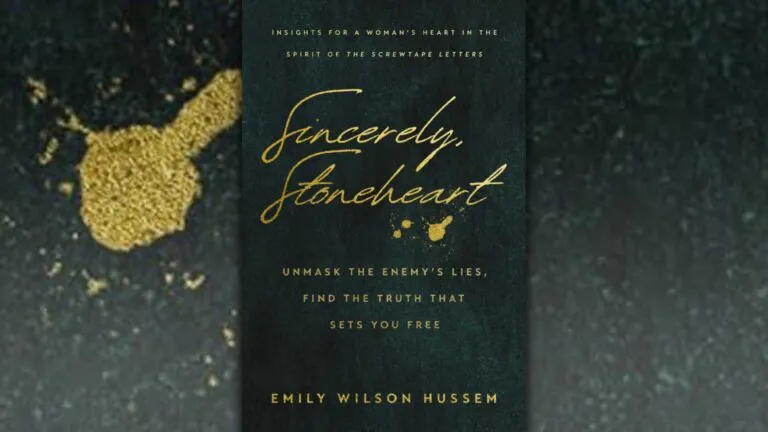
Sincerely, Stoneheart

by Emily Wilson Hussem
2025 / 240 pages

I can’t find my car keys!

Can you relate to this panicked searching? If you don’t find your keys, you’ll be late for your appointment. Your kids are screaming at the door and you feel your self-control slipping as you flip pockets inside out and tear cushions off the couch.

All the while, your keys are in your back pocket.

In her book, Sincerely, Stoneheart, Emily Wilson Hussem relates this missing key experience to how many Christian women live: frantically searching for their identity, forgetting that God calls them his beloved.

Hussem writes in the same flavour as CS Lewis’ Screwtape Letters – letters written fictitiously from a senior demon, named Stoneheart, to his apprentice Belphegora (a demon of sloth, distraction and false promises of wealth). The letters are about how best to lure a female subject living in today’s world away from the Enemy. Reading from this angle takes some mental alertness. For believers, “the Enemy” is their Heavenly Father. This and other positive vocabulary need to be flipped, as the believing reader digests the temptations communicated by the demon. However, this mental exercise helps one examine one’s heart. These letters illuminate where you may be giving the Devil a foothold.

As the book’s subtitle reads, Sincerely, Stoneheart helps readers “unmask the enemy’s lies,” and, “find the truth that sets you free.” Hussem covers over 40 topics including: appearances, possessions, accomplishments and titles. One I found convicting was her noting that a woman scrolling through social media on her phone was in a remarkably similar posture to a child of God praying. How many times have I turned to my phone to answer a question or fill a heart longing, instead of sincerely praying to my Creator with folded hands?

The topics covered best relate to an educated Christian wife and mother of young children but would apply in part to Christian women at large. The author’s heart is for women to embrace God’s unique gift of femininity and to have hearts at rest in their identity of being God’s beloved. By abiding in this relationship with God, through prayer and scripture reading, women can find healing for their past hurts, live abundantly in the present, and entrust their future to Him.

This book is easy to read in small chunks and even out of order, making it approachable to moms familiar with interruptions. A study guide is also available. It could be used for personal reflection or a group study. It would also be helpful to husbands, fathers, pastors and elders who desire to understand the spiritual warfare many young woman face. Use this book to help you pray Ezekiel 36:26:

“And I will give you a new heart, and a new spirit I will put within you.
And I will remove the heart of stone from your flesh and give you a heart of flesh.”


Enjoyed this article?

Get the best of RP delivered to your inbox every Saturday for free.


Red heart icon with + sign.
Adult fiction, Book Reviews, Teen fiction

Lord Foulgrin’s and Screwtape’s letters: why you should read this devilish correspondence

The Screwtape Letters by C. S. Lewis 1942 / 200 pages Rating: Borrow/BUY/Give Lord Foulgrin's Letters by Randy Alcorn 2001 / 208 pages Rating: BORROW/Buy/Give Normally, we don’t appreciate people going through our personal correspondence. However, from the 1600s on, people have been fascinated by other people’s letters, whether real or fictional. In Screwtape Letters, C. S. Lewis used the device of the correspondence between two devils to make his own points about the kind of temptations faced by human beings, temptations that may well have been orchestrated by hell itself. (See the description of the tongue in James 3!) More recently, Randy Alcorn, who admits his debt to Lewis, has created his own more involved version of the same story, titled Lord Foulgrin’s Letters. Should we delve into this darkness? If you are considering reading either of these books, you may have two questions ringing alarm bells in your head. One is essentially negative: Does anyone have any business looking that deeply into the nature of evil, especially demonic evil? The other is skeptical, but basically positive: What can a look at the topsy-turvy perspective of the evil one tell us about the way life should be? So, first, is it dangerous to look at evil too closely? The apostle Paul certainly implies that we should not focus on evil, but on good, when he commands us to think about things that are “noble, ...right, ...pure, ...lovely, ...admirable, ...anything... excellent or praiseworthy” (Phili. 4:8, NIV). Paul also tells the Ephesians that “it is shameful even to mention what the disobedient do in secret” (Eph/ 5:12). So one might ask why C. S. Lewis and Randy Alcorn didn't choose to write about angels instead of focusing on demons. Lewis answered that question, explaining that he felt that it was impossible for him to write authentically about angels, since he, as a sinful man, could not well portray the absolute submission of angels to God’s will. However (sadly), we all know far too well what devilish thoughts and desires must be like, since by nature we are also in rebellion against God. Alcorn, on the other hand, does include a letter from one of God’s angels in his book, but you’ll have to read the book to find out whether or not this "works." Do not be naive...  Lewis’s words do give us an idea of why looking at devils might be useful for a Christian. To realize that temptation often has a demonic source may help us take our own sin and misery more seriously, something the Heidelberg Catechism points out is all-important knowledge (Lord’s Day 2). And while it may be shameful to self-righteously focus on others’ sins (see Matt. 7:1-5), we must be aware of our own sinful weaknesses, lest we fall prey to them. Lewis and Alcorn’s books echo the great truth of Eph. 6:12, that we are in the midst of a “struggle... against the spiritual forces of evil in the heavenly realms.” The Screwtape Letters and Lord Foulgrin’s Letters may even be seen as obeying the command of Philippians 4:8 when we realize that Lewis’s and Alcorn’s devils cannot help speaking about whatever is noble, right, pure, lovely, admirable, excellent and praiseworthy. Of course, they speak in enmity rather than awe, but as long as we accept whatever they reject, we can learn much from their malicious advice. Alcorn takes it one step further Alcorn’s book is particularly interesting, because it carries Lewis’s premise just a little further. Whereas Lewis sticks to letters written by a senior devil to his protege during World War II, Alcorn alternates letters with chapters of narrative about the family targeted by Foulgrin, and sets the story in our own time, with references to e-mail and teenage despair. Even more importantly, while Lewis’s account takes us up to the moment of conversion of a non-Christian, Alcorn deals with the demons’ reaction to the conversion of the central human character, especially their attempt to make him an ineffective Christian. What this means is that Alcorn deals with two issues that Reformed Christians also struggle with now: how to react to the world, and how to respond to God in our spiritual life. For instance, at the same time as Foulgrin extols the danger of pornography on the web, of broken families, of consumerism and materialism, he also rages against the “sludgebags” whom God gives physical bodies. Through Foulgrin’s words and the narrative chapters, we see both the temptations of worldly pleasures and the true beauty of the pleasures God gives us in this physical life: the taste of a fine meal, the touch of a loving husband in a foot massage for his pregnant wife, the sight of a sunset, and the smell of freshly baked chocolate chip cookies. Alcorn thus attacks both the attitude of Christians who mistrust enjoyment in life and the foolishness of those who think that we can experience the world on the world’s terms, and not be influenced by that world. Foulgrin gleefully mocks the stupidity of Christians who know that viewing someone else’s nudity and sexual intimacy is wrong, but do not flinch from seeing the same in a movie. He is, of course, immensely pleased also by parents who keep poisonous household products on the top shelf to protect their children, but who pay no attention to the toxic ideas their children ingest through the Internet and the music they listen to. Alcorn also uses Foulgrin’s warnings to his student Squaltaint to show what the demons shudder at in the Christian life. Foulgrin advises Squaltaint to keep his human charge Jordan Fletcher away from “the forbidden Book” (the Bible) and “the forbidden squadron” (the communion of saints in the local congregation). He warns Squaltaint not to let Fletcher draw close to God in prayer, not to let Fletcher read good Christian fiction, not to let Fletcher think of his life (his time, his thoughts and emotions, his money) as belonging to God rather than himself. Cautions and conclusion Are there still problems with reading about life from a demonic perspective? Any concerns with this way of writing about the spiritual and moral life of a Christian may be allayed by the fact that both Lewis and Alcorn show their demonic title characters losing in the ultimate sense. The only other problem that Reformed Christians might have with both these books is that they seem to imply that conversion is a matter of man’s free will – the error of Arminianism. Whether this Arminian tendency is simply the devils’ mistaken understanding is not clear, but Lewis at least seemed to be Arminian in his other writing (even while demonstrating that his own conversion was a result of God’s persistence rather than his search!). Despite this quibble, I would recommend both these books to any Christian who is open to considering just how effective and consistent his or her own Christian walk is, and in what areas he or she needs to plead for God’s Spirit to work “against the spiritual forces of evil in the heavenly realms.” Below is a 8 minute adaptation/preview of Lewis's "The Screwtape letters." ...