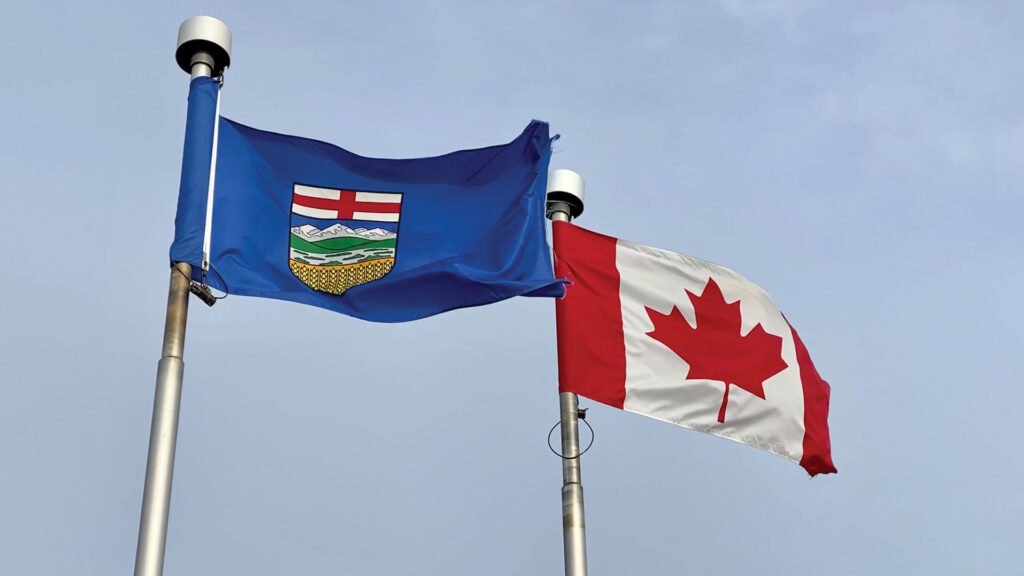
“Canada is like an old cow. The West feeds it. Ontario and Quebec milk it. And you can well imagine what it’s doing in the Maritimes.”
~ attributed to Tommy Douglas, premier of Saskatchewan from 1944-1961
I am a true-blue Albertan, born and raised in this province, and I truly haven’t found a better place to live. However, with a referendum looming in October I’ve been presented with the choice of whether my allegiance is to Alberta or to my country Canada. In October, Albertans will vote on the question:
“Should Alberta remain a province of Canada, or should the Government of Alberta commence the legal process required under the Canadian Constitution to hold a binding provincial referendum on whether or not Alberta should separate from Canada?”
Maybe your back goes up immediately – with words like disloyal, unpatriotic, and betrayal going through your mind. Or maybe you feel disillusioned with Canada and understand why a province would want to separate.
If I’m perfectly honest, I never felt like Alberta independence was a real thing. It’s been an idea at the back of Alberta political dialogue for my whole life, but mostly proposed in a joking way – “Wouldn’t we be better off if we were our own country?” But now the sentiment is real enough to send enough signatures on a petition to get the question put to a referendum.
Despite my skepticism of independence, I have always been sympathetic to western alienation. But my instinct was still to vote “stay” – that there was something good about loyalty, that grievance wasn’t enough of a reason to leave, that respect for my country meant not tearing it apart. But my instinct was not enough. So, when faced with writing this article, I knew what I had to do – I had to go beyond my own feelings and impressions. I needed to go out and talk to other Albertans, to figure out what exactly was going on, and to hear in their own words why they supported or did not support independence. But more importantly than that, I needed to compare their thoughts and opinions to the Word of God. What should Christians think of all this separatism talk?
Background
Let’s first start with the “why” behind the independence movement. I have sympathy for western alienation, and in my view it started with the eastern provinces viewing the development of the West as a resource for them to profit from. And while that makes sense from the perspective of Central Canada, the West never felt fully included in Canada.
Oil complicated this picture. It turned Alberta from a “have not” province based on farming to a “have” province based on oil, and gave it some power in terms of financial wealth. However, the federal government saw this as further resources to profit from, and implemented a series of taxes and programs to spread the financial wealth around the rest of Canada.
For example, here is how one prominent supporter of Albertan independence, Tim Stephens, put it in a speech on April 10:
“Alberta, having about 12% of the population of Canada, contributes nearly 20% to the federal tax revenue. And when this takes place, we have very little influence over the political future of our country. For instance, many of the elections are decided by Ontario and Quebec. And before people here even cast their vote, who our next government is going to be has already been decided.”
There is a feeling in Alberta that many provinces in Canada are happy to take our money as long as we don’t have any opinions on either how the country is run or what the federal government wants to do in our own province. Separatists will argue that through all these years, Albertans have tried through various political means to reform this system, to give Alberta a louder voice in a country they fund. Their conclusion is that the lack of success makes separation our only option.
So this is why I’m sympathetic to some of the arguments of the separatists. However, this raises several questions. Is “grievance” enough of a reason to base a new country on? Or even just the simple fact of being treated unfairly? God calls us to respect and obey our leaders, which means we have some responsibility in the place where we’re at. When do we judge we’ve made “enough” effort and our responsibility has come to an end? Lastly, there’s the question of the harm it would cause to our brothers and sisters in the rest of Canada. Even the mention of separation causes some economic instability. Is this justified?
I’m sympathetic and yet I feel a deep loyalty to Canada, and the home it provided to my Dutch ancestors fleeing the aftermath of WWII, to my husband when he immigrated, and now provides to our family.
“Personally, I argue that Alberta independence is compatible with biblical Christianity,” says Michael Wagner, another well-known supporter of independence, “but desiring Canada to stay together can also legitimately be a Christian perspective. So I don’t think the Bible requires Alberta Christians to support independence.”
Each Christian needs to think about why they are voting one way or the other.
Love for country, love for neighbor
While the motivations for separation are understandable, so is the backlash against the idea. For those who love Canada, it stirs up strong emotions. It’s like a sibling threatening to leave the family or to go “no contact.” This is true not only in the rest of the country, but in Alberta itself. While much of Alberta feels alienated from the political apparatus out East, many still feel deep loyalty and patriotism for Canada itself. Some have even become Canadian citizens specifically because they love Canada, and don’t want to be part of a different country. This is why this issue has become so divisive.
I began to reach out to various friends to hear how they’ve been thinking this issue through. “We have also been given political responsibility as those who vote,” one says to me.
“In a small way, we are those who bear the sword when we vote, when we choose what we believe is right for our nation. It is not evil to make what one believes to be the right choice in that vote. What is evil is insurrection, rebellion, and violence. But a referendum (democratic vote) is none of those things. Nor is a free discussion about why we think a political decision is right or wrong. Christians should concur with the legitimate result of the election, but they are free to think and vote as they see fit.”
It is true that mechanisms for provinces to leave have been worked out by the courts, and Alberta is not the first province to explore the option of leaving (see Quebec and Nova Scotia). It’s not immoral to explore an existing legal pathway to independence. But the motivations and reasons behind doing so may be.
Take the issue of grievances. “It’s one thing to forgive a grievance when it’s in the past,” the same friend tells me. “It’s another to remain complicit when that injustice is still ongoing. We can love (an act, not a feeling) our nation without believing that the nation has our best interests at heart.”
However, another friend argues, “As a father, I do not want to raise my boys to think that if you feel like you are treated unfairly, the answer is to threaten grievous harm to get what you want. That’s extortion and sinful.” He goes on to add, “A sovereign God has overseen this election, Carney is doing some good things in which I can rejoice, and I can pray for God’s hand in those areas that concern me and trust in Him.”
Next, I decide to reach out to my sister and get her opinion. She texts back to me: “One of the things that comes up the most often in the Bible is ‘take care of the widows and orphans and the poor’ – will separating improve people’s lives? Right now equalization payments benefit poorer provinces – isn’t that a good thing from a Christian perspective?”
I quickly text back, “One argument would be that the Bible teaches us to voluntarily help the poor, not that other people (the government) should make us help the poor.”
She replies, “I would say that it’s more that we should have an attitude of helping the poor – including through the government.”
That resonated with me, because it put into words something I had been struggling to articulate. If I want to keep Alberta’s money because I resent helping others like me in the rest of Canada, maybe my motivation is wrong. I might not agree with exactly how the government takes the money, but I should maintain my care for others even while I might advocate for better use of the money we send.
Lastly, I decide to listen to a speech available on YouTube on a Christian perspective on Albertan independence. In it, Clint Humfrey, senior pastor of Calvary Grace Church in Calgary, urges Christians to support the cause:
“That is what we need today here in Alberta. We need to expect great things from God and attempt great things for God… We ought to seek the relief of our neighbors groaning. We ought to seek the relief of our own groaning in our churches, but we also ought to seek the relief of our children’s future and the provision for them… If you have no hope, you will not be able to have the drive to see what could be done. And it starts with having hope in Jesus Christ for eternal life. And that then gives you the ability to have hope to try things… to try things all for the glory of God.”
For a brief moment, his excitement fired me up. But his vision was not my vision, though I certainly care about doing great things for God. The energy and effort required to build a new nation is not where I feel God calling me to work today, even as I try to care for my neighbors around me in my quiet, ordinary life.
Love for God
I feel somewhat lost in all the arguments for and against. My husband is one of the people whose opinions I value most in this world. So, on a recent trip out of town I took the opportunity of discussing it with him.
“Why don’t you support independence?” I ask.
“Because it’s about money,” he says. “What are we supposed to do when we’re afraid? Rely on God and keep our eyes fixed on Jesus. Yes, things are hard for people and gas prices are high. But – ” he gestures at the fields as we drive by, “wouldn’t you say Alberta is rich?”
“Ye-es,” I answer, thinking of the not-so-rich country my husband grew up in.
“So Alberta is prosperous, let’s trust God will continue to prosper us.”
“Okay, so what about this,” I say. “The argument is that the federal government does a lot of unchristian things with our money, and if we kept more of it we could use it for more Christian things.”
“Really?” he says. “Do you really think Alberta is more Christian? Alberta isn’t more Christian.”
“Why do you say that?”
“We have all the same issues as the rest of Canada.”
“But maybe statistically the number of Christians is slightly higher in Alberta?”
“Think about it,” he says. “Say the Prime Minister gives us what we want – more say, and lets us keep our money. We’d be happy, right? We say it’s all these unchristian laws, but that makes me think it’s about the money.”
I nod along because in my discussions I had come across many supporters of having more sovereignty but staying in Canada (and using this referendum as leverage to get it), or arguments that threatening separation had worked for Quebec so we should do it too. I think there are ardent separatists for whom nothing but independence would satisfy, and I hope Christians who vote to leave are not primarily motivated by the idea of leverage – but this group is smaller than the number of people who might vote “leave.”
“So, biblically,” I say, “what would you say the Christian thing is to do?”
“What does the Bible say? ‘Give to Caesar what is Caesar’s.’ That goes deeper than money – it goes to everything: respect, support, everything unless the government comes against our faith.”
I nod again, thinking of something similar John Calvin said that I’d read a while back:
“But Peter requires something more of us when he says, ‘Honor the king’ (1 Pet. 2: 17); and Solomon, when he says, ‘My son, fear thou the Lord and the king’ (Prov. 24: 21). For, under the term honor, the former includes a sincere and candid esteem, and the latter, by joining the king with God, shows that he is invested with a kind of sacred veneration and dignity…”
My husband looks over at me.
“And you know what? The government is coming against our faith. Why not fight that more? We’re willing to stand up for our money, to fight taxes, etc. We’ll fight when the government takes our money and gives it to someone else, but otherwise we stick to ourselves because we don’t want to rock the boat.”
He pauses. “There’s a reason God gave us this government, and put these people in power over us. Maybe it’s to teach us how much we need to call on Him.”
I think about all the energy that had gone into this separatism debate, and whether it was distracting us from other things.
He reaches over and grabs my hand. “Look at Psalms 35-40. I’ve been reading these in the morning lately. It’s all about the poor being oppressed. But who rescues them? God. Who fixes injustice? God. We need to cry out to Him. He’s the one who has our lives in His hands.”
Later, I look up Psalms 35-41. In Psalm 37, I read:
Trust in the Lord and do good;
dwell in the land and enjoy safe pasture.
… Be still before the Lord
and wait patiently for him;
do not fret when people succeed in their ways,
when they carry out their wicked schemes.
Refrain from anger and turn from wrath;
do not fret – it leads only to evil.
For those who are evil will be destroyed,
but those who hope in the Lord will inherit the land.
We can spend a lot of time fretting in our lives, over what we perceive as unfair, over evildoers “getting away” with something, over what might happen in our futures. But we don’t need to despair when God is on our side.
***
I want to be fair, so I reach out to Michael Wagner by email. He replies:
“The federal government in recent years has imposed policies on Alberta that undermine the well-being of many Albertans and their families. Looking for an alternative that provides a better future for Alberta has nothing to do with greed, ungodly grievances, or threats. Independence is an option that would make it possible for Albertans to choose political leaders who will adopt policies that will benefit Alberta rather than harm Alberta.”
He also says, “It’s about justice, not greed.”
I think about the issues at hand for many evenings as I rock my baby to sleep, staring at her beautiful face and wondering about the kind of future I want for my family. For me, my journey over the past couple years has been learning to fully trust God with everything in my life. To let go of control and really believe God will take care of my life. What kind of country do I want my daughter to live in?
I think about the “what if” vision that the supporters of independence have put forward, a vision of a more Christian nation we could build if we could just start over from scratch. I think about how much easier it is to tear things down rather than to build them. I think about Canada stagnating, losing its place in the world, and what that would look like for my daughter’s future. I think about the nation that I love and what I would want to tell her about it.
Ultimately I don’t have control over the future. It is enough if my daughter is able to trust herself into the hands of God.
And in the end, I will stay Albertan AND Canadian. I don’t see a compelling vision of Alberta as a sovereign nation yet, and I haven’t given up on Canada. I haven’t done everything in my power to change the country I love for the better yet. And so I will continue to trust myself and my family into God’s hands.