Transparent heart icon with white outline and + sign.

Life's busy, read it when you're ready!

Create a free account to save articles for later, keep track of past articles you’ve read, and receive exclusive access to all RP resources.

White magnifying glass.

Search thousands of RP articles

Helping you think, speak, and act in Christ.

Open envelope icon with @ symbol

Get Articles Delivered!

Helping you think, speak, and act in Christ. delivered direct to your Inbox!

A A
By:

More homeowners facing insolvency

Canadians have long been struggling with personal debt, but Scott Terrio, a manager at Hoyes, Michalos Licensed Insolvency Trustees told The Hub that the bigger story is who is now feeling the pinch.

“The big thing we’re seeing now that we weren’t seeing a year ago or a year and a half ago is homeowners calling us…. We didn’t speak to homeowners for a decade in this industry because of the housing boom. When houses are going up 20 percent a year, and you’re swimming in equity, you don’t need an insolvency trustee.”

The latest data from Statistics Canada reveals this marked increase in household debt, up 4.4 percent from a year prior. Canadian households now have the highest debt burden among G7 countries and the second-highest of 38 Organisation for Economic Co-operation and Development countries (only Switzerland is higher).

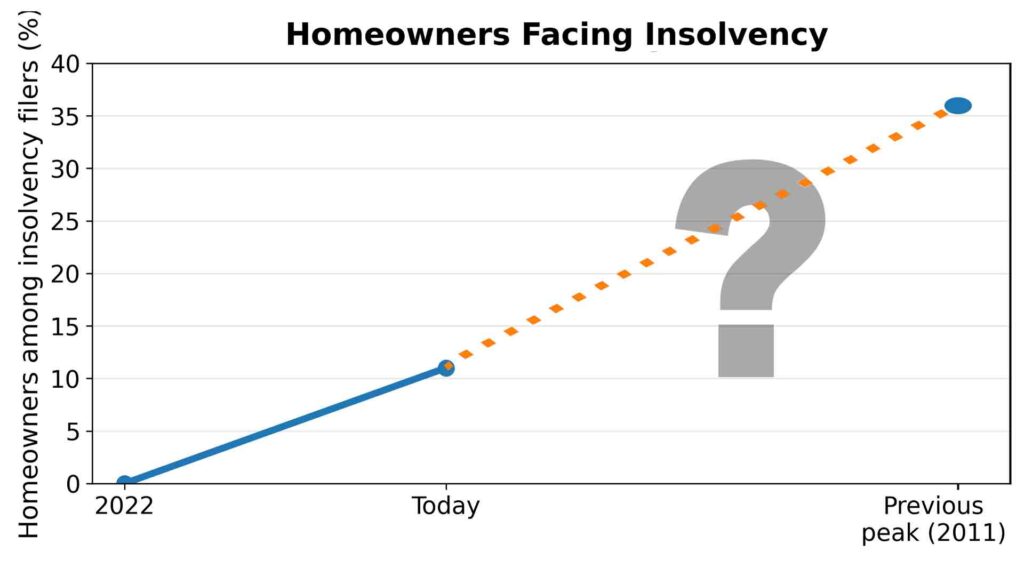
Hoyes Michalos has a homeowner bankruptcy index, which shows that insolvent homeowners have an average of $112,000 in unsecured debt in addition to their mortgage. The index shows that the percent of bankruptcy filers who own homes has increased from 0 percent in 2022 to 11 percent today and “we are going to be back at 36 [when it peaked in 2011] at some point. Guaranteed,” Terrio added.

The fact that 1 out of every 7 dollars is now being spent on debt payments verifies the wisdom of the Teacher in Proverbs 22:7 when he said that “the borrower is slave to the lender.” A home can be very attractive, especially when home values increase year after year. But the Great Teacher also reminds us in Luke 14:28 to first count the cost: “For which of you, desiring to build a tower, does not first sit down and count the cost, whether he has enough to complete it?” Sadly, many don’t, and are now paying for it.

Enjoyed this article?

Get the best of RP delivered to your inbox every Saturday for free.

A A
By:

Federal spending increases under Carney

To make a diamond dazzle, a skilled jeweller will slip a black cloth under it.

The federal government pulled a similar tactic with its Spring Economic Update, setting the current state of the economy in the context of the ongoing instability in the world. In spite of trade disruptions with the USA, conflict in the Middle East, and fragile global supply chains, the government was keen to showcase that Canada’s economy grew by 1.7 percent in 2025 and is expected to have the second-fastest growth in the G7, next to the USA.

But a careful examination shows a less dazzling picture.

The deficit for 2025 is a staggering $66.9 billion, with no end to deficits in sight. The federal government is already $1.3 trillion in debt, and is on track to pile up $309 billion more in total debt by the end of this decade. Our cost to service all our debt is projected to increase from $54 billion this year, to $81 billion by 2030-31. History backs up the instruction from Proverbs 22:7 that “the borrower is a slave to the lender.” Just like family debt handcuffs a household from pursuing opportunities they might otherwise want to pursue, the same is true for countries. We severely limit what we can do when we have to pay billions, not even to pay off the debt, but just to pay the yearly interest.  But the federal government emphasizes that we are doing better than most G7 countries.

After 9 consecutive budget deficits under Justin Trudeau, Prime Minister Carney promised:

“what we will do is to focus on reducing spending, if I’m elected…. The essence of this is to spend less, and invest more.”

When we hear our government wants to spend less to allow for more investment, we might conclude that means spending cuts will be accompanied by tax cuts to leave the private sector with more of their money. They can then invest those newly available funds in their businesses.

But that’s not what Carney means by “spending less.” His plan is to have the government spend much more overall, but label some of it “investing.” Neat trick, but let’s not fall for it. His new Economic Update reveals a plan to increase spending by $83.2 billion more than the Trudeau government planned from 2025/26 through 2029/30.